 2015, Vol. 37

 [PDF全文]


2. 中国石油天然气集团公司油藏描述重点实验室, 甘肃, 兰州 730020
2. Key Laboratory of Reservoir Description, PetroChina, Lanzhou, Gansu 730020, China
厚油层内部分布着许多厚度、连续性和分布形式各不相同的隔夹层,它们严重影响着厚油层的注水开发效果[1-3]。昆北油田A区下干柴沟组下段(E31)以辫状河三角洲前缘水下分流河道为主,具有横向上河道侧向摆动频繁,纵向下切、复合叠置的特点,因而分布面积广,砂体厚度大[4—5],主力油层段砂体厚度一般在16~33 m,属于中一特厚层储层。储层岩性主要为岩屑长石细砂岩及粉砂岩,储集空间以粒间孔为主,孔隙度变化范围5.0%~19.4%,平均为16.1%;渗透率变化范围0.01~230.00 mD,平均为27.50 mD,储层非均质性强。
该油田E31油藏为边水底水控制的构造型油藏,含油单砂体垂向叠置,但不同单砂体之间被不渗透的隔夹层所分隔,油层内部非均值强,油水分异现象明显,注采矛盾尤为突出。该油藏自2008年投入开发以来,目前综合含水率高达41.58%,采出程度为25.2%,属中含水期油藏。油田开发实践表明,隔夹层对砂体的分割和油气的遮挡起到一定作用[6-8],是影响注水开发效果的主要因素,因而亟需进行隔夹层的识别及其分布规律的研究,为注采工艺设计提供地质依据。
1 隔夹层识别及成因分析隔夹层是指在一定的压差范围内对储层流体运动起遮挡或阻隔作用的非渗透性岩层。一般将小层内的阻渗岩层称为夹层,小层之间的则称为隔层。夹层厚度薄,分布不稳定,对流体运动的控制不明显,但在局部范围能影响油水的分布。一般厚度只有几十厘米至几米,横向延伸较小,稳定性差[9]。隔层纵向厚度变化较大,一般大于2 m,也有几十厘米厚的隔层。但隔层横向分布较稳定,分布面积一般大于流动单元面积的二分之一。
沉积作用、成岩演化形成不同隔夹层成因。不同隔夹层的分布特征、阻渗性能有较大差异,因此,隔夹层对油水分布的控制作用也不同。按照不同岩性特征及阻渗能力来讲,隔夹层主要分为3类:泥质隔夹层、物性隔夹层和钙质隔夹层[6-11]。
不同隔夹层具有不同的测井响应特征。通过对该区3口取芯井进行详细观察和描述,发现区内主要发育泥质隔夹层及物性隔夹层,其中以泥质隔夹层最为发育。泥质隔夹层岩性主要为泥岩及粉砂质泥岩,测井响应特征主要表现为自然电位曲线明显回返、自然伽马值高和微电极差异幅度明显变差或无差异;井径曲线表现为扩径或稍有扩径,有时由于层薄只产生微小扩径(图 1)。
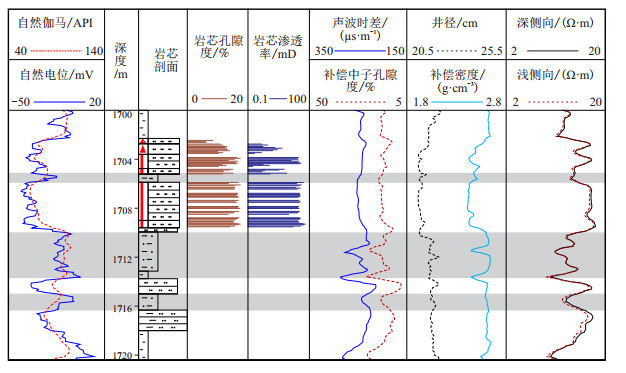 |
| 图1 Q10井隔夹层测井响应特征 Fig. 1 Logging response characteristics of muddy interlayer of Well Q10 |
物性隔夹层岩性主要为泥质粉砂岩及粉砂岩,现为高值,密度增大,值,成为物性隔挡层。其测井其物性较差,没有达到储层下限中子、声波曲线表响应特征为:自然电位曲线稍有回返,自然伽马中幅齿状,深浅侧向电阻率呈中低值,声波时差和密度孔隙度变小(声波低值,密度高值),井径曲线略有扩径或扩径不明显(图 1)。
研究区泥质隔夹层的成因有3种情况,1种是废弃河道被泥质充填形成侧向隔挡层;第2种是分流河道间泥质沉积形成侧向隔挡体;第3种是湖侵过程中细粒沉积物直接覆盖在砂体之上,并保存下来形成泥质隔夹层。通常第3种隔夹层厚度相对较大,平面分布广泛,可对比性大,钻遇率也高。物性隔夹层是由于辫状河沉积过程中水动力减弱、沉积物颗粒变细、泥质含量增加形成的,一般发育在单期河道顶部或单一坝体顶部,也可发育在水动力较弱的河道边部,如天然堤微相等[8, 12-14]。
2 隔夹层分布特征首先,依据取芯井隔夹层的测井响应特征对研究区所有井进行单井隔夹层的识别和划分;其次,进行横向对比,依据辫状河砂体内部隔夹层近似水平状的原则[9-10, 15-16],在辫状河砂体剖面顶面拉平的状态下,按照隔夹层在纵向上的分布位置,对其进行统一编号;最后,根据编号对其进行对比及空间组合。研究结果可以很直观地展示隔夹层的剖面、平面展布规律(图 2, 图 3)。
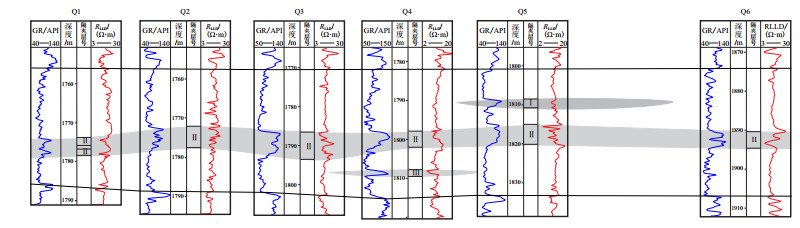 |
| 图2 Ⅰ-12小层隔夹层对比剖面 Fig. 2 Comparison profile of the interlayer in Ⅰ-12 layer |
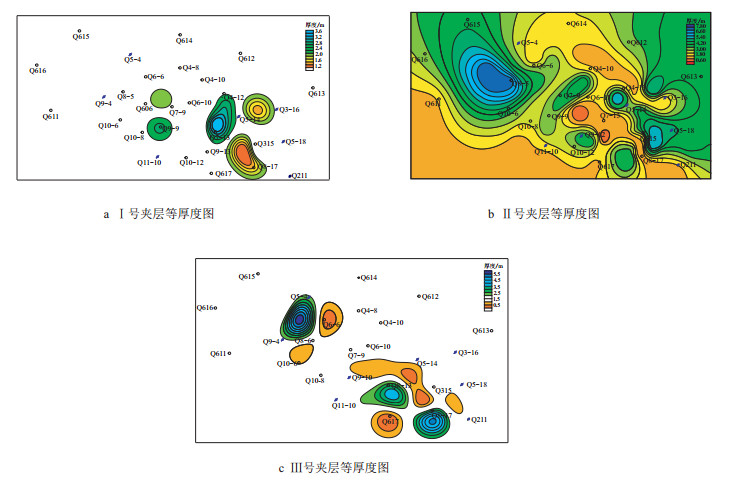 |
| 图3 Ⅰ-12小层隔夹层分布图 Fig. 3 Distribution of the interlayer in Ⅰ-12 layer |
根据隔夹层的剖面、平面展布特征将区内的隔夹层可分稳定型隔夹层、次稳定型隔夹层和不稳定型隔夹层为3类。从图 2、图 3可以看出,Ⅱ号隔夹层为稳定型隔夹层,其发育规模大,连续性好,平面展布广,发育频率及厚度也相对最大。沉积相研究成果认为,该隔夹层为湖侵形成的湖相泥岩。研究还发现,平面上该类型隔夹层厚度减小或不发育,那么在剖面与其上叠置的的河道砂体厚度就大,主要原因是晚期分流主河道水动力条件较强,由于河道的下切作用,将早期细粒沉积冲刷掉,从而导致其隔夹层变薄或缺失。该类隔夹层垂向阻挡效果好,对流体的流动起着水平或近水平的隔挡作用,有效地防止了单层之间流体的相互渗流。
Ⅲ号次稳定型隔夹层发育规模较小,连续性也较差,只在局部区小范围内连片分布(图 3),且发育频率及厚度也相对较小,厚度一般在1~5 m。分析认为该类型隔夹层为河道间或废弃河道成因。该类隔夹层可作为小范围注采井网开发层每的隔层。
Ⅰ号不稳定型隔夹层规模及稳定性最差,平面上零星分布,发育频率及厚度最小,厚度一般在1~3 m,系坝体顶部或河道间泥质细粒沉积物成因。
3 隔夹层随机建模预测随机模拟技术是复杂油气储层定量表征和预测的关键技术之一。随机建模是指以已知的信息为基础以随机函数为理论,应用随机模拟方法,产生可选的、等概率的储层模型方法。通过计算机技术人工合成多个可选的、等概率的和高精度的反映现有参数数据空间分布或该参数理论分布的储层模型[17]。为了尽量减少储层建模过程中的不确定性,应当采用确定性的地质信息对随机建模过程进行约束,即确定性建模与随机建模相结合[18-20]。
研究工区处于开发中期,虽然钻井在工区基本均匀分布,但井间距较大(约350 m),井网较稀,因此,本次研究在构造建模的基础上利用泥质含量参数(Ish)作为确定性约束条件对隔夹层进行定量化随机建模,以精细定量表征隔夹层的非均质性及其在空间的分布特征为条件,结合油田实际的生产动态资料,优选、修改、完善模拟结果并最终得到确定性的隔夹层地质模型(图 4),据此模型可对隔夹层的空间分布特征和连通关系做出了确定性的认知。
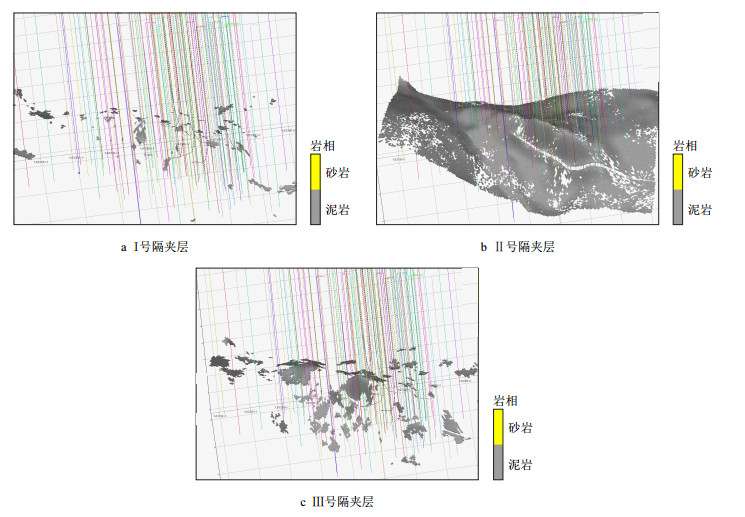 |
| 图4 隔夹层三维模型 Fig. 4 3D prediction modeling of the interlayer |
(1) 隔夹层的厚度变化及分布规模受水动力条件及沉积旋回的控制,依据井间对比识别结果及隔夹层剖面、平面分布特征及规模大小,将研究区隔夹层划分为稳定型、次稳定型和不稳定型3种类型。
(2) Ⅰ、Ⅲ号隔夹层分布比较分散,平面呈零星分布或局部连片分布,横向连续性差,可以控制单口井油气在纵向上的分布特征或小范围内油气在纵向及平面的分布特征,使油气的分布更复杂;Ⅱ号隔夹层在工区广泛、稳定发育,对工区油气的纵向沟通起到很好的封堵作用。
| [1] |
刘红. 厚油层内夹层分布模式及其对采收率的影响[J].
江汉石油学院学报, 2002, 24 (1) : 44 –45.
Liu Hong. Distribution patterns of interbeds within thick oil reservoir and their influence on recovery efficiency[J]. Journal of Jianghan Petroleum Institute, 2002, 24 (1) : 44 –45. |
| [2] |
陈程, 孙义梅. 厚油层内部夹层分布模式及对开发效果的影响[J].
大庆石油地质与开发, 2003, 22 (2) : 24 –27.
Chen Cheng, Sun Yimei. The distribution patterns of the interlayers within thick pays and their impact on recovery efficiency, Shuanghe Oilfield[J]. Petroleum Geology & Oilfield Development in Daqing, 2003, 22 (2) : 24 –27. |
| [3] |
刘斌, 何勇明, 段新国. 宝浪油田储层夹隔层特征及储层非均质性研究[J].
西南石油大学学报:自然科学版, 2010, 32 (6) : 25 –28.
Liu Bin, He Yongming, Duan Xinguo. Study on the characteristics of interlayers and reservoir heterogeneity of Baolang Oilfield[J]. Journal of Southwest Petroleum University:Science & Technology Edition, 2010, 32 (6) : 25 –28. |
| [4] |
严耀祖, 段天向. 厚油层中隔夹层识别及井间预测技术[J].
岩性油气藏, 2008, 20 (2) : 127 –131.
Yan Yaozu, Duan Tianxiang. Identification and inter-well prediction of interbeds in thick oil layer[J]. Lithologic Reservoirs, 2008, 20 (2) : 127 –131. |
| [5] |
邹志文, 斯春松, 杨梦云. 隔夹层成因、分布及其对油水分布的影响——以准噶尔盆地腹部莫索湾莫北地区为例[J].
岩性油气藏, 2010, 22 (3) : 66 –70.
Zou Zhiwen, Si Chunsong, Yang Mengyun. Origin and distribution of interbeds and the influence on oil-water layer:An example from Mosuowan area in the hinterland of Junggar Basin[J]. Lithologic Reservoirs, 2010, 22 (3) : 66 –70. |
| [6] |
杜秀娟, 刘月萍, 郭莉, 等. 莫西庄油田三工河组油气成藏主控因素分析[J].
西南石油大学学报:自然科学版, 2008, 30 (1) : 5 –7.
Du Xiujuan, Liu Yueping, Guo li, et al. Main control factors of hydrocarbon accumulation in Sangonghe reservoir Moxizhuang Oilfield[J]. Journal of Southwest Petroleum University:Science & Technology Edition, 2008, 30 (1) : 5 –7. |
| [7] |
刘建民, 徐守余. 河流相储层沉积模式及对剩余油分布的控制[J].
石油学报, 2003, 24 (1) : 58 –62.
Liu Jianmin, Xu Shouyu. Reservoir sedimentary model of fluvial facies and it's control to remaining oil distribution[J]. Acta Petrolei Sinica, 2003, 24 (1) : 58 –62. |
| [8] |
汪彦, 彭军, 陈果, 等. 七东区下侏罗统八道湾组储层特征及评价[J].
断块油气田, 2008, 15 (3) : 1 –3.
Wang Yan, Peng Jun, Chen Guo, et al. Reservoir characteristics and evaluation of Badaowan Formation of lower Jurassic in east Seventh Area[J]. Fault-Block Oil & Gas Field, 2008, 15 (3) : 1 –3. |
| [9] |
毛立华, 赵良金, 李中超, 等. 濮城油田沙河街组辫状河三角洲储层隔夹层研究[J].
断块油气田, 2008, 15 (6) : 21 –24.
Mao Lihua, Zhao Liangjin, Li Zhongchao, et al. Study on inerbeds of braided river delta reservoir Shahejie Formation of Pucheng Oilfield[J]. Fault-Block Oil & Gas Field, 2008, 15 (6) : 21 –24. |
| [10] | 徐守余. 油藏描述方法原理[M]. 北京: 石油工业出版社, 2005 . |
| [11] |
田亚铭, 施泽进, 王长城. 新都-洛带气田侏罗系遂宁组第二段致密砂岩储层特征[J].
成都理工大学学报:自然科学版, 2008, 35 (2) : 133 –138.
Tian Yaming, Shi Zejin, Wang Changcheng. Study on reservoir characteristics of Membber 2 of Jurassic Suining Formation in the Xindu-Luodai Gas Field, Sichuan, China[J]. Journal of Chengdu University of Technology:Science & Technology Edition, 2008, 35 (2) : 133 –138. |
| [12] |
张国一, 侯加根, 吴小斌. 厚油层内部隔夹层预测建模——以velasquez油田为例[J].
科技导报, 2010, 28 (23) : 56 –59.
Zhang Guoyi, Hou Jiagen, Wu Xiaobin. Modeling of inner interlayer prediction in thick oil layer——With Velasquez Oilfield as an example[J]. Science & Technology Review, 2010, 28 (23) : 56 –59. |
| [13] |
王健, 徐守余, 仲维苹. 河流相储层隔夹层成因及其分布特征[J].
地质科技情报, 2010, 29 (4) : 84 –88.
Wang Jian, Xu Shouyu, Zhong Weiping. Genesis and distribution of the interlayer in fluvial reservoir[J]. Geological Science and Technology Information, 2010, 29 (4) : 84 –88. |
| [14] |
张吉, 张烈辉, 胡书勇. 陆相碎屑岩储层隔夹层成因、特征及其识别[J].
大庆石油地质与开发, 2003, 22 (4) : 1 –3.
Zhang Ji, Zhang Liehui, Hu Shuyong. The genesis and characteristics and identification of interca-lations in reservoir of clastic rock[J]. Petroleum Geology & Oilfield Development in Daqing, 2003, 22 (4) : 1 –3. |
| [15] |
赵翰卿, 付志国, 吕晓光, 等. 大型河流-三角洲沉积储层精细描述方法[J].
石油学报, 2000, 21 (4) : 109 –113.
Zhao Hanqing, Fu Zhiguo, Lv Xiaoguang, et al. Merhods for detaled description large fluvial-delta depositional reservoir[J]. Acta Petrolei Sinica, 2000, 21 (4) : 109 –113. |
| [16] |
渠芳, 陈清华, 连承波, 等. 河流相储层细分对比方法探讨[J].
西安石油大学学报:自然科学版, 2008, 23 (1) : 17 –21.
Qu Fang, Chen Qinghua, Lian Chengbo. Discussion on the method for the subdivision and comparison of fluvial reservoir[J]. Journal of Xi'an Shiyou University:Natural Science Edition, 2008, 23 (1) : 17 –21. |
| [17] | 于兴河, 马兴祥, 穆龙新, 等. 辫状河储层地质模式及层次界面分析[M]. 北京: 石油工业出版社, 2004 . |
| [18] | 吴胜和. 储层表征与建模[M]. 北京: 石油工业出版社, 2010 . |
| [19] |
孙天建, 穆龙新, 赵国良. 砂质辫状河储集层隔夹层类型及其表征方法——以苏丹穆格莱特盆地Hegli油田为例[J].
石油勘探与开发, 2014, 41 (1) : 112 –120.
Sun Tianjian, Mu Longxin, Zhao Guoliang. Classification and characterization of barrier-intercalation in sandy braided river reservoirs:Taking Hegli Oilfield of Muglad Basin in Sudan as an example[J]. Petroleum Exploration and Development, 2014, 41 (1) : 112 –120. |
| [20] |
白振强. 辫状河砂体三维构型地质建模研究[J].
西南石油大学学报:自然科学版, 2010, 32 (6) : 21 –24.
Bai zhenqiang. Study on the 3D architecture geological modeling of braided fluvial sand-body[J]. Journal of Southwest Petroleum University:Science & Technology Edition, 2010, 32 (6) : 21 –24. |