 2015, Vol. 37

 [PDF全文]


2. 中国石油勘探开发研究院廊坊分院, 河北 廊坊 065007;
3. 中国石油新疆石油勘察设计研究院(有限公司), 新疆 乌鲁木齐 830000
2. Research Institute of Petroleum Exploration and Development-Langfang, Langfang, Hebei 065007, China;
3. Xinjiang Petroleum Servey and Design Institute(Company Limited), PetroChina, Urumqi, Xinjiang 830000, China
最近20年来,由于低渗透勘探取得较大发现,投入开发的特低渗透油田显著增多,并且实现了规模有效开发[1]。国内外现场实践及实验研究均表明,注水开发后仍然有大量剩余油滞留在储层中[2-4],注CO2是提高低渗透油藏采收率的一个重要手段[5],许多学者也对CO2混相驱、非混相驱渗流机理方面进行了研究[6],但是对已经注水开发的区块进行CO2驱方面的实验研究比较少。大庆外围油田储量比较丰富,但是渗透率较低、注水开发见效慢、吸水能力差等问题,注CO2驱油渗流阻力较少,可以建立有效的驱动体系[7-10]。本文针对大庆外围某低渗透油田,利用驱替实验及核磁共振技术,从微观孔隙角度出发,对注水开发后如何有效注气开发提高采收率进行研究,对现场先导试验起一定的经验借鉴作用。
1 实验内容 1.1 实验岩芯及原油本实验所取岩芯及原油来自大庆外围某特低渗透区块,岩芯的基本物性参数及最终采出程度见表 1。实验测得CO2最小混相压力为21 MPa,即在21 MPa下原油与CO2可达到混相,实验中CO2注气都是混相驱。实验所用原油按照黏度值的大小(3.6 mPa·s)混合煤油配制油样,得到原油的基本特征参数为:饱和压力为4.7 MPa,原油体积系数为1.108,原始气油比为22.8 m3/m3,原油密度0.787 g/m3,黏度值为3.6 mPa·s。
| 表1 岩芯基础物性资料 Table 1 Petrophysical parameters of core samples |
 |
驱替实验流程如图 1所示,实验过程如下:(1)在岩芯夹持器上装好岩芯,测试管线的密封性,然后对岩芯抽真空和饱和地层水,并进行核磁测量;(2)用Mn2+浓度为15 000 mg/L的MnCl2溶液驱替模拟水或者浸泡锰水3 d左右,做第二次核磁,将信号量降到原始信号量的1%以下;(3)建立束缚水饱和度。用配好的油驱岩芯中的水,直到不出水为止,稳定后,记录驱出水量,计算束缚水饱和度;(4)进行设计的实验,先水驱到不同含水饱和度下,再切换中间容器,注入一定PV数的CO2,实验记录好泵读数、入口压力、环压和驱出的油量;(5)实验结束后,用石油醚和酒精清洗岩芯,并用氮气吹送,最后干燥,然后重复(1)~(3)进行下一次实验。
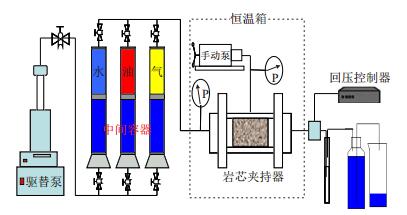 |
| 图1 驱替实验装置 Fig. 1 Flow chart of displacement experimental facility |
不同水驱程度转气驱的采出程度实验结果对比见图 2,可以发现,水驱程度越高后转气驱效果越不好,在10%~20%能维持较好的采收率。而且2.5 mD左右的岩芯由于渗透率较高,流通性较好,岩芯中可动流体比例较大,所以整体采出程度相比1.2 mD岩芯较好。
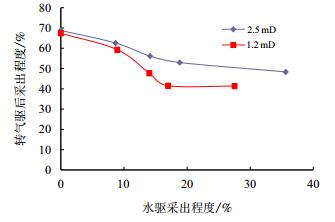 |
| 图2 不同水驱程度转气驱采出程度 Fig. 2 Recovery efficiency of gas injection at different degree of water flooding |
为了深入分析不同渗透率岩芯注水转注气效果差异的原因,测试其驱替前后核磁信号的变化,结合核磁共振T2谱图,可以得到剩余油在不同孔隙中的分布情况[11-12]。图 3是注水8%转注气的不同渗透率岩芯的一个对比,图 3a中6-10号岩样渗透率为2.5 mD,图 3b中7-1号岩样渗透率为1.2 mD。6-10号岩芯右峰面积大于7-1号岩芯,说明在大孔隙中的可动流体也越多,最终的采出程度也越高。同时,气驱过后6-10号岩芯的大孔隙中的原油部分被采出,小孔隙中的原油信号减少了9.28%,说明小孔隙中原油能被动用。同样,7-1号岩芯不仅大孔隙中原油被动用,而且小孔隙信号量减少了13.50%,说明7-1号岩芯中小孔隙中原油动用程度更高。可能由于CO2流体受压缩,波及体积更高,又通过改变孔隙表面的润湿性从而更容易进入孔隙盲端,进行中心轴向柱状流和流出盲端的柱面流,将小孔隙中的原油驱替出来,这也与秦积舜等[13]的结论相符。
 |
| 图3 注水8%转注气核磁谱图对比 Fig. 3 NMR spectrum comparison of water flooding of 8% and gas injection |
对比分析2.5 mD岩芯不同注入方式前后岩芯孔隙中剩余油的分布,从图 4中可以看出,注水驱动用的主要是岩芯中大孔隙的原油,而且动用程度较低hfill,中孔-低孔隙中基本未动用hfill。而6-9号岩芯注CO2驱中可以发现,中小孔隙中的原油也基本难以动用。但是由于CO2在高于混相压力下可以和原油形成混相,使得CO2和原油之间的界面张力不断降低,不断地萃取原油的轻质组分和少量溶解重质组分[14],从而形成油气混合相向前流动,从而整体驱油能力较强;但是过高的压力会导致溶解沥青质的胶质溶度减少[15-17],引起沥青质相互缔合沉淀下来,对较小的喉道进行堵塞。
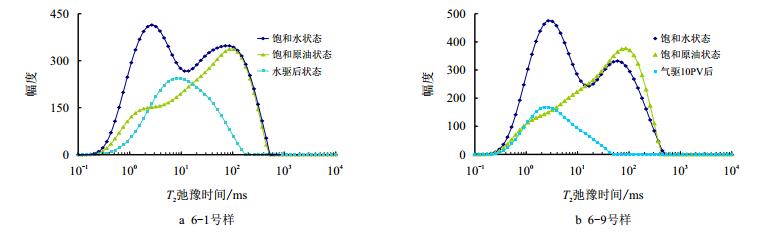 |
| 图4 注水驱和注CO2驱的核磁信号 Fig. 4 NMR spectrum of water flooding and CO2 injection |
(1) 利用低渗透不同渗透率岩芯进行驱替实验,通过注水、注气、注水转注气这3种方式进行对比,就总体采出程度来说,注气能达到67%为最高,而不同程度注水转注气其次,注水开发采收率40%为最低。
(2) 对比不同注入方式的剩余油信号,注水和注气动用的基本是大孔隙中的原油,对中小孔隙动用较少,而注水转注气由于CO2流体受压缩,波及体积较大,能对中小孔隙中的原油进行动用。
(3) 对不同注水程度转注气的研究中发现,越早转注气的开发效果越好,但是考虑经济因素和现场情况,在含水率10%~20%左右转注气可以有较好的经济效益。
| [1] |
胡文瑞. 中国低渗透油气的现状与未来[J].
中国工程科学, 2009, 11 (8) : 29 –37.
Hu Wenrui. The present and future of low permeability oil and gas in China[J]. Engineering Sciences, 2009, 11 (8) : 29 –37. |
| [2] | 姜楠. 深度开发高含水油田提高采收率问题的探讨[J]. 中国石油和化工标准与质量, 2012, 32 (3) : 298 . |
| [3] |
韩大匡. 准确预测剩余油相对富集区提高油田注水采收率研究[J].
石油学报, 2007, 28 (2) : 73 –78.
Han Dakuang. Precisely predicting abundant remaining oil and improving the secondary recovery of mature oilfields[J]. Acta Petrolei Sinica, 2007, 28 (2) : 73 –78. |
| [4] |
仵元兵, 胡丹丹, 常毓文, 等. CO2驱提高低渗透油藏采收率的应用现状[J].
新疆石油天然气, 2010, 6 (1) : 36 –39, 54.
Wu Yuanbing, Hu Dandan, Chang Yuwen, et al. Application status of CO2 flooding in low permeability reservoir to enhance oil recovery[J]. Xinjiang Oil & Gas, 2010, 6 (1) : 36 –39, 54. |
| [5] | 孙焕泉, 杨勇. 低渗透砂岩油藏开发技术[M]. 北京: 石油工业出版社, 2008 . |
| [6] |
杨正明, 张英芝, 郝明强, 等. 低渗透油田储层综合评价方法[J].
石油学报, 2006, 27 (2) : 64 –67.
Yang Zhengming, Zhang Yingzhi, Hao Mingqiang, et al. Comprehensive evaluation of reservoir in low permeability oilfields[J]. Acta Petrolei Sinica, 2006, 27 (2) : 64 –67. |
| [7] |
刘淑霞. 特低渗透油藏CO2驱室内实验研究[J].
西南石油大学学报:自然科学版, 2011, 33 (2) : 133 –136.
Liu Shuxia. Research on laboratory experiments of CO2 drive in ultra-low permeability reservoir[J]. Journal of Southwest Petroleum University:Science & Technology Edition, 2011, 33 (2) : 133 –136. |
| [8] |
李士伦, 周守信, 杜建芬, 等. 国内外注气提高石油采收率技术回顾与展望[J].
油气地质与采收率, 2002, 9 (2) : 1 –5.
Li Shilun, Zhou Shouxin, Du Jianfen, et al. Review and prospects of the development of EOR by gas injedtion at home and abroad[J]. Petroleum Geology and Recovery Efficiency, 2002, 9 (2) : 1 –5. |
| [9] |
曹学良, 郭平, 杨学峰, 等. 低渗透油藏注气提高采收率前景分析[J].
天然气工业, 2006, 26 (3) : 100 –102.
Cao Xueliang, Guo Ping, Yang Xuefeng, et al. An analysis of prospectof eor by gas injection in low-permeability oil reservoir[J]. Natural Gas Industry, 2006, 26 (3) : 100 –102. |
| [10] |
王丽, 卜祥福, 伍锐东. CO2混相驱提高原油采收率的研究现状及发展前景[J].
石油化工应用, 2010, 29 (2-3) : 4 –7.
Wang Li, Bu Xiangfu, Wu Ruidong. Research status and development prospects of CO2 miscible flooding enhanced oil recovery[J]. Petrochemical Industry Application, 2010, 29 (2-3) : 4 –7. |
| [11] |
王学武, 杨正明, 李海波, 等. 利用核磁共振研究特低渗透油藏微观剩余油分布[J].
应用基础与工程科学学报, 2013, 21 (4) : 702 –709.
Wang Xuewu, Yang Zhengming, Li Haibo, et al. Microscopic distribution of remaining oil of ultra-low permeability reservoir by using NMR technique[J]. Journal of Basic Science and Engineering, 2013, 21 (4) : 702 –709. |
| [12] |
李海波, 郭和坤, 刘强, 等. 致密油储层水驱油核磁共振实验研究[J].
中南大学学报:自然科学版, 2014, 45 (12) : 4370 –4376.
Li Haibo, Guo Hekun, Liu Qiang, et al. NMR experimental study of water displacing oil of tight oil reservoir[J]. Journal of Central South University:Science and Technology, 2014, 45 (12) : 4370 –4376. |
| [13] |
秦积舜, 张可, 陈兴隆. 高含水后CO2驱油机理的探讨[J].
石油学报, 2010, 31 (5) : 797 –800.
Qin Jishun, Zhang Ke, Chen Xinglong. Mechanism of the CO2 flooding as reservoirs containing high water[J]. Acta Petrolei Sinica, 2010, 31 (5) : 797 –800. |
| [14] |
张英芝, 杨正明, 唐立根, 等. 特低渗油藏注CO2驱油微观机制[J].
科技导报, 2012, 30 (35) : 29 –32.
Zhang Yingzhi, Yang Zhengming, Tang Ligen, et al. Microscopic mechanism of CO2 flooding in extra-low permeability reservoir[J]. Science & Technology Review, 2012, 30 (35) : 29 –32. |
| [15] |
刘伟, 李实, 王思然, 等. 草舍油田CO2驱中沥青质沉淀分析及防治措施[J].
西南石油大学学报:自然科学版, 2011, 32 (6) : 93 –97.
Liu Wei, Li Shi, Wang Siran, et al. The asphaltine precipitiation and controlling measures during the process of CO2 displacement in Caoshe Oilfield[J]. Journal of Southwest Petroleum University:Science & Technology Edition, 2011, 32 (6) : 93 –97. |
| [16] | Park S J, Escobedo J, Mansoori G A. Asphaltene and other heavy organic depositions[J]. Developments in Petroleum Science, 1994, 40 : 179 –205. DOI:10.1016/S0376-7361(09)70255-9 |
| [17] | Pan Huanquan, Firoozabadi A. Thermodynamic micellization model for asphaltene precipitation from reservoir crudes at high pressures and temperatures[C]. SPE 60842, 2000. |