 2015, Vol. 37

 [PDF全文]


目前,非常规油气的开发已经成为国内外油气资源开发的热点,致密油藏作为非常规油藏的重要组成部分在未来油气增产中起着越来越重要的作用[1-6]。多级压裂水平井作为致密油藏开发的重要手段在近年受到广泛的关注,取得了较多的成果。但是,致密油藏流体渗流不符合达西渗流[7-22],应用传统的商业软件进行油田方案设计在致密砂岩油藏开发中必定会造成较大误差,开发适用于致密油藏多级压裂水平井开发的新模型十分必要,因此,有必要结合室内实验和矿区实践建立多级压裂水平井的数值模拟技术,更好地指导致密砂岩的现场开发。
本文基于非线性渗流模型开发了多级压裂水平井三维三相数值模拟模型并对模型进行了验证,运用开发的数值模拟方法,对实际区块进行了历史拟合,并对相关参数进行了敏感性分析,为致密油数值模拟提供了理论支持。
1 非线性多级压裂水平井数值模拟模型致密油藏流体流动呈现非达西特征,根据低速非达西渗流在致密油藏中的渗流规律[23-24],把低速非达西渗流引入数值模拟模型,建立了直井低速非达西数值模拟模型。在前期研究基础上,将数值模拟扩展到多级压裂水平井,并生成多级压裂井三维三相的数值模拟模型,以满足目前致密油藏开发的需求。
1.1 模型假设(1)油藏中每种流体的流动都在等温下进行;(2)油藏的流体可以是油、气、水三相,也可以是其中任意两相,其中油和水的渗流符合低速非达西渗流,而气相符合达西渗流,在水力压裂裂缝中,各相的渗流符合达西渗流模式;(3)油藏中的烃类是以油相和气相组成的,气可以是自由气也可以是溶解气,而油相中存在油组分和气组分,水中存在部分溶解气;(4)不考虑气组分溶解和逸出所需要的时间,即气体在油相中的溶解和逸出是瞬时完成的;(5)油和气不相互溶解;(6)重力、毛管力等因素在模型中全部考虑。
1.2 数学模型 1.2.1 运动方程(1) 水力裂缝中渗流方程
假设在渗流过程中流体渗流符合达西公式,水力裂缝中的三相运动方程如下
| $ v_{\rm{o}} = - \dfrac{{KK_{{\rm{ro}}} }}{{\mu _{\rm{o}} }}\nabla p_{\rm{o}} $ | (1) |
| $ v_{\rm{w}} = - \dfrac{{KK_{{\rm{rw}}} }}{{\mu _{\rm{w}} }}\nabla p_{\rm{w}} $ | (2) |
| $ v_{\rm{g}} = - \dfrac{{KK_{{\rm{rg}}} }}{{\mu _{\rm{g}} }}\nabla p_{\rm{g}} $ | (3) |
式中:
(2)基质中渗流方程
假设在渗流过程中流体渗流符合姜瑞忠[23]公式,考虑低速非达西渗流低渗透油藏储层的三相运动方程如下
| $ v_{\rm{o}} = - \dfrac{{KK_{{\rm{ro}}} }}{{\mu _{\rm{o}} }}\bigg(1 - \dfrac{{\xi _{1{\rm{o}}} }}{{\nabla p_{\rm{o}} - \xi _{2{\rm{o}}} }}\bigg)\nabla p_{\rm{o}} $ | (4) |
| $ v_{\rm{w}} = - \dfrac{{KK_{{\rm{rw}}} }}{{\mu _{\rm{w}} }}\bigg(1 - \dfrac{{\xi _{1{\rm{w}}} }}{{\nabla p_{\rm{w}} - \xi _{2{\rm{w}}} }}\bigg)\nabla p_{\rm{w}} $ | (5) |
| $ v_{\rm{g}} = - \dfrac{{KK_{{\rm{rg}}} }}{{\mu _{\rm{g}} }}\nabla p_{\rm{g}} $ | (6) |
式中:
油组分方程
| $ - \nabla \cdot \left( {\rho _{\rm{o}} v_{\rm{o}} } \right) + q_{\rm{o}} = \dfrac{{\partial \left( {\phi \rho _{\rm{o}} S_{\rm{o}} } \right)}}{{\partial t}} $ | (7) |
水组分方程
| $ - \nabla \cdot \left( {\rho _{\rm{w}} v_{\rm{w}} } \right) + q_{\rm{w}} = \dfrac{{\partial \left( {\phi \rho _{\rm{w}} S_{\rm{w}} } \right)}}{{\partial t}} $ | (8) |
气组分方程
| $ - \nabla \cdot \left( {\rho _{{\rm{od}}} v_{\rm{o}} + \rho _{{\rm{wd}}} v_{\rm{w}} + \rho _{\rm{g}} v_{\rm{g}} } \right) + q_{\rm{g}} = \dfrac{\partial }{{\partial t}}\left[{\phi \left( {\rho _{{\rm{od}}} S_{\rm{o}} + \rho _{{\rm{wd}}} S_{\rm{w}} + \rho _{\rm{g}} S_{\rm{g}} } \right)} \right] $ | (9) |
式中:
将运动方程代入连续性方程,得到的流动方程和边界条件、初始条件共同组成了完整的数学模型,具体形式如下。
(1) 水力裂缝中渗流方程
油组分方程
| $ \nabla \Bigg[{\dfrac{{KK_{{\rm{ro}}} }}{{B_{\rm{o}} \mu _{\rm{o}} }}\nabla \left( {p_{\rm{o}}-\rho _{\rm{o}} {\rm{g}}D} \right){\rm{}}} \Bigg] + q_{{\rm{ov}}} = \dfrac{\partial }{{\partial t}}\left( {\dfrac{{\phi S_{\rm{o}} }}{{B_{\rm{o}} }}} \right) $ | (10) |
水组分方程
| $ \nabla \Bigg[{\dfrac{{KK_{{\rm{rw}}} }}{{B_{\rm{w}} \mu _{\rm{w}} }}\nabla \left( {p_{\rm{w}}-\rho _{\rm{w}} {\rm{g}}D} \right){\rm{}}} \Bigg] + q_{{\rm{wv}}} = \dfrac{\partial }{{\partial t}}\left( {\dfrac{{\phi S_{\rm{w}} }}{{B_{\rm{w}} }}} \right) $ | (11) |
气组分方程
| $ \nabla \left[{\dfrac{{R_{{\rm{so}}}\!KK_{{\rm{ro}}}}}{{B_{\rm{o}} \mu_{\rm{o}} }}\nabla\left({p_{\rm{o}}-\rho_{\rm{o}}{\rm{g}}D}\right)}\right]+\nabla \left[{\dfrac{{R_{{\rm{sw}}}KK_{{\rm{rw}}}}}{{B_{\rm{w}}\mu_{\rm{w}}}}\nabla\left({p_{\rm{w}}-\rho_{\rm{w}}{\rm{g}}D}\right)}\right]+\\ \nabla\left[{\dfrac{{KK_{{\rm{rg}}} }}{{B_{\rm{g}}\mu_{\rm{g}}}}\nabla\left({p_{\rm{g}}-\rho_{\rm{g}}{\rm{g}}D}\right)} \right]+q_{{\rm{gv}}} =\\ \hspace{10em}\dfrac{\partial}{{\partial t}}\left[{\phi\left({\dfrac{{S_{\rm{g}}}}{{B_{\rm{g}}}}+\dfrac{{R_{{\rm{so}}} S_{\rm{o}}}}{{B_{\rm{o}}}}+\dfrac{{R_{{\rm{sw}}}S_{\rm{w}}}}{{B_{\rm{w}}}}}\right)}\right] $ | (12) |
(2) 基质中渗流方程
油组分方程
| $ \nabla \bigg[{\dfrac{{KK_{{\rm{ro}}} }}{{B_{\rm{o}} \mu _{\rm{o}} }}\bigg(1-\dfrac{{\xi _{{\rm{1o}}} }}{{\nabla p_{\rm{o}}-\xi _{2{\rm{o}}} }}\bigg)\nabla \left( {p_{\rm{o}}-\rho _{\rm{o}} {\rm{g}}D} \right)} \bigg] +\\ \hspace{3em} q_{{\rm{ov}}} = \dfrac{\partial }{{\partial t}}\left( {\dfrac{{\phi S_{\rm{o}} }}{{B_{\rm{o}} }}} \right) $ | (13) |
水组分方程
| $ \nabla \bigg[{\dfrac{{KK_{{\rm{rw}}} }}{{B_{\rm{w}} \mu _{\rm{w}} }}\bigg(1-\dfrac{{\xi _{1{\rm{w}}} }}{{\nabla p_{\rm{w}}-\xi _{2{\rm{w}}} }}\bigg)\nabla \left( {p_{\rm{w}}-\rho _{\rm{w}} {\rm{g}}D} \right)} \bigg] + \\ \hspace{3em}q_{{\rm{wv}}} = \dfrac{\partial }{{\partial t}}\left( {\dfrac{{\phi S_{\rm{w}} }}{{B_{\rm{w}} }}} \right) $ | (14) |
| $ \nabla \left[{\dfrac{{R_{{\rm{so}}} KK_{{\rm{ro}}} }}{{B_{\rm{o}} \mu _{\rm{o}} }}\bigg(1-\dfrac{{\xi _{1{\rm{o}}} }}{{\nabla p_{\rm{o}}-\xi _{2{\rm{o}}} }}\bigg)\nabla \left( {p_{\rm{o}}-\rho _{\rm{o}} {\rm{g}}D} \right)} \right] + \\ \nabla \left[{\dfrac{{R_{{\rm{sw}}} KK_{{\rm{rw}}} }}{{B_{\rm{w}} \mu _{\rm{w}} }}\bigg(1-\dfrac{{\xi _{1{\rm{w}}} }}{{\nabla p_{\rm{w}}-\xi _{2{\rm{w}}} }}\bigg)\nabla \left( {p_{\rm{w}}-\rho _{\rm{w}} {\rm{g}}D} \right)} \right] +\\ \hspace{10em} \nabla \left[{\dfrac{{KK_{{\rm{rg}}} }}{{B_{\rm{g}} \mu _{\rm{g}} }}\nabla \left( {p_{\rm{g}}-\rho _{\rm{g}} {\rm{g}}D} \right)} \right] + q_{{\rm{gv}}} = \\ \dfrac{\partial }{{\partial t}}\left[{\phi \left( {\dfrac{{S_{\rm{g}} }}{{B_{\rm{g}} }} + \dfrac{{R_{{\rm{so}}} S_{\rm{o}} }}{{B_{\rm{o}} }} + \dfrac{{R_{{\rm{sw}}} S_{\rm{w}} }}{{B_{\rm{w}} }}} \right)} \right] $ | (15) |
式中:
g——重力加速度,g/s
饱和度方程
| $ S_{\rm{o}} + S_{\rm{w}} + S_{\rm{g}} = 1 $ | (16) |
毛管压力方程
| $ \left\{ \begin{array}{l} p_{{\rm{cow}}} = p_{\rm{o}} - p_{\rm{w}} \\ p_{{\rm{cog}}} = p_{\rm{g}} - p_{\rm{o}} \\ \end{array} \right. $ | (17) |
初始条件
| $ \left\{ \begin{array}{l} \left. {p_{\rm{w}} } \right|_{{\rm{i}} = 0} = p_{{\rm{wi}}} \left( {x, y, z} \right) \\ \left. {S_{\rm{w}} } \right|_{{\rm{i}} = 0} = S_{{\rm{wi}}} \left( {x, y, z} \right) \\ \left. {S_{\rm{o}} } \right|_{{\rm{i}} = 0} = S_{{\rm{oi}}} \left( {x, y, z} \right) \\ \end{array} \right. $ | (18) |
外边界条件
封闭边界
| $ \left\{ \begin{array}{l} \dfrac{{\partial \left( {p_{\rm{o}} - \rho _{\rm{o}} {\rm{g}}D} \right)}}{{\partial n}}\left| {_\varGamma } \right. = 0 \\ \dfrac{{\partial \left( {p_{\rm{w}} - \rho _{\rm{w}} {\rm{g}}D} \right)}}{{\partial n}}\left| {_\varGamma } \right. = 0 \\ \dfrac{{\partial \left( {p_{\rm{g}} - \rho _{\rm{g}} {\rm{g}}D} \right)}}{{\partial n}}\left| {_\varGamma } \right. = 0 \\ \end{array} \right. $ | (19) |
定压边界
| $ \left\{ \begin{array}{l} p_{\rm{o}} \left| {_\varGamma } \right. = {\rm{C}} \\ p_{\rm{w}} \left| {_\varGamma } \right. = {\rm{C}} \\ p_{\rm{g}} \left| {_\varGamma } \right. = {\rm{C}} \\ \end{array} \right. $ | (20) |
内边界条件
利用Peaceman公式[25],假设水平井沿
| $ q_{{\rm{wwell}}} = \rho _{\rm{w}} \dfrac{{KK_{{\rm{rw}}} }}{{\mu _{\rm{w}} }}\dfrac{{2\pi d_x }}{{\ln (r_{\rm{e}} /r_{\rm{w}} ) + s}}(p_{{\rm{wf}}} - p_{\rm{b}} ) $ | (21) |
| $ q_{{\rm{owell}}} = \rho _{\rm{o}} \dfrac{{KK_{{\rm{ro}}} }}{{\mu _{\rm{o}} }}\dfrac{{2\pi d_x }}{{\ln (r_{\rm{e}} /r_{\rm{w}} ) + s}}(p_{{\rm{of}}} - p_{\rm{b}} ) $ | (22) |
| $ q_{{\rm{gwell}}} = \rho _{\rm{g}} \dfrac{{KK_{{\rm{rg}}} }}{{\mu _{\rm{g}} }}\dfrac{{2\pi d_x }}{{\ln (r_{\rm{e}} /r_{\rm{w}} ) + s}}(p_{{\rm{gf}}} - p_{\rm{b}} ) $ | (23) |
| $ {r_e}\left\{ {\begin{array}{*{20}{l}} {0.208\Delta y}&{\Delta y = \Delta z, Ky = Kz}\\ {0.28\frac{{{{[{{({K_y}/{K_z})}^{1/2}}\Delta {z^2} + {{({K_z}/{K_y})}^{1/2}}\Delta {y^2}]}^{0.5}}}}{{{{({K_y}/{K_z})}^{1/4}} + {{({K_z}/{K_y})}^{1/4}}}}}&{其他} \end{array}} \right. $ | (24) |
式中:C——给定的常数;
对于多级压裂水平井,不同射孔位置的水,油,气之和等于井的总的水,油,气产量或注入量。
2 模型验证非线性渗流数值模拟模型是在常规黑油模型基础上开发的,当不考虑非线性渗流规律时,有必要对模型中是否保持了常规黑油模型的完备性进行验证。由非线性渗流模型可知,当
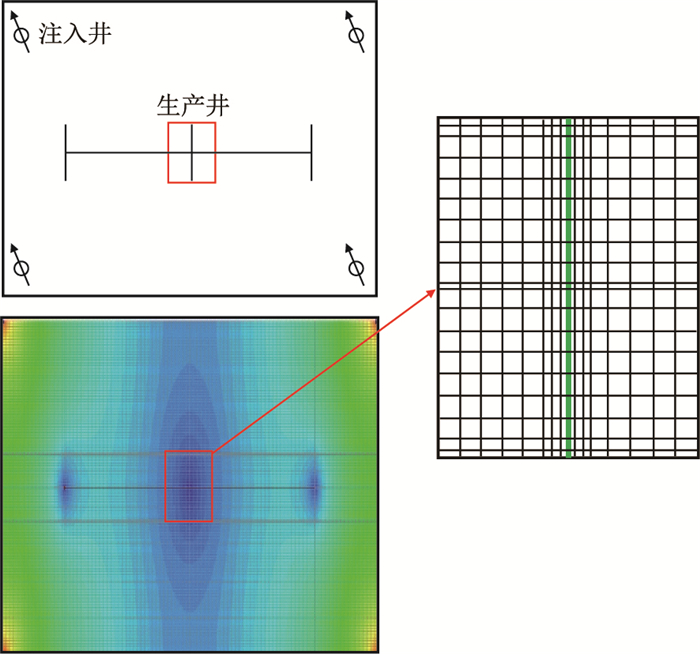 |
| 图1 数值模拟模型 Fig. 1 Numerical simulation model |
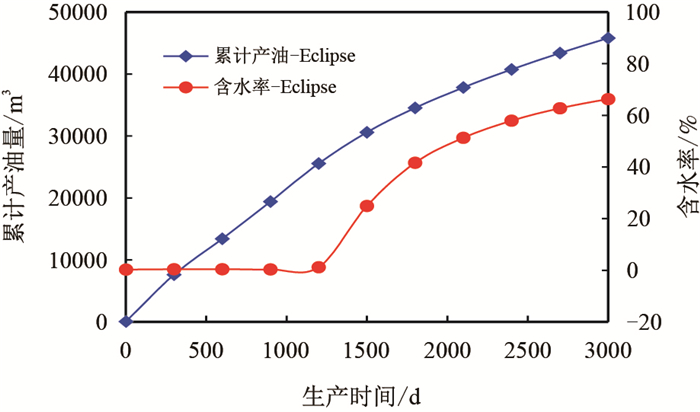 |
| 图2 新模拟器与Eclipse对比曲线 Fig. 2 Comparison curves of the new simulator with Eclipse |
| 表1 地质模型参数 Table 1 Parameters used in the simulations |
 |
选取X1井进行研究,该井钻遇砂岩厚度10 m,孔隙度分布范围为0.102
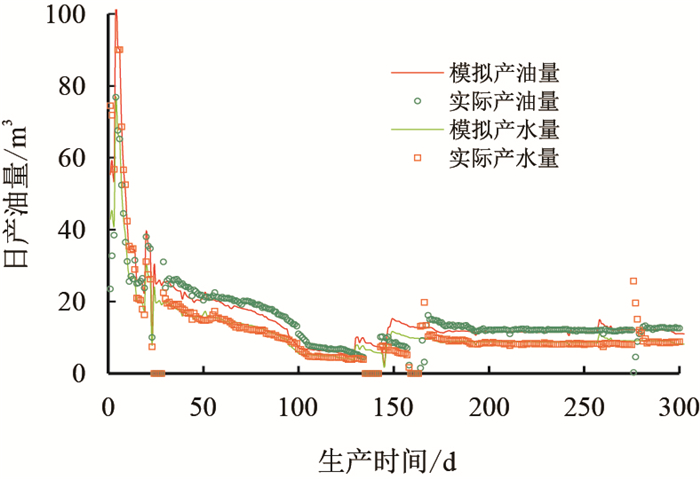 |
| 图3 模拟日产油量与实际产油量曲线 Fig. 3 Simulation of daily oil production and the actual oil production curve |
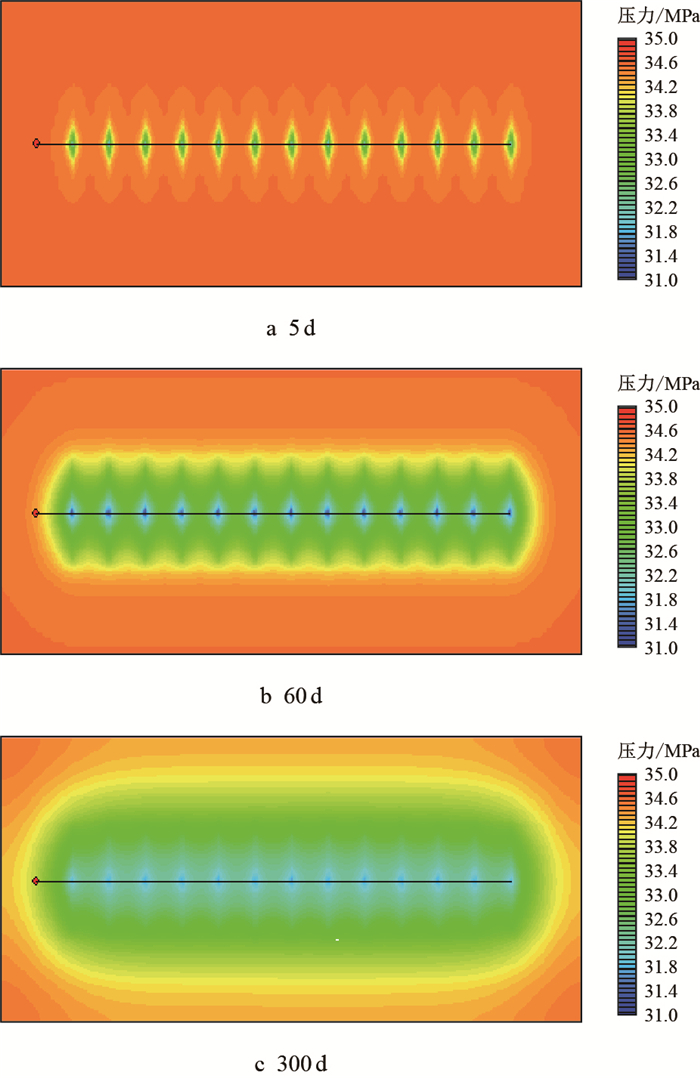 |
| 图4 模型模拟不同时刻压力分布图 Fig. 4 The pressure distribution at different times |
为了研究不同参数对致密油开发产量的影响,对相关参数进行敏感性分析,模拟过程中考虑定井底压力为15 MPa,预测10 a,其他参数用3.1中历史拟合的结果。
3.2.1 裂缝导流能力图 5为不同裂缝导流能力下多级压裂水平井累计产油量图,可以看出,裂缝导流能力越大,生产井初始产量越大,累计产量越大。当裂缝导流能力增加到一定程度,如本文中1 000 mD
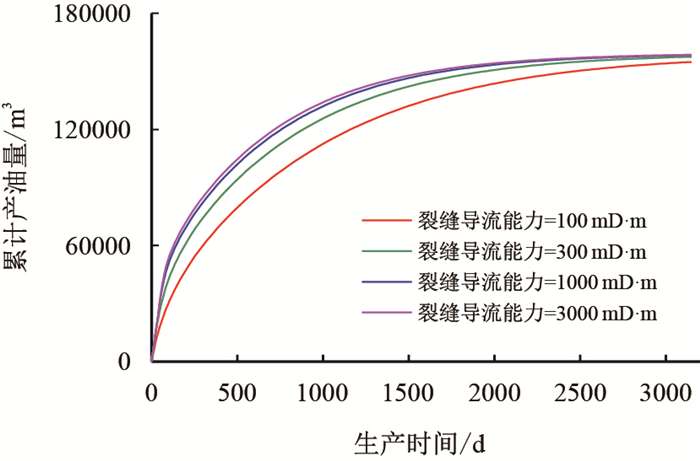 |
| 图5 不同裂缝导流能力时累产油量和时间的关系 Fig. 5 The relationship between oil production and the time when the different fracture conductivity |
图 6为改造区域示意图,假设改造区域穿透整个储层,对称分布于水力裂缝两侧,改造区域渗透率为10 mD。改造区域宽度分别设置0、10 m、30 m和50 m,图 7为不同改造区域宽度下的累计产油量曲线,可以看出,累计产油和初产随着改造区域宽度的增加而增加,因此,在实际施工造缝过程中,应该尽量提高改造区域的规模。本文选取的研究区块基质渗透率为0.9 mD,如果储层更加致密,基质渗透率更低,致密油生产过程中将长期处于线性流动阶段,改造区域的规模将直接决定初产的大小。
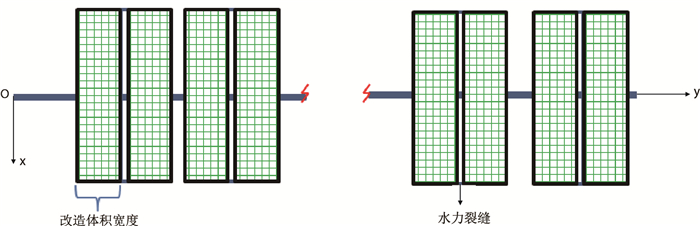 |
| 图6 改造区域宽度示意图 Fig. 6 The figure of transformation zone width |
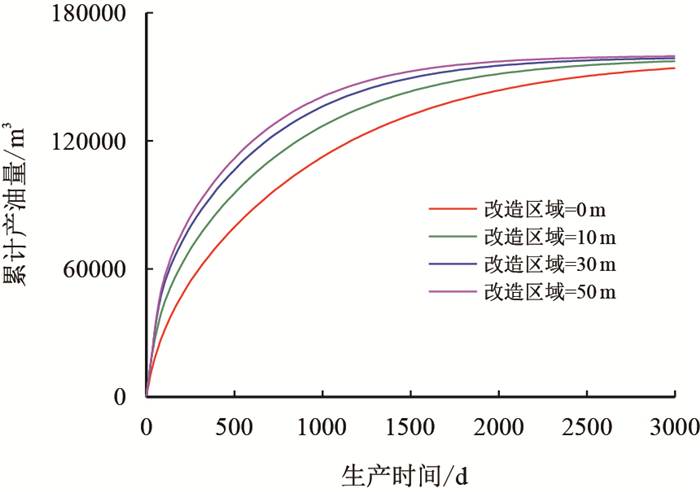 |
| 图7 不同改造区半径时累产油量和时间的关系 Fig. 7 The relationship between oil production and the time when the different SRV radius |
图 8为不同改造区域渗透率下,多级压裂水平井累计产油量图,可以看出,改造区域渗透率越大,生产井初始产量越大,累计产量越大。当改造区域渗透率增加到一定程度,累产增加效果不明显。
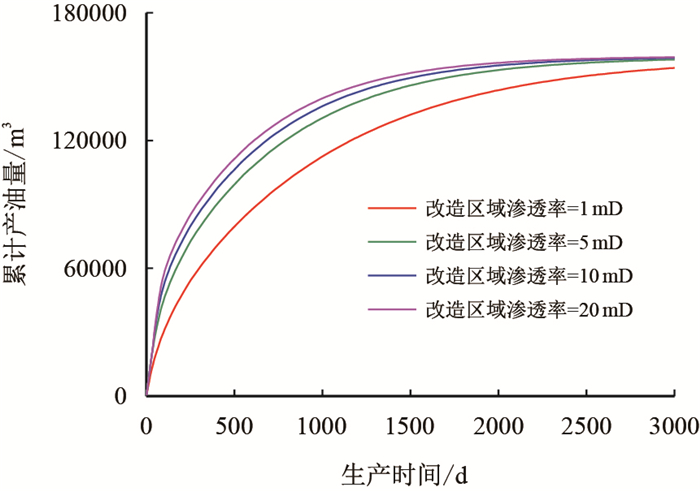 |
| 图8 不同改造区渗透率时累产油量和时间的关系 Fig. 8 The relationship between oil production and the time when the different SRV permeability |
图 9为不同非线性系数下,多级压裂水平井累计产油量图,可以看出,非线性渗流程度越大,生产井初始产量越小,累计产量越小。非线性渗流程度增加,流体在地下渗流阻力越大,因此,在相同的产量下会消耗较大的地层能量,对实际开发不利。
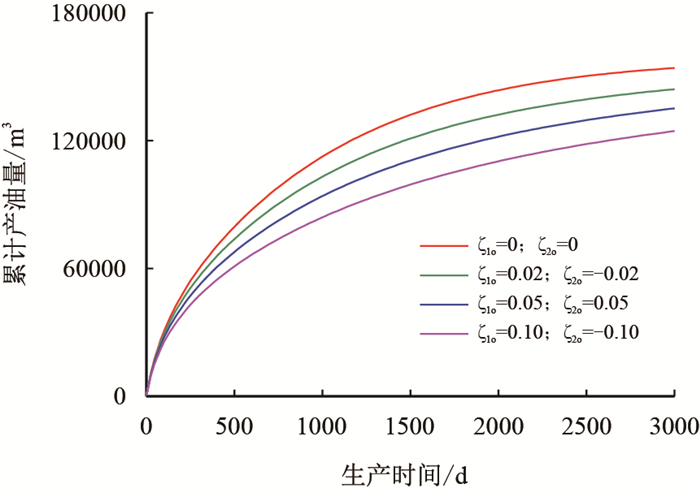 |
| 图9 不同非线性系数时累产油量和时间的关系 Fig. 9 The relationship between oil production and the time when the different non-linear coefficient |
图 10为不同初始压力下,多级压裂水平井累计产油量图,可以看出,初始压力越大,生产井初始产量越大,累计产量越大。初始压力增加,说明地层能量较大,在相同的流动阻力下,能够获得较高的产量。因此,在生产初期,可以合理地提高注采压差以获得较高的产量。
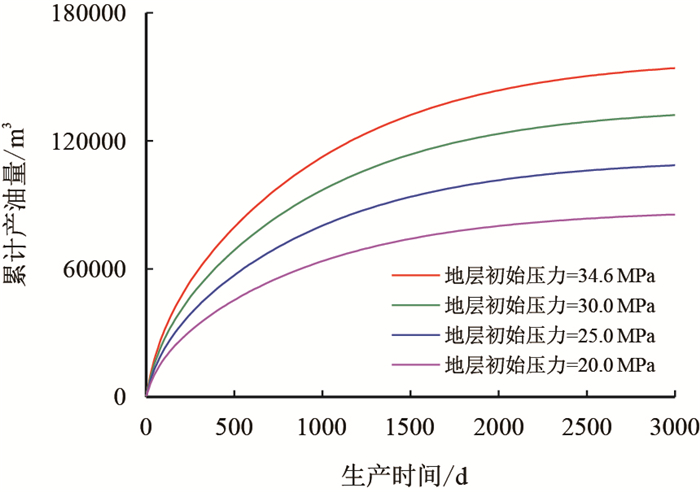 |
| 图10 不同初始压力时时累产油量和时间的关系 Fig. 10 The relationship between oil production and the time when the different initial pressure |
(1)考虑致密油的非线性渗流,建立了多级压裂水平井数值模拟模型,该模型可以有效地对多级压裂水平井的生产动态进行模拟。
(2)在历史拟合的基础上,对裂缝导流能力、改造区域规模、改造区域渗透率、非线性系数、初始压力等参数进行了敏感性分析。为获得较高的产量,可以通过增加裂缝导流能力、改造区域规模和改造区域渗透率等方式来获得。}
(3)地层中的非线性流动是流体流动的阻力,会造成过高的能量损耗,减小初期产量。在较高的初始地层压力下,油的初期产量较高,因此,在产油初期,可以适当地提高生产压差,获得较高的累计产油量。
| [1] |
贾承造, 郑民, 张永峰. 中国非常规油气资源与勘探开发前景[J].
石油勘探与开发, 2012, 39 (2) : 129 –136.
Jia Chengzao, Zheng Min, Zhang Yongfeng. Unconventional hydrocarbon resources in China and the prospect of exploration and development[J]. Petroleum Exploration and Development, 2012, 39 (2) : 129 –136. |
| [2] | Nelson P H. Pore-throat sizes in sandstones, tight sandstones, and shales[J]. AAPG Bulletin, 2009, 93 (3) : 329 –340. DOI:10.1306/10240808059 |
| [3] |
时宇, 杨正明, 黄延章. 低渗透储层非线性渗流模型研究[J].
石油学报, 2009, 30 (5) : 731 –734.
Shi Yu, Yang Zhengming, Huang Yanzhang. Study on non-linear seepage flow model for low-permeability reservoir[J]. Acta Petroleum Sinica, 2009, 30 (5) : 731 –734. |
| [4] | Jingli Y, Xiuqin D, Yande Z, et al. Characteristics of tight oil in Triassic Yanchang Formation, Ordos Basin[J]. Petroleum Exploration and Development, 2013, 40 (2) : 161 –169. DOI:10.1016/S1876-3804(13)60019-1 |
| [5] | Kuang L, Yong T, Dewen L, et al. Formation conditions and exploration potential of tight oil in the Permian saline lacustrine dolomitic rock, Junggar Basin, NW China[J]. Petroleum Exploration and Development, 2012, 39 (6) : 700 –711. DOI:10.1016/S1876-3804(12)60095-0 |
| [6] |
徐蕾, 师永民, 徐常胜, 等. 长石族矿物对致密油储渗条件的影响——以鄂尔多斯盆地长6油层组为例[J].
石油勘探与开发, 2013, 40 (4) : 448 –454.
Xu Lei, Shi Yongmin, Xu Changsheng, et al. Influences of feldspars on the storage and permeability conditions in tight oil reservoirs:A case study of Chang-6 oil layer group, Ordos Basin[J]. Petroleum Exploration and Development, 2013, 40 (4) : 448 –454. |
| [7] | Prada A, Civan F. Modification of Darcy's law for the threshold pressure gradient[J]. Journal of Petroleum Science and Engineering, 1999, 22 (4) : 237 –240. DOI:10.1016/S0920-4105(98)00083-7 |
| [8] | Zeng B, Cheng L, Li C. Low velocity non-linear flow in ultra-low permeability reservoir[J]. Journal of Petroleum Science and Engineering, 2011, 80 (1) : 1 –6. DOI:10.1016/j.petrol.2011.10.006 |
| [9] | Wang X, Yang Z, Qi Y, et al. Effect of absorption boundary layer on nonlinear flow in low permeability porous media[J]. Journal of Central South University of Technology, 2011, 18 (4) : 1299 . DOI:10.1007/s11771-011-0836-x |
| [10] | Fu Quan S, Jian Dong W, Hai Li L. Static threshold pressure gradient characteristics of liquid influenced by boundary wettability[J]. Chinese Physics Letters, 2010, 27 (2) : 024704 . DOI:10.1088/0256-307X/27/2/024704 |
| [11] | Zhu W, Song H, Huang X, et al. Pressure characteristics and effective deployment in a water-bearing tight gas reservoir with low-velocity non-Darcy flow[J]. Energy & Fuels, 2011, 25 (3) : 1111 –1117. |
| [12] | Yong H, Xizhe L, Yujin W, et al. Physical simulation on gas percolation in tight sandstones[J]. Petroleum Exploration and Development, 2013, 40 (5) : 621 –626. DOI:10.1016/S1876-3804(13)60081-6 |
| [13] | 黄延章. 低渗透油层渗流机理[M]. 北京: 石油工业出版社, 1998 . |
| [14] | Yao Y, Ge J. Characteristics of non-Darcy flow in low-permeability reservoirs[J]. Petroleum Science, 2011, 8 (1) : 55 –62. DOI:10.1007/s12182-011-0115-3 |
| [15] | Balhoff M T, Miller M J. An analytical model for cleanup of yield-stress fluids in hydraulic fractures[J]. SPE Journal, 2005, 10 (1) : 5 –12. DOI:10.2118/77596-PA |
| [16] | Xie K H, Wang K, Wang Y L, et al. Analytical solution for one-dimensional consolidation of clayey soils with a threshold gradient[J]. Computers and Geotechnics, 2010, 37 (4) : 487 –493. DOI:10.1016/j.compgeo.2010.02.001 |
| [17] | Hao F, Cheng L S, Hassan O, et al. Threshold pressure gradient in ultra-low permeability reservoirs[J]. Petroleum Science and Technology, 2008, 26 (9) : 1024 –1035. DOI:10.1080/10916460701675033 |
| [18] |
杨清立, 杨正明, 王一飞, 等. 特低渗透油藏渗流理论研究[J].
钻采工艺, 2007, 30 (6) : 52 –54.
Yang Qingli, Yang Zhengming, Wang Yifei, et al. Study on flow theory in ultra-low permeability oil reservoir[J]. Drilling & Production Technology, 2007, 30 (6) : 52 –54. |
| [19] |
邓英尔, 刘慈群. 两相流体非线性渗流模型及其应用[J].
应用数学和力学, 2003, 24 (10) : 1049 –1056.
Deng Ying'er, Liu Ciqun. Mathematical model of twophase fluid nonlinear flow in low-permeability porous media with applications[J]. Applied Mathematics and Mechanics, 2003, 24 (10) : 1049 –1056. |
| [20] | Xu Q, Liu X, Yang Z, et al. The model and algorithm of a new numerical simulation software for low permeability reservoirs[J]. Journal of Petroleum Science and Engineering, 2011, 78 (2) : 239 –242. DOI:10.1016/j.petrol.2011.05.012 |
| [21] | Xu Q Y, Liu X G, Yang Z M. Nonlinear seepage numerical simulation for super-low permeability reservoirs with artificial fractures[J]. Petroleum Science and Technology, 2013, 31 (1) : 23 –31. DOI:10.1080/10916466.2010.521787 |
| [22] | Xu J, Jiang R. Non-Darcy flow numerical simulation for low-permeability reservoirs[C]. SPE 154890, 2012. https://www.onepetro.org/conference-paper/SPE-154890-MS |
| [23] |
杨仁锋, 姜瑞忠, 刘世华, 等. 特低渗透油藏非线性渗流数值模拟[J].
石油学报, 2011, 32 (2) : 299 –306.
Yang Renfeng, Jiang Ruizhong, Liu Shihua, et al. Numerical simulation of nonlinear seepage in ultra-low permeability reservoirs[J]. Acta Petrolei Sinica, 2011, 32 (2) : 299 –306. |
| [24] |
姜瑞忠, 杨仁锋, 马勇新, 等. 低渗透油藏非线性渗流理论及数值模拟方法[J].
水动力学研究与进展:A辑, 2011, 26 (4) : 444 –452.
Jiang Ruizhong, Yang Renfeng, Ma Yongxin, et al. Nonlinear percolation theory and numerical simulation in low permeability reservoirs[J]. Chinese Journal of Hydrodynamics, 2011, 26 (4) : 444 –452. |
| [25] | Peaceman D W. Interpretation of well-block pressures in numerical reservoir simulation (includes associated paper 6988)[C]. SPE 6893, 1978. http://www.researchgate.net/publication/269611326_Interpretation_of_Well-Block_Pressures_in_Numerical_Reservoir_Simulation%28includes_associated_paper_6988_%29 |