 2014, Vol. 26

 [PDF全文]

2. 中国石油塔里木油田分公司勘探开发研究院, 新疆 库尔勒 841000;
3. 中国石油勘探开发研究院, 北京 海淀 100083
2. Research Institute of Exploration and Development, Tarim Oilfield Company, PetroChina, Korla, Xiangjiang 841000, China;
3. Research Institute of Petroleum Exploration & Development, PetroChina, Haidian, Beijing 100083, China
通常情况下,夹层是指砂岩层内所分布的相对非渗透层[1]。它是形成陆相储层流体运动非均质性的主要原因之一,也是控制厚油层复杂水淹形式的主要地质因素[2]。夹层影响了剩余油分布特征,在油田开发后期,它对剩余油分布的影响则更为显著。因此,国内许多学者开展了夹层成因及夹层建模等研究[3-13],取得了一定成果。
王媛媛等通过不同岩性的夹层特征确定有效储层的岩性下限[3];岳大力等以珠江口盆地流花11-1油田为例,揭示隔夹层对剩余油分布的控制作用[4];林博等利用序贯指示模拟方法建立夹层三维空间分布模型[5];国景星等对梁11 断块沙二段夹层的结构层次、岩石类型和成因等进行系统研究与分类[6];刘斌等认为夹层成因、类型和分布特征是导致储层严重非均质的主要原因[7];刘钰铭等采用随机模拟方法建立心滩坝内部的三维夹层模型[8];袁新涛等对苏丹Fula 油田储层内的隔夹层成因和井间预测方法进行研究[9];崔建等分析辫状河储层隔夹层特征及其对剩余油分布的影响[10];中国海洋石油总公司湛江分公司的姜平等应用地震协同的序贯高斯模拟方法,实现隔夹层三维空间分布模型[11-13]。以上研究为本次夹层模型建立提供了重要参考依据。序贯指示模拟(Sequential Indicator Simulation,SISIM)方法是随机模拟方法中适应性较强的一种方法,它不仅能综合各种信息,而且可以较好反映储层的非均质性,产生的储层参数分布能够与已有数据的空间分布规律保持一致。为搞清胜坨油田一区沙二段1-3 砂层组(以下简称沙二段1—3 砂层组)剩余油分布规律,笔者在精细地质研究的基础上,利用序贯指示模拟方法建立反映沙二段1—3 砂层组夹层发育规模和空间分布的三维地质模型,以期为将来油藏开发方案的制定和剩余油的挖潜等提供参考依据。
1 研究区地质概况胜坨油田一区位于胜坨油田西部(图 1),是一个油源和物源都较为丰富的含油气区,发育穹窿背斜构造油藏。胜坨油田一区主体构造比较简单,地层比较平缓,其北侧与两条近东西向的大断层邻接,东侧以它和胜坨油田二区东西两高点之间的鞍部为界,西侧和南侧分别与构造低部位的边水相连接。胜坨油田一区内自下而上所钻穿的古近系和新近系地层依次为孔店组、沙河街组(自下而上划分为沙四段、沙三段、沙二段和沙一段)、东营组、馆陶组和明化镇组。沙二段1—3 砂层组发育河流相储层,为主要含油层段,是本次夹层建模的主要研究对象。
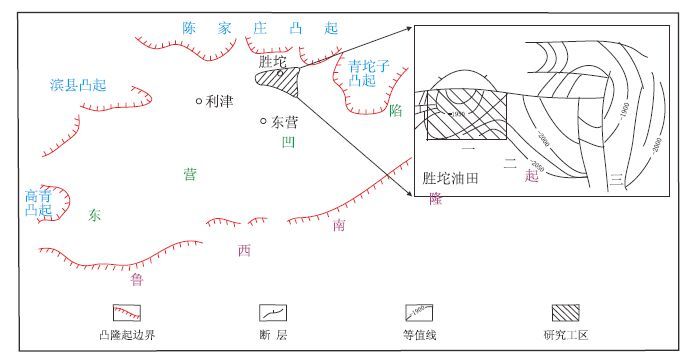 |
| 图1 胜坨油田一区构造位置简图 Fig. 1 Structural location map of the first district of Shengtuo Oilfield |
序贯指示模拟法[14-20] 由美国斯坦福大学的Journel 等于20 世纪80 年代提出,它是一种把指示变换和指示克里格相结合的方法。指示变换是指依据不同门限值,把原始数据编码成0 或1 的过程。
假设研究区储层的一组离散观测数据是{Z(xa),a = ⋅ ⋅ ⋅ N} ,且储层内具有K 种岩性,则可定义K 个指示变量:
| $I\left( {{x}_{a}} \right)=\left\{ \begin{matrix} \begin{matrix} 1, & {{x}_{a}}k \\ 0, & {} \\ \end{matrix} & k=1,2,\cdots K \\ \end{matrix} \right.$ | (1) |
式中:k 代表某一个指示变量。
指示克里格法则是对已获取的指示值做出预测,利用它得出待模拟点处岩性的概率估计
| $\begin{align} & E\left\{ {{I}_{k}}\left( {{x}_{a}};\left. Z \right|Z\left( {{x}_{a}} \right),a=1,2\cdots ,N \right) \right\}= \\ & {{P}^{*}}\left\{ {{I}_{k}}\left( {{x}_{a}};\left. Z \right|Z\left( {{x}_{a}} \right),a=1,2\cdots ,N \right) \right\} \\ \end{align}$ | (2) |
本次研究就是利用不同岩性来表示不同的夹层分布,基于序贯指示模拟方法实现夹层的井间分布预测。
3 沙二段1—3 砂层组夹层模型建立 3.1 夹层特征沙二段1—3 砂层组共发育3 类夹层,分别是泥质夹层、钙质夹层和物性夹层,其岩性、物性和电性特征(图 2)如下。
(1)泥质夹层
泥质夹层岩性主要为泥岩、粉砂质泥岩和泥质粉砂岩;泥质含量很高,孔隙度、渗透率较低;测井曲线响应表现为纯泥岩特征:自然电位靠近基线,微电极曲线幅度下降明显,而且幅度差几乎为零。
(2)钙质夹层
钙质夹层岩性主要为钙质胶结的中砂岩、细砂岩和少量粉砂岩,方解石为主要胶结物成分,其次是白云石,此外还带有少量铁方解石和铁白云石;微电极曲线幅度差较小且呈现出尖峰,微梯度曲线上升到微电位曲线位置,自然电位有轻微异常。
(3)物性夹层
物性夹层岩性主要为油斑细砂岩和粉砂岩;泥质含量也较高,除此之外,还含有砂、砾等;微电极曲线幅度变化在泥岩和钙质夹层之间,具有一定幅度差,自然电位异常幅度较低。
3.2 指示变换依据钻井与测井资料,结合夹层识别特征,对沙二段1—3 砂层组单井夹层进行指示变换:以1 表示砂岩,2 表示泥质夹层,3 表示钙质夹层,4 表示物性夹层。建立指示变换后的单井夹层数据库(共整理200 口井的夹层数据,利用前160 口井的数据建立夹层模型,后40 口井的数据对夹层模型进行检验),在此基础上应用序贯指示模拟方法建立夹层模型。
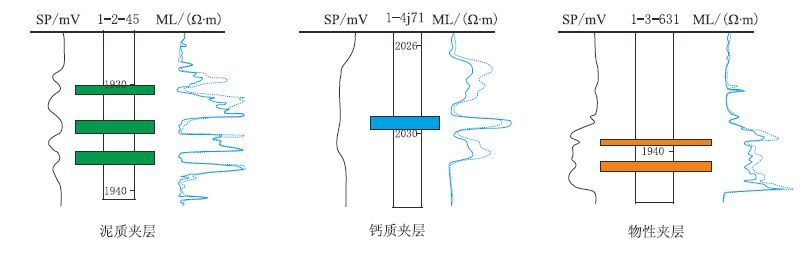 |
| 图2 胜坨油田一区沙二段1—3 砂层组不同类型夹层电性特征 Fig. 2 The electric properties of different interlayers in the 1st -3rd sandstonebeds of Es2 in the first district of Shengtuo oilfield |
一般情况下,变差函数变程对模拟结果有较大影响。胜坨油田一区处于开发后期,井网非常密集,平均井距约为280 m,以平均井距为依据选取变差函数变程。第1 组,长、短变程为平均井距的100.0倍、60.0 倍;第2 组,长、短变程为平均井距的60.0倍、36.0 倍;第3 组,长、短变程为平均井距的40.0倍、24.0 倍;第4 组,长、短变程为平均井距的25.0倍、15.0 倍;第5 组,长、短变程为平均井距的15.0倍、9.0 倍;第6 组,长、短变程为平均井距的10.0倍、6.0 倍。其他变差函数参数见表 1。
基于上述6 组变差函数参数,选取“10545”为随机种子,利用序贯指示模拟方法依次建立夹层模型,所得结果如图 3 所示(图中用不同颜色代表不同夹层的分布)。由图 3 可知,泥质夹层在整个研究区内的分布最为广泛,钙质夹层次之,物性夹层的分布范围最小。图 3a 和图 3b 中,泥质夹层、钙质夹层和物性夹层的空间展布形态基本一致;从图 3c开始,泥质夹层空间分布的连续性开始增强;图 3d中,泥质夹层空间分布的连续性进一步增强,物性夹层空间分布的连续性略微增强,钙质夹层的空间展布形态基本保持不变;与图 3c 和图 3d 相比,图 3e 和图 3f 中3 种夹层的空间展布形态基本保持不变。
| 表1 胜坨油田一区沙二段1—3 砂层组夹层指示变量变差函数参数表 Table 1 The variogram parameters of interlayer on indicating variable in the 1st -3rd sandstone beds of Es2 in the first district of Shengtuo Oilfield |
 |
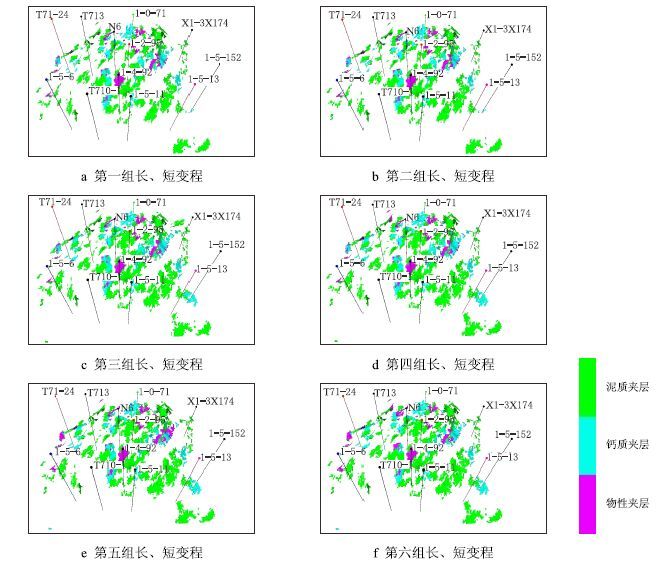 |
| 图3 胜坨油田一区沙二段1—3 砂层组夹层三维空间分布模型1 Fig. 3 The first group of interlayer 3D modelling in the 1st -3rd sandstonebeds of Es2 in the first district of Shengtuo Oilfield |
继续选取变差函数长、短变程:长、短变程分别为平均井距的9.0 倍、5.4 倍,8.0 倍、4.8 倍,7.0 倍、4.2 倍,4.0 倍、2.4 倍,3.0 倍、1.8 倍,2.0 倍、1.2 倍。其他变差函数参数保持不变。选取相同随机种子,利用序贯指示模拟方法依次建立夹层模型,所得结果如图 4 所示。图 4a、图 4b 和图 4c 中,泥质夹层、钙质夹层和物性夹层的空间展布形态基本一致;由图 4d 开始,泥质夹层空间分布的连续性逐渐变差,在图 4f 中其连续性达到最差;由图 4d 到图 4f,钙质夹层和物性夹层的空间展布形态基本保持不变。
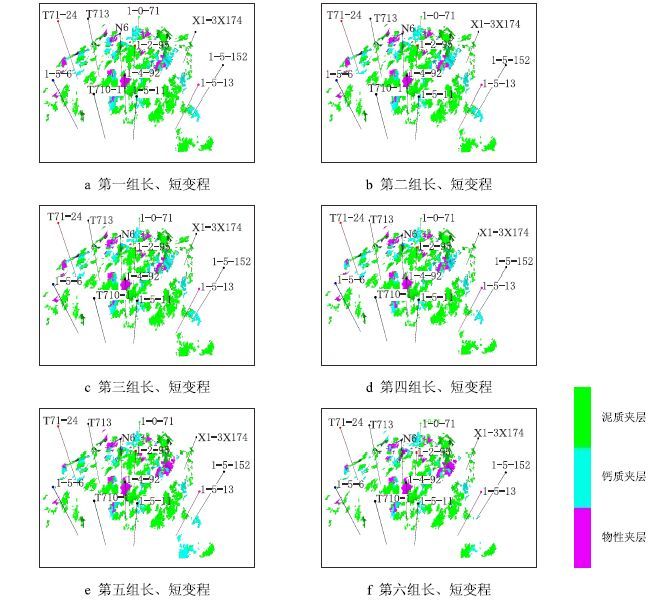 |
| 图4 胜坨油田一区沙二段1—3 砂层组夹层三维空间分布模型2 Fig. 4 The second group of interlayer 3D modelling in the 1st -3rd sandstonebeds of Es2 in the first district of Shengtuo Oilfield |
对图 3、图 4 综合分析后发现:当长变程大于平均井距的40.0 倍、短变程大于平均井距的24.0 倍时,模拟结果的连续性较差;随着长、短变程的不断变小,模拟结果的连续性逐渐增强;当长变程达到井距的25.0 倍、短变程达到井距的15.0 倍时,模拟结果的连续性达到最佳;当长、短变程持续变小时,模拟结果中泥质夹层、钙质夹层和物性夹层的空间展布形态基本保持不变,但当长变程变为井距的3倍、短变程变为井距的1.8 倍时,泥质夹层和钙质夹层分布的连续性开始变差,在长变程为井距的2 倍、短变程为井距的1.2 倍时,泥质夹层和钙质夹层分布的连续性达到最差。
可见,在相同的随机种子下,变差函数过大或过小的长、短变程都会导致模拟结果的不连续,降低模拟结果的精确度。本次夹层模型建立过程中,较为合理的长、短变程的取值范围分别是井距的25.0∼4.0 倍,15.0∼2.4 倍。
3.4 相同变差函数、不同随机种子的夹层模型建立选取6 组随机种子(表 2)和相同的变差函数参数(长变程为平均井距的4 倍,短变程为平均井距的2.4 倍,其他变差函数参数见表 1),利用序贯指示模拟方法建立夹层模型,所得结果如图 5 所示。由图 5 可知:不同随机种子产生的模拟结果中,泥质夹层、钙质夹层和物性夹层的空间展布形态较为接近,但均存在微小差异。对图 5 进行综合分析后,可得出这样一个结论:在井网较密的情况下,在相同的变差函数参数下,不同随机种子对模拟结果的影响极其微小。
| 表2 6 组随机种子参数 Table 2 Six groups of random seeds |
|
利用1-1-54 井等40 口井的夹层数据(夹层个数、单个夹层厚度、夹层频率和夹层密度)对以上所建夹层模型分别进行检验,发现当随机种子为“10545”,长、短变程分别为2 520 m 和1 512 m 时,夹层各项指标的预测值与实际值非常接近,相对误差均不超过15%(具体结果见表 3)。认为随机种子为“10545”,长、短变程分别为2 520 m 和1 512 m时得到的夹层模型(图 4c)最为准确,能够较好地反映研究区夹层的三维空间展布形态与发育特征。
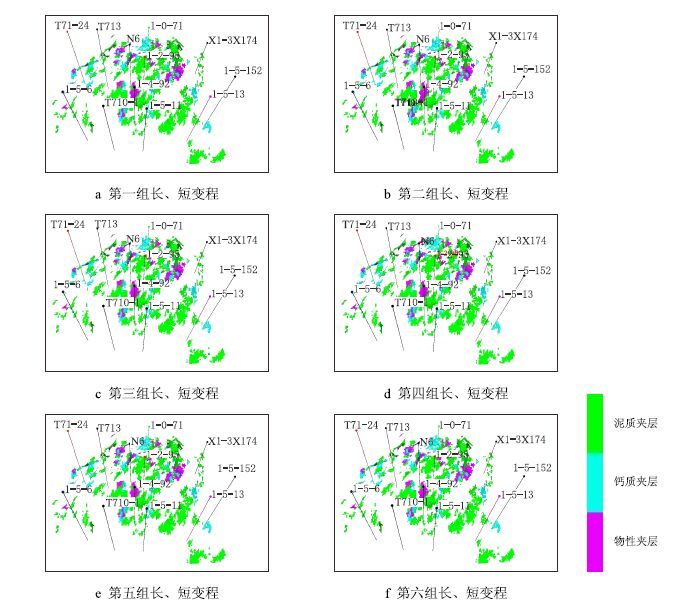 |
| 图5 胜坨油田一区沙二段1—3 砂层组夹层三维空间分布模型3 Fig. 5 The third group of interlayer 3D modelling in the 1st -3rd sandstonebeds of Es2 in the first district of Shengtuo Oilfield |
| 表3 胜坨油田一区沙二段1—3 砂层组抽稀井夹层实际数据与预测结果对比表 Table 3 The correlation table of interlayer on real data and predicated results in the 1st -3rd sandstonebeds of Es2 in the first district of Shengtuo oilfield |
|
(1)夹层建模是揭示储层非均质性的重要技术手段。本次研究建立的沙二段1—3 砂层组夹层地质模型为油藏开发后期的生产方案调整提供了可靠的地质基础。
(2)在相同随机种子下,过大或过小的长、短变程都会导致模拟结果的不连续,降低模拟结果的精确度;在井网较密的情况下,在同一长、短变程下,不同随机种子对模拟结果的影响极其微小。
(3)本次研究仅从建模角度对沙二段1—3 砂层组夹层的空间分布进行了探讨,而其成因和对剩余油的控制作用等则没有涉及。沙二段1—3 砂层组夹层的详细成因和对剩余油的具体控制作用,需在以后工作中做进一步的研究。
| [1] | 王健.储层隔夹层模型研究[D].东营:中国石油大学(华东), 2010. http://epub.cnki.net/kns/detail/detail.aspx?QueryID=46&CurRec=1&recid=&FileName=2010281184.nh&DbName=CMFD2011&DbCode=CMFD&pr= |
| [2] |
束青林. 孤岛油田馆陶组河流相储层隔夹层成因研究[J].
石油学报, 2006, 27 (3) : 100 –103.
Shu Qinglin. Interlayer characterization of fluvial reservoir in Guantao Formation of Gudao Oilfield[J]. Acta Petrolei Sinica, 2006, 27 (3) : 100 –103. |
| [3] |
王媛媛, 王桂成, 徐勇强, 等. 杏子川油田长6低渗透储层有效厚度下限研究[J].
地质科技情报, 2013, 32 (3) : 113 –117.
Wang Yuanyuan, Wang Guicheng, Xu Yongqiang, et al. Research on the minimum net pay thickness for Chang-6 oil reservoirs with low permeability in Xingzichuan Oilfield[J]. Geological Science and Technology Information, 2013, 32 (3) : 113 –117. |
| [4] |
岳大力, 吴胜和, 林承焰, 等. 礁灰岩油藏隔夹层控制的剩余油分布规律研究[J].
石油勘探与开发, 2005, 32 (5) : 113 –117.
Yue Dali, Wu Shenghe, Lin Chengyan, et al. Remaining oil distribution controlled by intercalation in reef limestone reservoir[J]. Petroleum Exploraion and Development, 2005, 32 (5) : 113 –117. |
| [5] |
林博, 戴俊生, 陆先亮, 等. 河流相储集层夹层的三维空间分布研究[J].
中国石油大学学报:自然科学版, 2006, 30 (4) : 17 –20.
Lin Bo, Dai Junsheng, Lu Xianliang, et al. Study on three dimensional spatial distribution model for interlayer in fluvial facies reservoir[J]. Journal of China University of Petroleum:Edition of Natural Science, 2006, 30 (4) : 17 –20. |
| [6] |
国景星, 张勇. 梁11断块沙河街组二段河口坝砂岩体夹层特征[J].
中国石油大学学报:自然科学版, 2010, 34 (5) : 7 –11.
Guo Jingxing, Zhang Yong. Interlayer characteristics of estuary dam reservoir of the 2nd Member of Shahejie Formation in L11 Fault Block[J]. Journal of China University of Petroleum:Edition of Natural Science, 2010, 34 (5) : 7 –11. |
| [7] |
刘斌, 何勇明, 段新国. 宝浪油田储层夹隔层特征及储层非均质性研究[J].
西南石油大学学报:自然科学版, 2010, 32 (6) : 25 –28.
Liu Bin, He Yongming, Duan Xinguo. Study on characteristics of interlayers and reservoir heterogeneity of Baolang Oilfield[J]. Journal of Southwest Petroleum University:Science & Technology Edition), 2010, 32 (6) : 25 –28. |
| [8] |
刘钰铭, 侯加根, 宋保全, 等. 辫状河厚砂层内部夹层表征——以大庆喇嘛甸油田为例[J].
石油学报, 2011, 32 (5) : 836 –841.
Liu Yuming, Hou Jiagen, Song Baoquan, et al. Characterization of interlayers within braided-river thick sandstones:A case study on the Lamadian Oilfield in Daqing[J]. Acta Petrolei Sinica, 2011, 32 (5) : 836 –841. |
| [9] |
袁新涛, 吴向红, 张新征, 等. 苏丹Fula油田辫状河储层内夹层沉积成因及井间预测[J].
中国石油大学学报:自然科学版, 2013, 37 (1) : 8 –12.
Yuan Xintao, Wu Xianghong, Zhang Xinzheng, et al. Sedimentary origin and interwell prediction of interbeds in braided river reservoir, Fula Oilfield in Sudan[J]. Journal of China University of Petroleum, 2013, 37 (1) : 8 –12. |
| [10] |
崔建, 李海东, 冯建松, 等. 辫状河储层隔夹层特征及其对剩余油分布的影响[J].
特种油气藏, 2013, 20 (4) : 26 –30.
Cui Jian, Li Haidong, Feng Jiansong, et al. Barrier-beds and inter-beds characteristics and their effects on remaining oil distribution in braided river reservoirs:A case study of the Ng IV Oil unit in shallow north Gaoshangpu Oilfield[J]. Special Oil and Gas Reservoir, 2013, 20 (4) : 26 –30. |
| [11] |
姜平, 黄俊辉, 雷霄, 等. 文昌A油田珠二段I油组隔夹层分布研究[J].
西南石油大学学报:自然科学版, 2014, 36 (1) : 19 –26.
Jiang Ping, Huang Junhui, Lei Xiao, et al. Study on interlayer distribution of I oil group in Member 2 of Zhujiang Formation in A Oilfield[J]. Journal of Southwest Petroleum University:Science & Technology Edition, 2014, 36 (1) : 19 –26. |
| [12] |
余成林, 国殿斌, 熊运斌, 等. 厚油层内部夹层特征及在剩余油挖潜中的应用[J].
地球科学与环境学报, 2012, 34 (1) : 35 –39.
Yu Chenglin, Guo Dianbin, Xiong Yunbin, et al. Characteristics of interbeds in thick reservoir and application in potential tapping of residual oil[J]. Journal of Earth Sciences and Environment, 2012, 34 (1) : 35 –39. |
| [13] |
张君劼, 于兴河, 章彤, 等. 滴12井区八道湾组扇三角洲隔夹层对注采效果的影响[J].
新疆石油地质, 2013, 34 (5) : 548 –551.
Zhang Junjie, Yu Xinghe, Zhang Tong, et al. The interlay-ers and effects on injection-production relationship in fan delta of Badaowan Formation, Di-12 well area in Cainan Oilfield[J]. Xinjiang Petroleum Geology, 2013, 34 (5) : 548 –551. |
| [14] |
王英伟, 张建民, 王满, 等. 基于序贯指示模拟方法的火山岩储层岩性及孔隙度模拟[J].
吉林大学学报:地球科学版, 2010, 40 (2) : 455 –460.
Wang Yingwei, Zhang Jianmin, Wang Man, et al. Simulation of lithology and porosity of volcanic rock reservoir based on sequential indicator simulation[J]. Journal of Jilin University:Earth Science Edition, 2010, 40 (2) : 455 –460. |
| [15] |
陈建阳, 田昌炳, 周新茂, 等. 融合多种地震属性的沉积微相研究与储层建模[J].
石油地球物理勘探, 2011, 46 (1) : 98 –102.
Chen Jianyang, Tian Changbing, Zhou Xinmao, et al. Sedimentary microfacies studies and reservoir modeling by integration of multiple seismic attributes[J]. Oil Geophysical Prospecting, 2011, 46 (1) : 98 –102. |
| [16] |
余振, 何静, 魏福吉, 等. 序贯指示模拟和序贯高斯模拟在某地区精细流体预测中的联合应用[J].
天然气地球科学, 2012, 23 (6) : 1170 –1174.
Yu Zhen, He Jing, Wei Fuji, et al. Joint application of sequential indicator simulation and sequential gaussian simulation for detailed fluid prediction in a certain area[J]. Natural Gas Geoscience, 2012, 23 (6) : 1170 –1174. |
| [17] |
付国民, 马力宁, 屈信忠. 采用多级模糊综合评判法对剩余油潜力定量评价[J].
地球科学与环境学报, 2004, 26 (2) : 38 –41.
Fu Guomin, Ma Lining, Qu Xinzhong. Quantitative evaluation for the potentiality of remaining oil by multilevel fuzzy judgement method[J]. Journal of Earth Sciences and Environment, 2004, 26 (2) : 38 –41. |
| [18] |
李阳. 塔河油田奥陶系碳酸盐岩溶洞型储集体识别及定量表征[J].
中国石油大学学报:自然科学版, 2012, 36 (1) : 1 –7.
Li Yang. Ordovician carbonate fracture-cavity reservoirs identification and quantitative characterization in Tahe Oilfield[J]. Journal of China University of Petroleum:Edition of Natural Science, 2012, 36 (1) : 1 –7. |
| [19] |
王月英, 姚军, 黄朝琴. 缝洞型碳酸盐岩储集层离散介质模型的建模方法[J].
新疆石油地质, 2012, 33 (2) : 225 –229.
Wang Yueying, Yao Jun, Huang Zhaoqin. Discrete medium method for fractured-vuggy carbonate reservoir[J]. Xinjiang Petroleum Geology, 2012, 33 (2) : 225 –229. |
| [20] |
马晓强, 侯加根, 胡向阳, 等. 论古岩溶洞穴型储层三维地质建模——以塔河油田四区奥陶系储层为例[J].
地质论评, 2013, 59 (2) : 315 –324.
Ma Xiaoqiang, Hou Jiagen, Hu Xiangyang, et al. Discussion on 3D geological modeling of palaeokarst cave reservoir:A case study on Ordovician reservoir of the 4th Block in the Tahe Oilfield[J]. Geological Review, 2013, 59 (2) : 315 –324. |