 2018, Vol. 39


 ,
, 2. 武汉大学中南医院 循证与转化医学中心, 湖北 武汉 430071;
3. 武汉大学第二临床学院循证医学与临床流行病学教研室 湖北 武汉 430071
2. Center for Evidence-Based and Translational Medicine, Zhongnan Hospital of Wuhan University, Wuhan 430071, China;
3. Center for Evidence-Based Medicine and Clinical Epidemiology, Second Clinical College of Wuhan University, Wuhan 430071, China
烟雾病(moyamoya disease,MMD)是一种特发性疾病,是以颈内动脉末端进行性狭窄或闭塞,脑底异常血管网增生为特征的一种进展性脑血管疾病。该病的发病率存在人种、地域和性别差异,但目前总的来说发病率最高的还是亚洲各国,尤其是日本、韩国和中国。干预方法主要是手术治疗,即通过直接旁路手术、间接旁路手术或联合手术经颈外动脉系统增加颅内血流量[1]。儿童与成人MMD的病理学改变和临床特征有差异,临床处理也不尽相同。本文主要讨论成人MMD两种手术方式处理效果的不同。
目前关于旁路手术术式的最佳选择仍存在一些争议。直接旁路手术主要是颞浅动脉大脑中动脉血管吻合术(STA-MCA),间接旁路手术则包括颞肌贴敷术(EMS)、颅骨多点钻孔手术等多种术式。有观点认为,直接旁路手术能直接增加脑灌注,而间接手术则需要几个月才能建立起良好的侧支循环,因而将直接旁路手术和联合手术作为同一组,将各种间接旁路手术方法作为一组进行比较[2]。本研究拟单纯比较直接旁路手术与间接旁路手术。
1 资料与方法 1.1 检索策略由2名评价员(邱永逸、孟详喻)检索Pubmed、Cochrane Central、Embase等数据库以获得文献。使用的检索词为“Moyamoya”、“Direct Bypass”、“Indirect Bypass”,检索的时间均为建库至2016年12月18日。
1.2 文献纳入和排除标准 1.2.1 纳入标准① 纳入经临床DSA“金标准”诊断为MMD或MMS(烟雾综合征)的有手术指征成年患者;②对比两种手术方式,每组至少5例患者,术后随访至少3个月;③有以下至少一项结局指标资料:围手术期的并发症发生率、术后随访期的卒中发生率、术后血管再通情况、术后血流动力学改善情况。
1.2.2 排除标准① 患者合并其他疾病(如动脉瘤);②参杂儿童病例;③参杂合并手术病例;④重要的资料报告不全,且联系作者未回复者;⑤重复报道。
1.2.3 文献质量评价由2位评价员(邱永逸、章剑剑)进行质量评价,与第3位评价员(曾宪涛)讨论解决分歧。由于纳入研究均为回顾性研究,故使用纽卡斯尔-渥太华量表(the Newcastle-Ottawa Scale,NOS)进行质量评价[3]。
1.2.4 资料提取由2名评价员(邱永逸、郭毅)独立进行数据提取,与第3位评价员(曾宪涛)讨论解决分歧。提取纳入研究基本情况资料和结局指标数据,后者的定义及分类方式如下:①主要结局为随访期症状性卒中;②血运重建的程度分“好”或“不好”两类,即当原始资料为3级分类时,将“广泛”、“良好”和“中等”归为“好”,而“差”或“不良”归为“不好”;当原始资料为4级分类,将“中度”和“广泛”或“良好”归为“好”,而将“差”、“无”或“不良”归为“不好”;③血流动力学改善情况,对比术前术后影像学灌注检查资料,分为“改善或正常化(好)”和“不变(不好)”两类;④围手术期并发症定义为手术后30 d内的任何主要不良事件,如死亡或永久性神经缺陷等。
1.2.5 统计分析使用RevMan 5.3软件进行Meta分析。首先通过Q检验和I2统计量对研究间的异质性进行评价,如果P≥0.1,I2≤50%,则说明研究间无显著异质性,使用固定效应模型;反之使用随机效应模型。本文涉及的资料均为计数资料,采用比值比(OR)作为分析统计量。所有分析均计算95%可信区间(95%CI)。同时,采用漏斗图评价发表偏倚。
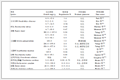
2 结果 2.1 纳入资料的一般情况初检出的相关文献为447篇。经标题和摘要后剔除不符合纳入标准的403篇。阅读全文进一步筛选,最终选得符合标准的文献9篇[4-12],共有478例受试者。纳入研究的一般情况见表 1。
|
表 1 纳入研究一般情况 |
根据NOS量表质量评价结果,纳入的9个研究基线具有可比性,但均有不同水平的偏倚。有2个研究的总分为5分,有7个研究的总分为6分,总体质量中等偏上。
2.3 Meta分析结果 2.3.1 术后随访期卒中发生率有8个研究[4-11]比较了直接旁路和间接旁路手术的术后随访期卒中发生率情况。研究间存在异质性(I2=53%,P=0.04),随机效应模型合并结果:OR=0.59,95%CI(0.21,1.60),P=0.30(图 1A),差异无统计学意义。漏斗图提示发表偏倚不明显。

|
图 1 直接旁路手术和间接旁路手术四个指标比较森林图 |
有5个研究[4, 7, 8, 11, 12]比较了直接旁路手术和间接旁路手术的术后血管再通情况。研究间无显著异质性(I2=0%,P=0.86),固定效应模型合并结果:OR=8.08,95%CI(3.52,18.56),P<0.000 01(图 1B),差异有统计学意义。漏斗图提示发表偏倚不明显。
2.3.3 术后血流动力学改善情况有3个研究[6, 7, 10]比较了直接旁路手术和间接旁路手术的术后血流动力学改善情况。研究间存在异质性(I2=56%,P=0.11),随机效应模型合并效应量:OR=2.10,95%CI(0.26,17.16),P=0.49(图 1C),差异无统计学意义。漏斗图无法判断是否有发表偏倚,因为纳入研究的数量太少。
2.3.4 围手术期并发症发生率有5个研究[5-7, 9, 10]比较了直接旁路手术和间接旁路手术的围手术期并发症发生率。研究间无显著异质性(I2=0%,P=0.48),固定效应模型合并结果:OR=1.20,95%CI(0.47,3.06),P=0.70(图 1D),差异无统计学意义。漏斗图提示发表偏倚不明显。
3 讨论有学者提出:直接旁路手术在治疗成人MMD上比间接旁路手术更有效。但也有人指出,间接旁路手术操作更简单、更安全,它有望通过软组织提供血运并产生新生血管,从而增强大脑的血运。但问题是,以往的很多说法都是基于经验总结,而没有统计学上的客观证据。且目前尚无人单独将直接旁路手术与间接旁路手术进行比较。
3.1 疗效指标评价随访期卒中发生率是最主要的疗效指标,我们的结果显示两组并没有显著差异(P=0.30)(图 1A)。但相较之下,直接旁路组显示出较少发生卒中的趋势。最近也有两篇文献将直接旁路手术(包括联合手术)与间接旁路手术相比[13, 14],显示直接旁路手术或联合手术能更好地预防卒中的发生。此外,有许多研究建议直接或联合旁路手术作为预防卒中发生的主要选择[4, 8, 9, 15, 16],但也研究表明间接旁路手术在成人症状性MMD患者中显示出良好的结果[17, 18]。因此,在成人MMD预防卒中发生上,仍不能完全说明直接旁路手术优于间接旁路手术。
在MMD的血管病变中,血管造影中显示的血管再通情况与卒中的预防有很大的相关性[6-8]。血管造影观察血运重建是评价手术效果比较直接的方法[19]。我们的Meta分析显示,直接旁路手术更有利于建立起良好的血运,且差异具有统计学意义(图 1B)。当然,最近关于联合旁路手术方法的两项研究表明,直接旁路手术和间接旁路手术在成人MMD患者的血运重建中具有互补作用[19]。
研究表明,脑血流动力学参数诸如脑血流量、脑血管储备能力等可用于选择适合手术治疗的MMD患者,并评估血液动力学稳定的程度[7, 8, 10]。我们的Meta分析虽然显示直接旁路手术有较好的血流动力学改善率,但两组之间的差异没有统计学意义。当然,目前纳入研究较少,还需进一步证实。
3.2 安全性指标评价在过去关于成人MMD患者的研究中,围手术期并发症的发生率从1.2%到15.6%不等[15, 17, 18]。我们的分析显示围手术期并发症的发生率为7.0%,其中在直接旁路组中为6.5%,在间接旁路组中为7.2%(图 1D),两组差异无统计学意义。不同研究团体所得数据差异如此之大,有可能与手术操作技术有关。目前对于MMD的手术的操作并没有统一规范化标准,能实施旁路手术的医生基本都是自成体系的专家,故手术操作上存在差异。
3.3 本研究的局限性我们目前的研究有存在一些局限性:①所有的文献均为回顾性研究,在证据质量上属于低质量证据;②由于所有的单臂研究都被有意识地排除,故本研究缺乏代表性;③不同术者手术操作差异较大,也会造成偏倚;④每个研究中对于患者进行临床随访的时间上有差异;⑤各研究在手术方式选择上存在偏倚。
3.4 总结本文Meta分析表明,直接旁路手术方法对于具有症状性或血液动力学不稳定的成人患者的血运重建是更好的;相对于间接旁路手术而言,直接旁路手术可能更有利于预防卒中的发生,虽然这种差异仍没有统计学意义,但说明了一种趋势,有利于直接旁路手术被更为广泛的接纳。日后,随着对该病认知和各方面技术的成熟,希望能够更好地控制研究中的各种偏倚,从而提供更为精确而充分的统计信息来评价外科手术的安全性和有效性,从而指导我们根据具体情况选择最好的手术方案,甚至可以引导我们对手术方法进行不断改进。
| [1] | Kim T, Oh CW, Bang JS. Moyamoya Disease: Treatment and Outcomes[J]. J Stroke, 2016, 18(1): 21-30. DOI: 10.5853/jos.2015.01739. |
| [2] | Kazumata K, Ito M, Tokairin K, et al. The frequency of postoperative stroke in moyamoya disease following combined revascularization: a single-university series and systematic review[J]. J Neurosurg, 2014, 121(2): 432-440. DOI: 10.3171/2014.1.JNS13946. |
| [3] | Stang A. Critical evaluation of the Newcastle-Ottawa scale for the assessment of the quality of nonrandomized studies in meta-analyses[J]. Eur J Epidemiol, 2010, 25(9): 603-605. DOI: 10.1007/s10654-010-9491-z. |
| [4] | Kawaguchi S, Okuno S, Sakaki T. Effect of direct arterial bypass on the prevention of future stroke in patients with the hemorrhagic variety of moyamoya disease[J]. J Neurosurg, 2000, 93(3): 397-401. DOI: 10.3171/jns.2000.93.3.0397. |
| [5] | Hyun SJ, Kim JS, Hong SC. Prognostic factors associated with perioperative ischemic complications in adult-onset moyamoya disease[J]. Acta Neurochir(Wien), 2010, 152(7): 1 181-1 188. DOI: 10.1007/s00701-010-0638-1. |
| [6] | Han JS, Abou-Hamden A, Mandell DM, et al. Impact of extracranial-intracranial bypass on cerebrovascular reactivity and clinical outcome in patients with symptomatic moyamoya vasculopathy[J]. Stroke, 2011, 42(11): 3 047-3 054. DOI: 10.1161/STROKEAHA.111.615955. |
| [7] | Bang JS, Kwon OK, Kim JE, et al. Quantitative angiographic comparison with the OSIRIS program between the direct and indirect revascularization modalities in adult moyamoya disease[J]. Neurosurgery, 2012, 70(3): 625-632. DOI: 10.1227/NEU.0b013e3182333c47. |
| [8] | Lee SB, Kim DS, Huh PW, et al. Long-term follow-up results in 142 adult patients with moyamoya disease according to management modality[J]. Acta Neurochir (Wien), 2012, 154(7): 1 179-1 187. DOI: 10.1007/s00701-012-1325-1. |
| [9] | Gross BA, Du R. Adult moyamoya after revascularization[J]. Acta Neurochir (Wien), 2013, 155(2): 247-254. DOI: 10.1007/s00701-012-1545-4. |
| [10] | Abla AA, Gandhoke G, Clark JC, et al. Surgical outcomes for moyamoya angiopathy at barrow neurological institute with comparison of adult indirect encephaloduroarteriosynangiosis bypass, adult direct superficial temporal artery-to-middle cerebral artery bypass, and pediatric bypass: 154 revascularization surgeries in 140 affected hemispheres[J]. Neurosurgery, 2013, 73(3): 430-439. DOI: 10.1227/NEU.0000000000000017. |
| [11] | Choi WS, Lee SB, Kim DS, et al. Thirteen-year experience of 44 patients with adult hemorrhagic moyamoya disease from a single institution: clinical analysis by management modality[J]. J Cerebrovasc and Endovasc Neurosurg, 2013, 15(3): 191-199. DOI: 10.7461/jcen.2013.15.3.191. |
| [12] | Arias EJ, Dunn GP, et al. Surgical revascularization in north american adults with moyamoya phenomenon: long term angiographic follow-up[J]. J Stroke Cerebrovasc Dis, 2015, 24(7): 1 597-1 608. DOI: 10.1016/j.jstrokecerebrovasdis.2015.03.053. |
| [13] | Qian C, Yu X, Li J, et al. The efficacy of surgical treatment for the secondary prevention of stroke in symptomatic moyamoya disease: a meta-analysis[J]. Medicine (Baltimore), 2015, 94(49): e2218. |
| [14] | Kazumata K, Ito M, Tokairin K, et al. The frequency of postoperative stroke in moyamoya disease following combined revascularization: a single-university series and systematic review[J]. J Neurosurg, 2014, 121(2): 432-440. DOI: 10.3171/2014.1.JNS13946. |
| [15] | Miyamoto S, Yoshimoto T, Hashimoto N, et al. Effects of extracranial-intracranial bypass for patients with hemorrhagic moyamoya disease: results of the Japan Adult Moyamoya Trial[J]. Stroke, 2014, 45(5): 1 415-1 421. DOI: 10.1161/STROKEAHA.113.004386. |
| [16] | Kim T, Oh CW, Kwon OK, et al. Stroke prevention by direct revascularization for patients with adult-onset moyamoya disease presenting with ischemia[J]. J Neurosurg, 2016, 124(6): 1 788-1 793. DOI: 10.3171/2015.6.JNS151105. |
| [17] | Bao XY, Duan L, Li DS, et al. Clinical features, surgical treatment and long-term outcome in adult patients with Moyamoya disease in China[J]. Cerebrovasc Dis, 2012, 34(4): 305-313. DOI: 10.1159/000343225. |
| [18] | Starke RM, Komotar RJ, Hickman ZL, et al. Clinical features, surgical treatment, and long-term outcome in adult patients with moyamoya disease. Clinical article[J]. J Neurosurg, 2009, 111(5): 936-942. DOI: 10.3171/2009.3.JNS08837. |
| [19] | Amin-Hanjani S, Singh A, Rifai H, et al. Combined direct and indirect bypass for moyamoya: quantitative assessment of direct bypass flow over time[J]. Neurosurgery, 2013, 73(6): 962-967. DOI: 10.1227/NEU.0000000000000139. |