 2017, Vol. 38

 ,
, 2. 华中科技大学同济医学院附属武汉中心医院消化内科 湖北 武汉 430014
2. Dept. of Gastroenterology & Key Laboratory for Molecular Diagnosis of Hubei Province, The Central Hospital of Wuhan, Tongji Medical College, Huazhong University of Science and Technology, Wuhan 430014, China
自身免疫相关疾病,狭义上来讲,指的是自身免疫性疾病,涉及全身组织、器官最多的疾病,发病机制尚未明确;但除此之外,还有一些疾病被报道出与自身免疫相关。目前认为,环境因素和遗传因素共同在自身免疫性疾病中的关联最大。作为控制T淋巴细胞活性的基因之一,蛋白酪氨酸磷酸酶非受体型22基因近几年被报道在多种自身免疫性疾病发展的过程中扮演重要角色。
1 PTPN22基因的功能及单核苷酸多态性蛋白酪氨酸磷酸酶非受体型22(protein tyrosine phosphatase non-receptor-22,PTPN22) 基因位于1号染色体短臂(1p13.3-1p13.1) 上,编码淋巴特异性酪氨酸磷酸酶(lymphoid-specific tyrosine phosphatase, Lyp),Lyp是由807个氨基酸残基组成,相对分子质量为105×103, 主要表达在成熟或未成熟的T、B淋巴细胞,抑制上述细胞对抗原的免疫应答[1],原理是限制或抑制Csk激酶[2],Lyp羧基端的有200个氨基酸残基,其中含有4个富含脯氨酸序列的基序, 称其为P1-P4,其中第一段基序P1(PPPLPERTPESFIVV)是通过抑制负性调控蛋白酪氨酸激酶Csk的SH3区域,对Zap70和Src等蛋白酪氨酸激酶家族发挥去磷酸化作用,抑制细胞受体(TCR)信号系统[3]。
PTPN22基因单核苷酸多态性(single nucleotide polymorphisms,SNPs)是引起人类自身免疫紊乱的因素之一,包括1858C>T、-1123G>C、+788G>A等,PTPN22单核苷酸变异后表达的蛋白,抑制免疫应答的功能减弱或者消失,引发自身免疫性疾病。1858C>T,LYP的P1区紊乱,LYP的SH3区与CSK激酶结合的功能受到影响;而且LYP的半衰期的减少,这些变化共同导致T细胞过度活化[4]。-1123G>C会影响中心活化蛋白4(AP-4) 结合位点,并可能影响LYP转录效率[5]。+788G>A降低LYP的基础物理活性和表现为T细胞功能丧失的突变[6],因此,该多态性在自身免疫性疾病的可能具有保护作用[7]。
与PTPN22 SNPs相关的自身免疫性疾病有1型糖尿病(T1D)[8]、成人隐匿性自身免疫性糖尿病[9]、类风湿性关节炎、Graves病[10]、系统性红斑狼疮[11]、斑秃[12]、冠状动脉性心脏病[13]、溃疡性结肠炎[14]、子宫平滑肌瘤[15]等。
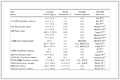
2 PTPN22基因的研究方法PTPN22基因多态性与自身免疫性疾病的相关性研究方法,大多是采用的是聚合酶链式反应-限制性片段长度多态性分析和基因测序。在研究对象的血液中提取DNA,通过引物设计(如表 1),扩增目的基因(含有rs2476601、rs2488457、rs33996649等多态性位点的基因片段),在扩增产物中加入相应的限制性内切酶,后经2.5%琼脂糖凝胶电泳分离,分析基因位点(如1858C>T、-1123G/C、+788G/A等)的多态性。
|
表 1 PTPN22基因多态性研究引物列表 |
糖尿病的发病是以前临床自身免疫周期为先导,特征是出现自身抗体破坏β细胞的结构[19]。糖尿病的病因是多因素的,是环境因素和基因易感性相互作用导致的。之前大量研究发现PTPN22基因多态性在糖尿病患者中表现出地域性差异,在欧美地区,关于爱沙尼亚地区的研究报道[9]T1D、LADA患者与1858C>T相关,而在关于捷克地区的研究报道中指出[20]T1D患者与1858C>T、-1123G>C均表现出相关性。在亚洲地区,日本T1D患者与-1123G>C、1970-852T>C相关[21]。此外,Ziegler[19]等人发现在哥伦比亚人群中,1858C>T的T等位基因在杂合子患者中对下一代有较高的遗传性,而且只在杂合状态增加遗传风险。
3.2 类风湿性关节炎(RA)RA是一种不明原因的自身免疫异常导致的慢性滑膜、软骨和骨的炎症。RA有两个临床亚型:抗环瓜氨酸抗体(ACPA)阳性和隐性。尽管RA的发病原理还不完全可知,但是基因易感性对于RA的影响是显著的。Viatte研究发现[22],在英国人中,PTPN22基因多态性与RA的两种亚型均相关,而且其作用独立于HLA。Heneberg等人发现基因多态性表现出明显的地域性差异[1]。在欧美地区,关于德国、荷兰的研究报道[23],RA与1858C>T、788G>A患者呈现出相关性;在亚洲地区,并未发现亚洲地区人群与1858C>T、+788G>A相关,而中国地区的RA患者与-1123G>C、1970-852T>C表现出相关性[24]。
3.3 弥漫性甲状腺亢进又称为Graves病(GD), 是伴有甲状腺素分泌增加的一种器官特异性自身免疫疾病,多由免疫、环境、遗传相互作用导致的。在欧美地区,Velaga研究发现1858C>T与英国GD患者相关[25],Zhebrun等人通过对比GD与RA、T1D的差异也证实了这一点,俄罗斯的GD患者与PTPN22多态性的相关性和其他自身免疫疾病并无区别[26]。在非洲地区,关于埃及人群的研究中报道[27],合并系统性红斑狼疮(SLE)的GD患者要比单纯SLE的患者的1858T基因频率要高。而在亚洲地区,日本人群中并未发现PTPN22基因1858C>T的相关性[28]。
3.4 系统性红斑狼疮(SLE)SLE是一种全身性的结缔组织疾病,免疫应答的调节缺陷是其发病机理的重要原因,这最终会导致炎症的进展和组织与器官的损伤。尽管发病机制还不完全清楚,但越来越多的研究表明基因方面的影响力要强于环境因素。Ostanek等人研究了PTPN22基因多态性与易感性、临床表现的相关性[11],证明PTPN22基因1858 C>T与波兰人的SLE及抗磷脂抗体相关。此外,纯合子TT基因型不增加SLE的患病风险[29]。有研究不支持PTPN22基因多态性与SLE相关的说法,在欧美地区,北美、芬兰、英国的白人SLE患者中并没有表现出与PTPN22基因多态性相关[30],在美国的欧洲后裔,1858T等位基因出现频率是增加的[31],而非洲裔美国人,T等位基因是普遍较欧洲人低的[32]。这表明PTPN22的基因多态性存在种族差异。
3.5 斑秃(AA)AA是一种免疫介导的基因性疾病,表现为皮肤或者全身脱发,最典型是在头部,特征为淋巴细胞浸润在毛发生长期的毛囊[33]。皮肤固有的T淋巴细胞是关键的免疫防线,然而也在导致皮肤疾病中起到一定作用[34],它的出现会使CD4+和CD8+淋巴细胞浸润在毛囊周围。这为AA的免疫假设提供了支持。总的来说,60%的病人会在20岁时出现第一个斑秃,而且60%的病人斑秃发生在10-25岁之间[35]。过去很多研究都认为AA的发展与多种相关的易感基因[36]。PTPN22基因只表达于免疫细胞,被认为是AA重要的因素。Salinassantander等人[12]研究了PTPN22基因1858C>T与AA的相关性,TT、CT基因型在墨西哥人群中是相关的易感基因,这支持免疫应答损伤皮肤毛囊的病理机制。
3.6 冠状动脉性心脏病(CAD)PTPN22之前报道与CAD的相关性具有统计学意义[13]。在最近的研究里表明,p53基因72密码子、酸性磷酸酶1(ACP1)、腺苷脱氨酶(ADA)的基因多态性会增加PTPN22与CAD的相关性。
P53基因的72密码子的基因多态性会出现单核苷酸置换,精氨酸/脯氨酸出现在氨基酸的序列中。置换为脯氨酸的蛋白质是一个比较强的转录激动剂,然而置换为精氨酸的蛋白质是一个比较强的细胞凋亡的诱导剂。尽管多态性对身体的影响很少被人明白,但有几个数据指出,这个蛋白可以通过转录活化蛋白1和炎症细胞因子产生免疫和炎症反应[37]。这种多态性对PTPN22与CAD相关性的影响具有统计学意义[38]。
ACP1的基因具有多态性,它控制一系列的低分子蛋白酪氨酸磷酸酶。这些酶有F (快)、S (慢)两个亚基。ACP1的基因多态性是由于常染色体上A、B、C三个显性等位基因。与之对应的6个基因型按照活性递增的顺序排列为AA<AB<BB<AC<BC<CC。这个酶把T淋巴细胞内ZAP70酪氨酸激酶的负性调节的磷酸化位点去磷酸化,使得激酶的活动性增强,增加T细胞受体的信号转导[39]。这表明ACP1与免疫有关系,而且ACP1与CAD有关[40]。
ADA的基因有12个外显子,32 kb,位于20号染色体。这个基因的外显子和内含子有很多不同的序列。表达的ADA控制腺苷的集中度,调节T细胞参与免疫应答的活性。已有实验表明,PTPN22与ADA2的相关性有统计学意义[41]。
Gloria-Bottini等人[42]研究得出PTPN22与CAD的相关性是与其他基因相互独立的。
3.7 溃疡性结肠炎(UC)UC是一种慢性的炎性肠道疾病,病变主要累及肠道的黏膜层及黏膜下层,表现是:反复的腹痛、腹泻,可伴有黏液脓血便,甚至发展为癌变等,与克罗恩病(CD)共称为炎症性肠疾病(IBD)。一些学者认为,环境因素的影响、微生物方面的作用、免疫因素、遗传因素和生活方式等被认为在疾病的发生发挥作用,其中基因方面的因素在发病过程中扮演重要角色[14],PTPN22基因多态性与IBD的相关性具有统计学意义,而且其多态性在CD和UC中并未发现差异。在欧美地区,关于荷兰、爱沙尼亚人群的研究中报道[43],788G>A与UC、CD均相关。在亚洲地区,关于中国地区的研究报道[18],启动子-1123G>C位点基因的频率与我国湖北的UC患者具有统计学的相关性,UC患者PTPN22基因启动子区-1123的C等位基因频率要显著高于对照组,CC+CG基因型频率也高于正常组,差异具有统计学意义;却未发现788G>A与湖北人群相关。
3.8 子宫平滑肌瘤子宫平滑肌瘤的病因还不清楚,年龄、肥胖、种族都是诱因。Wegienka报道说[44],平滑肌瘤是长期的慢性炎症性免疫的结果,PTPN22基因多态性可能在平滑肌瘤发展的过程中起到重要作用。Gloria-Bottini[15]的研究发现支持了Wegienka的假说,PTPN22基因1858C>T与罗马女性之间有相关性,而且在36岁以下的女性中更为明显。36岁以下的女性中PTPN22基因多态性表现的非常重要,而肥胖却没有起到重要作用。36岁以上的女性,肥胖敏感性使得PTPN22基因的作用更加明显。
4 结论自身免疫相关的疾病,绝大多数发病都是始于局部慢性的炎症性的反应,比如黏膜、表皮、结缔组织等;而关于自身免疫性疾病患者的研究同时也表明与基因的多态性存在很大的相关性。目前认为环境与基因易感性共同导致的疾病的发展。一方面,异物、血流、感染等环境因素可导致组织反复慢性炎症浸润。另一方面,基因多态性,导致负反馈性抑制炎症反应的蛋白(或多肽)功能丧失,使得炎症的程度无法控制而对自身正常组织、细胞产生免疫损害。
PTPN22 SNPs与免疫抑制的功能不全或者丧失乃至自身免疫疾病有关。但是,SNPs至疾病之间的过程,是复杂的、不明确的。目前有研究显示,PTPN22 SNPs可以影响IL-2的产生,IL-2可以通过STAT5刺激foxp3的表达的作用,表现出免疫抑制功能不全或丧失[45];而PTPN22 SNPs也可通过抑制细胞受体(TCR)信号系统[3],从而影响FOXP3表达[45]。
由于PTPN22 SNPs存在多个SNP的位点,同一基因SNP的位点在人群的地域、种族方面存在差异;而且,即便SNP的基因位点不同,但是在不同的人群中也有可能表现出相同的自身免疫疾病。导致关于PTPN22基因突变的来源、各突变位点之间的相互作用目前还不能明确,需进一步研究。
| [1] | Heneberg P, Malá M, Yorifuji T, et al. Low frequencies of autoimmunity-associated PTPN22 polymorphisms in MODY patients, including those transiently expressing islet cell autoantibodies[J]. Int Arch Allergy Immunol, 2015, 166(3): 189-198. DOI: 10.1159/000380853. |
| [2] | Manjarrez-Orduo N, Marasco E, Chung SA, et al. CSK regulatory polymorphism is associated with systemic lupus erythematosus and influences B-cell signaling and activation[J]. Nat Genet, 2012, 44(11): 1227-1230. DOI: 10.1038/ng.2439. |
| [3] | Cloutier JF, Veillette A. Cooperative Inhibition of T-cell antigen receptor signaling by a complex between a kinase and a phosphatase[J]. J Exp Med, 1999, 189(1): 111-121. DOI: 10.1084/jem.189.1.111. |
| [4] | Chang HH, Tai TS, Lu B, et al. PTPN22.6, a dominant negative isoform of PTPN22 and potential biomarker of rheumatoid arthritis[J]. PLoS One, 2012, 7(3): e33067. DOI: 10.1371/journal.pone.0033067. |
| [5] | Zheng K, Zhang J, Zhang P, et al. PTPN22 and CTLA-4 gene polymorphisms in resected thymomas and thymus for myasthenia gravis[J]. Thorac Cancer, 2012, 3(4): 307-312. DOI: 10.1111/tca.2012.3.issue-4. |
| [6] | Liu J, Chen M, Li R, et al. Biochemical and functionalstudies of lymphoid-specific tyrosine phosphatase(Lyp) variants S201F and R266W[J]. PLoS One, 2012, 7(8): e43631. DOI: 10.1371/journal.pone.0043631. |
| [7] | Orru V, Tsai SJ, Rueda B, et al. A loss-of-function variant of PTPN22 is associated with reduced risk of systemic lupus erythematosus[J]. Hum Mol Genet, 2009, 18(3): 569-579. |
| [8] | Rodríguez A, Alfaro JM, Balthazar V, et al. Association analysis of PTPN22, CTLA4 and IFIH1 genes with type 1 diabetes in Colombian families[J]. J Diabetes, 2015, 7(3): 402-410. DOI: 10.1111/jdb.2015.7.issue-3. |
| [9] | Kisand K, Uibo R. LADA and T1D in Estonian population-two different genetic risk profiles[J]. Gene, 2012, 497(2): 285-291. DOI: 10.1016/j.gene.2012.01.089. |
| [10] |
叶娟. PTPN22基因多态性与Graves病[J].
国际病理科学与临床杂志, 2013, 33(6): 548-552.
Ye J. PTPN22 gene polymorphism and Graves disease[J]. International Journal of Pathology and Clinical Medicine, 2013, 33(6): 548-552. |
| [11] | Ostanek L, Ostanek-Pańka M, Bobrowska-Snarska D, et al. PTPN221858C>T gene polymorphism in patients with SLE: association with serological and clinical results[J]. Mol Biol Rep, 2014, 41(9): 6195-6200. DOI: 10.1007/s11033-014-3498-6. |
| [12] | Salinassantander M, Sánchezdomínguez C, Cantúsali- nas C, et al. Association between PTPN22 C1858T polymorphism and alopecia areata risk[J]. Biochemical & Biophysical Research Communications, 2015, 8(21): 602-609. |
| [13] | Pertovaara M, Kähönen M, Juonala M, et al. Auto-immunity and atherosclerosis: the presence of antinuclear antibodies is associated with decreased carotid elasticity in young women. The Cardiovascular Risk in Young Finns Study[J]. Rheumatology(Oxford), 2009, 48(12): 1553-1556. DOI: 10.1093/rheumatology/kep288. |
| [14] | Sfar I, Aleya WB, Mouelhi L, et al. Lymphoid tyrosine phosphatase R620W variant and inflammatory bowel disease in Tunisia[J]. World J Gastroenterol, 2010, 16(4): 479-483. DOI: 10.3748/wjg.v16.i4.479. |
| [15] | Gloria-Bottini F, Pietropolli A, Ammendola M, et al. PTPN22 and uterine leiomyomas[J]. Eur J Obstet Gynecol Reprod Biol, 2015, 185: 96-98. DOI: 10.1016/j.ejogrb.2014.11.043. |
| [16] | Heneberg P, Malá M, Yorifuji T, Gat-Yablonski G, et al. Low frequencies of utoimmunity-ssociated PTPN22 polymorphisms in MODY patients, including those transiently expressing Islet cell autoantibodies[J]. Int Arch Allergy Immunol, 2015, 166(3): 189-198. DOI: 10.1159/000380853. |
| [17] | Rodríguez A, Alfaro JM, Balthazar V, et al. Association analysis of PTPN22, CTLA4 and IFIH1 genes with type 1 diabetes in Colombian families[J]. J Diabetes, 2015, 7(3): 402-410. DOI: 10.1111/jdb.2015.7.issue-3. |
| [18] |
陈志涛, 吴杰, 王萍, 等. 蛋白酪氨酸磷酸酶非受体型基因多态性与溃疡性结肠炎的相关性[J].
武汉大学学报:医学版, 2013, 34(5): 719-723.
Chen ZT, WU J, Wang P, et al. Association of Protein Tyrosine Phosphatase Nonreceptor Type 22 Gene -1123 G/C Polymorphism with Ulcerative Colitis[J]. Medical Journal of Wuhan University, 2013, 34(5): 719-723. |
| [19] | Ziegler AG, Pflueger M, Winkler M, et al. Accelerated progression from islet autoimmunity to diabetes is causing the escalating incidence of type 1 diabetes in young children[J]. J Autoimmun, 2011, 37(1): 3-7. DOI: 10.1016/j.jaut.2011.02.004. |
| [20] | Cinek O, Hradsky O, Ahmedov G, et al. No independent role of the 1123G>C and +2740A>G variants in the association of PTPN22 with type 1 diabetes and juvenile idiopathic arthritis in two Caucasian populations[J]. Diabetes Res Clin Pract, 2007, 76(2): 297-303. DOI: 10.1016/j.diabres.2006.09.009. |
| [21] | Taniyama M, Maruyama T, Tozaki T, et al. Association of PTPN22 haplotypes with type 1 diabetes in the Japanese population[J]. Human Immunology, 2010, 71(8): 795-798. DOI: 10.1016/j.humimm.2010.05.016. |
| [22] | Viatte S, Plant D, Bowes J, et al. Genetic markers of rheumatoid arthritis susceptibility in anti-citrullinated peptide antibody negative patients[J]. Ann Rheum Dis, 2012, 71(12): 1984-1990. DOI: 10.1136/annrheumdis-2011-201225. |
| [23] | Rodriguez-Rodriguez L, Taib WR, Topless R, et al. The PTPN22 R263Q polymorphism is a risk factor for rheumatoid arthritis in Caucasian case-control samples[J]. Arthritis Rheum, 2011, 63(2): 365-372. DOI: 10.1002/art.30145. |
| [24] | Huang JJ, Qiu YR, Li HX, et al. A PTPN22 promoter polymorphism-1123G>C is associated with RA pathogenesis in Chinese[J]. Rheum Int, 2012, 32(2): 767-771. |
| [25] | Velaga MR, Wilson V, Jennings CE, et al. The codon 620 tryptophan allele of the lymphoid tyrosine phosphatase (LYP) gene is a major determinant of Graves' disease[J]. J Clin Endocrinol Metab, 2004, 89(11): 5862-5865. DOI: 10.1210/jc.2004-1108. |
| [26] | Zhebrun D, Kudryashova Y, Babenko A, et al. Association of PTPN221858T/T genotype with Type 1 diabetes, Graves' disease but not with rheumatoid arthritis in Russian population[J]. Aging, 2011, 3(4): 368-373. DOI: 10.18632/aging.v3i4. |
| [27] | Hamza RT, Awwad KS, Temsah KA, et al. R620W polymorphism of protein tyrosine phosphatase PTPN22 in Egyptian children and adolescents with systemic lupus erythematosus: relation to thyroid autoimmunity[J]. Int J Adolesc Med Health, 2013, 25(2): 143-149. |
| [28] | Ban Y, Tozaki T, Taniyama M, et al. The codon 620 single nucleotide polymorphism of the protein tyrosine phosphatase-22 gene does not contribute to autoimmune thyroid disease susceptibility in the Japanese[J]. Thyroid, 2005, 15(10): 1115-1118. DOI: 10.1089/thy.2005.15.1115. |
| [29] | Piotrowski P, Lianeri M, Wudarski M, et al. Contribution of the R620 W polymorphism of protein tyrosine phosphatase non-receptor 22 to systemic lupus erythematosus in Poland[J]. Clin Exp Rheumatol, 2008, 26(6): 1099-1102. |
| [30] | Wu H, Cantor RM, Graham DSC, et al. Association analysis of the R620 W polymorphism of protein tyrosine phosphatase PTPN22 in systemic lupus erythematosus families: increased t allele frequency in systemic lupus erythematosus patients with autoimmune thyroid disease[J]. Arthritis Rheum, 2005, 52(8): 2396-2402. DOI: 10.1002/(ISSN)1529-0131. |
| [31] | Kaufman KM, Kelly JA, Herring BJ, et al. Evaluation of the genetic association of the PTPN22 R620 W polymorphism in familial and sporadic systemic lupus erythematosus[J]. Arthritis Rheum, 2006, 54(8): 2533-2540. DOI: 10.1002/(ISSN)1529-0131. |
| [32] | Lea WW, Lee YH. The association between the PTPN22 C1858T polymorphism and systemic lupus erythematosus: a meta-analysis update[J]. Lupus, 2011, 20(1): 51-57. DOI: 10.1177/0961203310381774. |
| [33] | Galán-Gutiérrez M, Rodríguez-Bujaldón A, Moreno-Giménez JC, et al. Update on the treatment of alopecia areata[J]. Actas Dermosifiliogr, 2009, 100(4): 266-276. DOI: 10.1016/S0001-7310(09)70820-8. |
| [34] | Smith SE, Neier SC, Davis TR, et al. Signaling protein complexes isolated from primary human skinresident T cells can be analyzed by Multiplex[J]. Exp Dermatol, 2014, 23(4): 272-273. DOI: 10.1111/exd.2014.23.issue-4. |
| [35] | Alzolibani AA. Epidemiologic and genetic characteristics of alopecia areata[J]. Acta Dermatovenerol Alp Panonica Adriat, 2011, 20(4): 191-198. |
| [36] | Redler S, Albert F, Brockschmidt FF, et al. Investigation of selected cytokine genes suggests that IL2RA and the TNF/LTA locus are risk factors for severe alopecia areata[J]. Br J Dermatol, 2012, 167(6): 1360-1365. DOI: 10.1111/bjd.12004. |
| [37] | Jailwala P, Waukau J, Glisic S, et al. Apoptosis of CD4+ CD25(high) T cells in type 1 diabetes may be partially mediated by IL-2 deprivation[J]. PLoS One, 2009, 4(8): e6527. DOI: 10.1371/journal.pone.0006527. |
| [38] | Saccucci P, Banci M, Amante A, et al. Coronary artery disease: evidence of interaction between PTPN22 and p53 genetic polymorphisms[J]. Cardiology, 2011, 120(3): 166-168. DOI: 10.1159/000334808. |
| [39] | Bottini N, Stefanini L, Williams S, et al. Activation of ZAP-70 through specific dephosphorylation at the inhibitory Tyr-292 by the low molecular weight phosphotyrosine phospha-tase (LMPTP)[J]. J Biol Chem, 2002, 277(27): 24220-24224. DOI: 10.1074/jbc.M202885200. |
| [40] | Banci M, Saccucci P, D'Annibale F, et al. ACP1 genet-ic polymorphism and coronary artery disease: an association study[J]. Cardiology, 2009, 113(4): 236-242. DOI: 10.1159/000203405. |
| [41] | Tzall S, Ellenbogen A, Eng F, et al. Identification and characterization of nine RFLPs at the adenosine deami-nase (ADA) locus[J]. Am J Hum Genet, 1989, 44(6): 864-875. |
| [42] | Gloria-Bottini F, Saccucci P, Banci M, et al. Effect of genetic factors on the association between coronary artery disease and PTPN22 polymorphism[J]. World J Cardiol, 2014, 6(6): 376-380. DOI: 10.4330/wjc.v6.i6.376. |
| [43] | Diaz-Gallo LM, Espinopaisán L, Fransen K, et al. Differential association of two PTPN22 coding variants with Crohn's disease and ulcerative colitis[J]. Inflamm Bowel Dis, 2011, 17(11): 2287-2294. DOI: 10.1002/ibd.21630. |
| [44] | Wegienka G. Are uterine leiomyoma a consequence of a chronically inflammatory immune system[J]. Med Hypotheses, 2012, 79(2): 226-231. DOI: 10.1016/j.mehy.2012.04.046. |
| [45] | Pesenacker AM, Cook L, Levings MK. The role of FOXP3 in autoimmunity[J]. Current Opinion in Immunology, 2016, 43(16): 16-23. |