 2017, Vol. 38

 ,
, 载脂蛋白 E(apolipoprotein E,ApoE) 是一种富含精氨酸的碱性蛋白,由299个氨基酸残基组成,同时也是血浆脂蛋白的重要组成部分,在血脂代谢及维持胆固醇平衡等起十分重要的作用,ApoE 基因位点的变异性将会影响血脂水平,APOE有三种基因亚型(E2、E3、E4) ,在普通人群中表现有三种纯合子(E2/E2,E3/E3,E4/E4) 以及三种杂合子(E3/E2,E4/E2,E4/E3) 。三种基因表型:分别为E2型组(E2/E2,E2/E3) 、E3型组(E3/E3,E2/E4) 、E4型组(E3/E4,E4/E4) 。本研究分析不同APOE基因型人群与血脂紊乱相关性,并指导合理治疗和饮食干预。
1 资料与方法 1.1 实验对象收集2015年11月至2016年4月我科高脂血症患者62例胆固醇(TC)、甘油三酯(TG)、低密度脂蛋白(LDH)异常增高任其一者,年龄32-96岁,平均年龄(63.05±15.63) 岁,其中男性52人,女性10人。排除肿瘤、 严重心肝肺肾功能不全、近期手术或创伤、结缔组织病以及正在服用他汀类以及其他降脂药物治疗影响血脂水平的因素的病例,本研究入选600例患者,排除538例。
1.2 实验方法 1.2.1 血脂测定患者血液样本均为促凝管采集清晨空腹肘静脉血 3 ml,取血后立即1 500 r/min离心,分离血清,我院临床生化自动分析仪检测患者TC、TG、LDH-C浓度。
1.2.2 APOE基因分型检测方法由检验中心基因诊断室进行检测。首先全血DNA提取,采用可以特异性结合DNA的离心吸附柱和缓冲液系统,提取血液中的基因组DNA。再用PCR技术扩增特定基因片段,最后用赛乐奇公司APOE基因分型检测:基因芯片法,扩增的特定基因片段与芯片上特异性核酸探针杂交,以检测特定的基因位点的突变,通过生物信号原位放大技术,使基因芯片杂交信号放大到肉眼判读的水平。
1.2.3 根据不同的基因表型分为3组E2表型组(E2/E2,E2/E3) 、E3表型组(E3/E3,E2/E4) 、E4表型组(E3/E4,E4/E4) ,进行一般情况比较,包括年龄、吸烟、饮酒和患高血压、糖尿病等方面。对其结果与脂代谢紊乱相关性进行统计分析。
1.3 统计学分析所有统计分析采用SPSS 23.0软件完成。年龄、TC、 TG、 LDL-C为计量资料,采用均数±标准差(xx±s)形式表示,性别、高血压、血脂异常类型、APOE基因表型为计数资料,采用率表示。两个样本均数间的比较用t检验分析; 多个样本率及构成比之间的比较用卡方检验,多个样本均数间的比较用单因素方差分析,其组间两两比较采用LSD法检验。检验水准定为 α=0.05。
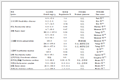
2 结果 2.1 APOE各等位基因表型APOE基因表型以E3型占比最高,为64.52%,E4型与E2型分别为19.35%、 16.13%。各等位基因表型见表 1 。
|
表 1 62例高脂血症各等位基因表型 |
62例高脂血症患者,其中高胆固醇血症21例;高甘油三脂31例;高低密度脂蛋白22例。高TC血症21例中E4表型组占比最高,为50%,E2表型组最低,为10%;高TG血症31例中E2表型组占比最高,为70%,E4表型组最低,为41.6%;高LDL-C血症22例中E4表型组占比最高,为50%,E2表型组最低,为20%,见表 2。
|
|
表 2 62例高脂血症与基因表型分布 |
3组间不同的基因表型在年龄、吸烟、饮酒和患高血压、糖尿病方面无统计学差异(P>0.05) 。E3、E4表型组在性别上存在统计学差异(P<0.05) ,见表 3。
|
|
表 3 62例高脂血症基因表型各组间一般情况比较 |
E2表型组TG浓度均值较E3、E4表型组高;E4表型组TC和LDL-C浓度均值较E2、E3表型组高。E2、E3表型组TC浓度水平与E4表型组比较有统计学差异(P<0.05) ,3组表型TG、LDL-C浓度水平无统计学差异(P>0.05) 。见表 4。
|
|
表 4 62例高脂血症基因表型各组间血脂水平比较 |
高血脂症是冠心病常见的危险因素之一,影响血脂水平的危险因素包括年龄、高血压、糖尿病、吸烟史等,而ApoE基因是目前研究较多的血脂相关基因。ApoE各等位基因编码的ApoE异构体与脂蛋白受体的亲和性及其在体内的代谢速度不同,从而导致个体间血脂水平的差异[1]。
本研究62例高脂血症患者ApoE基因表型占比分别为E2型16.13%,E3型64.52%,E4型19.35%,E3型占比最高、E2型占比最低。通常,E2表型患者LDL-C较低,TG较高[2, 3],E4表型患者LDL-C、TC均容易升高[4, 5]。本研究三组基因表型TG、LDL-c浓度均无统计学差异,但E2表型TG均值与占比(70%)均较其他两型高,各型TG浓度均值大小依次为:E3<E4<E2。且E2表型组LDL-C浓度均值与占比20%均较其他两型低。E4表型组LDL-C浓度均值最高,各基因组表型LDL-C浓度水平依次为E2<E3<E4,且E4型组高LDL-C血症患者占比(50%)最高,另外各组间TC浓度存在统计学差异(P <0.05),E4表型组TC浓度均值与占比(50%)均高于其他两组,TC浓度均值水平依次为E2<E3<E4。与国外研究报道相符。
临床上可根据APOE不同的基因表型指导患者正确选择调脂药物和饮食干预治疗,以期降低冠心病的发病率和心血管事件风险。E2型为长寿基因型[6],对他汀类药物敏感,故治疗首选他汀类药物[7-9]。该型低脂饮食效果不明显,指导患者少量饮酒对血脂控制有益。E3型组血脂异常无明显偏性,采用黄酮类药物降脂效果更好。E4型组发生早发性心血管病、老年痴呆的风险较高,血脂异常时运用他汀类药物治疗效果较其他两型差,可选用普罗布考治疗或者他汀类药物加大剂量治疗[4, 10, 11],辛伐他汀虽然在降低E4携带者患者血脂水平方面同其他他汀类药物类似,但能更好的降低E4携带者心肌梗死的死亡风险,所以既往有心肌梗死疾病的患者运用他汀类药物治疗临床获益更大[12],同时需注意监测药物不良反应,该型低脂饮食效果更佳,对烟酒引起的不良反应更为敏感。同时加强健康教育,指导低脂饮食,戒烟限酒[13-16]。
综上所述,APOE基因多态性对血脂水平有重要影响,临床上可根据APOE不同的基因表型指导患者正确选择调脂药物和饮食干预治疗,以期降低冠心病的发病率和心血管事件风险。后续研究需扩大样本量,结合年龄、性别、体重指数、吸烟饮酒史等相关危险因素进一步深入探讨。
| [1] | Mahoney-Sanchez L, Belaidi AA, Bush AI, et al. The complex role of apolipoprotein E in alzheimer's disease: an overview and update[J]. Journal of Molecular Neuroscience, 2016, 60(3): 325-335. DOI: 10.1007/s12031-016-0839-z. |
| [2] | Zende PD, Bankar MP, Kamble PS, et al. Apolipoprotein e gene polymorphism and its effect on plasma lipids in arteriosclerosis[J]. Journal of Clinical and Diagnostic Research, 2013, 7(10): 2149-2152. |
| [3] | Scarabino D, Broggio E, Gambina G, et al. Apolipoprotein E genotypes and plasma levels in mild cognitive impairment conversion to Alzheimer's disease: A follow-up study[J]. Am J Med Genet B Neuropsychiatr Genet, 2016, 171(8): 1131-1138. DOI: 10.1002/ajmg.b.v171.8. |
| [4] | Chaudhary R, Likidlilid A, Peerapatdit T, et al. Apolipoprotein E gene polymorphism:effects on plasma lipids and risk of type 2 diabetes and coronary artery disease[J]. Cardiovasc Diabetol, 2012, 11: 36. DOI: 10.1186/1475-2840-11-36. |
| [5] | Arraiz N, Bermudez V, Prieto C, et al. Association between apoliprotein E gene polymorphism and hypercholesterolemic phenotype in Maracaibo,Zulia state,Venezuela[J]. Am J Ther, 2010, 17(3): 330-336. DOI: 10.1097/MJT.0b013e3181c1235d. |
| [6] | Garatachea N, Marin PJ, Santos-Lozano A, et al. The ApoE gene is related with exceptional longevity: a systematic review and meta-analysis[J]. Rejuvenation Res, 2015, 18(1): 3-13. DOI: 10.1089/rej.2014.1605. |
| [7] | Hu M, Tomlinson B. Lipid-lowing pharmacogenomics in Chinese patients[J]. Expert Rev Cardiovasc Ther, 2013, 11(8): 985-997. DOI: 10.1586/14779072.2013.814839. |
| [8] | Baptista R, Rebelo M, Decq-Mota J, et al. Apolipoprotein E epsilon-4 polymorphism is associated with younger age at referral to a lipidology clinic and a poorer response to lipid-lowering therapy[J]. Lipids Health Dis, 2011, 10: 48. DOI: 10.1186/1476-511X-10-48. |
| [9] | Hopewell JC, Parish S, Offer A, et al. Impact of common genetic variation on response to simvastatin therapy among 18705 participants in the Heart Protection Study[J]. Eur Heart J, 2013, 34(13): 982-992. DOI: 10.1093/eurheartj/ehs344. |
| [10] | van der Baan FH, Knol MJ, Maitland-Van DZA, et al. Added value of pharmacogenetic testing in predicting statin response: results from the REGRESS trial[J]. Pharmacogenomics J, 2013, 13(4): 318-324. DOI: 10.1038/tpj.2012.12. |
| [11] | Zhang MD, Gu W, Qiao SB, et al. Apolipoprotein E gene polymorphism and risk for coronary heart disease in the Chinese population: a meta-analysis of 61 studies including 6634 cases and 6393 controls[J]. PLoS One, 2014, 9(4): e95463. DOI: 10.1371/journal.pone.0095463. |
| [12] | Gerdes LU, Gerdes C, Kervinen K, et al. The apolipoprotein epsilon4 allele determines prognosis and the effect on prognosis of simvastatin in survivors of myocardial infarction : a substudy of the Scandinavian simvastatin survival study[J]. Circulation, 2000, 101(12): 1366-1371. DOI: 10.1161/01.CIR.101.12.1366. |
| [13] | Corella D, Tucker K, Lahoz C, et al. Alcohol drinking determines the effect of the APOE locus on LDL-cholesterol concentrations in men: the Framingham Offspring Study[J]. Am J Clin Nutr, 2001, 73(4): 736-745. |
| [14] | Hannuksela ML, Liisanantti MK, Savolainen MJ. Effect of alcohol on lipids and lipoproteins in relation to atherosclerosis[J]. Crit Rev Clin Lab Sci, 2002, 39(3): 225-283. DOI: 10.1080/10408360290795529. |
| [15] | Lussier-Cacan S, Bolduc A, Xhignesse M, et al. Impact of alcohol intake on measures of lipid metabolism depends on context defined by gender, body mass index, cigarette smoking, and apolipoprotein E genotype[J]. Arterioscler Thromb Vasc Biol, 2002, 22(5): 824-831. DOI: 10.1161/01.ATV.0000014589.22121.6C. |
| [16] | Moreno JA, Perez-Jimenez F, Marin C, et al. The effect of dietary fat on LDL size is influenced by apolipoprotein E genotype in healthy subjects[J]. J Nutr, 2004, 134(10): 2517-2522. |