 2016, Vol. 49
文章信息
- 马晓宁, 王选仓, 朱金鹏
- MA Xiaoning, WANG Xuancang, ZHU Jinpeng
- 新疆地区沥青路面基面层间处治研究
- Study of inter-laminar treatment between surface layer and base layer for asphalt pavement in Xinjiang Region
- 武汉大学学报(工学版), 2016, 49(3): 407-410
- Engineering Journal of Wuhan University, 2016, 49(3): 407-410
- http://dx.doi.org/10.14188/j.1671-8844.2016-03-015
-
文章历史
- 收稿日期: 2015-11-20


2. 山西省交通科学研究院,山西 太原 030006
2. Shanxi Transportation Research Institute, Taiyuan 030006, China
沥青路面基面层间主要依靠透层和封层进行连接,由于材料性能差异,基面层结合面往往是路面结构的薄弱面[1-5].新疆地区沥青路面多采用水稳砂砾基层,基面层间粘结更加脆弱,而采用透层油少与较高温度加重了层间破坏[6-8].本文进行了新疆层间处治气候分区与工作状态分级;研究了处治材料与用量对基面层间结合状况的影响,建立了层间工作状态与处治材料的合理匹配关系;研究了风吹沙污染对基面层间粘结强度的影响,建立了污染量与层间抗剪强度的回归函数.
1 层间处治气候分区本文以30 a最热月14~15时平均最高气温为分级指标,40 ℃为分界进行气候分区[9],如表 1所示.
| 气候分区 | 1 | 2 |
| 气候 | 夏炎热 | 夏热 |
| 地质 | 沙漠、戈壁 | 山区、高原 |
| 最热月平均最高气温/℃ | ≥40 | 30~40 |
基于气候分区标准将新疆分为8个区,分别推荐了封层基质沥青标号,见表 2.G216阿勒泰段位于1-1-4区,应选用90号基质沥青.
| 区号 | 特征 | 气温/℃ | 年降水量/mm | 沥青路用性能 | 基质沥青标号 | |
| 最热月平均最高 | 年极端最低 | |||||
| 1-1-4 | 夏炎热冬严寒干旱 | 37~43 | -45~-47 | 100~250 | 高低温兼顾 | 90 |
| 1-2-4 | 夏炎热冬寒干旱 | 38~41 | -37~-27 | <100 | 高温为主,兼顾低温 | 90 |
| 1-3-4 | 夏炎热冬冷干旱 | 38~42 | >27.5 | <100 | 高温为主,适当顾及低温 | 90 |
| 2-1-4 | 夏热冬严寒干旱 | 33~38 | <-45 | 100~250 | 低温为主,适当顾及高温 | 110 |
| 2-2-2 | 夏热冬寒湿润 | 32~36 | -37~-27 | 500~1 000 | 低温 | 90 |
| 2-2-3 | 夏热冬寒半干 | 33~36 | -37~-27 | 250~500 | 高低温兼顾 | 90 |
| 2-2-4 | 夏热冬寒干旱 | 32~34 | -37~-27 | 100~250 | 低温 | 90 |
| 3-2-4 | 夏凉冬寒干旱 | <30 | -37~-27 | 100~250 | 低温 | 110 |
层间工作状态以最大剪应力为标准,分为三级:Ⅰ级工况条件最差,Ⅱ级一般,Ⅲ级良好[10-13],如表 3~5.
| 道路实际工况 | 气候分区 | ||
| 1区 | 2区 | ||
| 高速、一级 | 一般路段 | Ⅱ | Ⅲ |
| 特殊路段 | Ⅰ | Ⅱ | |
| 二级 | 一般路段 | Ⅲ | Ⅲ |
| 特殊路段 | Ⅱ | Ⅲ | |
| 注:一般路段为非长大纵坡路段、非重交通公路;特殊路段为长大纵坡路段(纵坡>3.0%且坡长大于3 000 m),重交通公路(BZZ-100累计标准轴次Ne>1.2×10⁷次/车道). | |||
| 工况分级 | 界面温度/℃ | 路面厚度/cm | 纵坡度/% | 轴载/MPa |
| Ⅰ | 35 | 8 | 5 | 1.4 |
| Ⅱ | 30 | 14 | 3 | 1.1 |
| Ⅲ | 25 | 20 | 1 | 0.7 |
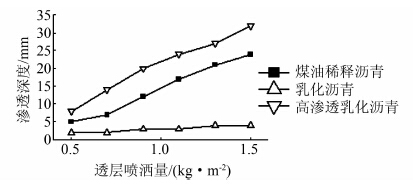
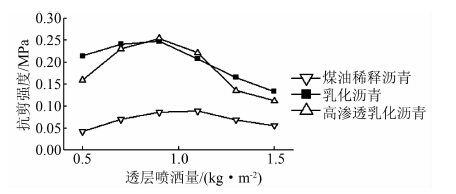
通过渗透试验和抗剪试验,得到渗透深度与抗剪强度见图 1、2.
|
| 图 1 渗透深度与透层油洒布量的关系 Figure 1 Penetration depth versus volume of prime coat |
|
| 图 2 抗剪强度与透层油洒布量的关系 Figure 2 Shear strength versus volume of prime coat |
对于渗透性能,高渗透乳化沥青>煤油稀释沥青>乳化沥青;对于抗剪性能,高渗透乳化沥青和乳化沥青性能相近,皆优于煤油稀释沥青.且基于抗剪强度的最佳洒布量为:高渗透乳化沥青0.9 kg/m2;乳化沥青0.9 kg/m2;煤油稀释沥青1.1 kg/m2[14, 15].
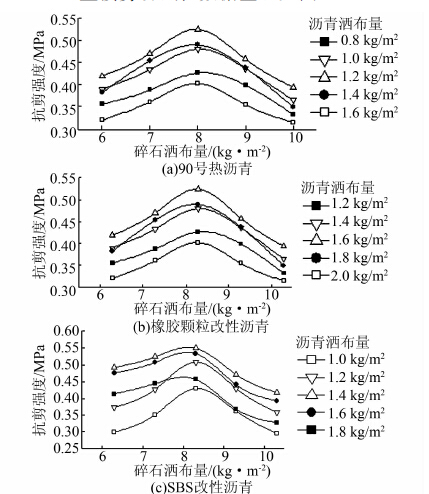
4.2 下封层材料最佳洒布量25℃直接剪切试验数据整理见图 3.
|
| 图 3 不同沥青洒布量下抗剪强度与碎石洒布量关系 Figure 3 Shear strength versus spraying volume of gravel with different spraying volumes of asphalt |
基于抗剪切强度的碎石最优洒布量为8.0 kg/m2,基于抗剪强度材料性能排序为:SBS改性沥青>橡胶改性沥青>90号热沥青,三者沥青最佳洒布量分别为1.4、1.6、1.2 kg/m2.
4.3 不同工况层间处治材料推荐结合不同类型透层油性能,推荐了不同工况下透层材料及用量,如表 6.
| 工况 | 洒布量/(kg·m-2) | 透层材料 |
| Ⅰ | 0.9~1.10.9~1.2 | 煤油稀释沥青高渗透乳化沥青 |
| Ⅱ | 0.7~0.90.6~0.8 | 煤油稀释沥青高渗透乳化沥青 |
| Ⅲ | 0.6~0.7 | 煤油稀释沥青 |
“两油一料”同步碎石封层的抗剪强度与防水性能均优于“一油一料”,据此分别推荐了不同工况下封层材料及用量,如表 7.
| 工况 | 下封层材料及洒布量/(kg·m-2) |
| Ⅰ | 0.4(乳化沥青)+8(碎石)+1.4(SBS改性沥青) |
| Ⅱ | 1.4(SBS改性沥青)+8(碎石) |
| Ⅲ | 2.2(橡胶改性沥青)+9(碎石) |
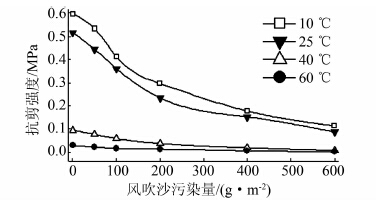
干燥状态下剪切试验结果见图 4.
|
| 图 4 干燥状态下污染量与抗剪强度的关系 Figure 4 Shear strength versus blown sand amount |
污染量与抗剪强度回归函数见表 8.
| 温度/℃ | 回归函数 | 相关系数 |
| 10 | A=0.570 3e-0.003X | 0.988 2 |
| 25 | A=0.489 7e-0.003X | 0.987 6 |
| 40 | A=0.092 2e-0.004X | 0.997 3 |
| 60 | A=0.027 4e-0.004X | 0.994 1 |
同温度下,层间抗剪强度随污染量增加而降低;污染量小于100 g/m2时,抗剪强度对温度较为敏感;10 ℃下,污染量600 g/m2的抗剪强度比0 g/m2减小约80%,说明温度较低时,污染量是影响抗剪强度的主要因素.可推断出:温度和污染程度对层间抗剪强度的影响是等效的.
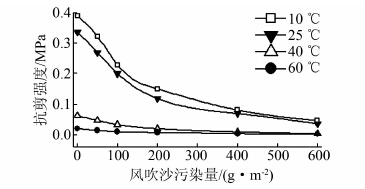
5.2 饱水状态下风吹沙对层间强度影响
|
| 图 5 饱水状态下污染量与抗剪强度的关系 Figure 5 Shear strength versus blown sand amount |
污染量与抗剪强度回归函数见表 9.
| 温度/℃ | 回归函数 | 相关系数 |
| 10 | A=0.350 7e-0.004X | 0.983 2 |
| 25 | A=0.301 1e-0.004X | 0.983 0 |
| 40 | A=0.056 7e-0.005X | 0.994 6 |
| 60 | A=0.016 9e-0.004X | 0.992 1 |
饱水状态下曲线比干燥时更陡,说明风吹沙和水损害共同作用下层间抗剪强度急剧降低;无层间污染时,25 ℃饱水抗剪强度比干燥时降低35%,即饱水时抗剪强度对温度与污染更敏感.可推断:水损害、温度、层间污染对层间抗剪强度的影响是等效的.
6 结论本文对新疆地区层间工作状态及处治材料进行了研究,得出如下结论:
1) 基于道路实际工况可将新疆地区路面层间工作状态分为三级.
2) 通过室内试验研究了透层与封层材料性能与最佳洒布量,并基于不同工况分别进行了层间材料合理配置.
3) 水损害、温度与层间污染对基面层间抗剪强度的影响是等效的.
| [1] |
孙立军.
沥青路面结构行为理论[M]. 北京: 人民交通出版社, 2005.
Sun Lijun. Structural Behavior Study for Asphalt Pavements[M]. Beijing: China Communications Press, 2005. |
| [2] |
李彦伟, 穆柯, 石鑫, 等. 基面层间接触状态对沥青路面力学响应影响[J].
长安大学学报: 自然科学版, 2014(2): 38–44.
Li Yanwei, Mu Ke, Shi Xin, et al. Impact of base-surface contact conditions on mechanical response of asphalt pavement[J]. Journal of Chang’ an University: Natural Science Edition, 2014(2): 38–44. |
| [3] |
李星, 刘志芳, 宋晓燕. 层间接触对半刚性沥青路面力学性能的影响[J].
重庆交通大学学报:自然科学版, 2014(2): 44–48.
Li Xing, Liu Zhifang, Song Xiaoyan. Influence of interlayer contact on the mechanics behavior of semi-rigid asphalt pavement[J]. Journal of Chongqing Jiaotong University: Natural Science Edition, 2014(2): 44–48. |
| [4] |
宋学艺, 朱金鹏, 张健, 等. 沥青路面基面层间接触状态对路面力学响应的影响分析[J].
公路工程, 2014(5): 131–135.
Song Xueyi, Zhu Jinpeng, Zhang Jian, et al. Analysis of the bonding condition between base and surface courses of asphalt pavement on street response[J]. Highway Engineering, 2014(5): 131–135. |
| [5] |
胡钢. 层间接触状态对路面结构力学响应的影响[J].
公路, 2015(3): 34–40.
Hu Gang. The effect of interfacial contact condition on pavement structure mechanics response[J]. Highway, 2015(3): 34–40. |
| [6] |
袁玉卿, 周鑫, 王选仓. 旧水泥路面沥青加铺层层间剪应力分析[J].
河南大学学报: 自然科学版, 2009(1): 97–101.
Yuan Yuqing, Zhou Xin, Wang Xuancang. Analysis of shearing strength between old cement concrete pavement and asphalt overlay[J]. Journal of Henan University: Natural Science Edition, 2009(1): 97–101. |
| [7] | Mariana R Kruntcheva, Andrew C Collop, Nicholas H Thom. Properties of asphalt concrete layer interfaces[J]. Journal of Materials in Civil Engineering, 2006, 18(3): 467–471. DOI:10.1061/(ASCE)0899-1561(2006)18:3(467) |
| [8] | Hyunwook Kim, Martin Arraigada, Christiane Raab, et al. Numerical and experimental analysis for the interlayer behavior of double-layered asphalt pavement specimens[J]. Journal of Materials in Civil Engineering, 2011, 23(1): 12–20. DOI:10.1061/(ASCE)MT.1943-5533.0000003 |
| [9] |
张学文, 张家宝.
新疆气象手册[M]. 北京: 气象出版社, 2006.
Zhang Xuewen, Zhang Jiabao. Meteorological Manual of Xinjiang District[M]. Beijing: Meteorological Press, 2006. |
| [10] |
谢海巍.新疆公路沥青路面典型结构形式研究[D].西安: 长安大学, 2011.
Xie Haiwei. The typical structure of asphalt pavement in Xinjiang [D]. Xi’an: Chang’ an University, 2011. http://cdmd.cnki.com.cn/Article/CDMD-11941-1011186350.htm |
| [11] |
邓学钧.
路基路面工程[M]. 北京: 人民交通出版社, 2008.
Deng Xuejun. Subgrade and Pavement Engineering[M]. Beijing: China Communications Press, 2008. |
| [12] |
苏新国, 颜赫, 鲁圣弟, 等. 沥青路面层间粘结效果影响因素[J].
长安大学学报:自然科学版, 2013(3): 21–26.
Su Xinguo, Yan He, Lu Shengdi, et al. Influencing factors on bonding effect between asphalt layers[J]. Journal of Chang’ an University: Natural Science Edition, 2013(3): 21–26. |
| [13] |
陈华鑫, 黄泽国. 沥青混凝土路面层间黏结效果影响研究[J].
公路, 2014(12): 33–39.
Cheng Huaxin, Huang Zeguo. Study of the interlayer bonding condition of asphalt concrete pavement[J]. Highway, 2014(12): 33–39. |
| [14] |
徐真真. 半刚性基层沥青路面层间处治技术研究[D]. 西安: 长安大学, 2012.
Xu Zhenzhen. Research on treatment technologies of interlayers in semi-rigid asphalt pavement [D]. Xi’an: Chang’ an University, 2012. http://cdmd.cnki.com.cn/Article/CDMD-10710-1013018448.htm |
| [15] |
张艳红, 申爱琴, 郭寅川, 等. 不同类型基层沥青路面设计指标的控制[J].
长安大学学报: 自然科学版, 2011(1): 6–11.
Zhang Yanhong, Shen Aiqin, Guo Yinchuan, et al. Control of designing indices for asphalt pavement with different types of base[J]. Journal of Chang’ an University: Natural Science Edition, 2011(1): 6–11. |
| [16] |
刘细军, 郝培文. 评价沥青路面粘结层粘结强度的新试验方法[J].
中外公路, 2006(1): 131–134.
Liu Xijun, Hao Peiwen. New test method for bonding strength evaluation of asphalt pavement bonding layer[J]. Journal of China & Foreign Highway, 2006(1): 131–134. |