 2016, Vol. 49
文章信息
- 朱谊彪, 崔凤坤, 徐岳
- ZHU Yibiao, CUI Fengkun, XU Yue
- 基于响应面法的钢管混凝土拱桥扣索张拉力确定
- Determination of supporting cables' tensioning force for CFST arch bridge based on response surface method
- 武汉大学学报(工学版), 2016, 49(3): 402-406
- Engineering Journal of Wuhan University, 2016, 49(3): 402-406
- http://dx.doi.org/10.14188/j.1671-8844.2016-03-014
-
文章历史
- 收稿日期: 2015-12-27


随着无支架施工方法的发展与应用以及钢管混凝土拱桥跨径不断增大,目前大跨度钢管混凝土拱桥普遍采用无支架缆索吊装斜拉扣挂法进行施工[1].拱肋节段标高的调整通过扣索张拉来实现,扣索张拉力对拱肋合龙后的裸拱线形及成桥线形影响很大,因此需合理地确定扣索张拉力.
钢结构与预制混凝土结构进行拼装时,需考虑各个施工阶段发生的切向角位移,否则无法实现无缝拼装.张万晓等[2]给出了切线拼装的坐标修正公式,采用ANSYS优化模块初调、影响矩阵微调确定钢管混凝土拱桥扣索张拉力.张建民等[3]通过对拼装构件的节点坐标、转角等进行修正来考虑切向角位移的影响,采用一阶优化算法确定钢管混凝土拱桥扣索张拉力.袁海庆等[4]通过分析拱肋吊装施工工艺,针对通常的“前进算法”的不足,提出基于迭代理论的前进算法来确定钢管混凝土拱桥扣索张拉力.扬胜等[5]利用Matlab编制了无支架缆索吊装系统的受力分析软件并用来确定钢管混凝土拱桥扣索张拉力.上述各方法求解扣索张拉力过程均较复杂,不便于工程应用.
本文以钢管混凝土拱桥为研究对象,把扣索张拉力作为影响拱肋合龙线形的自变量,将有限元模型计算与响应面法相结合,通过一次张拉施工工艺,使拱肋合龙线形符合设计要求.
1 响应面模型响应面法(Response Surface Method,RSM)是一种统计学方法[6~8],基本思想是通过构造一个具有明确数学表达式的函数来近似表达隐式的功能函数,在实际函数值已知点附近用一个超曲面来代替实际复杂函数进行计算.近年来,响应面法已广泛应用于生物学、食品学以及工程学等众多领域中[9~16].
1.1 试验设计试验设计方法是获得理想响应面模型的基础,选取合适的试验点能使回归的响应面函数在实际函数值已知点附近区域最有效地描述隐式的功能函数.目前,响应面分析常用的试验设计方法有:中心组合设计(Central Composite Design)、BOX设计(Box-Behnken Design)、均匀设计以及二次饱和D-最优设计等.本文针对无支架缆索吊装斜拉扣挂施工方法特点,采用BOX设计法进行试验设计.
1.2 响应面模型回归响应面模型常用形式有多项式、三角函数、对数、指数或它们的组合等.典型的二次多项式回归响应面模型如下:
式中:y为响应值;c0、ci、cjk为待定的回归系数;xi、xj、xk为设计变量;ε为回归误差.
根据实际问题确定n个设计变量x1,x2,…,xn,按1.1节所述方法进行试验设计,得到m组试验点,将每组试验点代入有限元模型计算得到响应值,即得到关于c0、ci、cjk的非线性方程组,通过最小二乘原理使试验误差最小,解得c0、ci、cjk,代入式(1)得响应面模型.
得到响应面模型之后,为判断响应面模型的拟合精度,可用下式对其预测能力进行评估:
式中:R2为多重拟合系数;yRS(i)为响应面模型计算值;y(i)为有限元模型计算值;为有限元模型计算值的平均值.
多重拟合系数R2取值范围为0~1,若R2值越大(要求在0.9~1之间),则回归的响应面模型能很好地预测实际情况;若R2值小于一定的限值,应重新进行试验设计.
2 基于响应面法的扣索张拉力确定流程大跨度钢管混凝土拱桥多采用无支架缆索吊装斜拉扣挂法进行施工,为使拱肋合龙后的线形符合设计要求,需对每一施工过程的扣索张拉力进行控制.基于响应面法的扣索张拉力确定就是将设计的试验点代入考虑施工阶段的有限元模型进行计算,建立高精度响应面模型,并对结构响应进行预测,具体步骤分为5步.
1) 试验设计.无支架缆索吊装斜拉扣挂法施工中影响拱肋合龙线形的因素主要是扣索张拉力,因此选取扣索张拉力作为自变量xi(i=1,2,…,n),拱肋合龙阶段各控制截面的竖向位移平方和y2作为因变量,然后按照BOX设计法进行试验设计,确定m组试验点.
2) 有限元模型计算.将试验设计得到的试验点代入考虑施工阶段的有限元模型进行计算,可以得到m组因变量.
3) 响应面模型回归.将m组试验点及其对应的m组因变量代入式(1),运用最小二乘原理使试验误差最小,回归得到响应面模型.本文采用工程中常用的多项式来回归响应面模型.
4) 精度检验.采用多重拟合系数R2检验响应面模型精度,若满足要求,进行步骤5),否则返回步骤1)重新进行试验设计.
5) 确定扣索张拉力,预测结构响应.以拱肋合龙阶段各控制截面的竖向位移平方和y2作为目标函数,扣索张拉力的取值范围作为约束条件:
运用非线性规划方法求解扣索张拉力,可得约束条件下拱肋合龙阶段各控制截面的竖向位移平方和y2最小值.
3 应用实例 3.1 工程概况某桥梁全长314.8 m,桥跨布置为2×13 m预制空心板+跨径262 m钢管混凝土拱+2×13 m预制空心板,主桥采用中承式有推力钢管混凝土拱桥结构,计算跨径为248 m,计算矢高比1/4,拱轴线为m=1.5的悬链线,桥道系全宽16 m,上下行双向6车道,车道荷载为公路I级.
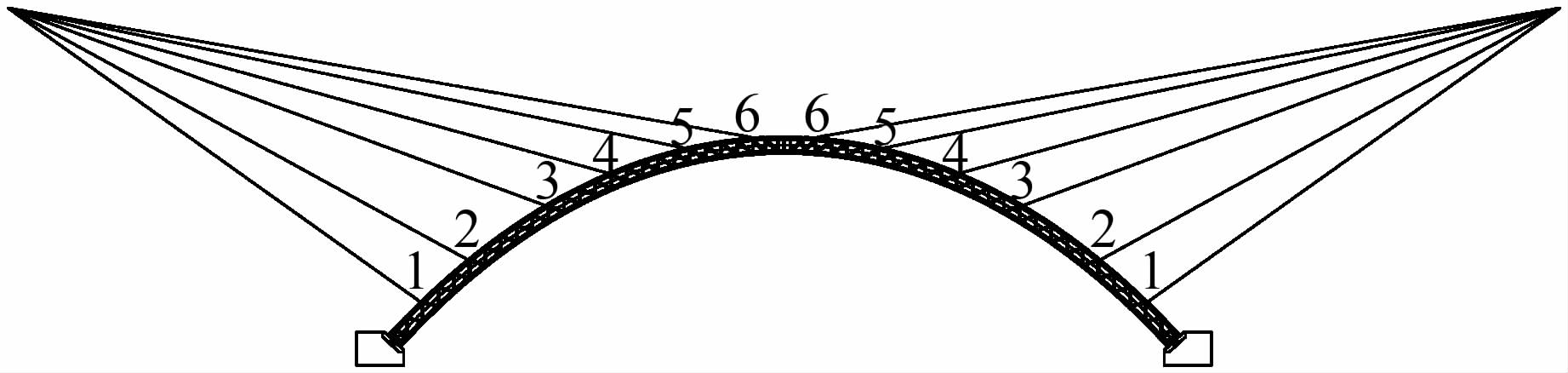
拱肋施工采用无支架缆索吊装斜拉扣挂法施工,全拱共12个吊装段和1个合龙段,各扣索扣挂位置如图 1所示.
|
| 图 1 某工程斜拉扣挂示意 Figure 1 Cable-stayed buckling diagram of practical project |
该工程扣索采用一次张拉施工工艺,试验选取扣索张拉力作为自变量xi(i=1,2,…,6),采用BOX设计进行试验设计,各组试验点取值见表 1.
| kN | ||||||
| 序号 | x1 | x2 | x3 | x4 | x5 | x6 |
| 1 | 117.809 5 | 401.741 3 | 585.488 5 | 384.647 5 | 287.217 7 | 874.832 3 |
| 2 | 117.809 5 | 401.741 3 | 390.325 7 | 384.647 5 | 287.217 7 | 437.416 2 |
| 3 | 117.809 5 | 267.827 5 | 390.325 7 | 384.647 5 | 574.435 5 | 874.832 3 |
| 4 | 58.904 75 | 267.827 5 | 195.162 8 | 384.647 5 | 574.435 5 | 1 312.249 |
| … | … | … | … | … | … | … |
| 51 | 117.809 5 | 267.827 5 | 585.488 5 | 576.971 3 | 574.435 5 | 437.416 2 |
| 52 | 117.809 5 | 267.827 5 | 390.325 7 | 384.647 5 | 574.435 5 | 874.832 3 |
| 53 | 58.904 75 | 267.827 5 | 390.325 7 | 576.971 3 | 861.653 2 | 874.832 3 |
| 54 | 58.904 75 | 133.913 8 | 390.325 7 | 192.323 8 | 574.435 5 | 874.832 3 |
将各组试验点代入考虑施工阶段的有限元模型进行计算,得各组试验点对应的拱肋合龙阶段扣点截面竖向位移yi(i=1,2,…,6),以拱肋合龙阶段扣点截面竖向位移平方和y2、拱肋合龙阶段扣点截面竖向位移yi(i=1,2,…,6)作为因变量,采用最小二乘原理估计多项式系数.限于篇幅只列举各扣索张拉力xi(i=1,2,…,6)与拱肋合龙阶段扣点截面竖向位移平方和y2的响应面模型:
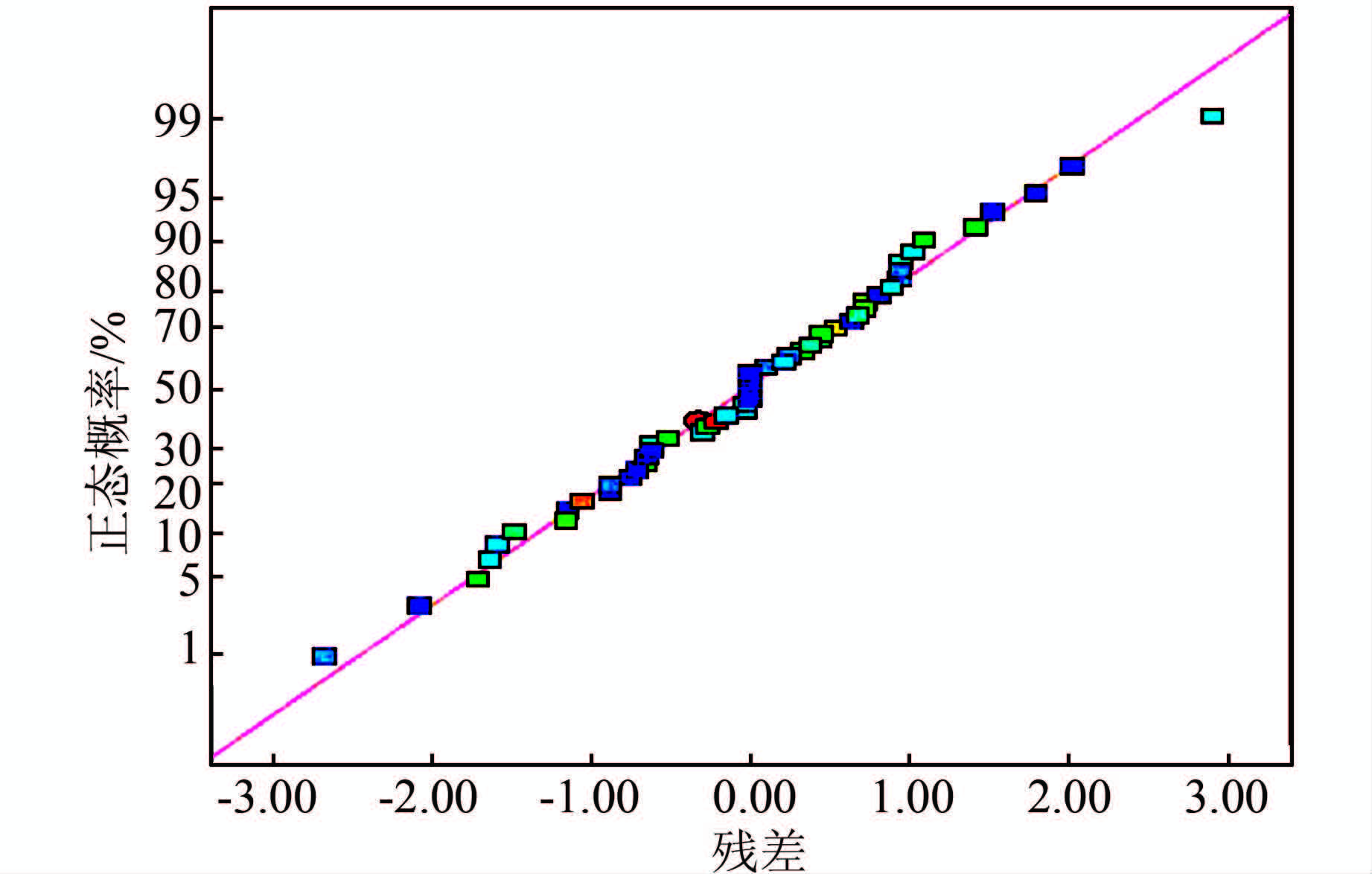
通过多重拟合系数R2对响应面模型精度进行检验,各因变量的多重拟合系数均大于0.995,表明回归的响应面模型能很好地预测实际情况.图 2为y2残差正态分布概率图.由图 2可知:各残差主体部分呈一条直线,因此可认为所得的响应面模型拟合精度高,该模型可以精确地反映扣索张拉力与拱肋合龙阶段扣点截面竖向位移平方和之间的关系,从而保证拱肋合龙线形.
|
| 图 2 y2残差正态分布概率 Figure 2 Normal probability plot of residual errors for y2 |
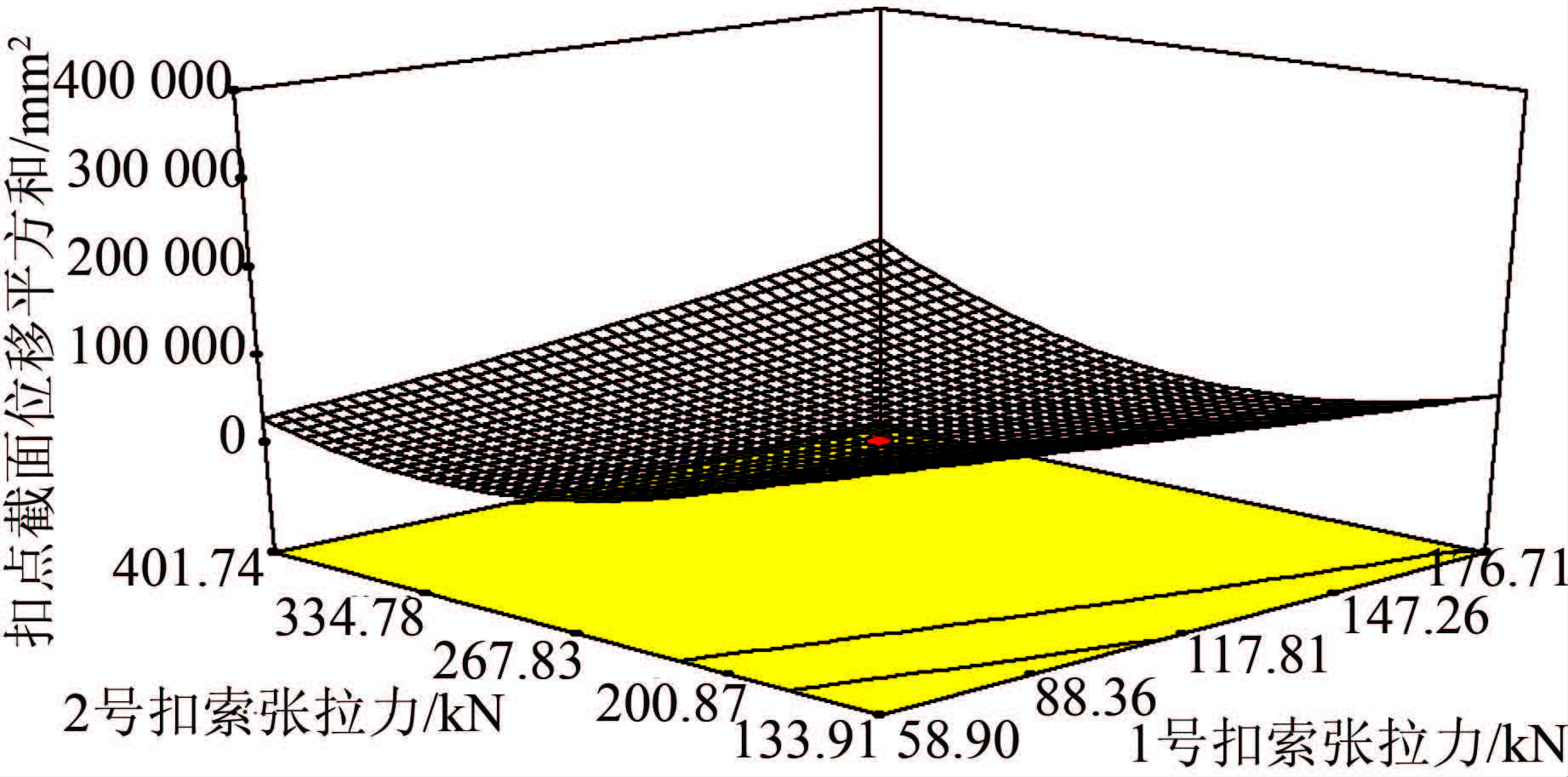
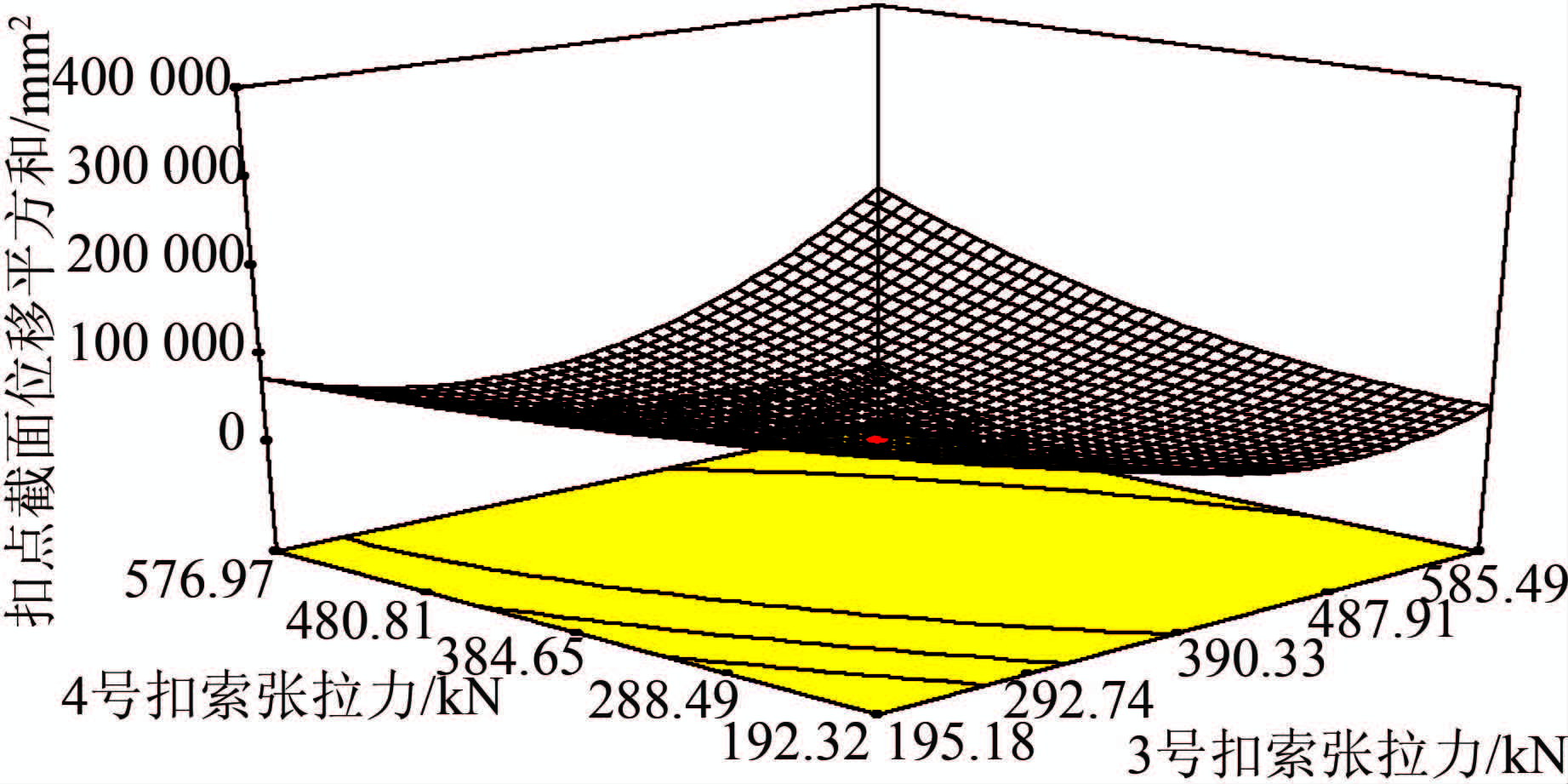
图 3~5分别为1、2号,3、4和5、6号扣索张拉力对y2的响应面.由图 3~5可以看出:各扣索张拉力过大或过小,都将导致拱肋合龙阶段扣点截面竖向位移平方和增大,因此可寻找一组扣索张拉力使拱肋合龙阶段扣点截面竖向位移平方和最小.
|
| 图 3 1、2号扣索张拉力对y2的影响 Figure 3 The influences of #1 and #2 supporting cables' tensioning forces on y2 |
|
| 图 4 3、4号扣索张拉力对y2的影响 Figure 4 The influences of #3 and #4 supporting cables' tensioning forces on y2 |
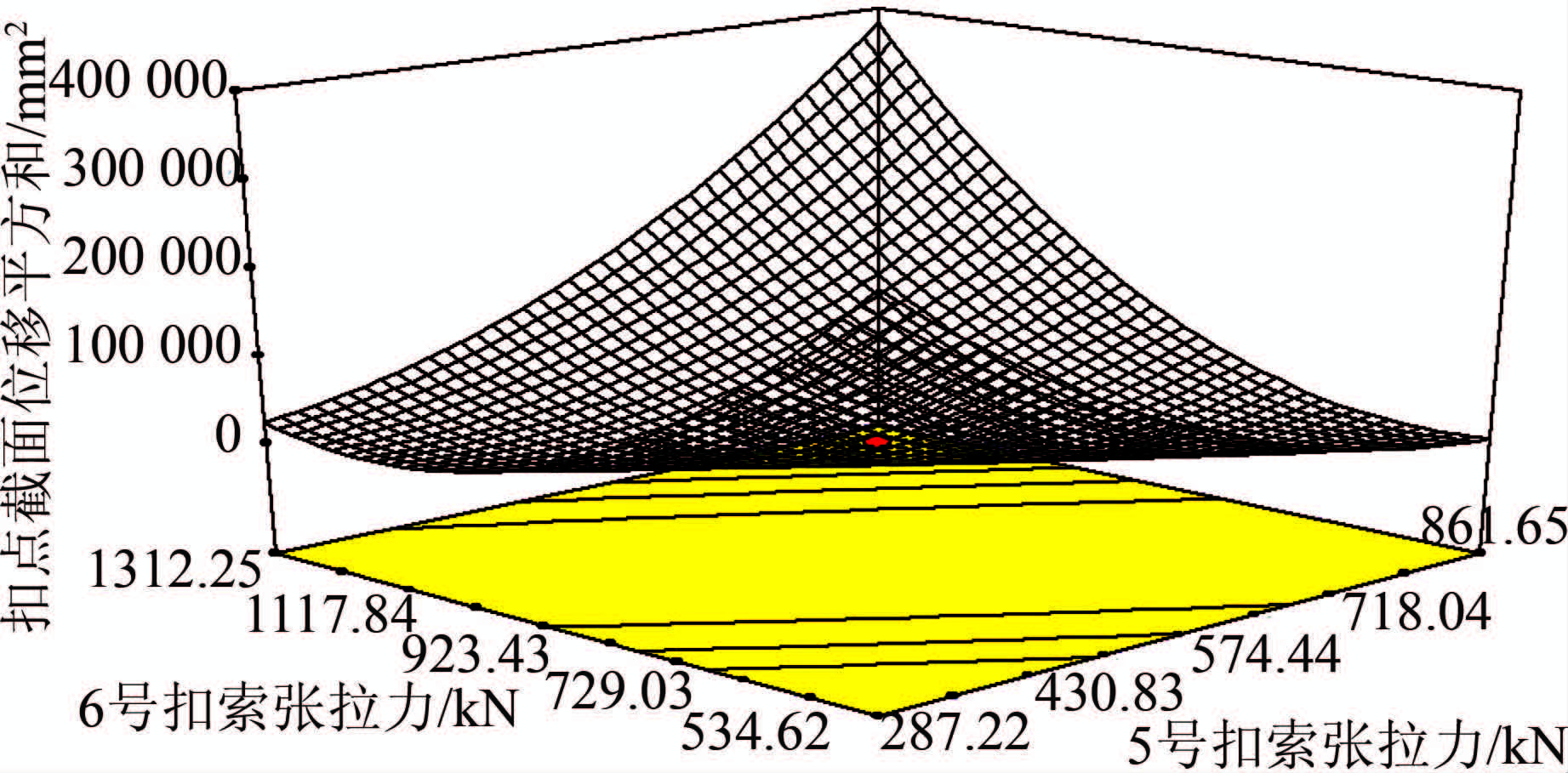
|
| 图 5 5、6号扣索张拉力对y2的影响 Figure 5 The influences of #5 and #6 supporting cables' tensioning forces on y2 |
以回归的响应面模型式(4)作为目标函数,各扣索张拉力取值范围作为约束条件,构造如下式所示的数学模型:
采用非线性规划方法求目标函数最小值,各扣索张拉力计算结果见表 2.
| kN | ||||||
| 扣索编号 | 1 | 2 | 3 | 4 | 5 | 6 |
| 张拉力 | 117.02 | 266.69 | 395.53 | 397.21 | 600.91 | 798.60 |
为了验证响应面模型的准确性,将表 2中的各扣索张拉力代入考虑施工阶段的有限元模型进行计算,并与响应面模型预测比较,如表 3.
| mm | ||||||
| 扣点截面 | 1 | 2 | 3 | 4 | 5 | 6 |
| 响应面预测值 | -0.235 | -0.288 | -0.207 | 0.039 | 0.054 | 0.254 |
| 有限元计算值 | -0.236 | -0.289 | -0.207 | 0.040 | 0.055 | 0.253 |
由表 3可知:响应面模型预测值与有限元模型计算值误差小,可以满足结构响应预测的要求.
4 结论1) 将响应面法用于钢管混凝土拱桥扣索张拉力的确定,以各扣索张拉力为自变量进行响应面分析,回归得到高精度的响应面模型.模型验证表明响应面预测值与有限元计算值误差小,拟合的响应面模型能够精确预测结构响应,可用于指导施工.
2) 以响应面模型作为目标函数,各扣索张拉力取值范围作为约束条件,运用非线性规划方法求解扣索张拉力,思路清晰,精度高.
| [1] |
陈宝春. 钢管混凝土拱桥应用与研究进展[J].
公路, 2008(11): 57–66.
Chen Baochun. Application and research progress of concrete-filled steel tubular arch bridges[J]. Highway, 2008(11): 57–66. |
| [2] |
张万晓, 杨昌龙, 周水兴,等. 基于无应力状态法的拱桥悬臂施工控制方法研究[C]// 第21届全国桥梁学术会议论文集(上册),2014:785-789.
Zhang Wanxiao, Yang Changlong, Zhou Shuixing, et al. Study on control methods for arch bridges constructed by cantilever construction based on unstressed state method[C]// The Proceedings of The 21st National Bridge Academic Conference (Volume 1), 2014: 785-789. |
| [3] |
张建民. 大跨度钢管混凝土拱桥承载能力与施工控制研究[D]. 广州:华南理工大学, 2001.
Zhang Jianmin. Bearing capacity and construction control research of long-span concrete filled steel tubular arch bridges[D]. Guangzhou:South China University of Technology,2001. |
| [4] |
袁海庆, 范小春, 范剑锋, 等. 大跨度钢管混凝土拱桥拱肋吊装预测的迭代前进算法[J].
中国公路学报, 2003, 16(3): 48–51.
Yuan Haiqing, Fan Xiaochun, Fan Jianfeng, et al. Iterative go-ahead method of rib-assembling predicting for long-span concrete filled steel tubular arch bridge[J]. China Journal of Highway and Transport, 2003, 16(3): 48–51. |
| [5] |
杨胜, 韦赤鹰, 张建仁, 等. Matlab在无支架缆索吊装索力计算中的应用[J].
长沙理工大学学报:自然科学版, 2005, 2(2): 23–28.
Yang Sheng, Wei Chiying, Zhang Jianren, et al. Matlab language and its application in the calculation of cable force[J]. Journal of Changsha University of Science and Technology(Natural Science), 2005, 2(2): 23–28. |
| [6] |
王永菲, 王成国. 响应面法的理论与应用[J].
中央民族大学学报:自然科学版, 2005, 14(3): 236–240.
Wang Yongfei, Wang Chengguo. The application of response surface methodology[J]. Journal of the CUN(Natural Science Edition), 2005, 14(3): 236–240. |
| [7] | Box G E P, Wilson K B. On the experimental attainment of optimum condition[J]. Journal of the Royal Statistical Society, 1951, 13(1): 1–34. |
| [8] | Cundy A L. Use of response surface meta-models in damage identification of dynamic structure[D]. New Mexico: Los Alamos National Laboratory, 2003. |
| [9] |
蒋水华, 李典庆, 方国光. 结构可靠度分析的响应面法和随机响应面法的比较[J].
武汉大学学报(工学版), 2012, 45(1): 46–53.
Jiang Shuihua, Li Dianqing, Phoon Kokkwang. A comparative study of response surface method and stochastic response surface method for structural reliability analysis[J]. Engineering Journal of Wuhan University, 2012, 45(1): 46–53. |
| [10] |
陈鹏霏, 刘巧玲, 刘海芳. 基于改进Box-Behnken法的随机系统可靠性灵敏度分析方法[J].
武汉大学学报(工学版), 2014, 47(6): 843–848.
Chen Pengfei, Liu Qiaoling, Liu Haifang. A method of reliability sensitivity analysis about random system based on improved Box-Behnken method[J]. Engineering Journal of Wuhan University, 2014, 47(6): 843–848. |
| [11] |
郝学财, 余晓斌, 刘志钰, 等. 响应面方法在优化微生物培养基中的应用[J].
食品研究与开发, 2006, 27(1): 38–41.
Hao Xuecai, Yu Xiaobin, Liu Zhiyu, et al. The application of surface response methodology optimization of microbial media[J]. Food Research and Development, 2006, 27(1): 38–41. |
| [12] |
慕运动. 响应面方法及其在食品工业中的应用[J].
郑州工程学院学报, 2001, 22(3): 91–94.
Mu Yundong. Response surface methodology and its application in food industry[J]. Journal of Zhengzhou Institute of Technology, 2001, 22(3): 91–94. |
| [13] |
桂劲松, 康海贵. 结构可靠度分析的响应面法及其Matlab实现[J].
计算力学学报, 2004, 21(6): 683–687.
Gui Jinsong, Kang Haigui. Response surface method for structural reliability analysis and its realization with Matlab[J]. Chinese Journal of Computational Mechanics, 2004, 21(6): 683–687. |
| [14] |
熊铁华, 常晓林. 基于响应面的三维随机有限元法在大型结构可靠度分析中的应用[J].
武汉大学学报(工学版), 2005, 38(1): 125–128.
Xiong Tiehua, Chang Xiaolin. Application of 3D stochastic FEM based on response surface in large structure reliability analysis[J]. Engineering Journal of Wuhan University, 2005, 38(1): 125–128. |
| [15] |
王永胜. 基于响应面法和蒙特卡罗法的混凝土结构可靠性分析[D]. 西安:西安建筑科技大学, 2005.
Wang Yongsheng. R.C. structure analysis based on response surface and Monte Carlo method[D]. Xi'an: Xi'an University of Architecture and Technology, 2005. |
| [16] |
宗周红, 高铭霖, 夏樟华. 基于健康监测的连续刚构桥有限元模型确认(Ⅰ)——基于响应面法的有限元模型修正[J].
土木工程学报, 2011, 2(2): 90–98.
Zong Zhouhong, Gao Minglin, Xia Zhanghua. Finite element model validation of the continuous rigid frame bridge based on structure health monitoring Part1: FE model updating based on the response surface method[J]. China Civil Engineering Journal, 2011, 2(2): 90–98. |