 2016, Vol.29


2. Collaborative Innovation Center for Diagnosis and Treatment of Infectious Diseases, Hangzhou 310003, Zhejiang, China;
3. Microbiology Laboratory, Shijiazhuang Center for Disease Control and Prevention, Shijiazhuang 050016, Hebei, China
In order to develop a rapid and reliable method for B. cereus genotyping,factors influencing PFGE results,including preparation of bacterial cells embedded in agarose,lysis of embedded cells,enzymatic digestion of intact genomic DNA,and electrophoresis parameters allowing for reproducible and meaningful DNA fragment separation,were controlled. Optimal cellular growth (Luria-Bertani agar plates for 12-18 h) and lysis conditions (4 h incubation with 500 µg/mL lysozyme) produced sharp bands on the gel. Restriction enzyme NotI was chosen as the most suitable. Twenty-two isolates were analyzed by NotI digestion,using three electrophoretic parameters (EPs). The EP-a was optimal for distinguishing between isolates. The optimized protocol could be completed within 40 h which is a significant improvement over the previous methods.
Bacillus cereus is an aerobic,spore-forming,Gram-positive bacillus with close phenotypic and genetic relationships to several other Bacillus species,especially B. anthracis[1]. B. cereus is widely distributed in nature,largely because of the resistance of the bacterial endospore to various environmental stresses,which contribute to their long-term survival under unfavorable conditions. The natural environmental reservoirs of B. cereus include decaying organic matter,fresh and marine waters,vegetables,and fomites. B. cereus is recognized as an important etiological agent in food-borne infectious disease outbreaks in Europe and China[2]. Outbreaks are often associated with boiled rice being left overnight at room temperature,rather than in the refrigerator. Two main types of B. cereus food poisoning have been described: emetic and diarrhea. What’s more,it is reported that this pathogen can also infect both immunologically compromised and immunocompetent individuals and cause systemic and local infections.
Because of its ubiquitous nature,genetic differentiation among isolates of B. cereus is necessary to identify,and also rule-out potential sources of contamination,and to determine routes of transmission. Development of a reliable and efficient molecular typing strategy would allow rapid detection of outbreaks and prevent the spread of B. cereus infections. An international molecular typing network for foodborne disease surveillance,PulseNet,has been established,and has successfully detected numerous multistate (USA) and international food-borne infectious disease outbreaks. The China CDC became a member of PulseNet International in 2004,and PFGE along with other molecular sub-typing methods have been widely used to detect outbreaks and trace pathogen sources in China[3].
A standardized PFGE protocol that could be universally implemented would assist with local,national,and international outbreak investigations by allowing increased confidence in source tracking of contamination and determination of routes of transmission. An optimal PFGE protocol produces a suitable number of large-molecular-weight restriction fragments that,when separated,provide distinct patterns for genetically unique strains following agarose separation. Several PFGE protocols related to B. cereus have been described previously[4, 5, 6, 7, 8]. NotI and SmaI are the most frequently used enzymes in these PFGE protocols. However,most laboratories using PFGE to subtype B. cereus cannot compare their results because the protocols used vary at critical parameters,including the restriction enzymes used and the electrophoresis conditions. As a result,there is currently no universally accepted protocol and thus no international database of B. cereus PFGE patterns.
In this study,key factors influencing band number,pattern,and quality were addressed in the development of a reliable and robust PFGE method for B. cereus. Variations in culture conditions,lysis time,restriction enzymes,and electrophoresis parameters were investigated to establish the most robust method for subtyping B. cereus isolates.
In total,22 B. cereus isolates were examined in this study,including 14 isolates recovered from foodstuffs and 8 isolates from soil from various locations in China. All isolates were cultivated on Luria-Bertani (LB) agar medium. Three isolates of the strains were used to optimize the culture medium for bacterial growth,lysis of the bacterial cell wall,and enzyme selection. Salmonella enterica serotype Braenderup H9812 was used as a DNA size marker,as recommended by PulseNet.
Bacteria were grown in LB broth medium or streaked onto LB agar plates for 12-18 h at 37 ℃. The fresh culture was then suspended in 2 mL of TE buffer (10 mmol/L Tris,1 mmol/L EDTA,pH 8.0) and adjusted to an optical density of 5.0-5.5 using a Densimat (bioMérieux,France). Lysozyme (2 mg/mL) (Amresco Inc.,Solon,OH,USA) was added to the cell suspension and incubated for 10-20 min at 37 ℃. Following incubation,proteinase K (1 mg/mL)(Merck,Darmstadt,Germany) was added,and 300 µL of the mixture were immediately added to 300 µL of Seakem Gold Agarose (Lonza,Rockland,ME,USA) and pipetted into plug molds (Bio-Rad,Hercules,CA,USA). Plugs were incubated for 2-16 h in 5 mL of TE buffer containing lysozyme (0.5 mg/mL) at 37 ℃,and then for a further 2 h at 54 ℃ in 5 mL of CLB buffer (10 mmol/L Tris,1% sarcosyl,50 mmol/L EDTA,pH 8.0) containing proteinase K (75 µg/mL). Each agarose plug was subsequently washed four times at 50 ℃ with gentle shaking,followed by a single wash for 10 min in ultrapure water,and three washes (each 15 min) in TE buffer. A slice of each plug (2.5 mm) was cut and then incubated for 3 h with 20 U of each restriction endonuclease,using buffers and reaction conditions recommended by the manufacturer. The restriction endonucleases examined in this study were XbaI,NheI,MluI,SmaI,ApaI,BlnI,SpeI,and NotI (TaKaRa Bio,Dalian,China). Electrophoresis was performed using a CHEF-DRIII system (Bio-Rad). Images were captured on a Gel Doc 2000 system (Bio-Rad) and converted to TIFF files for computer analysis. Plugs of S. Braenderup strain H9812 were prepared and digested along with the test isolates,using 40 U/slice XbaI. All electrophoresis steps were conducted with a voltage gradient of 6 V/cm,an included angle of 120°,and a linear ramp.
Solid and liquid media were compared to find the most appropriate medium for producing clear DNA fragments. Bacteria were streaked onto LB agar plates and typical colonies were picked and subcultured on LB agar plates or in LB liquid medium,respectively. Bacteria were incubated for 12-18 h at 37 ℃,and subsequently 5 µL of an overnight liquid culture were inoculated in 5 mL of LB liquid medium and incubated at 37 ℃ for another 3 h.
For lysis,bacterial suspensions including lysozyme (final concentration: 2 mg/mL) were incubated for 10-20 min at 37 ℃ prior to adding agarose and being dispensed into a plug mold. Resulting agarose plugs containing bacteria cells were placed in a mixture of TE buffer and lysozyme and incubated for 2 h,4 h,or 16 h under gentle shaking.
Restriction enzymes were selected using DNASTAR 5.01 software (DNASTAR,Inc.,Madison,USA),with analyses based on available B. cereus whole genome sequences (GenBank accession numbers NC003909,NC004722,NC006274,and NC011773). A pilot test using three isolates was conducted using PFGE,and the optimal enzyme was selected based on the distribution of the bands. The candidate enzyme was then further evaluated by PFGE using all 22 B. cereus isolates.
Twenty-two isolates were analyzed following NotI digestion using three different EPs,named EP-a,EP-b,and EP-c. EP-a is carried out for 19 h with pulse from 5 to 80 s as described in previous literature[4]. EP-b is last for 19 h with pulse from 2.4 to 60.8 s. EP-c is last for 20 h with pulse from 2.4 to 60.8 s for 16 h and followed from 1 to 25 s for 4 h. The Simpson diversity index (D-value)[9] and similarity coefficients were used to compare the discriminatory powers of the three methods. The D-value was calculated by the equation D=1−(∑[nj(nj−1)])/[N(N−1)],where N is the total number of strains in the sample population,and nj is the number of strains belonging to the jth type. The similarity coefficients of every two PFGE patterns were compared. Two-tailed probability was calculated using the Friedman test in SPSS version 11.5 (SPSS,Inc.,Chicago,USA) for multi-group and two-group comparisons. The EP with the highest D values and smallest similarity coefficients was considered optimal for distinguishing between isolates.
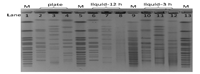
To prevent sporulation,early-log-phase cultures grown in brain heart infusion broth or LB medium (3 h on a shaker at 37 ℃) have been used in most previous protocols[4, 5, 6, 7, 8]. However,these methods often require long incubation times to produce sufficient concentrations of bacteria for manipulation. To test whether bacteria removed directly from solid medium would produce DNA samples of comparable quality for PFGE,bacteria were removed after overnight growth and used to make a cellular suspension for PFGE. These plugs were compared with bacterial plugs made using liquid cultures. Bacterial suspensions made directly from plate cultures produced patterns that were equivalent or better in quality than those patterns observed for samples cultured in liquid medium and then digested with NotI(Figure 1). As well as reducing the preparation time,use of bacterial cells directly from agar plates appeared to prevent the ‘trailing’ phenomenon that is frequently observed with DNA plugs made from cultures grown in liquid medium,which are caused by the degradation of DNA by toxic metabolites in the liquid medium.
|
Download:
|
| Figure 1. PFGE images of NotI-digested DNA from three B. cereus isolates collected directly from LB agar plates (lanes 2-4), LB liquid medium grown overnight (lanes 6-8), and LB liquid medium grown for 3 h (lanes 10-12). The size standard (M) was loaded in lanes 1, 5, 9, and 13. | |

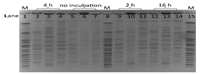
As the cell wall of B. cereus is difficult to lyse because of its thick peptidoglycan mesh,addition of lysozyme to the intact cell suspension is necessary prior to the suspensions being transferred into the agarose plug molds,as shown in the image. The most important parameter investigated in this study was the optimal length of time for incubation of the bacterial plugs in lysis buffer. Experimental evidence from this study demonstrated that an incubation period of 4 h is optimal for recovery of quality DNA. Resolution of bands after 4 h incubation in lysis buffer was equivalent to that of bands from samples incubated for 16 h (Figure 2). In our pilot study,an incubation period of 30 min had resulted in poor image. However a rapid PFGE protocol was developed by Ksminska[10] by increasing the concentration of lysozyme and the incubation time was reduced to 20 min.
|
Download:
|
| Figure 2. PFGE images of NotI-digested DNA from three B. cereus isolates incubated with lysozyme for 2 h (lanes 9-11), 4 h (lanes 2-4), 16 h (lanes 12-14), and no incubation (lanes 5-7). The size standard (M) was loaded in lanes 1, 8, and 15. | |

Theoretical enzyme selection was performed to determine enzymes that would yield satisfactory DNA banding profiles. In addition to SmaI and NotI,six enzymes were chosen as candidate enzymes for the pilot study. Results showed that NotI provided reproducible,clearly distinguishable bands throughout the resolvable portion of the agarose gels following PFGE. The PFGE profiles generated by SmaI,ApaI,and BlnI contained too many bands to resolve clearly,while the profiles generated by XbaI,NheI,MluI,and SpeI yielded DNA fragments with similar,low molecular weights. Identical PFGE run parameters were used for all of the restriction enzyme samples (18 h,switch times from 1-20 s).
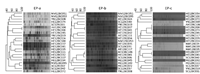
The EP recommended by the PFGE manufacturer was a switch time of 2.4-60.8 s for 19 h (EP-b). In this experiment,EP conditions were fine-tuned to distinguish DNA fragments of <200 kb,resulting in EP-c. EP-a and EP-b produced a D-value of 99.13%,while the D-value of EP-c was 99.56% (Figure 3). To compare similarity coefficients,multi-group comparisons were performed. One-sample Kolmogorov-Smirnov tests showed that the data were not normally distributed. Therefore,non-parametric tests were carried out. The Friedman test showed that there were significant differences among the three conditions (asymptotic significance,P=-0.027) for the 22 test isolates (n=231; chi-square=7.205; df=2). Two-group comparisons showed similarity coefficients generated for EP-a were significantly smaller than those obtained for EP-b and EP-c (Table 1). However,there was no significant difference between EP-b and EP-c. Because EP-a showed smaller calculated similarity coefficients,it was selected as the optimal EP.
|
Download:
|
| Figure 3. Clustering results of patterns obtained using three different sets of electrophoresis parameters following NotI digestion. Charts are shown for 22 B. cereus strains. | |


|
Table 1. Two-group Comparisons Made Using the Friedman Test for Significant Differences in Similarity Coefficients |
In summary,the method described here is rapid and robust compared with existing methods. The overall time needed for PFGE could be as short as 40 h (manual operation time within 9 h). We believe that adoption of this method will assist in the analysis of outbreaks of B. cereus,and will be of benefit to laboratories performing sub-typing of important food-borne pathogens.
The authors thank all individuals for their participation in the study,especially thank Professor ZHOU Hai Jian from Chinese Center for Disease Control and Prevention for his valuable suggestions to optimize the experiment scheme.
| 1. | Ash C, Farrow JA, Dorsch M, et al. Comparative analysis of Bacillus anthracis, Bacillus cereus, and related species on the basis of reverse transcriptase sequencing of 16S rRNA. Int J Syst. Bacteriol, 1991; 41, 343-6. |
| 2. | Logan NA. Bacillus and relatives in foodborne illness. J Appl Microbiol, 2012; 112, 417-29. |
| 3. | Li W, Lu S, Cui Z, et al. PulseNet China, a model for future laboratory-based bacterial infectious disease surveillance in China. Frontiers of Medicine, 2012; 6, 366-75. |
| 4. | Harrell LJ, Andersen GL, Wilson KH. Genetic variability of Bacillus anthracis and related species. J Clin Microbiol, 1995; 33, 1847-50. |
| 5. | Liu P, Ke SC, Chen SL. Use of pulsed-field gel electrophoresis to investigate a pseudo-outbreak of Bacillus cereus in a pediatric[uni]t. J Clin Microbiol, 1997; 35, 1533-5. |
| 6. | Zhong W, Shou Y, Yoshida TM, et al. Differentiation of Bacillus anthracis, B. cereus, and B. thuringiensis by using pulsed-field gel electrophoresis. Appl Environ Microbiol, 2007; 73, 3446-9. |
| 7. | Otlewska A, Oltuszak-Walczak E, Walczak P. Differentiation of strains from the Bacillus cereus group by RFLP-PFGE genomic fingerprinting. Electrophoresis, 2013; 34, 3023-8. |
| 8. | Merzougui S, Lkhider M, Grosset N, et al. Prevalence, PFGE typing, and antibiotic resistance of Bacillus cereus group isolated from food in Morocco. Foodborne Pathog Dis, 2014; 11, 145-9. |
| 9. | Hunter PR, Gaston MA. Numerical index of the discriminatory ability of typing systems:an application of Simpson's index of diversity. J Clin Microbiol, 1988; 26, 2465-6. |
| 10. | Kaminska PS, Fiedoruk K, Jankowska D, et al. One-day pulsed-field gel electrophoresis protocol for rapid determination of emetic Bacillus cereus isolates. Electrophoresis, 2015; 36, 1051-4. |