 2021, Vol. 45


2. 上海体育学院 运动科学学院, 上海 200438;
3. 扬州大学 体育学院, 江苏 扬州 225009;
4. 上海体育学院 心理学院, 上海 200438;
5. 华东师范大学 体育与健康学院, 上海 200241;
6. 武汉体育学院 健康科学学院, 湖北 武汉 430079;
7. 沈阳体育学院 体育教育学院, 辽宁 沈阳 110102;
8. 首都体育学院 运动科学与健康学院, 北京 100191;
9. 广州体育学院 运动与健康学院, 广东 广州 510500;
10. 同济大学 医学院, 上海 200092;
11. 复旦大学 附属闵行医院, 上海 201100;
12. 上海交通大学 医学院, 上海 200025;
13. 暨南大学 粤港澳中枢神经再生研究所, 广东 广州 510632;
14. 上海健康医学院 体育部, 上海 201318;
15. 广州体育学院 体育教育学院, 广东 广州 510500;
16. 南京师范大学 体育科学学院, 江苏 南京 210097;
17. 西安体育学院 经济与体育管理系, 陕西 西安 710068;
18. 苏州大学 附属第一人民医院, 江苏 苏州 215006;
19. 上海市第一人民医院 宝山分院, 上海 200940;
20. 海军军医大学 心理系, 上海 200433;
21. 咸阳市精神病专科医院 精神科, 陕西 咸阳 713200;
22. 上海中医药大学 附属岳阳中西医结合医院, 上海 200437;
23. 湖南省第二人民医院 精神卫生中心, 湖南 长沙 430100
2. School of Kinesiology, Shanghai University of Sport, Shanghai 200438, China;
3. School of Physical Education, Yangzhou University, Yangzhou 225009, Jiangsu, China;
4. School of Psychology, Shanghai University of Sport, Shanghai 200438, China;
5. School of Physical Education and Health, East China Normal University, Shanghai 200241, China;
6. School of Health Sciences, Wuhan Sports University, Wuhan 430000, Hubei, China;
7. School of Physical Education, Shenyang Sports University, Shenyang 110102, Liaoning, China;
8. School of Kinesiology and Health, Capital Sports University, Beijing 100191, China;
9. School of Sports and Health, Guangzhou Sports University, Guangzhou 510500, Guangdong, China;
10. School of Medicine, Tongji University, Shanghai 200092, China;
11. Minhan Hospital Affiliated Fudan University, Shanghai 201100, China;
12. School of Medicine, Shanghai Jiao Tong University; Shanghai 200025, China;
13. Guangdong-Hong Kong-Macau Institute of CNS Regeneration, Jinan University, Guangzhou 510632, Guangdong, China;
14. Sport Teaching Department, Shanghai University of Medicine and Health Sciences, Shanghai 201318, China;
15. School of Physical Education, Guangzhou Sports University, Guangzhou 510500, Guangdong, China;
16. School of Physical Education, Nanjing Normal University, Nanjing 210097, Jiangsu, China;
17. Department of Sport Economy and Management, Xi'an Physical Education University, Xi'an 710068, Shaanxi, China;
18. The First Affiliated Hospital, Soochow University, Soochow 215006, Jiangsu, China;
19. Baoshan Branch of Shanghai First People's Hospital, Shanghai 200940, China;
20. Faculty of Psychology, Naval Medical University, Shanghai 200433, China;
21. Xianyang Psychiatric Hospital, Xianyang 713200, Shaanxi, China;
22. Yueyang Hospital of Integrated Traditional Chinese and Western Medicine, Shanghai University of Traditional Chinese Medicine, Shanghai 200437, China;
23. The Second People's Hospital of Hunan Province, Changsha 430100, Hunan, China
老年人认知衰退已成为全球性的公共健康问题。研究[1]结果显示,我国60~ < 70岁、70~ < 80岁、80岁以上3个年龄段轻度认知障碍的患病率分别为9.93%、18.46%,26.13%。队列研究[2]结果显示,欧洲65岁以上老年人的轻度认知障碍(mild cognitive impairment,MCI)发病率为9.5%。与正常同龄人相比,MCI患者患痴呆(dementia)的可能性更大,年转化率接近10%[3]。到目前为止,尚无治疗MCI的特效药,根据最新的MCI临床指导建议,应降低患者的心血管危险因素水平,并对其采用认知训练,提供社会交往机会[4]。因此,如何保持大脑健康、预防或延缓认知功能衰退己成为老龄化社会亟待解决的问题。
体育锻炼改善认知的效果已逐渐被证实。最近的动物实验研究[5]发现,运动可刺激神经元再生,降低β淀粉样蛋白沉积,从而改善小鼠的认知功能,缓解阿尔茨海默病(AD)症状。我国学者[6]发现运动后皮质内雷帕霉素靶蛋白(mTOR)通路被激活,进一步运用双光子在体成像手段,发现跑步机训练可持续增加小鼠运动皮质内Ⅴ层锥体神经元的顶树突棘发生,进而改善神经网络,提高运动技能学习能力和认知功能。大量临床实验和meta分析证实,体育锻炼能改善或有效延缓各种认知状态人群的认知衰退[7],不同程度地改善MCI患者的认知功能,降低罹患痴呆风险[8-10],延缓痴呆患者的认知衰退[11]。2017年12月,美国神经病学学会(American Academy of Neurology,AAN)正式将体育锻炼作为干预手段推荐给MCI患者[12]。
虽然目前对体育锻炼改善认知功能已达成共识,但体育锻炼各变量(运动类型、时间、强度、频率、周期)对认知功能影响的量效关系仍不明确[7, 13],迫切需要临床医生、体育科研人员制订体育锻炼延缓认知衰退量效关系的指导手册。鉴于此,来自全国各高校、医院的专家和学者共同探讨并撰写体育锻炼延缓老年人认知衰退的专家共识,为老年人和医疗工作者提供量效关系明确的体育锻炼方案。
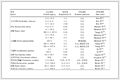
1 方法 1.1 证据水平和推荐等级根据英国牛津循证医学中心提出的针对诊断性、前瞻性和治疗性研究证据水平标准,对相关研究证据水平进行分级(表 1、表 2)。该体系是公认的经典评价标准,根据证据水平划分为强证据、中等证据、弱证据、矛盾证据等4个证据强度,分别对应A、B、C、D共4个推荐等级[14]。
| 表 1 英国牛津循证医学中心证据水平标准 Table 1 Evidence level and recommendations grades of Oxford Centre for Evidence-Based Medicine |
|
| 表 2 推荐等级 Table 2 Grades of recommendation |
|
|
纳入标准:①研究对象为健康老年人、MCI老年人、痴呆老年人、AD老年人。②干预方式包括步行、功率自行车等锻炼形式的有氧运动;克服器械、弹力带等锻炼形式的抗阻运动;2种及以上锻炼形式的多成分运动;太极拳、八段锦等锻炼形式的中国民族传统体育运动,并且详细描述体育锻炼频率、强度、时间、周期等“运动剂量”指标。③结局指标或部分结局指标为认知功能。④纳入的文献类型均为公开发表的RCT研究。
排除标准:①干预方式为非运动干预;②未报道具体干预手段、时间、频率和强度;③干预方案含有非运动干预的混杂因素,如维生素补剂、药物等。
1.3 数据检索通过计算机检索PubMed、Embase、The Cochrane Library、WoS(Web of Science)、中国知网(CNKI)等数据库,检索期限均从各个数据库收录起始年限至2019年10月6日。中文检索词为老年人、体育锻炼、体育活动、运动、有氧运动、抗阻运动、身心运动、太极拳、八段锦、易筋经、六字诀、运动干预、轻度认知障碍、认知衰退、认知障碍、痴呆、阿尔茨海默病、认知功能、认知表现、记忆、执行功能;英文检索词为elderly、old people、exercise、physical activity、fitness、aerobic exercise、resistance training、mind-body exercise、Tai Chi、Baduanjin、Yijinjing、Liuzijue、exercise intervention、mild cognitive impairment、cognitive decline、cognitive dysfunction、dementia、Alzheimer’s disease、cognitive function、cognitive performance、memory、executive function。采用主题词与自由词相结合的方式检索,且经反复预检后确定,并辅以手工检索,必要时追溯所纳入文献的参考文献。
1.4 数据提取与编码由2位研究员独立提取被纳入分析文献的信息,用事先设计的资料提取表格提取信息,内容包括以下3个方面。
(1)基本信息:作者,发表年份,试验对象样本量、年龄、认知状况,方法学特征。
(2)试验干预特征信息:干预措施、运动强度、运动时间、运动周期、频率,以及整体认知、执行功能、记忆功能等3个方面的结局指标。
(3)体育锻炼变量:锻炼形式一般分为有氧运动、抗阻运动、多成分运动(含有2种及以上锻炼形式)和身心运动[7]。由于本文所纳入的身心运动全部为中国民族传统体育运动,所以将锻炼形式划分为有氧运动、抗阻运动、多成分运动和中国民族传统体育运动。运动频率分为每周1~2次、3~4次、5次及以上;运动强度分为低、较低、中、较高、高等5个等级。运动强度具体标准(表 3):每次锻炼时间划分为 < 30 min、30~60 min、>60 min;周期划分为 < 12周、12~24周、>24周[7, 13]。
| 表 3 运动强度等级划分 Table 3 Exercise intensity grading |
|
|
效应量计算方法:运用Cohen[16]的公式计算效应量,即d=(MPost-MPre)/SDP,其中:MPre代表干预前2组均值之差,MPost代表干预后2组均值之差,SDP代表合并标准差;d<0.2为极小效应量,0.2≤d<0.5为小效应量,0.5≤d<0.8为中效应量,d≥0.8为大效应量。
1.6 文献质量评价全文判定证据水平、证据强度和推荐等级均以英国牛津循证医学中心证据水平标准(表 1)和证据等级推荐表(表 2)为重要依据,在此基础上,参考PEDro量表[17-18]和“CONSORT 2010声明”[19],从方法学质量和报告质量两方面辅助评价纳入文献的质量。PEDro量表包括11个维度的方法学质量评价,“符合标准”“随机分配”“分配隐藏”“基线均衡”“对受试者施盲”“对治疗师施盲”“对结果评估施盲”“退出率≤15%”“意向分析”“组间统计比较”“点估计和变异性测量”,其中“符合标准”不计分,总分为10分,<4分为“质量差”,4~5分为“中等质量”,6~8分为“质量较好”,9~10分为“高质量”,只纳入中等质量以上的文献。“CONSORT 2010声明”针对的是RCT报告质量形成的标准,涵盖了题目和摘要、前言、方法、结果、讨论、其他等7个方面的清晰信息共25个条目的规范要求。文献质量由2位研究者独立进行并互相复核,若有分歧,则由第3位作者共同讨论决定。
1.7 专家共识形成方法专家团队由24名来自全国高校、医院的教授、副教授、主任医师、副主任医师和研究员等组成,65%为教授,9%为副教授,9%为主任医师,13%为副主任医师,4%为研究员,专业背景涉及体育教育训练学、运动心理学、心理学、医学、康复学等专业。各专家根据纳入文献的证据水平、证据强度、推荐等级分别给出各自的意见,意见等级分为“①同意”“②既不同意也不反对”“③不同意”3个选项:选择同意的比例高于75%,则纳入该条目;若低于75%,则共同研讨,并再次征求意见,直至同意比例高于75%。
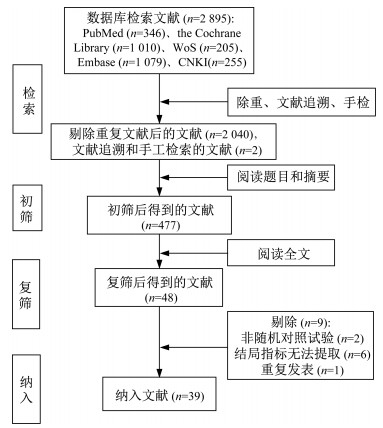
2 文献检索结果通过检索得到2 895篇文献并导入Endnote X7软件,除重后得到文献2 040篇。筛选过程由2位作者独立进行,若有分歧,则由第3位作者共同讨论决定是否纳入。阅读题目与摘要后获得477篇文献,阅读全文进行复筛获得48篇文献,根据排除标准剔除不符合标准的文献,最终有39篇文献纳入本研究(图 1)。
|
| 图 1 文献筛选流程 Figure 1 Literature selection flow |
随着年龄的增大,心血管功能逐步下降,进而导致静息态脑血流(CBF)下降,而CBF下降与认知功能的衰退有关[20]。在安静状态下进行记忆编码任务,健康老年人后扣带回和海马的脑灌注量显著高于MCI老年人[21],海马脑灌注量高的老年人罹患AD的概率低[22],因此,心血管功能可能是认知衰退的重要中介。
体育锻炼尤其是有氧锻炼可显著改善心血管功能,提升大脑的血液循环速度和供氧能力,从而使大脑的组织细胞得到更多的营养维护大脑功能。该假说认为体育锻炼通过提高心血管功能改善认知功能[23],这也解释了为何许多经典研究都采用有氧运动方案。
3.2 体育锻炼改善认知老化的脑结构机制随着年龄的增长,外侧前额叶皮质、海马等脑组织出现脑细胞凋亡速度加快的现象。老年人在颞叶、前额叶、顶叶的灰质密度,靠近外侧与第三脑室前内侧区的白质密度显著降低[24]。经常参加体育锻炼可减缓与增龄相关的额叶、顶叶和颞叶皮质密度的下降趋势[25],有效延缓MCI患者海马体积的萎缩[26]。有研究[27]利用弥散张量成像技术测量了脑白质纤维束的体积,发现有氧锻炼使海马体积增加了2%~16%。Brinke等[28]对女性MCI患者进行了6个月的随机对照运动干预试验,试验结束后的核磁共振(MRI)检查发现有氧锻炼组左侧海马体积明显增大。有研究[29]利用体素形态学测量方法(voxel-based morphometry,VBM)分析运动干预前后大脑额叶、顶叶及扣带皮质等区域灰质体积变化情况,发现有氧锻炼和拉伸锻炼均能增大灰质体积。上述多项研究通过先进手段发现长期有规律的体育锻炼改变了大脑的结构,特别是与记忆等有关的海马的变化。
3.3 体育锻炼改善认知老化的分子机制β淀粉样蛋白(Aβ)和tau蛋白是AD病理学说中的2种重要物质。动物实验研究表明,跑轮运动抑制了小鼠淀粉前体蛋白(APP)降解为Aβ[30],降低了小鼠Ser404、Ser202、Thr231等磷酸化位点的tau蛋白磷酸化水平[31]。人体试验也有类似的研究结果,通过运动干预发现AD患者淀粉样斑块减少[32],抗阻运动显著提高老年人的短时记忆力,试验组外周血胰岛素样生长因子-1(IGF-1)水平增高[33]。有氧运动能促进人脑源性神经营养因子(BDNF)的合成与释放,海马和大脑皮质等负责高级认知功能的脑区含有大量BDNF[34],而BDNF能通过影响神经胶质细胞的激活程度促进神经元的功能,进而提高中央执行功能、记忆和学习能力[35]。Erickson等[36]从分子标志物和大脑结构的角度验证了有氧运动对老年人认知功能的促进作用,干预后试验组BDNF增加11%、海马容积增加2%。
meta分析结果显示,规律运动可提高体内BDNF水平[37-38],抗阻运动可能会促进血浆同型半胱氨酸(homocysteine)与IGF-1的分泌[39]。体育锻炼可改善大脑的代谢,促进大脑中更多的树突分支和突触生长,进而改善认知功能。
4 有氧运动延缓老年人认知衰退的量效关系 4.1 纳入文献的基本特征表 4显示,共纳入有氧运动干预老年人认知功能的文献11篇共12项RCT研究,涉及正常老年人和MCI老年人共计517人。其中:5篇文献纳入老年人年龄均值为75岁以上,6篇年龄均值在65岁左右;6篇研究对象为正常老年人,5篇研究对象为MCI老年人;有氧运动项目包括步行、慢跑、功率自行车、游泳等;所有文献均详细描述了锻炼频次、强度、时间、周期。
| 表 4 有氧运动干预老年人认知功能的研究特征 Table 4 Characteristics of aerobic exercise training interventions to improve cognition function in the elderly |
|
|
所有纳入文献均为RCT研究,有3篇文献存在方法学或依从率低等问题。6篇文献PEDro得分为5分,4篇得分在6~8分,1篇为9分,均值为5.9分。根据“CONSORT 2010声明”进行评估,纳入文献均包含题目、摘要、前言、方法、结果、讨论和其他等7个方面的清晰信息。综合评判,纳入文献质量相对较高,最终确定9项为Ⅰ级证据水平[28, 40-46]、3项为Ⅱ级证据水平[44, 47-48]。
4.2 有氧运动各锻炼变量对老年人认知功能结局指标的影响表 4显示,从每周锻炼频率角度分析,共4项研究选择每周锻炼2次的运动方案,其中:2项结局指标涉及执行功能,结果表明均具有正向效应(效应量分别为0.19、1.05);3项研究结局指标涉及记忆功能,结果表明1项为正向效应(效应量为0.58),2项为负向效应。有8项研究选择每周锻炼3~4次运动方案,其中:结局指标涉及执行功能的有4项,结果表明均具有正向效应(效应量分别为0.71、0.65、0.68、0.29);结局指标涉及整体认知功能的有3项,结果表明均具有正向效应(效应量分别为0.37、0.69、0.61);结局指标涉及记忆功能的有3项,结果表明均具有正向效应(效应量分别为0.67、0.45、0.42)。
推荐意见:建议每周3~4次的锻炼频率,Ⅰ级证据,推荐等级为A。
从锻炼强度角度分析,有9项研究选择中等强度运动方案,其中:2项结局指标涉及整体认知功能,结果均具正向效应;4项结局涉及记忆功能,仅2项结局具有正向效应;5项结局涉及执行功能,结果均为正向效应。有2项研究采用高强度运动方案,结局指标涉及整体功能、记忆功能各1项,结果表明均具有正向效应。有1项研究采用低强度运动方案,结局指标涉及记忆功能和执行功能,结果表明均具有正向效应。
推荐意见:建议采用中等强度,Ⅰ级证据,推荐等级为A。
从每次锻炼时间角度分析,选择30 min以内运动方案的研究有3项,结局指标涉及整体认知功能、记忆功能的研究分别为2项、1项,结果表明均具有正向效应。选择30~60 min方案的有9项,结局指标涉及整体认知功能、记忆功能、执行功能的分别为1项、5项和6项,结果表明对执行功能和整体认知功能均具有正向效应,有2项研究对记忆功能具有负向效应。
推荐意见:建议采用30~60 min的锻炼时间,Ⅰ级证据,推荐等级为A。
从干预周期角度分析,选择12周以内的运动方案有5项研究,结局指标涉及整体认知功能、记忆功能、执行功能的研究各有2项,结果表明均具有正向效应;选择12~24周运动方案的有6项,结局指标涉及整体认知功能、记忆功能、执行功能的分别为1项、3项和4项,结果表明对执行功能和整体认知功能具有正向效应,有1项对记忆功能有负向效应。选择24周以上运动方案的有1项,结局指标选择记忆功能,结果表明具有负向效应。
推荐意见:建议采用12~24周锻炼周期,Ⅰ级证据,推荐等级为A。
4.3 有氧运动专家推荐方案有氧运动是指在运动过程中主要以糖和脂肪的有氧氧化供能的运动,是目前研究认知功能最常用的运动干预形式之一,干预效果已得到了众多试验性研究和系统综述的证实。Baker等[43]将33名MCI患者随机分为高强度有氧运动组(跑步机、功率自行车)和拉伸组,经过6个月每周4次、每次45~60 min的干预后,患者的多种认知功能得到显著改善(Ⅰ级证据)。Tsai等[40]将64名老年人随机分为步行组、乒乓球组和对照组,发现经6个月中等强度、每周3次、每次40 min步行锻炼的老年人,其在完成N-back任务、Task-switching任务时P3波幅均增大,反应时均缩短(Ⅰ级证据)。Albinet等[49]的RCT研究发现,持续21周、每周2次、每次60 min的游泳锻炼显著改善了受试者的Stroop任务表现和词语广度测试成绩(Ⅰ级证据)。游泳项目并不适合所有老年人,且有一定的危险性,所以降低其推荐等级。有关运动剂量研究[50]发现:每次体育锻炼时间为31~45 min的效果好于15~30 min;6个月以上干预周期效果好于1~3个月(Ⅰ级证据)。根据上述分析结果和证据水平、推荐等级标准制定如下有氧运动方案(表 5)。
| 表 5 有氧锻炼运动方案循证推荐 Table 5 The evidence-based exercise prescription for aerobic trainning |
|
|
如表 6所示,纳入以抗阻运动改善老年人认知衰退的文献10篇共14项研究,涉及正常人和MCI患者共859人,抗阻运动的主要形式是器械抗阻、弹力带抗阻和徒手抗阻等3种形式。研究对象年龄均值75岁以上的有2篇文献,75岁以下的有8篇文献。
| 表 6 抗阻运动干预老年人认知功能的研究特征 Table 6 Characteristics of resistance exercise training interventions to improve cognition function in the elderly |
|
|
所有纳入文献均为RCT研究,10篇文献PEDro得分在6~8分,均值为7分,文献的方法学质量较高。根据“CONSORT 2010声明”进行评估,纳入文献均包含题目、摘要、前言、方法、结果、讨论和其他等7个方面的清晰信息,特别是部分文献对分配隐藏和盲法均有详细说明,报告质量较高。综合评判,纳入文献质量较高,最终将所有纳入文献的证据水平定为Ⅰ级。
5.2 抗阻运动各锻炼变量对老年人认知功能的影响表 6显示,从每周锻炼频率角度分析:共11项研究选择每周锻炼1~2次的方案,其中:有1项涉及整体认知功能,结果具有正向效应(效应量为0.42);4项研究涉及记忆功能,其中只有1项具有正向效应(效应量为0.32);8项研究涉及执行功能,结果均具有正向效应(效果量分别为0.20、0.34、0.20、0.40、1.18、0.40、0.21、0.13)。3项研究采用每周锻炼3~4次的方案,2项涉及整体认知功能,其中1项具有正向效应(效应量为0.42);2项研究涉及执行功能,其中1项具有正向效应(效应量为0.65)。
推荐意见:建议采用每周2次的锻炼频率,Ⅰ级证据,推荐等级为A。
从锻炼强度角度分析:10项研究选择高等强度,其中1项涉及整体认知功能,结果具有负向效应;2项研究涉及记忆功能,其中1项具有正向效应;10项研究涉及执行功能,其中9项具有正向效应。4项研究选择中等强度锻炼方案,2项涉及整体认知功能,结果均具有正向效应;2项涉及记忆功能,其中1项具有正向效应。
推荐意见:建议采用中、高强度锻炼方案,Ⅰ级证据,推荐等级为A。
从锻炼时间角度分析,设计方案呈现高度一致性,纳入的14项RCT锻炼时间全部选择每次30~60 min。3项研究涉及整体认知功能,其中2项具有正向效应;4项研究涉及记忆功能,其中2项具有正向效应;10项研究涉及执行功能,其中9项具有正向效应。
推荐意见:建议采用30~60 min的锻炼时间,Ⅰ级证据,推荐等级为A。
从锻炼周期角度分析:2项研究选择12周以下的锻炼周期,对整体认知功能均具有正向效应;3项研究采用12~24周的锻炼周期,涉及整体认知功能、记忆功能、执行功能,均具有负向效应;10项研究采用24周以上的锻炼周期,3项涉及记忆功能,其中2项具有正向效应,9项研究涉及执行功能,结果均具有正向效应。
推荐意见:建议采用24周的锻炼周期,Ⅰ级证据,推荐等级为A。
5.3 抗阻运动专家推荐方案抗阻运动俗称力量训练,是一种特定的骨骼肌群对抗外部阻力的运动。美国运动医学学会、美国心脏协会、美国老年病学会等将抗阻运动作为促进身体健康的主要体育运动类别之一,并建议每周至少进行2次抗阻运动[15](Ⅰ级证据)。抗阻训练显著提高了受试者IGF-1水平[60],而IGF-1可增强突触的可塑性和神经元的存活率[61],促进海马神经生长[62],显著改善老年人的抑制控制[63]。前人的meta分析发现:抗阻训练对老年人的执行功能和整体认知功能有正向效应,但对记忆功能的影响较弱,且每周3次锻炼效果好于每周2次[64](Ⅰ级证据);锻炼强度为70%~79% 1RM,每周锻炼2次,每次锻炼2~3组,每组重复7~9次的锻炼效果最佳[65](Ⅰ级证据)。
根据前人研究结果和本文的研究结果制定的延缓老年人认知衰退的运动方案如表 7所示。
| 表 7 抗阻运动方案循证推荐 Table 7 The evidence-based exercise prescription for resistance trainning |
|
|
如表 8所示,纳入多成分运动干预老年人认知功能的文献共9篇,涉及正常人群、MCI患者、痴呆患者共计703人。多成分运动项目包括有氧运动与抗阻运动组合,有氧运动与平衡组合,有氧与抗阻、平衡共同组合等形式。研究对象年龄均值为85岁以上的有3篇文献(33.3%),75岁以上的有4篇文献(44.5%),65岁左右的有2篇文献(22.2%)。
| 表 8 多成分运动干预老年人认知功能的研究特征 Table 8 Characteristics of multicomponent exercise training interventions to improve cognition function in the elderly |
|
|
所有纳入文献均为RCT研究。2篇文献存在方法学或依从率低等方面的问题;4篇文献PEDro得分为4~5分,5篇文献为6~8分,均值为6.2,文献的方法学质量总体水平在中等以上。根据“CONSORT 2010声明”进行评估,纳入文献均包含题目的清晰摘要、前言、方法、结果、讨论和其他等7个方面的清晰信息,有些文献在样本量确定、盲法、意向性治疗、实验注册等方面未描述清楚,影响了文献质量。综合评判,纳入文献质量相对较高,最终确定:7项为Ⅰ级证据水平[11, 66-71],2项为Ⅱ级证据水平[72-73]。
6.2 多成分运动各锻炼变量对老年人认知功能的影响如表 8所示,从锻炼频率角度分析:2项研究选择每周锻炼2次方案,涉及整体认知功能、记忆功能、执行功能,结果均具有正向效应(效应量分别为0.09、0.07、0.50);6项研究选择每周锻炼3~4次方案,4项涉及整体认知功能,其中3项具有正向效应(效应量分别为0.48、1.25、0.89),3项涉及记忆功能且均具有正向效应(效应量分别为0.42、0.16、1.11),3项涉及执行功能且均具有正向效应(效应量分别为0.37、1.04、1.14);1项研究选择每周锻炼5次的方案,涉及整体认知功能,结果具有正向效应(效应量为1.02)。
推荐意见:建议采用每周3~4次的锻炼频率,Ⅰ级证据,推荐等级为A。
从锻炼强度角度分析:5项研究选择中等强度锻炼方案,整体认知功能、记忆功能、执行功能均涉及的3项,除1项对整体认知功能具有负向效应外,其他均具有正向效应;2项研究选择高强度锻炼方案,结果对整体认知功能有正向效应;2项采用低强度锻炼方案,涉及3个认知领域,结果均有正向效应。
推荐意见:建议采用中等强度锻炼方案,Ⅰ级证据,推荐等级为A。
从每次锻炼时间分析:2项研究采用30 min以下方案,涉及整体认知功能的2项,结果均具有正向效应,涉及记忆功能、执行功能的各1项,结果具有正向效应;6项采用30~60 min的方案,4项涉及整体认知功能,结果3项具有正向效应,涉及记忆功能、执行功能的各2项,结果均具有正向效应;1项采用60 min以上的方案,结果对记忆功能、执行功能具有正向效应。
推荐意见:建议采用30~60 min的锻炼时间,Ⅰ级证据,推荐等级为A。
从运动周期角度分析:4项研究选择12周以内的方案,涉及整体认知功能的3项,2项具有正向效应,涉及记忆功能、执行功能的各2项,结果均具有正向效应;3项选择12~24周的方案,涉及整体认知功能、记忆功能、执行功能等3个认知领域,结果均具有正向效应;2项选择24周以上的方案,涉及整体认知功能、记忆功能、执行功能等3个认知领域,结果均具有正向效应。
推荐意见:建议采用12~24周的锻炼周期,Ⅰ级证据,推荐等级为A。
6.3 多成分体育运动专家推荐方案大脑额叶是认知功能的主要脑区,与抑制相关的脑区位于右额下回,与工作记忆相关的脑区位于左前扣带回、左前运动皮质、右额下回,与任务转移相关的脑区分布于双侧额叶皮质[74],这可能是影响体育锻炼类型对认知功能干预效果的神经结构基础。不同类型的体育锻炼可能通过不同的途径影响认知功能,多成分的运动干预包含有氧运动、抗阻运动、协调、平衡等各个方面,对认知的影响也是多方面的,所以对整体认知功能的影响更明显。一项为期9周的RCT研究[11]结果显示,抗阻联合有氧的多成分运动比单纯有氧锻炼更有助于延缓痴呆患者认知功能的下降(Ⅰ级证据),包含有氧、抗阻、平衡的多成分运动,干预12个月后,显著改善老年人的整体认知功能、执行功能和记忆[75](Ⅰ级证据)。近几年的多项meta分析[76-78]也得到了类似结果,类似的研究结果也在MCI和痴呆患者身上发现[79](Ⅰ级证据)。
根据前人研究结果和本文的研究结果制定的延缓老年人认知衰退的多成分运动方案如表 9所示。
| 表 9 多成分运动方案循证推荐 Table 9 The evidence-based prescription of multicomponent exercise |
|
|
如表 10所示,纳入运用中国民族传统体育方式干预老年人认知的文献共9篇,涉及正常、MCI、痴呆3类人群,共计835人,涉及的中国民族传统体育项目包括太极拳7篇文献(占77.8%)、八段锦1篇文献(占11.1%)、六字诀1篇文献(占11.1%)。研究对象年龄均值为75岁左右的有6篇文献(占66.7%),65岁左右的有3篇文献(占33.3%)。
| 表 10 中国民族传统体育运动干预对老年人认知功能的研究特征 Table 10 Characteristics of Chinese traditional exercise training interventions to improve cognition function in the elderly |
|
|
所有纳入文献均为RCT研究。5篇文献的PEDro得分在6~8分,4篇文献的PEDro得分在9~10分,平均得分7.8分,方法学质量较高。根据“CONSORT 2010声明”进行评估,纳入文献均包含题目、摘要、前言、方法、结果、讨论和其他等7个方面的清晰信息,有些文献在盲法、实验注册等方面未描述清楚,影响了文献质量,但文献整体质量较高。综合评判,纳入文献质量较高,最终将所有纳入文献的证据水平定为Ⅰ级。
7.2 中国民族传统体育各锻炼变量对老年人认知功能的影响如表 10所示,从锻炼频率角度分析:6项研究选择每周锻炼3~4次的方案,4项涉及整体认知功能,结果均具有正向效应(效应量分别为1.20、0.60、0.40、0.22);3项研究涉及记忆功能,结果均显示具有正向效应(效应量分别为0.39、0.17、0.40);4项研究涉及执行功能,有2项显示具有正向效应(效应量分别为0.53、0.17);3项研究选择每周锻炼5次及以上的方案,涉及整体认知功能,结果均具有正向效应(效应量分别为1.99、1.35、1.08)。
推荐意见:建议采用每周3~5次的锻炼频率,Ⅰ级证据,推荐等级为A。
从运动强度角度分析,纳入的所有文献均未具体描述干预的运动强度,但通过阅读全文发现基本都是中等及以下强度。控制运动强度是运用中国民族传统体育项目改善老年人认知衰退需要解决的重要问题。由此笔者认为,中等强度为弱证据,推荐等级为C。
从每次锻炼时间分析:3项研究选择30 min以下的方案,均涉及整体认知功能,结果均具有正向效应;2项研究涉及记忆功能,结果均具有正向效应;2项研究涉及执行功能,结果具有负向效应;4项研究选择30~60 min的方案,涉及整体认知功能、记忆功能、执行功能的研究分别为4项、1项、2项,结果均具有正向效应。
推荐意见:建议采用30~60 min的锻炼时间,Ⅰ级证据,推荐等级为A。
从锻炼周期的角度分析:4项研究选择12周及以下的运动方案,涉及整体认知功能、记忆功能的研究各2项,结果均具有正向效应;3项研究涉及执行功能,其中2项研究具有正向效应;3项研究选择12~24周的运动方案,结果对整体认知功能有正向效应;2项研究选择24周以上的方案,涉及整体认知功能、记忆功能的分别为2项、1项,结果均具有正向效应,1项研究涉及执行功能,结果显示为负向效应。
推荐等级:建议采用12~24周的锻炼周期,Ⅰ级证据,推荐等级为A。
7.3 中国民族传统体育运动专家推荐方案中国民族传统体育项目众多,目前用于老年人认知干预较多的项目主要有太极拳、八段锦、五禽戏、六字诀等。以太极拳为代表的中国优秀传统文化,融合传统哲学、医学、五行学说,将身体运动与吐纳术相结合,注重“形与神俱”“天人合一”,讲究“以心行意,以意导体,以气运身”,力求达到心、意、力、气、形的高度统一,不断进行动作方向、幅度、劲力、速度上的调整运动,练习时不仅需记忆训练,还需多种更高层次的认知(如感知速度、视觉空间能力、注意力、多任务处理和计划)来保持姿势的稳定性,使肢体运动过程中的相关脑区也得到活动,刺激大脑细胞兴奋性,有利于维持大脑感知觉功能,改善老年人记忆力,达到健脑的功效[89-90]。此外,练习的组织方式多为群体学习,为练习者提供了一个智力交流(社会互动)的平台,减轻压力、缓解焦虑,进一步促进认知功能的改善[91]。
RCT研究发现,太极拳比步行能更好地改善心肺功能和能量代谢水平[92](Ⅰ级证据),长期太极拳、八段锦锻炼可改善额顶叶脑网络连接[93],增加额中沟、岛叶环形沟下段、颞上回、枕颞沟和舌回等大脑区域的皮质厚度[94-95](Ⅱ级证据),有效提高血浆BDNF的浓度[88](Ⅰ级证据)。
根据本文研究结果制定的中国民族传统体育延缓老年人认知衰退的体育锻炼方案如表 11所示。
| 表 11 中国民族传统体育运动方案循证推荐 Table 11 The evidence-based prescription of Chinese traditional exercise |
|
|
体育锻炼延缓老年人认知衰退的正向效应已被广泛证实,不同的体育锻炼变量(类型、频率、强度、时间、周期)产生的认知效益不同,在制订体育锻炼方案时应根据人群的特点、目标认知功能等因素全面考量,这已形成共识。
在运动延缓老年人认知衰退的试验中,体育锻炼各变量在锻炼周期上多选择12~24周,在每次锻炼时间上多选择30~60 min,在每周锻炼频率上多选择2~3次,有氧运动和多成分运动推荐中等强度,抗阻运动推荐中、高强度,中国民族传统体育运动推荐中等强度,这已形成共识。
作者贡献声明:
蔡治东设计论文框架,收集资料,完成论文初稿,并根据其余23名作者的意见进行修改。
第2~24位作者对论文初稿提出修改意见。
所有作者对共识主要观点进行认可程度评级,并形成终稿。
| [1] |
JIANG X, LI J, LIANG J, et al. The prevalence of mild cognitive impairment in China:A systematic review[J].
Aging and Disease, 2018, 9(4): 706-715 DOI:10.14336/AD.2017.0928 (  0) 0)
|
| [2] |
GANGULI M, FU B, SNITZ B E, et al. Mild cognitive impairment:Incidence and vascular risk factors in a population-based cohort[J].
Neurology, 2013, 80(23): 2112-2120 DOI:10.1212/WNL.0b013e318295d776 ( 0)
|
| [3] |
MITCHELL A J, SHIRI-FESHKI M. Rate of progression of mild cognitive impairment to dementia:Meta-analysis of 41 robust inception cohort studies[J].
Acta Psychiatrica Scandinavica, 2009, 119(4): 252-265 DOI:10.1111/j.1600-0447.2008.01326.x ( 0)
|
| [4] |
PETERSEN R C, LOPEZ O, ARMSTRONG M J, et al. Practice guideline update summary:Mild cognitive impairment[J].
Neurology, 2018, 90(3): 126-135 DOI:10.1212/WNL.0000000000004826 ( 0)
|
| [5] |
CHOI S H, BYLYKBASHI E, CHATILA Z K, et al. Combined adult neurogenesis and BDNF mimic exercise effects on cognition in an Alzheimer's mouse model[J].
Science, 2018, 361(6406): eaan8821 DOI:10.1126/science.aan8821 ( 0)
|
| [6] |
CHEN K, ZHENG Y, WEI J A, et al. Exercise training improves motor skill learning via selective activation of mTOR[J].
Science Advances, 2019, 5(7): 1888 DOI:10.1126/sciadv.aaw1888 ( 0)
|
| [7] |
NORTHEY J M, CHERBUIN N, PUMPA K L, et al. Exercise interventions for cognitive function in adults older than 50:A systematic review with meta-analysis[J].
British Journal of Sports Medicine, 2017, 52(3): 154-160 ( 0)
|
| [8] |
KRAMER A F, COLCOMBE S. Fitness effects on the cognitive function of older adults:A meta-analytic study revisited[J].
Perspectives on Psychological Science, 2018, 13(2): 213-217 DOI:10.1177/1745691617707316 ( 0)
|
| [9] |
BANGSBO J, BLACKWELL J, BORAXBEKK C J, et al. Copenhagen Consensus statement 2019:Physical activity and ageing[J].
British Journal of Sports Medicine, 2019, 53(14): 856-858 DOI:10.1136/bjsports-2018-100451 ( 0)
|
| [10] |
KIRK-SANCHEZ N J, MCGOUGH E L. Physical exercise and cognitive performance in the elderly:Current perspectives[J].
Clinical Interventions in Aging, 2014, 51(9): 51-62 ( 0)
|
| [11] |
BOSSERS W J R, WOUDE L H VVAN DER, BOERSMA F, et al. A 9-week aerobic and strength training program improves cognitive and motor function in patients with dementia:A randomized, controlled trial[J].
American Journal of Geriatric Psychiatry, 2015, 23(11): 1106-1116 DOI:10.1016/j.jagp.2014.12.191 ( 0)
|
| [12] |
PETERSON B M, JOHNSON C, CASE K R, et al. Feasibility of a combined aerobic and cognitive training intervention on cognitive function in cancer survivors:A pilot investigation[J].
Pilot and Feasibility Studies, 2018, 4: 50 DOI:10.1186/s40814-018-0242-3 ( 0)
|
| [13] |
ERICKSON K I, HILLMAN C, SULLMAN C M, et al. Physical activity, cognition, and brain outcomes:A review of the 2018 physical activity guidelines[J].
Medicine and Science in Sports and Exercise, 2019, 51(6): 1242-1251 DOI:10.1249/MSS.0000000000001936 ( 0)
|
| [14] |
MARTIN R L, CHIMENTI R, CUDDEFORD T, et al. Achilles pain, stiffness, and muscle power deficits:Midportion achilles tendinopathy revision 2018[J].
The Journal of Orthopaedic and Sports Physical Therapy, 2018, 48(5): A1-A38 DOI:10.2519/jospt.2018.0302 ( 0)
|
| [15] |
U.S.Department of Health and Human Services.Physical activity guidelines for Americans[EB/OL].2nd ed.[2020-12-12].https://health.gov/our-work/physical-activity/current-guidelines
( 0)
|
| [16] |
COHEN J.
Statistical power analysis for the behavioral sciences[M]. 2nd ed. Mahwah: Lawrence Erlbaum Associates, 1988: 490-500.
( 0)
|
| [17] |
VERHAGEN A P, DE VET H C, DE BIE R A, et al. The Delphi list:A criteria list for quality assessment of randomized clinical trials for conducting systematic reviews developed by Delphi consensus[J].
Journal of Clinical Epidemiology, 1998, 51(12): 1235-1241 DOI:10.1016/S0895-4356(98)00131-0 ( 0)
|
| [18] |
DE MORTON N A. The PEDro scale is a valid measure of the methodological quality of clinical trials:A demographic study[J].
The Australian Journal of Physiotherapy, 2009, 55(2): 129-133 DOI:10.1016/S0004-9514(09)70043-1 ( 0)
|
| [19] |
SCHULZ K F, ALTMAN D G, MOHER D. CONSORT 2010 statement:Updated guidelines for reporting parallel group randomized trials[J].
Annals of Internal Medicine, 2010, 152(11): 726-732 DOI:10.7326/0003-4819-152-11-201006010-00232 ( 0)
|
| [20] |
BERTSCH K, HAGEMANN D, HERMES M, et al. Resting cerebral blood flow, attention, and aging[J].
Brain Research, 2009(21): 77-88 ( 0)
|
| [21] |
XIE L, DOLUI S, DAS S R, et al. A brain stress test:Cerebral perfusion during memory encoding in mild cognitive impairment[J].
NeuroImage:Clinical, 2016, 11(2): 388-397 ( 0)
|
| [22] |
WOLTERS F J, DE BRUIJN R F A G, HOFMAN A, et al. Cerebral vasoreactivity, apolipoprotein E, and the risk of dementia[J].
Arteriosclerosis, Thrombosis, and Vascular Biology, 2015, 36(1): 204-210 ( 0)
|
| [23] |
COLCOMBE S, ERICKSON K, P E, KIM J, et al. Aerobic exercise training increases brain volume in aging humans[J].
Journals of Gerontology, 2006, 61(11): 1166-1170 DOI:10.1093/gerona/61.11.1166 ( 0)
|
| [24] |
GORDON B A, RYKHLEVSKAIA E I, BRUMBACK C R, et al. Neuroanatomical correlates of aging, cardiopulmonary fitness level, and education[J].
Psychophysiology, 2008, 45(5): 825-838 ( 0)
|
| [25] |
COLCOMBE S J, ERICKSON K I, RAZ N, et al. Aerobic fitness reduces brain tissue loss in aging humans[J].
The Journals of Gerontology Series A:Biological Sciences and Medical Sciences, 2003, 58(2): M176-M180 DOI:10.1093/gerona/58.2.M176 ( 0)
|
| [26] |
KLAUS F, KONSTANZE F, BETTY T, et al. VEGF is necessary for exercise-induced adult hippocampal neurogenesis[J].
European Journal of Neuroscience, 2015, 18(10): 2803-2812 ( 0)
|
| [27] |
SAYAL N. Exercise training increases size of hippocampus and improves memory[J].
Proceedings of the National Academy of Sciences of the United States of America, 2015, 108(7): 3017-3022 ( 0)
|
| [28] |
BRINKE L FTEN, BOLANDZADEH N, NAGAMATSU L S, et al. Aerobic exercise increases hippocampal volume in older women with probable mild cognitive impairment:A 6-month randomised controlled trial[J].
British Journal of Sports Medicine, 2015, 49(4): 248-263 DOI:10.1136/bjsports-2013-093184 ( 0)
|
| [29] |
KÖBE T, WITTE A V, SCHNELLE A, et al. Combined omega-3 fatty acids, aerobic exercise and cognitive stimulation prevents decline in gray matter volume of the frontal, parietal and cingulate cortex in patients with mild cognitive impairment[J].
Neuroimage, 2016, 131(6): 226-238 ( 0)
|
| [30] |
ADLARD P A, PERREAU V M, POP V, et al. Voluntary exercise decreases amyloid load in a transgenic model of Alzheimer's Disease[J].
The Journal of Neuroscience, 2005, 25(17): 4217-4221 DOI:10.1523/JNEUROSCI.0496-05.2005 ( 0)
|
| [31] |
UM H S, KANG E B, KOO J H, et al. Treadmill exercise represses neuronal cell death in an aged transgenic mouse model of Alzheimer's Disease[J].
Neuroscience Research, 2010, 69(2): 161-173 ( 0)
|
| [32] |
OKONKWO O C, SCHULTZ S A, OH J M, et al. Physical activity attenuates age-related biomarker alterations in preclinical AD[J].
Neurology, 2015, 83(19): 1753-1760 ( 0)
|
| [33] |
CASSILHAS R C, VIANA V A, GRASSMANN V, et al. The impact of resistance exercise on the cognitive function of the elderly[J].
Medicine and Science in Sports and Exercise, 2007, 39(8): 1401-1407 DOI:10.1249/mss.0b013e318060111f ( 0)
|
| [34] |
HYMAN C, HOFER M, BARDE Y A, et al. BDNF is a neurotrophic factor for dopaminergic neurons of the substantia nigra[J].
Nature, 1991, 350(6315): 230-232 DOI:10.1038/350230a0 ( 0)
|
| [35] |
LECKIE R L, OBERLIN L E, VOSS M W, et al. BDNF mediates improvements in executive function following a 1-year exercise intervention[J].
Frontiers in Human Neuroscience, 2014, 8: 985 ( 0)
|
| [36] |
ERICKSON K I, VOSS M W, PRAKASH R S, et al. Exercise training increases size of hippocampus and improves memory[J].
Proceedings of the National Academy of Sciences of the United States of America, 2011, 108(7): 3017-3022 DOI:10.1073/pnas.1015950108 ( 0)
|
| [37] |
SZUHANY K L, BUGATTI M, OTTO M W. A meta-analytic review of the effects of exercise on brain-derived neurotrophic factor[J].
Journal of Psychiatric Research, 2015, 60(1): 56-64 ( 0)
|
| [38] |
PRICK A E, DE LANGE J, SCHERDER E, et al. The effects of a multicomponent dyadic intervention with physical exercise on the cognitive functioning of people with fementia:A randomized controlled trial[J].
Journal of Aging and Physical Activity, 2017, 25(4): 539-552 DOI:10.1123/japa.2016-0038 ( 0)
|
| [39] |
LIU-AMBROSE T, DONALDSON M G. Exercise and cognition in older adults:Is there a role for resistance training programmes?[J].
British Journal of Sports Medicine, 2008, 43(1): 25-27 DOI:10.1136/bjsm.2008.055616 ( 0)
|
| [40] |
TSAI C L, PAN C Y, CHEN F C, et al. Open- and closed-skill exercise interventions produce different neurocognitive effects on executive functions in the elderly:A 6-month randomized, controlled trial[J].
Frontiers in Aging Neuroscience, 2017, 9: 294 DOI:10.3389/fnagi.2017.00294 ( 0)
|
| [41] |
SCHERDER E J, PAASSCHEN JVAN, DEIJEN J B, et al. Physical activity and executive functions in the elderly with mild cognitive impairment[J].
Aging & Mental Health, 2005, 9(3): 272-280 ( 0)
|
| [42] |
VARELA S, AYAN C, CANCELA J M, et al. Effects of two different intensities of aerobic exercise on elderly people with mild cognitive impairment:A randomized pilot study[J].
Clinical Rehabilitation, 2012, 26(5): 442-450 DOI:10.1177/0269215511425835 ( 0)
|
| [43] |
BAKER L D, FRANK L L, FOSTER-SCHUBERT K, et al. Effects of aerobic exercise on mild cognitive impairment:A controlled trial[J].
Archives of Neurology, 2010, 67(1): 71-79 ( 0)
|
| [44] |
CHAMARI F K, MUCCI P, MASS BIRON J. Improvement of cognitive function by mental and/or individualized aerobic training in healthy elderly subjects[J].
International Journal of Sports Medicine, 2002, 23(6): 415-421 DOI:10.1055/s-2002-33735 ( 0)
|
| [45] |
JONASSON L S, NYBERG L, KRAMER A F, et al. Aerobic exercise intervention, cognitive performance, and brain structure:Results from the physical influences on brainin aging (PHIBRA) study[J].
Frontiers in Aging Neuroscience, 2017, 8: 336 ( 0)
|
| [46] |
NAGAMATSU L S, CHAN A, DAVIS J C, et al. Physical activity improves verbal and spatial memory in older adults with probable mild cognitive impairment:A 6-month randomized controlled trial[J].
Journal of Aging Research, 2013, 2013: 861893 ( 0)
|
| [47] |
FERREIRA L, TANAKA K, SANTOS-GALDUROZ R F, et al. Respiratory training as strategy to prevent cognitive decline in aging:A randomized controlled trial[J].
Clinical Interventions in Aging, 2015, 10(3): 593-603 ( 0)
|
| [48] |
ALBINET C T, BOUCARD G, BOUQUET C A, et al. Increased heart rate variability and executive performance after aerobic training in the elderly[J].
European Journal of Applied Physiology, 2010, 109(4): 617-624 DOI:10.1007/s00421-010-1393-y ( 0)
|
| [49] |
ALBINET C T, ABOU-DEST A, ANDRE N, et al. Executive functions improvement following a 5-month aquaerobics program in older adults:Role of cardiac vagal control in in hibition performance[J].
Biological Psychology, 2016, 115(3): 69-77 ( 0)
|
| [50] |
COLCOMBE S, KRAMER A F. Fitness effects on the cognitive function of older adults:A meta-analytic study[J].
Psychological Science, 2003, 14(2): 125-130 DOI:10.1111/1467-9280.t01-1-01430 ( 0)
|
| [51] |
BEST J R, CHIU B K, HSU C L, et al. Long-term effects of eesistance exercise training on cognition and brain volume in older women:Results from a randomized controlled trial[J].
Journal of the International Neuropsychological Society, 2015, 21(10): 745-756 DOI:10.1017/S1355617715000673 ( 0)
|
| [52] |
DAO E, DAVIS J C, SHARMA D, et al. Change in body fat mass is independently associated with executive functions in older women:A secondary analysis of a 12-month randomized controlled trial[J].
PloS One, 2013, 8(1): e52831 DOI:10.1371/journal.pone.0052831 ( 0)
|
| [53] |
AMBROSE T L, NAGAMATSU L S, VOSS M W, et al. Resistance training and functional plasticity of the aging brain:A 12-month randomized controlled trial[J].
Neurobiology of Aging, 2012, 33(8): 1690-1698 DOI:10.1016/j.neurobiolaging.2011.05.010 ( 0)
|
| [54] |
AMBROSE T L, NAGAMATSU L S, GRAF P, et al. Resistance training and executive functions:A 12-month randomized controlled trial[J].
Archives of Internal Medicine, 2010, 170(2): 170-178 DOI:10.1001/archinternmed.2009.494 ( 0)
|
| [55] |
CHUPEL M U, FÁBIO D, FURTADO G E, et al. Strength training decreases inflammation and increases cognition and physical fitness in older women with cognitive impairment[J].
Frontiers in Physiology, 2017, 8: 377 DOI:10.3389/fphys.2017.00377 ( 0)
|
| [56] |
HONG S G, KIM J H, JUN T W. Effects of 12-week resistance exercise on electroencephalogram patterns and cognitive function in the elderly with mild cognitive impairment:A randomized controlled trial[J].
Clinical Journal of Sport Medicine, 2018, 28(6): 500-508 DOI:10.1097/JSM.0000000000000476 ( 0)
|
| [57] |
NAGAMATSU L, HANDY T, HSU C L, et al. Resistance training promotes cognitive functions and functional plasticity in senior women with probable mild cognitive impairment:A 6-month randomized controlled trial[J].
Alzheimer's & Dementia, 2012, 8(4 Suppl): 522-523 ( 0)
|
| [58] |
ANSAI J H, REBELATTO J R. Effect of two physical exercise protocols on cognition and depressive symptoms in oldest-old people:A randomized controlled trial[J].
Geriatrics & Gerontology International, 2015, 15(9): 1127-1134 ( 0)
|
| [59] |
TSAI C L, WANG C H, PAN C Y, et al. The effects of long-term resistance exercise on the relationship between neurocognitive performance and GH, IGF-1, and hornocysteine levels in the elderly[J].
Frontiers in Behavioral Neuroscience, 2015, 9: 23 ( 0)
|
| [60] |
BORST S E, DE HOYOS D V, GARZARELLA L, et al. Effects of resistance training on insulin-like growth factor-I and IGF binding proteins[J].
Medicine & Science in Sports & Exercise, 2001, 33(4): 648-653 ( 0)
|
| [61] |
VAYNMAN S S, YING Z, YIN D, et al. Exercise differentially regulates synaptic proteins associated to the function of BDNF[J].
Brain Research, 2006, 1070(1): 124-130 DOI:10.1016/j.brainres.2005.11.062 ( 0)
|
| [62] |
TREJO J L, CARRO E, TORRES-ALEMAN I. Circulating insulin-like growth factor I mediates exercise-induced increases in the number of new neurons in the adult hippocampus[J].
Journal of Neuroscience, 2001, 21(5): 1628-1634 DOI:10.1523/JNEUROSCI.21-05-01628.2001 ( 0)
|
| [63] |
LIU-AMBROSE T Y, ASHE M C, GRAF P, et al. Increased risk of failing in older community-dwelling women with mild cognitive impairment[J].
Physical Therapy, 2008, 88(12): 1482-1491 DOI:10.2522/ptj.20080117 ( 0)
|
| [64] |
LI Z, PENG X, XIANG W, et al. The effect of resistance training on cognitive function in the older adults:A systematic review of randomized clinical trials[J].
Aging Clinical and Experimental Research, 2018, 30(11): 1259-1273 DOI:10.1007/s40520-018-0998-6 ( 0)
|
| [65] |
BORDE R, HORTOBÁGYI T, GRANACHER U. Dose-response relationships of resistance training in healthy old adults:A systematic review and meta-analysis[J].
Sports Medicine, 2015, 45(12): 1693-1720 DOI:10.1007/s40279-015-0385-9 ( 0)
|
| [66] |
SUZUKI T, SHIMADA H, MAKIZAKO H, et al. Effects of multicomponent exercise on cognitive function in older adults with amnestic mild cognitive impairment:A randomized controlled trial[J].
BMC Neurology, 2012, 12: 144-145 DOI:10.1186/1471-2377-12-144 ( 0)
|
| [67] |
WEI X H, JI L L. Effect of handball training on cognitive ability in elderly with mild cognitive impairment[J].
Neuroscience Letters, 2014, 566(9): 98-101 ( 0)
|
| [68] |
WILLIAMSON J D, ESPELAND M, KRITCHEVSKY S B, et al. Changes in cognitive function in a randomized trial of physical activity:Results of the lifestyle interventions and independence for elders pilot study[J].
The Journals of Gerontology:Series A, Biological Sciences and Medical Sciences, 2009, 64(6): 688-694 ( 0)
|
| [69] |
LAUTENSCHLAGER N T, COX K L, FLICKER L, et al. Effect of physical activity on cognitive function in older adults at risk for Alzheimer Disease:A randomized trial[J].
JAMA, 2008, 300(9): 1027-1037 DOI:10.1001/jama.300.9.1027 ( 0)
|
| [70] |
RUIZ J R, GIL-BEA F, BUSTAMANTE-ARA N, et al. Resistance training does not have an effect on cognition or related serum biomarkers in nonagenarians:A randomized controlled trial[J].
International Journal of Sports Medicine, 2015, 36(1): 54-60 ( 0)
|
| [71] |
TELENIUS E W, ENGEDAL K, BERGLAND A. Long-term effects of a 12 weeks high-intensity functional exercise program on physical function and mental health in nursing home residents with dementia:A single blinded randomized controlled trial[J].
BMC Geriatrics, 2015, 15: 158 DOI:10.1186/s12877-015-0151-8 ( 0)
|
| [72] |
KEMOUN G, THIBAUD M, ROUMAGNE N, et al. Effects of a physical training programme on cognitive function and walking efficiency in elderly persons with dementia[J].
Dementia and Geriatric Cognitive Disorders, 2010, 29(2): 109-114 DOI:10.1159/000272435 ( 0)
|
| [73] |
KWAK Y S, UM S Y, SON T G, et al. Effect of regular exercise on senile dementia patients[J].
International Journal Sports Medicine, 2008, 29(6): 471-474 DOI:10.1055/s-2007-964853 ( 0)
|
| [74] |
ZHENG D, SUN H, DONG X, et al. Executive dysfunction and gray matter atrophy in amnestic mild cognitive impairment[J].
Neurobiology of Aging, 2014, 35(3): 548-555 DOI:10.1016/j.neurobiolaging.2013.09.007 ( 0)
|
| [75] |
SUZUKI T, SHIMADA H, MAKIZAKO H, et al. A randomized controlled trial of multicomponent exercise in older adults with mild cognitive impairment[J].
PLoS One, 2013, 8(4): e61483 DOI:10.1371/journal.pone.0061483 ( 0)
|
| [76] |
SAEZ DE ASTEASU M L, MARTINEZ-VELILLA N, ZAMBOM-FERRARESI F, et al. Role of physical exercise on cognitive function in healthy older adults:A systematic review of randomized clinical trials[J].
Ageing Research Reviews, 2017, 37(5): 117-134 ( 0)
|
| [77] |
严飞, 陈阳, 杨蓉. 轻度认知功能障碍的社区干预措施研究进展[J].
中国全科医学, 2018, 21(12): 1402-1407 DOI:10.3969/j.issn.1007-9572.2018.00.085 ( 0)
|
| [78] |
WANG S, YIN H, WANG X, et al. Efficacy of different types of exercises on global cognition in adults with mild cognitive impairment:A network meta-analysis[J].
Aging Clinical and Experimental Research, 2019, 31(10): 1391-1400 DOI:10.1007/s40520-019-01142-5 ( 0)
|
| [79] |
HEYN P, ABREU B C, OTTENBACHER K J. The effects of exercise training on elderly persons with cognitive impairment and dementia:A meta-analysis[J].
Archives of Physical Medicine and Rehabilitation, 2004, 85(10): 1694-1704 DOI:10.1016/j.apmr.2004.03.019 ( 0)
|
| [80] |
LAM L C, CHAU R C, WONG B M, et al. A 1-year randomized controlled trial comparing mind body exercise (Tai Chi) with stretching and toning exercise on cognitive function in older Chinese adults at risk of cognitive decline[J].
Journal of the American Medical Directors Association, 2012, 13(6): 568 ( 0)
|
| [81] |
LAM L C. Effectiveness of Tai Chi in maintenance of cognitive and functional abilities in mild cognitive impairment:A randomised controlled trial[J].
Hong Kong Medical Journal, 2014, 20(3): 20-23 ( 0)
|
| [82] |
BURGENER S C, YANG Y, GILBERT R, et al. The effects of a multimodal intervention on outcomes of persons with early-stage dementia[J].
American Journal of Alzheimer's Disease and Other Dementias, 2008, 23(4): 382-389 DOI:10.1177/1533317508317527 ( 0)
|
| [83] |
王乾贝, 绳宇. 太极拳对轻度认知障碍老年人记忆力和执行功能的影响[J].
山东体育学院学报, 2016, 32(3): 68-72 ( 0)
|
| [84] |
林秋. 八段锦健身运动在老年轻度认知功能障碍患者中的应用效果及认知功能改善情况[J].
中国老年学杂志, 2017, 37(14): 3558-3560 ( 0)
|
| [85] |
MATTHEWS M M, WILLIAMS H G. Can Tai Chi enhance cognitive vitality? A preliminary study of cognitive executive control in older adults after a Tai chi intervention[J].
Journal of the South Carolina Medical Association, 2008, 104(8): 255-257 ( 0)
|
| [86] |
郑信团, 于娟, 凃人顺, 等. 健身气功六字诀对老年轻度认知障碍康复作用的研究[J].
国际中医中药杂志, 2013, 35(11): 968-972 ( 0)
|
| [87] |
TSAI P F, CHANG J Y, BECK C, et al. A pilot cluster-randomized trial of a 20-week Tai Chi program in elders with cognitive impairment and osteoarthritic knee:Effects on pain and other health outcomes[J].
Journal of Pain and Symptom Management, 2013, 45(4): 660-669 DOI:10.1016/j.jpainsymman.2012.04.009 ( 0)
|
| [88] |
SUNGKARAT S, BORIPUNTAKUL S, CHATTIPAKORN N, et al. Effects of Tai Chi on cognition and fall risk in older adults with mild cognitive impairment:A randomized controlled trial[J].
Journal of the American Geriatrics Society, 2016, 65(4): 721-727 ( 0)
|
| [89] |
ZOU L, LOPRINZI P D, YEUNG A S, et al. The beneficial effects of mind-body exercises for people with mild cognitive impairment:A systematic review with meta-analysis[J].
Archives of Physical Medicine and Rehabilitation, 2019, 100(8): 1556-1573 DOI:10.1016/j.apmr.2019.03.009 ( 0)
|
| [90] |
石俊梅. 秧歌舞训练干预对老年女性认知功能障碍患者的影响[J].
中国老年学杂志, 2016, 36(18): 4625-4626 ( 0)
|
| [91] |
ZOU L, YEUNG A, QUAN X, et al. Mindfulness-based Baduanjin exercise for depression and anxiety in people with physical or mental illnesses:A systematic review and meta-analysis[J].
International Journal of Environmental Research and Public Health, 2018, 15(2): 321 DOI:10.3390/ijerph15020321 ( 0)
|
| [92] |
HUI S S C, XIE Y J, WOO J, et al. Practicing Tai Chi had lower energy metabolism than walking but similar health benefits in terms of aerobic fitness, resting energy expenditure, body composition and self-perceived physical health[J].
Complementary Therapies in Medicine, 2016, 27: 43-50 DOI:10.1016/j.ctim.2016.05.006 ( 0)
|
| [93] |
TAO J, CHEN X, EGOROVA N, et al. Tai Chi Chuan and Baduanjin practice modulates functional connectivity of the cognitive control network in older adults[J].
Scientific Reports, 2017, 7: 41581 DOI:10.1038/srep41581 ( 0)
|
| [94] |
WEI G X, SI G, TANG Y Y. Editorial:Brain-mind-body practice and health[J].
Frontiers in Psychology, 2017, 8: 1886 DOI:10.3389/fpsyg.2017.01886 ( 0)
|
| [95] |
YU A P, TAM B T, LAI C W, et al. Revealing the neural mechanisms underlying the beneficial effects of Tai Chi:A neuroimaging perspective[J].
The American Journal of Chinese medicine, 2018, 46(2): 231-259 DOI:10.1142/S0192415X18500131 ( 0)
|