 2012, Vol. 23

Raising plantations, especially of ornamental species in arid urban regions, is a difficult task, and obtaining good growth in such circumstances is even more challenging. The hostile and harsh environment of the hot Thar Desert of India, for example, includes extremes of temperature, low and erratic mean annual rainfall, and very high rates of evapotranspiration as the main features that reduce plant growth and survival (Chaudhry et al. 2010). A technically sound and well managed landscaping of these areas may overcome the problems of survival and growth. Landscaping of such areas by planting trees and shrubs with grass lawns not only creates naturalistic and picturesque effects but improves environmental quality and the life style of people (Nielson 1978; Beard et al. 1994). A healthy and multifunctional green infrastructure is one of the basic requirements in today's life, especially in arid hot regions. It includes planning, designing, selection of plant species according to site and water requirements, proper planting technique, and scientific management (Cheng et al. 2000).
Urban green spaces have many benefits, for example, reducing noise pollution in cities (Fang et al. 2005; Bolund et al. 1999), reducing storm water runoff (Xiao et al. 1998), alleviating the intensity of heat islands (Potchter et al. 2008), increasing carbon sequestration (Johnson et al. 2003; McPherson et al. 2005; Pataki et al. 2006), reducing air pollution (Nowak 1994; McPherson et al. 1998; Jim et al. 2009) and maintaining biodiversity (Attwell 2000). In addition to these, proximity of public parks/gardens, natural areas, golf courses, and tree avenues can have a significant effect on real estate values (Luttik 2000; Bolitzer et al. 2000). Research in European cities showed that green spaces provide better environment for commercial and residential purposes (Konijnendijk 1999, 2001). Turf grasses in combination with trees are helpful in stabilizing atmospheric dust, controlling soil erosion, and absorbing air-polluting gases. Therefore, planting of trees and turf together not only provides protection from hot and desiccating winds and the invasion of sand in arid regions but also contributes to improvements in our physical and mental health.
High air temperatures, common in hot arid climates, cause heat stress which decreases the capacity of turfgrass to fix carbon into sugars and other carbohydrates (Stier 2009). Therefore, it is always beneficial to raise turf in combination with trees and shrubs in such circumstances to achieve their better growth (Shashua-Bar et al. 2009). Trees, shrubs and turfgrasses all require water, sunlight and root space for growth, particularly below ground. During initial growth stages, the roots of most tree species are spread near the ground surface over two to three feet from the trunk while water absorbing roots are in the top at 15.24 cm of soil. Grass roots ordinarily occupy greater soil volume than tree roots to compete for water and nutrients, especially around young trees and can impede tree growth during early stages. Grass roots are sometimes so vigorous that tree roots can not grow in the same soil. Grass roots also grow very fast, compared to roots of trees. These roots can quickly and thoroughly penetrate every part of the soil for extracting the all available resources ahead of other plants. Watson (2004) showed that turf grass could drastically reduce the amount of tree roots present in the top few inches of soil. Removing of grass from pits of young plants eliminates competition and stimulates growth of young trees. However, time intervals for soil tilling to remove grass around young plants in a hot arid landscape has not been discussed yet in the scientific literature related to arid zone plantation. Considering cost effectiveness of any plantation model or landscape design, suitable management practices are needed (Suleiman et al. 2002). With this idea in view, we undertook a study of landscape plants in the urban hot arid region of the Thar Desert in Jodhpur city of India and conducted an experiment on management practices of soil tillage for better growth of plants. The main objective of the study was to assess the optimum soil tilling interval for ornamental and aesthetic plants raised with and without turf grass in hot arid conditions of the Indian subcontinent. Our findings can help develop aesthetically rich landscapes in hot arid conditions of this region with reduced labor inputs and related expenditures.
Materials and methods Study areaThe study was conducted at the Arid Forest Research Institute, Jodhpur, which is a premier research institute in the field of forestry in arid hot region of India. This region forms part of Indian Thar Desert. Soils had low organic matter content (0.27%) and available P (10.2 mg⋅kg-1 soil), and pH of 7.8 (Singh et al. 2007). Microclimates over the study area (20.82 ha) can be assumed as uniform considering the small size of the area. Landscaping of the campus area was carried out by planting various kinds of ornamental plant species and turfgrass during 2005-2006. The choice of these species was broadly based on professional experience of the authors after observing their performance in arid and semi arid regions of India. An area of about 10, 000 m2 was developed as grass lawn around office buildings and the residential complex of the institute. Ornamental plant species were planted in lawn and open areas of the campus, including Alstonia scholaris L.R.Br., Bougainvillea glabra, Ervatamia divaricata (L.) Burkill, Hibiscus rosa-chinensis Linn., Nerium odorum Sol. ex Aiton, Tecoma stans (L.) Juss. ex Kunth, Ficus benjamina L.'black', Ficus benjamina L.'exotica', Ficus benjamina L. 'starlight', Ficus panda L., Ficus retusa L., Thuja compacta Stand. ex Gordon, Polyalthia longifolia Sonn., P.longifolia var. pendula, Phoenix canariensis Chabaud, Areca catechu L., Codiaeum variegatum (L.) A. Juss., Hyophorbe lagenicaulis (L. Bailey) H.E.Moore, Caryota urens L., Murraya paniculata (L.) Jack, Nyctanthes Arbor-tristis L., Duranta repens L. 'Golden form', Clerodendrom inerme (L.) Gaertn., and Tecomaria capensis (Thunb.) Lindl.
Experimental designExperimental design Spreading of turfgrass into plant pits was noticed between 15 to 30 days and one plant pit of three feet diameter was covered with turfgrass within 45-50 days. In order to estimate the optimal tilling interval of soil in plant pits, an experiment was initiated in 2006. The experiment was designed with three factors i.e. three soil tilling intervals (15 days, 30 days and 45 days), two plantation models (inside lawn area and outside lawn area) and six plant species, namely Alstonia scholaris, Bougainvillea glabra, Ervatamia divaricata, Hibiscus rosa-chinensis, Nerium odorum and Tecoma stans. Fifteen plants of each species were studied for both areas separately. Five plants of each species were selected at random for different soil tilling intervals. In total, there were 180 plants of all six species for the study. In lawn areas, irrigation of both plants and grass was supplied through one hour operation of sprinklers. Each plant received 3 L of water on average per day. Plants were irrigated daily in summer and on alternate days in winters. Plants outside lawn areas were supplied 30 L of water in summer and 15 L in winter at intervals of 10 days. Total irrigation was 90 L per plant per month in summer and 45 L per plant per month in winter in both models. Plants outside lawn areas were irrigated manually. No irrigation was given to the plants and grasses during the rainy season. Soil in the plant pits on both areas was tilled to 15.24 cm depths to remove grass and weeds over a 0.91.44 cm diameter. These practices were continued until 2009. Initial height data were recorded for all plant species in 2006 before carrying out systematic soil tilling. Initial crown diameter and stem diameter were not recorded as these were too small to be measured. Height and crown diameter data were recorded after three years in 2009.
Data analysisGeneral Linear Model (GLM) factorial analysis was performed using Statistical Package for Social Sciences (SPSS, 8.0) software for height and crown diameter of six selected plant species. The analysis was carried out considering plant species (spp.), soil tilling intervals (STI) and plantation models (PM) as independent factors, and height & crown diameter as dependent variables under the null hypothesis that plant height and crown diameter were not affected significantly by these factors and their interactions. All the significant main effects and their interactions were studied. To compare the means for main effects and interactions, we used the Duncan Multiple Range Test (DMRT). Initial height of plants was taken as a covariate presuming that variations in height at planting would not influence the results. Covariates were used to refine the experimental results and reduce the error of the experiment (Dospekhov 1984).
Results Height analysisThree-way analysis of variance (ANOVA) showed that main effects of plant species (F5, 143=1515.34, p < 0.001), planting mod-els (F1, 143=78.73, p < 0.001) and soil tilling intervals (F2, 143=137.54, p < 0.001); interactions of species with planting models (F5, 143=20.93, p < 0.001) and planting models with soil tilling intervals (F2, 143=67.33, p < 0.001) were highly significant for plant height. Interactions of plant species with soil tilling intervals (F10, 143=1.73, p=0.079) and species, planting models with soil tilling intervals (F10, 143=0.81, p=0.620) did not significantly affect plant height. Initial plant height did not significantly affect experimental error (F1, 143= 0.681, p=0.411).
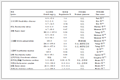
Plants with turfgrass showed significantly taller height (221.95 cm) at 15 day STI than at 45 day STI (203.72 cm), (Table 1). Mean height of turfgrass plants (218.98 cm) was significantly taller than for plants without turfgrass (210.43 cm). With turfgrass, greatest mean plant height of 230.07 cm was recorded at 15 day STI, not different from 226.73 cm at 30 day STI. Plants at 45 day STI were significantly shorter (200.13 cm). Plants without turfgrass showed similar responses, where greatest mean height (213.83 cm) was recorded at 15 day STI, followed by mean height (210.17 cm) at 30 day STI (not significant). Plants at 45 day STI attained the second lowest height (207.30 cm), not different from plants at 30 day STI (Table 1).
|
Table 1 Effect of soil working intervals on height and crown diameter of different varieties of plants planted in two plantation models |
Greatest mean height was recorded at 15 day STI in turfgrass areas. Plant height at 15 day STI was similar to that at 30 day STI, but significantly higher than at 45 day STI in both areas. Height differences for 30 and 45 day STI were significant in turfgrass areas. Plants with turfgrass were significantly taller at 15 day and 30 day STI than plants without turfgrass.
Crown diameter analysisCrown diameter analysis Crown diameter of plants was significantly affected by species (F5, 144=6720.58, p < 0.001), planting models (F1, 144=27.05, p < 0.001), STI (F2, 144=80.92, p < 0.001) and interaction of planting models with STI (F2, 144=17.01, p < 0.001). Interactions of species with planting models (F5, 144=1.92, p=0.094), species with STI (F10, 144=132.00, p=0.227), and species, planting models with STI (F10, 144= 0.824, p=0.606) did not affect crown diameter significantly.
Plants in turfgrass had significantly greater mean crown diameter (181.27 cm) than those (177.62 cm) without turfgrass (p < 1%), (Table 1). Mean crown diameter of 183.62 cm at 15 day STI was equivalent to 181.45 cm at 30 day STI, but significantly greater than 173.27 cm at 45 day STI. Plants at 30 day STI also had significantly greater crown diameter than those at 45 day STI. With turfgrass, greatest crown diameter of 186.93 cm was recorded at 15 day STI, followed by 30 day STI (184.67 cm) (not significant). Similar to height, crown diameter of turfgrass plants was also found to be smallest (172.20 cm) at 45 day STI. Plants outside turfgrass areas showed maximum mean crown diameter (180.30 cm) at 15 day STI, followed by mean crown diameter of 178.23 cm at 30 day STI (not significant). Plants at 45 day STI attained the lowest crown diameter of 174.33 cm (p < 0.05), (Table 1). Plants with turfgrass showed significantly better results at 15 day and 30 day STI than did those without turfgrass. The differences in crown diameters for STI of 30 and 45 day were significant in both areas.
A. scholaris attained maximum height (297.0 cm), followed by B. glabra (250.93 cm) and T. stans (248.33 cm), significantly taller than others (p < 1%). Maximum height increase from 2006 (209.07 cm) was recorded for A. scholaris, followed by B. glabra (191.76 cm). T. stans also performed well and attained good growth (157.40 cm). E. divaricata attained the lowest increase in height (62.54 cm) (Table 1). Crown diameter was greatest for B. glabra (260.30 cm), followed by A. scholaris (234.87 cm) and T. stans (231.77 cm), all significantly greater than other species.
DiscussionSuppression of woody plants by grasses has been widely reported; but few studies investigated the factors causing reduced growth and poor appearance of ornamental trees and shrubs planted in areas with turfgrass (Fales et al. 1981). In many landscapes of hot, arid, urban areas, plantations die due to lack of sound management practices. Plants in various turfgrass areas do not attain the desired growth even when receiving sufficient irrigation because they are not managed technically and their growth is stunted. Hendrickson (2008) found significant root growth differences occurring in turfgrass-tree combinations in a study conducted in Utah Intermountain west region with dry winds and sparse rainfall. Seedling survival decreased significantly due to competing grass cover (Bush et al. 1990; Wagner et al. 1999). Neither of these studies was conducted in a hot, arid region. Nielsen and Wakefield (1978) observed suppression of growth of some ornamental shrubs planted in combination with turfgrass. A literature survey of scientific databases including SCOPUS, GOOGLE, and SCHOLAR, showed no study of the effect of soil tilling interval on the growth and development of ornamental and aesthetic plants raised in combination with turfgrass in semi arid and arid regions. Therefore, our study was conducted in hot arid region of India.
Plants in turfgrass areas attained significantly greater height and crown diameter at 15 day and 30 day STIs as compared to those without turfgrass, whereas these attained lowest growth at 45 day STI. This might be due to grass minimizing moisture loss, leaving more moisture for plant growth. However further research is required on the effects of some parameters, such as moisture availability, reduction in temperature, improvement in relative humidity, and soil properties in the presence of turfgrass and interactions of these factors. We recorded no significant differences in terms of height and crown diameters of plants at 15 day and 30 day STI, whereas the difference was found to be significant for soil tilling at 15 days and 45 days in both plantation models (with and without turfgrass). We recorded significant declines in height and crown diameter for plants with turfgrass at 45 day STI in comparison to those at 30 day STI (Fig. 1). Without turfgrass, crown diameters of plants at 45 day STI were significantly lower than at 30 day STI. We hypothesize that the roots of turfgrass impeding the growth of plants due to competition for moisture and soil nutrients at longer STIs. We conclude that soil tilling at 30 day intervals was the best practice to obtain greater plant height and crown diameter. If soil tilling is performed in plant pits during the initial establishment stage, it adds to proper growth of plants.

|
Fig. 1 Effect of soil tilling on height and crown diameter of plants with respect to plantation models (mean±S.E.) |
Soil tilling at 30 day intervals could result in increased plant height of 13% and crown diameter of 7% in turfgrass areas in comparison to 45 day tilling intervals. We conclude that the growth of plants was significantly better with turfgrass than without turfgrass. Plants planted in turfgrass areas attained 8% more height and 4% more crown diameter at 30 day tilling intervals in comparison to plants planted outside turfgrass areas at 45 day intervals. Taking both plantation models together, height and crown diameter showed significant increases at 7% and 5%, respectively, at tilling intervals of 30 day compared to 45 day (Table 1).
We recommend tilling at 30 day intervals to achieve optimum growth of ornamental plant species in both plantation models in hot, arid regions of Indian subcontinent. This obtains dual benefits through savings on labor inputs and achievement of better landscape results in fewer days.
Attwell K (2000) Urban land resource and urban planning-case studies from Denmark. Landscape and Urban Planning 52: 145-163. DOI:10.1016/S0169-2046(00)00129-8 |
Beard JB, Green RL (1994) The role of turf grasses in environmental protection and their benefits to humans. Journal of Environmental Quality 23: 1-16. |
Bolitzer B, Netusil NR (2000) The impact of open spaces on property values in Portland, Oregon. Journal of Environmental Management 59: 185-193. |
Bolund P, Hunhammar S (1999) Ecosystem services in urban areas. Ecological Economics 29: 293-301. DOI:10.1016/S0921-8009(99)00013-0 |
Bush JK, Van Auken OW (1990) Growth and survival of Prosopis glandulosa seedlings associated with shade and herbaceous competition. Botanical Gazette 151: 234-239. DOI:10.1086/337822 |
Chaudhry P, Gupta RK (2010) Urban greenery and its sustainable extension strategies in hot arid region of India. International Journal of Sustainable Society 2: 146-155. DOI:10.1504/IJSSOC.2010.033627 |
Cheng G, Xiao D, Wang G (2000) Characteristics and construction of landscape ecology in arid regions. Chinese Geographical Science 10: 13-19. DOI:10.1007/s11769-000-0031-8 |
Dospekhov BA (1984) Field Experimentation. Moscow: Mir Publishers: p.352.
|
Fales SL, Wakefield RC (1981) Effects of turf grass on the establishment of woody plants. Agronomy Journal 73: 605-610. DOI:10.2134/agronj1981.00021962007300040009x |
Fang C, Ling D (2005) Guidance for noise reduction provided by the tree belts. Landscape and Urban Planning 71: 29-34. DOI:10.1016/j.landurbplan.2004.01.005 |
Hendrickson C. 2008. Evaluation of competition between turf grass and trees in the landscape. All Graduate Theses and Dissertations. Paper 65, Utah State University, US. Available at http://digitalcommons.usu.edu/etd/65.
|
Jim CY, Wendy YC (2009) Ecosystem services and valuation of urban forests in China. Cities 26: 187-194. DOI:10.1016/j.cities.2009.03.003 |
Johnson AD, Gerhold HD (2003) Carbon storage by urban tree cultivars, in roots and above-ground. Urban Forestry & Urban Greening 2: 65-72. |
Konijnendijk CC (1999) Urban Forestry in Europe:A Comparative Study of Concepts, Policies and Planning for Forest Conservation, Management and Development in an around major European cities.Doctoral dissertation. Research Notes No 90, Faculty of Forestry, University of Joensuu. |
Konijnendijk CC. 2001. Urban Forestry in Europe. In: Palo, M., Uusivuori, J., Mery, G. (Eds. ), World Forests (Vol Ⅲ, 2001). Dordrecht: Kluwer Academic Publishers, pp. 413-424.
|
Luttik J (2000) The value of trees, water and open Space as reflected by house prices in The Netherlands. Landscape and Urban Planning 48: 161-167. DOI:10.1016/S0169-2046(00)00039-6 |
McPherson EG, Simpson JR (1998) Air Pollutant uptake by Sacramento's urban forest. Journal of Arboriculture 24: 224-234. |
McPherson EG, Simpson JR, Peper PF (2005) Municipal forest benefits and costs in five US cities. Journal of Forestry 103: 411-416. |
Nielson AP, Wakefield RC (1978) Competitive effects of turf grass on the growth of ornamental shrubs. Agronomy Journal 70: 39-42. DOI:10.2134/agronj1978.00021962007000010010x |
Nowak DJ. 1994. Air pollution removal by Chicago's urban forest. In: E. G McPherson, D J Nowak and R A Rowntree (eds. ), Chicago's Urban Forest Ecosystems: Results of the Chicago's Urban Forest Climate Project General Technical Report NE-186, US Department of Agriculture, Forest Service, North Central Research Station, St. Paul, MN, pp. 63-81.
|
Pataki DJ, Alig RJ.Fung AS, Golubiewski NE, Kennedy CA, Mc Pherson EG, Nowak DJ, Pouyat RV, Lankao PR (2006) Urban ecosystems and the North American carbon cycle. Global Change Biology 12: 2092-2102. DOI:10.1111/gcb.2006.12.issue-11 |
Potchter O, Goldman D, Kadish D, Iluz D (2008) The oasis effect in an extremely hot and arid climate:the case of southern Israel. Journal of Arid Environments 72: 1721-1733. DOI:10.1016/j.jaridenv.2008.03.004 |
Shashua-Bar L, Pearlmutter D, Erell E (2009) The cooling efficiency of urban landscape strategies in a hot dry climate. Landscape and Urban Planning 92: 179-186. DOI:10.1016/j.landurbplan.2009.04.005 |
Singh G, Mutha S, Bala N (2007) Effect of tree density on productivity of a Prosopis cineraria agroforestry system in North Western India. Journal of Arid Environments 70: 152-163. DOI:10.1016/j.jaridenv.2006.12.003 |
Stier J. 2009. How to grow turf in the shade, Grounds and commercial turf session papers. Department of hortculticulture, University of Wisconsin. Available at http://archive.lib.msu.edu/tic/mitgc/article/1999186.pdf[Retrieved March 20, 2010]
|
Suleiman MK, Abdal MS (2002) Water availability for the greening of Kuwait. Limnologica Ecology & Management of Inland Waters 32: 322-328. |
Watson G. 2004. Tree vs Lawn: Uneasy Coexistence. Available at http://www.mortonarb.org/images/stories/pdf/our_work/Tree_vs_Lawn.pdf[Retrieved March 15, 2010]
|
Wagner RG, Mohmmed GH, Noland TL (1999) Critical period of interspecific competition for northern comfers associated with herbaceous competition. Canadian Journal of Forestry Research 29: 890-897. DOI:10.1139/x99-055 |
Xiao QF, McPherson EG, Simpson JR (1998) Rainfall interception by Sacramento's urban forest. Journal of Arboriculture 24: 235-244. |