 2012, Vol. 23

2. Department of Forestry, Faculty of Natural Resources, Sari Agricultural Science and Natural Resources University, Sari, Iran;
3. Caspian forest tree center, Mahmoud Abad city, Mazandaran province, Iran
Land rehabilitation in arid zones presents many challenges (Anderson and Ostler 2002). In particular, strong seasonal aridity, and low and erratic rainfall hampers revegetation of areas following disturbance (Glenn et al 2001).
Understanding the seed biology and characters of species in revegetation plans is important for ensuring seedling establishment. For example, pre-treating seeds or overcoming seed dormancy prior to planting are important steps for increasing the likelihood of seed germination and seedling establishment, especially in arid environments.
Except moisture and an appropriate incubation temperature for germination, some seeds require a germination stimulant such as sulfuric acid, boiling water, or scarification.
Acacia (Mill.) is the largest genus in the Leguminosae- Mimosoideae with approximately 1, 200 species distributed mainly in tropical and subtropical regions (Mabberley 1997). Multipurpose trees like Acacia sp., which can cope with severe environmental conditions are useful tree species for afforestation in arid and semi-arid areas (Aref 1996).
The main problem when using Acacia species in afforestation is the often poor germination of their seeds. This is caused by their water-impermeable seed coats, which cause a physical, exogenous dormancy (Holmes et al. 1987). To overcome seed dormancy and obtain rapid and synchronous germination artificially before sowing, the seed must be treated physically or chemically. Pre-germination treatments will quickly destroy the integrity of the impermeable seed coat, enabling the embryo to receive water. Several methods are used to break the hard, impermeable seed coats of Acacias. Treatment with sulfuric acid for three to fifteen min is a commonly used method for breaking seed dormancy in Acacia Senegal (Cheema and Qadir 1973). Also the hardness and impermeability of the seed coat, as an inhibited sactor in seed germination, has been studied in several species of the family Leguminosae. For example, according to Gebre and Karam (2004), scarification with concentrated sulfuric acic for 15 min proved to be quite satisfactory in breaking the hard seed coat in Cercis siliquastrum (a leguminous shrub). Pipinis et al (2010) found that combination of acid scarification and moist stratification is the best method for breaking seed dormancy in Cercis siliquatrum.
Acacia tortilis is a nitrogen fixing tree species and occurs naturally in arid and semi-arid regions in North and East Africa, and the near and Middle East (Web et al 1989). acacia tortilis is a useful species specially for cattle. Camels can eat leaves, sprouts and fruits of acacia tortilis. This species is also a good choice for improving soil fertility due nitrogen fixation. Leaves and sprouts of acacia oerfota are good fodder for cow and camel and can increase milk production in cattle but seeds have a hard coat and are not edible. Improving Soil fertility can achieve via this species and in some cases timber of acacia oerfota is used as fuel (Emtehani 2003).
Few studies have addressed seed biology of arid zone species in the Middle East and Africa. The aim of this study was to investigate the seed biology of two life forms, one tree and one shrub, of the Leguminosae family and to document the effects of common germination promoting treatments.
Materials and methods Seed collectionsRipe fruits of A. tortilis and A. oerfota were collected from mature and healthy trees in Minab in southern Iran during 2009. After collection, seeds were removed from pods and stored at laboratory conditions until germination testing commenced. Then, the empty seeds were removed by floating in water. Experiments were conducted on seeds of A. tortilis and A. oerfota.
Pre-germination treatmentsThe pre-germination treatments in the experiment were:
1. soaking seeds in water for 48 h;
2. soaking seeds in boiled water and let them to get to the room temperature
3. soaking seeds in sulfuric acid for 15 min followed by soaking in tap water for 24 h;
4. soaking seeds in sulfuric acid for 15 min;
5. soaking seeds in sulfuric acid for 15 min and then in H2O2 for 15 min;
6. use of sandpaper to abrade seed coats
After pre-germination treatment, seeds were sterilized by washing in 70% ethanol for 1 min, and then seeds were rinsed three times with sterilized deionized water. Seeds were incubated in Petri dishes containing L2 medium. Three replicates of 10 seeds were used in all treatments. The dishes were maintained in a germinator with day/night temperatures of 25℃/15℃ (±2℃), relative humidity of 90% and a 16-h photoperiod. Germination was defined as the emergence of the radical, and this was scored every week up to 28 d.
Statistical analysisGermination percentage is an estimate of the viability of population of seeds. The equation to calculate germination percentage is:
| $ {G_P} = \frac{n}{N} \times 100 $ | (1) |
Where, GP is the final germination percentage, N is the total number of seeds and n is the germinated seeds.
The germination rate provides a measure of the time course of seed germination. Germination rate is determined by calculating the at different time intervals using below equation:
| $ {G_s} = \sum\limits_{i = 1}^n {\left({\frac{n}{t}} \right)} $ | (2) |
where, Gs is the germination rate, n is number of germinated seeds and t is the time interval (7 days in our study).
The design implemented was a completely randomized design (CRD). Data for each treatment were analyzed by two-way analysis of variance (ANOVA). When significant differences were detected by ANOVA, we used the Duncan test at 95% confidence for multiple comparisons.
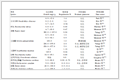
Results and discussionGermination percentage and germination rate differed significantly by treatment and species, and in the interaction of treatments and species (p < 0.01) (Table 1).
|
Table 1 Results of 2-way analysis of variance (ANOVA) of species, treatments and their interaction for the germination parameters |
Final seed germination percentages for two species scarified by sandpaper and soaked in sulfuric acid and H2O2 were high (>80%). Whereas, seeds soaked in water for 48 h and also seeds soaked in H2SO4 and then soaked in tap water for 24 hours showed the lowest germination percentage in A. oerfota and A. tortilis, respectively. The seeds failed to germinate properly (Fig. 1). Germination rate had similar regime to germination percentage and the quickest germination rates were found for sandpaper and soaking in sulfuric acid and H2O2 (Fig. 2).

|
Fig. 1 Germination percentage (mean±SE) in different treatments: 1-Sand paper, 2-Boiling water, 3-Soaking for 48 h, 4-H2SO4 then soaking in tap water for 24 h, 5-H2SO4 for 15 min, and 6-H2SO4 then H2O2. |

|
Fig. 2 Germination rate (mean±SE) in different treatments: 1-Sand paper, 2-Boiling water, 3-Soaking for 48h, 4-H2SO4then soaking in tap water for 24h, 5-H2SO4 for 15 min, and 6- H2SO4then H2O2. |
We tested several methods to overcome seed dormancy in two Acacia species. Most Acacia species have a hard coat to survive in severe environment conditions which might be one of the most important strategies for survival in harsh environments. Jurado and Westoby (1992) hypothesized that quick germinating species would take advantage of a single rainfall event, whereas, slow germinating species would wait for several rainfall events ensuring adequate soil moisture over a considerable length of time. Seed dormancy aids the survival of Acacia populations by preventing out-season emergence, and spreading the germination over many weeks or even a year. The hard seed coat of Acacia seeds can be broken by mechanical or chemical softening (Sadhu and Kaul 1989; Danthu et al. 1992). However, manual scarification does not ensure germination of all viable seeds and it is not suitable for large-scale usage (Clemens et al. 1977). Mechanical scarification of seeds of A. origena and A. pilispina, however, resulted in 100% germination (Teketay 1998). Germination of A. oerfota increased significantly when the seeds were scarified by sandpaper. Tests of pre-treatments of seeds of A. victoriae, A. saligna, A. farnesiana, and A. aneura revealed that soaking seeds in concentrated H2SO4 or in water significantly increased germination percentages (Al-mudaris et al. 1999). For A. origena and A. pilispina, sulphuric acid soaking for 60 min, 90 min, and 120 min significantly increased germination percentages (>95%) (Teketay 1998). Rodrigues et al. (2008) showed that immersion of A. mangium seeds in sulfuric acid for 90 min and in boiling water for 60 s were most effective in overcoming seed dormancy. Masuda and Konishi (1993) hypothesized that degradation of the seed coat by acid treatment promoted germination by increasing water permeation and oxygen influx to the embryo. In addition, acid treatment may have decreased inhibitors in the pericarp and thus improved germination. Rostami and Shahsavar (2009) also showed that chemical scarification softened seed coats and increased the permeability of the endocarp layer. This facilitated water penetration, which lead to activation of the embryo.
Fig. 1 and Fig. 2 show that treatment with sulfuric acid and hydrogen peroxide gave the best result. Hydrogen peroxide increased seed moisture uptake, which led to increased seed germination. Takagi et al. (1986) reported that hydrogen peroxide treatment had a significant effect on breaking rice seed dormancy. As cautioned by Danthu et al. (1992), the application of sulfuric acid as a seed coat softener is difficult in nursery conditions and therefore hazardous and not recommend for beginners.
A. tortilis seeds immersed in boiling water showed good germination, so boiling water can replace sulfuric acid and scarification. This result concurs with Magnai et al. (1993) and Aref (2000). The germination rate of the seeds of A. cambagei (R.T. Baker), A. Senegal (L.) Wild. and A. lineata (Cunn.) also were improved after soaking in boiling water (Larsen 1962). Foroughbakhsh et al. (2000) showed that the best results for A. farnesiana were obtained by immersion in warm water and concentrated sulfuric acid for 10−20 min. Rehman et al. (1999) also found that soaking in water at 70℃ was the most effective method, with soaking time between 1 and 100 min safely overcoming hard seed coat dormancy and permitting maximum germination of A. salicina. Aliero (2004) suggested that the sudden dip of dry seeds in boiling water leads to rapture of the seed coat, allowing water to permeate the seed tissue causing physiological changes and subsequent germination of the embryo. In contrast Nasroun and Al-Mana (1992) asserted that boiling the seeds of A. salicina, A. saligna, A. seyal, A. farnesiana and A. tortilis did not significantly increase their germination percentage. Soaking in tap water for 48 h in the present study resulted in lower germination percentage compared with other treatments especially for A. oerfota, which has a harder seed coat than A. tortilis. Goda (1986) found that soaking the seeds of A.nilotica in tap water for 72 h had only a slight impact on germination (4%). Because the treatments that induced germination in our experiments were those that disrupt the seed coat, we conclude that dormancy of these seeds is mechanical and is associated with the seed coat.. After appropriate treatment, the majority of our seeds germinated quickly. This would enable rapid response to sporadic and infrequent rainfall events that characterize most parts of Middle East and Africa.
ConclusionOur research results have important implications for germination and nursery production of species for restoration and rehabilitation of arid zones. Before sowing, species whose seeds are characterized by physical dormancy will need to be scarified to allow water penetration to the embryo. In terms of germination percentage, we found both species of Acacia responding similarly to treatments. According to the results of our study, , sandpaper and H2SO4 treatments were necessary to break dormancy and to enhance germination of Acacia seeds. H2O2 is also recommended because it appears to help seeds to breathe after treatment by supplying oxygen to the embryo. Nevertheless, use of H2SO4 is dangerous and not recommended for beginners. However, for A. oerfota, one of these methods is recommended. For A. tortilis seeds we recommend soaking in boiling water as an easy and quick treatment method.
AcknowledgmentThe authors thank Yahya Kooch (department of forestry, university of Tarbiat moddares) for statistical analyses. We would like to thank the staff and expert of Bandar Abbas natural recourses office for the collection of seeds used in this study.
Aliero BL (2004) Effects of sulfuric acid, mechanical scarification and wet heat treatments on germination of seeds of African locust bean tree, Parkia biglobosa. African Journal of Biotechnology 3(3): 179-181. |
Al-mudaris MA, Omari MA, Hattar BI (1999) Enhancing germination of four Australian Acacia species through seed treatments overcoming coat-imposed dormancy. Journal of Agriculture in the Tropics and Subtropics 100(2): 147-156. |
Anderson DC, Ostler WK (2002) Revegetation of degraded lands at U.S. department of Defence installation: strategies and successes. Arid Land Research and Management 16(3): 197-212. DOI:10.1080/153249802760284766 |
Aref IMI (1996) The Distribution and Ecophysiology of Acacia Species in the South Western Zone of Saudi Arabia. A Ph.D. Thesis, UK: University of Edinburgh: p. 273.
|
Aref IMI (2000) Effects of pre-germination treatments and sowing depths upon germination potential of some Acacia species. Research Bulletin 95: 5-17. |
Cheema MSZA, Qadir SA (1973) Autecology of Acacia Senegal (L.) Willd. Plant Ecology 27(1/3): 131-162. |
Chhipa BR, Lal P (1995) Na/K ratios as the basis of salt tolerance in wheat. Australian Journal of Agricultural Research 46(3): 533-539. DOI:10.1071/AR9950533 |
Clemens J, Jones PG, Gilbert NH (1977) Effect of seed treatments on germination in Acacia. Australian Journal of Botany 25(3): 269-276. DOI:10.1071/BT9770269 |
Danthu A, Roussel J, Saar JA (1992) Effect of different pretreatments on the germination of Acacia Senegal seeds. Seed Science and Technology 20(1): 111-117. |
Doran JC, Turnbull JW, Boland DJ, Gunn BV (1983) Handbook on Seeds of Dry-Zone Acacias. Published by FAO.
|
Emtehani MH (2003) Native Acacia species in Iran. Yazd: Yazd University Press: p. 122.
|
Foroughbakhch R, Hauad LA, Maiti RK, Rodrigues M, Hernandez-pinero J, Badii MH, Cespendes AE, Ponce-moreno EE (2000) Technique of germination and growth potential of some fuelwood species in northeastern Mexico. Phyton 69: 17-22. |
Gebre GH, Karam NS (2004) Germination of Crecis siliquastrum seeds in response to giberelic acid and startification. Seed science and technology 32: 255-260. DOI:10.15258/sst |
Glenn EP, Waugh WJ, Moore D, McKeon C, Nelson SG (2001) Revegetation of an abandoned uranium millsite on the Colorado Plateaeu, Arizona. Journal of Environmental Quality 30(4): 1154-1162. DOI:10.2134/jeq2001.3041154x |
Goda SE (1986) Germination of Acacia nilotica (L.Willd) seeds. Sudan Silva 26: 25-32. |
Holmes RJ, McDonald JNAW, Juritz J (1987) Effects of clearing treatment on seed bank of the Alinene invasive shrubs Acacia saligna and Acacia cyclops in the southern and south Western Cape, South Africa. Journal of Applied Ecology 24: 1045-1051. DOI:10.2307/2404000 |
Jurado E, Westoby M (1992) Germination biology of selected central Australian plants. Australian Journal of Ecology 17(3): 341-348. DOI:10.1111/aec.1992.17.issue-3 |
Larsen E (1962) Germination response of Acacia seeds to boiling. Australian Journal of Forest Research 1: 51-53. |
Mabberley DJ (1997) The Plant Book: A Portable Dictionary of the Vascular Plants, 2nd edition. Cambridge, UK: Cambridge University Press.
|
Magnani G, Macchia M, Serra G, Moscheni E (1993) Practical methods for overcoming seed hardness in some ornamental Acacia species. Colture-Protette Italy 22(12): 71-78. |
Masuda M, Kuniyoshi K (1993) Improvement of high-temperature germination of spinach seed with Acid scarification and Priming with Polyethylene Glycol 6000. Journal of Japanese Society and Horticultural Science 62(2): 419-424. DOI:10.2503/jjshs.62.419 |
Nasroun TH, Al-Mana FA (1992) The effect of pretreatment of seeds of some arid zone species on their germination response. Journal of King Saudi University, Agricultural Sciences 4(1): 79-93. |
Pipinis E, Milios E, Smiris P, Gioumousidis Ch (2011) Effect of acid scarification and cold moist stratification on the germination of crecis siliquatrum L.seeds. Turkish journal of agriculture and forestry 35(3): 259-264. |
Rehman S, Loescher RNJ, Harris PJS (2000) Dormancy breaking and germination of Acacia salisina Lindl seeds. Seed Science and Technology 27(2): 553-558. |
Rodrigues DC, Kohl MC, Pedrinho DR, Arias ERA, favero S (2008) Treatments to overcome dormancy of Acacia mangium seeds. Acta Scientiarum Agronomy (UEM) 30: 279-283. |
Rostami AA, Shahsavar A (2009) Effects of seed scarification on seed germination and early growth of Olive seedlings. Journal of biological science 9(8): 825-828. DOI:10.3923/jbs.2009.825.828 |
Sadhu RN, Kaul V (1989) Seed coat dormancy in Robinia pseudo-acacia. Indian Forester 115: 483-487. |
Takagi Y, Samoto Sh, Kishikawa H, Motomura T (1986) Effect of Hydrogen peroxide on dormancy breaking in Rice seed. Bulletin of Faculty of Agriculture. Saga University 61: 55-59. |
Teketay D (1998) Germination of Acacia origena, A. pilispina and Pterolobium stellatum in response to different pre-sowing seed treatments, temperature and light. Journal of Arid Environments 38(4): 551-560. DOI:10.1006/jare.1997.0332 |
Webb DB, Wood PJ, Smith JP, Henman GS (1984) A guide to species selection for tropical and sub-tropical plantations. Tropical Forestry Papers No. 15. Oxford: Oxford Forestry Institute.
|