


在自然界和工程实际应用的气固两相流中,固相的颗粒如粉、尘、烟、霾等不仅受到流体相的输运作用,其自身还往往出现由物理或化学作用导致的生长、凝并(颗粒碰撞后形成一个颗粒)、破碎等现象。颗粒一般动力学方程(General dynamic equation, GDE),又称颗粒数平衡方程(Population balance equation, PBE),可用来描述颗粒相数密度在流体输运下出现以上现象后的演变过程[1]。
在大多数情况下,两相流处于湍流状态,湍流导致的流动无序性与多尺度特性,使得两相湍流变得很复杂,因而更具有研究价值。流场物理量的脉动是湍流场的一个重要特征,对于湍流脉动特性的研究,其科学意义不仅局限于湍流或多相流领域[2]。本文关注微纳颗粒两相湍流中的湍流脉动效应,在微纳颗粒两相湍流中,颗粒的形成与生长受到环境因素如流场速度、流场剪切率、化学组分浓度、温度、压力等的影响,而这些环境因素会受到湍流脉动的影响变化,所以颗粒的形成和生长速率会受到湍流脉动的影响。于是,若不考虑湍流的脉动而仅仅用平均后的环境因素来计算颗粒的形成和生长就会与实际情形产生偏差。例如,在云层凝结的过程中,湍流导致的温度脉动会使水蒸气饱和度发生变化,从而使得用平均参数给出的云雾颗粒形成率与生长率与实际不符[3-8]。在实验室条件下,湍流造成的温度脉动、物质组分脉动也不可忽略[9-11],否则会使实验测量结果产生偏差[12-13]。在数值模拟方面,已有一些探讨湍流脉动影响的研究,例如将DNS得到的结果与用平均场求得的结果进行对比[14-18],将LES得到的结果与用雷诺平均方法得到的结果进行对比[19-24],将用和不用脉动量概率密度函数进行修正的结果进行对比[25-27]。除了颗粒的形成与生长受湍流脉动的影响外,颗粒的凝并与破碎也受湍流脉动的影响,因为颗粒的布朗凝并、湍流凝并、湍流破碎都与颗粒的浓度有关,而颗粒浓度在湍流场中也存在脉动[2, 10, 28-34]。湍流脉动对颗粒凝并影响的研究虽然较少,但这种影响是存在的[25, 35-38]。
1 颗粒相方程 1.1 颗粒一般动力学方程颗粒一般动力学方程是描述颗粒数密度函数(Number density function, NDF)的控制方程。假设颗粒尺度小于最小流动尺度且颗粒雷诺数远小于1,颗粒数密度分布
| $ \frac{\partial n}{\partial t}+\nabla \cdot n{{u}}-\nabla \cdot {D}_{p}\nabla n={S}_{n}+{S}_{g}+{S}_{c}+{S}_{b} $ | (1) |
式中
(1)成核项。成核是指通过结晶或其他化学作用形成初始体积为
| $ {S}_{n}=B\left({Y}\right)\cdot \delta \left(v-{v}_{0}\right) $ | (2) |
式中
(2)生长项。颗粒的凝积生长是指其他物质凝结、沉积在颗粒上,使颗粒尺度增长的过程:
| $ {S}_{g}=\frac{\partial }{\partial v}\left(G\left({Y},v\right)\cdot n\left(v\right)\right) $ | (3) |
式中
(3)凝并项。凝并是指颗粒间相互碰撞聚集导致颗粒整体尺度增大、数密度减少的过程:
| $ \begin{split} {S}_{c}=&\frac{1}{2}{\int }_{0}^{v}\beta \left(v-{v}_{1},{v}_{1}\right)n\left(v-{v}_{1}\right)n\left({v}_{1}\right){\rm{d}}{v}_{1}-\\& {\int }_{0}^{\mathrm{\infty }}\beta \left(v,{v}_{1}\right)n\left(v\right)n\left({v}_{1}\right){\rm{d}}{v}_{1} \end{split}$ | (4) |
式中
(4)破碎项。破碎是指颗粒因无法支撑团聚状态而导致裂解,使得颗粒整体尺度减小、数密度增加的过程:
| $ {S}_{b}={\int }_{0}^{\mathrm{\infty }}a\left({v}_{1}\right)b\left(v|{v}_{1}\right)n\left({v}_{1}\right){\rm{d}}{v}_{1}-a\left(v\right)n\left(v\right) $ | (5) |
式中
对方程(1)的求解难点在于对源项的处理,当对每个源项给出相应的表示方式后,便可对方程(1)进行求解。除了极少数情况能得到方程(1)的相似解[1],大多数情况需要采用数值方法求解。在数值求解方法中,分区法和节点法是在将颗粒尺度离散化的基础上得到离散的尺度分布,然后通过计算大量离散尺度下的颗粒数密度得到收敛的数密度分布[39-40]。矩方法则是将颗粒数密度分布对颗粒尺度
采用雷诺平均方法,将流场速度和颗粒数密度表示成平均量和脉动量之和:
| ${{u}}={{{\bar u}}}+{{{u}}}' ,\;\;n=\bar{n}+{n}'$ |
将其代入方程(1)后进行平均得:
| $ \begin{split}& \frac{\partial \bar{n}}{\partial t}+\nabla \left({{{\bar u}}}\cdot \bar{n}\right)+\nabla \left( \overline{{{{u}}}'\cdot {n}'}\right)-{D}_{p}{\nabla }^{2}\bar{n}=\\&\qquad {\bar{S}}_{n}+{\bar{S}}_{g}+{\bar{S}}_{c}+{\bar{S}}_{b} \end{split} $ | (6) |
左边第三项为脉动对流项,通常采用梯度扩散假说进行封闭,引入湍流扩散系数
| $ \overline{{{{u}}}'\cdot {n}'}=-{D}_{t}\nabla \bar{n} $ | (7) |
将其与左边第四项合并得:
| $ \frac{\partial \bar{n}}{\partial t}+\nabla \left({{{\bar u}}}\cdot \bar{n}\right)-\left({D}_{p}+{D}_{t}\right){\nabla }^{2}\bar{n}={\bar{S}}_{n}+{\bar{S}}_{g}+{\bar{S}}_{c}+{\bar{S}}_{b} $ | (8) |
则方程左边完全封闭,接下来处理右边。
(1) 成核项。经平均后的成核项为:
| $ {\bar{S}}_{n}=\bar{B}\left({Y}\right)\cdot \delta \left(v-{v}_{0}\right) $ | (9) |
(2)生长项。生长项的雷诺平均有几种情况:
①最简单的情况是生长核函数与环境参数无关,用
| $ {\bar{S}}_{g}=\bar{n}\left(v\right)\frac{\partial G\left(v\right)}{\partial v}+G\left(v\right)\frac{\partial \bar{n}\left(v\right)}{\partial v} $ | (10) |
该情况的生长项无需封闭,当温度、化学组分等环境参数对颗粒生长的影响很小时,可直接使用。
②若生长核函数与环境参数相关,但与颗粒尺度无关,核函数会受到环境参数脉动的影响,则生长核函数可写成
| $ {\bar{S}}_{g}=\bar{G}\left({Y}\right)\frac{\partial \bar{n}\left(v\right)}{\partial v}+\overline{G\left({{\bar Y}}+{{Y}}'\right)\frac{\partial {n}'\left(v\right)}{\partial v}} $ | (11) |
式中的实际平均生长率
③若生长核函数与环境参数以及颗粒尺度
| $\begin{split} {\bar{S}}_{g}=& \bar{G}\left({Y},v\right)\frac{\partial \bar{n}\left(v\right)}{\partial v}+\overline{G\left({Y},v\right)\frac{\partial {n}'\left(v\right)}{\partial v}}+\\& \bar{n}\left(v\right)\frac{\partial \bar{G}\left({Y},v\right)}{\partial v}+\overline{{n}'\left(v\right)\frac{\partial G\left({Y},v\right)}{\partial v}} \end{split}$ | (12) |
式中的
(3) 凝并项。该项的雷诺平均也分有几种情况:
①凝并核函数
| $ \begin{split} {\bar{S}}_{c}=&\frac{1}{2}{\int }_{0}^{v}\beta \left(v-{v}_{1},{v}_{1}\right)\bar{n}\left(v-{v}_{1}\right)\bar{n}\left({v}_{1}\right){\rm{d}}{v}_{1}-\\& {\int }_{0}^{\mathrm{\infty }}\beta \left(v,{v}_{1}\right)\bar{n}\left(v\right)\bar{n}\left({v}_{1}\right){\rm{d}}{v}_{1}+\\& \frac{1}{2}{\int }_{0}^{v}\beta \left(v-{v}_{1},{v}_{1}\right)\overline{{n}'\left(v-{v}_{1}\right){n}'\left({v}_{1}\right)}{\rm{d}}{v}_{1}-\\& {\int }_{0}^{\mathrm{\infty }}\beta \left(v,{v}_{1}\right)\overline{{n}'\left(v\right){n}'\left({v}_{1}\right)}{\rm{d}}{v}_{1} \end{split}$ | (13) |
方程中的脉动凝并项
②凝并核函数
| $ \begin{split} {\bar{S}}_{{c}}=&\frac{1}{2}{\int }_{0}^{v}\overline{\beta \left(v-{v}_{1},{v}_{1}\right)n\left(v-{v}_{1}\right)n\left({v}_{1}\right)}{\rm{d}}{v}_{1}-\\& {\int }_{0}^{\mathrm{\infty }}\overline{\beta \left(v,{v}_{1}\right)n\left(v\right)n\left({v}_{1}\right)}{\rm{d}}{v}_{1} \end{split} $ | (14) |
进行展开,例如湍流凝并核函数为[56]:
| $ \beta \left(v,{v}_{1}\right)=\alpha \varGamma _{\eta }\left({v}^\frac{1}{3}+{v}_{1}^\frac{1}{3}\right) $ | (15) |
式中
(4) 破碎项。
①当破碎核函数不含任何湍流脉动量时,平均后的破碎项为:
| $ {\bar{S}}_{{b}}={\int }_{0}^{\mathrm{\infty }}a\left({v}_{1}\right)b\left(v|{v}_{1}\right)\bar{n}\left({v}_{1}\right){\rm{d}}{v}_{1}-a\left(v\right)\bar{n}\left(v\right) $ | (16) |
②当破碎核函数含湍流脉变量时,平均后的破碎项为:
| $ {\bar{S}}_{{b}}={\int }_{0}^{\mathrm{\infty }}b\left(v|{v}_{1}\right)\overline{a\left({v}_{1}\right)n\left({v}_{1}\right)}{\rm{d}}{v}_{1}-\overline{a\left(v\right)n\left(v\right)} $ | (17) |
如湍流破碎核为:
| $ a\left(v\right)={k}_{b}{\left(\frac{\mu \varGamma _{\eta }}{\varGamma ^{\mathrm{*}}}\right)}^{q}{v}^\frac{1}{3} $ | (18) |
式中:
湍流脉动引起颗粒的成核、生长、凝并与破碎项使方程(1)变得不封闭,目前尚无对这些项模化的公认模型,大部分数值模拟中只能直接忽略这些项,而已有研究表明,有些情况下这些项并不可忽略,例如湍流微尺度与颗粒尺度相当的情形[1]。
2 湍流脉动导致的颗粒成核与生长随着对湍流研究的不断深入,湍流场中脉动压力、脉动温度对颗粒成核与生长的影响逐渐引起人们的关注。最早开始研究湍流脉动对颗粒生成与生长影响的是Levin和Sedunov[57],他们认为湍流场中压力的脉动影响饱和度的稳定,从而改变雨滴的生长率,使雨滴的尺度分布变宽。然而,他们没有给出颗粒浓度和粒径分布的最终信息。随着对概率密度函数(PDF)方程求解技术的提高,有关湍流脉动对颗粒生成与生长影响的研究有了比较有效的手段。Lesniewski和Friedlander[12]计算了圆湍射流场蒸汽冷凝过程中颗粒成核的速率,并对比了用温度PDF和平均温度场计算得出的结果。经典理论表明,在过饱和点的位置附近,颗粒成核速率会急剧增加,而在该位置之外成核速率几乎为零。采用温度PDF研究的结果表明,所有情况下都存在蒸汽冷凝成核,只是最大成核速率没有经典理论给出的那么大。在考虑温度脉动的情况下,得到的颗粒浓度分布较均匀且更宽。后来,Lesniewski和他的同事[13, 58]继续用二丁基邻苯二甲酸与氮气在圆湍射流中进行颗粒成核实验,以说明脉动温度与脉动组分浓度对成核的影响,结果表明湍流导致的脉动对颗粒生成与生长的影响不可忽略,这一结果引起了人们的重视,后续的数值模拟研究[15-17, 19-22, 26-27, 37]中都采用了与该实验相同的条件。
2.1 颗粒成核率、生长率的数值模拟结果采用不同的数值模拟方法,得到的颗粒成核率、生长率的结果也不同。以下采取统一的表达方式来描述瞬时、表观和各类平均的数值结果。以经典的蒸汽凝结均质成核速率表达式为例:
| $ B=\frac{{P}_{v}{N}_{v}{v}_{m}}{kT}{\left(\frac{2\sigma }{{\text{π}} m}\right)}^ \frac{1}{2}\mathrm{exp}\left[-\frac{16{\text{π}} {\sigma }^{3}{m}^{2}}{3{\left(kT\right)}^{3}{\rho }_{p}^{2}{\left(\mathrm{ln}S\right)}^{2}}\right] $ | (19) |
式中
要考虑环境参数脉动对成核的影响,一种方法是引入脉动环境参数已知的PDF,然后计算PDF的平均值。例如,考虑温度和蒸汽浓度的脉动时,PDF平均成核速率为[13, 19]:
| $\begin{split} & B\left(\mathrm{p}\mathrm{d}\mathrm{f}\left\langle T,{N}_{v}\right\rangle \right)=\\ &\qquad \int_0^1 {\int_0^1 I } \left({\theta }_{N},{\theta }_{T},{N}_{0},{N}_{\mathrm{\infty }},{T}_{0},{T}_{\mathrm{\infty }}\right)P\left({\theta }_{N},{\theta }_{T}\right){\rm{d}}{\theta }_{N}{\rm{d}}{\theta }_{T} \end{split} $ | (20) |
式中
Fager等[20]将用LES得到的环境参数代入成核速率式,得到空间滤波的成核速率,还以前面的成核率为例:
| $ B\left(\left\langle {Y}\right\rangle \right)=\frac{\left\langle {P}_{v}\right\rangle \left\langle {N}_{v}\right\rangle {v}_{m}}{k\left\langle T\right\rangle }{\left(\frac{2\sigma }{{\text{π}} m}\right)}^\frac{1}{2}\mathrm{exp}\left[-\frac{16{\text{π}} {\sigma }^{3}{m}^{2}}{3{\left(k\left\langle T\right\rangle \right)}^{3}{\rho }_{p}^{2}{\left(\mathrm{ln}\left\langle S\right\rangle \right)}^{2}}\right] $ | (21) |
对生长核函数
Veroli和Rigopoulos[27]采用蒙特卡洛方法计算了二丁基邻苯二甲酸蒸汽在圆湍射流中的凝结成核,并对用平均温度场和温度场PDF得到的表观饱和度
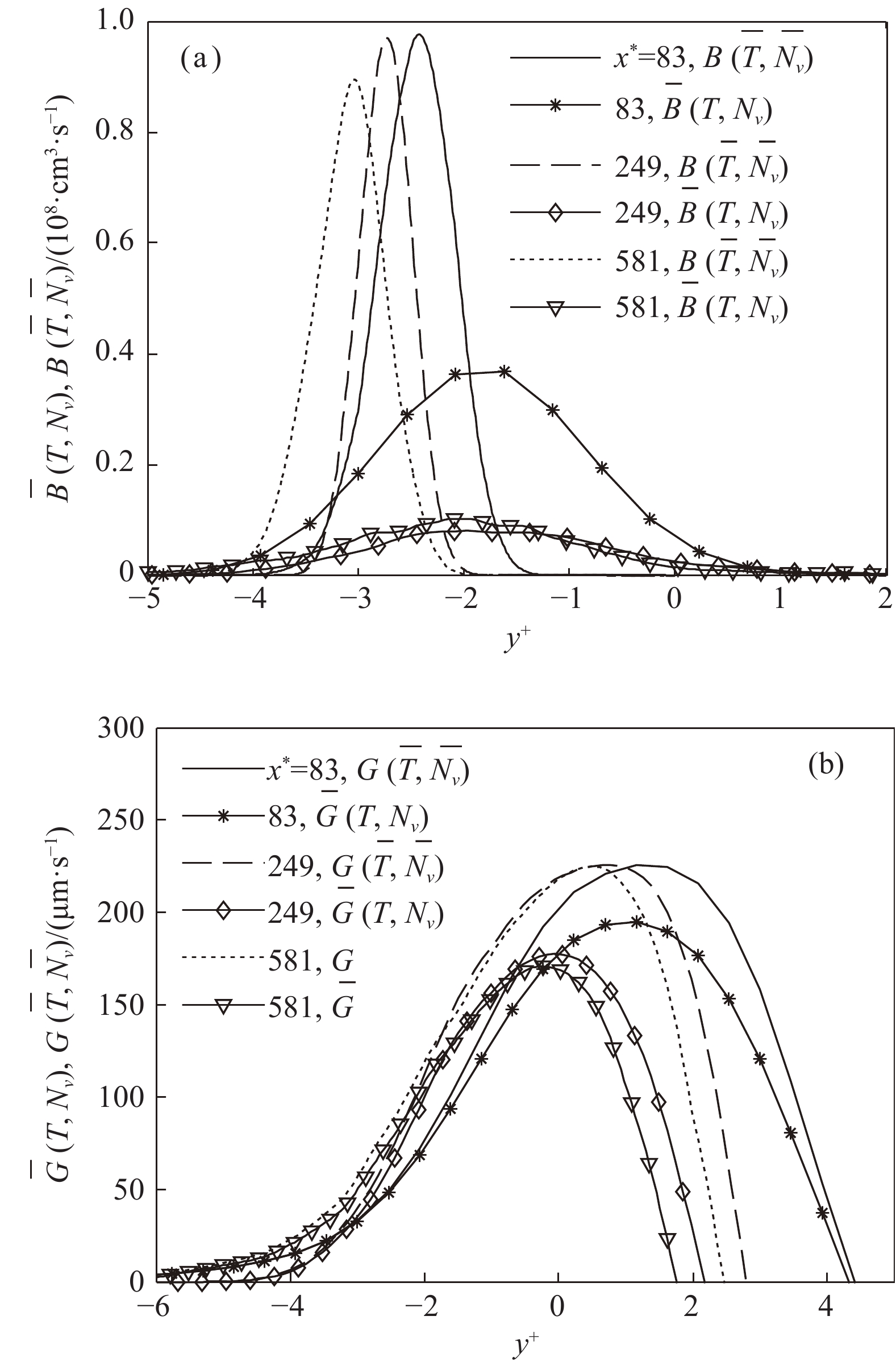
Zhou等[17]用DNS方法模拟流场、积分矩方法(Quadrature Method of Moment, QMOM)求解颗粒相的源项,计算了二丁基邻苯二甲酸蒸汽在混合剪切层中的冷凝成核与凝积生长,并将成核速率和生长速率的真实平均值
|
图 1 成核速率与粒径凝积生长速率在混合剪切层的空间分布[17] Fig.1 Space distribution of nucleation rate and condensation growth rate in mixing shear layer[17] |
Pesmazoglou等[22]用LES数值模拟了圆湍射流中二丁基邻苯二甲酸蒸汽的凝结成核,并将由LES和RANS方法得到的空间滤波成核速率
在对受湍流脉动影响的颗粒成核项和生长项进行模化时,首先需确定湍流脉动在特定条件下对这两项的影响程度。例如,在蒸汽凝结成核过程中,颗粒成核率对温度的变化很敏感,Garrick等对二丁基邻苯二甲酸蒸汽的凝结成核进行了数值模拟[15-16, 20-21],发现湍流场中的颗粒成核率主要受温度、饱和度、组分浓度这三者脉动的影响。
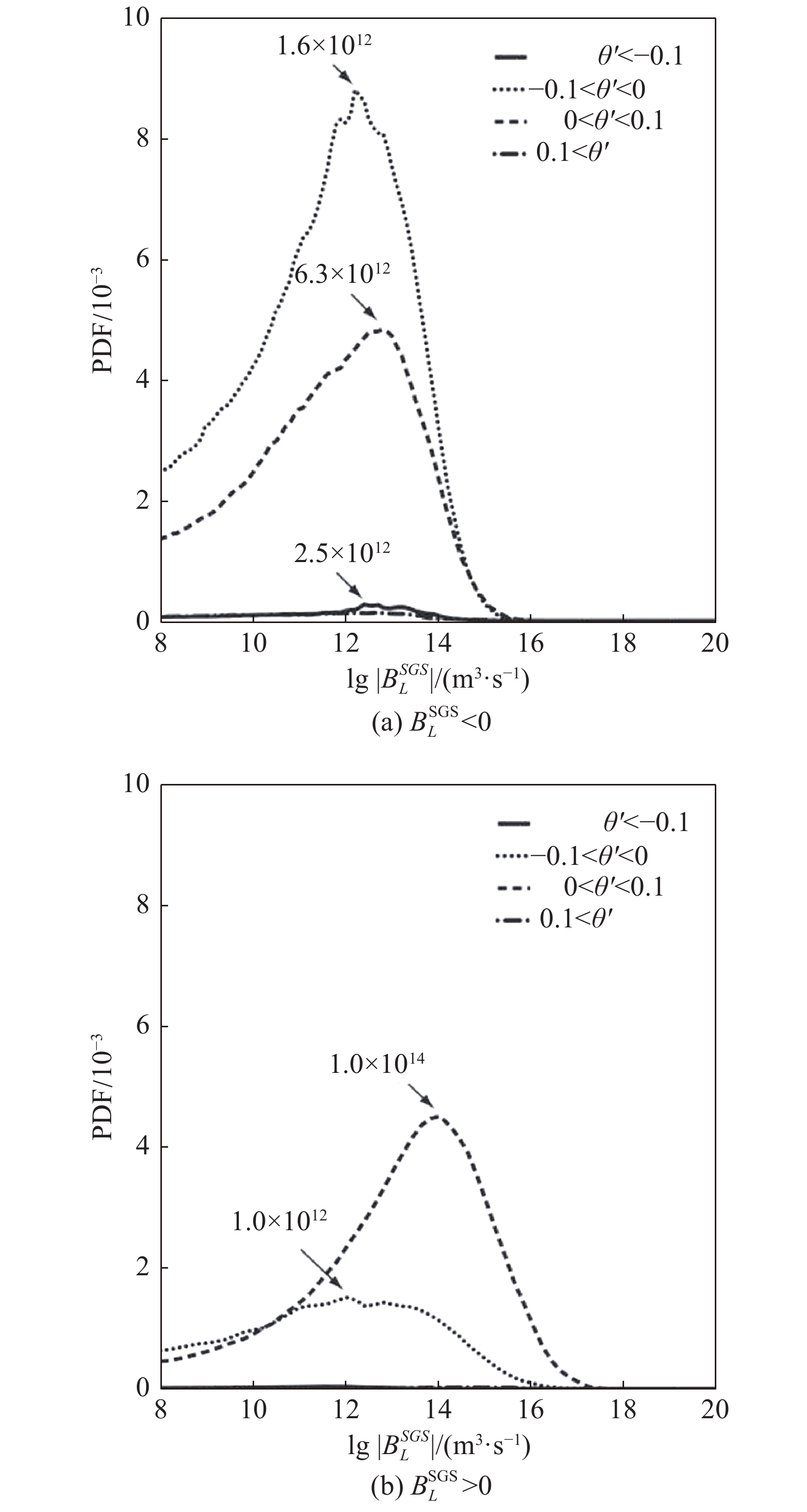
用

进一步对数据进行处理和研究,可以得到不同温度脉动情况下的成核率亚格子尺度脉动,结果如图3所示。对比图3(a)和图3(b)可知,成核率的负脉动比正脉动的幅值大,温度的负脉动和正脉动对成核率的负脉动和正脉动的影响最大,成核率约为
|
图 3 不同标准化脉动温度 |
在颗粒凝并项方程(13)中,包含了
随着空间滤波方法的出现以及LES方法的发展,人们提出了颗粒数密度脉动的空间自关联形式
| $ St\equiv \dfrac{{\tau }_{p}}{{\tau }_{\eta }}=\dfrac{\dfrac{1}{18}\left(\dfrac{{\rho }_{p}}{{\rho }_{f}}\right)\dfrac{{d}_{p}^{2}}{\nu }}{{\left( \dfrac{\nu}{\varepsilon} \right)}^ \frac{1}{2}}=\dfrac{1}{18}\left(\dfrac{{\rho }_{p}}{{\rho }_{f}}\right){\left(\dfrac{{d}_{p}}{\eta }\right)}^{2} $ | (22) |
式中
为了体现湍流脉动对颗粒凝并的影响,一种思路是对颗粒凝并率进行湍流脉动的修正,即给出湍流凝并核函数
| $ {G}_{11}\left(R\right)\approx \frac{\overline{{N}^{2}}}{{\overline{N}}^{2}},\; \;{G}_{12}\left(R\right)\approx \frac{\overline{{N}_{1}{N}_{2}}}{\overline{{N}_{1}}\cdot \overline{{N}_{2}}}$ | (23) |
式中
Sundaram[67]提出颗粒聚集时单分散颗粒的凝并核函数:
| $ \beta =4{\text{π}} {{d}_{p}}^{2}g\left({d}_{p}\right){\int }_{-\mathrm{\infty }}^{0}-{w}_{r}P\left({w}_{r}|{d}_{p}\right){\rm{d}}{w}_{r} $ | (24) |
式中
基于上述凝并核函数的形式,Reade和Collins[69]得到颗粒径向分布函数为
Wang等[70]进一步得到新的凝并核函数
Zhou等[71]得到双分散颗粒情况下任意两种尺度颗粒的凝并核函数:
| $ {\beta }_{ij}=2{\text{π}} {\left({r}_{i}+{r}_{j}\right)}^{2}{g}_{ij}\left({r}_{i}+{r}_{j}\right)\left\langle \left|{w}_{r}\right|\right\rangle $ | (25) |
双分散颗粒的径向分布函数
Saffman和Turner[56]提出适用于剪切条件下的湍流凝并核,Chun等[74]基于该凝并核,得到在
| $ {\beta }_{ij}=\gamma \alpha \varGamma _{\eta }{\left({d}_{i}+{d}_{j}\right)}^{3}{c}_{0}{\left(\frac{\eta }{{d}_{i}+{d}_{j}}\right)}^{{c}_{1}} $ | (26) |
式中
上述研究都是基于颗粒的拉格朗日描述用DNS来求解流场,这在惯性颗粒系统中有效[75-76],但对零惯性颗粒(忽略颗粒质量)而言则无效。从物理机制看,零惯性颗粒有良好的跟随性,颗粒与流体的速度几乎一致,湍流场的涡运动无法因离心效应而导致颗粒的聚集。因此,需要采用其他方法描述零惯性颗粒的浓度脉动。
3.2 湍流脉动对凝并生长效应的影响颗粒的生长除了凝积外,还可以通过凝并。凝并使颗粒粒径增大、浓度减少。定义粒径增长率为:
| $ \varOmega =\frac{\partial \left({d}_{g}\right)}{\partial t},\;\;\varOmega ={\left(\frac{2}{9{\text{π}} }\right)}^\frac{1}{3}{v}_{g}^{-\frac{2}{3}}\frac{\partial {v}_{g}}{\partial t} $ | (27) |
式中
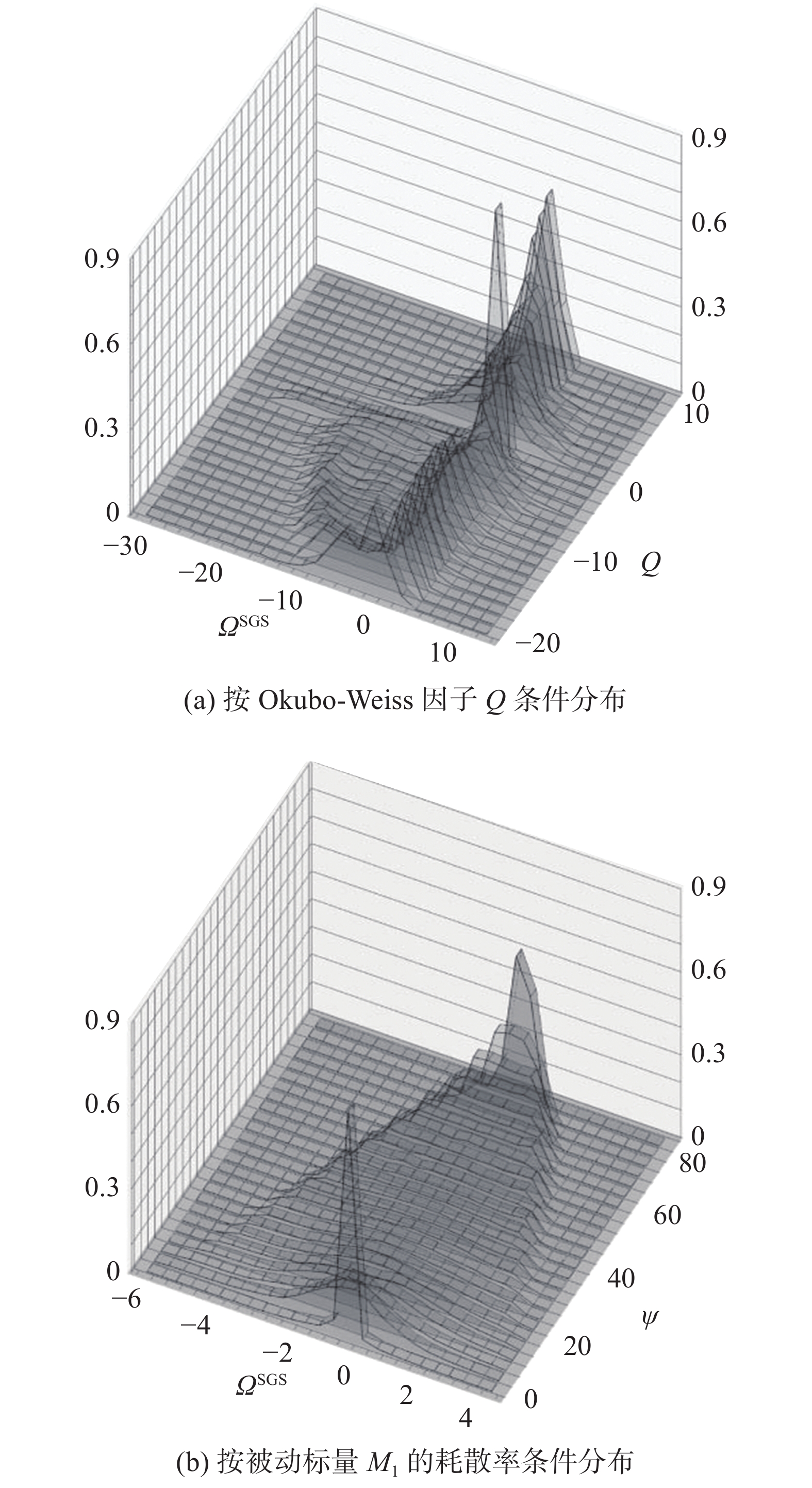
在直接数值模拟方法中,对包含完整脉动信息的颗粒数密度场
|
图 4 SGS尺度粒径增长效应 |
不可压缩流场中,定义Okubo-Weiss因子
在湍流场中,被动标量
| $ \varPsi =\frac{1}{ReS{c}_{M}}\left(\frac{\partial {M}_{1}}{\partial {x}_{i}}\frac{\partial {M}_{1}}{\partial {x}_{i}}\right) $ | (28) |
式中
考虑到
| $ {g}_{nn}=\frac{\overline{{n}'\left(v\right){n}'\left({v}_{1}\right)}}{\bar{n}\left(v\right)\bar{n}\left({v}_{1}\right)} $ | (29) |
于是,可用
| $\begin{split} {\bar{S}}_{{c}}=&\frac{1}{2}{\int }_{0}^{v}\left(1+{g}_{nn}\right)\beta \left(v-{v}_{1},{v}_{1}\right)\bar{n}\left(v-{v}_{1}\right)\bar{n}\left({v}_{1}\right){\rm{d}}{v}_{1}-\\& {\int }_{0}^{\mathrm{\infty }}\left(1+{g}_{nn}\right)\beta \left(v,{v}_{1}\right)\bar{n}\left(v\right)\bar{n}\left({v}_{1}\right){\rm{d}}{v}_{1} \\[-14pt]\end{split}$ | (30) |
该式中还需确定
| $ {g}_{nn}=\frac{k}{k+\frac{{\bar{u}}_{i}^{2}}{2}} $ | (31) |
式中
除了
| $ \overline{\beta \left(v,{v}_{1}\right)n\left(v\right)n\left({v}_{1}\right)}=\alpha \left({v}^\frac{1}{3}+{v}_{1}^\frac{1}{3}\right)\overline{\varGamma _{\eta }n\left(v\right)n\left({v}_{1}\right)} $ | (32) |
对
| $\begin{split}& \overline{\varGamma _{\eta }n\left(v\right)n\left({v}_{1}\right)}=\varGamma _{\eta }\bar{n}\left(v\right)\bar{n}\left({v}_{1}\right)+{\bar\varGamma }_{\eta }\overline{{n}'\left(v\right){n}'\left({v}_{1}\right)}+\\&\qquad \bar{n}\left(v\right)\overline{\varGamma _{\eta }'{n}'\left({v}_{1}\right)}+\bar{n}\left({v}_{1}\right)\overline{\varGamma _{\eta }'{n}'\left(v\right)}+\overline{\varGamma _{\eta }'{n}'\left(v\right){n}'\left({v}_{1}\right)} \end{split}$ | (33) |
定义新的增强因子:
| $ {g}_{\mathrm{\varGamma }n}=\frac{\overline{\varGamma _{\eta }'{n}'\left(v\right)}}{{\overline\varGamma }_{\eta }\bar{n}\left(v\right)} ,\;\;{g}_{\mathrm{\varGamma }nn}=\frac{\overline{\varGamma _{\eta }'{n}'\left(v\right){n}'\left({v}_{1}\right)}}{{\bar\varGamma }_{\eta }\bar{n}\left(v\right)\bar{n}\left({v}_{1}\right)}$ | (34) |
令
| $ {g}_{3}=\frac{2k}{{\bar{u}}_{i}^{2}} $ | (35) |
对于破碎项中的
| $\begin{split} \overline{\varGamma _{\eta }^{q}n\left(v\right)}=&{\bar\varGamma }_{\eta }^{q}\bar{n}\left(v\right)+\sum _{i=1}^{\mathrm{\infty }}\frac{q!}{i!\left(q-i\right)!}{\bar\varGamma }_{\eta }^{q-i}\overline{{\varGamma '}_{\eta }^{i}{n}'\left(v\right)}+\\& \sum _{i=2}^{\mathrm{\infty }}\frac{q!}{i!\left(q-i\right)!}\varGamma _{\eta }^{q-i}\bar{n}\left(v\right)\overline{{\varGamma '}_{\eta }^{i}} \end{split}$ | (36) |
则新的增强因子定义为
| $ \overline{{\tau }_{\eta }^{q}n\left(v\right)}=\left(1+{g}_{q}\right){\bar{\tau }}_{\eta }^{q}\bar{n}\left(v\right) $ | (37) |
此处沿用并定义
微纳米颗粒两相湍流存在于自然现象和大量的实际应用中,研究其规律具有重要的实际意义。微纳米颗粒两相流与大颗粒两相流相比具有其特殊性和复杂性,对其研究具有重要的科学意义。
在微纳米颗粒两相湍流中,湍流导致的流场速度脉动、颗粒浓度脉动、温度脉动以及饱和度脉动会对颗粒相的成核、凝积生长、碰撞凝并、破碎产生影响。本文在给出颗粒一般动力学方程的基础上,分析了方程中因湍流脉动导致的与颗粒成核、生长、凝并、破碎相关的脉动量关联项,介绍了对这些关联项进行模化从而使方程得以封闭的研究途径和相关的研究结果。
湍流脉动对颗粒成核、凝积生长、碰撞凝并、破碎的影响已受到人们的重视并开展了研究,但仍有一些方面的问题有待将来进一步探讨。
1)颗粒聚集使颗粒碰撞的几率增加,从而导致颗粒凝并的增强。而在第3.3节的研究结论中,湍流脉动会抑制颗粒的凝并,这与颗粒聚集导致颗粒凝并增强的结论似乎存在矛盾,因为湍流脉动使得颗粒数密度脉动,而数密度脉动的结果也有可能导致颗粒聚集。所以有必要对湍流脉动对颗粒凝并的影响进行深入的研究。
2)微纳颗粒两相湍流场的实验研究具有一定的难度。湍流场尤其是充分发展的湍流场具有空间和时间多尺度的特征。受多尺度的影响,在测量颗粒的取样频率还很低的情况下,难以全面获得微纳尺度颗粒在流场中的运动信息[80],有必要在实验仪器和实验技术方面做进一步的研究。
3)在纳颗粒两相湍流场中,对颗粒一般动力学方程进行雷诺平均后会出现与颗粒成核、生长、凝并、破碎相关的脉动量关联项,这些项使得平均后的方程不封闭,要使方程封闭,就要对这些项进行模化。目前,由模化后得到的数值模拟结果与实验结果如颗粒燃烧[81-83]、成核[13]、凝并[84]、破碎弥散[85-86]还存在一定的差异,原因是数值模拟中可以有针对性地对成核、生长、凝并、破碎中的某一项进行,而实验的结果往往是这几项中若干项的综合结果。所以有必要进一步对颗粒一般动力学方程中未知项的模化开展有针对性的实验研究。
| [1] |
FRIEDLANDER S K. Smoke, dust, and haze: Fundamentals of aerosol dynamics[M]. 2nd ed. New York: Oxford University Press, 2000.
|
| [2] |
ATTILI A, BISETTI F. Fluctuations of a passive scalar in a turbulent mixing layer[J]. Physical Review E, Statistical, Nonlinear, and Soft Matter Physics, 2013, 88(3): 033013. DOI:10.1103/PhysRevE.88.033013 |
| [3] |
SAITO I, GOTOH T. Turbulence and cloud droplets in cumulus clouds[J]. New Journal of Physics, 2018, 20(2): 023001. DOI:10.1088/1367-2630/aaa229 |
| [4] |
SIEBERT H, SHAW R A. Supersaturationfluctuations during the early stage of cumulus formation[J]. Journal of the Atmospheric Sciences, 2017, 74(4): 975-988. DOI:10.1175/jas-d-16-0115.1 |
| [5] |
CHEN SS, XUE LL, YAU M K. Impact of aerosols and turbulence on cloud droplet growth: an in-cloud seeding case study using a parcel–DNS (direct numerical simulation) approach[J]. Atmospheric Chemistry and Physics, 2020, 20(17): 10111-10124. DOI:10.5194/acp-20-10111-2020 |
| [6] |
PINSKY M B, KHAIN A P. Turbulence effects on droplet growth and size distribution in clouds—A review[J]. Journal of Aerosol Science, 1997, 28(7): 1177-1214. DOI:10.1016/S0021-8502(97)00005-0 |
| [7] |
SHAW R A. Particle-turbulenceinteractionsinatmosphericclouds[J]. Annual Review of Fluid Mechanics, 2003, 35(1): 183-227. DOI:10.1146/annurev.fluid.35.101101.161125 |
| [8] |
GRABOWSKI W W, WANG L P. Growth of cloud droplets in a turbulent environment[J]. Annual Review of Fluid Mechanics, 2013, 45(1): 293-324. DOI:10.1146/annurev-fluid-011212-140750 |
| [9] |
JAYESH, WARHAFT Z. Probability distribution, conditional dissipation, and transport of passive temperature fluctuations in grid-generated turbulence[J]. Physics of Fluids A: Fluid Dynamics, 1992, 4(10): 2292-2307. DOI:10.1063/1.858469 |
| [10] |
GRANDMAISON E W, BECKER H A, ZETTLER N L. Scalar mixing in turbulent concentric round jets[J]. The Canadian Journal of Chemical Engineering, 1996, 74(4): 433-447. DOI:10.1002/cjce.5450740402 |
| [11] |
BAŁDYGA J, ORCIUCH W. Closure problem for precipitation[J]. Chemical Engineering Research and Design, 1997, 75(2): 160-170. DOI:10.1205/026387697523624 |
| [12] |
LESNIEWSKI T, FRIEDLANDER S K. The effect of turbulence on rates of particle formation by homogeneous nucleation[J]. Aerosol Science and Technology, 1995, 23(2): 174-182. DOI:10.1080/02786829508965302 |
| [13] |
LESNIEWSKI T K, FRIEDLANDER S K. Particle nucleation and growth in a free turbulent jet[J]. Proceedings of the Royal Society of London Series A: Mathematical, Physical and Engineering Sciences, 1998, 454(1977): 2477-2504. DOI:10.1098/rspa.1998.0267 |
| [14] |
DAS S, GARRICK S C. The effects of turbulence on nanoparticle growth in turbulent reacting jets[J]. Physics of Fluids, 2010, 22(10): 103303. DOI:10.1063/1.3486203 |
| [15] |
MURFIELD N J, GARRICK S C. The effects of unresolved scalar fluctuations during homogeneous nucleation[J]. Aerosol Science and Technology, 2013, 47(7): 806-817. DOI:10.1080/02786826.2013.791743 |
| [16] |
MURFIELD N J, PYYKÖNEN J, JOKINIEMI J, et al. The structure of nanoparticle nucleation in planar jets[J]. Journal of Aerosol Science, 2013, 62: 1-14. DOI:10.1016/j.jaerosci.2013.03.003 |
| [17] |
ZHOU K, ATTILI A, ALSHAARAWI A, et al. Simulation of aerosol nucleation and growth in a turbulent mixing layer[J]. Physics of Fluids, 2014, 26(6): 065106. DOI:10.1063/1.4884789 |
| [18] |
GARRICK S C. Growth mechanisms of nanostructured titania in turbulent reacting flows[J]. Journal of Nanotechnology, 2015, 2015: 1-10. DOI:10.1155/2015/642014 |
| [19] |
ZHOU K, CHAN T L. Simulation of homogeneous particle nucleation in a free turbulent jet[J]. Aerosol Science and Technology, 2011, 45(8): 973-987. DOI:10.1080/02786826.2011.572935 |
| [20] |
FAGER A J, LIU J, GARRICK S C. Hybrid simulations of metal particle nucleation: a prioriandaposteriorianalyses of the effects of unresolved scalar interactions on nanoparticle nucleation[J]. Physics of Fluids, 2012, 24(7): 075110. DOI:10.1063/1.4737660 |
| [21] |
MURFIELD N J, GARRICK S C. Large eddy simulation and direct numerical simulation of homogeneous nucleation in turbulent wakes[J]. Journal of Aerosol Science, 2013, 60: 21-33. DOI:10.1016/j.jaerosci.2013.01.009 |
| [22] |
PESMAZOGLOU I, KEMPF A M, NAVARRO-MARTINEZ S. Aerosol nucleation in a turbulent jet using Large Eddy Simulations[J]. Chemical Engineering Science, 2014, 116: 383-397. DOI:10.1016/j.ces.2014.05.022 |
| [23] |
NEUBER G, KRONENBURG A, STEIN O T, et al. MMC-LES modelling of droplet nucleation and growth in turbulent jets[J]. Chemical Engineering Science, 2017, 167: 204-218. DOI:10.1016/j.ces.2017.04.008 |
| [24] |
HOUSIADAS C, DROSSINOS Y, LAZARIDIS M. Effect of small-scale turbulent fluctuations on rates of particle formation[J]. Journal of Aerosol Science, 2004, 35(5): 545-559. DOI:10.1016/j.jaerosci.2003.10.012 |
| [25] |
RIGOPOULOS S. PDF method for population balance in turbulent reactive flow[J]. Chemical Engineering Science, 2007, 62(23): 6865-6878. DOI:10.1016/j.ces.2007.05.039 |
| [26] |
GARMORY A, MASTORAKOS E. Aerosol nucleation and growth in a turbulent jet using the Stochastic Fields method[J]. Chemical Engineering Science, 2008, 63(16): 4078-4089. DOI:10.1016/j.ces.2008.05.012 |
| [27] |
DI VEROLI G Y, RIGOPOULOS S. Modeling of aerosol formation in a turbulent jet with the transported population balance equation-probability density function approach[J]. Physics of Fluids, 2011, 23(4): 043305. DOI:10.1063/1.3576913 |
| [28] |
BECKER H A, HOTTEL H C, WILLIAMS G C. Concentration fluctuations in ducted turbulent jets[J]. Symposium (International) on Combustion, 1967, 11(1): 791-798. DOI:10.1016/S0082-0784(67)80204-2 |
| [29] |
SPALDING D B. Concentration fluctuations in a round turbulent free jet[J]. Chemical Engineering Science, 1971, 26(1): 95-107. DOI:10.1016/0009-2509(71)86083-9 |
| [30] |
SUNDARAM S, COLLINS L R. Spectrum of density fluctuations in a particle-fluid system—i. monodisperse spheres[J]. International Journal of Multiphase Flow, 1994, 20(6): 1021-1037. DOI:10.1016/0301-9322(94)90052-3 |
| [31] |
SUNDARAM S, COLLINS L R. Spectrum of density fluctuations in a particlefluid system—II. Polydisperse spheres[J]. International Journal of Multiphase Flow, 1994, 20(6): 1039-1052. DOI:10.1016/0301-9322(94)90053-1 |
| [32] |
EATON J K, FESSLER J R. Preferential concentration of particles by turbulence[J]. International Journal of Multiphase Flow, 1994, 20: 169-209. DOI:10.1016/0301-9322(94)90072-8 |
| [33] |
NIJMAN E J, MERKUS H G, MARIJNISSEN J C M, et al. Simulations and experiments on number fluctuations in photon-correlation spectroscopy at low particle concentrations[J]. AppliedOptics, 2001, 40(24): 4058-4063. |
| [34] |
XIE Z T, HAYDEN P, ROBINS A G, et al. Modelling extreme concentrations from a source in a turbulent flow over a rough wall[J]. Atmospheric Environment, 2007, 41(16): 3395-3406. DOI:10.1016/j.atmosenv.2006.12.022 |
| [35] |
KOCH D L, POPE S B. Coagulation-induced particle-concentration fluctuations in homogeneous, isotropic turbulence[J]. Physics of Fluids, 2002, 14(7): 2447. DOI:10.1063/1.1478562 |
| [36] |
GARRICK S C. Effects of turbulent fluctuations on nanoparticle coagulation in shear flows[J]. Aerosol Science and Technology, 2011, 45(10): 1272-1285. DOI:10.1080/02786826.2011.589482[LinkOut] |
| [37] |
ZHOU K, ATTILI A, BISETTI F. Direct numerical simulation of aerosol growth processes in a turbulent mixing layer[C]// Seventh International Conference on Computation Fluid Dynamics (ICCFD7), Big Island, Hawaii, 2012. ICCFD7-1504.
|
| [38] |
PESMAZOGLOU I, KEMPF A M, NAVARRO-MARTINEZ S. Large eddy simulation of particle aggregation in turbulent jets[J]. Journal of Aerosol Science, 2017, 111: 1-17. DOI:10.1016/j.jaerosci.2017.06.002 |
| [39] |
GELBARD F, TAMBOUR Y, SEINFELD J H. Sectional representations for simulating aerosol dynamics[J]. Journal of Colloid and Interface Science, 1980, 76(2): 541-556. DOI:10.1016/0021-9797(80)90394-X |
| [40] |
HOUNSLOW M J, RYALL R L, MARSHALL V R. A discretized population balance for nucleation, growth, and aggregation[J]. AIChEJournal, 1988, 34(11): 1821-1832. DOI:10.1002/aic.690341108 |
| [41] |
PRATSINIS S E. Simultaneous nucleation, condensation, and coagulation in aerosol reactors[J]. Journal of Colloid and Interface Science, 1988, 124(2): 416-427. DOI:10.1016/0021-9797(88)90180-4 |
| [42] |
MCGRAW R, LENG L, ZHU W, et al. Aerosol dynamics using the quadrature method of moments: comparing several quadrature schemes with particle-resolved simulation[J]. Journal of Physics: Conference Series, 2008, 125: 012020. DOI:10.1088/1742-6596/125/1/012020 |
| [43] |
YU M Z, LIN J Z. Taylor-expansion moment method for agglomerate coagulation due to Brownian motion in the entire size regime[J]. Journal of Aerosol Science, 2009, 40(6): 549-562. DOI:10.1016/j.jaerosci.2009.03.001 |
| [44] |
刘演华, 林建忠. 两相流中颗粒参数分布的矩方法研究[J]. 空气动力学学报, 2009, 27(6): 656-663. LIU Y H, LIN J Z. Research on method of momens of particulate parameter distribution in multiphase flow[J]. ActaAerodynamicaSinica, 2009, 27(6): 656-663. DOI:10.3969/j.issn.0258-1825.2009.06.006 (in Chinese) |
| [45] |
YU M Z, LIN J Z, CAO JJ, et al. An analytical solution for the population balance equation using a moment method[J]. Particuology, 2015, 18: 194-200. DOI:10.1016/j.partic.2014.06.006 |
| [46] |
LI D Y, LI Z P, GAO Z M. Quadrature-based moment methods for the population balance equation: an algorithm review[J]. Chinese Journal of Chemical Engineering, 2019, 27(3): 483-500. DOI:10.1016/j.cjche.2018.11.028 |
| [47] |
SEWERIN F, RIGOPOULOS S. An LES-PBE-PDF approach for modeling particle formation in turbulent reacting flows[J]. Physics of Fluids, 2017, 29(10): 105105. DOI:10.1063/1.5001343 |
| [48] |
SEWERIN F, RIGOPOULOS S. An LES-PBE-PDF approach for predicting the soot particle size distribution in turbulent flames[J]. Combustion and Flame, 2018, 189: 62-76. DOI:10.1016/j.combustflame.2017.09.045 |
| [49] |
JIANG X, ZHOU K, XIAO M, et al. Stochastic simulation of soot formation evolution in counterflow diffusion flames[J]. Journal of Nanotechnology, 2018, 2018: 1-8. DOI:10.1155/2018/9479582 |
| [50] |
ZHOU K, JIANG X, CHAN T L. Error analysis in stochastic solutions of population balance equations[J]. Applied Mathematical Modelling, 2020, 80: 531-552. DOI:10.1016/j.apm.2019.11.045 |
| [51] |
ZHOU K, HE Z. Monte Carlo simulation of aerosol evolution in a planar mixing layer[J]. International Journal of Numerical Methods for Heat & Fluid Flow, 2014, 24(8): 1769-1781. DOI:10.1108/hff-04-2013-0123 |
| [52] |
ZHOU K, HE Z, XIAO M, et al. Parallel Monte Carlo simulation of aerosol dynamics[J]. Advances in Mechanical Engineering, 2014, 6: 435936. DOI:10.1155/2014/435936 |
| [53] |
AKRIDIS P, RIGOPOULOS S. Modelling of Soot formation in a Turbulent Diffusion flame using a comprehensive CFD- PBE model with full chemistry[C]//Proceedings of the European Combustion Meeting, 2015.
|
| [54] |
LIU S Y, CHAN T L. A stochastically weighted operator splitting Monte Carlo (SWOSMC) method for the numerical simulation of complex aerosol dynamic processes[J]. International Journal of Numerical Methods for Heat & Fluid Flow, 2017, 27(1): 263-278. DOI:10.1108/hff-08-2015-0335 |
| [55] |
LIU H M, CHAN T L. A coupled LES-Monte Carlo method for simulating aerosol dynamics in a turbulent planar jet[J]. International Journal of Numerical Methods for Heat & Fluid Flow, 2019, 30(2): 855-881. DOI:10.1108/hff-11-2018-0657 |
| [56] |
SAFFMAN P G, TURNER J S. On the collision of drops in turbulent clouds[J]. Journal of Fluid Mechanics, 1956, 1(1): 16. DOI:10.1017/s0022112056000020 |
| [57] |
LEVIN L M, SEDUNOV Y S. The theoretical model of the drop spectrum formation process in clouds[J]. Pure and Applied Geophysics, 1968, 69(1): 320-335. DOI:10.1007/BF00874922 |
| [58] |
LESNIEWSKI T K. Particle nucleation and growth in turbulent jets[D]. Los Angeles: University of California, 1997.
|
| [59] |
LUNDGREN T S. Distribution functions in the statistical theory of turbulence[J]. Physics of Fluids, 1967, 10(5): 969. DOI:10.1063/1.1762249 |
| [60] |
WARSHAW M. Cloud droplet coalescence: statistical foundations and a one-dimensional sedimentation Model1[J]. Journal of the Atmospheric Sciences, 1967, 24(3): 278-286. DOI:10.1175/1520-0469(1967)024<0278:cdcsfa>2.0.co;2 |
| [61] |
BECKER H A, HOTTEL H C, WILLIAMS G C. The nozzle-fluid concentration field of the round, turbulent, free jet[J]. Journal of Fluid Mechanics, 1967, 30(2): 285-303. DOI:10.1017/s0022112067001430 |
| [62] |
BECKER H A, HOTTEL H C, WILLIAMS G C. On the light-scatter technique for the study of turbulence and mixing[J]. Journal of Fluid Mechanics, 1967, 30(2): 259-284. DOI:10.1017/s0022112067001429 |
| [63] |
GRANDMAISON E W, RATHGEBER D E, BECKER H A. Some characteristics of concentration fluctuations in free turbulent jets[J]. The Canadian Journal of Chemical Engineering, 1982, 60(2): 212-219. DOI:10.1002/cjce.5450600203 |
| [64] |
ELGHOBASHI S E, PUN W M, SPALDING D B. Concentration fluctuations in isothermal turbulent confined coaxial jets[J]. Chemical Engineering Science, 1977, 32(2): 161-166. DOI:10.1016/0009-2509(77)80101-2 |
| [65] |
ELPERIN T, KLEEORIN N, ROGACHEVSKII I. Dynamics of the passive scalar in compressible turbulent flow: Large-scale patterns and small-scale fluctuations[J]. Physical Review E, Statistical Physics, Plasmas, Fluids, and Related Interdisciplinary Topics, 1995, 52(3): 2617-2634. DOI:10.1103/physreve.52.2617 |
| [66] |
ELPERIN T, KLEEORIN N, ROGACHEVSKII I I. Self-excitation of fluctuations of inertial particle concentration in turbulent fluid flow[J]. Physical Review Letters, 1996, 77(27): 5373-5376. DOI:10.1103/PhysRevLett.77.5373 |
| [67] |
SUNDARAM S, COLLINS L R. Collision statistics in an isotropic particle-laden turbulent suspension. Part 1. Direct numerical simulations[J]. Journal of Fluid Mechanics, 1997, 335: 75-109. DOI:10.1017/s0022112096004454 |
| [68] |
WANG L P, WEXLER A S, ZHOU Y. Statistical mechanical descriptions of turbulent coagulation[J]. Physics of Fluids, 1998, 10(10): 2647-2651. DOI:10.1063/1.869777 |
| [69] |
READE W C, COLLINS L R. Effect of preferential concentration on turbulent collision rates[J]. Physics of Fluids, 2000, 12(10): 2530. DOI:10.1063/1.1288515 |
| [70] |
WANG L P, WEXLER A S, ZHOU Y. Statistical mechanical description and modelling of turbulent collision of inertial particles[J]. Journal of Fluid Mechanics, 2000, 415: 117-153. DOI:10.1017/s0022112000008661 |
| [71] |
ZHOU Y, WEXLER A S, WANG L P. Modelling turbulent collision of bidisperse inertial particles[J]. Journal of Fluid Mechanics, 2001, 433: 77-104. DOI:10.1017/s0022112000003372 |
| [72] |
ZAICHIK L I, ALIPCHENKOV V M. Refinement of the probability density function model for preferential concentration of aerosol particles in isotropic turbulence[J]. Physics of Fluids, 2007, 19(11): 113308. DOI:10.1063/1.2813044 |
| [73] |
WANG L P, AYALA O, KASPRZAK S E, et al. Theoretical formulation of collision rate and collision efficiency of hydrodynamicallyinteracting cloud droplets in turbulent atmosphere[J]. Journal of the Atmospheric Sciences, 2005, 62(7): 2433-2450. DOI:10.1175/jas3492.1 |
| [74] |
CHUN J, KOCH D L, RANI S L, et al. Clustering of aerosol particles in isotropic turbulence[J]. Journal of Fluid Mechanics, 2005, 536: 219-251. DOI:10.1017/s0022112005004568 |
| [75] |
MONCHAUX R, BOURGOIN M, CARTELLIER A. Analyzing preferential concentration and clustering of inertial particles in turbulence[J]. International Journal of Multiphase Flow, 2012, 40: 1-18. DOI:10.1016/j.ijmultiphaseflow.2011.12.001 |
| [76] |
GUSTAVSSON K, MEHLIG B. Statistical models for spatial patterns of heavy particles in turbulence[J]. Advances in Physics, 2016, 65(1): 1-57. DOI:10.1080/00018732.2016.1164490 |
| [77] |
YANG H L, LIN J Z, CHAN T. Effect of fluctuating aerosol concentration on the aerosol distributions in a turbulent jet[J]. Aerosol and Air Quality Research, 2020, 20(7): 1629-1639. DOI:10.4209/aaqr.2019.11.0556 |
| [78] |
LIN J Z, PAN X J, YIN Z Q, et al. Solution of general dynamic equation for nanoparticles in turbulent flow considering fluctuating coagulation[J]. Applied Mathematics and Mechanics, 2016, 37(10): 1275-1288. DOI:10.1007/s10483-016-2131-9 |
| [79] |
KHAIN A, PINSKY M, ELPERIN T, et al. Critical comments to results of investigations of drop collisions in turbulent clouds[J]. Atmospheric Research, 2007, 86(1): 1-20. DOI:10.1016/j.atmosres.2007.05.003 |
| [80] |
TU C X, YIN Z Q, LIN J Z, et al. A review of experimental techniques for measuring micro- to nano-particle-laden gas flows[J]. Applied Sciences, 2017, 7(2): 120. DOI:10.3390/app7020120 |
| [81] |
ZHU J Z, QI H Y, WANG J S. Nanoparticle dispersion and coagulation in a turbulent round jet[J]. International Journal of Multiphase Flow, 2013, 54: 22-30. DOI:10.1016/j.ijmultiphaseflow.2013.02.004 |
| [82] |
YIN Z Q, LIN J Z, QIAN L J. An experimental study on the characteristics of nanoparticles emission from a vehicle[J]. Advanced Materials Research, 2012, 508: 180-183. DOI:10.4028/www.scientific.net/amr.508.180 |
| [83] |
CHOWDHURY S, BOYETTE W R, ROBERTS W L. Time-averaged probability density functions of soot nanoparticles along the centerline of a piloted turbulent diffusion flame using a scanning mobility particle sizer[J]. Journal of Aerosol Science, 2017, 106: 56-67. DOI:10.1016/j.jaerosci.2016.10.012 |
| [84] |
BELUT E, CHRISTOPHE T. A new experimental dataset to validate CFD models of airborne nanoparticlesagglomeration[C]//9th International Conference on Multiphase Flow, Firenze, Italy, 2016.
|
| [85] |
TU C X, LIN J Z, YIN Z Q, et al. Powder disperser for the continuous aerosolizing of dry powdered nanoparticles[J]. Advanced Powder Technology, 2017, 28(11): 2848-2858. DOI:10.1016/j.apt.2017.08.011 |
| [86] |
YUAN F Y, TU C X, YU J F, et al. High-pressure dispersion of nanoparticle agglomerates through a continuous aerosol disperser[J]. Applied Nanoscience, 2019, 9(8): 1857-1868. DOI:10.1007/s13204-019-00991-w |