


50年前,伽马射线暴由Vela卫星(Vela Satellite Network) 首次探测到[1]。伽马射线暴的持续时间短至千分之一秒,长则数小时,在短时间内释放巨大的能量,是目前所发现的宇宙中最剧烈的爆发形式[2]。经历半个世纪的研究,伽马射线暴的本质仍然不很清楚,但研究人员还在继续努力探索[3-4]。
T90是伽马射线暴重要的参数之一,是指伽马射线光子流量占总流量5%到95%之间的持续时间。20世纪90年代,根据大样本的伽马射线暴数据,人们发现T90的分布呈双峰结构,并据此把伽马射线暴分为长暴和短暴两种类型,它们的分界线在2 s左右的位置,前者的峰值在30 s左右,后者的峰值在0.3 s左右[5-9]。通常认为长暴和短暴具有不同起源,长暴起源于大质量恒星的塌缩[10-14],而短暴起源于双致密星并合[15-16]。
探讨伽马射线暴各个物理参数之间的相关性是研究伽马射线暴的重要手段。1999年,文[17]利用BATSE(Burst and Transient Source Experiment) 观测到大量脉冲,证明伽马射线暴的能谱硬度与持续时间存在负相关关系,但没有排除该相关性是否由于长暴与短暴两个样本本身的差别导致,换言之,没有验证对于长暴和短暴,该相关性是否仍然存在。为了验证这个假设,2000年,文[18]把筛选自4B星表(the Fourth BATSE burst catalog[9]) 的1 179个伽马射线暴根据T90是否大于2 s分为长暴和短暴两个子样本,然后分别分析两个子样本的能谱硬度与持续时间的相关性,结果显示,对于长暴子样本和短暴子样本,能谱硬度与持续时间均不存在相关性
近20年来,伽马射线暴的样本体量不断扩充,本文利用文[19]整理的最新伽马射线暴星表数据,再次验证长暴和短暴的能谱硬度与持续时间是否存在相关性。该研究结果可以为伽马射线暴的能谱硬度与持续时间之间是否存在相关性提供更加可靠的统计结果。
1 样本来源与筛选本文使用的伽马射线暴数据来自文[19]根据以往的文献整理的包含6 289个伽马射线暴的样本(从GRB 910421到GRB 160509A)。该样本中伽马射线暴的观测时间从1991年8月21日到2016年5月9日。样本中的数据大部分收集自GCN (Gamma-ray Coordinates Network) 网站、已发表的文章和BATSE (Burst And Transient Source Experiment) 官网[19]。
文[19]整理的样本包含6 289个伽马射线暴的红移、光度距离、T90等共46个参数。本文需要的参数是伽马射线暴的能谱硬度和持续时间。因此,我们对6 289个伽马射线暴样本进行筛选,去除持续时间或能谱硬度为空值的数据,余下3 589个伽马射线暴组成本文的总样本。这3 589个伽马射线暴大部分来自Swift, Fermi和康普顿卫星(Compton Gamma Ray Observatory, CGRO) 的观测结果。CGRO即搭载BATSE探测器的卫星,其伽马暴数据公布于BATSE官网。
根据持续时间T90是否大于2 s,我们把总样本分为长暴子样本和短暴子样本,其中长暴子样本包含2 913个伽马射线暴,短暴子样本包含676个伽马射线暴,短暴的样本数据相对较少,短暴与长暴样本数量之比约为1 ∶ 4。
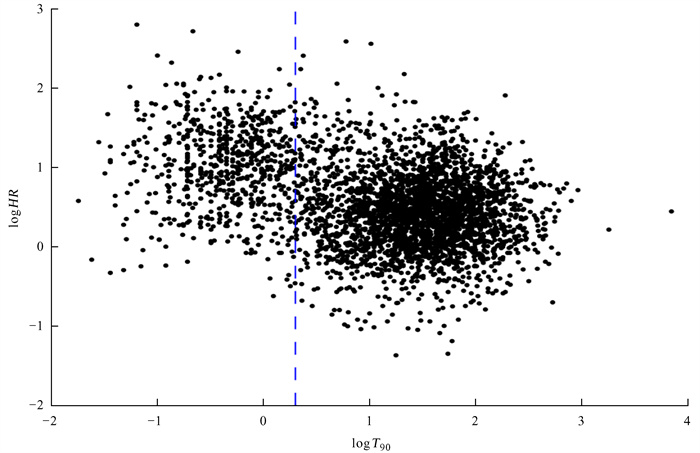
我们对伽马射线暴的能谱硬度和持续时间分别取对数,其中能谱硬度为100~2 000 keV能段与20~100 keV能段的伽马射线暴通量的比值,持续时间采用T90,伽马射线暴的能谱硬度与持续时间的对数图如图 1。图 1中的横坐标为伽马射线暴的持续时间T90 (单位为s) 的对数值,纵坐标为伽马射线暴能谱硬度的对数值;蓝色垂直虚线为T90=2 s,左边是短暴数据点,右边是长暴数据点。
|
| 图 1 3 589个伽马射线暴的能谱硬度与持续时间的统计分布 Fig. 1 The statistical distribution of the duration and hardness ratio of the 3 589 gamma-ray bursts |
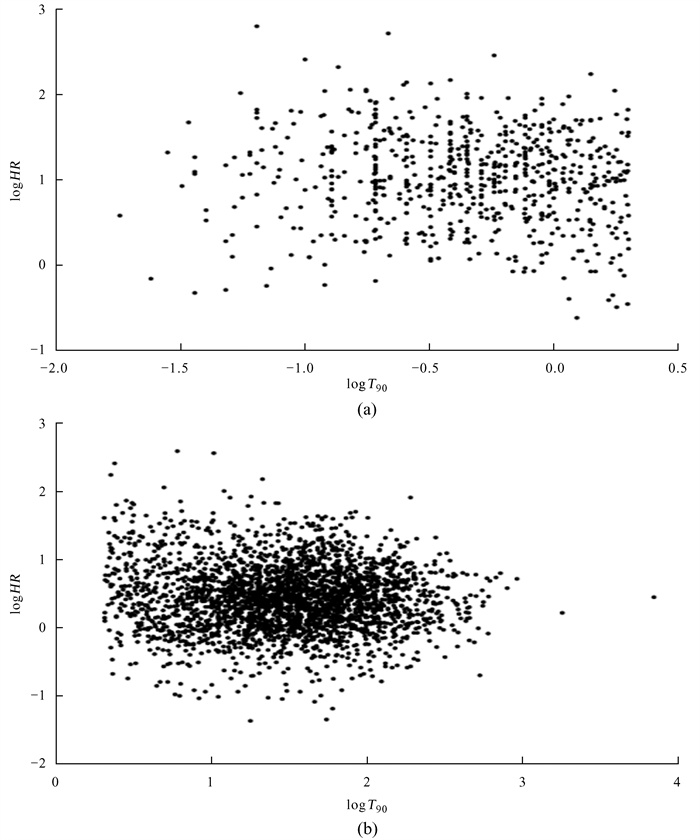
3 589个伽马射线暴的能谱硬度与持续时间的数据分布如图 1,图 1中蓝色垂直虚线(T90=2 s) 左边是676个短暴的数据点,右边是2 913个长暴的数据点。图 2是两个子样本的能谱硬度与持续时间的数据分布图,其中(a) 是676个短暴的数据点,(b) 是2 913个长暴的数据点。从logHR的值来看,短暴能谱硬度的中值约为1.03,平均值为1.01;长暴能谱硬度的中值约为0.43,平均值为0.44,说明短暴能谱的平均硬度比长暴大。
|
| 图 2 伽马射线暴两个子样本的能谱硬度与持续时间的统计分布 Fig. 2 The statistical distribution of the duration and hardness ratio of gamma-ray bursts in two sub-samples |
能谱硬度和持续时间的相关性分析结果显示,3 589个伽马射线暴总样本的
通过相关性分析,总样本的能谱硬度和持续时间存在相关性(
在本文的总样本中,短暴能谱硬度的中值约为1.03,平均值为1.01;长暴能谱硬度的中值约为0.43,平均值为0.44 (以上4个值均为logHR值)。短暴的能谱平均硬度比长暴的大,相当于前者高能光子与低能光子的比值更大。造成短暴的能谱比长暴的能谱偏硬的原因是什么,目前还没有定论。通常认为长暴起源于大质量恒星塌缩[10-14],而短暴起源于双致密星并合[15-16]。由此可见,起源于致密双星并合的伽马射线暴能谱比起源于大质量恒星塌缩的伽马射线暴更硬。
伽马射线暴能谱硬度和持续时间的数据分布图,以及短暴子样本和长暴子样的能谱硬度和持续时间不存在显著的相关性,揭示了伽马射线暴存在长暴和短暴这两种类型,证明了这种分类方法的合理性,也暗示着长暴和短暴性质的差异,支持这两种伽马射线暴具有不同起源的观点。
文[18]采用的总样本只包含1 179个伽马射线暴,其中304个短暴子样本,875个长暴子样本;本文的伽马射线暴总样本为3 589个,其中676个短暴子样本,2 913个长暴子样本,总样本和长暴的样本量是文[18]的3倍多,因此,本文得到的统计结果更为可靠。
| [1] | KLEBESADEL R W, STRONG I B, OLSON R A. Observations of gamma-ray bursts of cosmic origin[J]. The Astrophysical Journal, 1973, 182: L85–L88. DOI: 10.1086/181225 |
| [2] | KUMAR P, ZHANG B. The physics of gamma-ray bursts&relativistic jets[J]. Physics Reports, 2015, 561: 1–109. DOI: 10.1016/j.physrep.2014.09.008 |
| [3] |
常学钊, 彭朝阳, 王道周, 等. 基于GRB051117A的能谱延迟及其耀发特性的研究[J]. 天文研究与技术, 2021, 18(4): 427–436 CHANG X Z, PENG Z Y, WANG D Z, et al. Study on spectral lag and flare characters based on GRB051117A[J]. Astronomical Research&Technology, 2021, 18(4): 427–436. |
| [4] |
王道周, 彭朝阳, 常学钊, 等. Fermi伽马暴时间分辨谱拐折幂率拟合的模型限制[J]. 天文研究与技术, 2021, 18(1): 43–51 WANG D Z, PENG Z Y, CHANG X Z, et al. Model limitation of break power-law fitting of the Fermi GRB time-resolved spectra[J]. Astronomical Research&Technology, 2021, 18(1): 43–51. |
| [5] | DEZALAY J P, BARAT C, TALON R, et al. Short cosmic events: a subset of classical GRBs?[C]//Proceedings of the American Institute of Physics Conference Series. 1992: 304-309. |
| [6] | KOUVELIOTOU C, MEEGAN C A, FISHMAN G J, et al. Identification of two classes of gamma-ray bursts[J]. The Astrophysical Journal Letters, 1993, 413(2): L101–L104. |
| [7] | FISHMAN G J, MEEGAN C A, WILSON R B, et al. The first BATSE gammma-ray burst catalog[J]. The Astrophysical Journal Supplement Series, 1994, 92: 229–283. DOI: 10.1086/191968 |
| [8] | MEEGAN C A, PENDLETON G N, BRIGGS M S, et al. The third BATSE gamma-ray burst catalog[J]. The Astrophysical Journal Supplement Series, 1996, 106: 65–110. DOI: 10.1086/192329 |
| [9] | PACIESAS W S, MEEGAN C A, PENDLETON G N, et al. The fourth BATSE gamma-ray burst catalog (revised)[J]. The Astrophysical Journal Supplement Series, 1999, 122(2): 465–495. DOI: 10.1086/313224 |
| [10] | GALAMA T J, VREESWIJK P M, VAN PARADIJS J, et al. An unusual supernova in the error box of the γ-ray burst of 25 April 1998[J]. Nature, 1998, 395: 670–672. DOI: 10.1038/27150 |
| [11] | STANEK K Z, MATHESON T, GARNAVICH P M, et al. Spectroscopic discovery of the supernova 2003dh associated with GRB 030329[J]. The Astrophysical Journal, 2003, 591(1): L17–L20. DOI: 10.1086/376976 |
| [12] | WOOSLEY S E, BLOOM J S. The supernova gamma-ray burst connection[J]. Annual Review of Astronomy&Astrophysics, 2006, 44(1): 507–556. |
| [13] | HJORTH J, MALESANI D, JAKOBSSON P, et al. The optically unbiased GRB host (TOUGH) survey. I. Survey design and catalogs[J]. The Astrophysical Journal, 2012, 756(2): 187–200. DOI: 10.1088/0004-637X/756/2/187 |
| [14] | XU D, DE UGARTE POSTIGO A, LELOUDAS G, et al. Discovery of the broad-lined Type Ic SN 2013cq associated with the very energetic GRB 130427A[J]. The Astrophysical Journal, 2013, 776(2): 98. DOI: 10.1088/0004-637X/776/2/98 |
| [15] | ZHANG B, ZHANG B B, VIRGILI F J, et al. Discerning the physical origins of cosmological gamma-ray bursts based on multiple observational criteria: the cases of z=6.7 GRB 080913, z=8.2 GRB 090423, and some short/hard GRBs[J]. The Astrophysical Journal, 2009, 703(2): 1696–1724. DOI: 10.1088/0004-637X/703/2/1696 |
| [16] | NAKAR E. Short-hard gamma-ray bursts[J]. Physics Reports, 2007, 442(1): 166–236. |
| [17] | FISHMAN G J. Observed properties of gamma-ray bursts[J]. The Astrophysical Journal Supplement Series, 1999, 138(3): 395–398. DOI: 10.1051/aas:1999283 |
| [18] | QIN Y P, XIE G Z, XUE S J, et al. The hardness-duration correlation in the two classes of gamma-ray bursts[J]. Publications of the Astronomical Society of Japan, 2000, 52: 759–761. DOI: 10.1093/pasj/52.5.759 |
| [19] | WANG F F, ZOU Y C, LIU F X, et al. A comprehensive statistical study of gamma-ray bursts[J]. The Astrophysical Journal, 2020, 893(1): 77. DOI: 10.3847/1538-4357/ab0a86 |