


2. 山东省潍坊第一中学, 山东 潍坊 261205
2. Weifang No. 1 Middle School of Shandong, Weifang 261205, China
我国是世界上天文学发展最早的国家之一,早在3 000多年前就有可考的关于星象的文字记载。这些古代天象记载不仅对历史研究和古代天文学研究有重要价值,在现代天文学研究中也起着重要作用[1]。殷卜辞是甲骨文的主要内容之一,是研究殷商社会历史的重要资料。经过几代学者近百年的努力,已确认在殷卜辞中记录了5次有纪日干支的月食记载。中外学者对这些月食的发生年代做了推算和论证,有30多种不尽相同的结论[2]。结合新的殷墟甲骨分期,历史学家和考古学家研究认为,这5次殷卜辞月食都在武丁中期后半段到武丁末年或可延伸到祖庚之世,应在30年左右的时间跨度内。文[3]在该年代范围内找到殷都安阳可见的既符合卜辞干支时刻又符合先后位序的5次月食,分别为公元前1201年7月12日(癸未夕月食)、公元前1198年11月4日(甲午夕月食)、公元前1192年12月27日(己未夕皿庚申月食)、公元前1189年10月25日(壬申夕月食)和公元前1181年11月25日(乙酉夕月食)。该项研究为夏商周断代工程的重要成果之一[4]。
天文行星历表对于天文学和地球科学及其他相关学科领域都有重要的实用价值。美国航空航天局喷气推进实验室发布的DE系列现代天文行星历表已经在天体测量、深空导航和行星际探测等方面得到较为广泛的应用。2009年9月,喷气推进实验室发布DE422行星历表[5],数据跨度自公元前3001年12月7日至公元3000年1月30日。该历表可以满足有关学者对古代天象记载研究的基本需求。本文利用DE422行星历表对5次殷卜辞月食进行计算,研究它们在地球表面的可观测情况,并重点考察这5次月食在殷都安阳的可视性。
1 世界时改正数现代天文行星历表DE422的时间系统采用地球动力学时(Terrestrial Dynamical Time, TDT)。由于地球自转的长期变化,以地球自转为基础的世界时(Universal Time, UT) 与地球动力学时的时刻之间存在一个差值,即世界时改正数(ΔT)。利用古代的天象记载情况可以推算古代的ΔT数值,反之,已知古代某天象发生年代的ΔT数值,可以推算该天象在当时的可观测情况[6-8]。文[7]综合古代的若干天象记载,并设定月球轨道运动的加速度为-26.0角秒/(百年) 2,得出公元前501年之前的ΔT拟合公式为[-20 + 32 × (year-1820)2/1002] s。以下分别计算公元前1201年7月12日、公元前1198年11月4日、公元前1192年12月27日、公元前1189年10月25日和公元前1181年11月25日对应的ΔT。考虑到DE422行星历表中月球轨道运动的加速度为-25.85角秒/(百年) 2 [9],因此,在本项研究中需要对ΔT加入改正量。殷卜辞5次月食时刻对应的世界时改正数见表 1。因为ΔT的测定依赖于古代的天象记载,由公式得到的ΔT存在误差[10],表 1同时列出了ΔT的误差范围,以及该误差引起的地面点经度变化。
| Date | UT corrections (ΔT)/s | ΔTerror ranges/s | Longitude changes from ΔT error/° |
| Jul. 12, 1201 BCE | 29 018 | ±1 064 | ±4.43 |
| Nov. 4, 1198 BCE | 28 955 | ±1 057 | ±4.40 |
| Dec. 27, 1192 BCE | 28 837 | ±1 042 | ±4.34 |
| Oct. 25, 1189 BCE | 28 783 | ±1 035 | ±4.31 |
| Nov. 25, 1181 BCE | 28 628 | ±1 016 | ±4.23 |
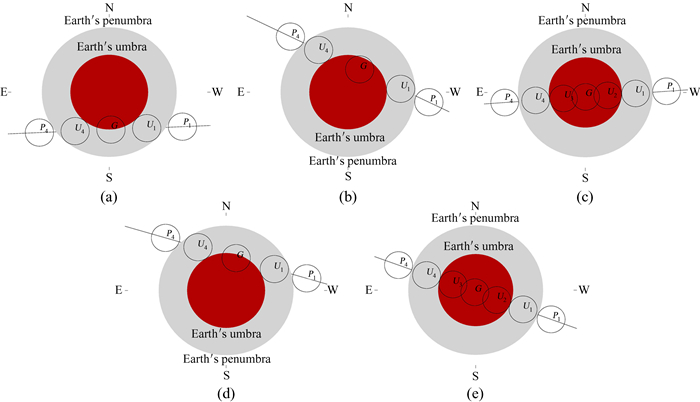
月食是地球运动到太阳和月球中间时,月球正好进入地球阴影的特殊天文现象。在月食过程中,如果整个月面全部进入地球本影,称为月全食;如果月面只有一部分进入地球本影,称为月偏食;月面进入地球半影时,称为半影月食。人们通常关注月全食和食分较大的月偏食。月全食有半影食始、初亏、食既、食甚、生光、复圆和半影食终7个食相过程。月偏食只有半影食始、初亏、食甚、复圆和半影食终5个食相过程。根据日、月和地球的几何位置关系,我们可以计算月食各食相的发生时刻[11]。这些食相可以通过月食概况图展示,图 1给出了公元前1201年7月12日、公元前1198年11月4日、公元前1192年12月27日、公元前1189年10月25日和公元前1181年11月25日5次月食的概况图。
|
| 图 1 殷卜辞5次月食的概况图。 (a) 公元前1201年7月12日月偏食;(b) 公元前1198年11月4日月偏食;(c) 公元前1192年12月27日月全食;(d) 公元前1189年10月25日月偏食;(e) 公元前1181年11月25日月全食 Fig. 1 Overview of the 5 lunar eclipses date in the Yin period oracle bone inscription. (a) The partial lunar eclipse on July 12, 1201 BCE; (b) the partial lunar eclipse on November 4, 1198 BCE; (c) the total lunar eclipse on December 27, 1192 BCE; (d) the partial lunar eclipse on October 25, 1189 BCE; (e) the total lunar eclipse on November 25, 1181 BCE |
在月食概况图中,用P1和P4分别标出半影食始和半影食终两个食相时刻的月心位置,用U1,U2,G,U3和U4分别标出初亏、食既、食甚、生光和复圆5个食相时刻的月心位置。显而易见,发生于公元前1201年7月12日、公元前1198年11月4日、公元前1189年10月25日的3次月食为月偏食,发生于公元前1192年12月27日和公元前1181年11月25日的2次月食为月全食。
2.2 殷卜辞月食的可观测情况考虑世界时改正数ΔT后,本文分别计算每次月食的各个食相时刻在地面观测月球的高度角,得到地面对各食相的可视性。以下分别计算这5次殷卜辞月食的可视情况,并采用圆柱投影分别绘于图 2的5个子图。

|
| 图 2 殷卜辞5次月食的地面可视性。 (a) 公元前1201年7月12日月偏食;(b) 公元前1198年11月4日月偏食;(c) 公元前1192年12月27日月全食;(d) 公元前1189年10月25日月偏食;(e) 公元前1181年11月25日月全食 Fig. 2 The visibility of the 5 lunar eclipses in the Yin period oracle bone inscription. (a) The partial lunar eclipse on July 12, 1201 BCE; (b) the partial lunar eclipse on November 4, 1198 BCE; (c) the total lunar eclipse on December 27, 1192 BCE; (d) the partial lunar eclipse on October 25, 1189 BCE; (e) the total lunar eclipse on November 25, 1181 BCE |
在图 2中,红色曲线为各食相时刻地面可视高度角为0的等高线,对应月出和月落的边界;红色圆圈为月球在最大食时刻的地面投影点;红色竖实线为可观测到最大食的地面子午线;红色竖虚线为ΔT误差引起的最大食子午线的经度变化,与红色竖线相对的地球另一侧为月食不可见区域。
2.3 殷卜辞月食在安阳的见食情况殷墟是中国商朝晚期都城遗址,是中国历史上第1个有文献可考并为考古学和甲骨文所证实的都城遗址,位于今河南省安阳市西北殷都区小屯村周围。该地(36.13°N,114.33°E) 对5次殷卜辞月食的见食情况见表 2。表列中“地方时”为世界时加上当地经度除以15得到,时间之前用“-1”表示上一天的时间,用“+1”表示下一天的时间。
| Date | Eclipse stage | Terrestrial Dynamical Time/(hh: mm: ss) | Local Time/(hh: mm: ss) | Magnitude | Sunrise (Local Time)/(hh: mm: ss) | Sunset (Local Time)/(hh: mm: ss) |
| Jul. 12, 1201 BCE | Penumbral eclipse begins | (-1)21:57:14 | (-1)21:30:56 | / | 4:38:11 | 19:16:46 |
| Partial eclipse begins | (-1)23:11:23 | (-1)22:45:04 | / | |||
| Maximum eclipse | 0:25:26 | (-1)23:59:08 | 0.49 | |||
| Partial eclipse ends | 1:39:22 | 1:13:03 | / | |||
| Penumbral eclipse ends | 2:53:39 | 2:27:20 | / | |||
| Nov. 4, 1198 BCE | Penumbral eclipse begins | 20:07:37 | 19:42:21 | / | 6:21:14 | 17:17:46 |
| Partial eclipse begins | 21:15:15 | 20:49:59 | / | |||
| Maximum eclipse | 22:39:33 | 22:14:17 | 0.71 | |||
| Partial eclipse ends | 24:03:47 | 23:38:31 | / | |||
| Penumbral eclipse ends | (+1)1:11:32 | (+1)0:46:16 | / | |||
| Dec. 27, 1192 BCE | Penumbral eclipse begins | 19:57:07 | 19:33:49 | / | 7:14:32 | 16:54:11 |
| Partial eclipse begins | 21:09:07 | 20:45:49 | / | |||
| Total eclipse begins | 22:14:04 | 21:50:46 | / | |||
| Maximum eclipse | 23:05:25 | 22:42:07 | 1.65 | |||
| Total eclipse ends | 23:56:46 | 23:33:29 | / | |||
| Partial eclipse ends | (+1)1:01:44 | (+1)0:38:26 | / | |||
| Penumbral eclipse ends | (+1)2:13:38 | (+1)0:50:20 | / | |||
| Oct. 25, 1189 BCE | Penumbral eclipse begins | 18:56:08 | 18:33:45 | / | 6:11:35 | 17:28:54 |
| Partial eclipse begins | 20:06:41 | 19:44:17 | / | |||
| Maximum eclipse | 21:20:36 | 20:58:12 | 0.52 | |||
| Partial eclipse ends | 22:34:27 | 22:12:03 | / | |||
| Penumbral eclipse ends | 23:45:05 | 23:22:41 | / | |||
| Nov. 25, 1181 BCE | Penumbral eclipse begins | 17:32:31 | 17:12:42 | / | 6:45:11 | 16:58:01 |
| Partial eclipse begins | 18:37:38 | 18:17:49 | / | |||
| Total eclipse begins | 19:38:48 | 19:18:59 | / | |||
| Maximum eclipse | 20:29:38 | 20:09:49 | 1.74 | |||
| Total eclipse ends | 21:20:27 | 21:00:38 | / | |||
| Partial eclipse ends | 22:21:36 | 22:01:47 | / | |||
| Penumbral eclipse ends | 23:26:53 | 23:07:04 | / |
由表 2可以看出,5次殷卜辞月食都发生在安阳当地夜间,每次月食的各个食相出现在日落之后和日出之前的一段时间内。其中,公元前1181年11月25日月食的初亏时间最早为18: 18 (当地日落时间16: 58),公元前1201年7月12日月食的复圆时间最晚为1: 13 (当地日出时间4: 38)。这些月食的食分在0.49到1.74之间(食分大于1的情形,为月面深入地球本影以内)。如果当夜不是阴雨天,这些月食造成的天空亮度及月相变化是非常明显的,可以初步推测古人有可能注意到这5次月食现象。需要指出的是,本文计算表 2所列的时刻值时使用了表 1中的ΔT值,因为ΔT存在误差,所以表 2中安阳见食的时刻值也存在误差。
3 小结本文根据美国喷气推进实验室发布的现代天文行星历表DE422,计算了殷卜辞中5次纪日月食的有关参数,给出各食相的地面可视性和殷都安阳的见食情况。结果表明,这些月食在安阳具有可以观测到的天文条件,支持夏商周断代工程得到的殷卜辞月食的初步结果。当然,年代学研究需要天文学、历史学、考古学乃至同位素测年等多学科交叉,开展更深入的研究和综合分析。本文结果可为殷卜辞月食的深入研究提供一定的参考。
| [1] |
冯时. 中国天文考古学[M]. 3版. 北京: 中国社会科学出版社, 2017. FENG S. Astroarchaeology in China[M]. 3rd ed. Beijing: China Social Sciences Press, 2017. |
| [2] |
冯时. 殷卜辞月食资料的整理与研究[J]. 古籍整理研究学刊, 2002, 6: 8–19 FENG S. Review and study on the lunar eclipse data recorded in the Yin period oracle bone inscription[J]. Journal of Ancient Books Collation and Studies, 2002, 6: 8–19. |
| [3] |
张培瑜. 日月食卜辞的证认与殷商年代[J]. 中国社会科学, 1999, 5: 172–198 ZHANG P Y. The identification of oracle bone inscriptions related to solar and lunar eclipses and the Shang dynasty dating[J]. Social Sciences in China, 1999, 5: 172–198. |
| [4] | 夏商周断代工程专家组. 夏商周断代工程1996-2000阶段成果报告[M]. 简本. 北京: 世界图书出版公司, 2000. Expert Group of the Xia-Shang-Zhou Chronology Project. 1996-2000 achievement report of the Xia-Shang-Zhou chronology project[M]. Simplified Version. Beijing: World Book Publishing Company, 2000. |
| [5] | KONOPLIV A S, ASMAR S W, FOLKNER W M, et al. Mars high resolution gravity fields from MRO, Mars seasonal gravity, and other dynamical parameters[J]. Icarus, 2011, 211: 401–428. DOI: 10.1016/j.icarus.2010.10.004 |
| [6] |
韩延本. 由古代天象记载研究揭示的地球自转变化的两个重要现象[J]. 地球物理学进展, 1996, 11(4): 116–118 HAN Y B. Two interesting phenomena in variation of the Earth's rotation derived from studies of records of ancient astronomical observations[J]. Progress in Geophysics, 1996, 11(4): 116–118. |
| [7] | MORRISON L V, STEPHENSON F R. Historical values of the Earth's clock error ΔT and the calculation of eclipses[J]. Journal for the History of Astronomy, 2004, 120: 327–336. |
| [8] |
马利华, 韩延本, 尹志强, 等. 基于现代天文行星历表的仲康日食研究[J]. 天文研究与技术, 2020, 18(3): 421–426 MA L H, HAN Y B, YIN Z Q, et al. Research on Zhongkang solar eclipse based on modern astronomical planetary ephemeris[J]. Astronomical Research & Technology, 2020, 18(3): 421–426. |
| [9] | WILLIAMS J G, BOGGS D H, FOLKNER W M. DE421 lunar orbit, physical librations, and surface coordinates[R/OL]. 2008[2020-11-12]. https://naif.jpl.nasa.gov/pub/naif/generic_kernels/spk/planets/a_old_versions/de421_lunar_ephemeris_and_orientation.pdf. |
| [10] | HUBER P J. Modeling the length of day and extrapolating the rotation of the Earth[J]. Journal of Geodesy, 2006, 80(6): 283–303. DOI: 10.1007/s00190-006-0067-3 |
| [11] |
唐汉良, 余宗宽, 沈昌钧. 日月食计算[M]. 南京: 江苏科学技术出版社, 1980. TANG H L, YU Z K, SHEN C J. Calculation of solar and lunar eclipses[M]. Nanjing: Jiangsu Science and Technology Press, 1980. |