


2. 中国科学院云南天文台, 云南 昆明 650216
2. Yunnan Observatories, Chinese Academy of Sciences, Kunming 650216, China
众所周知,耀变体是活动星系核中极其特殊的一个子类,在光学和射电波段具有偏振,在所有波长存在快速、大幅的光变,以及非热连续辐射[1-2]。根据发射线强度可以把耀变体分为两类,蝎虎天体(BL Lacs)不存在或存在微弱发射线,平谱射电类星体(Flat Spectrum Radio Quasars, FSRQs)具有强发射线[3-4]。耀变体光变可以根据光变时标分为3类[5-6],包括流量变化时标以天为量级的短时标光变(Intraday Variability, IDV)、流量变化时标以月为量级的中等时标光变(Short-Term Variability, STV)和流量变化时标以年为量级的长时标光变(Long-Term Variability, LTV)。S5 0716 + 714是一个具有连续光变的蝎虎天体,在短时标光变中,光变时标通常在几分钟到几小时之间,但色指数和星等之间的关系很复杂[7-9]。文[10-11]研究了2200 + 420的光变曲线,发现当光源变亮时,颜色会越亮越蓝(Bluer When Brighter, BWB),并且认为“凸”谱上的多普勒因子变化可能是解释长期变化及其轻微色变的机制。文[12]对OJ 287进行了研究,发现存在颜色变蓝的趋势。文[13-14]对处于低态的OJ 287进行了观测研究,发现存在颜色变蓝的趋势,对蝎虎天体H0323 + 022进行了长期观测研究,也具有颜色变蓝的趋势。文[15]分析了44个蝎虎天体的色指数,发现88%的蝎虎天体都有颜色变蓝的趋势。文[16]发现蝎虎天体通常具有颜色变蓝的趋势,相反,平谱射电类星体具有颜色变红的趋势。通过研究86个样本,文[17]发现所有平谱射电类星体受多普勒增强效应,并且平谱射电类星体的多普勒增强因子高于蝎虎天体。耀变体的多普勒聚束效应可以缩短视在时间尺度并极大地增强观测光度,这是研究人员可以利用具有多普勒效应的耀变体的流量变化来研究其中央引擎的原因[18]。许多研究者已经研究过耀变体的色指数,最常见的是通过研究色指数和星等的相关关系,进一步解释耀变体的辐射机制。为了研究多普勒聚束效应对耀变体的影响,从SMARTS网站①收集了19个费米耀变体的B和R波段星等数据做以下分析。
①http://www.astro.yale.edu/smarts/glast/home.php
1 观测数据和色指数分析 1.1 观测数据数据来自SMARTS网站。基于分析结果依赖于数据样本的大小,选取B波段和R波段具有较多观测数据的源,删除由于观测时间、望远镜故障等原因造成的不真实数据,最后获得了19个费米耀变体在B和R波段的准同时数据,包括3C 273,3C 279,3C 454.3,0208-512,0235+164,0250-225,0402-362,0454-234,0528+134,0531-4827,1004-217,1144-379,1406-076,1424-41,1510-089,1622-297,2052-474,2142-75,2155-304。观测历时最长的源是3C 454.3,从儒略日(JD)2454640到2457964。19个源中0235+164和2155-304属于蝎虎天体,其余均为平谱射电类星体,通过筛选之后,从SMARTS网站得到12 682组数据点,B波段和R波段数据点相同,都是6 341个。
1.2 色指数分析利用准同时数据得出19个源的色指数,计算了色指数与星等的相关关系。S5 0716 + 714在微光变时标、短时标和长时标内都发现了颜色变蓝的趋势;Mrk 501在中时标、短时标和微光变时标上具有颜色变蓝的趋势[19];耀发期的光谱指数与非耀发期的光谱指数不同[20],因此,色指数的变化可能与源的活动状态和时标有关。同时宿主星系、吸积盘成分的影响以及重力微透镜也会造成明显但不切实际的颜色变化[21-22]。因此,利用调整流量基准面的方法修正流量与色指数,对比修正前后色指数与星等相关关系的差别,从而研究多普勒效应对耀变体色指数的影响。调整流量基准面[10-12]的方法如下:(1)为了去除密集采样的影响,将流量进行4天的合并,而后利用合并的数据进行3次样条插值,这样就得到了消除长期趋势后的流量值。由于SMARTS网站公布的是观测源的星等,在计算前利用
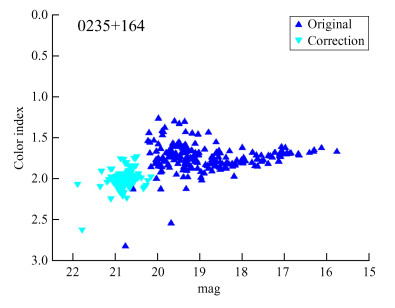
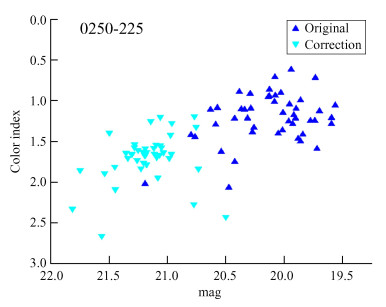
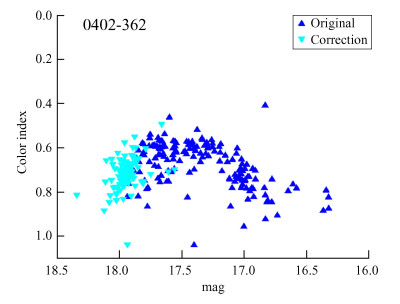
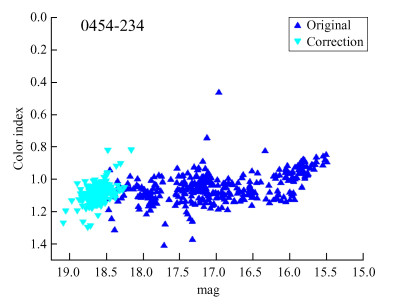
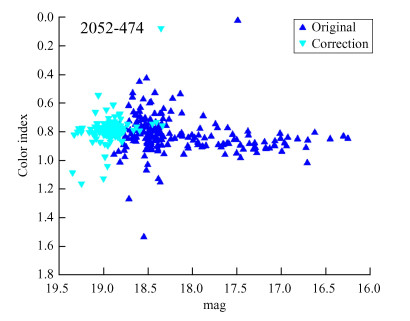
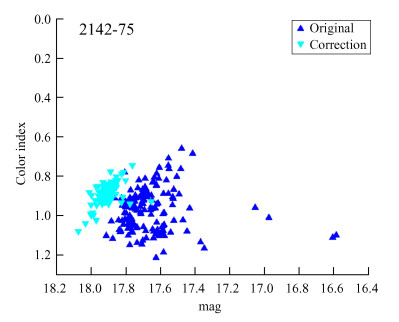
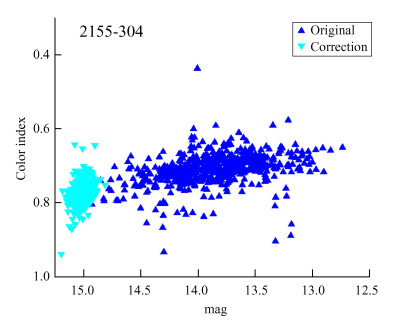
研究修正前后的色指数(B-R)与R波段星等(R)之间的关系。假设色指数为Y,星等值为X,则Y=a+bX。表 1和表 2分别是修正前后星等和色指数的相关关系,其中,a为截距;b为斜率;r为相关系数;p为置信度(P < 0.05认为相关);n为每个源对应的样本数量。色指数为Y,星等值为X的线性关系图如图 1至图 19。研究结果表明,调整流量基准面后的数据点集中在原始数据点的左侧。在修正前,根据色指数和星等之间的相关关系可以发现,源3C 279,0454-234,0528+134,1004-217和1144-379具有明显的颜色变蓝的趋势,而源3C 454.3,0402-362具有明显的越亮越红的趋势。修正后的结果表明,15个源有颜色变蓝的趋势,只有3C 454.3,0250-225,1406-076和1510-089没有表现出颜色变蓝的趋势。应该注意到颜色相关关系的弥散都很大。
| a | b | r | p | n | ||
| 3C 273 | -0.460 91 | 0.062 49 | 0.109 07 | 0.038 32 | 361 | N |
| 3C 279 | 0.216 85 | 0.053 26 | 0.522 | 1.27E-54 | 764 | SP |
| 3C 454.3 | 3.068 | -0.128 8 | -0.645 21 | 9.36E-103 | 863 | SN |
| 0208-512 | 1.794 47 | -0.050 25 | -0.233 72 | 5.16E-09 | 610 | WP |
| 0235+164 | 1.609 8 | 0.007 21 | 0.042 55 | 0.545 65 | 204 | N |
| 0250-225 | -4.838 95 | 0.300 45 | 0.354 17 | 0.014 59 | 47 | WP |
| 0402-362 | 2.783 32 | -0.121 37 | -0.449 47 | 1.11E-09 | 167 | SN |
| 0454-234 | 0.134 03 | 0.053 82 | 0.457 57 | 9.73E-19 | 335 | SP |
| 0528+134 | -12.262 5 | 0.663 22 | 0.609 47 | 2.56E-12 | 108 | SP |
| 0531-4827 | -0.036 07 | 0.057 41 | 0.379 91 | 0.001 18 | 70 | WP |
| 1004-217 | -12.324 18 | 0.754 16 | 0.773 24 | 1.16E-11 | 53 | SP |
| 1144-379 | -1.337 2 | 0.129 52 | 0.422 16 | 6.55E-09 | 174 | SP |
| 1406-076 | 1.247 19 | -0.017 82 | -0.036 19 | 0.595 98 | 217 | N |
| 1424-41 | 1.237 3 | -0.006 05 | -0.051 79 | 0.223 55 | 554 | N |
| 1510-089 | 2.167 02 | -0.081 21 | -0.207 14 | 8.63E-08 | 656 | WN |
| 1622-297 | 1.260 59 | -0.005 23 | -0.007 27 | 0.909 08 | 249 | N |
| 2052-474 | 1.462 8 | -0.035 27 | -0.151 76 | 0.033 72 | 196 | N |
| 2142-75 | 1.046 04 | -0.004 31 | -0.007 23 | 0.928 4 | 157 | N |
| 2155-304 | 0.138 3 | 0.041 25 | 0.375 49 | 4.65E-20 | 556 | WP |
| a | b | r | p | n | ||
| 3C 273 | -13.090 38 | 1.009 41 | 0.758 94 | 7.19E-69 | 361 | SP |
| 3C 279 | -2.023 85 | 0.164 32 | 0.342 16 | 2.09E-22 | 764 | WP |
| 3C 454.3 | 1.199 32 | -0.017 4 | -0.037 63 | 0.269 51 | 863 | N |
| 0208-512 | -4.140 15 | 0.251 17 | 0.296 15 | 8.17E-14 | 610 | WP |
| 0235+164 | -1.074 64 | 0.148 24 | 0.332 91 | 1.14E-06 | 204 | WP |
| 0250-225 | -4.073 06 | 0.272 47 | 0.232 48 | 0.115 83 | 47 | N |
| 0402-362 | -3.906 94 | 0.257 53 | 0.357 12 | 2.16E-06 | 167 | WP |
| 0454-234 | -3.107 32 | 0.225 36 | 0.488 76 | 1.62E-21 | 335 | SP |
| 0528+134 | -19.955 62 | 1.008 82 | 0.914 41 | 1.96E-43 | 108 | SP |
| 0531-4827 | -12.573 78 | 0.729 47 | 0.586 33 | 9.65E-08 | 70 | SP |
| 1004-217 | -12.360 44 | 0.747 86 | 0.754 83 | 6.63E-11 | 53 | SP |
| 1144-379 | -2.500 22 | 0.196 62 | 0.286 44 | 1.27E-04 | 174 | WP |
| 1406-076 | -3.304 33 | 0.199 16 | 0.176 89 | 0.009 02 | 217 | N |
| 1424-41 | -7.393 31 | 0.463 28 | 0.600 51 | 1.39E-55 | 554 | SP |
| 1510-089 | 0.926 08 | 0.038 29 | 0.077 17 | 0.048 19 | 656 | N |
| 1622-297 | -10.347 44 | 0.588 48 | 0.489 85 | 1.97E-16 | 249 | SP |
| 2052-474 | -3.983 86 | 0.252 09 | 0.404 15 | 4.24E-09 | 196 | SP |
| 2142-75 | -8.155 86 | 0.504 91 | 0.537 57 | 3.89E-13 | 157 | SP |
| 2155-304 | -2.138 1 | 0.193 7 | 0.393 26 | 5.24E-22 | 556 | WP |
| 表 1和表 2中SP表示强正相关关系(Strong positive correlation),WP表示弱正相关关系(Weak positive correlation),SN表示强负相关关系(Strong negative correlation),WN表示弱负相关关系(Weak negative correlation),N表示没有相关关系(No significant correlation) | ||||||
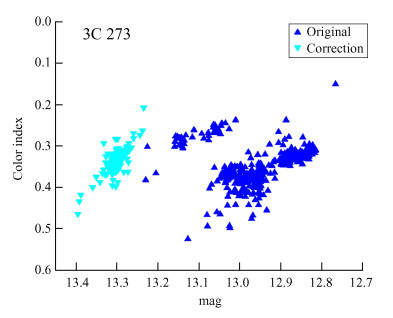
|
| 图 1 3C 273的色指数与星等关系图 Fig. 1 The relation between the color index and mag of 3C 273 |
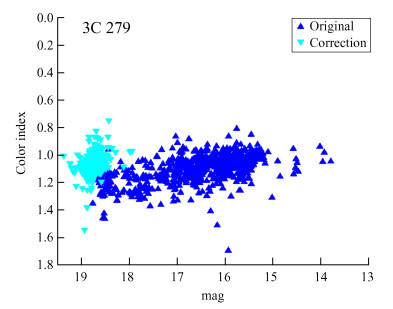
|
| 图 2 3C 279的色指数与星等关系图 Fig. 2 The relation between thecolor index and mag of 3C 279 |
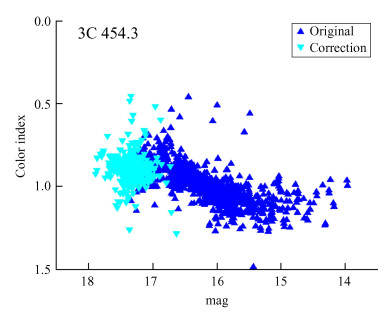
|
| 图 3 3C 454.3的色指数与星等关系图 Fig. 3 The relation between the color index and mag of 3C 454.3 |
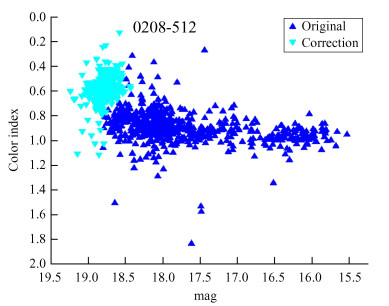
|
| 图 4 0208-512的色指数与星等关系图 Fig. 4 The relation between the color index and mag of 0208-512 |
|
| 图 5 0235+164的色指数与星等关系图 Fig. 5 The relation between the color index and mag of 0235+164 |
|
| 图 6 0250-225的色指数与星等关系图 Fig. 6 The relation between the color index and mag of 0250-225 |
|
| 图 7 0402-362的色指数与星等关系图 Fig. 7 The relation between the color index and mag of 0402-362 |
|
| 图 8 0454-234的色指数与星等关系图 Fig. 8 The relation between the color index and mag of 0454-234 |
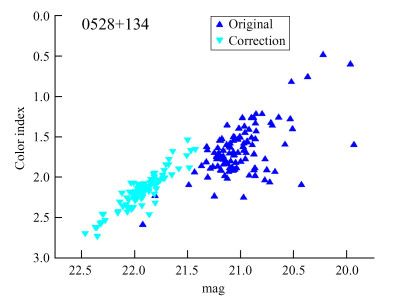
|
| 图 9 0528+134的色指数与星等关系图 Fig. 9 The relation between the color index and mag of 0528+134 |
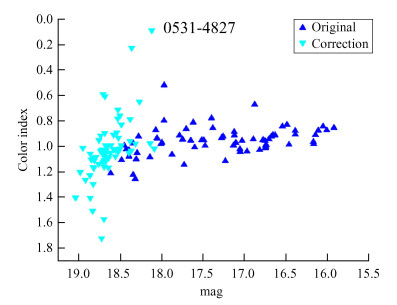
|
| 图 10 0531-4827的色指数与星等关系图 Fig. 10 The relation between the color index and mag of 0531-4827 |
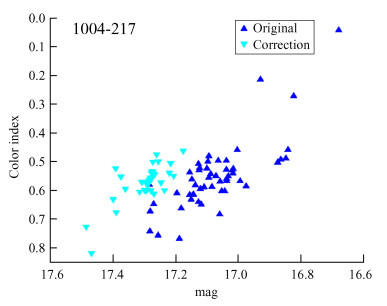
|
| 图 11 1004-217的色指数与星等关系图 Fig. 11 The relation between the color index and mag of 1004-217 |
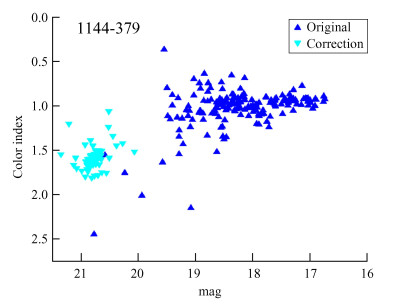
|
| 图 12 1144-379的色指数与星等关系图 Fig. 12 The relation between the color index and mag of 1144-379 |
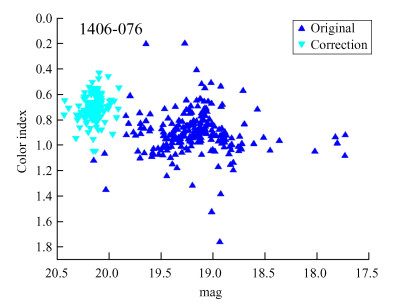
|
| 图 13 1406-076的色指数与星等关系图 Fig. 13 The relation between the color index and mag of 1406-076 |
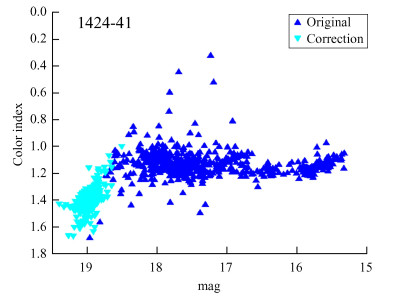
|
| 图 14 1424-41的色指数与星等关系图 Fig. 14 The relation between the color index and mag of 1424-41 |
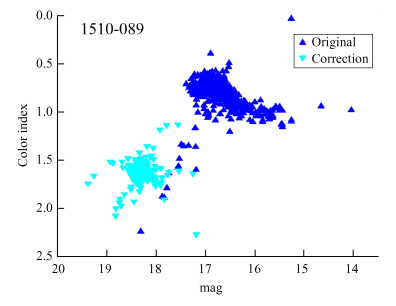
|
| 图 15 1510-089的色指数与星等关系图 Fig. 15 The relation between the color index and mag of 1510-089 |
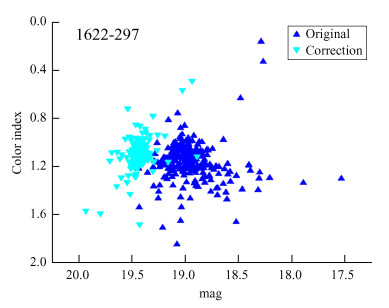
|
| 图 16 1622-297的色指数与星等关系图 Fig. 16 The relation between the color index and mag of 1622-297 |
|
| 图 17 2052-474的色指数与星等关系图 Fig. 17 The relation between the color index and mag of 2052-474 |
|
| 图 18 2142-75的色指数与星等关系图 Fig. 18 The relation between the color index and mag of 2142-75 |
|
| 图 19 2155-304的色指数与星等关系图 Fig. 19 The relation between the color index and mag of 2155-304 |
本文通过分析修正前后色指数与星等之间的相关关系发现:(1)修正前,只有5个源呈现明显的颜色变蓝的趋势,2个源呈现明显的颜色变红的趋势;(2)经过修正后,有9个源呈现明显的颜色变蓝的趋势,6个源呈现弱的颜色变蓝的趋势,只有4个源的色指数与星等不存在相关关系;(3)源3C 273,0528+143,0531-4827,1406-076,1424-41,1622-297,2052-474,2142-75的相关性在修正后增强,可以认为这些源颜色变蓝的趋势受到多普勒因子的影响。其中源3C 279,3C 454.3,0235+164,0250-225,1144-379,1510-089的相关性在修正后变小了,对于修正前后相关性无明显变化或变小的,认为多普勒因子对这些源的色指数没有太大影响或这些源具有较为复杂的辐射机制。用激波喷流模型能很好地解释颜色变蓝的趋势,当大量的电子向外辐射冲击强磁场区域,导致这个区域的辐射增加,在观测上这些高频率的辐射立刻暴露出来,而在低频率的辐射要相对迟一些,从而导致在流量上升的过程中天体慢慢变蓝。而由于观测视角的改变,使得多普勒聚束因子的变化导致部分耀变体颜色变蓝的趋势减弱。
| [1] | 黄克谅. 类星体和活动星系核[M]. 北京: 中国科学出版社, 2005. |
| [2] | ANGEL J R P, STOCKMAN H S. Optical and infrared polarization of active extragalactic objects[J]. Annual Review of Astronomy and Astrophysics, 1980, 18(8): 321–361. |
| [3] | URRY C M, PADOVANI P. Unified schemes for radio-loud active galactic nuclei[J]. Publications of the Astronomical Society of the Pacific, 1995, 107: 803–845. DOI: 10.1086/133630 |
| [4] | SCARPA R, FALOMO R. Are high polarization quasars and BL Lacertae objects really different?A study of the optical spectral properties[J]. Astronomy & Astrophysics, 1997, 325(1): 109–123. |
| [5] | POON H, FAN J H, FU J N. The optical microvariability and spectral changes of the BL Lacertae object S50716+714[J]. The Astrophysical Journal Supplement, 2009, 185(2): 511–525. DOI: 10.1088/0067-0049/185/2/511 |
| [6] | WAGNER S J, WITZEL A. Intraday variability in quasars and BL Lac objects[J]. Annual Review of Astronomy and Astrophysics, 1995, 33: 163–198. DOI: 10.1146/annurev.aa.33.090195.001115 |
| [7] | DAI B, ZENG W, JIANG Z, et al. Long-term multi-band photometric monitoring of blazar S50716+714[J]. The Astrophysical Journal Supplement Series, 2015, 218(2): 18–22. DOI: 10.1088/0067-0049/218/2/18 |
| [8] | GHISELLINI G, VILLATA M, RAITERI C M, et al. Optical-IUE observations of the gamma-ray loud BL Lacertae object S50716+714:data and interpretation[J]. Astronomy & Astrophysics, 1997, 327(1): 61–71. |
| [9] | BHATTA G, WEBB J R, HOLLINGSWORTH H, et al. The 72-h WEBT microvariability observation of blazars S50716+714 in 2009[J]. Astronomy & Astrophysics, 2013, 558: A92. |
| [10] | VILLATA M, RAITERI C M, KURTANIDZE O M, et al. The WEBT BL Lacertae campaign 2001 and its extension. optical light curves and colour analysis 1994-2002[J]. Astronomy and Astrophysics, 2004, 421(1): 103–114. DOI: 10.1051/0004-6361:20035895 |
| [11] | VILLATA M, RAITERI C M, KURTANIDZE O M, et al. The WEBT BL Lacertae campaign 2000[J]. Astronomy and Astrophysics, 2002, 390: 407–421. DOI: 10.1051/0004-6361:20020662 |
| [12] | DAI Y, WU J H, ZHU Z H, et al. Color behavior of BL Lacertae object OJ 287 during an optical outburst[J]. The Astronomical Journal, 2011, 141(2): 65. DOI: 10.1088/0004-6256/141/2/65 |
| [13] | ZHANG X, ZHAO G, ZHENG Y G, et al. CCD photometry and optical variability of gamma-ray-loud BL Lacertae object OJ 287 in a low, fainter state[J]. The Astronomical Journal, 2007, 133(5): 1995–2000. DOI: 10.1086/512126 |
| [14] | ZHANG X, ZHENG Y G, ZHANG H J, et al. CCD photometry and optical variability of the BL Lacertae object H0323+022[J]. The Astrophysical Journal Supplement, 2008, 174(1): 111–116. DOI: 10.1086/521401 |
| [15] | IKEJIRI Y, UEMURA M, SASADA M, et al. Photopolarimetric monitoring of blazars in the optical and near-infrared bands with the Kanata telescope. I. correlations between flux, color, and polarization[J]. Publications of the Astronomical Society of Japan, 2011, 63(3): 639–675. DOI: 10.1093/pasj/63.3.327 |
| [16] | RANI B, GUPTA A C, STRIGACHEV A, et al. Short-term flux and colour variations in low-energy peaked blazars[J]. Monthly Notices of the Royal Astronomical Society, 2010, 404(4): 1992–2017. |
| [17] | HOVATTA T, E V, M T, et al. Doppler factors, lorentz factors and viewing angles for quasars, BL Lacertae objects and radio galaxies[J]. Astronomy & Astrophysics, 2009, 494(2): 527–537. |
| [18] | GAUR H, GUPTA A C, BACHEV R, et al. Optical variability of Tevblazars on long time-scales[J]. Monthly Notices of the Royal Astronomical Society, 2019, 484(4): 5633–5644. |
| [19] | XIONG D, ZHANG X, YI T, et al. Multi-color optical monitoring of Mrk 501 from 2010 to 2015[J]. The Astrophysical Journal Supplement Series, 2016, 222(2): 24. DOI: 10.3847/0067-0049/222/2/24 |
| [20] | ZHENG Y G, ZHANG X, BI X W, et al. Long-term optical spectra variability of BL Lacertae object OJ 287[J]. Monthly Notices of the Royal Astronomical Society, 2008, 385(2): 823–829. DOI: 10.1111/j.1365-2966.2008.12761.x |
| [21] | HAWKINS M R S. Quasar variability: new surveys and new models[C]//The ASP Conference Series. 2002. |
| [22] | GAUR H, GUPTA A C, BACHEV R, et al. Nature of intra-night optical variability of BL Lacertae[J]. Monthly Notices of the Royal Astronomical Society, 2015, 452(4): 4263–4273. DOI: 10.1093/mnras/stv1556 |