


活动星系核(Active Galactic Nuclei, AGN)的中心是一个超大质量黑洞,黑洞周围有一个吸积盘,在黑洞与吸积盘的共同作用下,产生准直性非常好且垂直于吸积盘的喷流,并产生从射电到伽马射线波段的辐射。目前主流的理论认为,Ⅰ型和Ⅱ型活动星系核是从不同角度观测的相同对象,假设中心黑洞被一团厚厚的尘埃环包围, 从尘埃环的侧面观测是Ⅱ型活动星系核,从垂直于环面方向观测是Ⅰ型活动星系核,以上便是基于视角的统一模型, 此模型有较明显的各项异性[1]。因此,根据观测视角的不同, 在发射线、光度、连续光谱等方面也有所不同。活动星系核大致可分为塞弗特星系、类星体、射电星系、蝎虎座BL型天体等几大类。随着观测技术的进步, 对这几大类又有了更加细致的划分,例如按照视线方向的辐射是否被尘埃环吸收,塞弗特星系又分为Ⅰ型塞弗特星系(Seyfert 1)和Ⅱ型塞弗特星系(Seyfert 2)[2]。
活动星系核的一个独特性质是在所有波段都存在光变,硬X射线的光变提供了活动星系核最里面区域的信息[3]。活动星系核的硬X射线可以产生于吸积盘的热冕中,即软光子被盘上面的热等离子体中的电子康普顿化[4-5],活动星系核中的硬X射线的另一贡献来自于喷流中的相对论性电子同步辐射和逆康普顿散射。在这两种情况下,硬X射线的光变显示出一些不同的特征[6-15]。
文[16]使用Swift/BAT 15~150keV的数据,计算了30个活动星系核在硬X射线波段的功率谱密度,发现除了一个之外其他的功率谱可以用简单的幂律进行很好的拟合[16]。本文利用Swift/BAT在硬X射线波段的数据对Ⅰ型塞弗特星系、Ⅱ型塞弗特星系、平谱射电类星体(Flat Spectrum Radio, FSRQ)、蝎虎天体的功率谱进行统计分析。通过拟合不同类型活动星系核的硬X射线功率谱密度得到其幂律指数,分析活动星系核不同子类之间幂率指数的分布差异,得到硬X射线光变曲线的功率谱密度特征与活动星系核子类有关。
1 数据样本本文主要的目标样本来自Swift/BAT Hard X-ray Transient Monitor (https://swift.gsfc.nasa.gov/results/transients/),其中包含1019个源,硬X射线光变曲线有持续14年左右的数据,研究对象主要是活动星系核,所以从中选出了蝎虎天体、平谱射电类星体、Ⅰ型塞弗特星系和Ⅱ型塞弗特星系,该网站数据库中的Quasar子类都是平谱射电类星体。平谱射电类星体和蝎虎天体都属于活动星系核的子类耀变体,但是它们的吸积率以及宽线区都不一样[17],其X射线的产生机制可能不一样,所以把它们分开研究。表 1为这4个子类样本个数。在这些活动星系核的光变曲线中,光子流量出现了负值,可能有这几个原因:CCD的量子效应、热噪声和天光背景等。X射线光变曲线的功率谱幂律指数主要与光变的特征有关,因此,是否去除背景噪声对本文的分析结果的影响可以忽略不计。
| Source type | BL Lac | FSRQ | Seyfert 1 | Seyfert 2 | Total |
| Counts | 106 | 118 | 110 | 47 | 381 |
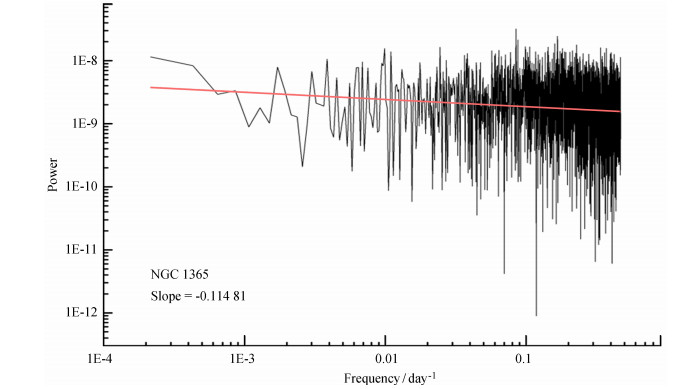
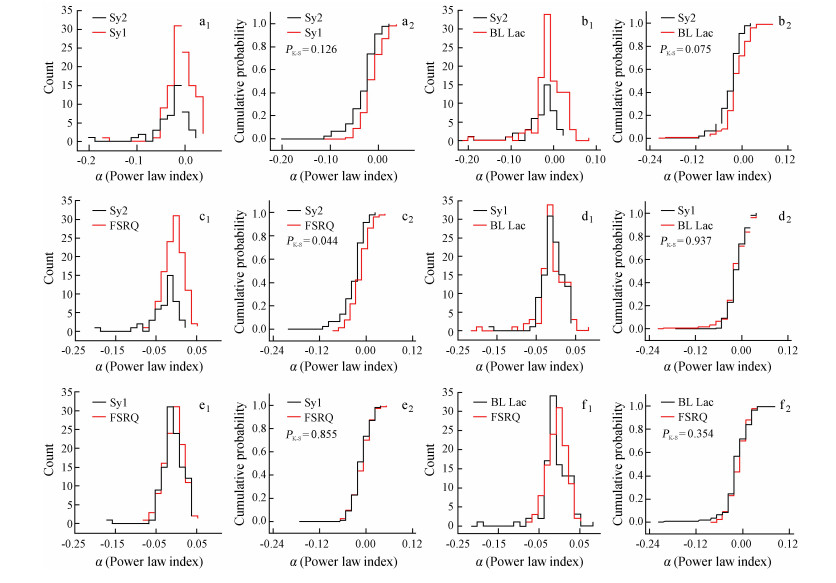
对这些源的光变曲线进行快速傅里叶变换(Fast Fourier transform, FFT),得到其功率谱如图 1(以NGC 1365为例),再通过线性拟合得到每个源的幂律指数(α),并对这些不同类型源的幂律指数进行统计分析,结果如图 2。
|
| 图 1 NGC 1365功率谱在对数坐标中的线性拟合,拟合所得斜率(slope)即幂律指数α Fig. 1 Linear fitting diagram of power spectrum of NGC 1365 in logarithmic coordinates, and the power law index (α) is a slope of fitting |
|
| 图 2 第1、3列是幂律指数分布,第2、4列是累积概率分布 Fig. 2 The first and third columns are the power law index distributions for subclasses of AGNs, and the second and fourth columns are the cumulative probability distributions |
分别将活动星系核的4个子类的幂律指数统计分布图进行比较:Ⅱ型塞弗特星系(Sy2)和Ⅰ型塞弗特星系(Sy1),Ⅱ型塞弗特星系和蝎虎天体,Ⅱ型塞弗特星系和平谱射电类星体,Ⅰ型塞弗特星系和蝎虎天体,Ⅰ型塞弗特星系和平谱射电类星体,蝎虎天体和平谱射电类星体;再将各子类的幂律指数累积归一化图进行比较,其比较结果如图 2,左边是幂律指数统计分布对比图,右边是幂律指数累积归一化对比图。
用柯尔莫哥洛夫-斯米尔诺夫检验(Kolmogorov-Smirnov test, K-S test)判断这两种分布的差异性,结果如表 2。
| K-S test between subclasses | Statistic | p-value | Significant level | Panel of Fig. 2 |
| Seyfert 2 vs Seyfert 1 | 0.200 | 0.127 | High | a1 |
| Seyfert 2 vs BL Lac | 0.220 | 0.075 | High | b1 |
| Seyfert 2 vs FSRQ | 0.233 | 0.044 | High | c1 |
| Seyfert 1 vs BL Lac | 0.072 | 0.937 | Low | d1 |
| Seyfert 1 vs FSRQ | 0.079 | 0.855 | Low | e1 |
| BL Lac vs FSRQ | 0.122 | 0.354 | Ordinary | f1 |
由以上结果可知,差异性非常显著的有Ⅰ型塞弗特星系和Ⅱ型塞弗特星系、平谱射电类星体和Ⅱ型塞弗特星系、蝎虎天体和Ⅱ型塞弗特星系;差异性一般显著的有蝎虎天体和平谱射电类星体;差异性不太显著的有蝎虎天体和Ⅰ型塞弗特星系、平谱射电类星体和Ⅰ型塞弗特星系。
3 结论与讨论本文主要收集了381个活动星系核,对这些活动星系核的硬X射线观测数据的光变曲线进行快速傅里叶变换分析,统计活动星系核各子类的功率谱幂律指数分布情况,用K-S检验判断其差异显著性,分析结果如表 2,Ⅱ型塞弗特星系这类有尘埃环遮挡的Ⅱ型活动星系核与蝎虎天体、平谱射电类星体、Ⅰ型塞弗特星系这类没有尘埃环遮挡的Ⅰ型活动星系核差异性显著。
活动星系核的硬X射线辐射的能谱成份很复杂,主要有两种可能的来源:(1)喷流,例如耀变体具有相对论性喷流且喷流视角较小,因此集束效应较强,观测到的辐射主要来自于喷流;(2)吸积盘的内区及热冕[18-19](例如塞弗特星系)。活动星系核的X射线辐射是喷流主导还是冕主导的,会呈现不同的辐射特征。实际观测的硬X射线辐射流量多是两者的混合,不同类型的活动星系核可能有不同的混合比例。塞弗特星系作为活动星系核的低光度子类,它的盘冕模型表明,吸积盘中的软光子在冕区被热康普顿散射而转化为更高能量的X射线光子,这个过程很好地解释了塞弗特星系的X射线光谱能用一个幂律谱拟合的现象。最近的研究也表明,活动星系核冕中的X射线辐射是中等程度各向异性的, 这表明冕的形状是两极突出的长条形,并且伴有外流(速度约为0.3~0.5倍光速)[20]。Ⅰ型塞弗特星系与Ⅱ型塞弗特星系的X射线辐射的差异可能主要是因为冕的各向异性而不是尘埃环的吸收,Ⅰ型塞弗特星系的硬X射线主要来自伴有外流的冕(Outflowing Coronae)[20]。在吸积率小于某个临界值(10-6倍爱丁顿吸积率)的低光度活动星系核的X射线辐射更可能来自喷流而不是径移主导的吸积流(Advection-Dominated Accretion Flow, ADAF)[21]。根据活动星系核统一模型,一般而言,Ⅰ型活动星系核的硬X射线辐射来自相对论性自喷流或者伴有外流的冕,具有各向异性;而Ⅱ型活动星系核的硬X射线辐射来自吸积盘的热冕, 且有吸收。
因此,硬X射线光变曲线的功率谱幂律指数的分布差异可以这样解释:来自相对论性喷流或者外流冕的硬X射线因为多普勒效应而在统计上有更大的幂律指数(α),而来自吸积盘热冕的硬X射线幂律指数较小。可以把硬X射线光变幂律指数(α)的分布特征差异作为活动星系核Ⅰ型和Ⅱ型分类统计上的新判据。
| [1] | URRY C M, PADOVANI P. Unified schemes for radio-loud active galactic nuclei[J]. Publications of the Astronomical Society of the Pacific, 1995, 107: 803–845. DOI: 10.1086/133630 |
| [2] | 黄克谅. 类星体与活动星系核[M]. 北京: 中国科学技术出版社, 2005. |
| [3] | SOLDI S, BECKMANN V, BAUMGARTNER W H, et al. Long-term variability of AGN at hard X-rays[J]. Astronomy & Astrophysics, 2014, 563: article id. 57(16pp). |
| [4] | HAARDT F, MARASCHI L. X-ray spectra from two-phase accretion disks[J]. The Astrophysical Journal, 1993, 413(2): 507–517. |
| [5] | MCHARDY I, LAWSON A, NEWSAM A, et al. Simultaneous X-ray and infrared variability in the quasar 3C273-Ⅱ. confirmation of the correlation and X-ray lag[J]. Monthly Notices of the Royal Astronomical Society, 2007, 375(4): 1521–1527. DOI: 10.1111/j.1365-2966.2006.11420.x |
| [6] | ARÉVALO P, MCHARDY I M, SUMMONS D P. X-ray variability of the Seyfert 1 Markarian 335:power spectrum and time lags[J]. Monthly Notices of the Royal Astronomical Society, 2008, 388(1): 211–218. DOI: 10.1111/j.1365-2966.2008.13367.x |
| [7] | CZERNY B, NIKOLAJUK M, PIASECKI M, et al. Black hole masses from power density spectra:determinations and consequences[J]. Monthly Notices of the Royal Astronomical Society, 2001, 325(2): 865–874. DOI: 10.1046/j.1365-8711.2001.04522.x |
| [8] | MCHARDY I M, KOERDING E, KNIGGE C, et al. Active galactic nuclei as scaled-up galactic black holes[J]. Nature, 2006, 444: 730–732. DOI: 10.1038/nature05389 |
| [9] | UTTLEY P, MCHARDY I M. X-ray variability of NGC 3227 and 5506 and the nature of active galactic nucleus 'states'[J]. Monthly Notices of the Royal Astronomical Society, 2005, 363(2): 586–596. DOI: 10.1111/j.1365-2966.2005.09475.x |
| [10] | SOLDI S, TÜRLER M, PALTANI S, et al.The multiwavelength variability of 3C 273[J]. Astronomy and Astrophysics, 2008, 486: article id. 411(16pp). |
| [11] | BELL M E, TZIOUMIS T, UTTLEY P, et al. X-ray and radio variability in the low-luminosity active galactic nucleus NGC 7213[J]. Monthly Notices of the Royal Astronomical Society, 2011, 411: 402–410. DOI: 10.1111/j.1365-2966.2010.17692.x |
| [12] | ZOGHBI A, FABIAN A C, UTTLEY P, et al. Broad iron L-line and X-ray reverberation in 1H0707-495[J]. Monthly Notices of the Royal Astronomical Society, 2010, 401: 2419–2432. DOI: 10.1111/j.1365-2966.2009.15816.x |
| [13] | CABALLERO-GARCIA M D, PAPADAKIS I E, AJELLO M, et al. Hard X-ray spectral variability of the brightest Seyfert AGN with SWIFT/BAT[C]//Proceedings of the X-ray Universe 2011.2011. |
| [14] | UTTLEY P, MCHARDY I M, PAPADAKIS I E. Measuring the broad-band power spectra of active galactic nuclei with RXTE[J]. Monthly Notices of the Royal Astronomical Society, 2002, 332(1): 231–250. DOI: 10.1046/j.1365-8711.2002.05298.x |
| [15] | PAPADAKIS I E. The scaling of the X-ray variability with black hole mass in active galactic nuclei[J]. Monthly Notices of the Royal Astronomical Society, 2004, 348(1): 207–213. DOI: 10.1111/j.1365-2966.2004.07351.x |
| [16] | SHIMIZU T T, MUSHOTZKY R F. The first hard X-ray power spectral density functions of active galactic nucleus[J]. The Astrophysical Journal, 2013, 770(1): article id. 60(21pp). |
| [17] | GHISELLINI G. The blazar's divide and the properties of Fermi blazars[C]//Proceedings of ASP Conference Series. 2009. |
| [18] | KAMRAJ N, FABIAN A, LOHFINK A, et al. Probing the physical properties of the corona in accreting black holes[J]. Bulletin of the American Astronomical Society, 2019, 51(3): article id. 126(8pp). |
| [19] | ANTONUCCI R. Unified models for active galactic nuclei and quasar[J]. Annual Review of Astronomy and Astrophysics, 1993, 31(1): 473–521. DOI: 10.1146/annurev.aa.31.090193.002353 |
| [20] | LIU T, WANG J X, YANG H, et al. Are X-ray emitting coronae around supermassive black holes outflowing?[J]. The Astrophysical Journal, 2014, 783(2): article id. 106(14PP). |
| [21] | YUAN F, YU Z L, HO L C. Revisiting the "fundamental plane" of black hole activity at extremely low luminosities[J]. The Astrophysical Journal, 2009, 703(1): 1034–1043. DOI: 10.1088/0004-637X/703/1/1034 |