


星系中心普遍存在超大质量的黑洞[1, 2, 3]。观测发现星系中超大质量黑洞的质量MBH与星系核球速度弥散σ或者星系核球质量Mb之间存在紧致关系,即MBH-σ关系或MBH-Mb关系[2, 4, 5, 6, 7, 8, 9, 10, 11, 12]。这种紧致关系预示着超大质量黑洞与星系相互影响共同演化。人们一般采用活动星系核反馈机制解释MBH-σ(或MBH-Mb)关系。活动星系核反馈机制包括能量驱动反馈机制[13, 14]和动量驱动反馈机制[15, 16, 17]。能量驱动反馈是指黑洞吸积释放的总能量能够有效地转移为星系中气体整体的热能或动能,并足以使这些气体摆脱星系束缚而逃出星系,这一机制可导致MBH∝σ5。动量反馈则是指由黑洞吸积导致的风或外流将动量传递给周围气体,并扫除这些气体从而终止了黑洞吸积和星系成长,并预言MBH∝σ4。目前尚不清楚活动星系核反馈究竟是能量还是动量反馈机制主导以及反馈机制的具体微观物理过程。
根据星系的黑洞质量和速度弥散测量,文[1]采用等温球模型研究活动星系核反馈的有效性。他们估计了气体从星系中逃出时所需的能量约为Mgcσ(c和Mg分别为光速和星系中气体的总质量),并将其与黑洞吸积释放的总能量ηMBHc2(η=0.1为质能转换或辐射效率)进行对比,发现单纯由黑洞吸积形成的风可能不足以将星系中气体全部吹出星系。因此活动星系核的反馈可能无效。
文[1]采用等温球模型描述星系的质量密度分布和势场分布。等温球分布在靠近星系核球中心位置密度与实际星系的密度分布相比过高,而且在星系外边界密度并不收敛。因而文[1]可能过高地估计了气体的逃逸速度ve(r)。另外文[1]采用(res-r)/ve(res)(res为气体逃逸半径)估计气体逃逸时标τ时,过高估计了气体的逃逸时标。由于星系中气体的逃逸速度随星系中心的距离降低,因而文[1]有可能过高估计了气体逃出活动星系核所需的时间以及所需的能量。总之,对于文[1]计算的ηMBHc2/Mgcσ<1,其核活动的反馈相应未必真的无效。为解释此问题,收集了一个星系样本,每一个样本星系有观测给出的面亮度分布数据。根据这些观测可以得到星系的密度分布轮廓,并估计星系的寄主暗物质晕质量及暗物质密度分布和星系势场。利用这些密度分布,重新考虑了在这些样本星系中的动量反馈过程,并检验了动量反馈过程的有效性。
论文第1节引入观测样本以及有关星系面亮度分布的观测数据[8, 10, 11, 12, 18, 19, 20, 21, 22];第2节根据面亮度分布得到样本星系的物质密度分布,并估计暗物质晕的大小和密度分布;第3节重新考虑活动星系核动量反馈过程及其有效性;第4节探讨气体向外扩散时康普顿冷却对活动星系核反馈的影响;第5节讨论影响动量反馈有效性的几个因素;第6节得出结论。
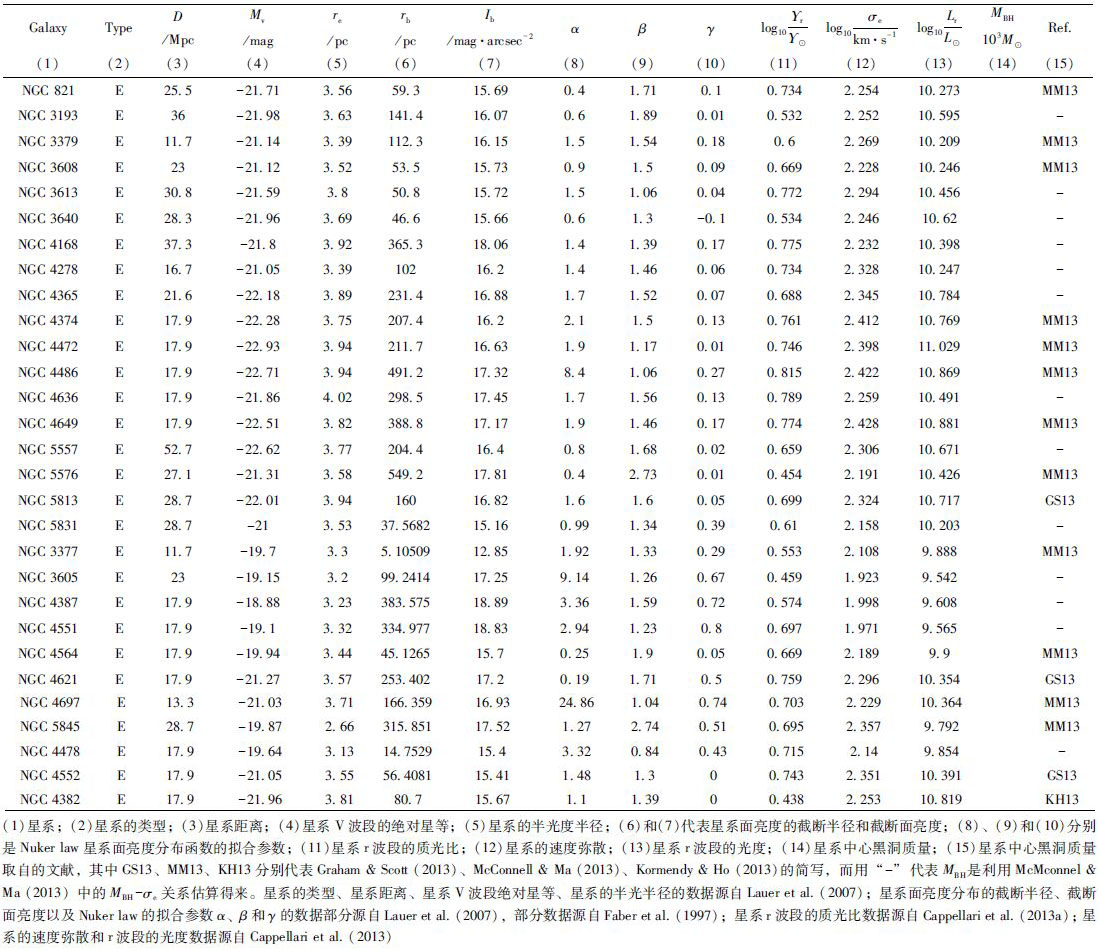
1 星系样本为检验活动星系核反馈的有效性,收集了29个星系的相关观测数据(表 1)。这29个星系核区部分(0.1″-10″)均由哈勃望远镜观测。哈勃观测的星系面亮度分布I(R)可以由Nuker law拟合,即

对于核区之外部分,星系的面亮度分布可以由de Vaucouleurs给出,即

为研究活动星系核反馈机制的有效性,需要知道星系中心黑洞的质量。表 1中一部分样本星系中心黑洞的质量直接来自测量值,而对于其它没有黑洞直接测量的样本星系则通过MBH-σ关系,即

星系内的物质包括星系中心的超大质量黑洞、恒星、气体和暗物质晕。若假设星系为球对称分布,除中心超大质量黑洞外,星系内的物质密度分布可表述为

星系的质量密度分布ρ*(r)可以通过对星系面亮度分布I作积分变换直接得到[23],即

表 1列出了面亮度分布Nuker law拟合参数,它们是通过对V波段的数据拟合得到。为计算ρ*(r),需要有V波段的质光比ΥV,文[20]给出的r波段的质光比Υr,将其转换成V波段的质光比ΥV,即ΥV=ΥrLr10(4.83-MV)/2.5,式中,Lr是星系r波段的光度;MV是V波段的绝对星等(相关数据在表 1中列出)。定义包含星系总光度的95%位置为星系的外半径R0,即


星系的暗物质质量密度分布一般可以由Nav-arro-Frenk-White(NFW)密度轮廓给出[24],即
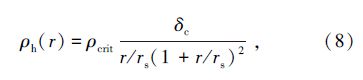
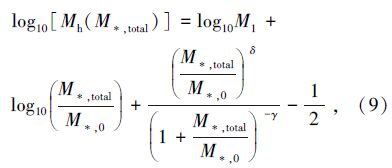
 ,参量cs为聚度,r200为暗物质晕的维里半径。根据文[25],cs=A${\left( {{{{M_{\rm{h}}}} \over {{M_{{\rm{pivot}}}}}}} \right)^B}$,这里Mpivot、A和B分别为2×10¹²h-1M⊙、5.74和-0.097;Mh为星系寄主暗物质晕的质量。单个星系的寄主暗物质晕的质量不容易得到,表 1中大多数星系的暗物质晕的质量无准确测量。采用星系的恒星总质量(M*,total)与其寄主暗物质晕(Mh)之间的关系[26]估计Mh,即
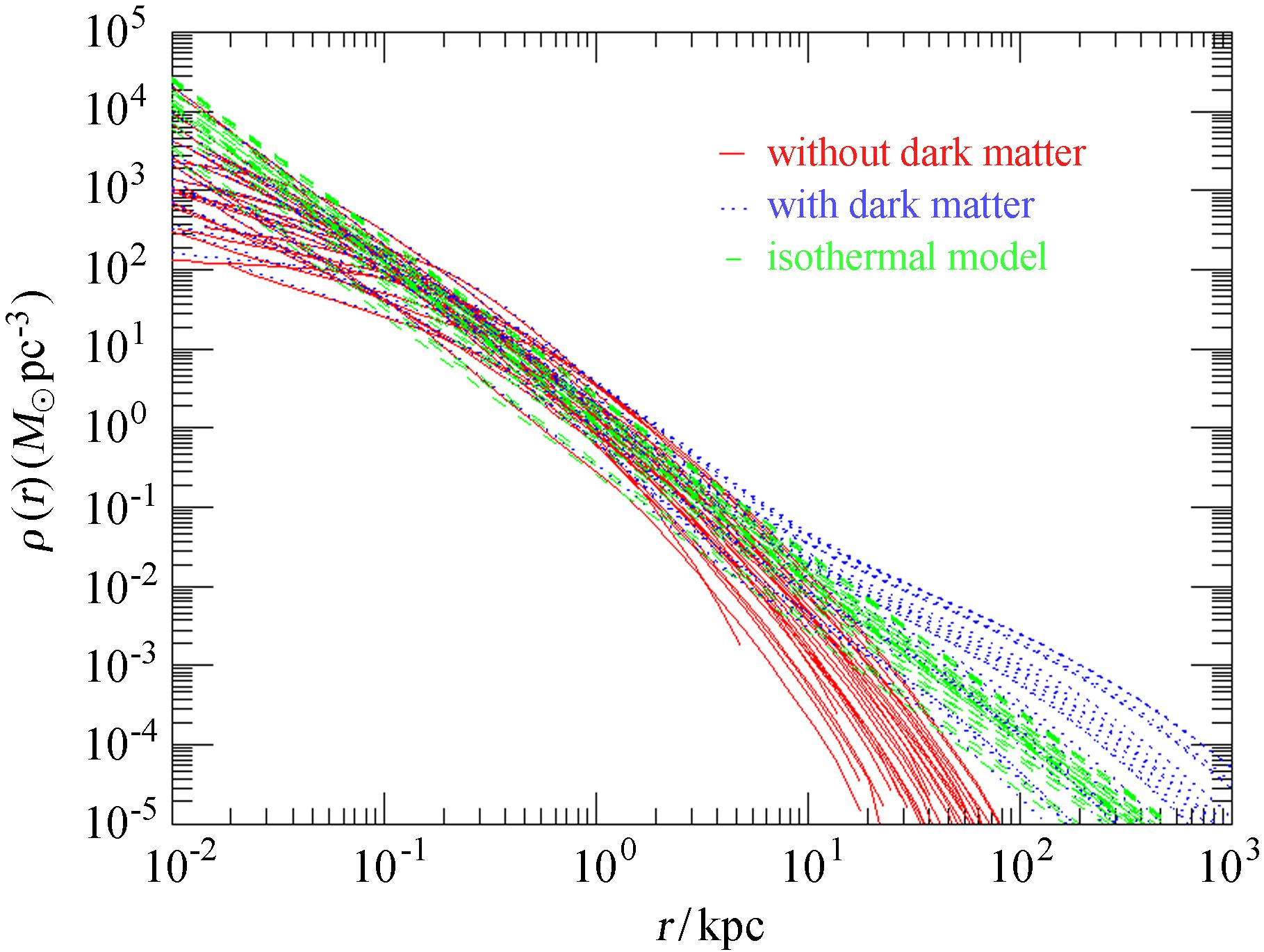
采用上述设定,根据(5)式和(8)式得到恒星质量密度随半径r的分布ρ*(r)和恒星与暗物质总质量密度随半径r的分布ρ(r)。图 1展示了恒星质量密度分布ρ*(r),包括暗物质星系质量密度分布ρ(r)以及等温球模型下星系的质量密度分布ρiso(r)。由图 1可知,在离星系中心几个kpc之内暗物质对星系的质量贡献不大,但超过10 kpc后星系中的暗物质开始占主导。此外,等温球模型下星系的质量密度分布为ρiso(r)=${{\sigma _{\rm{s}}^2} \over {2\pi G{r^2}}}$,采用等温球模型描述星系质量密度分布,则如图 1中红色实线。在靠近星系中心处,等温球模型给出星系质量密度过高,由等温球密度分布可知,在星系的外边界密度并不收敛。
|
| 图 1 星系质量密度分布。红色实线代表星系的恒星质量密度分布,蓝色点线代表包括恒星和暗物质质量密度分布,绿色虚线代表等温球模型下星系质量密度分布 Fig. 1 Density profiles for those galaxies in Table 1. The red solid lines represent the model only considering stellar mass,the blue dotted lines represent those considering both stellar mass and dark matter mass,and the green dashed lines represent the profiles given by the isothermal model |
根据星系及其寄主暗物质晕的质量密度分布可以得到它们的势场分布[23]:

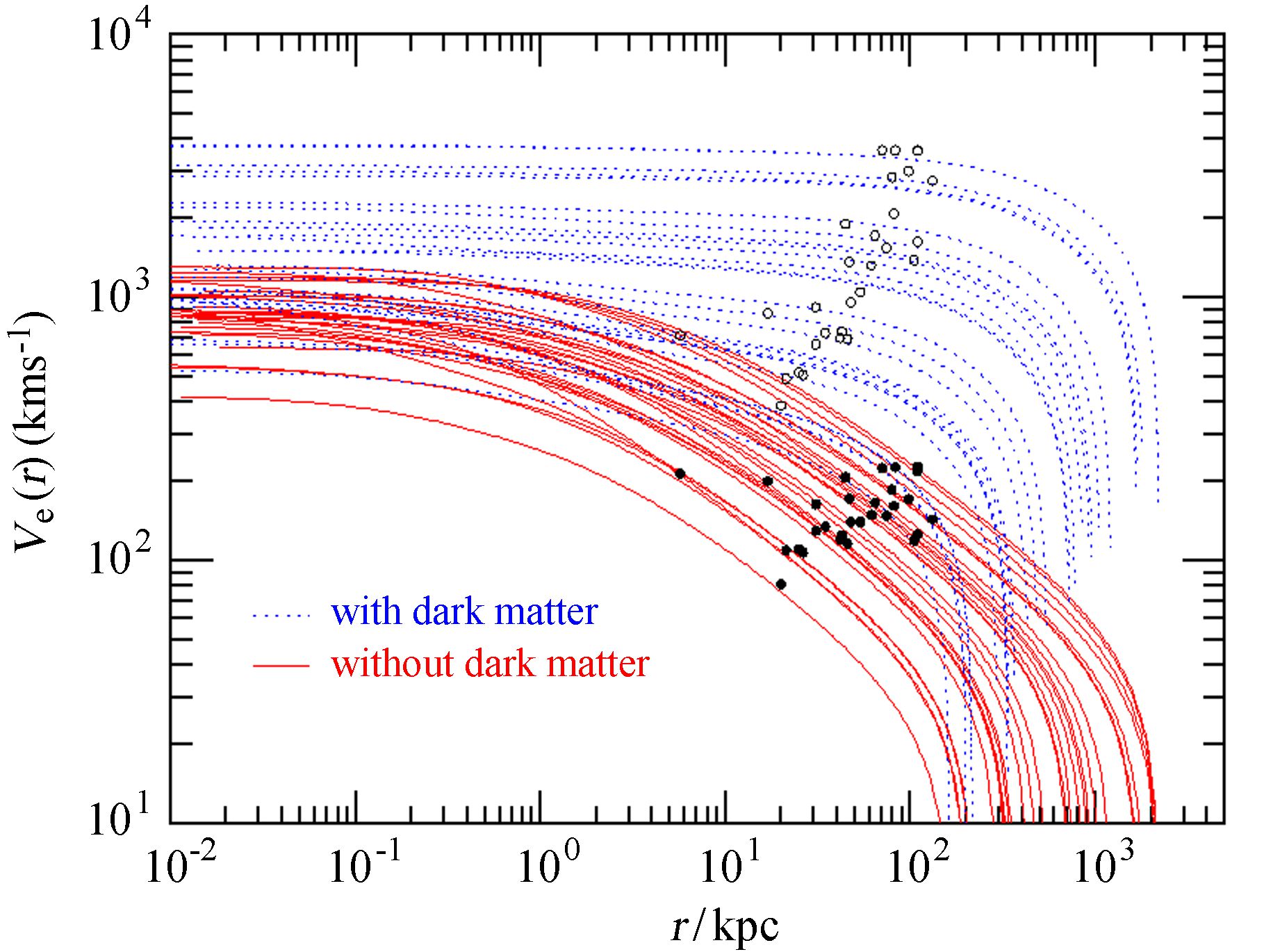
图 2展示了只考虑恒星物质或考虑暗物质晕的情况下,星系中不同位置r处的气体或粒子的逃逸速度ve(r),以及这两种情况下星系外半径R0处的逃逸速度ve(R0)。由图 2可知,当考虑星系周围暗物质晕时,星系气体的逃逸速度更大,即气体要摆脱星系和暗物质晕的束缚更加困难。
|
| 图 2 星系中气体或粒子的逃逸速度随半径的分布。红色实线和蓝色点线分别代表只考虑恒星物质和考虑恒星物质和暗物质的情况;黑色实心点和黑色空心点分别代表只考虑恒星物质和考虑恒星物质及其寄主暗物质晕的情况,星系外半径R0处的逃逸速度 Fig. 2 Escape velocitiesat different radii. The blue dotted lines show the results obtained by considering both the contribution from the stars and the dark matter halo to the potential,and the red solid lines show the results obtained by only considering the contribution of the stars to the potential. The open (Full) circles represent escape velocities at the galaxy outer boundary R0 by considering both stars and dark matter halo (or only stars) |
动量反馈可能是导致MBH-σe关系的主导机制[16, 17]。由于核活动性输出的动量~fpL(t)/c(或动能)会将星系核心处和星系中的气体挤压至气体壳层(r→r+dr)并向外驱离此气体壳层,这里L(t)是活动星系核的光度,观测表明fp为量级在1左右的常数因子[28],标志外流的动量输出与辐射光子总动量间的比例。若只考虑恒星物质的影响,根据动量守恒定律可有


星系一般存在于暗物质晕之中,若考虑暗物质晕对气体的引力束缚作用,上述动量方程则应替换为


采用两种光度随时间演化的形式求解(12)式和(14)式。其一是假设L(t)不随时间演化,取L(t)=LEdd(MBH)=4πGcμempMBH/σT,LEdd为最大光度极限爱丁顿光度(假设气体全部电离的情况),μe=1.15[29]为质子相对电子的个数(取星系中气体成分比例为原初比例,即氢占76%,氦占24%。当然其他元素也会影响平均分子量,但由于其他元素的比例较低,直接略去),mp为质子质量,σT电子散射截面。若中心黑洞为克尔黑洞,则活动星系核活动性持续一个Salpeter时标,为τs=${{{M_{{\rm{BH}}}}{c^2}} \over {{L_{{\rm{Edd}}}}}}{\varepsilon \over {1 - \varepsilon }}$,ε为辐射效率。观测给出辐射效率在0.1左右,因此τs≃4.3×10⁷ yr;若中心黑洞为快速旋转的克尔黑洞,且自旋参量取为0.998[30],则τs≃1.7×10⁸ yr。其二假设L(t)随时间指数变化L(t)=LEdd(MBH,0)${e^{{{t - {t_0}} \over {{\tau _{\rm{s}}}}}}}$(这里MBH,0为今天黑洞质量; t0为核活动终止时的宇宙学时间),由于黑洞质量通过吸积过程获得[31],因此,取t∈(-τs+t0,t0)。通过数值计算得出活动星系核演化一个周期后星系中气体壳层的速度vf与气体壳层的逃逸速度ve(rf),将两者作对比能够反映每个星系动量反馈的强弱。
求解(12)式和(14)式得出部分星系中气体能够克服恒星(或包括暗物质晕)的引力束缚所能达到的速度vf和能够到达的位置rf。核活动触发后星系中气体外流,样本星系中部分星系的活动星系核单位时间内输出的动量大于气体受到来自恒星(或包括暗物质)的引力束缚,气体动量会一直增加,当核活动终止时,有些星系气体已成功地逃出星系束缚(rf>R0)(或暗物质晕的维里半径rf>rvir);部分星系的气体动量先增加,活动星系核演化到一定时间,单位时间内来自中心引擎的动量小于来自恒星(或包含暗物质)的引力束缚时,气体动量减少。这些星系中有些在核活动终止时,气体外流的速度vf依然大于气体的逃逸速度ve(rf),气体就能够成功地摆脱星系的束缚,但是这些星系中有些能够逃出恒星的束缚,却逃不出来自暗物质晕的引力束缚。还有部分星系在核活动未终止前,气体壳层已经减速到0,停止向外扩散。
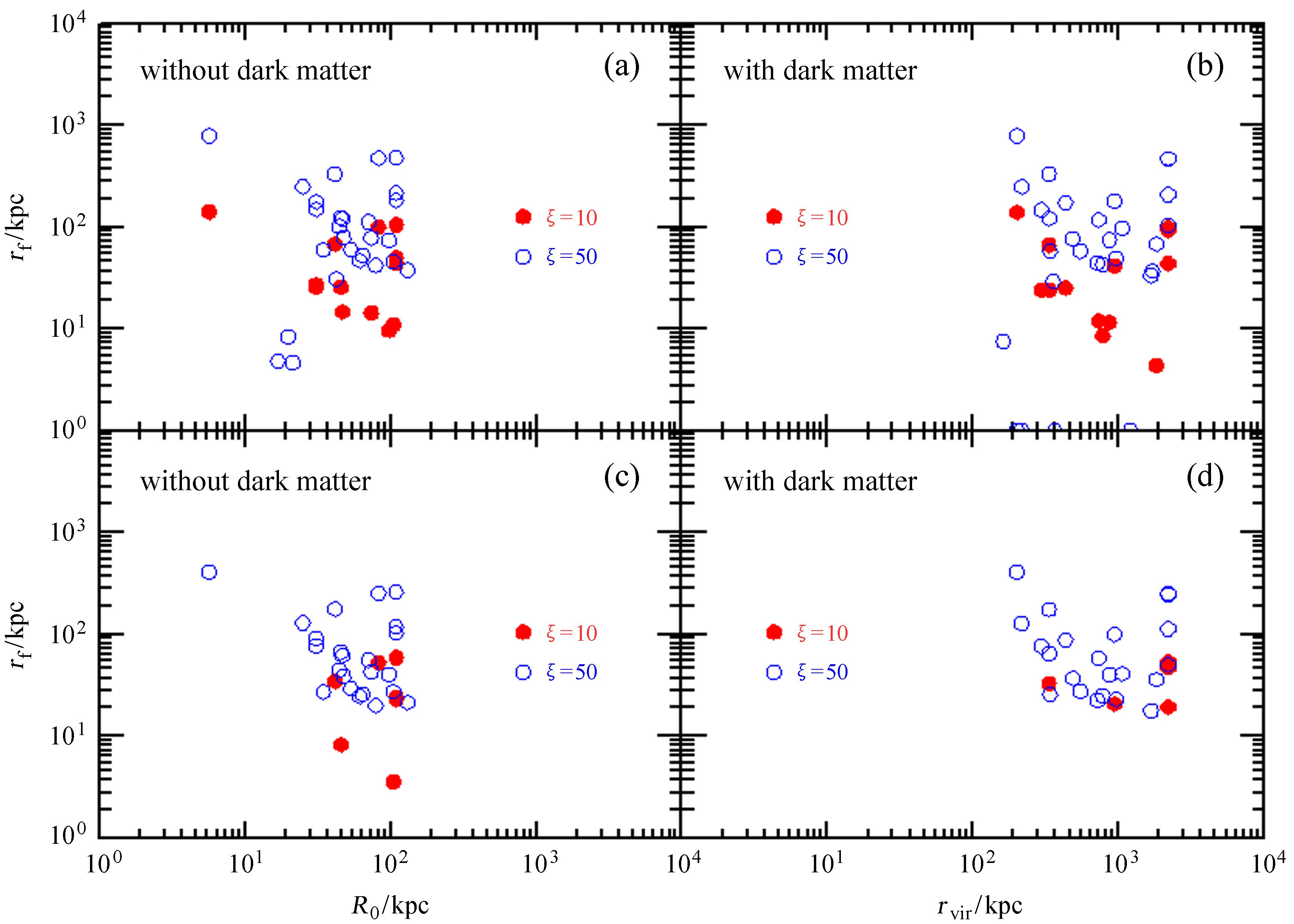
图 3展示了核活动终止时,星系的尺度R0或暗物质晕的维里半径rvir与气体壳层到达的位置rf之间的关系,图中只展示了核活动终止后气体外流速度vf不为0的星系。
|
| 图 3 核活动终止时,气体壳层到达位置。假定L(t)=LEdd(MBH)=const,(a)为只考虑恒星物质影响,(b)为考虑恒星物质和暗物质晕共同影响情况下的结果;假定LEdd(MBH,0)${e^{{{t - {t_0}} \over {{\tau _{\rm{s}}}}}}}$,(c)为只考虑恒星物质影响,(d)为考虑恒星物质和暗物质晕共同影响情况下的结果;图中蓝色空心圆点和红色实心圆点分别代表取ξ=50 (例如fp=5,fg=0.1,或fp=1,fg=0.02)和ξ=10 (例如fp=1,fg=0.1)情况下的结果 Fig. 3 The position of the gas shell at the time when the nuclear activity is quenched (rf). Under the Assumption of L(t)=LEdd(MBH)=const,the panel (a) shows the results obtained by only considering the contribution of the stars to the potential,the panel (b) shows the results obtained by considering both contributions from the stars and dark matter to the potential. Under assumption of LEdd(MBH,0)${e^{{{t - {t_0}} \over {{\tau _{\rm{s}}}}}}}$,the panel (c) shows the results by considering only the contribution of the stellar mass to the potential,and the panel (d) shows the results by considering both contributions from the stars and dark matter to the potential. The red dots represent the results by ξ=10 (fP=1 and fg=0.1) b,and the open blue circles represent the results by ξ=50 (fp=5,fg=0.1,or fp=1 and fg=0.02) |
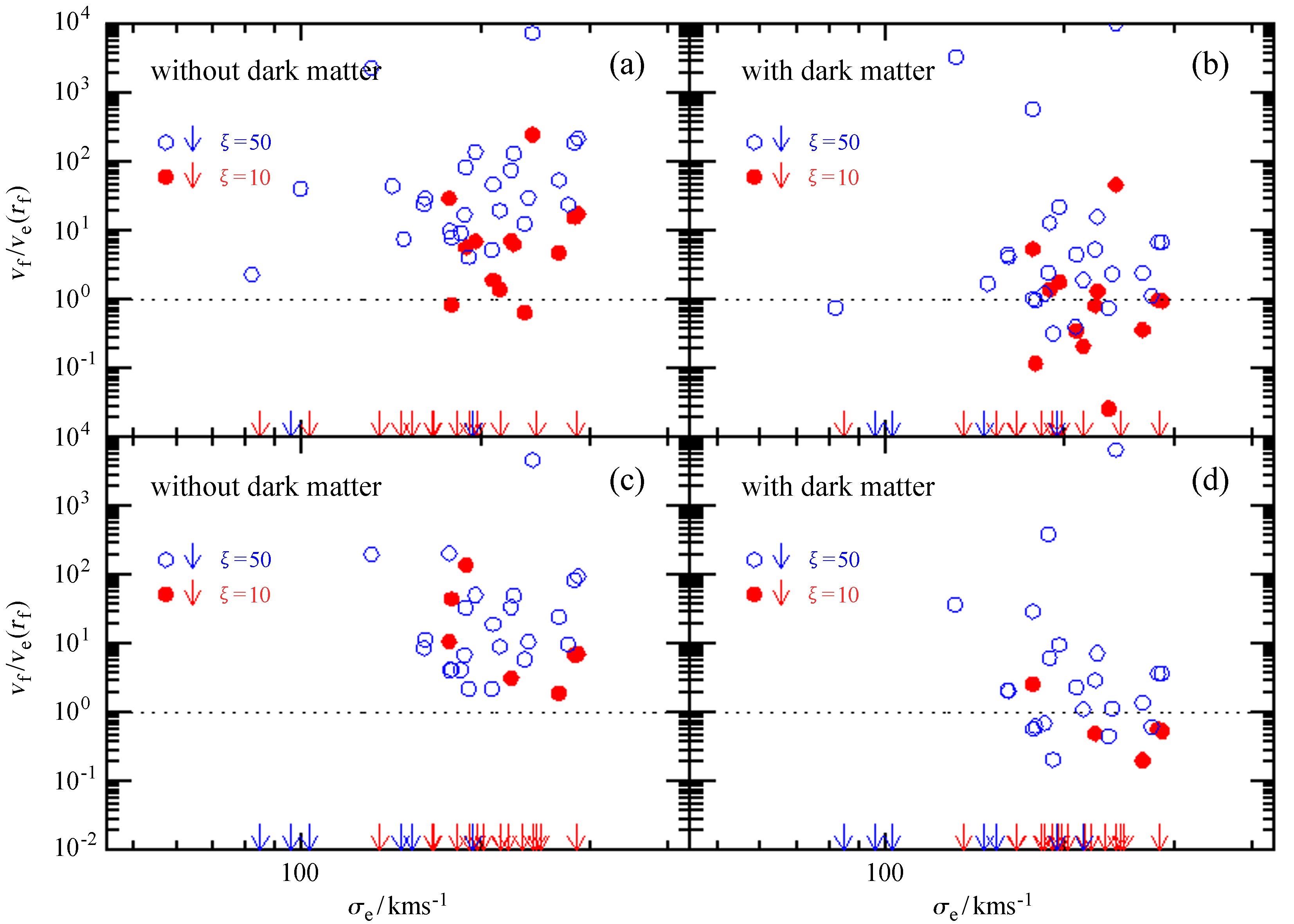
图 4展示了核活动终止时,气体壳层达到的速度vf与其所在位置rf处的逃逸速度ve(rf)的比值。利用核活动终止后气体壳层的速度vf与气体所在位置rf处逃逸速度ve(rf)的比值反映星系动量反馈的有效性,即vf/ve(rf)越大,活动星系核动量反馈越明显。图 4(a)可知,只考虑恒星物质影响的情况下,核活动终止时,假定L(t)=LEdd(MBH)=const,ξ=10的情况下,样本星系中有11/29星系的气体壳层vf>ve(rf),其中有3个星系的气体壳层rf>R0;ξ=50的情况下,样本星系中有27/29星系的气体壳层vf>ve(rf),其中有15个星系的气体壳层rf>R0,有1个星系的气体壳层rf>rvir。图 4(c)可知,只考虑恒星物质影响的情况下,假定LEdd(MBH,0)${e^{{{t - {t_0}} \over {{\tau _{\rm{s}}}}}}}$,ξ=10的情况下,样本星系中有7/29星系的气体壳层vf>ve(rf);ξ=50的情况下,样本星系中有23/29星系的气体壳层vf>ve(rf),其中有9个星系的气体壳层rf>R0,有1个星系的气体壳层rf>rvir。这些星系的气体壳层vf>ve(rf),意味着这些星系的气体能够成功逃出星系,动量反馈有效。由上述结果对比可知,动量反馈导致星系外流的速度与辐射光子总动量的比值fp,以及星系中气体质量与恒星质量的比值fg有很强的依赖性。
|
| 图 4 核活动终止时,气体壳层外流速度与其所在处逃逸速度的比值。假定L(t)=LEdd(MBH)=const,(a)为只考虑恒星物质影响,(b)为考虑恒星物质和暗物质晕共同影响情况下的结果;假定L(t)=LEdd(MBH,0)${e^{{{t - {t_0}} \over {{\tau _{\rm{s}}}}}}}$,(c)为只考虑恒星物质影响,(d)为考虑恒星物质和暗物质晕共同影响情况下的结果;图中蓝色空心圆点和红色实心圆点分别代表取ξ=50 (例如fp=5,fg=0.1,或fp=1,fg=0.02)和ξ=10 (例如fp=1,fg=0.1)情况下的结果。图中蓝色和红色向下的箭头代表在核活动未终止前,气体壳层已停止向外扩散的星系 Fig. 4 The ratio of the outflow velocity vf to the escape velocity ve(rf) at the time when the nuclear activity is quenched. Under the assumption of L(t)=LEdd(MBH)=const,the panel (a) shows the results obtained by only considering the contribution of the stars to the potential,and the panel (b)shows the results obtained by considering both contributions from the stars and dark matter to the potential. Under the assumption of L(t)=LEdd(MBH,0)${e^{{{t - {t_0}} \over {{\tau _{\rm{s}}}}}}}$ the panel (c) shows the results by considering only the contribution of the stellar mass to the potential,and the panel (d) shows the results by considering both contributions from the stars and dark matter to the potential. The red dots represent the results by ξ=10 (fp=1 and fg=0.1),and the open blue circles represent the results by ξ=50 (fp=5,fg=0.1,or fp=1 and fg=0.02). The red (blue) down arrows represent the galaxies at which the velocities of gas shell are zero before their nuclear activities quenched |
在气体壳层向外扩散的过程中,文[16]指出康普顿冷却对气体壳层的影响可能很重要。冷却非常迅速就有可能导致气体停止向外扩散,当气体壳层向外扩散时会产生激波而被加热,热电子与光子发生康普顿散射,光子吸收电子的能量,使得气体冷却。康普顿散射导致气体冷却的时标为



核活动演化到t时刻,若对应的康普顿冷却时标tc(t)远小于核活动时标,则气体会被有效地冷却,气体的动量和能量将最终以光子的形式释放,使气体无法逃出星系;反之,若tc(t)远大于核活动时标甚至Hubble年龄,则气体不能被有效冷却,将继续向外扩散,最终当核活动终止时,若气体壳层的速度vf大于逃逸速度ve(rf)时,气体就能够逃出星系。
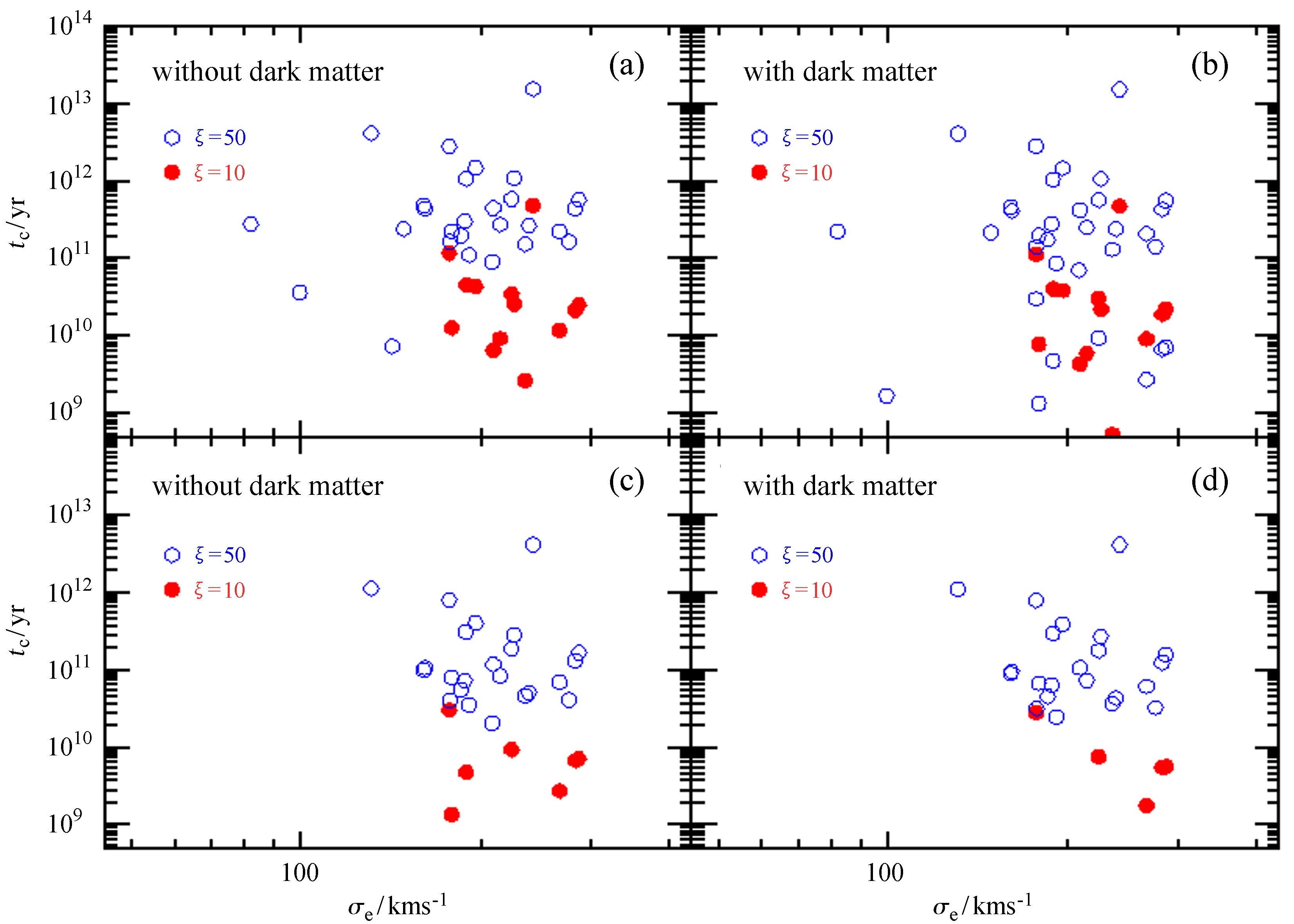
图 5展示了核活动终止时,被激波加速气体外流的冷却时标tc。由图 5可知,核活动终止后部分星系中的气体能够逃出星系的束缚,其康普顿冷却时标tc远大于活动星系核演化时标τs,康普顿冷却对这部分星系的动量反馈过程无影响。
|
| 图 5 核活动终止时,气体壳层激波加热后康普顿冷却时标。假定L(t)=LEdd(MBH)=const,(a)为只考虑恒星物质影响,(b)为考虑恒星物质和暗物质晕共同影响情况下的结果;假定L(t)=LEdd(MBH,0)${e^{{{t - {t_0}} \over {{\tau _{\rm{s}}}}}}}$,(c)为只考虑恒星物质影响,(d)为考虑恒星物质和暗物质晕共同影响情况下的结果;图中蓝色空心圆点和红色实心圆点分别代表取ξ=50 (例如fp=5,fg=0.1,或fp=1,fg=0.02)和ξ=10 (例如fp=1,fg=0.1)情况下的结果 Fig. 5 The compton cooling timescales of the chock heated gas shell at the time when the nuclear activity is quenched. Under the assumption of L(t)=LEdd(MBH)=const,the panel (a) shows the results obtained by only considering the contribution of the stars to the potential,and the panel (b) shows the results obtained by considering both contributions from the stars and dark matter to the potential. Under assumption of L(t)=LEdd(MBH,0)${e^{{{t - {t_0}} \over {{\tau _{\rm{s}}}}}}}$ the panel (c) shows the results by considering only the contribution of the stellar mass to the potential,and the panel (d) shows the results by considering both contributions from the stars and dark matter to the potential. The red dots represent the results by ξ=10 (fp=1 and fg=0.1),and the open blue circles represent the results by ξ=50 (fp=5,fg=0.1,or fp=1 and fg=0.02) |
引入星系的观测数据,重新考虑了动量反馈的过程。第4节中利用核活动终止后气体壳层的速度vf与气体所在位置rf处逃逸速度ve(rf)的比值反映星系动量反馈的有效性,即vf/ve(rf)越大,活动星系核动量反馈越明显。研究了星系中气体质量与恒星质量之比fg,外流动量输出与辐射光子总动量的比值fp以及星系周围的暗物质晕的引力束缚对星系动量反馈有效性的影响。下面讨论星系周围暗物质晕对动量反馈有效性的影响。由图 4(b)可知,考虑恒星物质和暗物质晕共同影响情况下,核活动终止时,假定L(t)=LEdd(MBH)=const,ξ=10的情况下,样本星系中有7/29星系的气体壳层vf>ve(rf);ξ=50的情况下,样本星系中有21/29星系的气体壳层vf>ve(rf)。由图 4(d)可知,考虑恒星物质和暗物质晕共同影响情况下,假定L(t)=LEdd(MBH,0)${e^{{{t - {t_0}} \over {{\tau _{\rm{s}}}}}}}$,ξ=10的情况下,样本星系中仅有1/29星系的气体壳层vf>ve(rf);ξ=50的情况下,样本星系中有16/29星系的气体壳层vf>ve(rf),以上星系的动量反馈过程有效。对比图 4(a)可知,部分星系中的气体能够摆脱恒星的引力束缚却逃不出暗物质晕的引力束缚,核活动终止后,这些气体向外减速最终停在暗物质晕中,进而得出星系周围暗物质晕对动量反馈有效性可能有影响。
核活动终止后,样本星系中部分星系的气体能够逃出星系(或暗物质晕),部分星系中的气体在核活动尚未终止已经停止向外扩散,与前者对比,后者星系恒星总质量M*,total(或暗物质晕质量Mh)与中心黑洞的质量MBH比值偏大。因此有可能是黑洞质量估计偏小。考虑了黑洞的真实质量稍大于测量给出的中心值(例如为测量值再加上一个标准偏差)这一情况下的活动星系核的动量反馈。
图 6展示了取黑洞质量上限的情况下,核活动终止时,气体壳层达到的速度vf与其所在位置rf处的逃逸速度ve(rf)的比值。由图 6(a)知,只考虑恒星物质影响的情况下,假定L(t)=LEdd(MBH)=const,ξ=10的情况下,样本星系中有15/29星系动量反馈有效;ξ=50的情况下,全部样本星系动量反馈有效。由图 6(b)知,考虑恒星物质和暗物质晕共同影响的情况下,假定L(t)=LEdd(MBH)=const,ξ=10的情况下,样本星系中有8/29星系动量反馈有效;ξ=50的情况下,样本星系中有24/29星系动量反馈有效。由图 6(c)知,只考虑恒星物质影响的情况下,假定L(t)=LEdd(MBH,0)${e^{{{t - {t_0}} \over {{\tau _{\rm{s}}}}}}}$,ξ=10的情况下,样本星系中有8/29星系动量反馈有效;ξ=50的情况下,样本星系中有28/29星系动量反馈有效。由图 6(d)知,考虑恒星物质和暗物质晕共同影响的情况下,假定L(t)=LEdd(MBH,0)${e^{{{t - {t_0}} \over {{\tau _{\rm{s}}}}}}}$,ξ=10的情况下,样本星系中有3/29星系动量反馈有效;ξ=50的情况下,样本星系中有19/29星系动量反馈有效。此外,星系和其寄主暗物质晕的质量在活动星系核反馈作用发生时可能显著小于测量的质量,是由于星系和暗物质晕在核活动结束后通过并合或吸积成长至今有2~3倍[33]。
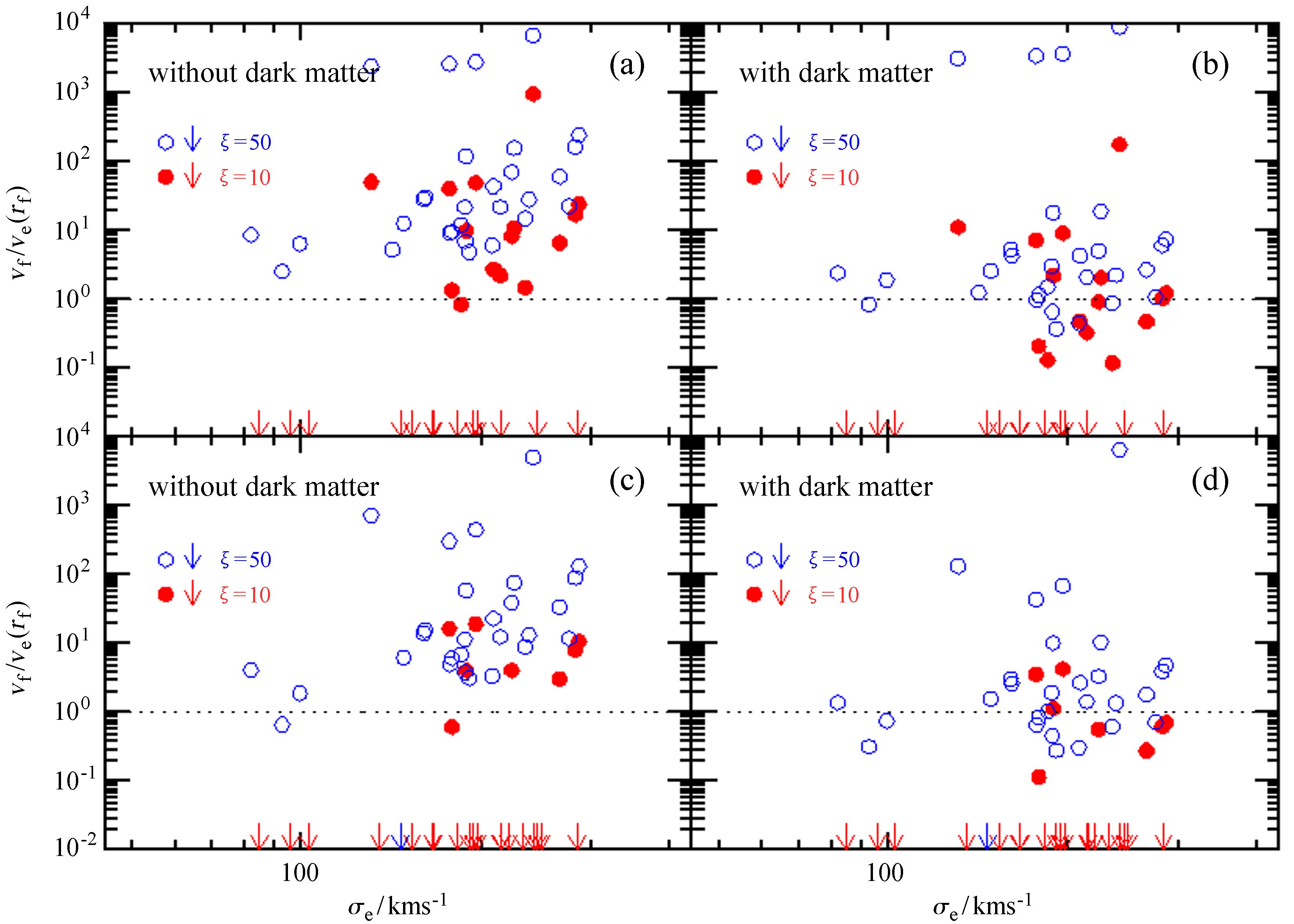
|
| 图 6 取黑洞质量为测量值再加上一个标准偏差,核活动终止时,气体壳层外流速度与其所在处逃逸速度的比值。假定L(t)=LEdd(MBH)=const,(a)为只考虑恒星物质影响,(b)为考虑恒星物质和暗物质晕共同影响情况下的结果;假定L(t)=LEdd(MBH,0)${e^{{{t - {t_0}} \over {{\tau _{\rm{s}}}}}}}$,(c)为只考虑恒星物质影响,(d)为考虑恒星物质和暗物质晕共同影响情况下的结果;图中蓝色空心圆点和红色实心圆点分别代表取ξ=50 (例如fp=5,fg=0.1,或fp=1,fg=0.02)和ξ=10 (例如fp=1,fg=0.1)情况下的结果。图中蓝色和红色向下的箭头代表在核活动未终止前,气体壳层已停止向外扩散的星系 Fig. 6 The ratio of the outflow velocity vf to the escape velocity ve(rf) at the time when the nuclear activity is quenched,where the black hole masses are taken as the measured value plus one standard deviation. Under the assumption of L(t)=LEdd(MBH)=const,the panel (a) shows the results obtained by only considering the contribution of the stars to the potential,and the panel (b) shows the results obtained by considering both contributions from the stars and dark matter to the potential. Under the assumption of L(t)=LEdd(MBH,0)${e^{{{t - {t_0}} \over {{\tau _{\rm{s}}}}}}}$,the panel (c) shows the results by considering only the contribution of the stellar mass to the potential,and the panel (d)shows the results by considering both contributions from the stars and dark matter to the potential. The red dots represent the results by ξ=10 (fp=1 and fg=0.1),and the open blue circles represent the results by ξ=50 (fp=5,fg=0.1,or fp=1 and fg=0.02). The red (blue) down arrows represent the galaxies in which the velocities of gas shell are zero before their nuclear activities quenched |
本文引入星系观测数据重构了星系的恒星质量密度分布和其寄主暗物质晕的密度轮廓,并据此重新考虑了动量反馈过程。研究并讨论了影响动量反馈有效性的几个因素,诸如星系中气体质量与恒星质量之比fg,外流动量输出与中心引擎辐射光子总动量之比fp以及星系周围的暗物质晕引力束缚的影响。发现动量驱动反馈机制在绝大多数星系演化过程中是有效的,从而修正了文[1]得到的动量反馈无效这一结果。
致谢:感谢陆由俊研究员在理论知识和数值计算方面的指导,以及在论文写作中的帮助。
| [1] | Silk J,Nusser A.The massive-black-hole-velocity-dispersion relation and the halo baryon fraction:a case for positive active galactic nucleus feedback[J].The Astrophysical Journal,2010,725:556-560. |
| [2] | Magorrian J,Tremaine S,Richstone D,et al.The demography of massive dark objects in galaxy centers[J].The Astronomical Journal,1998,115(6):2285-2305. |
| [3] | Richstone D,Ajhar E A,Bender R,et al.Supermassive black holes and the evolution of galaxies[J].Nature,1998,395(6701):A14-A19. |
| [4] | Ferrarese L,Merritt D.A fundamental relation between supermassive black holes and their host galaxies[J].The Astrophysical Journal,2000,539(1):L9-L12. |
| [5] | Gebhardt K,Bender R,Bower G,et al.A relationship between nuclear black hole mass and galaxy velocity dispersion[J].The Astrophysical Journal,2000,539(1):L13-L16. |
| [6] | Tremaine S,Gebhardt K,Bender R,et al.The slope of the black hole mass versus velocity dispersion correlation[J].The Astrophysical Journal,2002,574(2):740-753. |
| [7] | Häring N,Rix H W.On the black hole mass-bulge mass relation[J].The Astrophysical Journal,2004,604(2):L89-L92. |
| [8] | Gültekin K,Richstone D O,Gebhardt K,el al.The M-σ and M-L relations in galactic bulges and determinations of their intrinsic scatter[J].The Astrophysical Journal,2009,698(1):198-221. |
| [9] | Mcconnell N J,Ma C P,Graham J R,et al.The black hole mass in the brightest cluster galaxy NGC 6086[J].The Astrophysical Journal,2011,728(2):100-120. |
| [10] | Mcconnell N J,Ma C P.Revisiting the scaling relations of black hole masses and host galaxy properties[J].The Astrophysical Journal,2013,764(2):184-197. |
| [11] | Graham A W,Scott N.The M BH-L spheroid relation at high and low masses,the quadratic growth of black holes,and intermediate-mass black hole candidates[J].The Astrophysical Journal,2013,764(2):151-169. |
| [12] | Kormendy J,Ho L C.Coevolution(or not) of supermassive black holes and host galaxies[J].Annual Review of Astronomy and Astrophysics,2013,51(2):511-653. |
| [13] | Cattaneo A.Quasars and galaxy formation[J].Monthly Notices of the Royal Astronomical Society,2001,324(1):128-140. |
| [14] | Tiziana D M,Volker S,Lars H.Energy input from quasars regulates the growth and activity of black holes and their host galaxies[J].Nature,2005,433(7026):604-607. |
| [15] | Fabian A C.The obscured growth of massive black holes[J].Monthly Notices of the Royal Astronomical Society,1999,308:L39-L43. |
| /a> | |
| [16] | King A.Black holes,galaxy formation,and the M B H-σ relation[J].The Astrophysical Journal,2003,596(1):L27-L29. |
| [17] | Murray N,Quataert E,Thompson T A.On the maximum luminosity of galaxies and their central black holes:feedback from momentum-driven wind[J].The Astrophysical Journal,2005,618:569-585. |
| [18] | Faber S M,Tremaine S,Ajhar E,et al.The centers of early-type galaxies with HST.IV.central parameter relations[J].The Astronomical Journal,1997,114:1771-1796. |
| [19] | Lauer T R,Gebhardt K,Faber S M,et al.The centers of early-type galaxies with Hubble Space Telescope.VI.bimodal central surface brightness profiles[J].The Astrophysical Journal,2007,664(1):226-256. |
| [20] | Cappellari M,Scott N,Alatalo K,et al.The Atlas3D project-XV.benchmark for early-type galaxies scaling relations from 260 dynamical models:mass-to-light ratio,dark matter,Fundamental Plane and Mass Plane[J].Monthly Notices of the Royal Astronomical Society,2013,432(3):1709-1741. |
| [21] | Cappellari M,Remid R M,Alatalo K,et al.The Atlas3D project-XX.mass-size and mass-σ distributions of early-type galaxies:bulge fraction drives kinematics,mass-to-light ratio,molecular gas fraction and stellar initial mass function[J].Monthly Notices of the Royal Astronomical Society,2013,432(3):1862-1893. |
| [22] | Cappellari M,Emsellem E,Krajnović D,et al.The Atlas3D project-I.a volume-limited sample of 260 nearby early-type galaxies:science goals and selection criteria[J].Monthly Notices of the Royal Astronomical Society,2011,413(2):813-836. |
| [23] | Binney J,Tremaine S.Galactic dynamics[M].2nd ed.Princeton:Princeton University Press,1987. |
| [24] | Navarro J F,Frenk C S,White S D M.The structure of cold dark matter halos[J].The Astrophysical Journal,1996,462:563-575. |
| [25] | Duffy A R,Schaye J,Kay S T,et al.Dark matter halo concentrations in the Wilkinson Microwave Anisotropy Probe year 5 cosmology[J].Monthly Notices of the Royal Astronomical Society,2008,309:L64-L68. |
| [26] | Behroozi P S,Conroy C,Wechsler R H.A comprehensive analysis of uncertainties affecting the stellar mass-halo mass relation for[J].The Astrophysical Journal,2010,717:379-403. |
| [27] | Fouque P,Solanes J M,Sanchis T,et al.Structure,mass and distance of the Virgo cluster from a Tolman-Bondi model[J].Astronomy & Astrophysics,2001,375(3):770-780. |
| [28] | Pounds K A,King A R,Page K L,et al.Evidence of a high-velocity ionized outflow in a second narrow-line quasar PG 0844+349[J].Monthly Notices of the Royal Astronomical Society,2003,346(4):1025-1030. |
| [29] | Madau P,Haardt F,Dotti M.Super-critical growth of massive black holes from strellar-mass seeds[J].The Astrophysical Journal,2014,784:L38-L41. |
| [30] | Page D N,Thorne K S.Disk-accretion onto a black hole.I.time-averaged structure of accretion disk[J].The Astrophysical Journal,1974,191:499-506. |
| [31] | Yu Q,Tremaine S.Observational constraints on growth of massive black holes[J].Monthly Notices of the Royal Astronomical Society,2002,335(4):965-976. |
| [32] | Ishibashi W,Courvoisier J L.The physical origin of the X-ray power spectral density break timescale in accreting black holes[J].Astronomy & Astrophysics,2012,540(4):L2-L5. |
| [33] | Oser L,Naab T,Ostriker J P,et al.The cosmological size and velocity dispersion evolution of massive early-type galaxies[J].The Astrophysical Journal,2012,744:63-71. |