


2. 中国科学院太阳活动重点实验室 (国家天文台), 北京 100012
2. Key Laboratory of Solar Activities, National Astronomical Observatories, Chinese Academy of Sciences, Beijing 100012, China
摆镜平台是空间太阳望远镜图像稳定控制系统中的一个部件,为研究摆镜平台在空间环境下的使用寿命,国家天文台建立了摆镜平台寿命试验系统,并在此系统上进行了摆镜平台寿命试验。由于摆镜平台是一种高可靠性且价格昂贵的产品,因此,在进行寿命试验时只采用一个摆镜平台作为试件。在这种情况下,摆镜平台寿命评估属于单子样寿命试验评估问题。通常处理小子样估计的方法有Bayes方法和Bootstrap方法[1, 2]。由于摆镜平台的验前信息极少,采用Bayes方法进行寿命评估有一定的困难。Bootstrap方法是一种非参数统计方法,它对未知分布不做任何假设,仅利用计算机对原始样本数据进行再抽样模拟未知分布,通过再生抽样将小样本问题转化成大样本问题[3]。Bootstrap方法要求子样数n≥5,为使用Bootstrap方法对摆镜平台寿命进行评估,采用文[2]中的方法对子样数进行虚拟扩展,将子样数由1增加到5以上,然后再利用Bootstrap方法进行摆镜平台寿命估计,给出摆镜平台平均寿命的置信区间和置信下限。
1 半经验虚拟增广子样与Bootstrap方法相结合的极小子样评估方法文[2]给出了极小子样试验的半经验评估方法,同时指出这种评估方法由于试验均值的标准差大导致置信下限下降很大。为克服这一缺点,文[2]的作者提出了一种半经验虚拟增广子样与Bootstrap方法相结合的极小子样评估方法。
1.1 半经验虚拟增广子样方法为使虚拟增广新子样所蕴含的随机特性与原子样随机性的差别在允许范围之内,虚拟增广子样应满足下列条件:
(1)虚拟增广后的子样均值应与原来的子样均值相等;
(2)虚拟增广后的子样标准差与类似件的子样标准差相等。
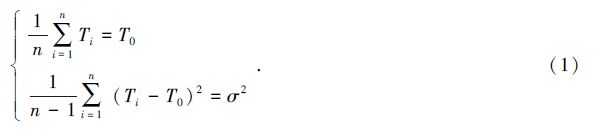
具体增广方法如下:设T0为试验值,σ为半经验所得的试验值的标准差,由于试验中试件只有一个,只得到一个试验值T0,因此,只能以此试验值作为试验均值的估计值。虚拟增广子样为Ti,i=1,2,…,n,其中某一子样值为T0,满足下列方程组:
Bootstrap方法是美国Stanford大学教授Efron于1979年提出的一种新的统计推断方法,是一种只依赖于给定观测信息,而不需要其它假设的统计推断方法。
设X=(x1,x2,…,xn)为来自未知总体分布F的子样,θ=θ(F)是总体分布的F的某个参数,Fn是子样X的经验分布,$\hat{\theta }$=$\hat{\theta }$(Fn)是θ的估计,估计误差记为
R(X,F)=$\hat{\theta }$(Fn)-θ(F)$ \buildrel \Delta \over = $Tn,
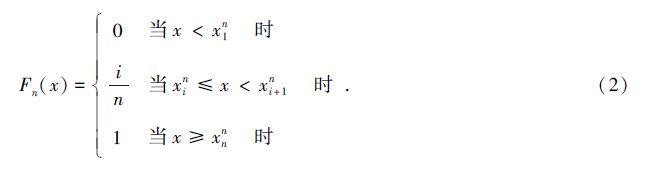
(1)将x1,x2,…,xn按从小到大排序,得到x1n≤x2n≤…≤xnn,并由此构造经验分布函数Fn:
(2)从Fn中抽取子样
X*=(x1*,x2*,…,xn*),
(3)用R*(X*,Fn)=$\hat{\theta }$(Fn*)-$\hat{\theta }$(Fn)$ \buildrel \Delta \over = $Rn的分布逼近R(X,F),R*(X*,Fn)的分布称为Bootstrap分布,其中Fn*为X*=(x1*,x2*,…,xn*)的经验分布;Rn为Tn的Bootstrap统计量。
利用Rn的分布模拟Tn的分布,可以对分布参数θ进行区间估计。
1.3 单子样寿命试验的区间估计利用半经验虚拟增广子样与Bootstrap方法相结合的极小子样评估方法可进行单子样寿命试验的区间估计,具体步骤如下:
(1)利用虚拟增广方法将子样由1个增广到n个;
(2)将n个子样值按从小到大顺序排列,然后计算经验分布函数Fn;
(3)根据Fn进行重抽样,获得抽样集合X*k=(x1,k*,x2,k*,…,xn,k*),k=1,2,…,N;
(4)利用上述抽样集合计算寿命的Bootstrap置信区间[4]。
1.4 算例文[2]给出了一个用此方法估计飞行器结构寿命的算例:一飞行器结构做了一次寿命试验,得出其寿命为T0=20 000 h,由经验知其寿命为对数正态分布,对数寿命的标准差σY=0.17,其中Y=logT,利用(1)式将Y由1个Y0=logT0=4.301,虚拟增广到5个{3.801,4.105,4.301,4.497,4.801},再用Bootstrap方法求出均值估计密度分布,得到Y均值90%置信度下限为4.084 76,对应寿命T均值的置信下限为12 153 h。
2 摆镜平台寿命估计 2.1 摆镜平台寿命的分布威布尔(Weibull)分布是瑞典物理学家Weibull在分析材料强度时推导的一种概率分布类型。由于威布尔分布含有两个或三个参数,它对各种类型试验数据拟合的能力强,因此,使用广泛,许多随机现象可认为近似服从威布尔分布。
若系统有n个部件,记第i个部件的寿命为Ti(i=1,2,…,n),假设每个部件的寿命分布都为F(t),并假设T1,T2,…,Tn是相互独立的,记Tmin为部件寿命T1,T2,…,Tn中的最小值,Tmin=min{T1,T2,…,Tn},如果整个系统的寿命是所有部件中最薄弱的部件的寿命,则Tmin就是系统的寿命。Tmin的分布为FTmin(t)=1-1-F(t)n,若F(t)是Weibull分布,则FTmin(t)也是Weibull分布。由n个部件组成的系统,若每个部件寿命分布为具有相同形状参数m的两参数Weibull分布,且部件寿命相互独立,则系统寿命为Weibull分布:

寿命试验中的试件为德国PI公司的S-340型摆镜平台,由两对压电陶瓷触动器推动摆镜平台台面摆动,S-340摆镜平台中的压电陶瓷促动器为PI公司的PICMA(PI Ceramic co-fired multilayer actuators),根据文[5] PICMA的寿命服从两参数威布尔分布,形状参数m的平均值为1.4。通过对摆镜平台构成部件的分析,认为摆镜平台寿命主要由PICMA决定。由于摆镜平台中两对PICMA的使用环境和工作条件相同,因此,可以认为其寿命分布的形状参数相同。假定摆镜平台的寿命为最薄弱的一个PICMA的寿命,根据(3)式摆镜平台寿命分布也为威布尔分布,且形状参数与PICMA相同为1.4。
2.2 单子样摆镜平台寿命试验的寿命Bootstrap置信下限计算文[6]给出了寿命服从威布尔分布情况下的半经验虚拟增广子样与Bootstrap结合的方法,将子样数由1虚拟增广到7,用Bootstrap方法计算平均寿命的置信下限。用此方法计算摆镜平台平均寿命置信下限的过程如下:
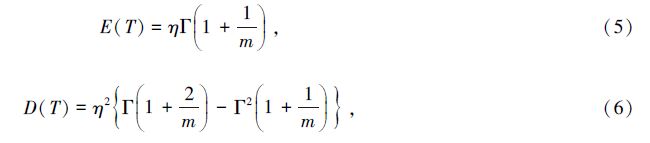
摆镜平台寿命T服从两参数威布尔分布,概率密度函数为

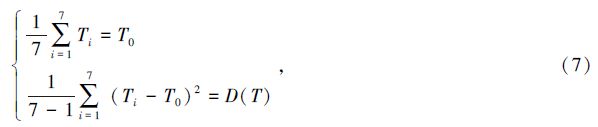
设T0为摆镜平台寿命的试验值,根据威布尔分布将其虚拟扩展为7个子样,记为T1、T2、T3、T4、T5、T6、T7,由于威布尔分布密度函数是偏态的,因此,在进行虚拟子样扩展时,在试验值T0左边取4个点,右边取2个点,且满足T1<T2<T3<T4<T5<T6<T7,其中T5=T0。根据(1)式,7个扩展样本值还应满足以下约束条件:




X=(k1T0,k2T0,k3T0,k4T0,T0,k6T0,k7T0),
利用X计算摆镜平台平均寿命的Bootstrap置信区间,具体步骤如下:
(1)以X为原始样本独立抽取N个容量为7的Bootstrap样本Xk*=(x1,k*,x2,k*,x3,k*,x4,k*,x5,k*,x6,k*,x7,k*),k=1,2,…,N,一般要求N≥1 000,对第i个样本计算:

(2)将${\hat{\mu }}$1*,${\hat{\mu }}$2*,…${\hat{\mu }}$N*自小到大排序,得${\hat{\mu }}$(1)*≤${\hat{\mu }}$(2)*≤…≤${\hat{\mu }}$(N)*;
(3)取k1=⌈N×$\frac{\alpha }{2}$⌉,k2=⌈N×(1-$\frac{\alpha }{2}$)⌉,以${\hat{\mu }}$(k1)*,${\hat{\mu }}$(k2)*分别作为${\hat{\mu }}$(α/2)*,${\hat{\mu }}$(1-α/2)*的估计,得到μ的置信水平为1-α的近似置信区间为(${\hat{\mu }}$(k1)*,${\hat{\mu }}$(k2)*),置信下限为${\hat{\mu }}$(k1)*。
为加快寿命试验的进程,在寿命试验中引入了加速过程,目前加速因子为5.5。摆镜平台寿命试验从2013年1月1日开始,到2014年3月18日已进行442天,摆镜平台工作正常。因此,可以认为寿命试验值T0=442×24×5.5=58 344 h,h表示小时。利用(11)式选出一组系数ki,i=1,2,3,4,6,7
{0.312 1,0.441 1,0.570 0,0.699 0,1.730 9,2.246 9}
{18 209,25 736,33 256,40 782,58 344,100 988,131 093}
如果摆镜正常工作2年,寿命试验值T0=730×24×5.5=96 360 h,摆镜平台寿命90%、95%、98%和99%的Bootstrap置信区间计算结果见表 2。
| 置信度/% | 置信下限/h | 置信上限/h |
| 90 | 35 766 | 84 146 |
| 95 | 31 468 | 89 163 |
| 98 | 28 598 | 96 688 |
| 99 | 26 808 | 99 916 |
| 置信度/% | 置信下限/h | 置信上限/h |
| 90 | 57 889 | 138 975 |
| 95 | 51 971 | 147 260 |
| 98 | 46 645 | 157 324 |
| 99 | 44 277 | 163 833 |
从表 1可知95%置信区间为[31 468 h,89 163 h],或[3.59年,10.18年],置信下限为T0.95=31 468 h=3.59年。
从表 2可知95%置信区间为[51 971 h,147 260 h],或[5.93年,16.81年],置信下限为T0.95=51 971 h=5.93年。
3 结 论对单子样摆镜平台寿命试验,在摆镜平台近似服从威布尔分布的假定下,根据以往摆镜平台组件寿命试验数据推断威布尔分布的形状参数,在此基础上可以采用半经验虚拟增广子样与Bootstrap方法相结合的方法进行摆镜平台寿命的Bootstrap区间估计,给出摆镜平台寿命的置信区间和置信下限。
| [1] | 冯蕴雯, 冯元生. 极小子样高可靠性成败型产品试验的贝叶斯评估方法研究[J]. 机械科学与技术, 1999, 18(2): 198-200. Feng Yunwen, Feng Yuansheng. Study of Bayes'estimation for product test of extreme small-sample high-reliability safe-or-failure pattern[J]. Mechanical Science and Technology for Aerospace Engineering, 1999, 18(2): 198-200. |
| [2] | 冯蕴雯, 黄玮, 吕震宙, 等. 极小子样试验的半经验评估方法[J]. 航空学报, 2004, 25(5): 456-459. Feng Yunwen, Huang Wei, Lv Zhenzhou, et al. The semiempirical evaluation method for extreme small sample test[J]. Acta Aeronautica Et Astronautica Sinica, 2004, 25(5): 456-459. |
| [3] | 唐雪梅, 张金槐, 邵凤昌, 等. 武器装备小子样试验分析与评估[M]. 北京: 国防工业出版社, 2001. |
| [4] | 盛骤, 谢式千, 潘承毅. 概率论与数理统计[M]. 北京: 高等教育出版社, 2008. |
| [5] | Pertsch P, Broich B, Block R, et al. Development of highly reliable piezo multilayer actuators and lifetime test under DC and AC operating conditions[EB/OL]. 2010[2013-12-18]. http://www.piezo.ws/pdf/Development_Highly_Reliable_Piezo_Actuators_white_Paper_PI_Ceramic.pdf. |
| [6] | 杨海峰, 冯蕴雯, 冯元生. 单子样结构疲劳试验寿命评估方法研究[J]. 机械设计与制造, 2010(9): 109-111. Yang Haifeng, Feng Yunwen, Feng Yuansheng. Research on reliability assessment of single sample[J]. Machinery Design & Manufacture, 2010(9): 109-111. |