 2013, Vol. 56


In recent years,many scholars try to find thermal anomalies related to earthquakes and current activity of faults through observations of temperatures in deep wells,the shallow subsurface and atmosphere,and thermal infrared remote sensing[1, 2, 3, 4, 5, 6, 7, 8, 9, 10, 11]. It is impossible to obtain thermal anomalies at several kilometers depth based on heat conduction through these observational approaches,because of quick temperature diffusion and decay of the crustal rocks. Therefore,some scholars put forward new hypothesizes such as "earth degassing theory" and "gas-thermal theory"[12],which suggest sudden deflation of the crust and thermal infrared warming in the lower atmosphere can be induced by mutagenic effects of the electrostatic field at low altitude,“ LAIC model”[13] which supposes that the air temperature rises because of the reaction between radon released from active faults and various gases in the atmosphere before earthquakes,and "surface deformation theory"[14]. This work focuses on temperature changes caused by surface deformation.
That heat is induced by fault friction is well known,but the temperature changes during rock deformation,especially the elastic deformation have rarely been studied. Elastic mechanics generally focuses on elastic deformation of isothermal processes. In isothermal conditions,the elastic body obeys Hooke’s Law: dσ = Edε,where σ is stress,ε is strain,and E is the elastic modulus. In fact,the material of the thermal expansion will also be heated under pressure during adiabatic process. In adiabatic conditions,the state equation of solid elastic deformation is no longer Hooke’s law,instead dσ = Edσ+βdT,where β is the thermal stress coefficient. This state equation is often used to study the stress caused by thermal expansion,but temperature change induced by stress is little researched.
Some scholars have carried out experimental studies of temperature variation during rock deformation[15, 16, 17, 18, 19, 20, 21, 22],and obtained many valuable results. The infrared thermal imaging system is usually used for temperature measurement in the experiments,but the conclusions according to different scholars have large differences due to the low accuracy of the infrared measurement systems and the small temperature changes of rock in elastic deformation. Our laboratory established a system of temperature observation in order to study the relationship between heat and strain[23],which can use both the contact temperature measurement system and the infrared thermal imaging system at the same time to observe temperature changes under different deformation conditions and in different parts of the samples. Two aspects of the work have been carried out using this experimental system: Firstly,under the adiabatic condition,for the reversible process (elastic deformation),the temperature of rocks of thermal expansion material (thermal stress coefficient is positive) rises when loading and drops when unloading by compression,and for adiabatic irreversible processes (plastic deformation,damage and friction),the temperature of the rock rises[14, 24]. That is to say,there are two mechanisms of temperature rise,one is caused by strain,and the other is due to friction. Secondly,it is proved that the thermal field is closely related with the strain field by studying the thermal field of the typical structures of fault models during the process of deformation[25, 26, 27]. It is further proved that the temperature changes of the compressive and tensile jog areas are induced by the volumetric strain by comparing temperature responses to the deformation in these parts,and fault dislocation can be judged by temperature changes in different structure parts of the samples. The authors also emphasized that the cooling in the jog area,heating in fault zones and heating pulse are the precursors of instability.
A large number of experiments show that there is a meta- instability stage between the peak stress point and fast instability point on the stress-strain curve[28],which is the final stage before instability and critical for short-term earthquake prediction. It is vital to study the evolution characteristics of a variety of physical fields of this deformation stage for judging instability. Some previous studies generally refer to the changes before instability as a precursor,making it difficult to use the observed phenomena to predict instability moment. For this reason,it is very important for earthquake precursor studies to use the favorable conditions of easily identifying the meta-instability stage by the stress-strain curve in the laboratory and the newly purchased infrared observation system to identify the characteristics of the thermal field in the meta-instability stage.
En echelon faults are common geological structure in the field,on which scholars have carried out many basic research[29, 30, 31]. Temperature changes of en echelon faults have different characteristics and mechanisms at different tectonic positions during the process of deformation,about which some studies have been conducted[25, 26, 27, 32]. This work focused on the evolution characteristics of the thermal field of compressive en echelon faults in the meta-instability stage.
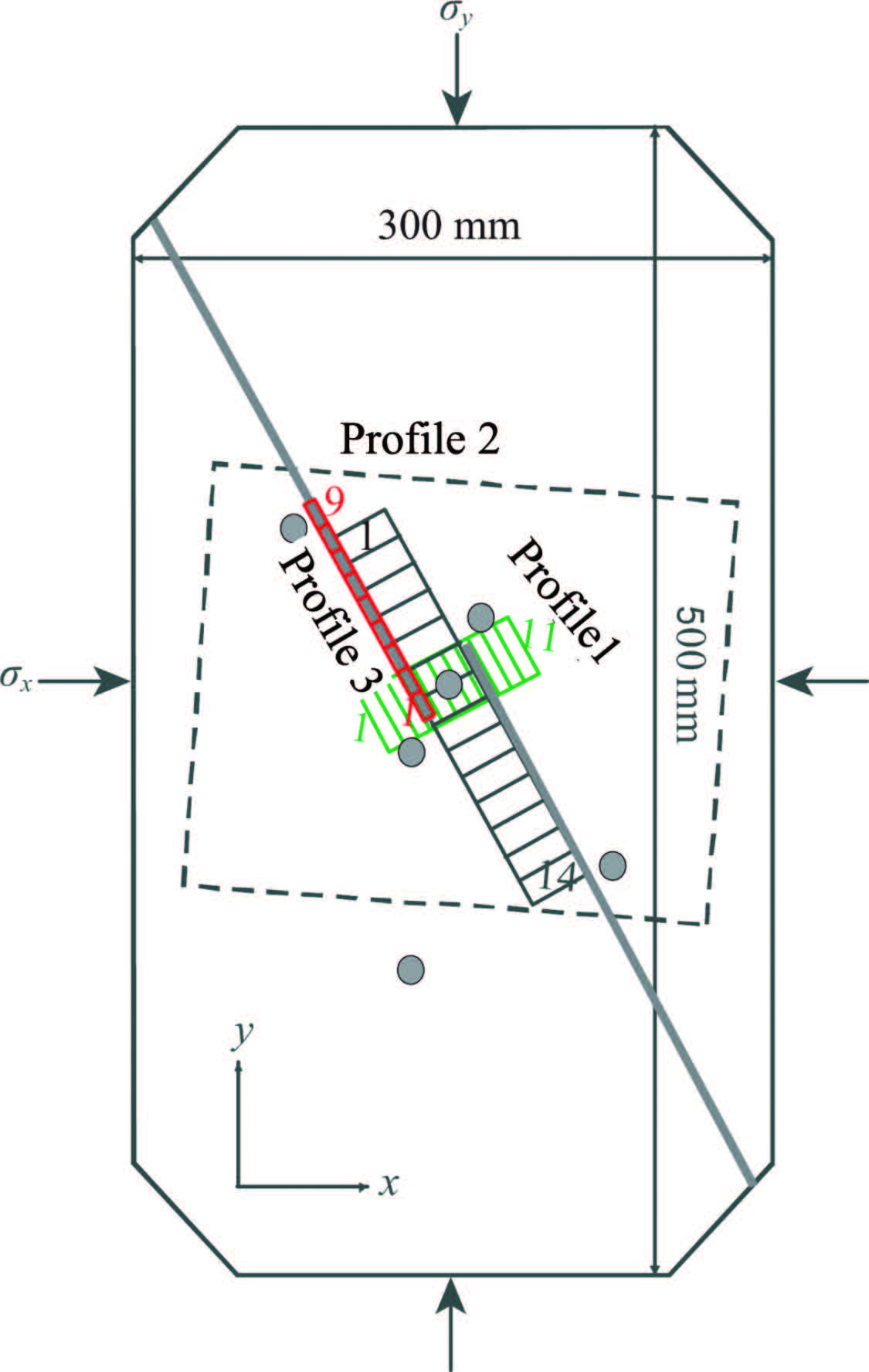
2 EXPERIMENTAL CONDITIONS AND DATA PROCESSINGThe primary tool of temperature measurement is the infrared thermal imaging system,also a few contact thermometer measuring points. The rock specimen for the experiment is made up of granodiorite from Fangshan county with a size of 500 mm×300 mm×50 mm. It is cut obliquely at an angle of 31°,forming two faults,and then filled with gypsum to simulate compressive en echelon fault structure. The vertical distance between the two faults is 35 mm,and the overlap distance is 29 mm (Fig.1). Dotted rectangular area in Fig.1 is the thermal image observation area.
|
Fig.1 Specimen structure and study area Gray thick solid lines are precut faults,dashed box is observation range,gray solid circles are locations of contact-type thermometers,green,black and red areas are profiles 1,2,and 3. |
The technical parameters of the infrared imaging system are as follows: spectrum range is 8~14 μm,AD mode transform is 14 bit,the minimum temperature resolution of AD mode transform is 2.5 mK when temperature measurement range is set to 0~40°C,noise equivalent temperature difference is 25 mK,and spatial resolution is 640×512 pixels. In this experiment each pixel corresponds to the actual size of 0.35 mm,and the thermal imaging acquisition rate is 10 frames/s.
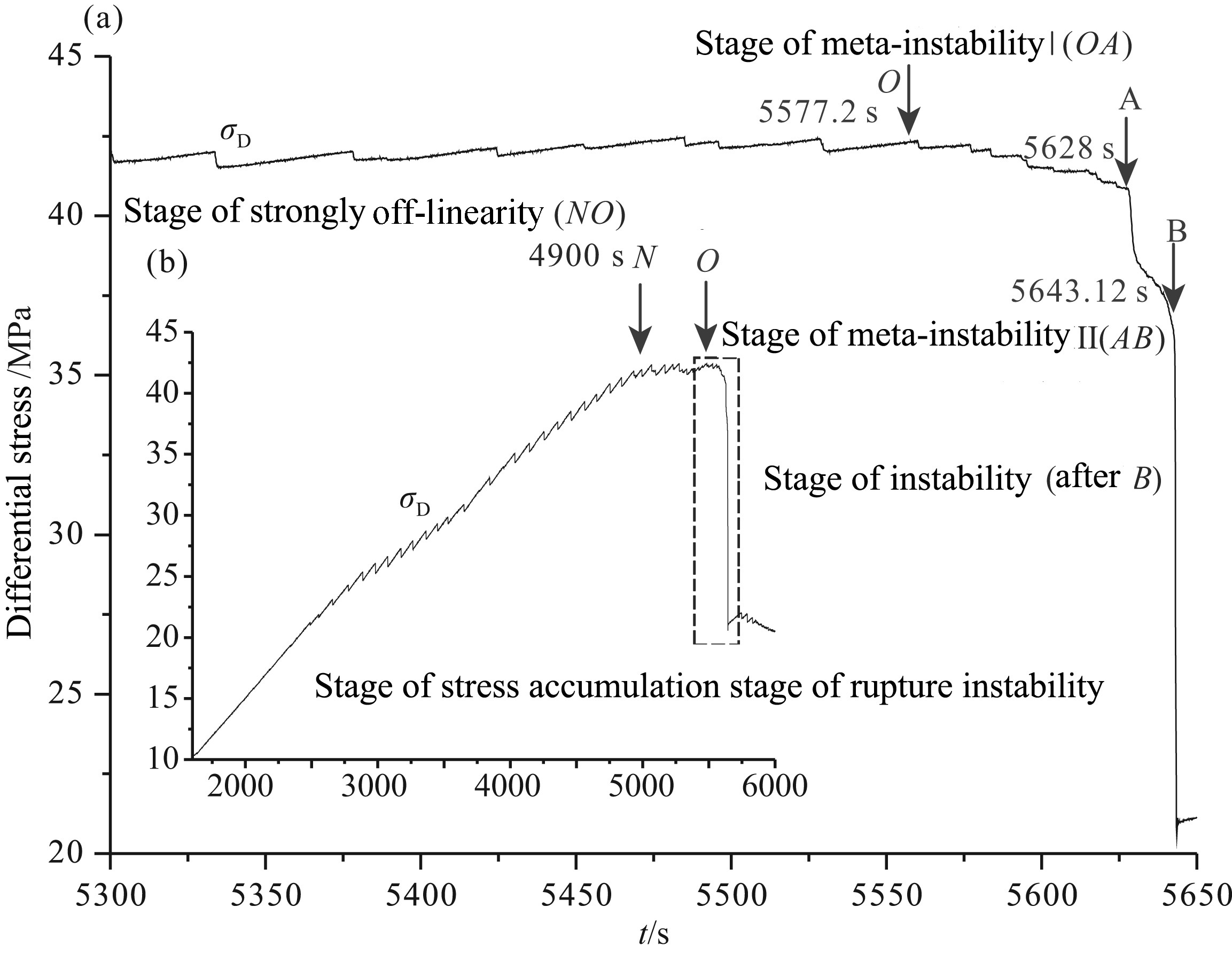
The two-direction servo-control system was used to apply load on the sample. During the experiment,the load in both directions was forced to 5 MPa and maintained constant (5 MPa) in the x direction,then the load in the y direction was applied by a displacement rate of 0.5 μm/s. The right and lower sides of the sample were fixed,and the left and top sides of the sample were slidable when loaded,making the upper fault active. Fig.2b shows the differential stress variation with time during the experiment. This article focuses on the process before failure (periods marked by black dotted line in Fig.2b ),Fig.2a is the enlargement figure of the differential stress time curve for the period.
|
Fig.2 Variation of differential-stress with time (Fig.2a is the enlarged figure of the dotted area in Fig.2b) |
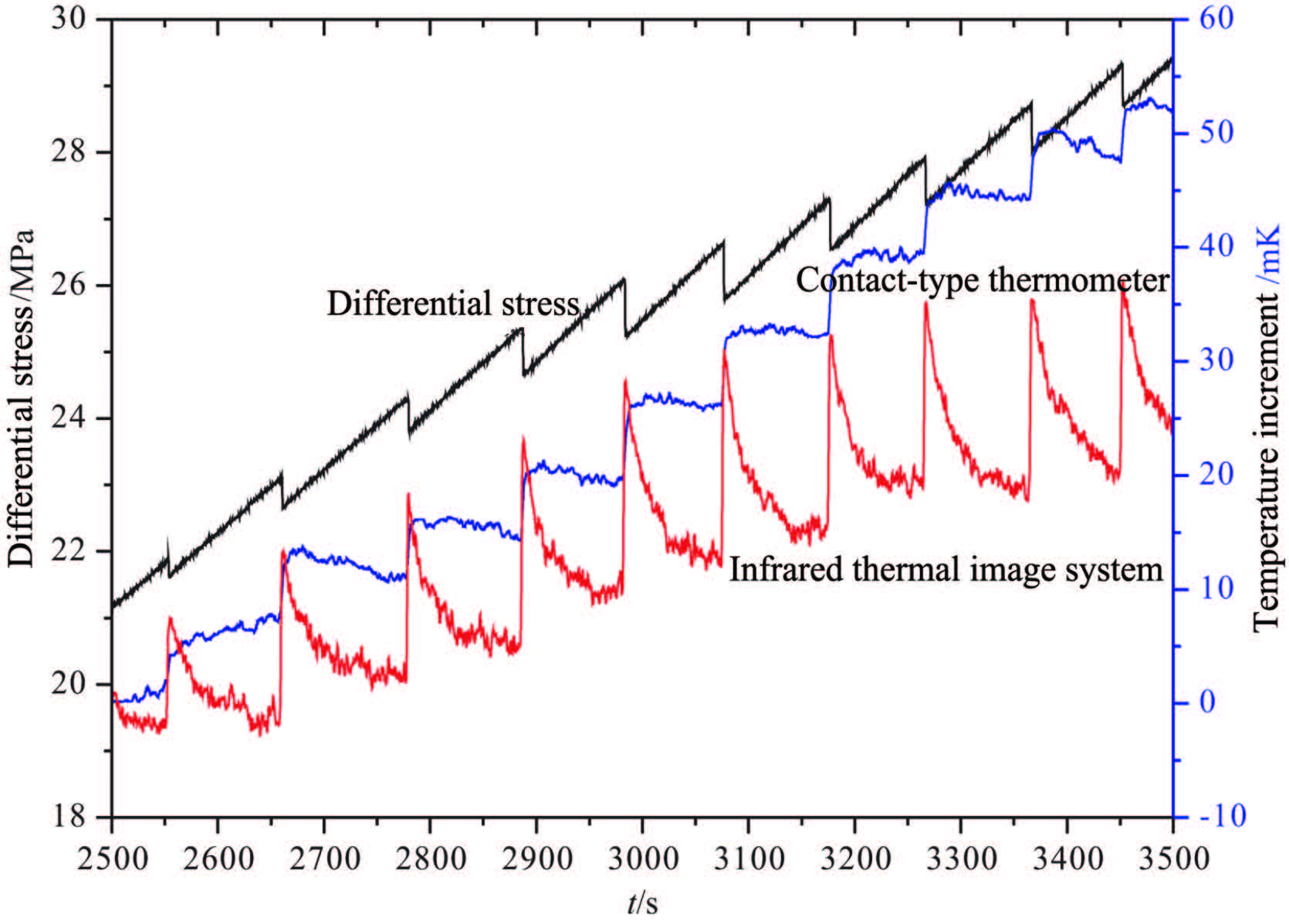
The relationship of differential stress and two kinds of temperature measurement results (infrared imaging,contact thermometer) can be seen in Fig.3. The temperature change corresponds to stress state change. The trends of two kinds of temperature results are consistent,but the thermal imager responses faster to temperature changes and has greater amplitude without the influence of thermal inertia of sensors,and the temperature is spike-like when stick-slip takes place.
|
Fig.3 Variation of temperature and differential stress with time Red and blue curves represent temperature results of infrared thermal image and contact-type thermometer respectively. |
Further processing of the data is required because it is very difficult to see directly from the thermal image on subtle changes in temperature due to small magnitude temperature changes caused by the strain and inhomogeneity of the background of the sample and the environmental noise. In this work,the regional average method and moving average method were applied to reduce the random noise,that is,to decline the spatial and temporal resolution in exchange for temperature measurement accuracy,which reduced the noise equivalent temperature difference.
3 EXPERIMENTAL RESULTS 3.1 Division of Rupture Instability StageThe deformation process largely contains two stages,stress accumulation stage accompanied by small stick-slip events and rupture instability stage with the point N as a demarcation point. This study focused on the rupture instability stage. Fig.2b shows strongly deviation from linearity at the point N (4900 s). Fig.2a shows low- rate increase of differential stress after the point N,and the stress reaches the peak point O at 5577.2 s. After the point O the differential stress decreases at a slower rate and keeps stress state stalemate. At the 5628 s the deformation process reaches a turning point A. After point A the release of differential stress accelerates,and the release rate becomes smaller after 2~3 s. The deformation process reaches instability at point B,i.e. 5643.12 s. After more than ten seconds,the release rate increases rapidly with the occurrence of instability dislocation. This process can be divided into four stages by the points N,O,A,B: NO is called "strongly-off-linearity stage",OA is called "meta-instability stage I",AB is called "meta-instability stage II",and the stage after B is called "instability stage".
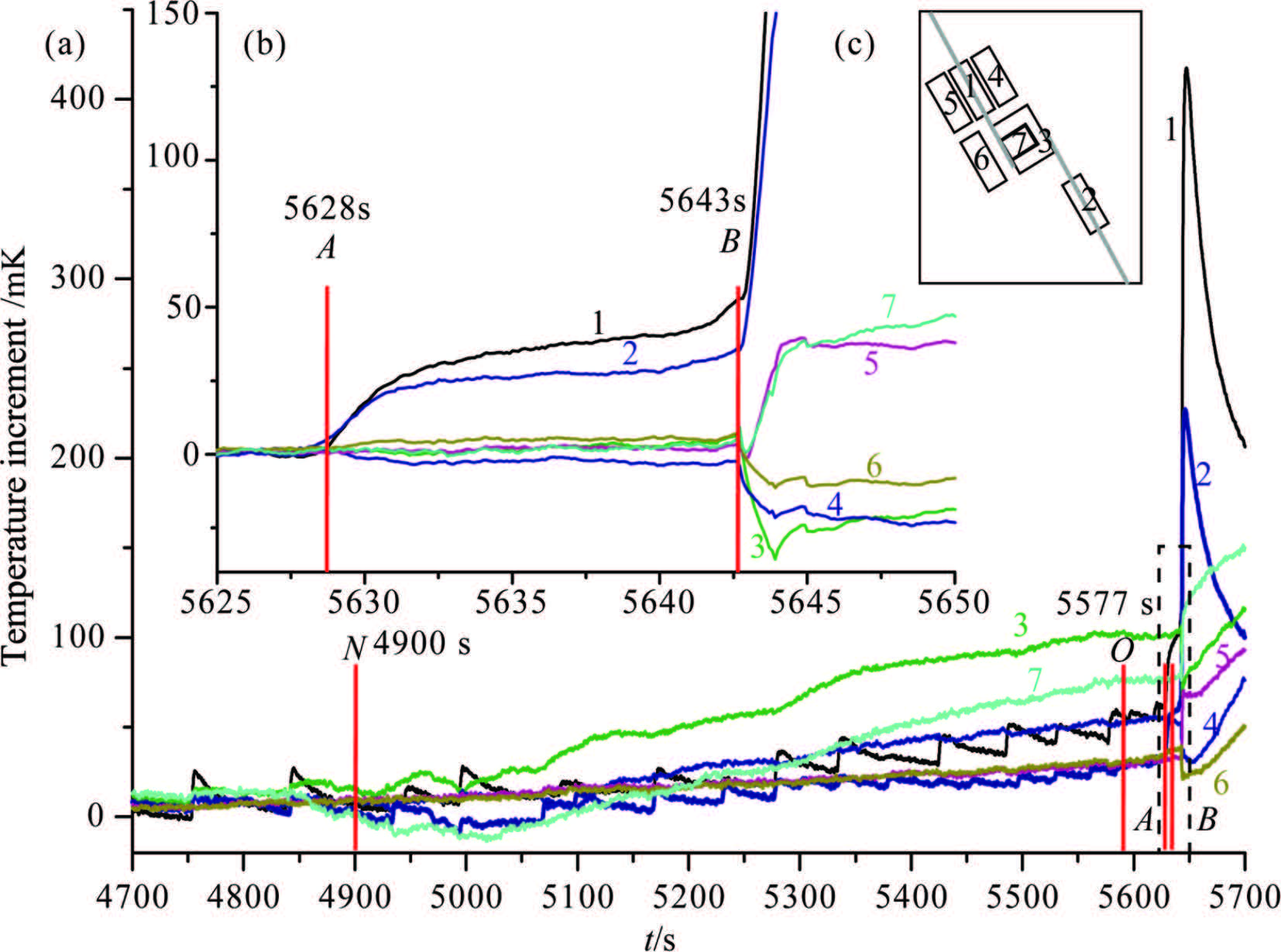
3.2 Temperature Variation With Time at Different Tectonic PositionsCurves 1-7 in Fig.4 represent variations of average temperature with time at different tectonic positions. Fig.4b is an enlarged view of the dashed box in Fig.4a. Fig.4c is the sketch of tectonic positions analyzed: areas 1 and 2 are in the upper and lower faults,3 and 7 are in the jog area,4 is located in between the faults,and 5,6 are outside the faults.
|
Fig.4 Variation of average temperature in different tectonic positions with time Fig.4a is the enlarged figure of the dotted area in Fig.4b; the vertical axis value is an incremental temperature versus 4500 s (5620 s) in Fig.4a (Fig.4b); Fig.4c is the sketch map of tectonic positions. |
Figures 4a and 4b show that temperature status significantly changes at points O,A,and B. At point O,temperature increase is getting close to the peak point in the jog area,with small fluctuations after point O. At point A,warming in the faults accelerates. At point B,the temperature suddenly rises in faults,and firstly drops then rises outside the faults (area 5) and the jog area (area 7),and drops substantially around the jog area (areas 3,6) and in between the faults (area 4).
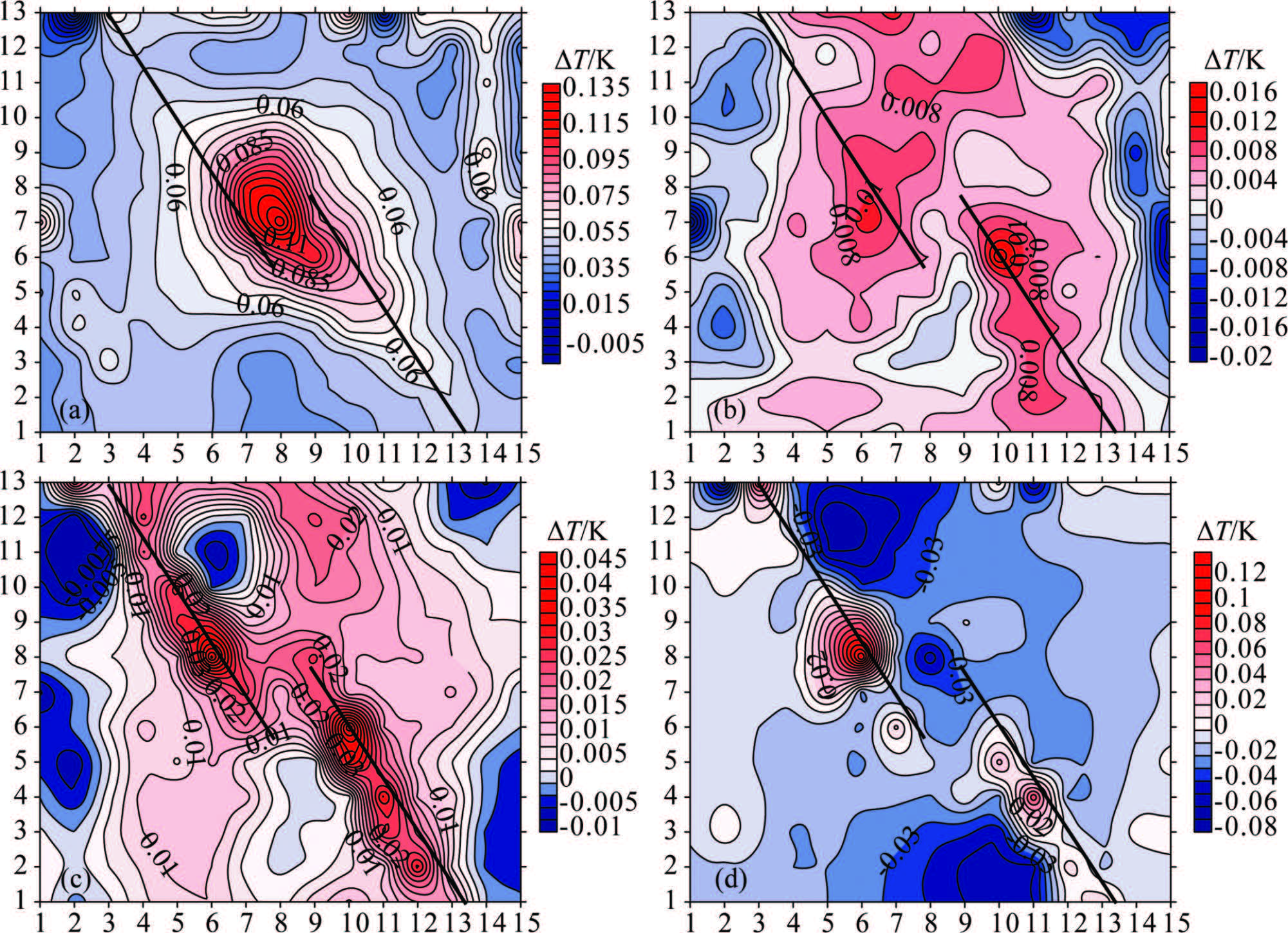
Temporal and spatial variations of temperature can be more visually represented by temperature increment images. In the stage of strongly-off-linearity (Fig.5a),the temperature in the jog area increases significantly by about 134 mK,and the average heating rate is about 0.23 mK/s. In late stage of meta-instability I (Fig.5b),the warming zone gradually transfers to the faults,and the maximum of warming is up to 18 mK,and the average heating rate is 0.38 mK/s. In the late stage of meta-instability II (Fig.5c),warming in the faults is more obvious,and appear more hot spots,and temperature in between the faults decreases. At the moment of rupture instability (Fig.4d),the temperature in the faults rises by 130 mK while the temperature of the whole sample drops by 20~40 mK,and the average heating rate is 65 mK/s,the average cooling rate is 10~20 mK/s.
|
Fig.5 Temperature increment in different stages (a) Temperature increase in the jog area in stage of strongly off-linearity; (b) Temperature increase in fault zones in late stage of meta-instability I; (c) Temperature increase in fault zone and temperature decrease in between the faults in late stage of meta-instability II; (d) Temperature decrease of the whole sample and temperature increase in fault zones in stage of instability. Fig.5a is an increment of 5577 s subtracting 4997 s,Fig.5b is an increment of 5625 s subtracting 5577 s,Fig.5c is an increment of 5641 s subtracting 5625 s,and Fig.5d is an increment of 5643.91 s subtracting 5641 s. |
The center of temperature decrease is located in the jog area and in between the faults. Such temperature decrease at the moment of instability has not been obviously observed in previous experiments.
The continuously-increased pressure in Y -axis made the jog area stay in compressive state. The stress is highly concentrated in the jog area and the temperature rises significantly in the strongly-off-linearity stage. The faults are partially dislocated and the temperature in faults rises due to friction in the meta-instability stage. The rupture in the jog area provides conditions for fault dislocation,which leads to temperature decrease between the faults caused by stress unloading and enlarged temperature-increase area due to extended fault dislocation in the meta-instability stage II. The stress releases overly due to the slip of the faults and the temperature in fault zones rise is caused by friction in stage of instability. Greater stress held in the jog area and in between the faults before instability lead to larger stress drop,making these areas cooling centers.
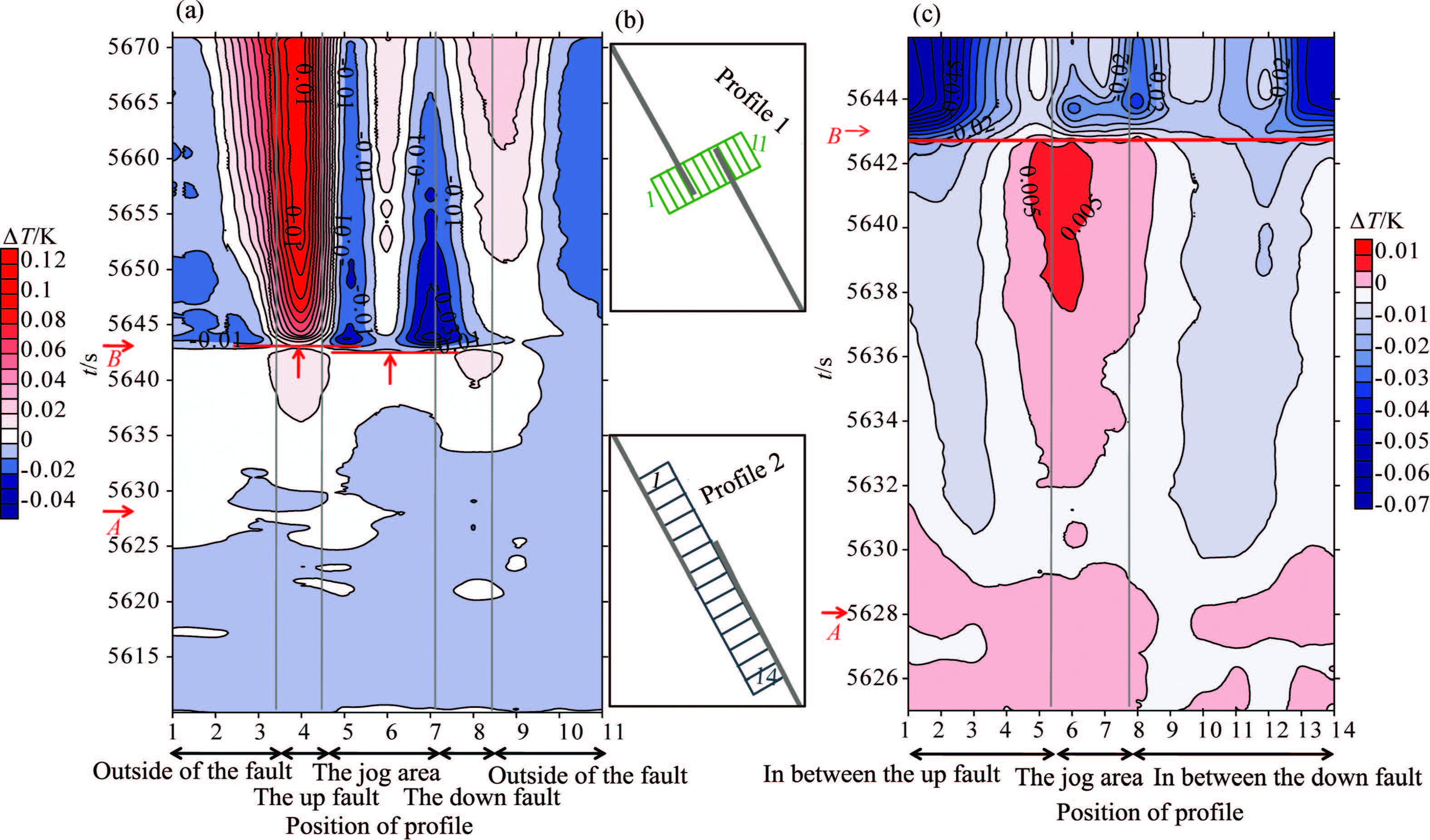
3.3 Temperature Variations with Time on Different ProfilesFigure6a shows temperature variation with time on profile 1 (The horizontal axis is position of the profile,and the vertical axis is time. Profile 1 is perpendicular to the fault,and the locations are shown on the map in Fig.6b. Position 4,8 is the fault,5,6,7 is the jog area). Temperature changes randomly before point A. After point A,the faults start warming. Near point B,the temperature in the jog area firstly drops,and then the faults are dislocated and the temperature rises rapidly. The temperature decrease means connection of the jog area,which provides conditions for fault dislocation. Temperature increase in the faults and decrease in the jog area are important features of the meta-instability stage.
|
Fig.6 Temperature variations of profiles vertical to the fault (profile 1) and parallel to the fault (profile 2) with time (a)Temperature variations of profile vertical to the fault (profile 1) with time; (b) The sketch map of position of profiles; (c) Temperature variations of profile parallel to the fault (profile 2) with time. Black dotted line in Fig.6a and Fig.6c for separating the locations of the profile; red solid line and arrow show temperature decrease in jog area occurred earlier than strong increase in fault zones in Fig.6a; red solid line show synergy of temperature decrease of the whole profile before instability in Fig.6c; Fig.6b is the sketch map of the profile positions. |
Figure6c shows temperature variation with time on profile 2 (profile positions are shown in the bottom of Fig.6b,the positions 1 to 5 and 8 to 14 are in between the faults,and the positions 6 and 7 are in the jog area). After point A,temperatures at different positions appear differentiation,including temperature decrease in between the faults and temperature increase in the boundary between the upper fault and the jog area which may be associated with stress concentration in the crack area,also described in the previous literature [15]. There are two important temperature decrease events after point A: the first event happens 14 s before the instability and temperature decrease appears only in between the faults; the second event occurs about 0.4 s before the instability (as shown by the red line in Fig.6c) when the temperature variation of the whole profile shows consistency and synergy of temperature decrease. Both the temperature decrease phenomena are important signals in the stage of meta-instability.
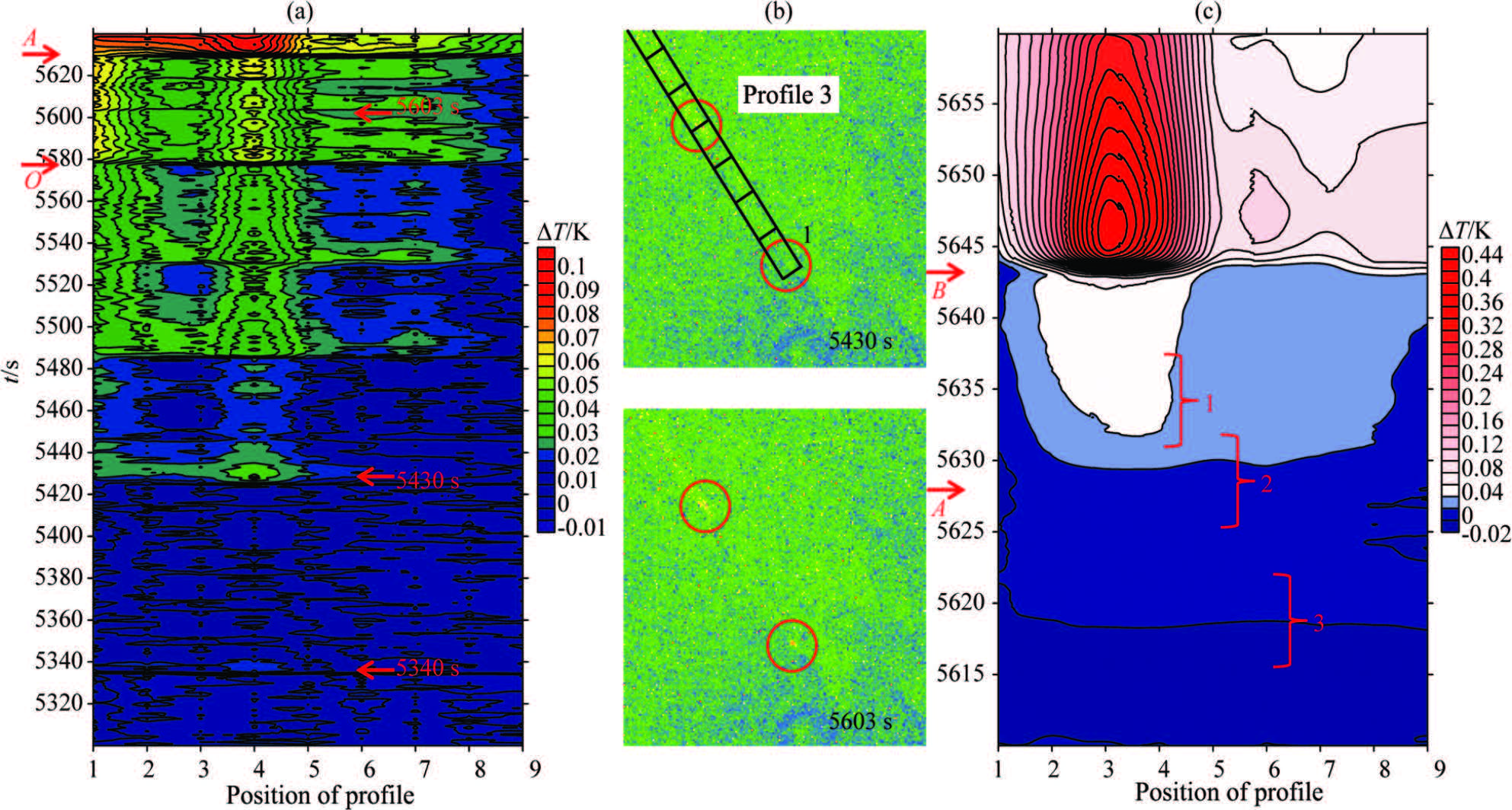
Figures 7a and 7c show temperature variation with time at different time on profile 3 (the top figure of Fig.7b),that is,along the upper fault. Fig.7a shows relatively high temperature spots at 5340 s,which becomes distinguished in the thermal image at 5430 s (the top figure of Fig.7b),and clearer (lower figure of Fig.7b) in the meta-instability stage (5603s). After point A,the temperature of the whole fault accelerates to rise and shows synergy of warming (Fig.7a),which is earlier than the synergy of temperature decrease (Fig.6c) before instability and only occurs on the fault. The period after the peak point O,including stage of instability,is chosen and further analyzed,and three step-heating (Fig.7c) at 24 s,14 s,and 10 s before the instability are found. High temperature concentrating at the end point of the jog area is also an important thermal sign in the meta-instability stage.
|
Fig.7 Temperature variations of profile along the fault (profile 3) with time in different stages and the thermal images (a) Strongly off-linearity stage to meta-instability stage; (b) Thermal images and the sketch map of position of profile 3; (c) Meta-instability stage to instability stage. Red arrow show locations of special temperature changes in Fig.7a; red braces and numbers show three stepped temperature increase in the fault zones during stage of meta-instability in Fig.7c. |
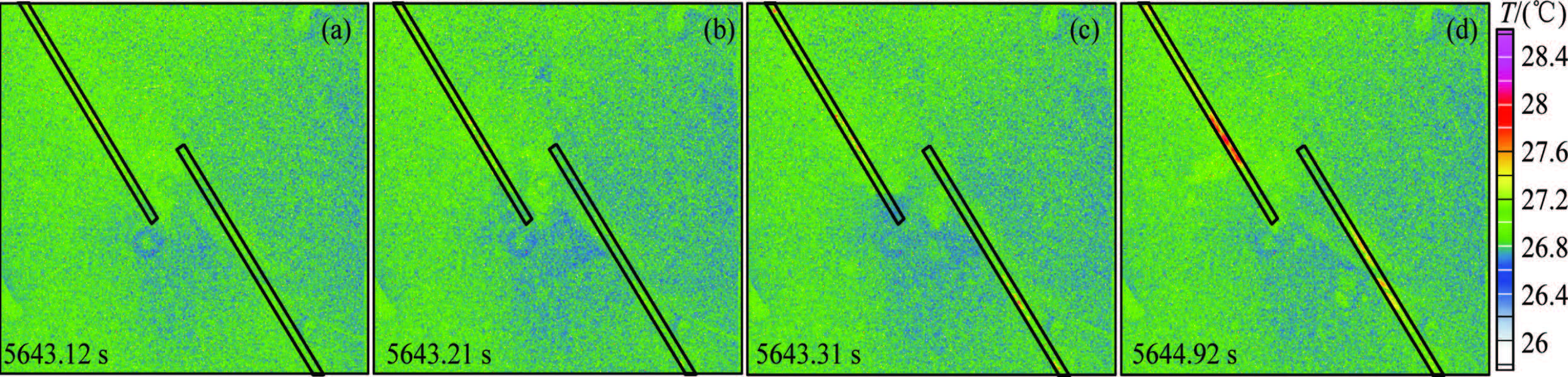
The dynamic process of instability and dislocation of the faults can also be directly observed on the thermal images (Fig.8): At 5643.12 s (moment B),the temperature of the whole fault increases,and the high temperature spots at the endpoint of the upper fault get weakened compared to the temperature at 5603 s (the lower figure of Fig.6b). At 5643.21 s,the high temperature spots appear on the upper and lower faults. At 5643.31 s,the hot parts of the upper and lower faults expand at the same time and get enhanced. At 5644.92 s,the temperature of the fault rises to the peak point,which is 311 mK of the upper fault and 162 mK of the lower fault. Comparing Fig.8a with Figs. 8b and 8c,the enlargement of the low temperature region in the late stage is clearly seen. Temperature decrease of the sample as a whole marks a wide range of stress release.
|
Fig.8 Thermal images of different moment during instability stage |
The rupture instability process can be divided into the strongly-off-linearity stage,meta-instability stage and instability stage according to the stress-time curve. This article discusses the thermal field variations of the various stages and comes to the following conclusions:
(1) In the stage of strongly-off-linearity,the strain mainly concentrates in the jog area,where the temperature increases obviously (Fig.5a). Hot spots begin to appear due to partially fault dislocation (Fig.7a).
(2) In the meta-instability stage I,the warming zone gradually transfers to the faults (Fig.5b),with hightemperature points more pronounced (lower figure of Fig.7b). In meta-instability stage II,the area of fault dislocation extends,and temperature increase converts from the partial to the whole (Fig.5c). The temperature in between the faults decreases (Fig.5c),and the faults show synergy of temperature increase (Fig.7a) while the jog area and area in between the faults show synergy of temperature decrease (Fig.6c) near the instability.
(3) In the stage of instability,stress releases and the temperature of the whole sample decreases due to unloading. Only the temperature of the faults rises by friction (Fig.5d). At the same time,the interaction of the upper and lower faults and the expansion of cooling area except for the fault can be seen on the thermal images (Fig.8).
In short,the temperature varies with different deformation stages and different structural parts of the specimen. It is possible to identify the deformation stages according to the temperature changes of the sample. The important thermal signal to discern the stage of meta-instability is acceleration of temperature increase in the faults (Fig.7c) and the enlargement area of temperature decrease in between the faults (Fig.5c,Fig.6c). The synergy of temperature increase in faults (Fig.7a) and the synergy of temperature decrease in the jog area and in between the faults (Fig.6c) are vital signals of the upcoming instability. Fault dislocation does not start from one point as a whole but from multiple points according to the variations of the thermal field. The high temperature points gradually extend to connect and the synergistic phenomenon appears,and then comes the instability.
5 DISCUSSIONSPossible positions of the precursors have been obtained from the experiment. As for compressive en echelon faults,the important positions aforementioned are mainly located in the jog area,faults and in between the faults. It is very important and instructive to find out the possible positions of the precursors of different structural forms for analyzing of remote sensing data and deployment of geothermal stations. The experiments also show that temperature varies in different stages of the same tectonic position,so when the thermal anomaly is observed in the field,not only the structural positions but also the deformation stages should be considered.
It is theoretically significant of the experiment for exploration of earthquake precursors. Moreover,the results can explain some of the observed field earthquake precursory phenomena to some extent. (1) Thermal infrared remote sensing results show that temperature decrease occurs in many earthquake cases in addition to abnormal temperature increase before the earthquakes: Three days before the Turkey M7.8 earthquake,the warming anomaly disappeared[33],which means that temperature decrease happened. The temperature decrease one day before the Kerman earthquake was very obvious[34]. One day before the 2008 Wenchuan 8.0 earthquake the temperature increase also disappeared[35],that is,there has been temperature decrease. Geothermal station data show both temperature increase and decrease of the co-seismic were present in response to this earthquake[36]. The temperature decrease of the Bayan Har-Songpan block in the central Tibetan Plateau caused by the Indonesia event in 2004 was the after-shock effect[8]. This experiment shows that temperature decrease of the rock specimen due to stress release would happen at some special structural positions before and at the moment of instability. Although if the observed temperature decrease fields are relative to tectonic activities remain to be studied,when thermal anomaly is analyzed,temperature decrease should also be considered. (2) By analysis of remote sensing data some scholars found that multiple hot spots firstly appeared before earthquakes,and then expanded into one piece. One month before the Bhuj 7.9 earthquake,two hot spots appeared near the epicenter[37]; the thermal anomaly area before the Pamir (Ucha) Ms6.8 earthquake contained three hotspots[38]. In this experiment we found that the dislocation of the fault began from multi-points rather than entire fault,which explains the phenomenon observed by remote sensing.
The study of the meta-instability state has just begun. It still requires experiments of various structural forms of samples to find more general expressions of the thermal field. The most important problem is to associate the experiment results with the similar structural forms in the field,which is the next focus of the work .
ACKNOWLEDGMENTSLi Pu-chun participated in the experiment. We are grateful to Liu Li-qiang,Ma Sheng-li and Guo Yanshuang for their comments and suggestions. This work was supported by the National Natural Science Foundation of China (41172180) and Special Projects of Basic Scientific Business of Institute of Geology of China Earthquake Administration.
| [1] Qiang Z J, Xu X D, Lin C G. Satellite infrared thermal anomaly: Earthquake imminent precursor. Chinese Science Bulletin (in Chinese), 1990, 35(17): 1324-1327. |
| [2] Jiang H, Wang Z R, Liu Y X, et al. The dynamic statistical characteristics between the earthquake, ground temperature and precipitation in China. Chinese J. Geophys. (in Chinese), 2002, 45(suppl.): 1141-1149. |
| [3] Tronin A A, Biagi P F, Molchanov O A, et al. Temperature variations related to earthquakes from simultaneous observation at the ground stations and by satellites in Kamchatka area. Physics and Chemistry of the Earth, 2004, 29(4-9): 501-506. |
| [4] Pulinets S A, Ouzounov D, Karelin A V, et al. The physical nature of thermal anomalies observed before strong earthquakes. Physics and Chemistry of the Earth, 2006, 31(4-9): 143-153. |
| [5] Chen S Y, Liu P X, Liu L Q, et al. Wavelet analyses to thermal infrared radiation of land surface and its implementation for exploring the current tectonic activity. Chinese J. Geophys. (in Chinese), 2006, 49(3): 824-830. |
| [6] Chen S Y, Ma J, Liu P X, et al. A study on the normal annual variation field of land surface temperature in China. Chinese J. Geophys. (in Chinese), 2009, 52(9): 2273-2281. |
| [7] Lu S L, Shen X H, Zou L J, et al. Remote sensing image enhancement method of the fault thermal information based on scale analysis: A case study of Jiangshan-Shaoxing fault between Jinhua and Quzhou of Zhejiang Province. Chinese J. Geophys. (in Chinese), 2008, 51(5): 1484-1493. |
| [8] Ma J, Chen S Y, Hu X Y, et al. Spatial-temporal variation of the land surface temperature field and present-day tectonic activity. Geoscience Frontiers (in Chinese), 2010, 1(1): 57-67. |
| [9] Chen S Y, Liu P X, Liu L Q, et al. Comparative analysis between land surface temperatures obtained by field measurement and satellite remote sensing and its implication in earthquake research. Chinese J. Geophys. (in Chinese), 2011, 54(3): 747-755. |
| [10] Zhang Y S, Guo X, Wei C X, et al. The characteristics of seismic thermal radiation of Japan MS9.0 and Myanmar MS7.2 earthquake. Chinese J. Geophys. (in Chinese), 2011, 54(10): 2575-2580. |
| [11] Chen S Y, Ma J, Liu P X, et al. A thermal physical index to explore current tectonic activity with satellite remote sensing. Science in China: Earth Science (in Chinese), 2012, 55(2): 290-295. |
| [12] Qiang Z J, Kong L C, Zheng L Z, et al. An experimental study on temperature increasing mechanism of satellite thermo-infrared. Acta Seismologica Sinica, 1997, 10(2): 247-252. |
| [13] Pulinets S, Ouzounov D. Lithosphere-Atmosphere-Ionosphere Coupling (LAIC) model-An unified concept for earthquake precursors validation. Journal of Asian Earth Sciences, 2011, 41(4): 371-382. |
| [14] Liu P X, Liu L Q, Chen S Y, et al. An experimental on the infrared radiation of surficial rocks during deformation. Seismology and Geology (in Chinese), 2004, 26(3): 502-511. |
| [15] Luong M P. Infrared thermovision of damage processes in concrete and rock. Engineering Fracture Mechanics, 1990, 35(1-3): 127-135. |
| [16] Deng M D, Cui C Y, Geng N G. Application of principle of remote sensing to earthquake prediction and the experimental results. Earthquake Research in China (in Chinese), 1993, 9(2): 163-169. |
| [17] Cui C Y, Deng M D, Geng N G. Study on the features of spectrum radiation of rocks under different loading. Chinese Science Bulletin (in Chinese), 1993, 38(6): 538-541. |
| [18] Geng N G, Yu P, Deng M D, et al. The simulated experimental studies on cause of thermal infrared precursor of earthquakes. Earthquake (in Chinese), 1998, 18(1): 83-88. |
| [19] Wu L X, Wang J Z. Infrared radiation features of coal and rocks under loading. Int. J. Rock Mech. & Min. Sci., 1998, 35(7):969-976. |
| [20] Yin J Y, Fang Z F, Qian J D, et al. Research on the application of infrared remote sensing in earthquake prediction and its physical mechanism. Earthquake Research in China (in Chinese), 2000, 16(2): 140-148. |
| [21] Liu S J, Wu L X, Wang C Y, et al. Remote sensing-rock mechanics (VIII)-TIR omens of rock fracturing. Chinese Journal of Rock Mechanics and Engineering (in Chinese), 2004, 23(10): 1621-1627. |
| [22] Zhang Y B, Liu S J, et al. Thermal radiation temperature field variation of hole rock in loading process. Rock and Soil Mechanics (in Chinese), 2011, 32(4): 1013-1024. |
| [23] Liu L Q, Chen G Q, Liu P X, et al. Infrared measurement system for rock deformation experiment. Seismology and Geology (in Chinese), 2004, 26(3): 492-501. |
| [24] Chen S Y, Liu L Q, Liu P X, et al. Theoretical and experimental study on relationship between stress strain and temperature variation. Science in China: Series D (in Chinese), 2009, 52(11): 1825-1834. |
| [25] Ma J, Liu L Q, Liu P X, et al. Thermal precursory pattern of fault unstable sliding: An experimental study of en echelon faults. Chinese J. Geophys. (in Chinese), 2007, 50(4): 995-1004. |
| [26] Liu P X, Ma J, Liu L Q, et al. An experimental study on variation of thermal fields during the deformation of a compressive en-echelon fault set. Progress in Natural Science (in Chinese), 2007, 17(3): 288-304. |
| [27] Ma J, Ma S P, Liu L Q, et al. Experimental study of thermal and strain fields during deformation of en enchelon faults and its geological implications. Geodynamics & Tectonophysics, 2010, 1(1): 24-35. |
| [28] Ma J, Sherman S I, Guo Y S. Identification of meta-instable stress state based on experimental study of evolution of the temperature field during stick-slip instability on a 5° bending fault. Science in China: Series D (in Chinese), 2012, 55(6): 869-881. |
| [29] Liu L Q, Ma J, Wu X Q. An experimental study on the process of deformation and instability for en-echelon faults. Acta Seismologica Sinica (in Chinese), 1986, 8(4): 393-403. |
| [30] Ma S L, Deng Z H, Ma W T, et al. Experimental study on evolution of physical field during deformation of en-echelon faults (1). Seismology and Geology (in Chinese), 1995, 17(4): 327-335. |
| [31] Jiang H K, Ma S L, Zhang L, et al. Spatial-temporal characteristic of acoustic emission during the deformation of rock samples with compressional and extensional en-echelon fault pattern. Acta Seismologica Sinica (in Chinese), 2002, 24(4): 385-396. |
| [32] Wu L X, Liu S J, Wu Y H, et al. Remote sensing-rock mechanics (I)-laws of thermal radiation from fracturing of discontinuous jointed faults and its meanings for tectonic earthquake omens. Chinese Journal of Rock Mechanics and Engineering (in Chinese), 2004, 23(1): 24-30. |
| [33] Tramutoli V, Cuomob V, Filizzola C, et al. Assessing the potential of thermal infrared satellite surveys for monitoring seismically active areas: The case of Kocaeli earthquake, August 17, 1999. Remote Sensing of Environment, 2005, 96(3-4): 409-426. |
| [34] Saraf A K, Rawat V, Banerjee P, et al. Satellite detection of earthquake thermal infrared precursors in Iran. Nat Hazards, 2008, 47(1): 119-135. |
| [35] Wei L J, Guo J F, Cai H, et al. Satellite thermal infrared anomaly: a short-term and impending earthquake precursor before the Wenchuan MS8.0 earthquake in Sichuan, China. Acta Geoscientica Sinica (in Chinese), 2008, 29(5): 583-591. |
| [36] Zhao G, Wang J, He A H, et al. Co-seismic response and post-seismic effect of geotherm on Wenchuan MS8.0 earthquake. Journal of Geodesy and Geodynamics (in Chinese), 2009, 29(2): 29-32. |
| [37] Ouzounov D, Liu D F, Kang C L, et al. Outgoing long wave radiation variability from IR satellite data prior to major earthquakes. Tectonophysics, 2007, 431(1-4): 211-220. |
| [38] Zhang Y S, Guo X, Zhong M J, et al. Wenchuan earthquake: Brightness temperature changes from satellite infrared information. Chinese Science Bulletin (in Chinese), 2010, 55(18): 1917-1924. |