 2013, Vol. 56


2. Institute of Computational Mathematics and Scientific/Engineering Computing, Beijing 100190, China;
3. School of Ocean and Earth Science, Tongji University, Shanghai 200092, China
Exploration seismology is an inversion problem in essence. The object of study is geophysical media. For the forward problem,the seismic wave propagation phenomenon is investigated. And for the inversion problem,the media parameters (velocity,density and anisotropy parameters) are estimated by back-propagating or projecting the acquired wave-fields (surface data,well log,cross-well,ocean bottom surface,etc.). The procedure of solving the geophysical parameters from seismic data is called seismic inversion. There are three levels of seismic inversion: geometrical structure description,amplitude preserved imaging and rock parameters estimation. Traditional migration imaging methods solve the problem of geometrical structure description[1]. The purpose of seismic inversion is to solve the problem of rock parameters estimation[2, 3]. For the second problem,amplitude preserved imaging,we need to combine the migration imaging and the inversion frame. From the point of view of imaging,the factors influencing the final imaging results include spherical spreading effect,surface consistency,accuracy of propagator and rock’s absorption and attenuation[4]. Least-squares migration (LSM) estimates an optimized imaging result under the inversion frame[5]. LSM can adjust most of the above factors during imaging via the Hessian operator[6, 7, 8]. The Hessian operator includes all the information which can be described by the wave equation. It is difficult to solve the accurate Hessian operator and to invert. The same problem is present in the Gauss-Newton full waveform inversion (FWI) where the Hessian operator is used as a precondition to raise the inversion efficiency[9]. In this paper,we present two new transformed Hessian forms which can be used into LSM and FWI. Numerical tests prove our method is effective in synthetic dataset processing.
2 SEISMIC INVERSION AND HESSIAN OPERATORThe seismic wave propagation and reception can be formulated as


In essence,seismic inversion is a nonlinear problem,i.e. the forward operator changes nonlinearly with model parameters. But for convenience,people often linearize the problem to calculate. To solve a inverse problem,a misfit function under the L2 norm is defined as


In the nonlinear problem,the Fr′echet derivative depends on the model. The Newton method assumes that the misfit function satisfies the quadratic form. Using the Taylor expansion:



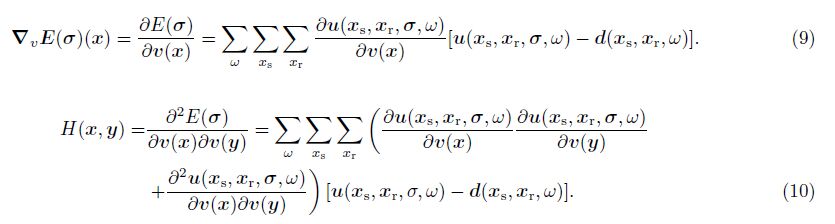
Mathematically,the Hessian operator is the second derivative of the misfit function to the model. In physics,we calculate the Hessian operator based on the wave equation to discuss its meaning. In the FWI,the exact Hessian operator includes two terms: linear term Ha and the nonlinear term R. In most cases,the computational amount is huge to calculate R. Under the assumption of local linearization,R approaches towards zero. So,we firstly need to study the approximateHa which is also a difficult point in the Gauss-Newton FWI and the LSM.
Starting from the acoustic wave equation,there is

Under the Born approximation[11] (local linearization),the seismic wavefield at the receiver point is

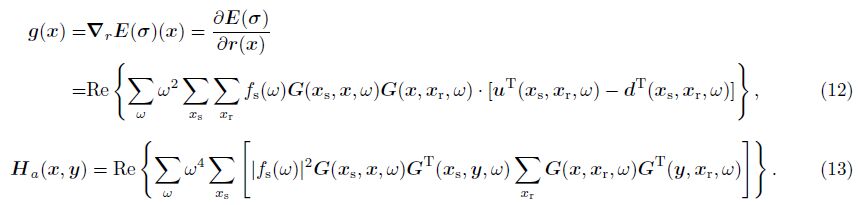







The gradient term LTd in the first iteration stands for the seismic migration which back-propagates the data to image. Besides the Hessian operator Ha = LTL,the migration imaging process can be seen as a half time iteration[12],

The Hessian operator takes a significant position in seismic inversion. But for both the Gauss-Newton FWI and LSM,a serious problem caused by the Hessian operator is its huge scale (elements of squared model parameter number). To avoid the difficult of solving and inverting the Hessian operator,many approximation forms have been proposed to replace the exact one. Yu et al.[13] presented an inversed Hessian scheme in a v(z) medium. Lecomte[14] solved the inversion problem based on the ray theory. Plessix and Mulder[5] derived the Hessian matrix in the space domain and suggested four approximation forms for the diagonal Hessian. Tang[15] used the phase-encoding method to calculate the Hessian matrix in a fast way. From the previous study[7],the linearized Hessian matrix is a main diagonal dominant banding one. Using the diagonal elements of the Hessian matrix which is commonly so-called pseudo-Hessian,traditional Gauss-Newton inversion is realized. This pseudo-Hessian is expressed as

The LSM can remove the effects caused by acquisition aperture,footprint,and absorption attenuation. Meanwhile the LSM equation based on the inversion frame can be used to different operators. If only a suiTable forward modeling operator L and its adjoint migration operator LT are estimated,the gradient term and Hessian can be calculated by the matrix operation.
Offset continuation is one of the seismic data projection methods. Bagaini[16] derived the offset continuation form in the shot domain. Formel[17] modified the equation and presented a more precise one. Based on this thought,the shot domain wavefield can be decomposed into the planewaves:

The double square root (DSR) operator for prestack time migration (PSTM) in the frequency-wavenumber domain can be expressed as









Under the traditional Newton FWI frame,the Hessian operator is used as a preconditioner to increase the iteration efficiency. But how to estimate a corresponding Hessian is difficult. In the early study,we developed a local angle domain Hessian operator[7] which matches the wavelet domain propagator. The local angle domain Hessian operator is corresponding to the imaging points x and the dip-angle

This transformed Hessian operator can be applied to the LSM but can not be used to FWI easily. Here,we propose a new similar sub offset domain Hessian form

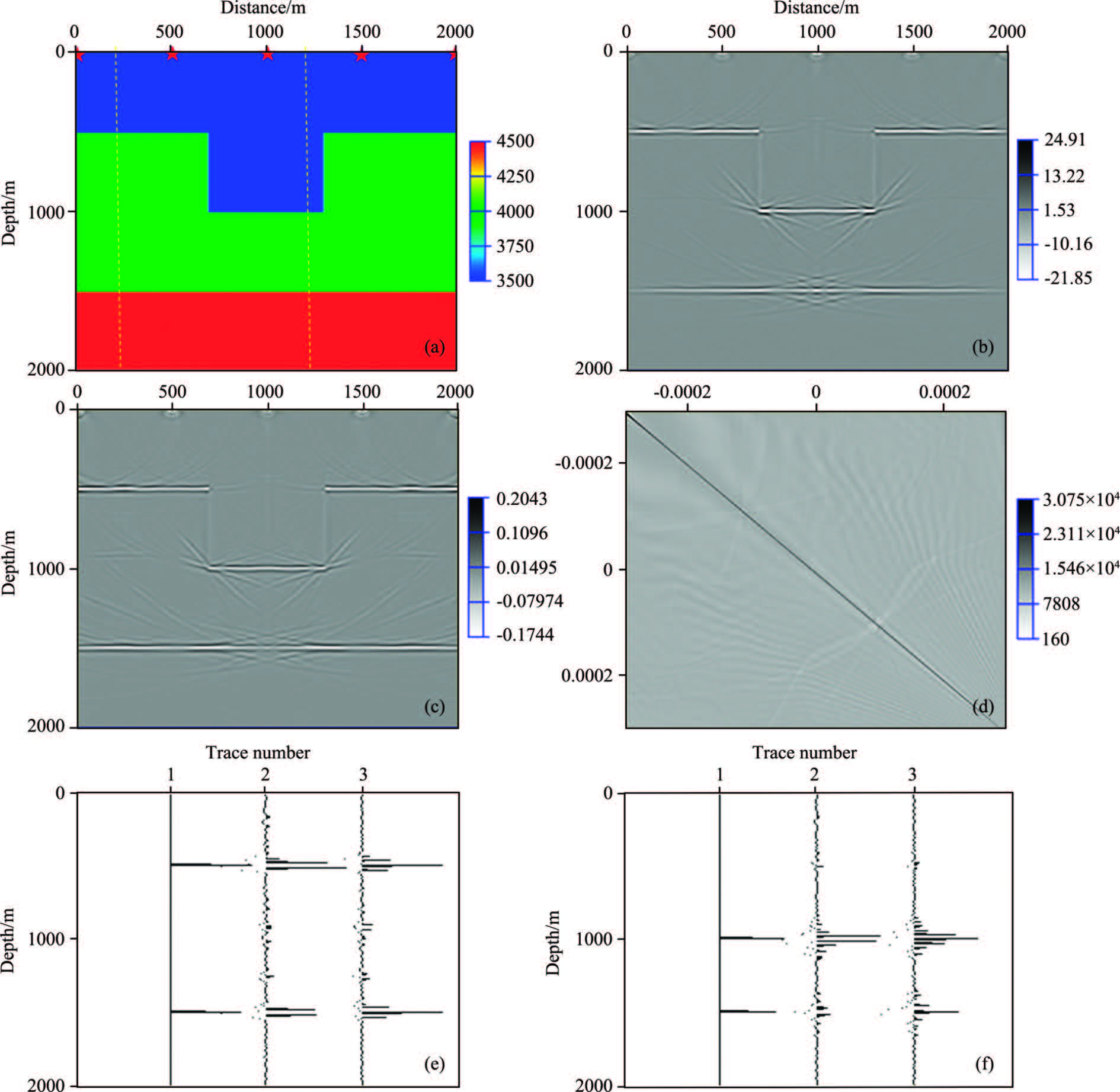
Firstly,we test the planwave Hessian using a simple model. On the model shown in Fig.1a,5 shots dataset are synthesized from the star-marked points with the main frequency of 30 Hz. Two reference traces are chosen to test the planewave domain Hessian and LSM. Fig.1b and 1c give the direct planewave migration results and the planewave LSM results using the planewave Hessian shown in Fig.1d. It is apparent that the LSM results are better both in the resolution and illumination. For this model,the planewave Hessian is main diagonal dominance. Fig.1e and 1f show the reflectivity,direct imaging results and LSM imaging results for two reference traces marked in Fig.1a,respectively. Comparison indicates that the LSM result has better resolution and balanceed illumination than the direct one.
|
Fig.1 Planewave least-squares migration test (a) Time-depth velocity model of Aoxian model; (b) Planewave PSTM imaging result; (c) Planewave LSM imaging result; (d) Planewave Hessian matrix; (e) Reflectivity,direct imaging and LSM imaging result of reference trace 1; (f) Reflectivity,direct imaging and LSM imaging result of reference trace 2. |
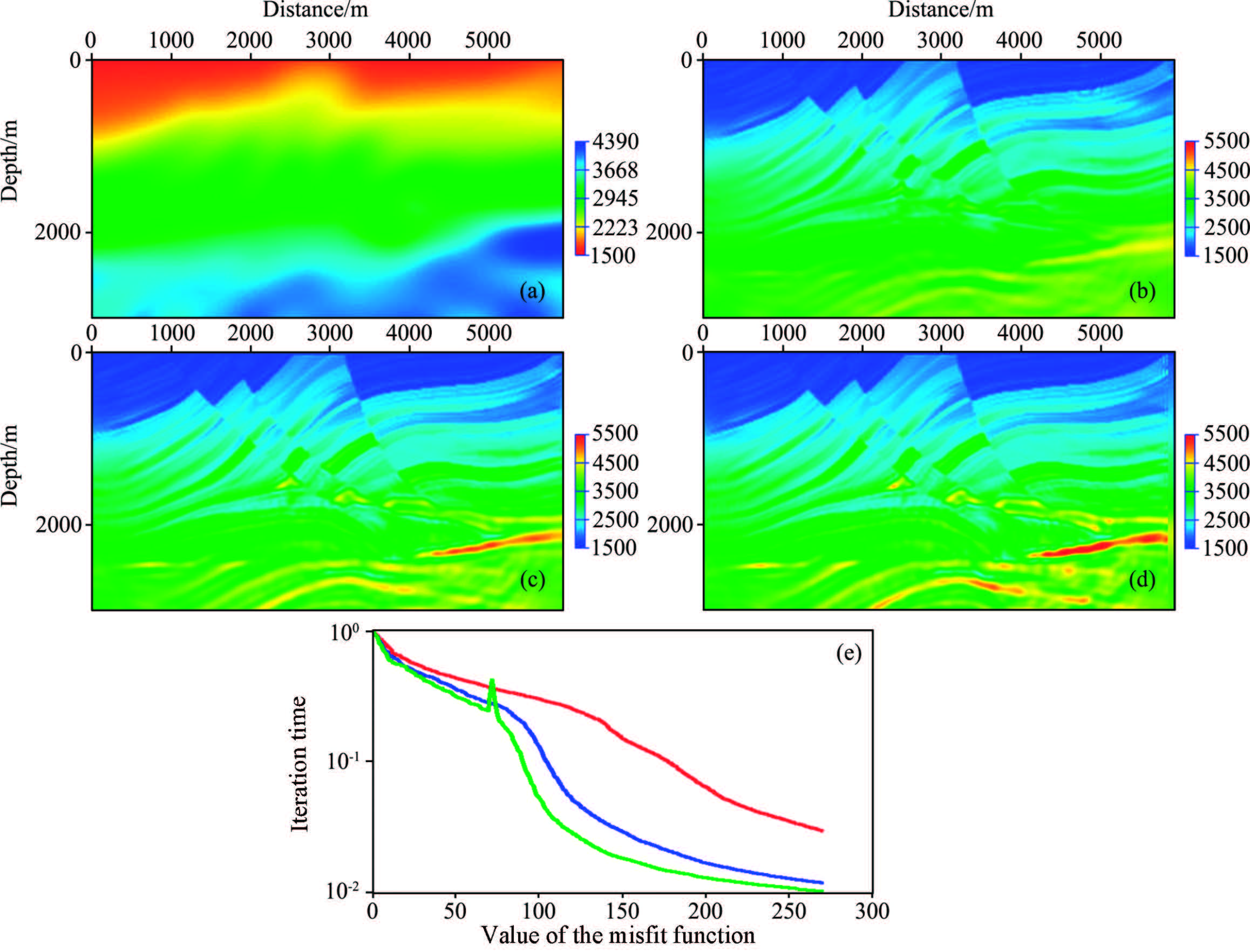
The Full Waveform Inversion (FWI) has the highest resolution theoretically. But the expensive computation is a great challenge for FWI. We use the transformed Hessian operator in Eq.(34) as a preconditioner for the quasi-Newton FWI and apply it to the Marmousi model. Starting from a smoothed initial model (shown in Fig.2a),we perform the general conjugate gradient (CG) FWI,shot illumination preconditioned FWI and the Offset Hessian preconditioned FWI (Fig.2(b-e)). From the convergence curve shown in Fig.2f,after the preconditioner of both shot illumination and offset Hessian is used,the convergence is significantly faster than the traditional CG method. Although the stability of full sub offset Hessian preconditioned FWI needs to be studied further,the general convergence trend with this method is acceptable.
|
Fig.2 Tests on the offset-Hessian used to full waveform inversion (a) Initial model; (b) Traditional CG-FWI result after 270 iterations; (c) Shot-illuminated CG-FWI result after 270 iterations; (d) Offset-Hessian preconditioned CG-FWI result after 270 iterations; (e) Restraintion curve of misfit function,red line-Traditional; Blue line-Shot illuminated; Green line-Offset hessian preconditioned. |
Starting from the Newton inversion frame,this paper discusses and analyzes the Hessian operator in seismic inversion imaging both mathematically and physically. In math,the Hessian operator is the second derivative of the misfit function to the model. So,whether the variation of misfit function with respect to the model satisfies the quadratic form is a problem. Previous studies pointed out that the seismic inverse problem is strongly nonlinear. But we can assume that in a local area,the problem is quadratic or even linear. This approximation can be utilized in the Born assumption which can lead to the LSM and FWI. So,the methods we proposed in this paper also need a good initial macro velocity model. Under the acoustic equation,the Hessian matrix can be expressed as the Green’s function. An exact invert Hessian operator can generate an amplitude-preserved result. The planewave Hessian proves the capability of the LSM. Similarly,the Newton inversion based on the quadratic assumption can produce a better result. The subsuface offset Hessian applied to FWI can result in a fast convergence. In sum,the Hessian operator has a significant value in seismic inversion imaging. The study on further enhancement of calculation efficiency and stability will be the next target in the future.
ACKNOWLEDGMENTSThe authors thank the financial supports by SINOPEC Key Laboratory of Geophysics Foundation,Zhejiang Province Postdoc Preferential Foundation (Bsh1202046) and National Natural Science Foundation of China (NSFC) (ID: 41304089). The first author was grateful to the Wave Phenomenon and Inversion Imaging (WPI) research group at Tongji University for the discussions and suggestions.
| [1] Claerbout J F. Toward a unified theory of reflector mapping. Geophysics, 1971, 36(3):467-481. |
| [2] Tarantola A. Inversion of seismic reflection data in the acoustic approximation. Geophysics, 1984, 49(8):1259-1266. |
| [3] Ren H R, Wang H Z, Huang G H. Theoretical analysis and comparison of seismic wave inversion and imaging methods. Lithologic Reservoirs (in Chinese), 2012, 24(5):12-18. |
| [4] Ren H R, Wang H Z, Zhang L B. Compensation for absorption and attenuation using wave equation continuation along ray path. Geophysical Prospecting for Petroleum (in Chinese), 2007, 46(6):557-561. |
| [5] Etgen J, Gray S H, Zhang Y. An overview of depth imaging in exploration geophysics. Geophysics, 2009, 74(6):WCA5-WCA17. |
| [6] Plessix R E, Mulder W A. Frequency-domain finite-difference amplitude-preserving migration. Geophysics Journal International, 2004, 157(3):975-987. |
| [7] Ren H R, Wu R S, Wang H Z. Wave equation least square imaging using the local angular Hessian for amplitude correction. Geophysical Prospecting, 2011, 59(4):651-661. |
| [8] Ribodetti A, Operto S, Agudelo W, et al. Joint ray+Born least-squares migration and simulated annealing optimization for target-oriented quantitative seismic imaging. Geophysics, 2011, 76(2):R23-R42. |
| [9] Pratt G, Shin C, Hicks G J. Gauss-Newton and full Newton methods in frequency-space seismic waveform inversion. Geophysical Journal International, 1998, 133(2):341-362. |
| [10] Hadamard J. An Essay on the Psychology of Invention in the Mathematical Field. Princeton:Princeton University Press, 1945. |
| [11] Chen S C, Cao J Z, Ma Z T. Stable pre-stack depth migration method with Born approximation. Oil Geophysical Prospecting (in Chinese), 2001, 36(3):291-296. |
| [12] Lailly P. The seismic inverse problem as a sequence of before stack migrations.//Bednar J B, ed. Conference on Inverse Scattering:Theory and Application. Philadelphia:Society for Industrial and Applied Mathematics, 1983:206-220. |
| [13] Yu J, Hu J, Schuster G T, et al. Prestack migration deconvolution. Geophysics, 2006, 71(2):S53-S62. |
| [14] Lecomte I. Resolution and illumination analyses in PSDM:A ray-based approach. The Leading Edge, 2008, 27(5):650-663. |
| [15] Tang Y. Target-oriented wave-equation least-squares migration/inversion with phase-encoded Hessian. Geophysics, 2009, 74(6):WCA95-WCA107. |
| [16] Bagaini C, Spagnolini U. 2-D continuation operators and their applications. Geophysics, 1996, 61(6):1846-1858. |
| [17] Formel S. Theory of differential offset continuation. Geophysics, 2003, 68(2):718-732. |
| [18] Stolt R H, Benson A K. Seismic Migration Theory and Practice:Theory and Practice. London:Geophysical Press, 1986. |
| [19] Feng B, Wang H Z. 3D offset plane-wave finite-difference pre-stack time migration. Chinese J. Geophys. (in Chinese), 2011, 54(11):2916-2925. |
| [20] Sava P C, Fomel S. Angle-domain common-image gathers by wavefield continuation methods. Geophysics, 2003, 68(3):1065-1074. |
| [21] Liu S W, Wang H Z, Cheng J B, et al. Space-time-shift imaging condition and migration velocity analysis. Chinese J. Geophys. (in Chinese), 2008, 51(6):1883-1891. |