 2013, Vol. 56


2. Institute of Earthquake Science, China Earthquake Administration, Beijing 100036, China;
3. DFH Satellite Co., Ltd., Beijing 100094, China
The Schumann Resonance (SR) is an electromagnetic resonance phenomenon occurring in the cavity formed by the earth and the ionosphere. It is excited by global lightning activities,and its frequency depends on the Earth’s size[1]. The observed frequencies of the lowest five SR modes are at about 7.8 Hz,14.1 Hz,20.3 Hz,26.4 Hz and 32.5 Hz[2]. Several papers have reported SR background features observed at many places in the world. Sentman et al. presented SR intensities of the horizontal magnetic component measured in California and Western Australia during two separate intervals September -17,1989 and April 14-21,1990,respectively,and found that the diurnal variations of the lowest three SR modes showed different temporal profiles at two sites,and they suggested that this difference was caused by the local D region height[3]. The peak frequencies and amplitude for the first three SR modes were determined by the observations of vertical electrical component in Hungary in Central Europe,and each mode showed distinct daily and seasonal variations. The frequency and the amplitude of SR modes vary in that the inhomogeneity in the Earth-ionosphere cavity and the anisotropy due to the geomagnetic field can modify the attenuation,which is different for different modes. Daily and seasonal variations are influenced by the daily and seasonal changes at locations of thunderstorm active regions[4]. The diurnal variation of the frequency of the first SR mode has been studied by three ELF observatories located at Spitsbergen,the Kola Peninsula and the Kamchatka Peninsula. It is found that the diurnal variations of frequency in NS and EW components are in anti-phase change and the semidiurnal harmonics dominate in both components. The diurnal variations are mainly affected by local time[5]. By using observations of horizontal magnetic and vertical electrical components observed by the Negev observatory in Israel,the amplitude,central frequency and half-width of SR modes are studied. It is found that diurnal variation of amplitude of SR modes in these components are well related to three thunderstorm centers located at southeast Asia,Africa and south America,and diurnal variations of frequency and half-width are more complicated. Further theoretical work is needed to explain these variations of observations[6]. We can know from above,observations and studies of SR at many locations show that the diurnal and seasonal variations of SR intensity and frequency are mainly controlled by background features of lightning activities,the distance between observatory and thunderstorm centers,and the height of upper bound (D region) of Earth-ionosphere cavity.
Scientists of Japan have applied SR to earthquake research. Previous studies show that intensity increase or frequency shift at higher SR modes may be related with earthquakes[7, 8, 9]. Considering the prospect of SR application to earthquake research,Institute of Earthquake Science,China Earthquake Administration has established four SR observatories in Yunnan province,Southwest China since August,2010. Miao et al. carried out preliminary analysis of anomalous SR before earthquakes by using data from Yongsheng observatory in Yunnan[10]. Studying background features of SR in Yunnan is significant for further research on anomalous SR associated with earthquakes. This paper presents the study on SR background characteristics based on data from the Yongsheng observatory.
2 SR OBSERVATORIES IN YUNNAN AND DATA ACQUISITIONThere are four SR observatories in Yunnan,which are located at Qiaojia county (26.91°N,102.94°E),Tonghai county (24.11°N,102.79°E),Yongsheng county (26.70°N,100.77°E) and Mangshi (24.43°N,98.59°E). The instrument is composed by three induction coils,each is about one meter long. The instrument can measure BNS ,BEW and BV components simultaneously. The frequency band of the instrument is 0.1~29 Hz (within 3 dB bandwidth),and the sampling frequency is 100 Hz. Qiaojia,Tonghai and Yongsheng observatories have provided data continuously since August,2010,and Mangshi observatory began to acquire data at the end of 2011.
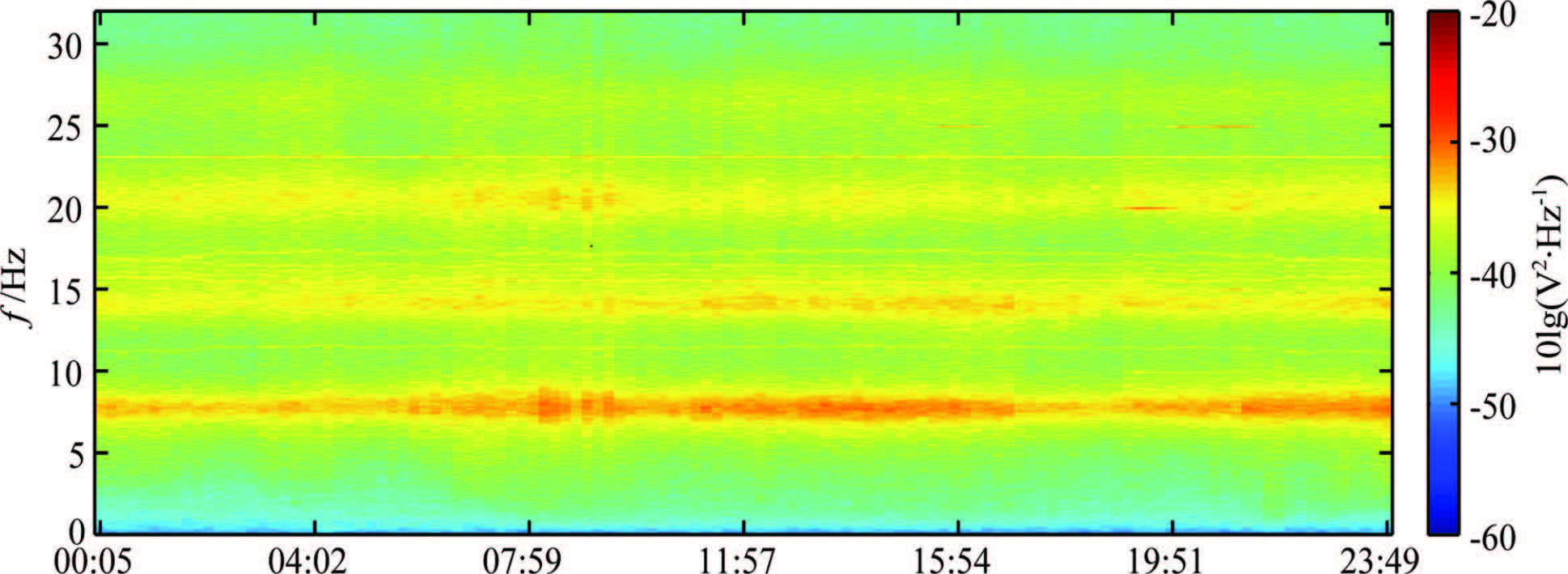
Considering data quality and the time length of data accumulation,this paper only uses the whole year data in 2011 at the Yongsheng observatory to study SR background characteristics. Fig.1 shows power spectral density (PSD) in BNS component on March 8,2011 at the Yongsheng observatory. We can see the lowest three SR modes are located at about 7.5 Hz,14 Hz and 20 Hz. PSD at the first mode is the most intensified and decreases with higher mode. This paper mainly analyzes variation characteristics of PSD and frequencies for the lowest three modes to understand general variation rules of SR parameters,and this facilitates application of SR in the earthquake science in the future.
|
Fig.1 Schumann resonance power spectrum in BNS component on March 8, 2011 at Yongsheng observatory |
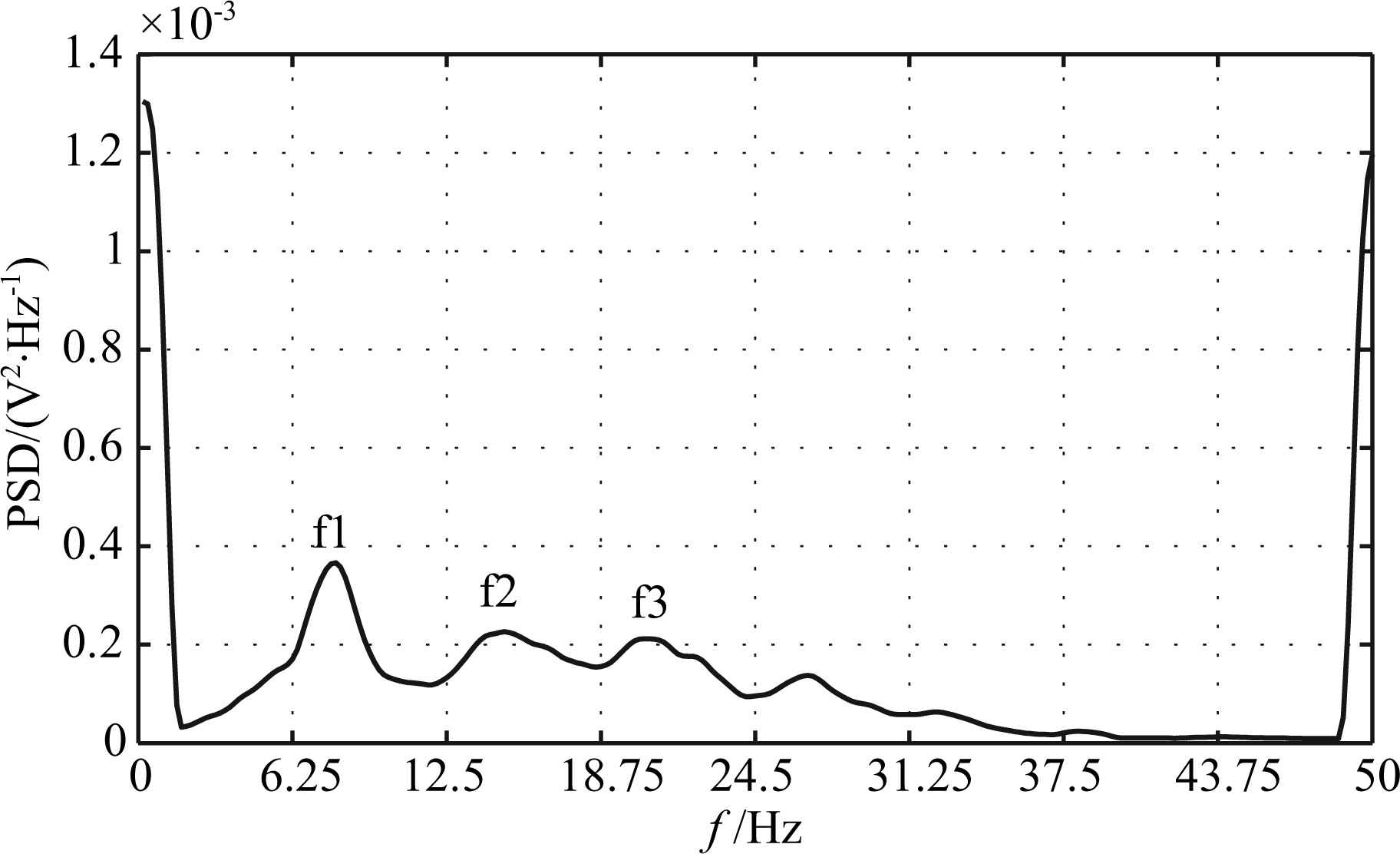
Every 4096 data points (about data length of 40 seconds) are subjected to DFT,and we obtain a section of PSD through the direct method. We take the theoretical frequencies for the first three modes,about 8 Hz,14 Hz and 20 Hz,as central frequencies,to looks for the frequency and PSD corresponding to maximal crest in the ±2 Hz range of central frequencies. Fig.2 demonstrates PSD at the intervals of 42 nd to 82 nd second in 01 hour on March 8,2011. We acquire peak frequencies (f1,f2,f3 as shown in Fig.2) and corresponding PSD of the first three modes through confirming three crests in the range of 8±2 Hz,14±2 Hz and 20±2 Hz. And then,the procedure averages about 87 frequencies and PSD in one hour (360000 data points). We finally obtain hourly average frequencies and PSD for the first three modes.
|
Fig.2 Power spectrum of Schumann resonance during 01 h 42–82 s on March 8, 2011 |
modes Using data of 15 days,i.e.,seven days before and equinoxes and solstices,this section presents diurnal variation of frequencies and PSD for the first three SR modes through the data processing method introduced in 3.1.1. Fig.3 shows diurnal variation of PSD both in BNS and BEW components in four seasons. We can see that PSD in BNS PSD in BEW component has some differences in four seasons,but there are common features in diurnal variation. PSD for various SR modes exhibits a maximum value at around 17 LT (09 UT). Diurnal variation of PSD in BNS component is more complicated. There are peaks about at 16-18 LT and 22-24 LT around spring equinox. At summer solstice,two peaks appear at 03-05 LT and 16-18 LT. The most significant peak is at 16-18 LT at autumn equinox. There are three minor peaks at 03-05 LT,16-17 LT and 22-24 LT around winter solstice. Generally speaking,peaks are more probable to appear at 03-05 LT (19-21 UT),16-18 LT (08-10 UT) and 21-23 LT (13-15 UT). Comparing with global thunderstorm centers,the dominant intervals of American,African and Asian source are at 21:00UT±1h,15:00UT±1h and 08:00UT±1h,respectively[7, 11]. From appearence time of peaks,BEW component is more sensible to Aisan source,and BNS component is well correspondeding to active intervals of three centers. Three thunderstorm centers are mainly located in east-west direction of the observatory. BNS component is more sensible to the signals from east-west direction. This is the reason that BNS component well corresponds to three active periods. The Asian center is close to the observatory,and it is the only center which lies nearly in the north-south direction relative to the observatory. So BEW component is mainly affected by the Asian center.

|
Fig.3 Power spectral density of the lowest three Schumann resonance modes both in BNS and BEW components around equinoxes and solstices |
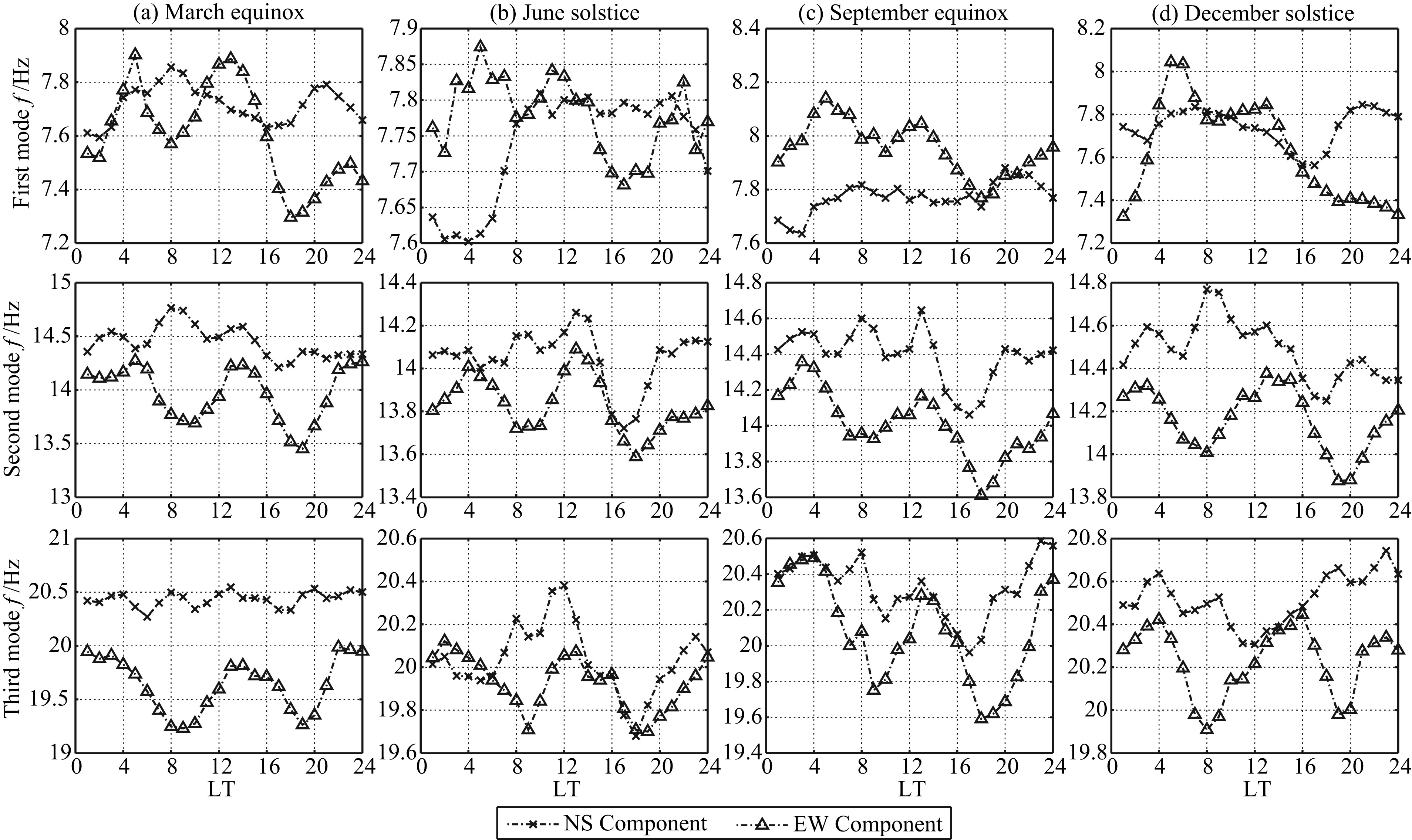
Similar to Fig.3,Fig.4 presents diurnal variation of frequencies for the lowest three SR modes both in BNS component and BEW component. Diurnal variations of frequencies are more complicated compared with diurnal variations of PSD. The trends of diurnal variation of frequency at the same SR mode are similar in different seasons. Frequencies in BNS component is 0.1~0.5 Hz larger than that in BEW component.
|
Fig.4 Frequency of the lowest three Schumann resonance modes both in BNS and BEW components around equinoxes and solstices |
For BEW component,the frequency range of the first SR mode is 7.2 to 8.2 Hz,and there are two peaks appearing at 04-05 LT and 12-13 LT. The range of the second mode is 13.5 to 14.5 Hz,and three peaks are at 03-04 LT,12-13 LT and 22-23 LT. The range of the third mode is 19.5 to 20.5 Hz,and intervals of three peaks are similar to the second mode. Semidiurnal harmonics dominate in frequencies of various SR modes in BEW component.
For BNS component,the frequency of the first mode changes between 7.6 and 7.9 Hz,and there are minor peaks around 8 LT and 21 LT. The range of second mode is 13.8 to 14.8 Hz,and frequency variation in one day in the same season is smaller than 0.5 Hz. Four small peaks appear at 04 LT,08 LT,13 LT and 20 LT. The frequencies of the third mode in four seasons do not show consistent variation features. The frequency variation in one day is smallest around spring equinox,within 0.2 Hz. The variation range is within 0.4 Hz at winter solstice. The frequency variation range is larger at summer solstice and autumn equinox with about 0.7 Hz changing extent.
Diurnal variation of resonance frequency may be caused by the effect of distance change between thunderstorm centers and the observatory[12, 13]. In a dissipation system,observed peak frequency corresponding to the maximum power may be shifted relative to the eigenfrequency of Earth-ionosphere cavity due to power leakage of adjacent resonances. For a fixed observatory,its distance from thunderstorm source changes with time and the amount of power leakage also varies with time. This effect produces time-varying shift of peak frequency[13].
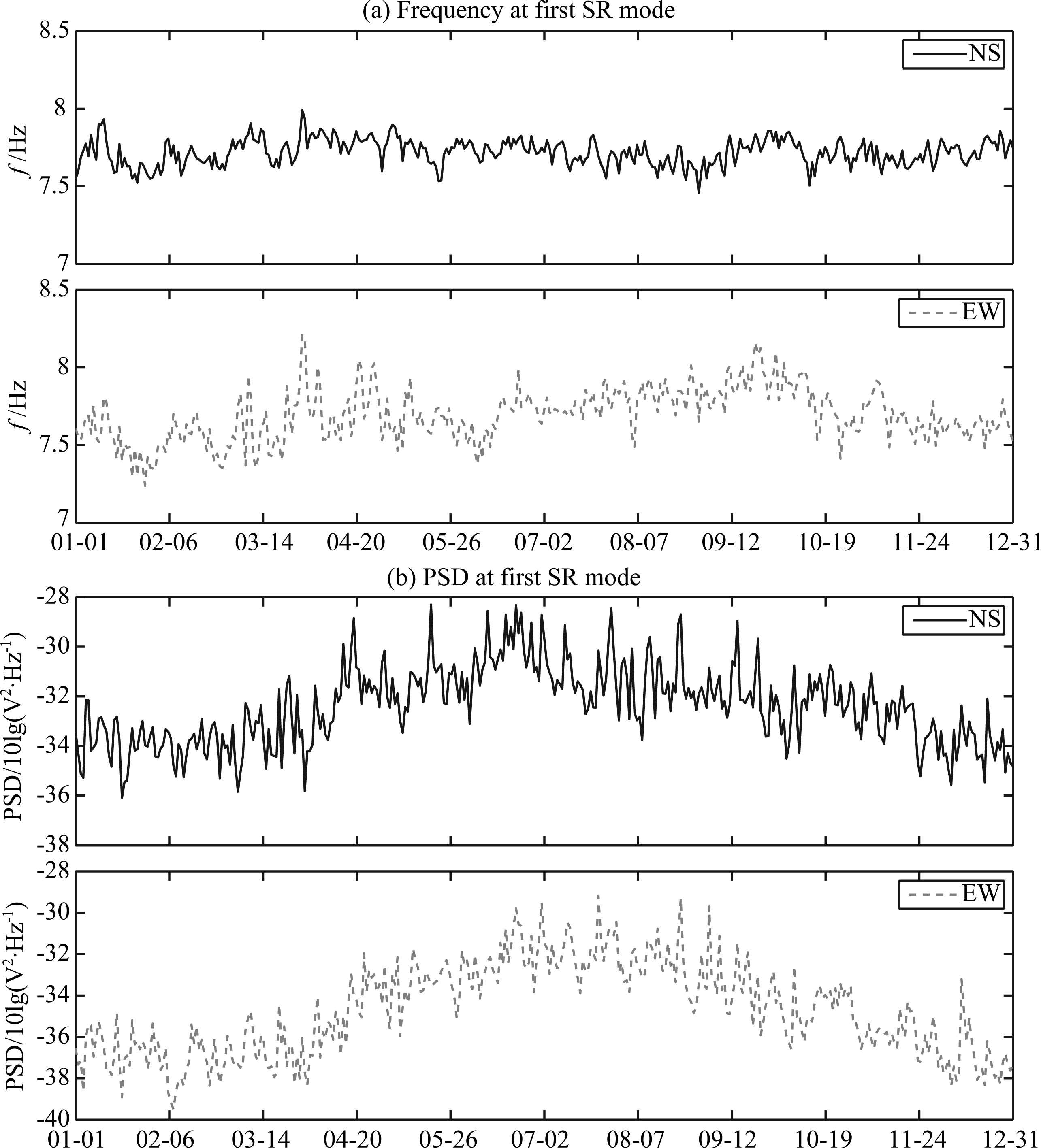
3.2 Seasonal VariationFrom diurnal variation of frequency and PSD showed in Fig.3 and Fig.4,we know that SR parameters are more variable in summer and autumn than that in spring and winter. This characteristic is related to more intensify lightning activities and ionization in D region in summer and autumn. For more clear presentation of seasonal variation of SR,Fig.5 shows daily median of frequency and PSD for the first mode both in BNS and BEW components in 2011 at the Yongsheng observatory. Figure5a presents the frequency of the first mode,and it is found that frequencies change slightly. The seasonal variation of frequency is blurry from the plot of the daily median frequency in one year. Figure5b shows PSD of the first mode,and daily median PSD presents the shape of half a period of sine curve. PSD shows increased tendency from January to July,while PSD decreases from July to December. The PSD variations in the whole year are symmetrically distributed about July.
|
Fig.5 Frequency and power spectral density of the first Schumann resonance mode both in BNS and BEW components in 2011 at Yongsheng observatory |
Daily median frequencies of the second and third modes have the similar features with the first mode frequency (not presented in this paper). The frequency alters little in one year,and the seasonal variation characters are not distinct. Daily median PSD of higher modes and that of the first mode are alike in variation. PSD is intensifying during periods of April to September,while PSD is weak between October and March.
Above analysis indicates that frequencies of various modes are relatively stable in four seasons. PSD of the first three modes is larger in rainy seasons than that in dry seasons,and this characteristic is consistent with lightning seasonal variation,i.e. lightning activities reach max during summer in the northern hemisphere as reported by Christian et al.[14].
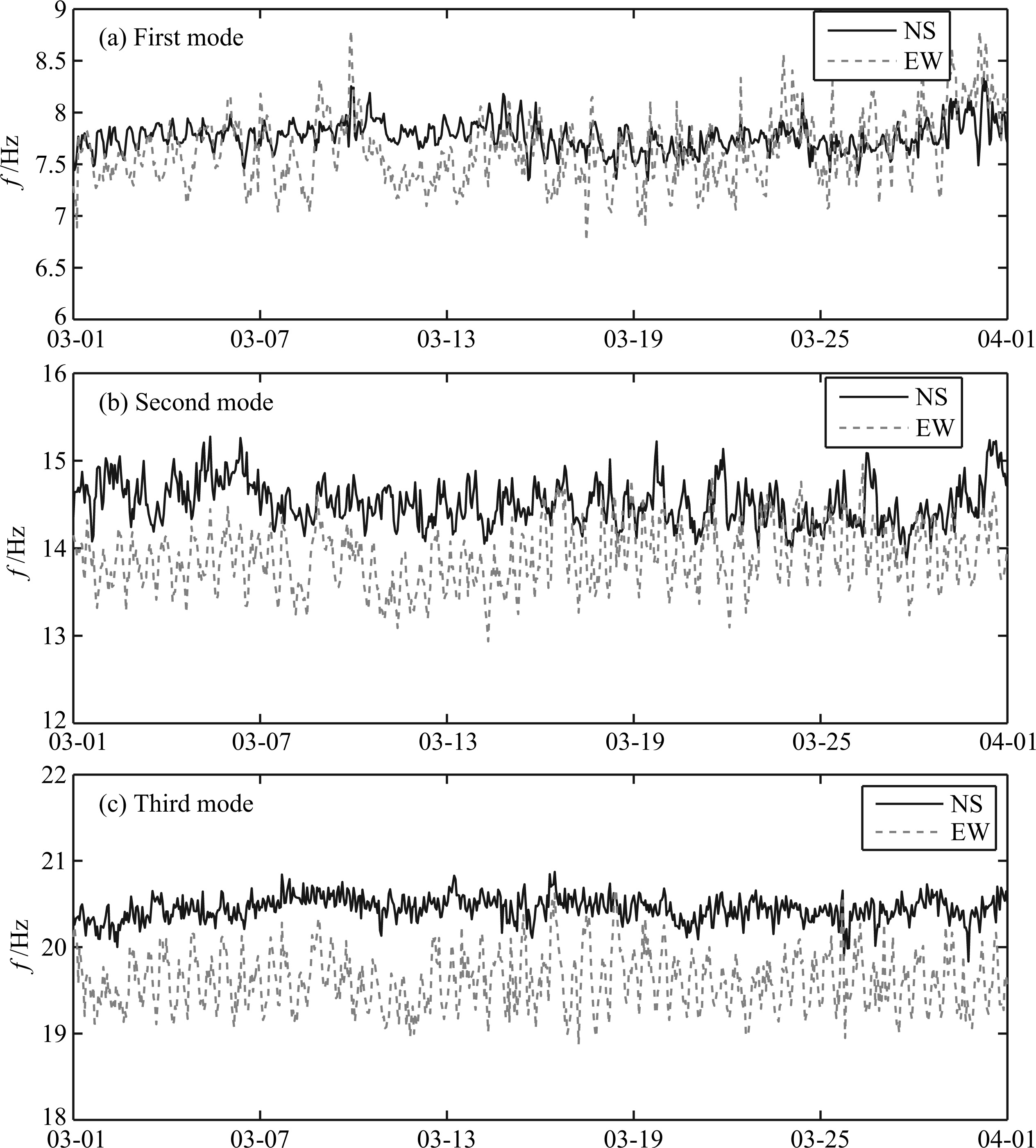
3.3 Frequency ShiftFigure6 shows variation features of peak frequencies for the lowest three modes both in BNS and BEW component in March 2011. Black solid line represents the results of BNS component and gray dashed line is the peak frequencies in BEW component. The peak frequencies of the first mode both in BNS and BEW component are at about 7.5 Hz,and the difference between two components is slight (see Fig.6a). The frequencies of the second and third modes in BNS component is 0.5 Hz larger than that in BEW component (see Fig.6(b,c)). It indicates that the first mode frequency is more stable,while with higher modes,the resonance frequencies shift between BNS and BEW component. Sentman et al. reported that the resonance frequency difference between BNS and BEW component is as much as 0.5 Hz by analyzing horizontal magnetic observations at 3-60 Hz during September 1985,and they suggested that this may be caused by different polarized magnetic fields in one day[15]. This paper provides resonance frequencies in BNS and BEW component in a longer period,and demonstrates that there is larger shift with higher mode. The reason for this phenomenon is complicated. At present,we just qualitatively think that it is associated with inhomogeneity of the Earth-ionosphere cavity and anisotropy of the Earth’s magnetic field.
|
Fig.6 Peak frequency at the lowest three Schumann resonance modes in March 2011 |
This paper analyzes SR parameters both in BNS and BEW component in 2011 at the Yongsheng observatory. We exact peak frequencies and PSD for the first three modes to analyze diurnal variation,seasonal variation and frequency shift. We summarize the results of this study as follows:
(1) PSD of the first three modes presents diurnal variation features,and there is a good relationship between intervals of PSD peaks and active periods of Asian,African and American sources. PSD in BNS and BEW components has different features which are related to the relative locations of observatories and three thunderstorm centers. The Asian source is located nearly in north-south direction relative to the observatory,so BEW component is sensible to the signals from the Asian source. African and American sources are distributed in east-west direction relative to the observatory,and the Asian source is distributed slightly more in east direction relative to the observatory. The geometry of observatory and thunderstorm centers makes BNS component records information from three thunderstorm centers. Diurnal variation of frequencies is more complicated,because resonance frequency may be controlled by distance change between thunderstorm centers and the observatory and upper bound (D region) of Earth-ionosphere cavity[16]. Resonance frequency may also be dependent on diurnal variation of ionization of the D region,especially change of the nominal height of the conductivity profile[13]. Price et al. found that peaks of diurnal profile of amplitude for different SR modes were well related to active intervals of three thunderstorm centers by using data of four years recorded in Israel,while diurnal variation of frequencies is more complex[6]. This is consistent with the results of this study.
(2) Analysis of PSD and frequencies for the first three modes around equinoxes and solstices indicates that PSD is larger in summer and autumn than that in spring and winter,so does frequencies variation range. This feature may be associated with more intensified lightning activities and ionization in D region,and the change of D region height as well. In addition,from the plot of daily median frequency and PSD of the first SR mode both in BNS and BEW component in 2011 at the Yongsheng observatory,it is found that frequency changes slightly and seasonal variation is not distinct. PSD presents clear seasonal variation,and there is an increasing trend from January to July,while a decreasing tendency from July to December. This characteristic is consistent with seasonal variation of lightning activities and accordant to the trend of amplitude for various modes in one year reported by S′atori et al.[4].
(3) The frequency of the first mode in BNS and BEW component is stable,at about 7.5 Hz. With higher modes,frequencies determined by two components shift about 0.5 Hz. Sentman et al. also found that resonance frequencies in BNS and BEW components are different as much as 0.5 Hz[15]. We have learned preliminarily about frequencies and PSD for various SR modes in Yunnan through this work. With the accumulation of data,it is necessary to carry out analysis of background features in a longer interval. It is considered that time series should be subject to denoising in future’s work to make use of records from multiple observatories in Yunnan and to obtain steadier SR features. Meanwhile,it is needed to carry out further study on the reason for generation of SR background variations.
5 ACKNOWLEDGMENTSWe are grateful to Xiao Zuo,Zhang Donghe and Hao Yongqiang of Peking University for their beneficial discussion on data processing and results. We also thank Qiao Xiaolin and Yu Haiyan of Harbin Institute of Technology at Weihai for their collaboration on instruments. This study was supported by the Basic Research Project of Institute of Earthquake Science,CEA (2013IES0306).
| [1] Schumann W. Über die strahlungslosen Eigenschwingungen einer leitenden Kugel die von einer Luftschicht und einer Ionosphärenhülle umgeben ist. Zeitschrift Naturforschung Teil A, 1952, 7:149. |
| [2] Balser M, Wagner C. Observations of Earth-ionosphere cavity resonances. Nature, 1960, 188(4751):638-641. |
| [3] Sentman D D, Fraser B J. Simultaneous observations of Schumann resonances in California and Australia:Evidence for intensity modulation by the local height of the D region. J. Geophys. Res., 1991, 96(A9):15973-15984. |
| [4] Sátori G, Zieger B. Spectral characteristics of Schumann resonances observed in Central Europe. J. Geophys. Res., 1996, 101(D23):29663-29669. |
| [5] Roldugin V C, Maltsev Y P, Vasiljev A N, et al. Diurnal variations of Schumann resonance frequency in NS and EW magnetic components. J. Geophys. Res., 2004, 109(A8):A08304. |
| [6] Price C, Melnikov A. Diurnal, seasonal and inter-annual variations in the Schumann resonance parameters. Journal of Atmospheric and Solar-Terrestrial Physics, 2004, 66(13-14):1179-1185. |
| [7] Hayakawa M, Nickolaenko A P, Sekiguchi M, et al. Anomalous ELF phenomena in the Schumann resonance band as observed at Moshiri (Japan) in possible association with an earthquake in Taiwan. Nat. Hazards Earth Syst. Sci., 2008, 8(6):1309-1316. |
| [8] Hayakawa M, Ohta K, Nickolaenko A P, et al. Anomalous effect in Schumann resonance phenomena observed in Japan, possibly associated with the Chi-chi earthquake in Taiwan. Annales Geophysicae, 2005, 23(4):1335-1346. |
| [9] Ohta K, Watanabe N, Hayakawa M. Survey of anomalous Schumann resonance phenomena observed in Japan, in possible association with earthquakes in Taiwan. Physics and Chemistry of the Earth, Parts A/B/C, 2006, 31(4-9):397-402. |
| [10] Miao Y Q, Zhang X M, Shen X H, et al. Initial results on anomalous Schumann resonance before earthquakes in Yunnan. Earthquake Research in China (in Chinese), 2011, 27(3):290-299. |
| [11] Nickolaenko A P, Hayakawa M. Resonances in the Earth-Ionosphere Cavity. Dordrecht:Kluwer Academic Pub., 2002. |
| [12] Nickolaenko A P, Rabinowicz L M. Study of the annual changes of global lightning distribution and frequency variations of the first Schumann resonance mode. Journal of Atmospheric and Terrestrial Physics, 1995, 57(11):1345-1348. |
| [13] Sentman D D, Resonances S. Handbook of Atmospheric Electrodynamics, Vol. 1. Boca Raton:CRC Press, 1995:267-298. |
| [14] Christian H J, Blakeslee R J, Boccippio D J, et al. Global frequency and distribution of lightning as observed from space by the Optical Transient Detector. J. Geophys. Res., 2003, 108(D1):ACL4-1-ACL4-15. |
| [15] Sentman D D. Magnetic elliptical polarization of Schumann resonances. Radio Sci., 1987, 22(4):595-606. |
| [16] Schlegel K, Fllekrug M. Diurnal harmonics in Schumann resonance parameters observed on both hemispheres. Geophys. Res. Lett., 2000, 27(17):2805-2808. |