 2013, Vol. 56


2. Department of Earth Sciences, Sun Yat-Sen University, Guangzhou 510275, China;
3. State Key Laboratory of Loess and Quaternary Geology, Institute of Earth Environment, Chinese Academy of Sciences, Xi'an 710075, China
The impetus for people to explore the process of sedimentary processes in sea-land transitional zones and their characteristics is to understand the change of regional environmental conditions during sea-land interaction,as well as to assess the influence of fluctuating sea level on human life[1, 2, 3]. For this purpose,such type of zones have been studied for a long time,and in recent years the environmental magnetism method has been gradually employed,which has played an active role in modeling the transitional history of sedimentary environments[4, 5, 6, 7, 8]. The change of concentration,grain size and type of magnetic minerals in sediments results from the terrigenous factor-dominated changes in the driving force for transport of sediments,the input of terrigenous detrital materials,and the marine factor-controlled fluctuation changes in the sea level. Therefore,the change of grain size and transition type of magnetic minerals can not only reflect the enhancement or weakening of hydrodynamic conditions caused by the sea level rise or decline,but also reflect the transition of the redox environment and the intensity of diagenesis in sedimentary zones.
The Fuzhou basin,located in southeastern China,is a sea-land transitional zone formed when the Min River flows into the East China Sea. It lies in the East Asian monsoon region,and the monsoon-controlled rainfall variation has an important effect on the sedimentary process by influencing the terrigenous detritus input in this area. The Holocene sea level fluctuation controlled the redox environment,and the diagenesis deeply imprinted the sedimentary characteristics of this area. Furthermore,the Fuzhou basin is an area where the Neolithic culture had ever been highly prosperous and ancient human activities had been frequent. As a result,there are a large number of Neolithic cultural remains discovered in this basin,such as the Zhuangbianshan site[9],Tanshishan site[10],and Fucun site[11]. Hence this area is an ideal place for studying the environmental change process to understand the impact of the past climatic change on human society. However,high-resolution studies of this area are still very few[3]. In this paper,using the environmental magnetism method and chronological dating,we mainly discuss the relationships between the terrigenous detritus input,sea level change,diagenesis and the magnetic properties of sediments,so as to provide basic data for environmental magnetism study on delta areas.
2 OUTLINE OF THE AREA 2.1 Geologic Setting and Core DescriptionThe Fuzhou basin,1478.6 m2 in size,lies in the middle coastal zone of Fujian Province,southeast China mainland,and is an intermontain fault-bounded basin of the Early Pleistocene[12]. It is surrounded by mountains and hills with altitudes 80 m to 450 m,and the Min River passes through the middle of the basin and flows into the East China Sea. The basement of the basin is composed of Late Yanshanian granite and Jurassic granite. It long-term remained stable with a red weathered layer developed in the Middle Pleistocene,subsided continuously and began to receive sediments in the Late Pleistocene. The whole sedimentary system includes marine facies,terrestrial facies and marine-terrestrial alternating facies,with complex sedimentary structure and thickness ranging from several meters to several tens meters due to the variation of basement,with a maximum being more than 70 m[13, 14].
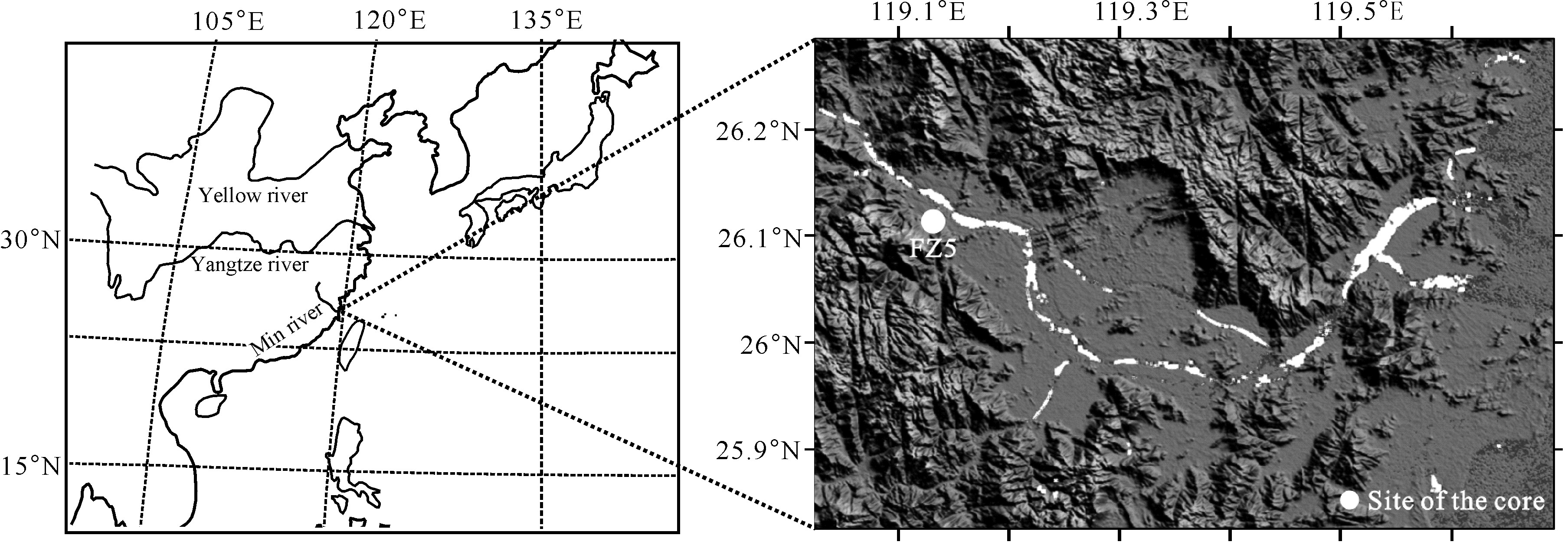
Core FZ5(119°07048.200E,26°06052.800N) is located in the northwest of the basin,where elevation is about 12 m,approximately 4 km off the river course of the Min River (Fig.1). It was completed by circumvolving coring using a non-magnetic plastic tube. The core is about 12.74 m in length,with a > 95% coring rate without obvious interruption in sedimentation. The sediments include cyan-gray clay in the bottom,from 12.74 m to 7.9 m,gravelly silt and gravelly sand from 7.9 m to 7.5 m,peat bed from 7.5 m to 7.0 m,gray-brown and yellow-brown clay from 7.0 m to 3.0 m,and artificial earth fill within 3.0 m.
|
Fig.1 Simplified geologic map of the Fuzhou basin and location of core FZ5 |
After the core was split lengthwise,a Bartington Ms2 magnetic susceptibility meter was employed to measure the volume susceptibility (κ) of the sample,and then a U-Channel (2 cm×2 cm×150 cm) non-magnetic plastic tube was vertically pressed into the lengthwise section of the core to continuously take samples,which were used to determine such magnetic parameters of sediment as natural remanent magnetization (NRM),anhysteresis remanent magnetization (ARM),and isothermal remanent magnetization (IRM). In addition,1.9 cm×1.9 cm×1.9 cm cubic samples and powder samples were taken for rock magnetic tests including saturation isothermal remanent magnetization (SIRM) acquisition curves,remanent coercive force spectrum (Bcr),hysteresis loops,and thermomagnetic curves.
U-Channel continuous samples were placed at a spacing of 2 cm in a 2G-760 system; the NRM of the sediments was demagnetized gradually within an alternating field interval of 0~90 mT (at a step length of 10 mT) and the remanent magnetization was measured. Afterwards,an alternating field with a peak of 80 mT and a 0.05 mT direct current field were applied to measure the ARM,and 20,40,60 and 80 mT alternating magnetic fields were applied respectively,to conduct gradual demagnetization and to measure remanent magnetization. After the samples were magnetized in a 2G-760 IRM impulse magnetometer with a 1 T impulse field applied,their SIRM was measured in the 2G-760 system; then alternating fields same as those for ARM were applied to conduct demagnetization and to measure the remanent magnetization. A 1 T impulse field and a -300 mT counter magnetic field were applied to the samples again to measure the isothermal remanent magnetization IRM-300mT; the ratio IRM-300mT/IRM1T was defined as S300 [15]. Some parallel-samples were selected to measure the hysteresis loop parameter of sediment in a MicroMag3900 alternating gradient magnetometer system; some dried powder samples were used to measure the temperature-dependent (T) (from room temperature to 700 °C) magnetization intensity (J) curves and magnetic susceptibility curves of sediments with a VFTB system and a KLY-3S/CS-3 system,respectively,(the heating rate was 30°/min) (the magnetization intensity was measured in the air atmosphere and the magnetic susceptibility was measured in the argon atmosphere; two samples from 3.86 m and 4.8 m were measured twice in the air atmosphere and the argon atmosphere,respectively). All magnetic experiments were completed in the Paleomagnetism and Geochronology Laboratory,Institute of Geology and Geophysics,Chinese Academy of Sciences.
Two representative samples with significantly different colors were taken from depths ~4.8 m and ~10.18 m; after repeated wet cyclic magnetic separation,these two samples were analyzed using scanning electron microscopy/energy dispersive spectrometry (SEM/EDS) (instrument model: S-520/ISIS-300; completed in the Instrumental Analysis & Research Center,Sun Yat-sen University) and X-ray diffraction analyzer (XRD) (instrument model: Rigaku D/MAX IIIa; completed in the School of Earth Sciences and Engineering,Nanjing University).
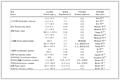
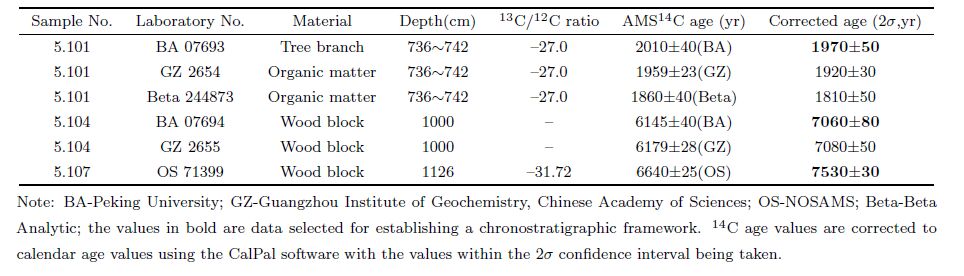
4 14C DATINGThree phytoclasts or whole-rock organic matter samples were selected first to conduct chronological dating in different 14C laboratories (Table1). These samples were divided into one part,two parts and three parts,respectively,which were pretreated and tested in the Guangzhou Institute of Geochemistry,Chinese Academy of Sciences; State Key Laboratory of Nuclear Physics and Technology,Peking University; or National Ocean Sciences Accelerator Mass Spectrometry Facility (NOSAMS),respectively. Samples 5.107 (11.26 m) and 5.104 (10 m) were taken from wood blocks in the clay layer in the bottom of the core,and the sample 5.104 was divided into two parts,which were sent to both State Key Laboratory of Nuclear Physics and Technology,Peking University and Guangzhou Institute of Geochemistry,Chinese Academy of Sciences for test,and of which the results have good consistency,as 7170~6940 cal. yr BP. The third sample 5.101 (7.4 m) was a large tree trunk,taken from the peat bed with rich organic matter. As a peat bed is a good indicator of sea-level change,the sample 5.101 was divided and submitted to three different laboratories in order to obtain accurate age results. The dating results are very close to each other,and are about 1900 cal. yr BP. All dating samples were from the middle and middle-to-lower parts of core FZ5,and no 14C dating material was found in other parts of the core,so the sedimentary ages of the top and bottom of the cire could not be determined. Due to the characteristic of large change in the sedimentation rate in the delta basin,we did not establish the chronology sequences of core FZ5 using the method of linear interpolation to age points in this paper.
|
Table 1 Accelerator mass spectrometry (AMS) 14C dating results for core FZ5 |
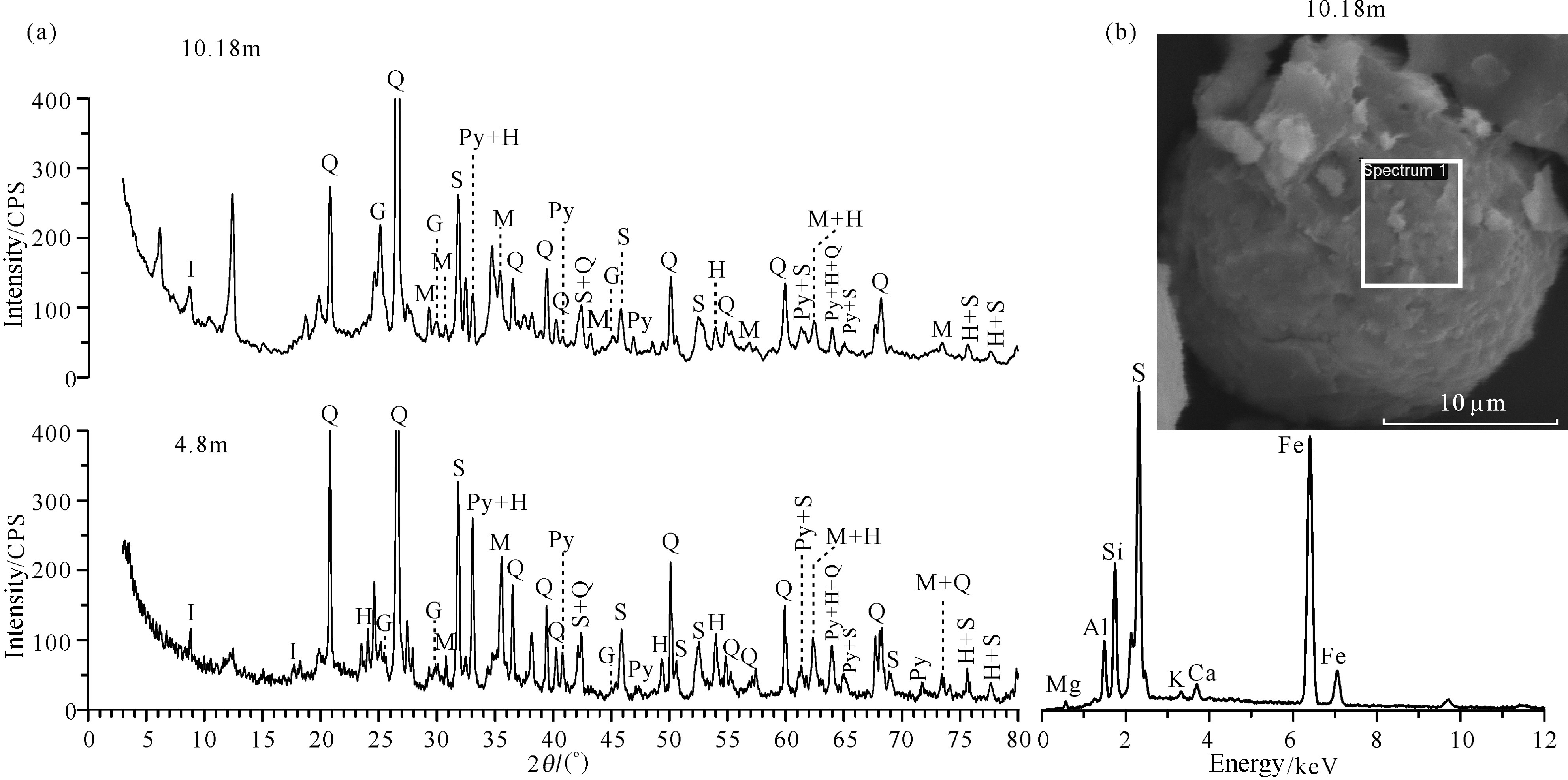
The XRD results of two representative samples show that the types of magnetic minerals are similar as a whole,and all containing magnetite,hematite,siderite,pyrite and greigite (Fig.2a). The analysis of intensity of diffraction peaks shows that the sample from depth ~4.8 m contains much hematite and little magnetite with weak greigite information,whereas the sample from depth ~10.18 m contains much magnetite with conspicuous greigite diffraction peaks,and spheroidal iron sulfide can be found in the sample by scanning electron microscope (Fig.2b).
|
Fig.2 X-ray powder diffraction pattern (a) and SEM image and energy dispersive spectra (EDS)(b) for representative samples Identified peaks are labeled for illite(I),quartz(Q),hematite(H),greigite(G),magnetite(M),siderite(S),pyrite(Py). |
Further rock magnetic test results are similar to those of XRD. The SIRM acquisition curves of 11 representative samples (Fig.2a) reveal that,at 300 mT,all samples did not reach saturation magnetization and the obtained remanent magnetization intensity was about 72%~95% of SIRM. When the magnetic field reached 800 mT,the saturation magnetization was reached. It indicates that the main magnetism-dominant components in the sediments included a certain quantity of magnetic minerals with medium-high coercivity,in addition to magnetic minerals with low coercivity. The Bcr spectra and hysteresis loops of sediments clearly exhibit two magnetic mineral types (Figs. 3b and 3c). One type is in the samples from depths above 7.9 m,of which the Bcr values ranges from 60 mT to 80 mT and the hysteresis loops show a wasp-waisted feature and tend to be closed when magnetic field is 800 mT (Fig.3c). This indicates that the components with medium-high coercivity have important contribution to the remanent magnetization of sediments (with the samples from 3.86 m,4.8 m,6.22 m and 7.2 m as representatives)[16, 17]. The other type is in the samples from depths below 7.9 m,of which the Bcr values are < 50 mT and the hysteresis loops tend to be closed when the magnetic field is 500 mT; implying that the components with medium-high coercivity have little contribution to the magnetic properties of sediments.

|
Fig.3 IRM acquisition curves,coercivity spectra of SIRM and hysteresis loops of representative samples (a) SIRM acquisition curves; (b) Bcr Spectra; (c) Hysteresis loops; (d) Day diagram[18]. Hollow (solid) circles represent samples above (below) 7.9 m,the boundry of magnetism domain is based on Ref.[18]. SD,single domain; PSD,pseudo-single-domain; MD,multidomain. |
We further analyzed the thermomagnetic curve characteristics of sediments (Figs. 4 and 5) and found that for the samples with Bcr > 50 mT (with the samples from 3.86 m and 4.8 m as representatives),the magnetic susceptibility starts to significantly rise when the samples are heated to about 225 °C,reaches its maximum at about 300 °C,and then starts to decline with increasing temperature. In the cooling curves,the magnetic susceptibility starts to significantly rise after the temperature is less than 580 °C,reaches its peak at about 350 °C,and then exhibits a gradual descending trend with declining temperature. At room temperature,the magnetic susceptibility in the cooling curves is much higher than that in the heating curves. The temperaturedependent magnetic susceptibility curves in the air atmosphere exhibit similar characteristics to those in the argon atmosphere. However,the minimum of magnetic susceptibility does not appear until 650 °C,which indicates that there may be hematite in the samples. In the cooling curves,the magnetic susceptibility shows an ascending trend from ~310 °C,indicating that pyrite may have been oxidized into pyrrhotite in the heating process[19]. In the air atmosphere,the temperature-dependent magnetization intensity curves do not exhibit great increase similar to that in the magnetic susceptibility change curves,and the magnetization intensities of some samples (e.g.,the sample from depth 7.2 m) did not reach their minimum values until ~650 °C; the cooling curves are also higher than the heating curves.

|
Fig.4 Temperature-dependent magnetic susceptibility curves for the representative samples Solid (dotted) lines represent heating (cooling) curves. a and b,in the air atmosphere; the others,in the argon atmosphere. |

|
Fig.5 Curves of temperature-dependent magnetization of the representative samples Solid (dotted) lines represent heating (cooling) curves. |
To more clearly reveal the contribution of the magnetic minerals in sediments to the characteristics of thermomagnetic curves,we heated the same group of samples repeatedly and stepwise in the argon atmosphere to observe the magnetic susceptibility change characteristics. For the samples with Bcr > 50 mT (samples from depths above 7.9 m),they were heated for the first time to 280 °C and then cooled. It was seen that there are obviously new magnetic minerals generated. After cooling down,the samples were heated for the second time to 350 °C. Consequently the magnetic susceptibility starts to decrease slowly at about 280 °C and that the cooling curves are slightly lower than the heating curves,indicating that there are no new magnetic minerals generated in the second heating process. After cooling down,the samples were heated again to 700 °C. During this heating process,the magnetic susceptibility also starts to decrease at ~280 °C,has an inflection point at ~450 °C,and continuously decreases until ~580 °C,the Curie temperature of magnetite reaches its minimum,and the cooling curves are far higher than the heating curves,indicating that there is a large amount of magnetite newly generated in the heating process after 350 °C. With the XRD results being considered together,it can be thought that the ascending of magnetic susceptibility curves at ~250 °C and descending after 280 °C should be attributed to the greigite in the samples[20]; whereas the ascending of magnetic susceptibility curves after 350 °C should be ascribed to the new magnetite and maghemite generated from decomposition of the pyrite and siderite in the samples in the heating process[19, 21, 22].
For the samples with Bcr < 50 mT (Figs. 4f,4g and 4h ; Figs. 5c,5d and 5e),the magnetic susceptibility has a weak peak at ~225 °C,starts to greatly rise at ~420 °C,reaches its maximum at ~530 °C,and then rapidly decreases until ~580 °C to reach its minimum (reaching its minimum after 650 °C for some samples). The magnetic susceptibility after cooling is also much larger than that before heating. In the air atmosphere,the temperature-dependent magnetization intensity curves exhibit the similar characteristics,indicating that there may be pyrite in the sediments,which forms magnetite in the heating process[19]. Of course,it cannot be excluded that partial ferrous silicate mineral or clay mineral is converted into magnetite in the heating process[23, 24]. These characteristics show that the magnetic minerals in this type of samples are mainly magnetite and probably a little greigite,and some samples contain a little hematite. Pyrite,as a paramagnetic mineral,may exist in the samples (Fig.6b). The stepwise heating curves of these samples also show that the newly generated magnetite is also largely concentrated in the heating temperature interval of 400 °C~520 °C,so it should be from the comprehensive contribution of siderite and pyrite in the samples[19, 21, 22].

|
Fig.6 Temperature-dependence susceptibility measurements for the representative samples in the argon atmosphere Maximal temperatures are 280 °C,350 °C,450 °C,560 °C,700 °C,Solid (dotted) lines represent heating (cooling) curves. |
Hysteresis loop parameters of the representative samples on Day-Plot (Fig.3d) show that the samples from depths above 7.9 m (with samples from 3.86 m,4.8 m,6.22 m,and 7.2 m as representatives,marked by circles in Fig.2d) or at the corresponding sedimentary stage are small particle-size distribution (PSD) particulate minerals. The samples from depths below 7.9 m are large-PSD (close to MD) particulate minerals,which is consistent with the sediment lithology that the sediments are mainly clayish. However,there are magnetic minerals with medium-high coercivity existing in the sediments at depths above 7.9 m,which disturb determining the grain size of magnetic minerals,so the indicative significance of grain size is only for reference.
Summarizing the above XRD,SEM and rock magnetic results,we found that the magnetic minerals in the sediments from core FZ5 have two major types. One type (12.74~7.9 m) contains mainly PSD particulate magnetite as dominant minerals,and also contains siderite and pyrite and a little greigite,and the sediments in several horizons contain a little hematite. The other type (7.9~3 m) contains mainly magnetite,and hematite in slightly higher proportion compared with that in the layers with depths below 7.9 m,and contains siderite and still a little greigite and pyrite.
5.2 Variations of Environmental Magnetic Parameters with DepthBased on the depth-dependent change characteristics of volume susceptibility κ,SIRM,ARM,ARM/SIRM,S300 and IRM80mT/SIRM and the lithology characteristics of the sediments (including color,grain size,and peat bed) (Fig.7),the sedimentary process represented by core FZ5 can be divided into three stages. The first stage is from 12.74 m to 7.9 m,with highly variable amplitudes of various magnetic parameters. The magnetic minerals are mainly magnetite with low coercivity,with average S300 of ~0.85. Several horizons with small S300 reflect a little magnetic mineral with high coercivity (hematite) in the sediments. Both the ARM and SIRM exhibit a clear large-small-large cycle process,and the S300 ratio shows a high-low-high change accordingly. This indicates that when the concentration of magnetic minerals is high,the content of magnetic mineral components with low coercivitye is large,and when the concentration of magnetic minerals decreases,the content of magnetic mineral components with high coercivity increases accordingly. The peaks of three groups of ARM and SIRM around depths of ~10.4 m,11.3 m and 12.3 m reveal three periods with significant increase in the concentration of magnetic minerals. The second stage is from 7.9 m to 7.0 m,marked by lithology abruptly changing from fine-grain clay to gravelly coarse sand,with S300 reducing gradually from 0.91 to ~0.8 and gradual rising of IRM80mT/SIRM increasing indicates that the proportion of magnetic minerals with high coercivity increases gradually,which is consistent with the rock magnetic test (Figs. 3a and 3b). Each of κ,ARM and SIRM decreases rapidly from its maximum to the minimum in the whole core. The ARM/SIRM decreases rapidly and shows a continual low value in the sediments of the whole second stage. The third stage covers 7.0 m to 3.0 m,marked by abrupt change from underlying peat layer to gray brown fine-grain clay,and various magnetic parameters changed most significantly at the stage. Although in the segment from 5.5 m to 4.5 m,the S300 is high and the IRM80mT/SIRM is low,the S300 decreased and the IRM80mT/SIRM increased as a whole at the stage,which reveals that the magnetic components with medium-high coercivity have important effects on the magnetic properties of the sediments and that the sedimentary environment starts to significantly change. The rock magnetic results indicate that the minerals,including magnetite,hematite,and siderite,jointly become important dominant minerals in the sediments.

|
Fig.7 Variations of environmental magnetic parameters in core FZ5 sediments with depth. Thick dotted lines represent the boundary between sediment stages,grey dashed lines represent the peak of magnetic mineral concentration,°13C curves is based on Ref.[3] |
The alternating field demagnetization result of the sediments in different horizons differ greatly (Fig.8). In the section from ~3 m to 4.4 m with low S300 ratio,the NRM direction is messy. After the alternating field peak reaches 60 mT,the NRM intensity attenuates by about 40%~80% and then maintains stable; which shows the contribution of the components with high coercivity,and the NRM intensity of the sample from ~4 m even rises with the increase of the alternating field. In the section from ~4.4 m to 5.4 m with high S300 ratio,the NRM direction stably tends to the origin point,and the NRM intensity attenuates by ~75% at 60 mT and then does not change. In the section from ~5.4 m to 6.5 m,some samples also have messy NRM directions,and the NRM intensity rises with the alternating field changing from 0 to 20 mT and then starts to decline to different degrees,and attenuates by about 80%~30% at 60 mT and then remains unchanged. The other samples have relatively stable NRM directions,and the NRM intensity attenuates very rapidly with the alternating field changing from 0 to 30 m,and then broadly maintains stable. For the sample from ~6.3 m,the NRM intensity rises significantly with the increase of the alternating field. For the samples from depths below 6.5 m,the NRM directions are relatively stable within 0~60 mT,but most samples have NRM directions deviating from the original ones after 60 mT,and the NRM intensity after 60 mT maintains stable or rises by different amplitudes with the increasing alternating field,especially with more significant amplitudes for the samples from 8.3~8.6 m,10.3~10.5 m and 12~12.6 m. The samples from ~7.8 m,11.3 m,11.8 m and 12.6 m also exhibit rise in NRM intensity with the increase of the alternating field; the other samples have NRM intensities attenuating with the increase of the alternating field and NRM directions stably tending to the original point (e.g.,the samples from 7.52 m and 8.7 m).

|
Fig.8 Alternating field demagnetization diagram of representative samples in different layers. Panes represent horizontal projection,circles represent vertical projection |
The rock magnetic results and the alternating field demagnetization results of NRM reveal that the sediments in the Fuzhou basin underwent relatively complex diagenesis process including reduction and oxidation with the sea-level fluctuation (Fig.9). At the first stage of the sedimentary process (from ~12.7 to 7.9 m),rich organic matters provided favorable conditions for reduction occurrence[3]. With the decomposition of organic matters and the activities of anaerobic bacteria,partial fine-grain detrital magnetite was reduced into siderite and iron sulfide[4, 25]. Components with low coercivity were still the primary contributors to the remanent magnetization at this stage,but the occurrence of pyrite and the alternating field demagnetization characteristics of NRM clearly indicate how the reduction reforms and impacts on the primary magnetic components. Slight increase in magnetic susceptibility at about 250 °C on the thermomagnetic curves shows that the content of greigite,the intermediate product generated during pyritization,was very small and it was further reduced into pyrite in the ongoing diagenesis process. Estimating the pyrite content and sulfurization intensity in the sediments with the magnetic susceptibility at about 500 °C and the magnetization intensity peak on the thermomagnetic curves,we found that the sulfurization was enhanced with the increase in concentration of magnetic minerals and did not show a directly proportional relationship with the organic matter content. Since the pyrite did not carry remanent magnetization,we further analyzed the change of sulfurization intensity with greigite content. If there is stable single-domain (SD) greigite existing in the sediments,then when the alternating field is larger than 60 mT during the alternating field demagnetization,the NRM will not attenuate but rise with the increase of the alternating field due to rotational magnetization effect[25, 26, 27]. Therefore,the difference of NRM60mT-NRM90mT can be used to roughly estimate the greigite content in samples (Fig.10). Three minimum differences are approximately located in 12.6~12.0 m,10.6~10.2 m and 8.4~8.2 m,respectively,all of which correspond to concentration peaks of magnetic minerals and minima of ARM(0~60mT)/ARM,and the grain sizes of magnetic minerals also become relatively large. Such change in grain size may be related to first dissolution of fine-grain magnetite by diagenesis[4]. However,it cannot deny that the grain size of original magnetic minerals was also relatively large. The cause of this phenomenon may be that when the concentration of magnetic minerals is large,which means large input of terrigenous detrital material,rapid sedimentation rate and large porosity,relatively rich pore water is easier to activate bacterial activity under hot and wet subtropical climatic conditions to produce H2S gas that enhances the sulfurization. The greigite produced during reduction gradually grows into SD particles,which carry some remanent magnetization and cause the SIRM fluctuation to be larger than κ,that is,SIRM/κ appears as a peak. The intensity of reduction is not enhanced with the increase of time and depth,but related to such factors as the concentration and grain size of original magnetic minerals in the sediments,and the amount of H2S gas generated in the pore water. The alternating field demagnetization results of NRM reveal that there was no reduction occurring in some horizons (e.g.,~7.52 m,and ~8.7 m,etc.). Just as pointed out by Rowan et al.[4] and Demory et al.[28],the sulfate-methane transition (SMT) that influences reduction was moving in the early diagenesis process. With approximately 60 mT as the demarcation,there are two types of sTable magnetic components on NRM demagnetization curve. The magnetic components before 60 mT stably tend to the origin point and those after 60 mT deviate from the origin point direction. These results show that the reduction did not completely eliminate the primary magnetic components,and that after the fine-grain magnetite was dissolved and reduced to greigite,the remaining magnetite still carried stable characteristic remanent magnetization.

|
Fig.9 Illustration of the sulfate reduction or oxidation with sea-level change Curves with 100%,50%,20% grey represent sea-level,oxidation,reduction,respectively. Dotted curves represent the present sealevel or the interface has no oxidation and reduction. Positive 1 represents the rising sea level and increasing oxidation or reduction. |

|
Fig.10 Variations of NRM,ARM and SIRM in the core FZ5 with depth. Thick dotted lines represent the boundry of sedimental stages,grey dashed lines represent sulphidation stage,numbers represent strong paleo-oxidation layers |
The characteristics of early diagenesis at the second (from ~7.9 to ~7 m) or the third (from ~7 to ~3 m) stages of the sedimentary process are similar to the first stage,but the characteristics of diagenesis at the middle and late (depths above 5.6 m) third stage show great differences. The magnetic susceptibility increase very significantly at about 280~300 °C and its peak weakens or disappears after ~450 °C,which means that the greigite content in the sediments increases and the pyrite content decreases. Based on the yellow brown color of the sediments (Fig.7),the high coercivity of the magnetic minerals,and the existing research results[3],it can be inferred that the sediments formed at the middle and late third stage belong to terrestrial facies under an oxidation condition. In addition,the organic matter content in the sediments formed at this stage decreases significantly,which is contradictory to the case that sulfurization generally occurs under reducing condition. This indicates that in the hot and wet subtropical climatic zone,sulfurization occurred within a short time after sedimentation. The occurrence cause was related to the condition of high sedimentation rates at this stage (the sedimentation rate was ~0.35 cm/yr at the third stage and ~0.082 cm/yr at the firstandsecond stages,without compaction being taken into consideration) and to more pore-rich water in sediments,which increased the content and mobility of H2S and sulfate to create ideal conditions for diagenesis occurrence[29]. However,the sulfurization lasted for a short time,as the oxidation condition had important suppression on the formation of greigite and the transformation to pyrite. There was no rotational magnetization characteristic of greigite occurring in the process of alternating field demagnetization of NRM. The remanent magnetization directions were messy in the whole demagnetization process in the section with high coercivity but the remanent magnetization was characterized by stably tending to the origin point in the section with low coercivity. This indicates that the minerals with high coercivity generated during the late oxidation,which had much stronger effect on the remanent magnetization than reduction,and basically changed primary remanent magnetization carried by the sediments.
6.2 Response of Magnetic Properties of Sediments to Sea-Level Fluctuation and SedimentaryEnvironment Change Although the sediments from the core underwent reformation by early sulfurization and oxidation so that the primary magnetic properties were changed to a certain extent,such change did not completely eliminate the response characteristics of the magnetic properties to the sedimentary environment. Three significant stages of the rock magnetic and environmental magnetic parameters clearly show the considerable change process during the sea-land interaction. Despite lacking of age control data for the bottom of the core,based on the research of Rolett et al.[3],we can roughly estimate that the sedimentary age of the bottom is about 9 cal. ka BP. Then,based on 14C dating results (Table1),we can estimate the sedimentary ages corresponding to different stages. The first stage (12.74~7.9 m) is about 9~3 cal. ka BP,during which the sea level in the Fuzhou basin started to rise and the water depth increased gradually[3, 30]. Both the rock magnetic properties and the S300 and IRM60mT/SIRM parameters of the sediments indicate that the soft magnetic component magnetite was the main dominant mineral,and the fluctuation in the concentration of magnetic minerals shows the changes in terrigenous detritus input controlled by the driving force for transport. Based on the changes in the concentration of remanence-carrying minerals (ARM and SIRM) and in the S300 ratio,we can infer that the input of terrigenous detritus experienced a change process composed of two sub-stages with the sea-level rise and decline,i.e.,the early (12.74~9.8 m,about 9~6.8 cal. ka BP) drastic fluctuation sub-stage and the late (9.8~7.9 m,about 6.8~3 cal. ka BP) relatively stable substage (Fig.7). At the early sub-stage,the geochemical and diatom records from core FZ5 reveal that the sediments were formed in littoral-neritic facies environment[3] and show the early transgression process in the Holocene. In such a shallow water environment,the magnetic properties of sediments were easy to be influenced by transport forces such as surface runoff. The concentration of magnetic minerals characterized by ARM and SIRM experienced a process of gradual reduction as a whole and had a positive correlation with the S300 change and an inverse correlation with the change in grain size expressed by ARM/SIRM,which indicates that as the concentration of magnetic minerals increased,the soft magnetic component content increased accordingly and the grain size of magnetic minerals turned large. This phenomenon was caused by the joint effect of the change in transport forces including surface runoff and the rise in sea level. As the sea level rose and the water depth increased,the effect of the surface runoff on the sedimentation weakened so that the concentration of magnetic minerals reduced,the grain size turned small and the coercivity increased accordingly. During this period,the ARM and SIRM reached their peaks at ~11.3 m (~7.5 cal. ka BP) and ~10.4 m (~7.2 cal. ka BP),respectively,which may represent the input peaks of terrigenous detrital materials caused by two strong rainfall events. These two events appeared as significant cold events in the North Atlantic region[31],and as weak monsoon periods in the East Asian region[32, 33]. The characteristics of these two events are different; the components with low coercivity increased evidently (high S300 and low IRM80mT/SIRM ratio) in the event at ~10.4 m (~7.2 cal.ka BP),during which strong sulfurizing reduction occurred. Whereas in the event at ~11.3 m (~7.5 cal. ka BP),the components with high coercivity increased (low S300 and high IRM80mT/SIRM ratio). As the NRM(0-60mT)/NRM exhibits a negative value,and the NRM intensity appears as an increase trend with the increase in the alternating field,the event occurrence layer is a paleo-oxidation interface. The case is similar to that at ~ 11.3 m (~ 7.5 cal. ka BP) and at ~11.8 m (~7.7 cal. ka BP),but different from the event at ~11.3 m (~7.5 cal. ka BP). The event at~11.8 m (~7.7 cal. ka BP) is characterized by low magnetic susceptibility and NRM and basically unchanged ARM(0-60mT)/ARM and SIRM(0-60mT)/SIRM,which represents the case of small input of terrigenous detrital material. However,based on the coercivity of the magnetic minerals,the oxidation was much less drastic than at ~11.3 m. In addition,at ~12.6 m (~8.2 cal. ka BP). There are both low NRM(0-60mT)/NRM and strong sulfurization,and also large concentration of magnetic minerals,which may represent hot and wet climatic conditions. The late sub-stage (10~7.9 m,about 6.8~3 cal. ka BP) is a period when the sea level rose to its maximum in ~6.8 cal. ka BP,and then maintained stable and started to gradually decline[30]. Various environmental magnetic parameters changed the least at this sub-stage,showing relatively stable redox environment condition and hydrodynamic condition,and indicating that the sedimentation at this sub-stage occurred in deep water condition and the deep water effect weakened the effect of terrigenous detritus input.
The sedimentary structure at the second stage (7.9~7 m,after ~3 cal. ka BP) is characterized by turning fine upwards. The gravelly moderately-coarse sand in the bottom contacted with the silty clay in an erosion structure and the sediments changed upwards gradually into fine sand and silty clay,and the top peat layer,which indicates a process transitioning from significant decline in sea level and enhanced erosion and transport to intertidal relatively still water environment[34] (Fig.7). The κ,SIRM and ARM reduced rapidly from their maxima to the minima in the whole core (Fig.7),which indicates that the hydrodynamic condition rapidly attenuated to the minimum,showing a consistent change law with the lithology. During this period,the κ and SIRM changed more significant than the ARM and the ARM/SIRM ratio,which indicates that the change in the concentration of magnetic minerals is mainly due to relatively coarse minerals[35] and that the dominant factor of concentration change is the terrigenous detritus input subject to hydrodynamic force. During the decrease in the concentration of magnetic minerals,the coercivity characterized by both S300 and IRM80mT/SIRM ratios increased significantly with the highest coercivity corresponding to the peat layer,the decrease amplitude of the SIRM(0-60mT)/SIRM was significantly larger than that of the ARM(0-60mT)/ARM,which indicates that as the sedimentary environment transited to reduction,the content of magnetic minerals with high coercivity including coarse-grain hematite from detrital input increased and the sedimentary environment gradually turned arid. The change processes of the concentration,grain size and type of magnetic minerals at this stage indicate that the sea-land transitional environment and the magnetic properties of the sediments during sea-level decline were mainly influenced by the terrigenous detritus input. The low NRM(0-60mT)/NRM and ARM(0-60mT)/ARM at ~7.8 m (~2.7 cal. ka BP) reflect another oxidation event,which iconized the change of the Late Holocene climatic environment widely recorded worldwide[36].
The third stage of the sedimentation occurred after ~1.5 cal. ka BP[3],when the color of fine-grain clay sediments turned from gray to yellow brown and gray brown and the components with high coercivity in the sediments increased evidently (S300 decreased and IRM80mT/SIRM increased),indicating a terrestrial sedimentary process with the sedimentary environment transiting from reduction to oxidation under weak hydrodynamic condition. Within about 5.4~4.4 m (about 0.7~1.1 cal. ka BP),which is the peak interval in the concentration of magnetic minerals,the coercivity of magnetic minerals is low,reflecting a period with relatively suitable climate. Significant negative anomalies of NRM(0-60mT)/NRM and low ARM(0-60mT)/ARM occurring twice at ~4 m (~0.5 cal. ka BP) and ~6.3 m (~1.5 cal. ka BP) represent two very strong arid climate events in the Late Holocene.
7 CONCLUSIONSSummarizing the above,we drew the following conclusions:
(1) The sediments from core FZ5 in the Fuzhou basin experienced sulfurizing reduction to different extents so that the magnetic properties of the primary sediments were transformed to a certain extent. The interface of sulfurization migrated with the changes in the concentration and grain size of the magnetic minerals. At the early stage of sedimentation (9~3 cal. ka BP),the magnetite was dissolved and reduced to pass through the greigite stage,and was finally converted into pyrite,and there was still characteristic remanent magnetization carried by magnetite in the sediments; whereas at the late stage (since 3 cal. ka BP),due to the suppression of oxidation environment,the sulfurization products mostly appeared as greigite and the oxidation basically disturbed the remanent magnetization carried by the magnetite.
(2) The change in the magnetic properties of the sediments is closely related with the sedimentary environment. During the transgression process in the Early Holocene (9~6.8 cal. ka BP),the reduction,the oxidation,and the concentration of magnetic minerals,etc.,changed sharply,and the terrigenous detritus input,the sealevel fluctuations and the redox environment strongly influenced the magnetic minerals. Whereas at the high sea level stage,the magnetic properties of the sediments were relatively stable,since the deep water environment weakened the effects of other factors. In the Late Holocene,as the sea level declined and the continental sedimentary environment appeared,the components with high coercivity in the sediments took an important position. During the sedimentary process since ~9 cal. ka BP,there had been at least six paleo-oxidation interfaces,which represent extraordinarily arid climatic conditions then in the Fuzhou basin.
ACKNOWLEDGMENTSWe cordially thank Prof. Cai Yuanfeng,School of Earth Sciences and Engineering,Nanjing University for his guidance to and help for the XRD tests of the samples in this study,and the reviewer for his corrective and constructive opinions which improve the quality of this paper,and the journal editors for their assistance in reviewing this paper. This work was supported by the National Natural Science Foundation of China (41072264),the Fundamental Research Funds for the Central Universities,the Foundation of State Key Laboratory of Loess and Quaternary Geology (SKLLQG1016).
| [1] Zong Y,Chen Z,Innes J B,et al.Fire and flood management of coastal swamp enabled first rice paddy cultivation in east China.Nature,2007,449(7161):459-462. |
| [2] Chen Z,Zong Y,Wang Z,et al.Migration patterns of Neolithic settlements on the abandoned Yellow and Yangtze River deltas of China.Quat.Res.,2008,70(2):301-314. |
| [3] Rolett B V,Zheng Z,Yue Y.Holocene sea-level change and the emergence of Neolithic seafaring in the Fuzhou Basin(Fujian,China).Quat.Sci.Rev.,2011,30(7-8):788-797. |
| [4] Rowan C J,Roberts A P,Broadbent T.Reductive diagenesis,magnetite dissolution,greigite growth and paleomagnetic smoothing in marine sediments:A new view.Earth Planet.Sci.Lett.,2009,277(1-2):223-235. |
| [5] Yang X Q,Grapes R,Zhou H Y,et al.Magnetic properties of sediments from the Pearl River Delta,South China:Paleoenvironmental implications.Sci.China Ser.D-Earth Sci.,2008,51(1):55-66. |
| [6] Liu J,Zhu R X,Li S Q,et al.Magnetic mineral diagenesis in the post-glacial muddy sediments from the southeastern South Yellow Sea:Response to marine environmental changes.Sci.China Ser.D-Earth Sci.,2005,48(1):134-144. |
| [7] Amazaki T,Abdelaziz L A,Ikehara K.Rock-magnetic changes with reduction diagenesis in Japan Sea sediments and preservation of geomagnetic secular variation in inclination during the last 30000 years.Earth Planets Space,2003,55(6):327-340. |
| [8] Fu Y Z,von Dobeneck T,Franke C,et al.Rock magnetic identification and geochemical process models of greigite formation in Quaternary marine sediments from the Gulf of Mexico(IODP Hole U1319A).Earth Planet.Sci.Lett.,2008,275(3-4):233-245. |
| [9] Lin G W.Excavations at Zhuang-Bian-Shan in Min-Hou county at the period of 1982-1983 year,Fukien Province.Fujian Wenbo(in Chinese),1984(2). |
| [10] Zeng F.Excavations(sixth season) at Tan-Shi-Shan in Min-Hou county,Fujian province.Acta Archaeologica Sinica(in Chinese),1976,(1):83-119. |
| [11] Zeng f.Excavations at Fucun,Fuzhou city.Acta Archaeologica Sinsca(in Chinese),1958,(2):17-27. |
| [12] Wang J,Zhao Z B.The formation and evolution of Fuzhou Basin.Journal of Fujian Normal University(Natural Science Edition)(in Chinese),1988,4(3):98-103. |
| [13] Fujian Provincial Bureau of Geology and Mineral Resources.Regional Geology of Fujian Province.Beijing:Geological Publishing House,1985:76-88. |
| [14] Lin J X.Preliminary cognition for Transgression along the coast of Fujian province during Holocene.China Sci.Bull.,1979,24(11):517-520. |
| [15] King J W,Channel J E T.Sedimentary magnetism,environmental magnetism,and magnetostratigraphy.Rev Geophys Suppl(IUGG Report-Contributions in Geomagnetism),1991,29:358-370. |
| [16] Roberts A P,Cui Y,Verosub K L.Wasp-waisted hysteresis loops:Mineral magnetic characteristics and discrimination of components in mixed magnetic systems.J.Geophys.Res.,1995,100(B9):17909-17924. |
| [17] Dunlop D J,Ozden O.Magnetism Rock:Fundamentals and Frontiers(Cambridge Studies in Magnetism).Cambridge:Cambridge University Press,1997. |
| [18] Dunlop D J.Theory and application of the Day plot(Mrs/MS versus Hcr/Hc) 2.Application to data for rocks,sediments,and soils.J.Geophys.Res.,2002,107(B3):2057,10-1029. |
| [19] Li H Y,Zhang S H.Detection of mineralogical changes in pyrite using measurements of temperature-dependence susceptibilities.Chinese J.Geophys.(in Chinese),2005,48(6):1384-1391. |
| [20] Torii M,Fukuma K,Horng C S,et al.Magnetic discrimination of pyrrhotite-and greigite-bearing sediment samples.Geophys.Res.Lett.,1996,23(14):1813-1816. |
| [21] Pan Y X,Zhu R X,Liu Q S,et al.Magnetic susceptibility variation and AMS exchange in thermal-treat of siderite.Chinese Science Bulletin(in Chinese),1998,43(12):1319-1322. |
| [22] Pan Y X,Zhu R X,Banerjee S K,et al.Rock magnetic properties related to thermal treatment of siderite:Behavior and interpretation.Journal of Geophysical Research,2000,105(B1):783-794. |
| [23] Deng C L,Vidic N J,Verosub K L,et al.Mineral magnetic variation of the Jiaodao Chinese loess/paleosol sequence and its bearing on long-term climatic variability.J.Geophys.Res.,2005,110:(B3103),doi:10.1029/2004JB003451. |
| [24] Ao H,Dekkers M J,Deng C L,et al.Palaeclimatic significance of the Xiantai fluvio-lacustrine sequence in the Nihewan Basin(North China),based on rock magnetic properties and clay mineralogy.Geophys.J.Int.,2009,177(3):913-924. |
| [25] Rowan C J,Roberts A P.Magnetite dissolution,diachronous greigite formation,and secondary magnetizations from pyrite oxidation:Unravelling complex magnetizations in Neogene marine sediments from New Zealand.Earth Planet.Sci.Lett.,2006,241(1-2):119-137. |
| [26] Snowball I F.Gyroremanent magnetization and the magnetic properties of greigite-bearing clays in southern Sweden.Geophys.J.Int.,1997,129(3):624-636. |
| [27] Sagnotti L,Winkler A.Rock magnetism and palaeomagnetism of greigite-bearing mudstones in the Italian peninsula.Earth Planet.Sci.Lett.,1999,165(1):67-80. |
| [28] Demory F,Nowaczyk N R,Annette W,et al.High-resolution magnetostratigraphy of late quaternary sediments from Lake Baikal,Siberia:timing of intracontinental paleoclimatic responses.Global Planet Change,2005,46(1-4):167-186. |
| [29] Berner R A.Sedimentary pyrite formation:An update.Geochim.Cosmochim.Ac.,1984,48(4):605-615. |
| [30] Zong Y Q.Mid-Holocene sea-level highstand along the Southeast Coast of China.Quat.Int.,2004,117(1):55-67. |
| [31] Bond G,Kromer B,Beer J,et al.Persistent solar influence on North Atlantic climate during the Holocene.Science,2001,294(5549):2130-2136. |
| [32] Dong J,Wang Y,Cheng H,et al.A high-resolution stalagmite record of the Holocene East Asian monsoon from Mt Shennongjia,central China.The Holocene.2010,20(2):257-264. |
| [33] Wang Y J,Cheng H,Edwards R L,et al.The Holocene Asian monsoon:Links to solar changes and North Atlantic climate.Science,2005,308(5723):854-857. |
| [34] Zhang Q,Jiang T,Shi Y F,et al.Relationship between climatic changes and the flooding occurrence since the holocene in the Yangtze River delta region.Marine Geology & Quaternary Geology(in Chinese),2003,(3):11-15. |
| [35] Inoue S,Yamazaki T.Geomagnetic relative paleointensity chronostratigraphy of sediment cores from the Okhotsk Sea.Palaeogeogr Palaeoclimatol Palaeoecol,2010,291(3-4):253-266. |
| [36] Frank M C,Dmitri M,Sally A B,et al.Globally synchronous climate change 2800 years ago:Proxy data from peat in South America.Earth Planet.Sci.Lett.,2007,253(3-4):439-444. |