 2016, Vol. 31
扩展功能

文章信息
- 栗培龙, 张争奇, 王秉纲
- LI Pei-long, ZHANG Zheng-qi, WANG Bing-gang
- 基于AMPT的沥青混合料的黏弹性动态响应特性
- Visco-elastic Dynamic Response Property of Asphalt Mixture Based on AMPT
- 公路交通科技, 2016, Vol. 31 (1): 1-6,26
- Journal of Highway and Transportation Research and Denelopment, 2016, Vol. 31 (1): 1-6,26
- 10.3969/j.issn.1002-0268.2016.01.001
-
文章历史
- 收稿日期: 2014-11-20


沥青混合料是一种多相颗粒性材料,具有典型的黏弹性,其黏弹性动态响应与沥青路面的车辙、开裂、疲劳等病害密切相关,因此沥青混合料的黏弹性动态响应越来越受到国内外道路领域研究者的关注[1, 2, 3, 4, 5]。Little[6]采用蠕变试验分析了沥青混合料黏弹性响应;Chang[7]采用黏弹性本构模型分析了沥青混合料的黏弹性;Schwartz[8]进行了不同温度的沥青混合料蠕变试验,并获取黏弹性响应参数;关宏信[9]提出了沥青混合料疲劳损伤演化的黏弹性疲劳损伤模型;周志刚[10]根据动蠕变试验推导出了沥青混合黏弹性参数,并讨论了黏弹性参数与车辙动稳定度之间的关系。栗培龙[12]分析了试验温度、应力水平以及矿料级配对沥青混合料黏弹性响应的影响。这些研究主要是基于传统试验方法及参数进行的沥青混合料的黏弹性动态响应分析。在NCHRP-29[13]项目中,开发了能够反映黏弹性响应的沥青混合料性能试验(Asphalt Mixture performance Test,AMPT)设备,试验参数有动态模量(E*)、相位角(δ)、流动时间(FT)、流动次数(FN)等。其中动态模量是沥青路面设计中最重要的参数之一,也是沥青路面结构设计体系由静态向动态转变的关键。
本研究采用AMPT试验,测试沥青混合料在不同试验条件下的动态模量和相位角,讨论试验温度和加载频率对沥青混合料黏弹性动态响应的影响,并根据时间-温度等效原理,得到了沥青混合料动态模量主曲线,用以描述沥青混合料的黏弹性动态响应。
1 试验材料采用SK-SBS改性沥青(SK-SBS)、茂名70#(MM)、中海90#(ZH)3种沥青,分别拌制AC-13,AC-16,AC-20,3种级配[14]的沥青混合料,进行AMPT试验。沥青性能指标和集料级配如表1和表2所示。粗细集料选用角闪岩,石灰岩矿粉用作填料,采用马歇尔设计方法确定最佳沥青用量,3种沥青混合料的最佳油石比分别为5.2%,4.9%和4.3%,设计空隙率4.0%。
| 试验项目 | SK-SBS | MM | ZH | |
| 密度(15 ℃)/(g·cm-3) | 1.031 | 0.986 | 1.005 | |
| 针入度(25 ℃,5 s,100 g)/(0.1 mm) | 69 | 74 | 86 | |
| 软化点(R&B)/℃ | 75.0 | 49 | 45.5 | |
| 延度(5 cm·min-1)/cm | 42 | 154 | >150 | |
| 闪点/℃ | 298 | 283 | 272 | |
| 针入度指数 | -0.032 | -0.495 | -0.991 | |
| 薄膜加热试验 (163 ℃,5 h) | ||||
| 质量损失/% | 0.08 | -0.35 | 0.04 | |
| 针入度比/% | 65.0 | 68 | 76.3 | |
| 残留延度 (5 cm·min-1)/cm | 23 | 44.3 | >150 | |
| 注:(1)SK-SBS沥青试验温度为5 ℃;(2)MM和ZH沥青试验温度为15 ℃。 | ||||
| 级配 | 各筛孔孔径(mm)通过率/% | |||||||||||
| 26.5 | 19 | 16 | 13.2 | 9.5 | 4.75 | 2.36 | 1.18 | 0.6 | 0.3 | 0.15 | 0.075 | |
| AC-13 | — | — | 100 | 95.6 | 72.7 | 40.4 | 30 | 19.4 | 14.5 | 10.3 | 8.1 | 5.1 |
| AC-16 | — | 100 | 96.5 | 89 | 75 | 48 | 30 | 22 | 16 | 11 | 8 | 5 |
| AC-20 | 100 | 99.2 | 90.2 | 76 | 62.2 | 37 | 26.7 | 18.3 | 12.6 | 8.1 | 5.9 | 5 |
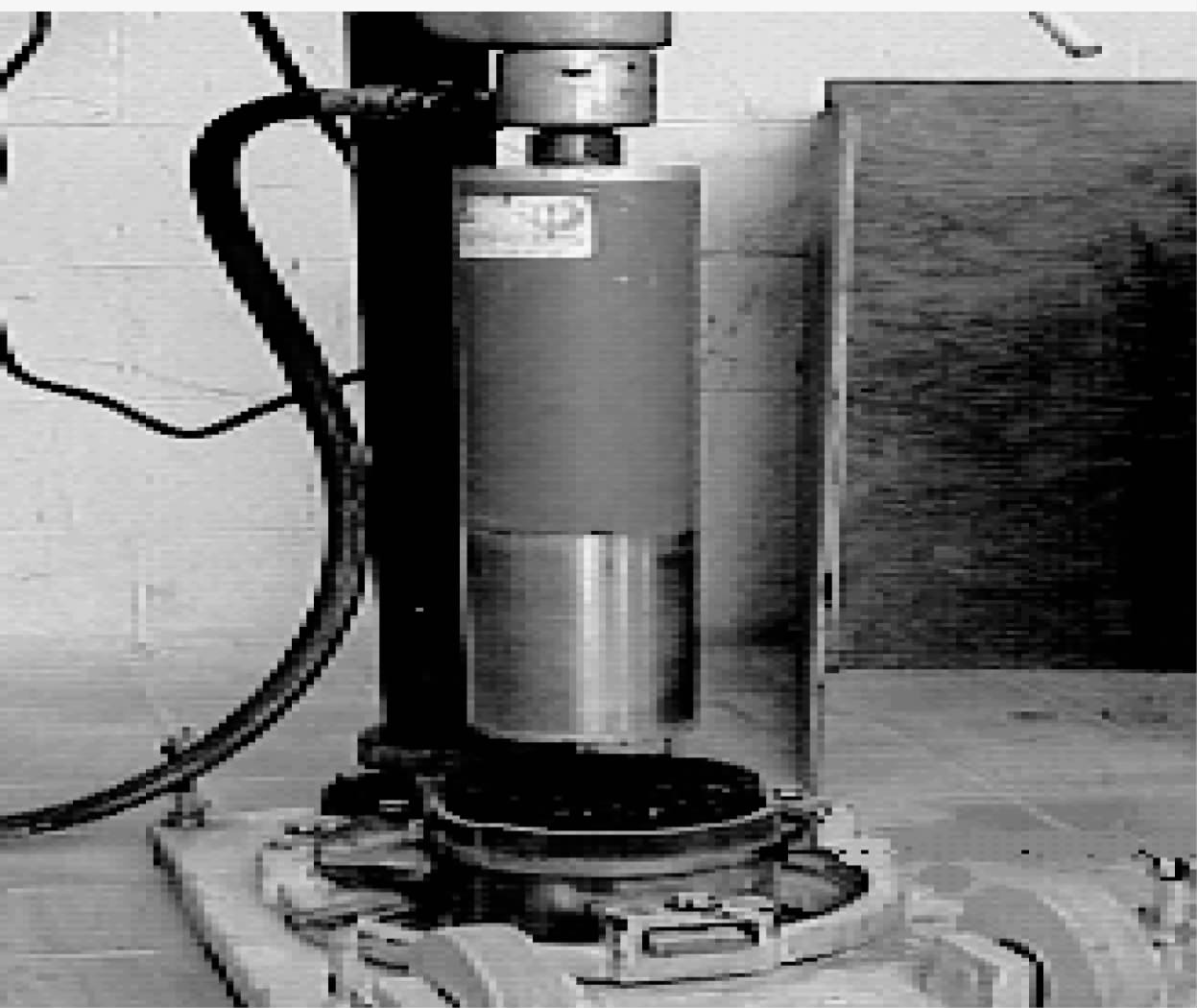
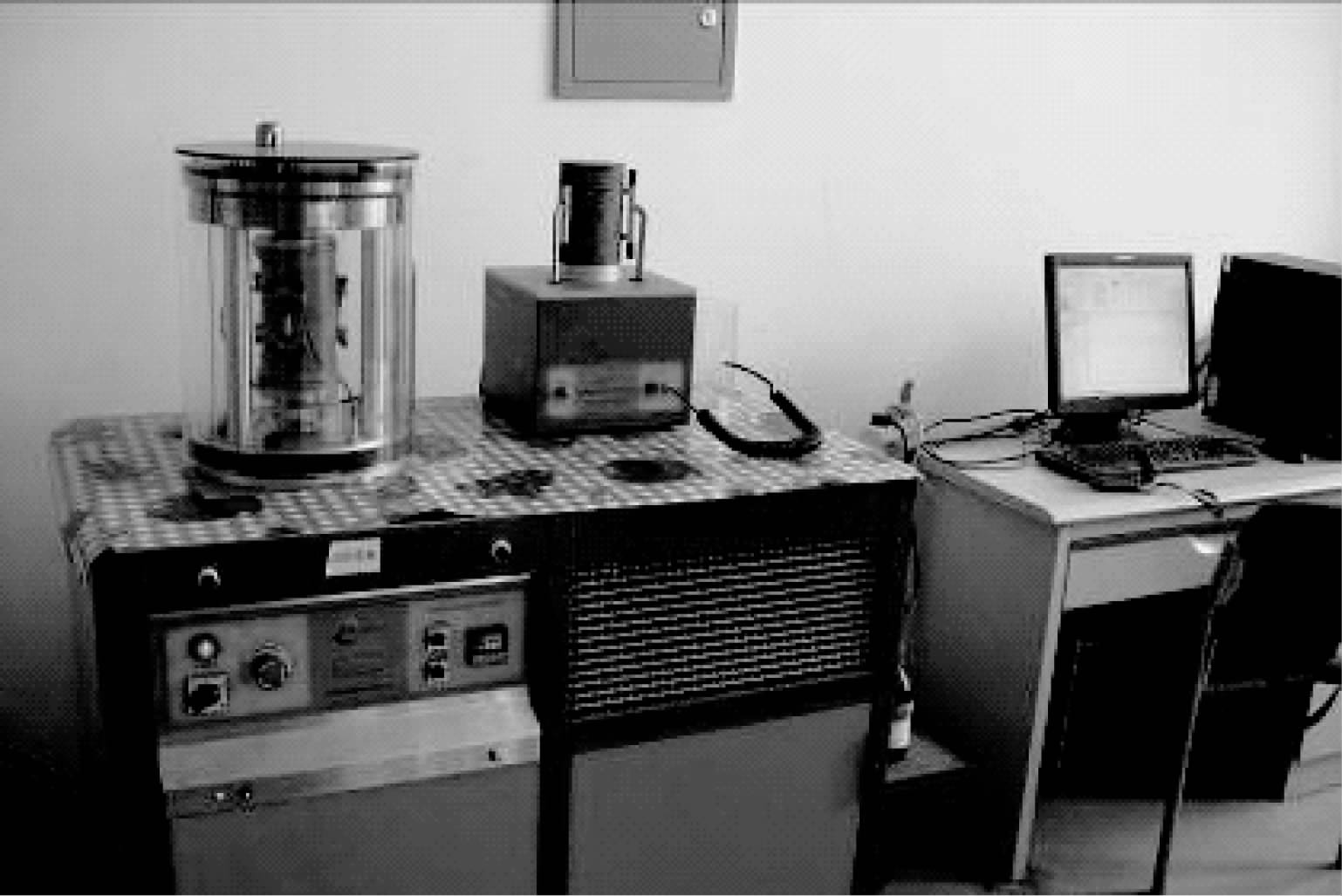
为了减小试模边界效应的影响并加速试验进程,首先采用Troxler 4140型旋转压实仪成型φ150 mm×H 150 mm 的大型试件,再钻芯并切割得到尺寸为φ100 mm×H 110 mm的试件(见图1)。采用AMPT试验设备(见图2),进行正弦波加载,应力水平为50~150 με下对应的应力;试验温度分别为5,15,25,45,55 ℃;荷载频率分别为0.01,0.1,0.2,0.5,1,2,5,10,20,25 Hz,见表3和表4。
|
| 图 1 钻芯取样 Fig. 1 Core drilling |
|
| 图 2 AMPT试验设备 Fig. 2 AMPT equipment |
| 温度/℃ | 混合料 | 不同加载频率(Hz)下动态模量/MPa | |||||||||
| 25 | 20 | 10 | 5 | 2 | 1 | 0.5 | 0.2 | 0.1 | 0.01 | ||
| 5 | AC-13 AC-16 AC-20 | 22 020 30 701 31 550 | 21 479 29 916 31 088 | 19 328 27 423 28 523 | 17 365 25 030 26 305 | 14 928 21 698 23 413 | 13 142 19 149 21 169 | 11 444 16 759 18 898 | 9 340 13 751 15 964 | 7 895 11 698 13 865 | 4 256 6 086 7 672 |
| 15 | AC-13 AC-16 AC-20 | 12 416 19 375 22 024 | 11 970 18 622 20 964 | 10 258 16 021 18 170 | 8 639 13 756 15 623 | 6 700 10 914 12 483 | 5 382 9 014 10 276 | 4 257 7 253 8 206 | 3 095 5 171 5 844 | 2 464 3 881 4 383 | 1 360 1 388 1 647 |
| 25 | AC-13 AC-16 AC-20 | 5 969 8 851 9 897 | 5 501 8 233 9 503 | 4 290 6 494 7 693 | 3 306 5 008 6 060 | 2 343 3 385 4 223 | 1 816 2 429 3 106 | 1 470 1 742 2 280 | 1 160 1 151 1 568 | 1 010 889.6 1 241 | 737.9 504.8 754.7 |
| 45 | AC-13 AC-16 AC-20 | 1 574 2 043 1 995 | 1 475 1 828 1 752 | 1 172 1 286 1 206 | 969.3 927.5 863.5 | 786.1 632.8 596.2 | 698.1 518.1 492.4 | 649.7 449.5 428.6 | 597.7 395.2 375.9 | 572.7 375.6 353.0 | 521.6 359.0 328.4 |
| 55 | AC-13 AC-16 AC-20 | 926.8 840.1 1 040 | 881.5 765.0 962.2 | 750.9 598.5 762.1 | 661.2 491.8 634.6 | 572.7 395.6 521.0 | 539.5 364.5 485.3 | 517.0 343.7 462.0 | 495.9 326.9 446.0 | 488.6 322.2 440.9 | 474.3 319.1 440.1 |
| 温度/℃ | 混合料 | 不同加载频率(Hz)下相位角/(°) | |||||||||
| 25 | 20 | 10 | 5 | 2 | 1 | 0.5 | 0.2 | 0.1 | 0.01 | ||
| 5 | AC-13 AC-16 AC-20 | 10.83 9.63 8.65 | 11.55 10.08 9.18 | 12.89 11.35 9.94 | 14.33 12.73 11.12 | 16.32 14.93 13.02 | 17.90 16.78 14.67 | 19.59 18.85 16.50 | 21.91 21.79 19.15 | 23.47 23.94 21.11 | 27.34 30.94 28.28 |
| 15 | AC-13 AC-16 AC-20 | 19.86 17.49 15.45 | 20.62 17.91 17.23 | 22.65 20.50 19.39 | 24.64 23.11 21.67 | 27.08 27.17 24.87 | 28.62 29.03 27.23 | 29.71 31.19 29.63 | 30.25 34.09 32.36 | 29.68 35.45 33.77 | 24.62 36.22 33.77 |
| 25 | AC-13 AC-16 AC-20 | 29.94 30.96 28.28 | 30.39 31.04 28.57 | 31.79 33.43 30.92 | 32.52 35.26 32.65 | 32.14 36.89 34.22 | 31.03 37.36 34.69 | 28.98 36.80 34.22 | 25.94 35.38 32.77 | 23.35 33.21 30.68 | 14.33 24.62 23.04 |
| 45 | AC-13 AC-16 AC-20 | 30.78 37.77 38.47 | 29.74 36.99 37.81 | 27.70 35.24 36.29 | 25.28 33.04 34.01 | 22.44 29.83 30.27 | 20.11 26.24 26.39 | 18.04 22.67 22.81 | 15.84 18.57 18.84 | 14.31 15.98 16.21 | 11.77 11.62 12.19 |
| 55 | AC-13 AC-16 AC-20 | 27.55 33.84 31.68 | 26.35 33.44 30.37 | 23.59 30.18 27.39 | 21.21 26.62 24.15 | 18.71 22.41 20.63 | 16.82 19.01 17.74 | 15.28 16.24 15.54 | 13.63 13.83 13.43 | 12.66 12.22 12.19 | 10.52 10.03 10.25 |
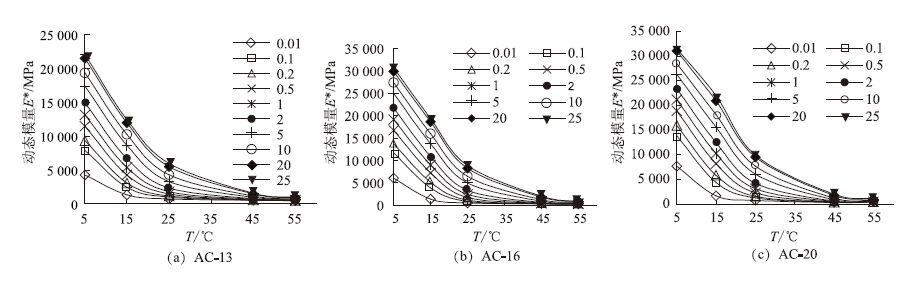
沥青混合料是感温性材料,试验温度直接影响沥青混合料的黏弹性。一般而言,温度越低,沥青混合料越接近弹性材料;温度越高,越接近黏性材料[15]。不同加载频率下,3种沥青混合料的动态模量随温度变化如图3所示。
|
| 图 3 沥青混合料的动态模量随温度变化 Fig. 3 Dynamic modulus of asphalt mixture varying with temperature |
动态模量和相位角可以直观地反映沥青混合料的黏弹性动态响应。由图3可知,3种沥青混合料的动态模量变化趋势相同,随着温度的升高逐渐衰减。但在相同试验条件下,不同混合料的动态模量存在较大差异,随着温度的升高,不同加载频率的动态模量差异越来越小,当达到55 ℃时动态模量趋于相同。
不同加载频率下的动态模量随温度都呈指数模型衰减,将试验测定的动态模量按照式(1)进行回归,回归模型列于表5中。

| 混合料 | 加载频率/Hz | 回归模型 | R2 |
| AC-13 | 0.01 | E*=7 775.0e-T/6.9+500.9 | 0.999 7 |
| 0.1 | E*=14 369.3e-T/7.5+503.9 | 0.999 9 | |
| 0.2 | E*=16 444.0e-T/8.1+486.3 | 0.999 8 | |
| 0.5 | E*=19 050.8e-T/9.1+440.6 | 0.999 2 | |
| 1 | E*=20 972.9e-T/10.1+373.6 | 0.998 4 | |
| 2 | E*=22 883.3e-T/11.3+286.6 | 0.997 7 | |
| 5 | E*=25 450.9e-T/13.0+131.8 | 0.997 2 | |
| 10 | E*=27 529.7e-T/14.5-55.8 | 0.997 3 | |
| 20 | E*=29 886.3e-T/16.1-282.4 | 0.998 0 | |
| 25 | E*=30 396.7e-T/16.7-380.6 | 0.998 6 | |
| AC-16 | 0.01 | E*=13 462.1e-T/5.9+329.3 | 1.000 0 |
| 0.1 | E*=20 982.7e-T/8.4+194.1 | 0.998 0 | |
| 0.2 | E*=23 393.0e-T/9.4+100.4 | 0.996 2 | |
| 0.5 | E*=26 927.6e-T/10.8-67.1 | 0.994 0 | |
| 1 | E*=29 708.6e-T/11.9-235.6 | 0.993 2 | |
| 2 | E*=32 666.9e-T/13.2-449.9 | 0.993 6 | |
| 5 | E*=36 363.5e-T/15.2-883.7 | 0.993 8 | |
| 10 | E*=39 007.9e-T/17.1-1 385.1 | 0.993 9 | |
| 20 | E*=41 953.2e-T/19.5-2 174.9 | 0.994 1 | |
| 25 | E*=42 890.9e-T/20.3-2 429.9 | 0.994 3 | |
| AC-20 | 0.01 | E*=17 353.7e-T/5.7+420.0 | 0.999 4 |
| 0.1 | E*=25 132.1e-T/8.1+279.9 | 0.999 4 | |
| 0.2 | E*=27 156.2e-T/9.3+169.1 | 0.998 2 | |
| 0.5 | E*=30 030.8e-T/11.0-55.7 | 0.995 9 | |
| 1 | E*=32 270.8e-T/12.6-327.0 | 0.994 1 | |
| 2 | E*=34 540.3e-T/14.4-730.3 | 0.993 0 | |
| 5 | E*=37 698.4e-T/17.3-1 561.4 | 0.991 6 | |
| 10 | E*=40 496.4e-T/20.0-2 537.9 | 0.990 6 | |
| 20 | E*=44 137.5e-T/22.8-3 791.5 | 0.989 6 | |
| 25 | E*=45 070.3e-T/24.2-4 420.1 | 0.986 7 |
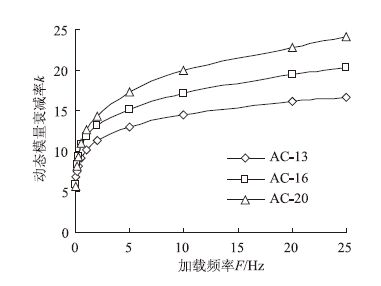
模型参数k反映了动态模量随温度的衰减率,k值越大,混合料的动态模量随温度的衰减速率越快。由3种沥青混合料的动态模量衰减率与加载频率的关系(图4)可知,加载频率越高,动态模量随温度衰减速率越大,但其增加率越来越缓慢;3种沥青混合料的动态模量随温度衰减速率存在显著差异,其中AC-20混合料的衰减速率最大,AC-13混合料的衰减速率最小。
|
| 图 4 沥青混合料的动态模量衰减率与加载频率的关系 Fig. 4 Relationship between attenuation rate of dynamic modulus of asphalt mixture and loading frequency |
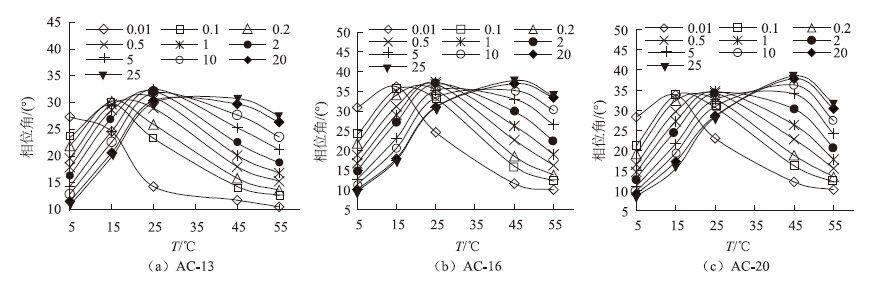
3种沥青混合料的相位角随温度变化如图5所示,3种沥青混合料的相位角也呈相同的变化趋势,即随着温度的升高,相位角先增大后减小。不同加载频率的相位角出现峰值的温度不同,加载频率越低,出现峰值的温度也越低,3种沥青混合料在加载频率为0.01,0.1,0.2,0.5,1.0,2.0 Hz的相位角均在不超过25 ℃出现峰值,而25 Hz对应的相位角峰值均出现在45 ℃处。
|
| 图 5 沥青混合料的相位角随温度变化 Fig. 5 Phase angle of asphalt mixture varying with temperature |
可见,在一定的频率和荷载作用下,沥青混合料的动态模量随着温度的增加而减小;随着温度的增加,沥青混合料呈现明显的黏性,相位角增大,但温度增加到一定时,沥青胶结料变软,矿料骨架效应占主导,此时沥青混合料的相位角会降低,即随温度的增加相位角存在一个峰值。
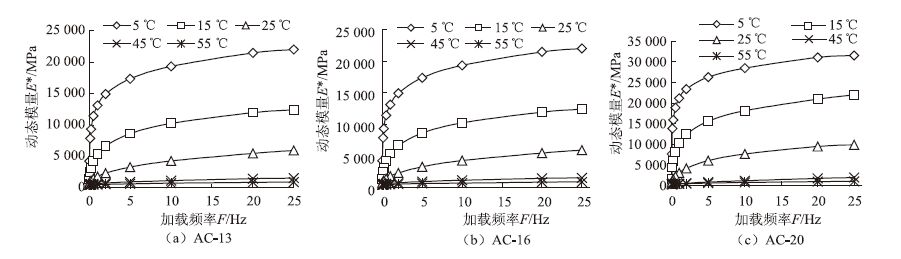
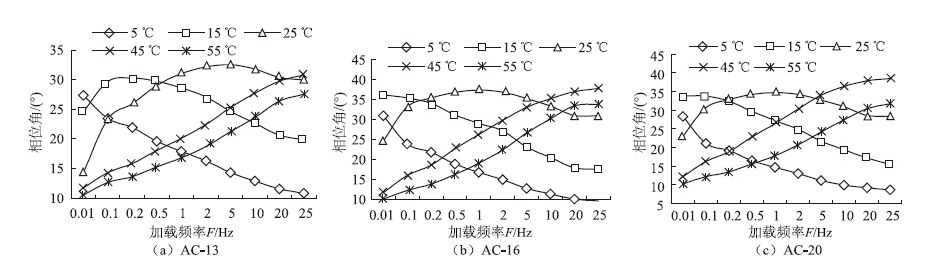
3.2 加载频率对沥青混合料黏弹性动态响应的影响在不同的温度下,沥青混合料动态模量和相位角随加载频率的变化如图6和图7所示。
|
| 图 6 沥青混合料的动态模量随加载频率变化 Fig. 6 Dynamic modulus of asphalt mixture varying with loading frequency |
|
| 图 7 沥青混合料的相位角随加载频率变化 Fig. 7 Phase angle of asphalt mixture varying with loading frequency |
由图6可知,3种沥青混合料在不同温度下的动态模量随加载频率的增加而不断增大,但在不同频率范围内增大的幅度不同,在低频范围内动态模量急剧增大,即变化敏感度较大;而在5~25 Hz的高频范围内,动态模量增加率越来越缓慢。随着温度的增加,沥青混合料的动态模量随加载频率的增加幅度越小,3种沥青混合料的45 ℃和55 ℃动态模量随频率的变化不显著。可见,不管是基质沥青混合料还是改性沥青混合料,随着温度的升高,沥青混合料的黏性表现充分,加载频率对动态模量影响越来越小。
由图7可以看出,3种沥青混合料的相位角随加载频率的变化趋势相同,随着加载频率的增大,5 ℃的相位角逐渐衰减,15 ℃和25 ℃相位角先增大后减小,出现了峰值,而45 ℃和55 ℃相位角逐渐增大。这是因为在较高的加载频率作用下,沥青混合料中高分子链段的运动就可以跟得上外力的变化,频率降低越能促进高分子链段的运动,相位角增大,但随着频率的不断降低,滞后现象减弱,相位角就会减小,因此可以推测在较宽的温度和频率范围内,不同温度下的相位角随加载频率增大先增大后减小。其中使用改性沥青的AC-13混合料的相位角峰值最小,但峰值对应的加载频率大于其他两种混合料。以25 ℃相位角为例,AC-13混合料的相位角峰值为32.52°,对应的频率为5 Hz;而AC-16和AC-20混合料对应的相位角峰值分别为37.36°和34.69°,对应相位角峰值频率均为1 Hz。
4 结论(1)沥青混合料的动态模量随着温度的升高呈指数关系衰减,达到较高的温度时(如55 ℃),不同加载频率的动态模量差异很小。加载频率越高,动态模量随着温度的衰减速率越大,但其增加率越来越缓慢;使用改性沥青AC-13混合料的动态模量随温度衰减速率最小。
(2)随着加载频率的升高,动态模量逐渐增大,温度越高,增加幅度越小。在低频范围内动态模量急剧增大,即变化敏感度较大;而在5~25 Hz的高频范围内,动态模量增加率越来越缓慢。
(3)不同加载频率的相位角出现峰值的温度不同,加载频率越低,出现峰值的温度也越低;在0.01~2.0 Hz范围内,3种沥青混合料的相位角均出现峰值的位置不超过25 ℃,而25 Hz对应的相位角峰值均出现在45 ℃处。
(4)降低加载频率越能促进高分子链段的运动,相位角增大,但随着频率的不断降低,滞后现象减弱,相位角就会减小,在较宽的温度和频率范围内,不同温度下的相位角随频率的增大先增大后减小。
| [1] | LEE H J, KIM Y R. Visco-elastic Constitutive Model for Asphalt Concrete under Cyclic Loading[J]. |
| [2] | SAADEH S,MASAD E,LITTLE D. Characterization of Asphalt Mix Response under Repeated Loading Using Anisotropic Nonlinear Viscoelastic-viscoplastic Model[J]. |
| [3] | TASHMAN L,MASAD E,ZBIB H,et al. Microstructural Viscoplastic Continuum Model for Permanent Deformation in Asphalt Pavements[J]. |
| [4] | ZHU X Y. Influence of Interfacial Zone between Asphalt Mastic and Aggregate on the Elastic Behavior of Asphalt Concrete[J]. Construction and Building Materials, 2013,49(6):797-806. |
| [5] | 张争奇,栗培龙,师晓鸽,等. 沥青混合料矿料滑移剪切试验研究[J]. 公路交通科技,2014,31 (10):13-20. HANG Zheng-qi,LI Pei-long,SHI Xiao-ge,et al. Study on Slip and Shear Test of Asphalt Mixture Aggregate[J]. Journal of Highway and Transportation Research and Development,2014,31 (10):13-20. |
| [6] | LITTLE D N,BUTTON J W,YOUSSEF H. Development of Criteria to Evaluate Uniaxial Creep Data and Asphalt Concrete Permanent Deformation Potential[J]. Transportation Research Record,1993,1417:49-57. |
| [7] | CHANG K G,MEEGODA J N. Micromechanical Simulation of Hot Mix Asphalt[J]. Journal of Materials in Civil Engineering,1997,12(5):495-503. |
| [8] | SCHWARTZ C W,GIBSON N H,SCHAPERY R A,et al. Viscoplasticity Modeling of Asphalt Concrete Behavior[C]//The 15th ASCE Engineering Mechanics Conference. New York: ASCE,2002:144-159. |
| [9] | 关宏信.沥青混合料粘弹性疲劳损伤模型研究[D].长沙:中南大学,2005. UAN Hong-xin. Research on Visco-elastic Fatigue Damage Model of Asphalt Mixture[D]. Changsha: Central South University,2005. |
| [10] | 周志刚,傅搏峰. 用粘弹性理论评价沥青混合料的高温稳定性[J].公路交通科技,2005,22(11):54-56. ZHOU Zhi-gang,FU Bo-feng. Applying the Theory of Viscoelasticity to Evaluate Thermal Stability of Asphalt Mixtures[J]. Journal of Highway and Transportation Research and Development,2005,22(11):54-56. |
| [11] | 侯航舰,胡霞光.沥青玛蹄脂粘弹性特性静态蠕变试验研究[J].建筑材料学报,2008,11(3):292-298. OU Hang-jian,HU Xia-guang. Study on Static Creep Test for Viscoelastic Property of Asphalt Mastic[J]. Journal of Building Materials,2008,11(3):292-298. |
| [12] | 栗培龙,张争奇,王秉纲. 沥青混合料粘弹性响应影响因素分析[J].郑州大学学报:工学版,2010,31(3):96-100. I Pei-long,ZHANG Zheng-qi,WANG Bing-gang. Analysis of Visco-elastic Response Influencing Factors of Asphalt Mixture[J].Journal of Zhengzhou University:Engineering Science Edition,2010,31(3):96-100. |
| [13] | WITCZAK M W,KALOUSH K,PELLINEN T. Simple Performance Test for Superpave Mix Design. NCHRP Report 465[R]. Washington, D.C.: Transportation Research Board, 2002. |
| [14] | JTG F40—2004,公路沥青路面施工技术规范[S]. TG F40—2004,Technical Specifications for Construction of Highway Asphalt Pavement[S]. |
| [15] | LI Pei-long,YANG Bo,ZHANG Zhang-qi,et al. Analysis of Factors Influencing Visco-elastic Response of Asphalt Mixture[C]// Proceedings of International Workshop on Energy and Environment in the Development of Sustainable Asphalt Pavements. Xi'an:Xi'an Jiaotong University Press,2010:147-151. |