引用本文 | 0 |
孟凡奇, 钱振东, 杨理广. 基于热物性的陶瓷沥青混凝土阻热性能研究[J]. 公路交通科技, 2015, Vol. 31 (11): 20-26.

MENG Fan-qi, QIAN Zhen-dong, YANG Li-guang. Research on Thermal Insulating Performance of Ceramic Asphalt Concrete Based on Thermo-physical Property[J]. Journal of Highway and Transportation Research and Denelopment, 2015, Vol. 31 (11): 20-26.
基于热物性的陶瓷沥青混凝土阻热性能研究
东南大学 智能运输系统研究中心, 江苏 南京 210096
收稿日期: 2014-10-24
基金项目: 国家自然科学基金项目(51178114);国家支撑计划项目课题项目(2009BAG15B03);乌鲁木齐科技局项目(Y131320007).
作者简介: 孟凡奇(1990-),男,河北泊头人,工学硕士.
摘要: 基于沥青混合料的热物性参数,研究陶瓷沥青混凝土(CAC)的阻热性能。将陶瓷集料等体积替代SMA-13的粗集料(替代率分别为10%,20%,30%,40%和50%)制备陶瓷沥青混凝土(CAC);测试不同陶瓷掺量的沥青混合料热物性参数(导热系数、热扩散率和比热容);数值模拟不同陶瓷掺量的陶瓷沥青混凝土(CAC)面层对路面结构的隔热效果,并对路面结构层间最高温度与沥青混合料热物性参数进行灰色关联分析。试验结果表明,陶瓷的掺入改变了沥青混合料的热物性参数,当陶瓷掺量为10%时,导热系数和热扩散率分别减少20.5%和23.5%,比热容增加20.9%。陶瓷掺量增加得越多,陶瓷对于沥青混合料热物性参数的改变效果越不明显。有限元结果表明,陶瓷的掺入有效降低沥青路面温度,厚度为4 cm的40%替代率的CAC-13面层底部温度较SMA-13低5.2 ℃。灰色关联分析表明导热系数、热扩散率和比热容共同影响沥青路面温度,导热系数相对于热扩散率、比热容对路面结构温度影响更大。
关键词:
道路工程
陶瓷沥青混凝土
瞬态平面热源法
温度场模拟
灰色关联分析
热物性参数
阻热性能
Research on Thermal Insulating Performance of Ceramic Asphalt Concrete Based on Thermo-physical Property
MENG Fan-qi
,
QIAN Zhen-dong,
YANG Li-guang
ITS Research Center, Southeast University, Nanjing Jiangsu 210096, China
Abstract: Based on thermo-physical parameters of asphalt mixture, the thermal insulating performance of ceramic asphalt concrete (CAC) is researched. CAC is produced by replacement of the coarse aggregate in SMA-13 with ceramic aggregate by the same volume (the replacement percentages are 10%,20%,30%,40% and 50%). Thermo-physical parameters (thermal conductivity, thermal diffusivity, specific heat capacity) of the mixtures with different ceramic replacement contents are tested, and the thermal insulating effect of the CAC surface with deferent ceramic replacement contents on pavement are simulated. The relationship between the maximum temperature in pavement structure and the thermo-physical parameters is analyzed by grey correlation method. The result demonstrates that (1) the addition of ceramic aggregate changes the thermo-physical parameters of the mixture, 10% ceramic replacement percentage result in a reduction of thermal conductivity and thermal diffusivity by 20.5% and 23.5% respectively and an increase of specific heat capacity by 20.9%; (2) as the increase of the ceramic replacement percentage, the influence of ceramic is decreasing. The FE analysis result shows that compared with 4 cm thickness SMA-13 surface layer, ceramic reduces the temperature in pavement structure effectively, and 40% replacement percentage of CAC-13 could reduce more temperature on the surface bottom by 5.2 ℃. Grey correlation analysis shows that the 3 thermal parameters jointly influence the pavement temperature, and thermal conductivity has the most significant impact on temperature followed by thermal diffusivity and specific heat capacity.
Key words:
road engineering
ceramic asphalt concrete
transient plane heat source method
temperature field simulation
grey correlation analysis
thermo-physical parameter
thermal insulating performance
0 引言
热阻式路面材料[1]是我国近几年提出的一种解决路面车辙病害,缓解城市热岛效应的沥青路面材料,该材料通过使用导热系数小的集料替代天然集料,以降低沥青混合料的导热系数。陶瓷是一种被广泛应用的具有较低导热系数的材料[2]。研究表明[3, 4, 5],将陶瓷应用于超薄磨耗层可以大幅降低沥青混合料的导热系数,与普通磨耗层材料相比,掺加20%的陶瓷就可以使车辙板试件上下表面的温度差从3.5 ℃增加到8.5 ℃,有效降低路面结构温度。将废陶瓷以粗骨料的形式掺入到多碎石沥青混合料(SAC)中[6],室内试验结果表明当陶瓷掺量从0%提高到50%时,沥青混合料的导热系数从3.625 kJ/(m·h·℃)降低到1.609 kJ/(m·h·℃),导热系数大幅度减小。
沥青混合料的热物性参数包括导热系数、热扩散率和比热容。现有成果仅定性地研究了陶瓷的掺入对沥青混合料导热系数的影响,对沥青混合料热物性参数与陶瓷集料掺量之间的关系少有研究。因此,本文基于沥青混合料的热物性参数,研究不同陶瓷掺量的陶瓷沥青混凝土(ceramic asphalt concrete,简称CAC)的阻热性能。
1 CAC配合比设计
本文选定沥青混合料级配类型为SMA-13,使用SBS改性沥青作为沥青结合料,粗集料采用玄武岩,细集料采用人工砂,矿料选用石灰石矿粉,材料指标均满足《公路沥青路面施工技术规范》(JGT F40—2004)的要求。按照马歇尔设计方法确定SMA-13的级配和最佳油石比,级配结果如表 1所示,最佳油石比为5.7%。将陶瓷集料按照10%,20%,30%,40%和50%,5种掺量等体积替代SMA-13级配中大于4.75粒径的粗集料,同样按照马歇尔设计方法,确定不同陶瓷掺量下的最佳油石比,结果如表 2所示。
表 1 SMA-13级配
Tab. 1 Gradation of SMA-13
| 筛孔/mm | 16 | 13.2 | 9.5 | 4.75 | 2.36 | 1.18 | 0.6 | 0.3 | 0.15 | 0.075 |
| 级配范围/% | 100 | 90~100 | 50~75 | 20~34 | 15~26 | 14~24 | 12~20 | 10~16 | 9~15 | 8~12 |
| 设计级配/% | 100 | 95.3 | 64.2 | 27 | 21.7 | 17.1 | 15.3 | 13.8 | 11.9 | 9.8 |
表 2 陶瓷沥青混合料马歇尔试验结果
Tab. 2 Marshall test result of ceramic asphalt mixture
| 陶瓷掺量/% | 0 | 10 | 20 | 30 | 40 | 50 |
| 最佳油石比/% | 5.7 | 5.8 | 5.8 | 5.9 | 6.0 | 6.2 |
| 毛体积相对密度/(g·cm-3) | 2.520 | 2.493 | 2.479 | 2.438 | 2.418 | 2.362 |
| 空隙率/% | 4.0 | 3.9 | 3.6 | 3.7 | 4.0 | 3.9 |
| 稳定度/kN | 8.65 | 7.39 | 7.16 | 7.28 | 7.13 | 6.57 |
| 流值/(0.1 mm) | 20.8 | 21.0 | 23.5 | 22.8 | 25.61 | 28.37 |
从表 2可知,随着陶瓷掺量的增多,混合料最佳油石比增加,毛体积相对密度减小;相对于SMA-13,陶瓷沥青混合料的马歇尔稳定度有所降低,并且随着掺量的增加而逐渐降低,这主要是由陶瓷集料强度较低,在成型过程中部分陶瓷破碎造成的。
2 沥青混合料热物性参数试验
国内对沥青及沥青混合料热物性参数的研究包括常功率平面热源法[7]、瞬态平面热源法[8]、差示扫描量热法(DSC)[9]和瞬态热线法[10]。本文采用基于非稳态法的瞬态平面热源法测试陶瓷沥青混合料的热物性参数,其优势在于仅需测量试样上一个点的温度即可同时测得材料的导热系数和热扩散率[11]。
2.1 试样制备
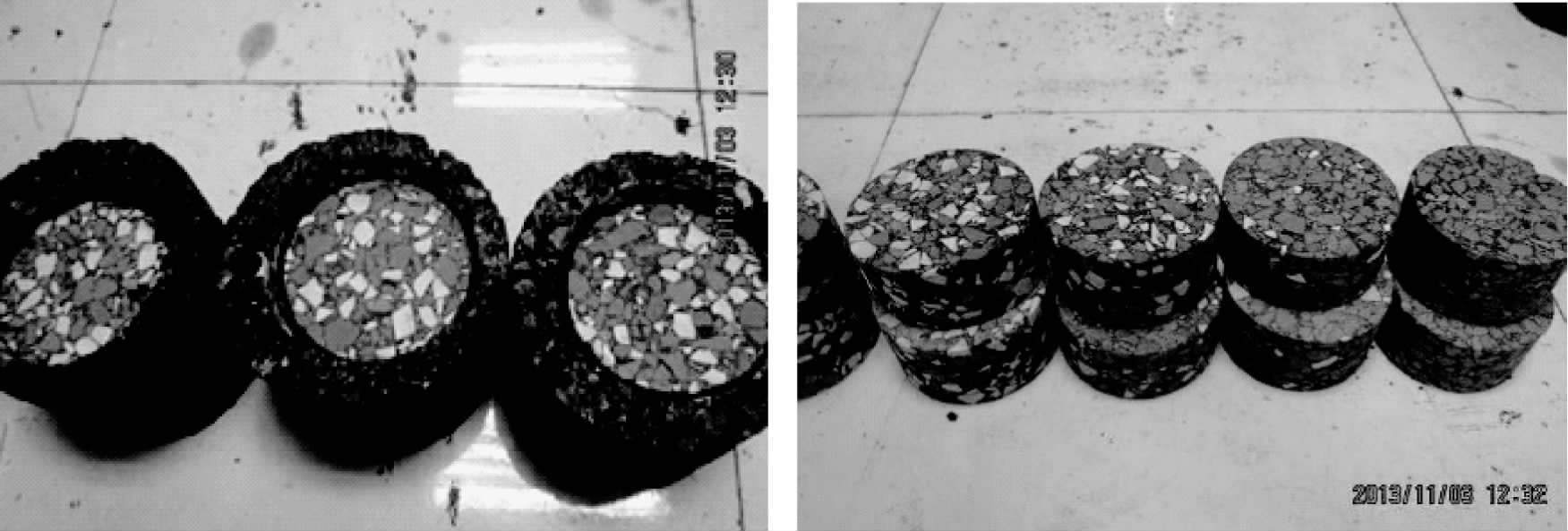
试验采用Superpave旋转压实仪成型不同陶瓷掺量(0%,10%,20%,30%,40%和50%)的沥青混合料试件,钻心切割得到Φ100 mm×H100 mm的柱状试件,并从试件中间切割、打磨成接触紧密的上下两片试样,如图 1所示。
2.2 试验过程及结果
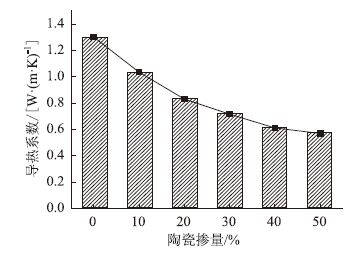
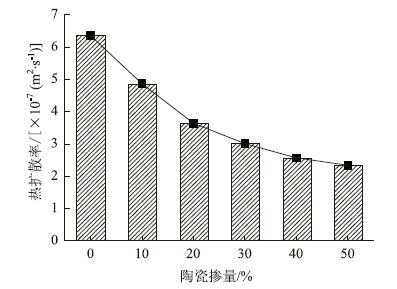
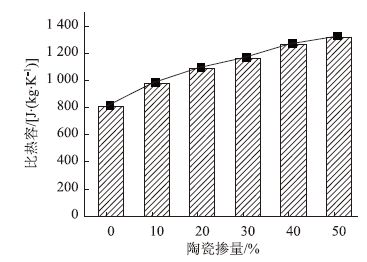
试验仪器选用Hot Disk公司型号为2500S的热常数分析仪,试验温度为20 ℃,测试时间40 s,输出功率为0.5 W。陶瓷沥青混合料的热物性参数试验结果如表 3和图 2~图 4所示。
表 3 不同陶瓷掺量热物性参数
Tab. 3 Thermo-physical parameters with different ceramic replacement contents
| 掺量/% | 0 | 10 | 20 | 30 | 40 | 50 |
| 导热系数/[W·(m·K-1)] | 1.302 | 1.035 | 0.831 | 0.716 | 0.611 | 0.57 |
| 热扩散率/[×10-7(m2·s-1)] | 6.538 | 4.864 | 3.642 | 3.01 | 2.569 | 2.341 |
| 热容量/[J·(kg·℃-1)] | 812.6 | 982.4 | 1 093.7 | 1 168.7 | 1 269.5 | 1 324.6 |
从图 2~图 4中的柱状图可知,随着陶瓷集料掺量的增加,沥青混合料的导热系数和热扩散率不断减小,比热容不断增加。当陶瓷掺量为10%的时候,导热系数和热扩散率分别减少了20.5%和23.5%,比热容增加了20.9%。当陶瓷掺量为50%的时候,导热系数减少了56.2%,热扩散率减少了63.2%,比热容增加了63.0%。图 2~图 4中的折线图的斜率表示陶瓷集料掺量单位增加量引起的沥青混合料热物性参数变化,从中可知随着陶瓷集料掺量不断增加,陶瓷集料对于沥青混合料热物性参数的改变效果逐渐降低,当陶瓷掺量超过40%时,沥青混合料热物性参数仅发生略微变化。
3 CAC面层对沥青路面温度场影响
3.1 路面结构温度场有限元模型
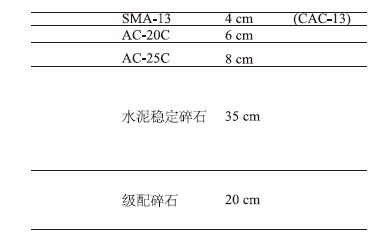
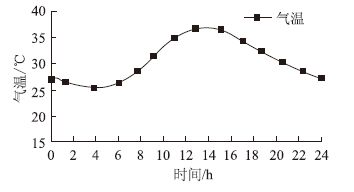
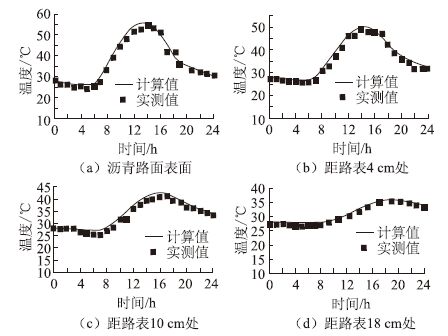
针对南方某城市干道沥青路面结构,见图 5,通过路面钻芯,埋设温度传感器,实测路面结构温度场,并建立路面结构温度场分析计算模型。模型材料参数[12, 13]如表 4所示。道路所在地最热月气象资料参考人地系统主题数据库,如表 5所示。当地 24 h 温度变化情况如图 6所示。计算并绘制路面结构在距离路表 0,4,10,18 cm处的温度随时间的变化曲线,并将路面结构温度场的计算值与实测值进行对比分析,检验路面结构温度场有限元模型的准确性。如图 7所示,沥青路面温度场的计算值与实测值变化趋势一致,计算值与实测值最大温差为3.4 ℃,误差约为6.9%,满足工程上的精度要求。
表 4 有限元模型材料参数
Tab. 4 FEM model material parameters
| 参数 | SMA-13 | AC-20C | AC-25C | 水泥稳定碎石 | 级配碎石 | 土基 |
| 导热系数/[J·(m·h·K)-1] | 4 687 | 3 852 | 3 600 | 5 616 | 4 320 | 5 616 |
| 密度/(kg·m-3) | 2 520 | 2 400 | 2 300 | 2 200 | 2 000 | 1 800 |
| 热容量/[J·(kg·℃)-1] | 812.6 | 850.0 | 800.0 | 911.7 | 900.0 | 1 040.0 |
| 太阳辐射吸收率 | 0.90 |
| 路面发射率 | 0.81 |
| 玻尔兹曼常数/[J·(h·m2·K4)-1] | 2.041 092×10-4 |
表 5 气象数据
Tab. 5 Meteorological data
|
日最高气温Tmax/℃ |
日最低气温Tmin/℃ |
日平均气温Tav/℃ |
日太阳辐射总量Q/(MJ·m-2) |
日有效日照时间h/h |
日平均风速vw/(m·s-2) |
| 3.8 | 25.4 | 31.1 | 22.3 | 11.3 | 2.4 |
3.2 CAC面层对路面结构温度场影响
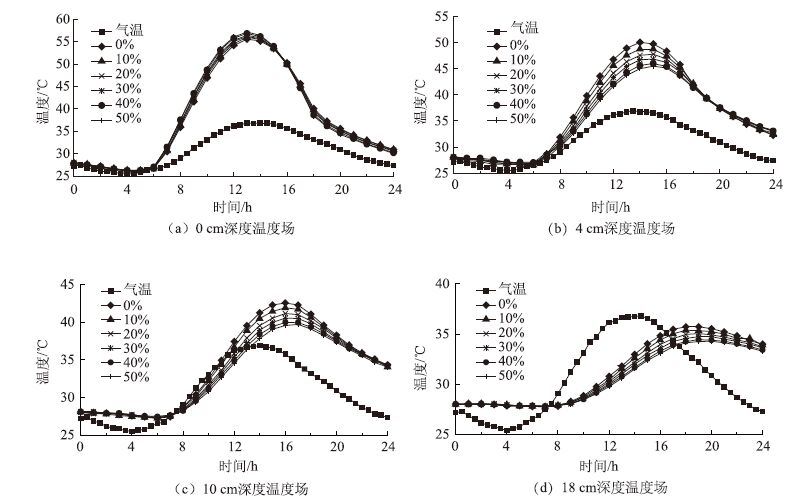
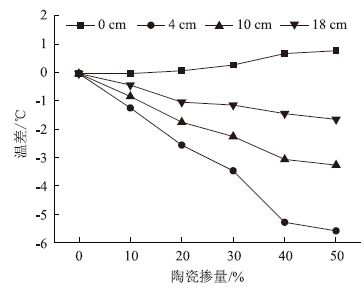
采用不同陶瓷掺量的CAC-13代替SMA-13面层,结合2.2得出的陶瓷沥青混合料热物性参数,分析不同陶瓷掺量下的CAC-13面层对路面结构温度场的隔热效果,如表 6和图 8所示。从图 8(a)和表 6可知,随着陶瓷集料掺量的增加,路表最高温度略微增加,路表最高温度出现时间提前。从图 8(a)~(d)和表 6可知,路面结构层间的最高温度随着陶瓷集料掺量增加而逐渐减小,最高温度出现时间滞后。结果表明,CAC-13面层降低了路面中下面层的温度,当陶瓷集料掺量为50%时,距路面表面4 cm深度处的最高温度降低了约5.5 ℃,10 cm深度的最高温度降低了约3.2 ℃,而18 cm深处的最高温度降低了约1.6 ℃。出现上述现象的原因主要是陶瓷集料改变了沥青混合料的热物性参数。导热系数和热扩散率的降低减弱了路面传递热量的能力,比热容的增加使路面结构吸收相同热量改变的温度降低。
表 6 不同陶瓷集料掺量的CAC-13面层对路面结构层间最高温度的影响情况
Tab. 6 Effect of CAC-13 surface layer with different ceramic replacement contents on maximum temperature in pavement structure layers
| 陶瓷掺量/% | 深度/cm | 最高温度(温差)/℃ | 时间 | 陶瓷掺量/% | 深度/cm | 最高温度(温差)/℃ | 时间 |
| 0 | 0 | 55.9(±0.0) | 13:30 | 30 | 0 | 56.2(+0.3) | 13:00 |
| 4 | 50.1(±0.0) | 14:30 | 4 | 46.6(-3.4) | 15:00 |
| 10 | 42.6(±0.0) | 16:00 | 10 | 40.4(-2.2) | 16:30 |
| 18 | 35.8(±0.0) | 18:30 | 18 | 34.7(-1.1) | 19:00 |
| 10 | 0 | 55.9(+0.0) | 13:30 | 40 | 0 | 56.6(+0.7) | 13:00 |
| 4 | 48.8(-1.2) | 14:30 | 4 | 44.8(-5.2) | 15:00 |
| 10 | 41.8(-0.8) | 16:00 | 10 | 39.6(-3.0) | 16:30 |
| 18 | 35.4(-0.4) | 18:30 | 18 | 34.4(-1.4) | 19:00 |
| 20 | 0 | 56.0(+0.1) | 13:00 | 50 | 0 | 56.7(+0.8) | 13:00 |
| 4 | 47.5(-2.5) | 14:30 | 4 | 44.5(-5.5) | 15:00 |
| 10 | 40.9(-1.7) | 16:30 | 10 | 39.4(-3.2) | 16:30 |
| 18 | 34.8(-1.0) | 18:00 | 18 | 34.2(-1.6) | 19:30 |
| 注:表中括号内温度差数值表示不同陶瓷掺量的CAC-13面层与SMA-13面层路面结构在相同深度位置的温度差,“+”表示温度升高,“-”表示温度降低。 |
图 9表示CAC-13面层与SMA-13面层路面结构在相同深度的温度差随陶瓷掺量变化的规律。从中可知随着陶瓷掺量的增加,陶瓷对路面结构的降温效果不断降低,当陶瓷掺量超过40%时,降温效果不再明显,结果与2.2节中沥青混合料热物性参数随陶瓷集料掺量增加的变化规律一致。
4 路面结构温度与沥青混合料热物性参数灰色关联分析
灰色关联分析是一种系统分析技术,其对发展态势进行量化比较分析,通过计算目标值与影响因素的关联度及关联度的排序,寻求影响目标值的主要因素[14]。陶瓷集料的掺入导致混合料热物性参数的改变,路表温度变化不大,而路面结构内部的温度变化较大。因此以路面结构层间最高温度(4 cm深度温度)为指标,研究其与陶瓷沥青混合料的导热系数、热扩散率及比热容的关联性。过程如表 7~表 9所示。按照同样方法可以得到10 cm和18 cm处温度与沥青混合料热物性参数的灰色关联度,如表 10所示,可以看出导热系数、热扩散率和比热容共同影响路面结构温度。导热系数相对于热扩散率、比热容对路面结构温度影响更大。
表 7 原始数据
Tab. 7 Original data
| 序号 | 1 | 2 | 3 | 4 | 5 | 6 |
| 掺量/% | 0 | 10 | 20 | 30 | 40 | 50 |
| 4 cm处温度/℃ | 50 | 48.8 | 47.5 | 46.6 | 44.8 | 44.5 |
| 导热系数/[W·(m·K-1)] | 1.302 | 1.035 | 0.831 | 0.716 | 0.611 | 0.57 |
| 热扩散率/[×10-7(m2·s-1)] | 6.538 | 4.864 | 3.642 | 3.01 | 2.569 | 2.341 |
| 热容量/[J·(kg·℃-1)] | 812.6 | 982.4 | 1 093.7 | 1 168.7 | 1 269.5 | 1 324.6 |
表 8 无量纲处理
Tab. 8 Dimensionless processing
| 序号 | 1 | 2 | 3 | 4 | 5 | 6 |
| 4 cm处温度 | 1.000 | 0.976 | 0.950 | 0.932 | 0.896 | 0.890 |
| 导热系数 | 1.000 | 0.795 | 0.638 | 0.550 | 0.469 | 0.438 |
| 热扩散率 | 1.000 | 0.765 | 0.573 | 0.473 | 0.404 | 0.368 |
| 热容量 | 1.000 | 1.209 | 1.346 | 1.438 | 1.562 | 1.630 |
表 9 4 cm处温度与热物性参数的关联系数
Tab. 9 Relation coefficients between 4 cm depth temperature and thermal physical parameters
| 序号 | 1 | 2 | 3 | 4 | 5 | 6 | 灰色关联度 |
| 导热系数 | 1.000 | 0.671 | 0.543 | 0.492 | 0.464 | 0.450 | 0.603 |
| 热扩散率 | 1.000 | 0.637 | 0.495 | 0.447 | 0.429 | 0.415 | 0.570 |
| 热容量 | 1.000 | 0.614 | 0.483 | 0.422 | 0.357 | 0.333 | 0.535 |
表 10 路面结构层间最高温度与混合料热物性参数的灰色关联度
Tab. 10 Grey relation coefficients of maximum temperature in pavement structure layers and thermal physical parameters of mixture
| 位置/cm | 灰色关联系数 |
| 导热系数 | 热扩散率 | 比热容 |
| 4 | 0.603 | 0.570 | 0.535 |
| 10 | 0.583 | 0.552 | 0.534 |
| 18 | 0.535 | 0.532 | 0.532 |
5 结论
本文将陶瓷集料按照10%,20%,30%,40%和50%,5种掺量等体积替代SMA-13级配中大于4.75粒径的粗集料,试验研究掺加陶瓷集料对沥青混合料热物性参数的影响,数值模拟CAC-13面层对路面结构温度场的影响,并对路面结构层间最高温度和沥青混合料热物性参数进行灰色关联分析,主要结论如下:
(1)陶瓷集料的掺加改变了沥青混合料的热物性参数。随着陶瓷集料掺量的增加,沥青混合料的导热系数和热扩散率逐渐降低,比热容不断增加。但陶瓷集料掺量超过40%时,沥青混合料的导热系数、热扩散率和比热容仅发生略微变化。
(2)CAC-13面层改变了路面结构的温度场。随着陶瓷掺量的增加,路表最高温度出现时间提前,路面结构层间最高温度出现时间滞后,最高温度减小。厚度为4 cm的陶瓷集料掺量为40%的CAC-13面层底部温度较SMA-13低5.2 ℃。
(3)沥青混合料的导热系数、热传导率和比热容共同影响沥青路面温度场,导热系数相对于热传导率、比热容对路面结构温度影响更大。
本研究着眼于陶瓷的掺入对沥青混合料热物性参数的试验分析,对其影响机理有待于进一步研究。
参考文献
| [1] |
雷雨滋,郑南翔,纪小平.热阻沥青混合料的降温效果及路用性能评价[J].武汉理工大学学报,2013,35(11):68-72. LEI Yu-zi,ZHENG Nan-xiang,JI Xiao-ping. Evaluation on Temperature Reduction and Road Performances of Thermal Resistance Asphalt Mixture[J]. Journal of Wuhan University of Technology,2013,35(11):68-72.
|
|
| [2] |
刘岗, 严岩.冷冻干燥法制备多孔陶瓷研究进展[J].无机材料学报,2014,29(6):571-583. LIU Gang,YAN Yan. Research Progress of Porous Ceramics Produced by Freeze Casting Technique[J]. Journal of Inorganic Materials,2014,29(6):571-583.
|
|
| [3] |
冯德成,张鑫,王广伟. 陶瓷热阻磨耗层材料开发及性能验证[J]. 公路,2010(11):151-155. FENG De-cheng,ZHANG Xin,WANG Guang-wei. Development of Ceramic Thermal Resistance Wearing Course Materials and Performance Test[J].Highway,2010(11):151-155.
|
|
| [4] |
王广伟,贾盛强. 陶瓷在超薄磨耗层中的应用研究[J].公路工程,2011,36(4):203-206,218. WANG Guang-wei,JIA Sheng-qiang. Research on the Application of the Ceramics Ultra-thin Wearing Surface[J].Highway Engineering,2011,36(4):203-206,218.
|
|
| [5] |
张鑫.沥青路面热反射与热阻技术降温机理与应用研究[D].哈尔滨:哈尔滨工业大学,2011. ZHANG Xin. Research on Heat Reflection and Cooling Mechanism of Thermal Resistance Technology of Asphalt Pavement [D].Harbin:Harbin Institute of Technology,2011.
|
|
| [6] |
任永利. 陶瓷废料用于沥青路面隔热层混合料的性能研究[D].广州:华南理工大学,2011. REN Yong-li. Research on Performance of Ceramic Waste for Insulation Layer of Asphalt Pavement [D].Guangzhou:South China University of Technology,2011.
|
|
| [7] |
冯德成,李兴海,郭大进,等.基于热物理特性的沥青混合料的研究[J].公路交通科技,2010,27(3):28-33. FENG De-cheng,LI Xing-hai,GUO Da-jin, et al. Research of Asphalt Mixture Based on Thermophysical Properly[J].Journal of Highway and Transportation Research and Development,2010,27(3):28-33.
|
|
| [8] |
肖红俊,于帆,张欣欣.瞬态平面热源法测量材料导热系数[J].北京科技大学学报,2012,34(12):1432-1436. XIAO Hong-jun,YU Fan,ZHANG Xin-xin. Thermal Conductivity Measurement of Materials Based on a Transient Hot-plane Method [J]. Journal of University of Science and Technology Beijing,2012,34(12):1432-1436.
|
|
| [9] |
陈华鑫,贺孟霜,李媛媛,等.沥青与沥青组分的差示扫描量热研究[J].重庆交通大学学报:自然科学版,2013,32(2):207-210. CHEN Hua-xin,HE Meng-shuang,LI Yuan-yuan,et al. DSC Analysis on Asphalt and Asphalt Fractions[J]. Journal of Chongqing Jiaotong University:Nature Science Edition,2013,32(2):207-210.
|
|
| [10] |
李彦伟,张倩,谢来斌,等.沥青路面导热系数测试及其对路面温度场影响得模拟[J].功能材料,2012,43(增1):129-132. LI Yan-wei,ZHANG Qian,XIE Lai-bin,et al. Testing of Asphalt Mixture Thermal Conductivity and Its Influences on Asphalt Pavement Temperature Field[J]. Journal of Functional Materials,2012, 43 (S1):129-132.
|
|
| [11] |
陈川涓,王如竹,夏再忠,等.瞬态平面热源法测量硅胶混合吸附剂热导系数[J].工程热物理学报,2008,29(5):811-814. CHEN Chuan-juan,WANG Ru-zhu,XIA Zai-zhong,et al. Measurement of Thermal Conductivity of Silica Gel and Composite Adsorbent by Using Transient Plane Source Technique [J]. Journal of Engineering Thermophysics,2008,29(5):811-814.
|
|
| [12] |
吴赣昌.半刚性路面温度应力分析[M].北京:科学出版社,1995. WU Gan-chang. Analysis of Semi-rigid Pavement Temperature Stress[M]. Beijing:Science Press,1995.
|
|
| [13] |
徐达.沥青混合料的热传导试验研究[D].西安:长安大学,2012. XU Da. Experimental Study on Heat Conduction of Asphalt Mixtures[D].Xi'an:Chang'an University,2012.
|
|
| [14] |
王鹏,曾凡奇,黄晓明. 沥青高温性能指标的灰色关联度分析[J].交通运输工程学报,2006,6(3):32-36. WANG Peng,ZENG Fan-qi,HUANG Xiao-ming. Grey Relation Degree Analysis of High-temperature Performance Indexes of Asphalt [J]. Journal of Traffic and Transportation Engineering,2006,6(3):32-36.
|
|
 2015, Vol. 31