 2020, Vol. 47
扩展功能

文章信息
- 张学智, 赖凌峰, 陈岩, 魏敏俊, 张倩闻, 江志群
- ZHANG Xue-Zhi, LAI Ling-Feng, CHEN Yan, WEI Min-Jun, ZHANG Qian-Wen, JIANG Zhi-Qun
- 颅内硬脑膜动静脉瘘临床特点与预后分析
- An analysis of the clinical characteristics and prognosis of intracranial dural arteriovenous fistula
- 国际神经病学神经外科学杂志, 2020, 47(3): 230-234
- Journal of International Neurology and Neurosurgery, 2020, 47(3): 230-234
-
文章历史
收稿日期: 2020-03-20
修回日期: 2020-06-18


硬脑膜动静脉瘘(Dural arteriovenous fistula,DAVF)是一种独特的血管畸形。它是脑膜动脉与硬脑膜静脉窦、脑膜静脉或者皮质静脉之间的一种动静脉分流[1]。在颅内动静脉畸形疾病中,DAVF约占其总数的10%~15%[2]。随着头颅磁共振(MR)、颅脑血管CT成像及全脑血管造影普及,颅内动静脉畸形相关疾病的年检出率有所升高[3]。此外,Pubmed数据库显示:2010年至2019年关于DAVF的文献数较2000年至2009年的文献数多了一倍以上。然而,DAVF治疗的疗效仍存在争议。本研究通过对近年收治的硬脑膜动静脉瘘患者治疗的疗效,进一步探讨DAVF的预后因素。
1 材料与方法 1.1 临床资料研究对象是南昌大学第一附属医院2012年3月—2019年9月期间收治的DAVF患者。本研究通过南昌大学第一附属医院联众数字化病案浏览器共收集了48例DAVF患者。其中,男27例,女21例;年龄16~77岁,平均(48.0±13.0)岁。3例患者自行要求出院,未进行手术切除和血管内介入治疗。9例患者接受颅内硬脑膜动静脉瘘切除术。36例患者先接受了血管内介入治疗。血管内介入治疗患者:1例患者血管内介入治疗失败后出院。2例患者血管介入治疗失败后进行DAVF切除术。35例患者成功完成血管内介入治疗,其中8例患者DAVF部分残留,另有2例患者进行了2次介入栓塞治疗。纳入标准为:①数字减影血管造影(DSA)确诊为硬脑膜动静脉瘘;②非住院复查患者。如表 1。
本研究查阅了48例患者的全脑血管造影资料,对DAVF的供血动脉分布、瘘口及皮质引流静脉进行了初步的分析。如表 1。
1.3 治疗疗效评价本研究均在患者出院后6个月对其进行随访,随访方式为门诊复诊及电话咨询。所有病例按预后分为:优(无神经功能缺损、重返工作岗位或正常退休生活)。良(患者能恢复正常生活,但有一些功能受损)。差(患者不能单独正常生活或死亡)有效=“优”+“良”;无效=差。
1.4 统计学方法应用SPSS 22.0进行统计学分析,计数资料采用χ2检验,DAVF患者预后相关的影响因素分析采用非条件Logistic回归。P<0.15差异有统计学意义。
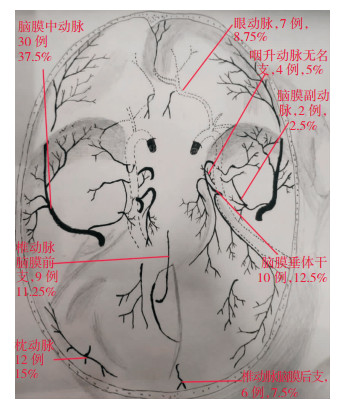
2 结果 2.1 供血动脉及首发症状根据患者全脑造影的影像及报告,本研究发现48例DAVF脑膜供血动脉的分布情况。48位患者总共有80支动脉参与脑膜供血,其中眼动脉7支,咽升动脉无名支4支,脑膜副动脉2支,脑膜垂体干10支,椎动脉脑膜后支6支,枕动脉12支,椎动脉脑膜前支9支,脑膜中动脉30支。如图 1。
|
| 图 1 DAVF的脑膜供血动脉分布图 |
本研究收集了48位患者所有的首发症状,并对其占比进行统计。大部分患者以头痛为首发症状(43.64%)。其次,眼部疾病(包括眼部充血、眼突、眼睑下垂、眼部包块、眼球活动障碍、视物模糊及视力下降)占18.18%。在本研究中,头痛及头晕是DAVF的常见合并症。结果见表 2。
| 首发症状 | 头痛 | 眼部疾病 | 头晕 | 恶心及呕吐 | 颅内杂音 | 意识不清 | 肢体活动障碍 | 癫痫 |
| 患者数目/个 | 24 | 10 | 9 | 3 | 3 | 2 | 2 | 2 |
| 占比/% | 43.64 | 18.18 | 16.36 | 5.45 | 5.45 | 3.64 | 3.64 | 3.64 |
本研究外科治疗与血管内治疗的临床资料(瘘口位置、病例数及颅内出血数)进行对比。(其中3例未进行治疗的DAVF患者未纳入统计中)如表 3。
| 瘘口位置 | 手术外科治疗 | 血管内治疗 | |||
| 病例数 | 颅内出血数 | 病例数 | 颅内出血数 | ||
| 前颅窝 | 6 | 2 | 7(其中1例治疗失败) | 1 | |
| 中颅窝 | 2 | 2 | 9 | 1 | |
| 后颅窝 | 1 | 1 | 20 | 7 | |
变量赋值情况见表 4。笔者把每个自变量与因变量(是否有效)进行单因素Logistic回归分析。分析结果的P值如表 5。结果提示性别、治疗方式与颅内出血等因素与DVAF预后相关(设置P值<0.15)。
| 因素 | 变量 | 赋值说明 |
| 是否有效 | Y | 0:无效;1:有效 |
| 性别 | X1 | 0:女;1:男 |
| 年龄 | X2 | 0:16-48;1:≥48 |
| 供血动脉数 | X3 | 0:单根;1:多根 |
| 是否有皮质静脉引流 | X4 | 0:无;1:有 |
| 瘘口所在颅窝 | X5 | 0:前颅窝;1:中颅窝;2:后颅窝 |
| 治疗方式 | X6 | 0:手术切除;1:血管内治疗 |
| 是否颅内出血 | X7 | 0:无;1:有 |
| 因素 | 无效数 | 有效数 | χ2值 | P值 |
| 性别 | ||||
| 女 | 5 | 15 | 2.445 | 0.118 |
| 男 | 2 | 23 | ||
| 年龄 | ||||
| 16-48岁 | 4 | 19 | 0.121 | 0728 |
| ≥48岁 | 3 | 19 | ||
| 供血动脉数 | ||||
| 单根 | 3 | 15 | 0.028 | 0.867 |
| 多跟 | 4 | 23 | ||
| 有无皮质静脉引流 | ||||
| 无 | 0 | 13 | 3.368 | 0.066 |
| 有 | 7 | 25 | ||
| 瘘口位置 | ||||
| 前颅窝 | 1 | 6 | ||
| 中颅窝 | 2 | 10 | 0.020 | 0.990 |
| 后颅窝 | 4 | 22 | ||
| 治疗方式 | ||||
| 手术切除 | 3 | 6 | 2.707 | 0.100 |
| 血管内治疗 | 4 | 32 | ||
| 是否颅内出血 | ||||
| 无 | 3 | 27 | 2.115 | 0.146 |
| 有 | 4 | 11 |
在单因素Logistic回归分析基础上,筛选进入分析的变量进行多因素Logistic回归分析。结果见表 6。多因素Logistic回归结果提示,性别(
(
| 变量 | β | SE | Wald χ2 | P | |
95%CI |
| Enter法性别(1) | 1.728 | 1.149 | 2.259 | 0.133 | 5.627 | 0.591-53.545 |
| 治疗方式(1) | 1.940 | 1.104 | 3.088 | 0.079 | 6.955 | 0.800-60.508 |
| 是否颅内出血(1) | -1.496 | 1.027 | 2.120 | 0.145 | 0.224 | 0.30-1.678 |
| 注:(1)表示:赋值=1与赋值=0相比。 | ||||||
男性DAVF患者较女性DAVF患者预后好5.627倍;经血管内介入治疗的DAVF患者较经手术切除的患者预后好3.955倍;无颅内出血患者较伴有颅内出血患者的预后好4.464(1/0.224)倍。
3 讨论 3.1 治疗方案DAVF的病因有创伤、外科手术、静脉窦血栓,先天因素及其他[4]。一般认为,DAVF是后天获得[5, 6]。脑血管造影在DAVF的诊断方面和手术方案设计方面上具有非常重要的作用[7, 8]。目前,DAVF的治疗策略主要包括血管内介入治疗、显微外科和立体定向放射外科[9-11]。显微外科创伤相对较大[12]。虽然立体定向放射外科手术达到DAVF治愈率58%~73%,潜伏期1~3年,立体定向放射外科手术通常不被看好[13, 14]。对于DAVF患者来说,手术切除与血管内介入治疗的两种疗效都比较满意。
然而,液体栓塞剂(Onyx和NBCA)的出现,血管内栓塞成为首选治疗方式。一方面是因为:液体栓塞剂早在20年前就用于血管内介入治疗,随着液体栓塞剂、微导管及导丝工艺的发展,液体栓塞剂得到广泛应用。另一方面是:液体栓塞剂聚合的速率可以根据需要进行调节,这样术者就可以避免栓塞剂在供血动脉中过早发生聚合反应或者在引流静脉处发生过晚地发生聚合反应[15]。此外,血管内介入治疗具有创伤小及住院时间短这两种优势。
3.2 影响预后的因素本研究发现性别为影响预后的危险因素,男性患者的预后较女性患者好。其原因尚待进一步研究。然而,Shah的研究认为女性的DAVF发生率(61%~66%)较男性高[16];但本研究的女性DAVF的发病率(43.75%)小于男性。本研究的相对小样本可能会造成结果偏倚。此外,性别的P值为0.133。因此,统计学上可能并不认为性别是预后的危险因素。颅内出血的预后与Malik的研究[17]相符。颅内出血常伴随永久性神经功能障碍,甚至导致患者瘫痪。本研究中,颅内出血导致2例患者肢体活动障碍,甚至导致2例患者意识不清。
本研究中,接受血管内治疗DAVF患者的预后较接受手术外科治疗的好。一方面是:外科治疗的病例数少,结果可能存在偏倚。然而,这种情况也可能跟术者倾向有关。随着血管内介入的材料、设备及技术等发展,术者可能更倾向于血管内治疗[18]。另一方面是:本研究中,外科治疗面对的DAVF患者可能常伴有颅内出血;同时,本研究中的2例患者是在血管内治疗失败后接受手术外科治疗。这些情况可能拉低外科治疗的价值。
本研究中皮质静脉引流未成为独立因素。这一点与Malik、Lasjaunias及Award等的研究[4、17、19]不同。皮质静脉引流是目前公认的DAVF预后因素。本研究的研究对象良性DAVF居多。由于头颅CTA普及[20],更多DAVF患者在还没演变成侵袭性DAVF前被诊断出来。本研究发现供血动脉数不是DAVF预后的影响因素。硬脑膜动静脉瘘的供血动脉往往来自比邻的脑膜支。Fincher病例报道证实:只解决供血动脉问题而不解决瘘口问题,DAVF会复发[21]。处理硬脑膜动静脉瘘的关键是闭塞瘘口。该瘘口的免疫组化表明,瘘口存在内皮和平滑肌细胞而没有内弹力膜,则证实其静脉来源[22]。因此,供血动脉数不是DAVF手术或者栓塞的主要治疗难度。手术的难度在于瘘口的寻找,而栓塞的难度在于导管能否到达瘘口位置。
本研究为回顾性研究,无法避免回顾性研究本身存在的误差。其次,本研究仅纳入48例研究对象,病例数较少,统计时可能出现偏倚。因此,本研究仍需扩大样本再次进行评估。
4 结论随着神经介入的发展,血管内介入治疗逐渐成为DAVF首先治疗方案。由于血管内介入治疗能够使DAVF患者获得比较满意的疗效,因此早期诊断、早期治疗对DAVF患者比较重要。
| [1] |
Gandhi D, Chen J, Pearl M, et al. Intracranial dural arteriovenous fistulas:classification, imaging findings, and treatment[J]. AJNR, 2012, 33(6): 1007-1013. DOI:10.3174/ajnr.A2798 |
| [2] |
Newton TH, Cronqvist S. Involvement of dural arteries in intracranial arteriovenous malformations[J]. Radiology, 1969, 93(5): 1071-1078. DOI:10.1148/93.5.1071 |
| [3] |
Al-Shahi R, Bhattacharya JJ, Currie DG, et al. Prospective, population-based detection of intracranial vascular malformations in adults:the Scottish Intracranial Vascular Malformation Study (SIVMS)[J]. Stroke, 2003, 34(5): 1163-1169. |
| [4] |
Awad IA, Little JR, Akrawi WP, et al. Intracranial dural arteriovenous malformations:factors predisposing to an aggressive neurological course[J]. J Neurosurg, 1990, 72(6): 839-850. DOI:10.3171/jns.1990.72.6.0839 |
| [5] |
Della Pepa GM, Parente P, D'Argento F, et al. Angio-architectural features of high-grade intracranial dural arteriovenous fistulas:Correlation with aggressive clinical presentation and hemorrhagic risk[J]. Neurosurgery, 2017, 81(2): 315-330. DOI:10.1093/neuros/nyw175 |
| [6] |
Padilha IG, Pacheco FT, Araujo AIR, et al. Tips and tricks in the diagnosis of intracranial dural arteriovenous fistulas:A pictorial review[J]. J Neuroradiol, 2019. DOI:10.1016/JNeurad.2019.06.004 |
| [7] |
Botsford A, Shankar JJS. Digital subtraction angiography-dynavision in pretreatment planning for embolization of dural arterio venous fistulas[J]. J Neuroimaging, 2018, 28(1): 112-117. DOI:10.1111/jon.12459 |
| [8] |
Guo H, Yin QK, Liu P, et al. Focus on the target:Angiographic features of the fistulous point and prognosis of transvenous embolization of cavernous sinus dural arteriovenous fistula[J]. Interv Neuroradiol, 2018, 24(2): 197-205. |
| [9] |
Natarajan SK, Ghodke B, Kim LJ, et al. Multimodality treatment of intracranial dural arteriovenous fistulas in the Onyx era:a single center experience[J]. World Neurosurg, 2010, 73(4): 365-379. |
| [10] |
Xu K, Ji TF, Li C, et al. Current status of endovascular treatment for dural arteriovenous fistula of the transverse-sigmoid sinus:A literature review[J]. Int J Med Sci, 2018, 15(14): 1600-1610. DOI:10.7150/ijms.27683 |
| [11] |
Baek HG, Park SH, Park KS, et al. Stereotactic radiosurgery for dural arteriovenous fistulas involving the transverse-sigmoid sinus:A single center experience and review of the literatures[J]. Korean Neurosurg Soc, 2019, 2(4): 458-466. |
| [12] |
Giannopoulos S, Texakalidis P, Mohammad Alkhataybeh RA, et al. Treatment of ethmoidal dural arteriovenous fistulas:A meta-analysis comparing endovascular versus surgical treatment[J]. World Neurosurg, 2019, 128: 93-599. |
| [13] |
Park SH, Park KS, Kang DH, et al. Stereotactic radiosurgery for intracranial dural arteriovenous fistulas:its clinical and angiographic perspectives[J]. Acta Neurochir (Wien), 2017, 159(6): 1093-1103. DOI:10.1007/s00701-017-3177-1 |
| [14] |
Tonetti DA, Gross BA, Jankowitz BT, et al. Stereotactic radiosurgery for dural arteriovenous fistulas without cortical venous reflux[J]. World Neurosurg, 2017, 107: 371-375. DOI:10.1016/j.wneu.2017.07.170 |
| [15] |
Debrun GM, Aletich V, Ausman JI, et al. Embolization of the nidus of brain arteriovenous malformations with n-butyl cyanoacrylate[J]. Neurosurgery, 1997, 40: 112-120. |
| [16] |
Shah SB, Lalwani AK, Dowd CF. Transverse-sigmoid sinus dural arteriovenous malformations[J]. Contemporary Neurosurgery, 1999, 21(15): 1-6. |
| [17] |
Malik GM, Pearce JE, Ausman JI, et al. Dural Arteriovenous Malformations and Intracranial Hemorrhage[J]. Neurosurgery, 1984, 15(3): 332-339. DOI:10.1227/00006123-198409000-00007 |
| [18] |
Cannizzaro D, Brinjikji W, Rammos S, et al. Changing Clinical and Therapeutic Trends in Tentorial Dural Arteriovenous Fistulas:A Systematic Review[J]. AJNR, 2015, 36(10): 1905-1911. DOI:10.3174/ajnr.A4394 |
| [19] |
Lasjaunias P, Chiu M, ter Brugge K, et al. Neurological manifestations of intracranial dural arteriovenous malformations[J]. Neurosurg, 1986, 64(5): 724-730. DOI:10.3171/jns.1986.64.5.0724 |
| [20] |
孙立军, 范一木, 只达石. 硬脑膜动静脉瘘的诊治进展[J]. 国际神经病学神经外科学杂志, 2006, 33(1): 34-37. |
| [21] |
Fincher EF. Arteriovenous fistula between the middle meningeal artery and the greater petrosal sinus; case report[J]. .Ann Surg, 133(6): 886-888. DOI:10.1097/00000658-195106000-00015 |
| [22] |
Elhammady MS, Ambekar S, Heros RC. Epidemiology, clinical presentation, diagnostic evaluation, and prognosis of cerebral dural arteriovenous fistulas[J]. Handb Clin Neurol, 2017, 143: 99-105. DOI:10.1016/B978-0-444-63640-9.00009-6 |