 2018, Vol. 42


肺癌是临床最常见的恶性肿瘤之一,其发病率及病死率近年来呈上升趋势。其中非小细胞肺癌(non-small cell lung cancer,NSCLC)患者占70%~80%,且21%~50%的NSCLC患者诊断时已有区域淋巴结转移[1]。NSCLC患者的诊断及准确分期(尤其是纵隔淋巴结分期)对其治疗方案的制定及预后非常重要。目前应用PET/CT诊断NSCLC纵隔淋巴结转移的报道较多,但尚缺少系统性的评价。我们通过Meta分析的方法对已发表文献进行统计分析及评价,以期为PET/CT诊断NSCLC纵隔淋巴结转移的准确性判断提供循证医学证据。
1 资料与方法 1.1 文献检索以“PET/CT或PET-CT”、“非小细胞肺癌”和“纵隔淋巴结转移”为检索词检索万方数据库、中国知网(China National Knowledge Infrastructure,CNKI)、维普数据库;以“PET/CT”或“PET-CT”或“positron tomography/computed tomography”、“non-small cell lung cancer”或“NSCLC”和“mediastinal lymph-nodal metastasis”为检索词检索PubMed、Embase、Cochrane Library数据库;检索文献发表时间为1990年至2016年。语言限中文和英文。
1.2 纳入标准与排除标准纳入标准:①研究对象为初诊或复发未经化疗和放疗的NSCLC患者而非病灶;②有“金标准”(手术切除病理结果)证实;③研究目的为评价18F-FDG PET/CT在NSCLC纵隔淋巴结转移中的诊断价值;④能间接或直接提供完整四格表,包含真阳性、假阳性、真阴性和假阴性,且患者数≥10。排除标准:①以病灶(转移淋巴结的个数)为研究对象;②会议摘要、讲座和评述类等数据不完整的文献;③无“金标准”证实的研究;④样本量 < 10的研究。
1.3 资料提取由2位研究者根据纳入与排除标准独立筛选文献、提取资料,如遇分歧讨论解决。内容包括纳入研究的一般信息(如出版年份、样本量、设备名称、“金标准”、研究类型等)、四格表内容(真阳性、假阳性、真阴性、假阴性)及研究对象的年龄、性别等。
1.4 文献质量评估本研究采用QUADAS(quality assessment of diagnostic accuracy studies)评价表[2]对纳入文献进行方法学评估。该表包含14个子项(其中3项为非必须评价条目),每条以“是”、“不清楚”或“否”作出评价,分别记为1、0.5和0分。为保证文献质量,本研究仅纳入评分≥8分的文献。此外,对于评价结果不一致的数据,讨论一致后决定。
1.5 统计学分析采用Meta-Disc 1.40软件进行统计学分析。①探讨异质性及其来源,主要评价有无阈值效应。绘制综合受试者工作特征(summary receiver operating characteristic,SROC)曲线,SROC曲线图检验若呈“肩臂”状分布,则提示存在阈值效应。也可计算灵敏度对数与(1-特异度)对数的Spearman相关系数,评价阈值效应是否存在,P>0.05表示不存在阈值效应。②评价非阈值效应。对灵敏度、特异度、阳性似然比(positive likelihood ratio,PLR)、阴性似然比(negative likelihood ratio,NLR)、诊断比值比(diagnostic odds ratio,DOR)行Cochran Q检验,分别计算P值。若P>0.05,则无异质性,采用固定效应模型;若P≤0.05,则存在异质性,采用随机效应模型。③合并灵敏度、特异度和DOR进行Cochran Q检验,计算SROC曲线的曲线下面积(area under curve,AUC)。0.5<AUC ≤0.7为诊断价值较低;0.7<AUC≤0.9为诊断价值中等;0.9以上为诊断价值较高。④对不同地区、是否接受增强扫描、是否曾患肺结核3个因素进行亚组分析,采用两样本t检验分析,对应结果以灵敏度(95%CI)和特异度(95%CI)表示。P < 0.05为差异有统计学意义。
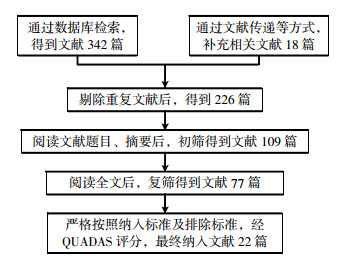
2 结果 2.1 文献检索结果共检索到相关文献360篇,经逐层筛选后(图 1),共纳入22篇文献[3-24],包括患者2543例。纳入研究的基本特征见表 1。
|
图 1 文献检索流程示意图 Figure 1 The process of literature retrieval 图中,QUADAS:quality assessment of diagnostic accuracy studies。 |

|
表1 纳入文献基本信息及汇总分析指标 Table 1 Basic information of the include literature and summary analysis |
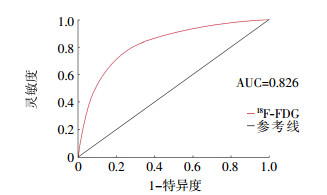
① 阈值效应分析。SROC曲线不呈典型的“肩臂状”分布,提示不存在阈值效应;Spearman相关系数为0.21,P>0.05,亦支持不存在阈值效应。合并相关数据得到:总灵敏度为0.66(0.62~0.69),总特异度为0.82(0.80~0.84),总PLR为3.60(2.82~4.58),总NLR为0.45(0.37~0.54),总DOR为9.12(6.15~13.52),AUC为0.826。PLR对应Q值为79.50,I2=73.6%;NLR对应的Q值为65.84,I2=68.1%;DOR对应Q值为59.96,I2=65%,P < 0.05,提示存在非阈值效应引起的异质性。SROC曲线见图 2。
|
图 2 18F-FDG PET/CT诊断2543例NSCLC纵隔淋巴结转移的综合受试者工作特征曲线 Figure 2 The summary receiver operating characteristic curve of 18F-FDG PET/CT in the diagnosis of mediastinal lymph node metastasis in 2543 cases non-small cell lung cancer 图中,NSCLC:非小细胞肺癌;AUC:曲线下面积;FDG:氟脱氧萄萄糖。 |
② 亚组分析。亚洲地区的15项研究(患者1704例)与非亚洲地区的7项研究(患者839例)比较,两者PET/CT对NSCLC纵隔淋巴结转移诊断的灵敏度和特异度差异均无统计学意义[灵敏度:0.69(0.66~0.73)与0.68(0.65~0.72);特异度:0.78(0.75~0.80)与0.79(0.76~0.81),t=0.31、1.96,均P>0.05]。
患者接受增强扫描的5项研究(患者428例)与未接受增强扫描的17项研究(患者2115例)比较,两者PET/CT对NSCLC纵隔淋巴结转移诊断的灵敏度和特异度差异均无统计学意义[灵敏度:0.73(0.63~0.83)与0.63(0.58~0.81);特异度:0.81(0.71~0.88)与0.83(0.77~0.89);t=1.29、0.72,均P>0.05]。
患者有肺结核病史的4项研究(患者178例)与患者无肺结核病史的9项研究(患者1181例)比较,两者PET/CT对NSCLC纵隔淋巴结转移诊断的灵敏度差异无统计学意义[0.75(0.67~0.85)与0.71(0.66~0.75),t=1.63,P>0.05];而特异度差异有统计学意义[0.79(0.72~0.84)与0.89(0.82~0.92),t=2.98,P < 0.05]。
3 讨论诊断纵隔淋巴结有无转移对NSCLC患者分期非常重要,会直接影响患者治疗方案的制定及疾病预后。出现纵隔淋巴结转移的患者(即处于N2或N3期)的手术机会很小,需改行放化疗方案。因此,一旦NSCLC诊断成立,必须立即明确疾病分期。
本项Meta分析共纳入文献22篇,包括2543例患者。结果显示:采用18F-FDG PET/CT诊断NSCLC纵隔淋巴结转移的总灵敏度为0.66,总特异度为0.82,说明其诊断纵隔淋巴结转移与否具有较高的特异度,而灵敏度略差,与白璐等[25]报道的结果相近。SROC曲线的AUC为0.826,表明18F-FDG PET/CT具有中等诊断价值。
本项Meta分析结果提示,研究存在非阈值效应引起的异质性,进一步的亚组分析结果显示,患者有无肺结核病史对PET/CT诊断特异度有影响。淋巴结结核是感染性病变,如果和NSCLC的转移发生在相近位置,易被误诊。CT、MR等影像学检查多是根据淋巴结大小来鉴别转移与否,一般将直径>1 cm者定义为肿大淋巴结。恶性肿瘤患者出现肿大淋巴结一般认为发生转移,但通过一系列的临床总结,笔者发现肿大的淋巴结不一定是转移[26]。除此之外,纵隔淋巴结的钙化程度及患者血糖水平也是18F-FDG PET/CT诊断NSCLC纵隔淋巴结转移的重要影响因素。转移淋巴结很少出现钙化,钙化淋巴结常为炎性病变的表现;18F-FDG PET/CT检查过程中,若患者血糖水平高于正常值,则在图像上会出现组织器官弥漫性浓聚,这会对诊断造成影响。因此,诊断医师需全面了解患者既往史。其他分组(不同地区、有无接受增强扫描)灵敏度与特异度差异均无统计学意义,说明本研究的异质性较小、可信度较高。
本研究也存在一定局限性,纳入的研究中显像剂使用剂量存在差异、仪器型号也不尽相同,相关研究结果可能存在一定的发表偏倚。综上,本项Meta分析结果表明,18F-FDG PET/CT诊断NSCLC纵隔淋巴结转移的特异度较高,可为NSCLC提供准确分期,有利于治疗方案的确定。
利益冲突 本研究由署名作者按以下贡献声明独立开展,不涉及任何利益冲突。
作者贡献声明 姚晓龙负责研究命题的提出与设计、数据的统计与论文的撰写;孙灿文负责技术工作的指导;娜仁花、何霖负责协助数据的统计;古丽菲拉·海克甫负责协助文献的搜集;杨小丰负责论文的审阅。
| [1] |
段晓蓓, 樊卫, 许泽清, 等.
基于18F-FDG PET/CT显像分析非小细胞肺癌纵隔淋巴结转移的危险因素[J]. 中国医学影像技术, 2012, 28(6): 1135–1139.
Duan XB, Fan W, Xu ZQ, et al. Analysis of risk factors for mediastinal lymph nodes metastases in non-small cell lung cancer patients with 18F-FDG PET/CT[J]. Chin J Med Imaging Technol, 2012, 28(6): 1135–1139. |
| [2] |
PennyWhiting, AnneWS Rutjes, JohannesB Reitsma, 等.
QUADAS的制定:用于系统评价中评价诊断性研究质量的工具[J]. 中国循证医学杂志, 2007, 7(4): 296–306.
DOI:10.3969/j.issn.1672-2531.2007.04.009 Penny WG, Anne WSR, Johannes BR, et al. The development of QUADAS:a tool for the quality assessment of studies of diagnostic accuracy included in systematic reviews[J]. Chin J Evid-based Med, 2007, 7(4): 296–306. DOI:10.3969/j.issn.1672-2531.2007.04.009 |
| [3] |
徐白萱, 刘雁翎, 姚树林, 等.
FDG PET对非小细胞肺癌纵隔淋巴结分期的价值[J]. 中国肺癌杂志, 2003, 6(3): 198–200.
DOI:10.3779/j.issn.1009-3419.2003.03.09 Xu BX, Liu YL, Yao SL, et al. Value of FDG PET for mediastinal lymph node staging in non-small cell lung cancer[J]. Chin Lung Cancer, 2003, 6(3): 198–200. DOI:10.3779/j.issn.1009-3419.2003.03.09 |
| [4] |
杨衿记, 吴一龙, 唐安戊, 等.
18F-FDG PET诊断非小细胞肺癌纵隔淋巴结转移的初步临床研究[J]. 岭南现代临床外科, 2004, 4(3): 215–217.
DOI:10.3969/j.issn.1009-976X.2004.03.022 Yang JJ, Wu YL, Tang AW, et al. The preliminary clinical study of 18F-FDG PET on diagnosing the metastasis of the mediastinal lymph nodes of NSCLC[J]. Lingnan Mod Clin Surg, 2004, 4(3): 215–217. DOI:10.3969/j.issn.1009-976X.2004.03.022 |
| [5] | Halpern BS, Schiepers C, Weber WA, et al. Presurgical staging of non-small cell lung cancer:positron emission tomography, integrated positron emission tomography/CT, and software image fusion[J]. Chest, 2005, 128(4): 2289–2297. DOI:10.1378/chest.128.4.2289 |
| [6] | Kim YK, Lee KS, Kim BT, et al. Mediastinal nodal staging of nonsmall cell lung cancer using integrated 18F-FDG PET/CT in a tuberculosis-endemic country:diagnostic efficacy in 674 patients[J]. Cancer, 2007, 109(6): 1068–1077. DOI:10.1002/cncr.22518 |
| [7] | Lee PC, Port JL, Korst RJ, et al. Risk Factors for occult mediastinal metastases in clinical stage Ⅰ non-small cell lung cancer[J]. Ann Thorac Surg, 2007, 84(1): 177–181. DOI:10.1016/j.athoracsur.2007.03.081 |
| [8] | Hwangbo B, Kim SK, Lee HS, et al. Application of endobronchial ultrasound-guided transbronchial needle aspiration following integrated PET/CT in mediastinal staging of potentially operable non-small cell lung cancer[J]. Chest, 2009, 135(5): 1280–1287. DOI:10.1378/chest.08-2019 |
| [9] | Lee JW, Kim BS, Lee DS, et al. 18F-FDG PET/CT in mediastinal lymph node staging of non-small-cell lung cancer in a tuberculosis-endemic country:consideration of lymph node calcification and distribution pattern to improve specificity[J]. Eur J Nucl Med Mol Imaging, 2009, 36(11): 1794–1802. DOI:10.1007/s00259-009-1155-4 |
| [10] |
李向东, 尹吉林, 柳伟坤, 等.
PET/CT对评价非小细胞肺癌纵隔淋巴结转移的诊断价值[J]. 南方医科大学学报, 2010, 30(3): 506–508.
Li XD, Yin JL, Liu WK, et al. Value of positron emission tomography computed tomography in the diagnosis of mediastinal lymph node metastasis of non-small cell lung cancer[J]. J South Med Univ, 2010, 30(3): 506–508. |
| [11] | Tasci E, Tezel C, Orki A, et al. The role of integrated positron emission tomography and computed tomography in the assessment of nodal spread in cases with non-small cell lung cancer[J]. Interact Cardiovasc Thorac Surg, 2010, 10(2): 200–203. DOI:10.1510/icvts.2009.220392 |
| [12] | Darling GE, Maziak DE, Inculet RI, et al. Positron emission tomography-computed tomography compared with invasive mediastinal staging in non-small cell lung cancer:results of mediastinal staging in the early lung positron emission tomography trial[J]. J Thorac Oncol, 2011, 6(8): 1367–1372. DOI:10.1097/JTO.0b013e318220c912 |
| [13] | Sommer G, Wiese M, Winter L, et al. Preoperative staging of non-small-cell lung cancer:comparison of whole-body diffusion-weighted magnetic resonance imaging and 18F-fluorodeoxyglucose-positron emission tomography/computed tomography[J]. Eur Radiol, 2012, 22(12): 2859–2867. DOI:10.1007/s00330-012-2542-y |
| [14] | Saydam O, Gokce M, Kilicgun A, et al. Accuracy of positron emission tomography in mediastinal node assessment in coal workers with lung cancer[J]. Med Oncol, 2012, 29(2): 589–594. DOI:10.1007/s12032-011-9879-y |
| [15] | Harders SW, Madsen HH, Hjorthaug K, et al. Characterization of pulmonary lesions in patients with suspected lung cancer:computed tomography versus[18F]fluorodeoxyglucose-positron emission tomography/computed tomography[J]. Cancer Imaging, 2012, 12(3): 437–446. DOI:10.1102/1470-7330.2012.0035 |
| [16] | Kuo WH, Wu YC, Wu CY, et al. Node/aorta and node/liver SUV ratios from 18F-FDG PET/CT may improve the detection of occult mediastinal lymph node metastases in patients with non-small cell lung carcinoma[J]. Acad Radiol, 2012, 19(6): 685–692. DOI:10.1016/j.acra.2012.02.013 |
| [17] |
许泽清, 段晓蓓, 樊卫.
18F-FDG PET/CT显像诊断非小细胞肺癌纵隔淋巴结转移的临床价值[J]. 中华核医学与分子影像杂志, 2013, 33(5): 381–382.
DOI:10.3760/cma.j.issn.2095-2848.2013.05.016 Xu ZQ, Duan XB, Fan W. Diagnostic value of 18F-FDG PET/CT for metastasis of mediastinal lymph nodes in non-small-cell lung cancer patients[J]. Chin J Nucl Med Mol Imaging, 2013, 33(5): 381–382. DOI:10.3760/cma.j.issn.2095-2848.2013.05.016 |
| [18] | Koksal D, Demirag F, Bayiz H, et al. The correlation of SUVmax with pathological characteristics of primary tumor and the value of tumor/lymph node SUVmax ratio for predicting metastasis to lymph nodes in resected NSCLC patients[J]. J Cardiothorac Surg, 2013, 8(1): 63. DOI:10.1186/1749-8090-8-63 |
| [19] | Billè A, Okiror L, Skanjeti A, et al. The prognostic significance of maximum standardized uptake value of primary tumor in surgically treated non-small-cell lung cancer patients:analysis of 413 cases.[J]. Clin Lung Cancer, 2013, 14(2): 149–156. DOI:10.1016/j.cllc.2012.04.007 |
| [20] | Booth K, Hanna GG, Mcgonigle N, et al. The mediastinal staging accuracy of 18F-fluorodeoxyglycose positron emission tomography/computed tomography in non-small cell lung cancer with variable time intervals to surgery[J]. Ulster Med J, 2013, 82(2): 75–81. |
| [21] | Li S, Zheng Q, Ma Y, et al. Implications of false negative and false positive diagnosis in lymph node staging of NSCLC by means of 18F-FDG PET/CT[J/OL]. Plos One, 2013, 8(10): e78552-e78552[2017-05-03]. http://journals.plos.org/plosone/article/file?id=10.1371/journal.pone.0078552&tpe=printable. DOI: 10.1371/journal.pone.0078552. |
| [22] | Xu ZQ, Xie L, Fan W, et al. Risk factors for mediastinal lymph node metastasis in non-small-cell lung cancer by PET/CT[J]. Nucl Med Commun, 2014, 35(5): 466–471. DOI:10.1097/MNM.0000000000000077 |
| [23] | Moloney F, Ryan D, McCarthy L, et al. Increasing the accuracy of 18F-FDG PET/CT interpretation of 'mildly positive' mediastinal nodes in the staging of non-small cell lung cancer[J]. Eur J Radiol, 2014, 83(5): 843–847. DOI:10.1016/j.ejrad.2014.01.016 |
| [24] |
黄占文, 陈跃, 蔡亮, 等.
18F-FDG PET/CT在非小细胞肺癌纵隔淋巴结转移的诊断价值[J]. 泸州医学院学报, 2015, 38(4): 368–370.
DOI:10.3969/j.issn.1000-2669.2015.04.012 Huang ZW, Chen Y, Cai L, et al. Role of 18F-FDG PET/CT in the evaluation of mediastinal lymph node metastasis of non-small cell lung cancer[J]. J Luzhou Med Coll, 2015, 38(4): 368–370. DOI:10.3969/j.issn.1000-2669.2015.04.012 |
| [25] |
白璐, 于楠, 李艳, 等.
基于18F-脱氧葡萄糖PET-CT成像对非小细胞肺癌纵隔淋巴结转移识别的Meta分析[J]. 中华放射学杂志, 2016, 50(10): 752–757.
DOI:10.3760/cma.j.issn.1005-1201.2016.10.005 Bai L, Yu N, Li Y, et al. The value of 18F-FDG PET-CT in the diagnosis of mediastinal lymph node metastasis in non-small cell lung cancer:a Meta-analysis[J]. Chin J Radiol, 2016, 50(10): 752–757. DOI:10.3760/cma.j.issn.1005-1201.2016.10.005 |
| [26] |
张召奇, 赵新明, 王建方, 等.
18F-FDG PET/CT诊断非小细胞肺癌纵隔淋巴结转移[J]. 中国医学影像学杂志, 2014, 22(4): 293–296.
DOI:10.3969/j.issn.1005-5185.2014.04.014 Zhang ZQ, Zhao XM, Wang JF, et al. 18F-FDG PET/CT in the diagnosis of mediastinal lymph node metastasis of non-small cell lung cancer[J]. Chin J Med Imaging, 2014, 22(4): 293–296. DOI:10.3969/j.issn.1005-5185.2014.04.014 |