 2022, Vol. 39


2. 仲恺农业工程学院 化学化工学院, 广东 广州 510225;
3. 深圳市凌盛电子有限公司, 广东 深圳 518000
2. School of Chemistry and Chemical Engineering, Zhongkai University of Agriculture and Engineering, Guangzhou 510225, China;
3. Shenzhen Lingsheng Electronics Co., Ltd., Shenzhen 518000, China
为了应对环境污染和能源危机,可再生能源和清洁能源在可持续发展方面发挥着越来越重要的作用[1-2],电池作为便携式电子产品和电气设备的主要电源,在大规模储能方面表现出广阔的应用前景[3-4]。因此,开发具有高比容量和良好循环稳定性的电极材料至关重要。有机羰基电极材料作为不含重金属的环保型金属离子电池的高能量密度电极材料,具有理论容量高、氧化还原中心可调和结构设计灵活等优点[5],但电子电导率低、电池倍率性能较差的缺点限制了它的应用。
PI是一种富氮的有机羰基聚合物,由于它的绝缘性,经常用作电池的黏结剂[6-7]和隔膜[8-9]材料,很少用作电池电极材料。直到2010年,Song等[10]对PI作为电池电极的可行性进行了论证,发现可以通过调节二酐和二胺的组成,设计高度共轭的PI骨架来提高PI的电化学性能,这为PI的电化学研究奠定了基础。此后,越来越多的研究证明,高度共轭结构的PI几乎不溶于电解液[11],用作电池电极材料,具有良好的循环稳定性。但是与大多数有机电极材料类似,PI较低的本征电导率导致其在循环过程中活性位点的利用率低、电化学性能差[12]。此外,在较深的放电过程中,PI还会伴随着电极结构的严重损伤而分解[10]。本文综述了PI基复合材料在电池中的研究进展,期望能为电极材料的研究提供参考。
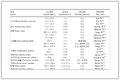
1 官能团掺杂改性PI活性位点的利用通常受到电极化学稳定性和离子传输能力的影响。小分子酰亚胺化合物易于溶解在电解质中,导致羰基活性中心利用率低和电池容量的快速衰减,高分子量的共轭PI则可以抑制电极材料溶解,提高电池循环性能[13-14]。在合成PI过程中引入羰基基团和大的共轭结构,是提高电池倍率和循环稳定性的主要方法。不同结构的聚酰亚胺电化学性能如表1所示。
|
表 1 不同结构的聚酰亚胺电化学性能 Table 1 Electrochemical properties of polyimides with different structures |


2010年,Song等[10]分别基于1,4,5,8萘四甲酸酐(NTCDA)和均苯四羧酸二酐(PMDA)合成了5种PI,首次作为锂离子电池的阴极材料,研究发现,相较于PMDA,基于NTCDA的PI具有大的共轭结构和较低的LUMO能级,表现出良好的电化学性能。此后,大量的研究证明了NTCDA是合成PI电极材料的优良二酐单体。Ba等[21]使用一种含苯醌结构的二胺单体与NTCDA反应,二胺的苯醌与二酐的羰基组合生成了苯胺结构,产物不仅具有含大量羰基的稳定聚合物链,还具有大π共轭主链,保证了它们的长循环寿命。Li等[22]使用三聚氰胺与NTCDA合成了具有不同共轭亚基的PI,位于不同方向的三聚氰胺的3个氨基可以有效地形成三维扩展的共轭网络,大分子共轭结构形成了较高的稳定性和导电性网络。Wang等[17]合成了一种含有π共轭萘环和席夫碱结构的PI,共轭萘环可以在快速充放电过程中保持聚合物骨架的稳定,同时席夫碱结构可以扩展聚合物骨架的共轭结构并增加活性位点的密度。Hernández等[19]将NTCDA与含不同官能团的芳族和脂族二胺制备了多种PI,用作锂离子电池阴极(见图1),结果表明,基于苯胺酞二胺的PI表现出最好的倍率和循环稳定性。

|
图 1 聚酰亚胺/液体电解质/锂电池的示意图[19] Figure 1 Schematic representation of the polyimide/liquid electrolyte/lithium cell[19] |
Liu等[20]通过在活性酸酐单元之间引入柔性链接剂,使得PI的大分子链易于活动,形成了具有大量活性中心的多孔网络,表现出很高的循环稳定性。Zhang等[23]通过调节NTCDA单元之间的二胺连接物来调整PI的微观结构和储锂性能,实现了大容量和高倍率能力。研究发现,可弯曲的二胺单元与乙二胺和二氨基丁烷的长度适度增加可以稳定聚合物骨架,并且形成充分暴露活性羰基的蜂窝状多孔结构。
1.2 其他二酐衍生的PI除了NTCDA外,研究人员对其他具有稳定共轭结构或含羰基的二酐合成的PI电极材料进行了探索。Jung等[24]报道了一种含3个羰基的PI,二酐和二胺结构单元都作为电活性物质,3个羰基充当了锂吸收的活性位点,具有良好的倍率性能。He等[16]报道了一种基于PMDA合成的PI,每个聚合物单位含6个羰基,可嵌入22个Li+,理论比容量高达1704 mAh·g−1,在30 ℃和60 ℃下分别进行电化学测试发现具有较高的可逆容量。Wang等[15]以联苯二酰亚胺为基础,合成了一种含2个七元酰亚胺环的共轭PI(PBPI),如图2所示,每个BPI单元可嵌入4个Li+,密度泛函理论计算后发现,引入带有羰基的扭曲的七元环,降低了充放电过程中的平稳电位,在低氧化还原电势下实现了稳定且可逆的氧化还原反应。Li等[18]使用3,3',4,4'-二苯基酮四酸酐(BTDA)和2,6-二氨基蒽醌合成了一种在骨架上带有高比例羰基和苯环的PI衍生物,该材料具有高度紧密排列的2D纳米片构成的球晶状结构,较大的比表面积有利于存储容量。在此基础上,李珺等[25]用同样的原料,分别使用N-甲基吡咯烷酮(NMP)、N,N-二甲基甲酰胺(DMAc)、N,N-二甲基乙酰胺(DMF)来调控聚合物的形貌,制备了多羰基PI。研究发现,以DMAc为溶剂时,所获得的聚合物形成了均匀片状结构的“灯笼形”球体结构,在50 mA·g−1电流密度下,聚合物的首次放电比容量达到230.4 mAh·g−1,50圈充放电循环后保持在332 mAh·g−1。
2 PI基复合电极材料
尽管PI可以直接用作电极材料,但是PI具有较低的本征电导率,循环过程中活性位点的利用率较低,电化学性能较差。因此,在PI中引入导电物质来增强其导电性成为提高电池倍率性能的常用方法。聚酰亚胺复合电极的性能如表2所示。
|
|
表 2 聚酰亚胺复合电极的性能 Table 2 Properties of polyimide composite electrode |
理论研究表明,氮掺杂会使碳原子上靠近氮原子的正电荷增加,石墨素布里渊区尖端的费米能量正移[45],PI碳化后形成的吡啶型N原子(N-6)和吡咯型N原子(N-5)不仅可以改变碳表面的电子态,提高材料的导电性,还会增加碳材料表面与锂离子的结合位点,提高锂的储存性能[46]。
Wang等[47]将废弃的PI隔膜分别在800、900、1000、1100、1300 ℃下碳化合成具有多孔形貌的硬质炭,发现碳化的PI保持了隔膜的三维结构,N-6和N-5的形成(见图3)促进了电子转移,提供了更多的活性中心。作为锂离子电池阳极,900 ℃煅烧的硬质炭表现出最好的电化学性能,20 mA·g−1时的可逆容量为380 mAh·g−1,500 mA·g−1时的可逆容量为190 mAh·g−1,1000多次的循环衰减约为0.009%/次;作为钠离子电池阳极,20 mA·g−1下,可逆容量可以达到190 mA·g−1。Wu等[48]将PI在氮气氛围下550 ℃煅烧,制备了氮掺杂的三维花状碳材料,独特的牡丹花状结构为电荷转移提供了较大的界面,减缓了电极材料的粉碎和聚集,作为锂离子电池阳极,1 A·g−1下循环1500圈后仍能保持182.5 mAh·g−1的可逆容量。Zhang等[40]在铜箔上使用激光石墨化工艺将溶液沉积的含脲聚酰亚胺转化为膨胀的三维石墨烯(NLSG),氮的掺杂量高达12.8%,在激光处理过程中,N2的存在会导致碳原子优先与氮而不是氧结合。Zhao等[39]将含有联苯环和嘧啶环的PI纳米纤维膜电纺丝碳化,制备出独立的、柔性的含杂原子碳膜,通过改变反应温度与时间来调控材料的平均粒径和含氮量,测试发现,650 ℃处理3h的碳膜具有最好的倍率和循环性能。

|
图 3 吡啶型N(N-6)和吡咯型N原子(N-5)的结合形成示意图[47] Figure 3 Schematic of binding formation of pyridinic N (N-6) and pyrrolic N atoms (N-5)[47] |
石墨烯具有较大的比表面积和高的电子导电性,活性材料通常被石墨烯包裹以增加它们的电子导电性。在PI中引入石墨烯,能够提高电极的电化学性能和机械强度[49-51],但是由于传统的石墨烯三维结构与PI粒子之间复合不牢固,PI粒子在循环过程中的电化学导电性仍然很差[52-53]。
Yang等[26]在PI基体中加入了多层石墨烯(MG)作为导电添加剂,原位聚合了具有独特层状结构的PI-MG,它提供了比纯PI和纯MG更多的活性位点,保证了PI内部的电子扩散和Li+的反应,并且由于PI的不溶性,PI-MG不易溶解在电解质中,具有良好的倍率和循环性。Lyu等[28]分别制备了以PI与质量分数为10%的零维C45(PI10C)、多壁碳纳米管(PI10T)、石墨烯(PI10G)为原料的复合材料,电化学测试发现,PI10G表现了优良的倍率和循环性能,原因在于PI的稳定氧化还原可逆性和石墨烯添加剂的高电子传导性,提高了电极的电子电导率和结构稳定性。与PI10G相比,PI10T、PI10C无法提供足够高的共轭表面用于微米级PI颗粒的原位生长,循环性能较差。Ahmad等[30]制备了含PI纳米结构的石墨烯复合电极(PI-FLEG),石墨烯与PI的互连骨架和非共价π-π堆积相互作用提供了大的表面积,垂直生长的PI在分散的石墨烯片上的协同作用,使得电解质中离子的嵌入/脱出变得容易。Huang等[31]采用原位聚合和溶剂热的策略,制备了3D还原氧化石墨烯/PI复合材料(GF-PI),石墨烯与PI聚合物之间的强耦合和独特多孔网络,使得电荷可以快速转移。
此外,利用PI前驱体溶液固有的黏度,可以在不添加导电碳或黏结剂的条件下制备柔性电极,提高电池的可逆容量。Meng等[29]以三维石墨烯和PI为原料制备了柔性膜电极(3D-RGO/PI),膜电极中活性物质的质量分数达到80%,PI易于扩散到石墨烯孔隙和聚合物的界面上(见图4),并且电极材料的层次化结构降低了与Li+反应的阻力,具有优良的循环稳定性。

|
图 4 三维石墨烯作为导电网络电极的示意图[29] Figure 4 Schematic of the electrode with 3D graphene (3D-RGO) as the conductive network[29] |
Liu等[27]将还原氧化石墨烯(RGO)和碳纳米管(CTNs)组成的导电网络引入到PI中,PI均匀生长在RGO层上,并与CTNs连接形成导电网络,制备了具有自黏性的PI@RGO/PI@CNTs,该材料可以紧密地附着在铜箔上,每一组分都能与Li+反应,能够实现100%的活性物质利用率。Chang等[32]制备了PI/石墨烯薄膜(G@PI/RGO),如图5所示,PI聚合物以G@PI的形式紧密嵌入到石墨烯中,电子可以在石墨烯和PI粒子之间快速转移,实现快速的氧化还原反应,G@PI薄膜表面的RGO覆盖提高了复合材料的电子导电性,保证了优异的倍率性能和超长的稳定性。
2.3 PI/碳纳米管(CNT)
CNT具有独特的一维管状结构、优良的导电性和大的表面积,经常被用作电极材料。PI与CNT复合可以制备出柔性电极材料,提高复合材料中PI的羰基利用率,改善电极整体的导电性和电池的循环稳定性。
Wu等[33]以PMDA和2,6-二氨基蒽醌为原料,通过缩聚反应制备了PI的衍生物,如图6所示,用单壁碳纳米管(SWNT)分散体过滤制备了柔性电极膜(PMAQ-SWNT),该聚合物可以将PI中醌单元的高容量与PI单元的稳定性集成在一起,实现3个电子的可逆转移。Gu等[34]以NTCDA和苯二胺(PDA)为原料合成了PI-多壁碳纳米管复合材料(PNP@CNTs),具有CNT网络连接的柔性共轭聚合物骨架提供了高的Na+迁移率,改善了Na+的嵌入/脱出反应动力学较差的状况。Wu等[35]以单壁碳纳米管膜为集电器,原位聚合的PI为活性物质,制备了柔性电极材料(PI/SWNT),SWNT薄膜的多孔结构保证了电极材料与集电体之间的良好接触,PI在单壁碳纳米管上呈现出垂直排列的纳米膜结构,纳米膜的孔隙促进了电解质渗透,具有优异的倍率性能。

Wang等[36]将基于NTCDA合成的2D聚芳酰亚胺(2D-PAI)和CNT为原料,缩聚反应后制备了2D-PAI@CNT(见图7),该材料具有丰富的氧化还原活性的π共轭萘二酰亚胺单元和较高的比表面积,提高了电极材料氧化还原活性中心的利用率(82.9%)、结构稳定性和离子扩散速率。Liu等[37]将PMDA和4,4-二氨基二苯醚(ODA)为原料合成的“Kapton”PI与CNT复合后,通过静电纺丝和碳化,制备了杂化薄膜。杂化薄膜的纳米纤维结构和三维交织的CNT网络在聚合物内部创造了连续的电子传递路径,PI中的ODA部分增强了电极的柔软性,保证了电极的机械强度。

|
图 7 结晶2D-PAI@CNT的合成和储能过程示意图[37] Figure 7 Schematic illustration of synthesis of crystalline 2D-PAI@CNT and energy storage process. [37] |
PI与其他材料复合的研究主要是PI作为离子传输骨架或者活性物质的保护层。Wang等[42]在Sb颗粒表面涂覆了高模量的PI,有效防止了Sb颗粒在充放电过程中的体积膨胀,并且由于PI涂层中的C=O基团与羧甲基纤维素(CMC)黏结剂中离子−偶极的相互作用,Sb颗粒被牢固地锚定PI上,表现出优异的循环稳定性。Liu等[41]通过原位聚合制备了包裹在PI基体中的SnO2纳米晶,缓解了SnO2纳米颗粒的体积变化,可以有效抑制充放电过程中裂纹在整个电极上的扩展,此外,PI链含有丰富的氧化还原活性羰基,也能够促进离子传导。Nan等[43]通过静电纺丝制备了聚酰胺酸(PAA)/SiO2杂化纳米纤维物,并对其进行碳化和刻蚀处理,制得了具有高孔隙率的碳纳米纤维(PCNF)。PCNF具有较大的比表面积(950 m2·g−1)和大量的微孔,具有良好的电化学性能。Wang等[38]以PAA/乙酰丙酮锰为前驱体,制备了MnO-碳杂化纳米纤维复合材料(MnO/CNF),MnO/CNF具有大的比表面积,保证了电子的快速转移,较大的空隙空间有效缓解了电极的粉化。Zhou等[44]制备了PI/金属有机框架(MOFs)杂化材料,MOFs特有的孔洞结构提供了良好的离子传输通道,含有大量共轭羰基的PI加快了电荷的转移和AlCl2+的扩散,两者的协同作用提升了电池的容量和循环稳定性。
3 结论与展望因为碳材料固有的稳定性能够保证电池的长时间稳定循环,目前对PI基电极材料的研究方向集中于PI的改性、碳化和与碳材料的复合,PI基其他复合材料的研究较少。为了改善PI电极材料的低导电率和活性位点低利用率的缺陷,研究人员大多采取以下策略:(1) 构建高度共轭的多羰基PI,阻止PI在电解质中的溶解,使得电极具有较好的循环稳定性;(2) 在惰性氛围中高温煅烧PI,利用碳化PI中的氮元素来提高导电性;(3) 采用原位聚合法将PI生长在导电材料上,制备出具有良好导电性和大比表面积的复合材料;(4) 将PAA混合导电材料后静电纺丝并碳化,制备具有稳定结构的碳纳米纤维,提高电池的循环倍率性能;(5) 将PI包覆在无机电极材料上,抑制其在充放电过程中的膨胀损坏。在未来,PI的研究重点在于提高PI在氧化还原过程中的羰基的利用率,提升PI与碳材料复合的电极容量以及寻找可以与PI稳定复合的其他高容量材料。
| [1] |
WENG W, KURIHARA R, WANG J, et al. Electrospun carbon nanofiber-based composites for lithium-ion batteries: structure optimization towards high performance[J].
Composites Communications, 2019, 15: 135-148.
DOI: 10.1016/j.coco.2019.07.005. |
| [2] |
李新喜, 袁晓娇, 张国庆, 等. 锂离子电池硅/石墨复合负极材料的制备及性能研究[J].
广东工业大学学报, 2014, 31(2): 27-31.
LI X X, YUAN X J, ZHANG G Q, et al. Preparation and properties of silicon/graphite composites as anode materials for lithium batteries[J]. Journal of Guangdong University of Technology, 2014, 31(2): 27-31. DOI: 10.3969/j.issn.1007-7162.2014.02.005. |
| [3] |
WANG L, LIU F, SHAO W, et al. Graphite oxide dopping polyimide nanofiber membrane via electrospinning for high performance lithium ion batteries[J].
Composites Communications, 2019, 16: 150-157.
DOI: 10.1016/j.coco.2019.09.004. |
| [4] |
LI L, CHEN Y, YU T, et al. Preparation of polylactic acid/TEMPO-oxidized bacterial cellulose nanocomposites for 3D printing via Pickering emulsion approach[J].
Composites Communications, 2019, 16: 162-167.
DOI: 10.1016/j.coco.2019.10.004. |
| [5] |
ZHAO Q, LU Y, CHEN J. Advanced organic electrode materials for rechargeable sodium-ion batteries[J].
Advanced Energy Materials, 2017, 7(8): 1601792.
DOI: 10.1002/aenm.201601792. |
| [6] |
胡季清. 锂离子电池用聚酰亚胺活性物质及粘结剂的研究[D]. 广州: 华南理工大学, 2019.
|
| [7] |
朱丽. 高性能聚酰亚胺粘结剂在锂离子电池硅负极中的研究[D]. 南昌: 江西师范大学, 2016.
|
| [8] |
王林林. 聚酰亚胺纳米纤维膜的制备及作为锂电池隔膜的研究[D]. 郑州: 中原工学院, 2020.
|
| [9] |
LI L, LIU P, FU Q S, et al. Study on preparation of polyacrylonitrile/polyimide composite lithium-ion battery separator by electrospinning[J].
Journal of Materials Research, 2019, 34(4): 642-651.
DOI: 10.1557/jmr.2019.8. |
| [10] |
SONG Z, ZHAN H, ZHOU Y. Polyimides: promising energy-storage materials[J].
Angew Chem Int Ed Engl, 2010, 49(45): 8444-8448.
DOI: 10.1002/anie.201002439. |
| [11] |
PARK J H, KIM J M, KIM J S, et al. Polyimide/carbon black composite nanocoating layers as a facile surface modification strategy for high-voltage lithium ion cathode materials[J].
Journal of Materials Chemistry A, 2013, 1(40): 12441-12447.
DOI: 10.1039/c3ta11163f. |
| [12] |
LEE M, HONG J, KIM H, et al. Organic nanohybrids for fast and sustainable energy storage[J].
Advanced Materials, 2014, 26(16): 2558-2565.
DOI: 10.1002/adma.201305005. |
| [13] |
WANG H G, YUAN S, MA D L, et al. Tailored aromatic carbonyl derivative polyimides for high-power and long-cycle sodium-organic batteries[J].
Advanced Energy Materials, 2014, 4(7): 1301651.
DOI: 10.1002/aenm.201301651. |
| [14] |
SONG Z, XU T, GORDIN M L, et al. Polymer-graphene nanocomposites as ultrafast-charge and discharge cathodes for rechargeable lithium batteries[J].
Nano Lett, 2012, 12(5): 2205-2211.
DOI: 10.1021/nl2039666. |
| [15] |
WANG Z, ZHANG B, ZHANG Y, et al. A novel π-conjugated poly(biphenyl diimide) with full utilization of carbonyls as a highly stable organic electrode for Li-ion batteries[J].
RSC Advances, 2020, 10(52): 31049-31055.
DOI: 10.1039/D0RA05483F. |
| [16] |
HE J, LIAO Y, HU Q, et al. Multi carbonyl polyimide as high capacity anode materials for lithium ion batteries[J].
Journal of Power Sources, 2020, 451: 227792.
DOI: 10.1016/j.jpowsour.2020.227792. |
| [17] |
WANG J, YAO H, DU C, et al. Polyimide schiff base as a high-performance anode material for lithium-ion batteries[J].
Journal of Power Sources, 2021, 482: 228931.
DOI: 10.1016/j.jpowsour.2020.228931. |
| [18] |
LI J, LUO M, BA Z, et al. Hierarchical multicarbonyl polyimide architectures as promising anode active materials for high-performance lithium/sodium ion batteries[J].
Journal of Materials Chemistry A, 2019, 7(32): 19112-19119.
DOI: 10.1039/C9TA05552E. |
| [19] |
HERNÁNDEZ G, SALSAMENDI M, MOROZOVA S M, et al. Polyimides as cathodic materials in lithium batteries: effect of the chemical structure of the diamine monomer[J].
Journal of Polymer Science Part A:Polymer Chemistry, 2018, 56(7): 714-723.
DOI: 10.1002/pola.28937. |
| [20] |
LIU X, QIU S, MEI P, et al. Chain structure-dependent electrochemical performance of polyimide cathode materials for lithium-ion batteries[J].
Journal of Materials Science, 2020, 56(5): 3900-3910.
|
| [21] |
BA Z, WANG Z, LUO M, et al. Benzoquinone-based polyimide derivatives as high-capacity and stable organic cathodes for lithium-ion batteries[J].
ACS Appl Mater Interfaces, 2020, 12(1): 807-817.
DOI: 10.1021/acsami.9b18422. |
| [22] |
LI Z, ZHOU J, XU R, et al. Synthesis of three dimensional extended conjugated polyimide and application as sodium-ion battery anode[J].
Chemical Engineering Journal, 2016, 287: 516-522.
DOI: 10.1016/j.cej.2015.11.063. |
| [23] |
ZHANG Q, LIN G, HE Y, et al. Chain engineering-tailored microstructures and lithium storage performance of hydrothermally-synthesized linear polyimides[J].
Materials Today Chemistry, 2020, 17: 100341.
DOI: 10.1016/j.mtchem.2020.100341. |
| [24] |
JUNG M H, GHORPADE R V. Polyimide containing tricarbonyl moiety as an active cathode for rechargeable Li-ion batteries[J].
Journal of The Electrochemical Society, 2018, 165(11): A2476-A2482.
DOI: 10.1149/2.0391811jes. |
| [25] |
李珺, 赵昕, 巴兆虎, 等. 多羰基聚酰亚胺正极材料的制备及其电化学性能[J].
东华大学学报(自然科学版), 2020, 46(3): 383-390.
LI J, ZHAO X, BA Z H, et al. Preparation and electrochemical properties of multicarbonyl polyimide cathode materials[J]. Journal of Donghua University (Natural Science), 2020, 46(3): 383-390. DOI: 10.3969/j.issn.1671-0444.2020.03.008. |
| [26] |
YANG H, LIU S, CAO L, et al. Superlithiation of non-conductive polyimide toward high-performance lithium-ion batteries[J].
Journal of Materials Chemistry A, 2018, 6(42): 21216-21224.
DOI: 10.1039/C8TA05109G. |
| [27] |
LIU S, YANG H, SUI L, et al. Self-adhesive polyimide (PI)@reduced graphene oxide (RGO)/PI@carbon nano-tube (CNT) hierarchically porous electrodes: maximizing the utilization of electroactive materials for organic Li ion batteries[J].
Energy Technology, 2020, 8(9): 2000397.
DOI: 10.1002/ente.202000397. |
| [28] |
LYU H, LI P, LIU J, et al. Aromatic polyimide/graphene composite organic cathodes for fast and sustainable lithium-ion batteries[J].
ChemSusChem, 2018, 11(4): 763-772.
DOI: 10.1002/cssc.201702001. |
| [29] |
MENG Y, WU H, ZHANG Y, et al. A flexible electrode based on a three-dimensional graphene network-supported polyimide for lithium-ion batteries[J].
J Mater Chem A, 2014, 2(28): 10842-10846.
DOI: 10.1039/C4TA00364K. |
| [30] |
AHMAD A, WU H, GUO Y, et al. A graphene supported polyimide nanocomposite as a high performance organic cathode material for lithium ion batteries[J].
RSC Advances, 2016, 6(40): 33287-33294.
DOI: 10.1039/C5RA27471K. |
| [31] |
HUANG Y, LI K, LIU J, et al. Three-dimensional graphene/polyimide composite-derived flexible high-performance organic cathode for rechargeable lithium and sodium batteries[J].
Journal of Materials Chemistry A, 2017, 5(6): 2710-2716.
DOI: 10.1039/C6TA09754E. |
| [32] |
CHANG B, MA J, JIANG T, et al. Reduced graphene oxide promoted assembly of graphene@polyimide film as a flexible cathode for high-performance lithium-ion battery[J].
RSC Advances, 2020, 10(15): 8729-8734.
DOI: 10.1039/D0RA00884B. |
| [33] |
WU H P, YANG Q, MENG Q H, et al. A polyimide derivative containing different carbonyl groups for flexible lithium ion batteries[J].
Journal of Materials Chemistry A, 2016, 4(6): 2115-2121.
DOI: 10.1039/C5TA07246H. |
| [34] |
GU T, ZHOU M, LIU M, et al. A polyimide–MWCNTs composite as high performance anode for aqueous Na-ion batteries[J].
RSC Advances, 2016, 6(58): 53319-53323.
DOI: 10.1039/C6RA09075C. |
| [35] |
WU H, SHEVLIN S A, MENG Q, et al. Flexible and binder-free organic cathode for high-performance lithium-ion batteries[J].
Adv Mater, 2014, 26(20): 3338-3343.
DOI: 10.1002/adma.201305452. |
| [36] |
WANG G, CHANDRASEKHAR N, BISWAL B P, et al. A crystalline, 2D polyarylimide cathode for ultrastable and ultrafast Li storage[J].
Adv Mater, 2019, 31(28): e1901478.
DOI: 10.1002/adma.201901478. |
| [37] |
LIU N, LIU Y, ZHAO Y, et al. CNT-intertwined polymer electrode toward the practical application of wearable devices[J].
ACS Appl Mater Interfaces, 2019, 11(50): 46726-46734.
DOI: 10.1021/acsami.9b15462. |
| [38] |
WANG J G, YANG Y, HUANG Z H, et al. MnO-carbon hybrid nanofiber composites as superior anode materials for lithium-ion batteries[J].
Electrochimica Acta, 2015, 170: 164-170.
DOI: 10.1016/j.electacta.2015.04.157. |
| [39] |
ZHAO F, ZHAO X, PENG B, et al. Polyimide-derived carbon nanofiber membranes as anodes for high-performance flexible lithium ion batteries[J].
Chinese Chemical Letters, 2018, 29(11): 1692-1697.
DOI: 10.1016/j.cclet.2017.12.015. |
| [40] |
ZHANG F, ALHAJJI E, LEI Y, et al. Highly doped 3D graphene Na-ion battery anode by laser scribing polyimide films in nitrogen ambient[J].
Advanced Energy Materials, 2018, 8: 1800353.
DOI: 10.1002/aenm.201800353. |
| [41] |
LIU Q, XIAO Z, CUI X, et al. In-situ confinement of ultrasmall SnO2 nanocrystals into redox-active polyimides for high-rate and long-cycling anode materials
[J].
Composites Communications, 2021, 23: 100561.
DOI: 10.1016/j.coco.2020.100561. |
| [42] |
WANG S, LEE P K, YANG X, et al. Polyimide-cellulose interaction in Sb anode enables fast charging lithium-ion battery application[J].
Materials Today Energy, 2018, 9: 295-302.
DOI: 10.1016/j.mtener.2018.06.007. |
| [43] |
NAN D, WANG J G, HUANG Z H, et al. Highly porous carbon nanofibers from electrospun polyimide/SiO2 hybrids as an improved anode for lithium-ion batteries
[J].
Electrochemistry Communications, 2013, 34: 52-55.
DOI: 10.1016/j.elecom.2013.05.010. |
| [44] |
ZHOU J, YU X, ZHOU J, et al. Polyimide/metal-organic framework hybrid for high performance Al-organic battery[J].
Energy Storage Materials, 2020, 31: 58-63.
DOI: 10.1016/j.ensm.2020.05.029. |
| [45] |
SHEN J, HU W, LI Y, et al. Fabrication of free-standing N-doped carbon/TiO2 hierarchical nanofiber films and their application in lithium and sodium storages
[J].
Journal of Alloys and Compounds, 2017, 701: 372-379.
DOI: 10.1016/j.jallcom.2017.01.100. |
| [46] |
REDDY A L M, SRIVASTAVA A, GOWDA S R, et al. Synthesis of nitrogen-doped graphene films for lithium battery application[J].
ACS Nano, 2010, 4(11): 6337-6342.
DOI: 10.1021/nn101926g. |
| [47] |
WANG Y, LI Y, MAO S S, et al. N-doped porous hard-carbon derived from recycled separators for efficient lithium-ion and sodiumion batteries[J].
Sustainable Energy & Fuels, 2019, 3(3): 717-722.
|
| [48] |
WU Q, LIU J, YUAN C, et al. Nitrogen-doped 3D flower-like carbon materials derived from polyimide as high-performance anode materials for lithium-ion batteries[J].
Applied Surface Science, 2017, 425: 1082-1088.
DOI: 10.1016/j.apsusc.2017.07.118. |
| [49] |
ZHANG G, XU Z, LIU P, et al. A facile in-situ polymerization strategy towards polyimide/carbon black composites as high performance lithium ion battery cathodes[J].
Electrochimica Acta, 2018, 260: 598-605.
DOI: 10.1016/j.electacta.2017.12.075. |
| [50] |
MA L, LU D, YANG P, et al. Solution-processed organic PDI/CB/TPU cathodes for flexible lithium ion batteries[J].
Electrochimica Acta, 2019, 319: 201-209.
DOI: 10.1016/j.electacta.2019.06.153. |
| [51] |
AMIN K, MENG Q, AHMAD A, et al. A carbonyl compound-based flexible cathode with superior rate performance and cyclic stability for flexible lithium-ion batteries[J].
Advanced Materials, 2018, 30(4): 1703868.
DOI: 10.1002/adma.201703868. |
| [52] |
CHENG Q, WU M, LI M, et al. Ultratough artificial nacre based on conjugated cross-linked graphene oxide[J].
Angewandte Chemie, 2013, 125(13): 3838-3843.
DOI: 10.1002/ange.201210166. |
| [53] |
LI N, CHEN Z, REN W, et al. Flexible graphene-based lithium ion batteries with ultrafast charge and discharge rates[J].
Proceedings of the National Academy of Sciences, 2012, 109(43): 17360-17365.
DOI: 10.1073/pnas.1210072109. |