 2021, Vol.41


2 贵州大学, 贵州 贵阳 550025;
3 广西文物保护与考古研究所, 广西 南宁 530003;
4 右江民族博物馆, 广西 百色 533000;
5 右江区文物管理所, 广西 百色 533000;
6 中国科学院脊椎动物演化与人类起源 重点实验室, 中国科学院古脊椎动物与古人类研究所, 北京 100044)
广西百色盆地因发现具有阿舍利(或似阿舍利)技术风格的石器组合而受到国内外学术界的广泛关注[1]。自1973年盆地内第一个遗址(上宋遗址)发现以来,目前已在盆地内第4级阶地发现旧石器遗址上百处,其中经过发掘的遗址超过20处,取得了一系列的研究成果[1~18]。研究者认为百色盆地内发育有7级阶地[19],其中第4级阶地因发现有手斧和伴生玻璃陨石显得尤为重要。在2000年发表的一项研究成果中,研究者通过对玻璃陨石进行氩-氩法测年,进而判断百色盆地第4级阶地手斧年代为803 ka B.P.[20]。但是,一些学者对这些手斧的年代提出质疑,认为测年所用玻璃陨石并非原地埋藏,且在百色盆地第4级阶地地层中未发现手斧,因此,玻璃陨石的年代不能代表百色盆地手斧年代[20]。但是,自2005年以来,在枫树岛和大梅遗址发现了与原位埋藏的玻璃陨石处于同一水平层位的手斧,从而为手斧年代问题的解决提供了更为明确的地层依据[21~25]。
目前,大部分百色盆地旧石器标本存放在百色市右江民族博物馆。从1990年开始,该馆研究人员即在百色盆地进行多次调查,并采集较多的石制品。目前馆藏石制品有5000多件,其中包括400多件手斧和手镐标本以及一定数量的玻璃陨石。2017年开始,中国科学院古脊椎动物与古人类研究所、广西民族大学、广西文物保护与考古研究所以及右江民族博物馆组成联合研究组,对百色盆地澄碧河库区含手斧遗址进行野外调查和复查,并对保存在右江民族博物馆的库区内所有石制品进行分析研究。从目前的材料来看,澄碧河库区是一处含手斧遗址相对集中的区域,发现的手斧数量也较多,这为深入探讨旧石器时代早期手斧工具的技术与形态特征,以及东西方早期人群的迁徙扩散和技术交流等提供了宝贵材料。本文主要对该区域含手斧遗址的调查与发现情况,以及手斧工具的特征进行研究和报道。
1 澄碧河库区旧石器遗址发现概况澄碧河库区位于广西百色市右江区,属于右江上游支流澄碧河流域。澄碧河库区总体上表现为低山和丘陵地貌,库区边缘低山海拔300~500 m,丘陵海拔180~300 m。地势自西北向东南逐渐降低。该地区属于亚热带季风气候,年均气温21.5~22.5 ℃,年均降水量1200 mm左右[26]。
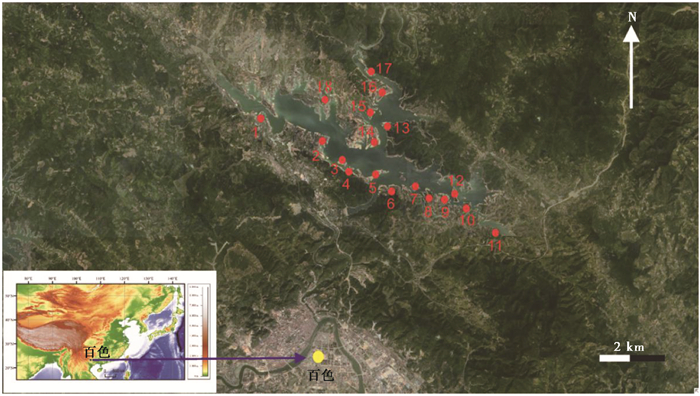
王頠[27]曾对澄碧河库区枫树岛遗址进行调查及发掘,首次在地层中发掘出土手斧,并在与手斧同一层位发现玻璃陨石。枫树岛的发掘和研究,有助于澄清国内外学术界有关百色手斧的地层来源问题和玻璃陨石能否代表手斧年代的问题;同时,枫树岛大量手斧的分析和研究,对于了解东亚地区早期人类起源、演化和文化传统都具有重要科学意义。本次,我们对澄碧河库区进行全面的考古调查和复查,其中复查遗址3处,新发现遗址15处,目前共发现旧石器遗址18处,分布在澄碧河库区周边,主要集中在库区南边。遗址包括后山遗址、林科所遗址、松树岛遗址、桃花岛遗址、无名岛遗址、澄碧林场遗址、松林岛遗址、枫树岛遗址、鸬鹚岛遗址、横山岛遗址、那务新村遗址、马鹿场遗址、太阳岛遗址、公兰岛遗址、囊前岛遗址、弄皇岛遗址、平毕遗址和那郎遗址(图 1)。其中14处遗址含有手斧,以太阳岛遗址、澄碧林场遗址、那朗遗址、无名岛遗址和鸬鹚岛遗址发现的手斧数量最多(见表 1)。
|
图 1 澄碧河库区旧石器遗址群 1.后山遗址(Houshan site);2.林科所遗址(Linkesuo site);3.松树岛遗址(Songshudao site);4.桃花岛遗址(Taohuadao site);5.无名岛遗址(Wumingdao site);6.澄碧林场遗址(Chengbilinchang site);7.松林岛遗址(Songlindao site);8.枫树岛遗址(Fengshudao site);9.鸬鹚岛遗址(Lucidao site);10.横山岛遗址(Hengshandao site);11.那务新村遗址(Nawuxincun site);12.马鹿场遗址(Maluchang site);13.太阳岛遗址(Taiyangdao site);14.公兰岛遗址(Gonglandao site);15.囊前岛遗址(Nangqiandao site);16.弄皇岛遗址(Nonghuangdao site);17.平毕遗址(Pingbi site);18.那朗遗址(Nalang site) Fig. 1 Distribution map of Paleolithic sites in the Chengbihe Reservoir region |
|
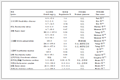
表 1 澄碧河库区石制品统计表 Table 1 General information of stone tools collected from the Chengbihe Reservoir region |
百色澄碧河库区遗址群地层堆积情况大致相同,从上而下可以划分为3层:
第1层,表土层;
第2层,网纹红土层,厚薄不一致,发现有丰富石制品及玻璃陨石,石制品包括手斧、手镐、砍砸器和刮削器等石器;
第3层,砾石层。
以太阳岛遗址为例,该遗址地理坐标为23°58′ 53″N,106°39′ 05″E;高程180.3 m。遗址处于澄碧河库区北岸,地势由西北向东南倾斜,由3个相邻的半岛组成。遗址呈不规则状分布,分布面积较大,东西长约1000 m,南北宽约3000 m。在遗址上采集到手斧、手镐、砍砸器和刮削器等石器,以及较多玻璃陨石。
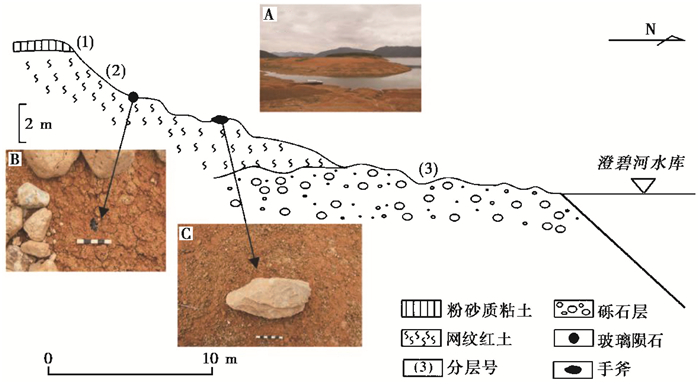
根据遗址在枯水期暴露的地层来看,遗址地层厚度约7 m,从上而下可分为3层(图 2):
|
图 2 太阳岛遗址地貌景观及石器与玻璃陨石发现位置 A.遗址面貌(landscape surrounding the site),B.玻璃陨石(tektite),C.手斧(handaxe);该图修自参考文献[28~29] Fig. 2 Geomorphologic landscape of the Taiyangdao site, along with the discovery of handaxe and tektite. Revised from the references[28~29] |
(1) 粉色砂质粘土组成的表土,松散,植被根系发育。厚0~40 cm;
(2) 上部网纹红土层,厚约6 m。为百色盆地第4级阶地典型堆积物,地表可采集到数量较多的石制品和玻璃陨石,石制品中包括手斧和手镐等具有阿舍利技术特色的工具类型;
(3) 下部砾石层,目前侵蚀暴露的砾石层厚约50 cm,未见底。砾石岩性以砂岩、石英为主,粒径以2~30 cm左右居多。表面散落的砾石以石英居多,砂岩、石英岩次之,中等磨圆度。
此次联合调查共采集石制品332件,另有玻璃陨石60件,手斧均为采集所得。石制品类型包括石核(n=97件)、石片(n=47件)、刮削器(n=9件)、砍砸器(n=46件)、手镐(n=13件)、手斧(n=88件)、粗制大型工具(n=32件)(表 1)。本文定义的粗制大型工具是指尚未加工成型的大型工具,主要表现为手斧或手镐等工具的初级形态。另外,传统上主要以加工方式来划分手斧和手镐工具,即单面加工的为手镐,两面加工的为手斧。为了便于对比研究,本文采用了目前国际学界广泛使用的分类标准[30~31],即根据石器远端部位形态的不同,将远端横截面呈三角形的石器划分为手镐,远端横截面呈平凸形、双凸形或其他扁平形态的石器划分为手斧。
从表 1中可以看出,在发现的18个遗址中,石制品数量最多是无名岛遗址(n=60件),其次是澄碧林场遗址(n=58件)和太阳岛遗址(n=56件)。工具类型包含砍砸器、手斧、手镐和刮削器,其中以手斧数量最多(n=88件),其次砍砸器(n=46件),刮削器最少(n=9件)。发现手斧的遗址有14个,占遗址总数的78 %。
澄碧河库区石器原料来自于附近的河滩砾石,岩性包括砂岩、石英岩、石英、各类硅质岩和火成岩等,其中石英岩比例最高,其次为各类硅质岩。包括手斧在内的部分石制品上保留有网纹红土印痕,且一些石制品磨蚀较为严重,表明其暴露地表的时间已经比较长。
调查中还发现了一定数量的玻璃陨石。这些玻璃陨石颜色漆黑,不透明,形状为条形和不规则状,陨石表面可见清晰的坑洼、凹槽和线纹,玻璃陨石表面未见人工打制的疤痕。澄碧河库区地表采集的玻璃陨石在形态特征上与目前已发掘出土的玻璃陨石非常相似(如库区内的枫树岛遗址),推断这些陨石属于早、中更新世之交的亚-澳散布区玻璃陨石[15]。
2 澄碧河库区手斧的技术与形态特征分析 2.1 手斧技术特征从88件手斧的磨蚀程度来看,大部分手斧都经历了不同程度的磨蚀,其中轻度磨蚀的有51件,占58.0 %;中度磨蚀和重度磨蚀的各有17件;仅有3件手斧仍保持新鲜的刃缘。因此,大部分手斧在暴露地表后,都经历了一定时间的外力(水流/风力)磨蚀作用。
制作手斧的原料主要为石英岩,有69件,占78.4 %;另有少量的硅质岩(n=7)、火成岩(n=6)、石英(n=4)和砂岩(n=2)。从对库区内自然砾石层的统计可以看出,砂岩和石英是占比最高的原料,石英岩仅占次要地位,这可能指示了古人类有意挑选石英岩作为制作手斧的原料。
从毛坯来看,大多数手斧(n=62,70.5 %)采用河滩砾石直接加工,但也有一部分手斧(n=11,12.5 %)以大石片为毛坯加工而成。少量手斧(n=4,4.5 %)采用板状毛坯(即自然裂开的砾石)进行加工,另有11件手斧由于磨蚀较为严重,难以辨别毛坯类型。相对于砾石毛坯和板状毛坯,大石片毛坯代表了更长的操作链系统以及更高的技术与认知能力的要求[32~33]。古人类首先需要选择尺寸较大的石核,并能够从石核上顺利剥取大石片,这类大石片的长度或宽度一般大于10 cm。在此基础上,以大石片为毛坯,进行手斧的加工制作。
在工具的加工方面,澄碧河库区手斧主要采用两面加工的方式制作而成,计有65件,占73.9 %;单面加工的手斧有22件,占25.0 %;另有1件手斧的加工方式难以确定。在之前的研究中,多数学者认为百色盆地手斧两面加工的手斧中以单面加工为主,并认为这是百色盆地手斧区别于其他地区手斧的技术特征之一[1, 34~35]。但是,澄碧河库区的手斧材料显示,两面加工的方式明显占比更高。造成这种差异的原因,目前仍不清楚,但考虑到澄碧河流域与右江流域在地理空间上的差异,今后可以尝试从空间变异性的角度对该问题进行探讨。
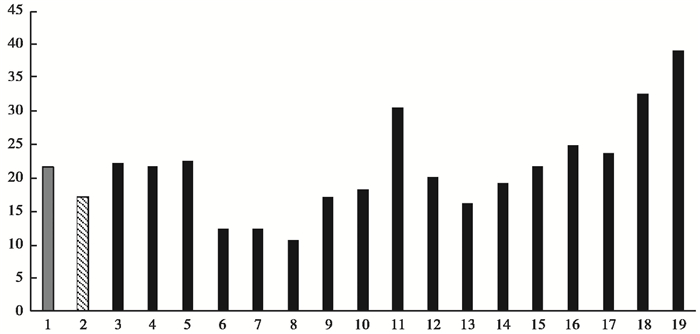
修理片疤(简称修疤)数量的多少,是反映手斧加工程度的一个重要指标[36~37]。对澄碧河库区手斧修疤的统计结果显示,修疤数量的变异范围较大,其中最少的有8个,最多的达47个,平均修疤数量为21.5个。另外,我们也对手斧上的阶梯状修疤进行了专门的统计。这类修疤一般认为是由原料内部发育的节理造成的,质地均一的原料,产生阶梯状修疤的几率较小。从统计数据来看,澄碧河库区手斧阶梯状修疤最少的仅1个,最多的则达26个,平均为7.5个。从每件手斧阶梯状修疤与总修疤的比值来看,比值最小的为7.1 %,最大为72.7 %,平均比值为35.0 %。这一结果显示,阶梯状修疤数量约占总修疤数量的三分之一,因此,原料质地对打制技术的发挥以及手斧最终形态都会产生一定程度的影响。另外,手斧修疤数量的区域间比较结果显示(图 3和表 2),澄碧河库区手斧平均修疤数量为21.5个,欧洲地区手斧平均修疤数量在10.6个到39个之间,澄碧河库区手斧的平均修疤数量处在西方手斧平均修疤数量的变异范围之内,表明在修理程度上,东西方手斧之间并没有显著的差别(图 3和表 2)。但是,我们也注意到,西方手斧的修疤数量与手斧年代之间存在一定的对应关系,即年代越晚,手斧修疤数量相应的越多。因此,在今后研究中,我们应该对比更多与澄碧河库区手斧在年代上相近或相同的西方手斧标本。
|
图 3 不同地区手斧修疤数量比较(左边坐标为修疤数量平均值,数据来源于参考文献[38~40]) 1.澄碧河库区(中国);2.丹江口库区3级阶地(中国);3. Hunsgi(印度);4. Chirki(印度);5. Porto Maior(西班牙);6. KGA6-A1 Locus C(埃塞俄比亚);7. KGA4-A2(埃塞俄比亚);8. KGA10-A11(埃塞俄比亚);9. KGA7-A1,A2,A3(埃塞俄比亚);10. KGA12-A1(埃塞俄比亚);11. KGA20-A1,A2(埃塞俄比亚);12. Olorgesailie(肯尼亚);13. Beds Ⅲ/IV of Olduvai(坦桑尼亚);14. Ternifine(摩洛哥);15. Grotte des Ours (摩洛哥);16. STIC(摩洛哥);17. Rietputs 15(南非);18. Doornlaagte(南非);19. Cave of Hearths(南非) Fig. 3 Inter-regional comparisons of the number of flaking scars on handaxes(column in the most left showing the average scar number of handaxes in the Chengbihe Reservoir Region, source data are extracted from references[38~40]). 1. Chengbihe Reservoir region(China); 2. Terrace three of the Danjiangkou Reservoir region(China); 3. Hunsgi(India); 4. Chirki(India); 5. Porto Maior(Spain); 6. KGA6-A1 Locus C(Ethiopia); 7. KGA4-A2(Ethiopia); 8. KGA10-A11(Ethiopia); 9. KGA7-A1, A2, A3(Ethiopia); 10. KGA12-A1(Ethiopia); 11. KGA20-A1, A2(Ethiopia); 12. Olorgesailie(Kenya); 13. Beds Ⅲ/Ⅳ of Olduvai(Tanzania); 14. Ternifine(Morocco); 15. Grotte des Ours(Morocco); 16. STIC(Morocco); 17. Rietputs 15(South Africa); 18. Doornlaagte (South Africa); 19. Cave of Hearths(South Africa) |
|
|
表 2 不同地区手斧修疤数量的比较(数据来源于参考文献[38~40]) Table 2 Inter-regional comparisons of the mean flaking scar numbers on handaxes(data extracted from references[38~40]) |
本文首先对澄碧河库区手斧远端和近端的横截面形态进行了统计。结果显示,手斧远端(即由两边汇聚而成的尖部)横截面形态以平凸形(n=42,47.7 %)和双凸形(n=40,45.5 %)为主,仅有少量为梯形(n=4,4.5 %)和不规则形(n=2,2.3 %)形态。手斧近端(即底部)横截面形态则以椭圆形为主,可细分为厚度较大的椭圆形(n=40,45.5 %)和扁平的椭圆形(n=9,10.2 %)两种;其次为不规则形,有20件,占22.7 %;三角形(n=10,11.4 %)和方形(n=9,10.2 %)的底部也占有一定比例。
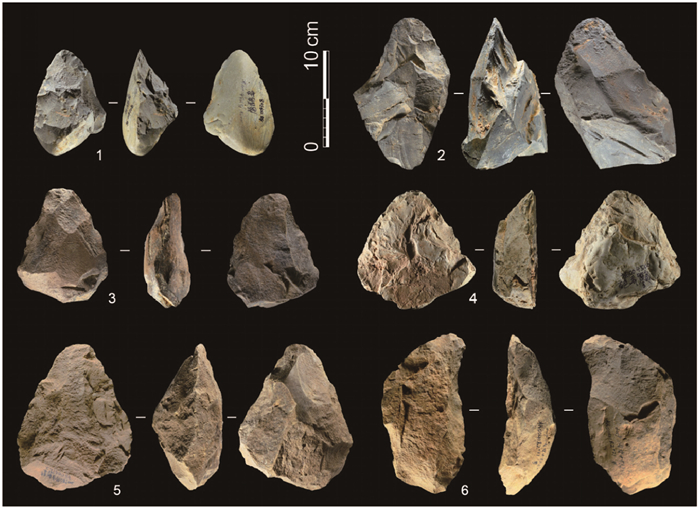
远端是手斧的使用功能单元,而近端往往是用于手握的把手端。平凸或双凸形为主的远端形态更有利于发挥切割、砍砸等功能。对远端刃缘角度的统计也显示,刃角平均值为55°,指示手斧的刃缘以锋利型为主。相较远端,澄碧河库区手斧的近端形态主要为椭圆形,这种把端形态保证了无需修理,便可以手握,应是古人类对原料有目的选择的结果(图 4)。
|
图 4 澄碧河库区调查发现的手斧标本 1.标本004308鸬鹚岛(Lucidao);2.标本004155那郎(Nalang);3.标本004153那郎(Nalang);4.标本004506弄皇岛(Nonghuangdao);5.标本004162那务新村(Nawuxincun);6.标本004182澄碧林场(Chengbilinchang) Fig. 4 Handaxes surface-collected from the Chengbihe Reservoir region |
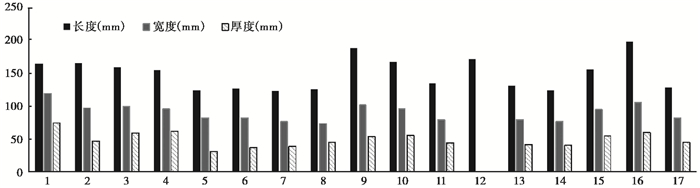
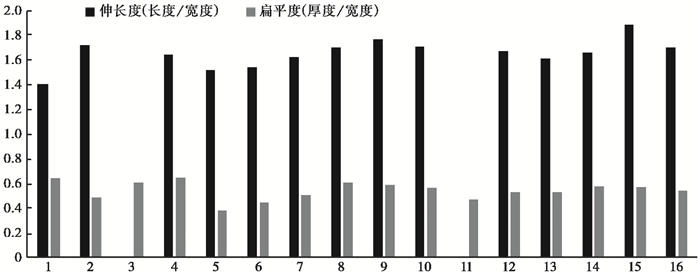
先前研究中,学者们对百色盆地手斧的尺寸测量指标也给予了特别的关注,并且认为百色盆地手斧在厚度上明显不同于西方阿舍利技术中的手斧,可能暗示了该地区手斧的出现是本土趋同演化的结果[41]。为了更好地认识澄碧河库区手斧的形态特征,我们将该地区手斧与非洲、欧洲以及中国其他地区发现的手斧进行尺寸对比。除了之前学者们广泛应用的厚度指标,本研究还加入了长度、宽度、伸长度(长度/宽度)和扁平度(厚度/宽度)指标,以便全面地认识区域间手斧尺寸的异同。另外,对与手斧同层出土的玻璃陨石的氩氩法测年结果显示,澄碧河库区手斧的年代处于距今80万年左右的早-中更新世过渡阶段[15],因此,本研究有目的地选择了距今80万年以来的手斧标本进行对比分析。
统计结果显示,澄碧河库区手斧在长度指标(Mean=162.86 mm)上处于其他地区手斧的变异范围之内,但在宽度(Mean=118.33 mm)和厚度(Mean=73.66 mm)上,都明显高于其他地区的手斧标本(图 5和表 3)。澄碧河库区手斧的伸长度指标(Mean=1.40)在所有地区中是最低的,而扁平度指标(Mean=0.64)则明显较高,仅次于韩国汉滩江流域的手斧(Mean=0.65)(图 6和表 3)。因此,澄碧河库区手斧的宽度和厚度明显较大,进而导致手斧在侧视时两侧呈鼓起的形态,而在正视时器身较短、远端的尖状程度也较弱。对于造成澄碧河库区手斧独特尺寸特点的原因,可能与当地原料的形状和大小有关,尤其是砾石石器,不同区域的砾石形状及大小存在较大的差异;当然,也可能与手斧在当地生态环境下所发挥的功能有一定关系[42~44]。
|
图 5 不同地区手斧长宽厚测量指标的比较(数据来源于参考文献[38~40]) 1.澄碧河库区(中国);2.丹江口库区3级阶地(中国);3.洛南盆地(中国);4.汉滩江盆地(IHRB)(韩国);5. Boxgrove(英国);6. Broom Pits(英国);7. Corfe Mullen(英国);8. Cuxton(英国);9. Porto Maior(西班牙);10. STIC(摩洛哥);11. Grotte des Ours(摩洛哥);12. KGA20-A1,A2(埃塞俄比亚);13. Olduvai,Masek Beds(坦桑尼亚);14. Elandsfontein(南非);15. Amanzi Springs(南非);16. Doornlaagte(南非);17. Cave of Hearths(南非) Fig. 5 Inter-regional comparisons of the mean values of length, width and thickness of handaxes(data extracted from references[38~40]). 1. Chengbihe Reservoir region(China); 2. Terrace three of Danjiangkou Reservoir region(China); 3. Luonan basin(China); 4. Hantan River Basin(IHRB)(Korea); 5. Boxgrove(UK); 6. Broom Pits(UK); 7. Corfe Mullen(UK); 8. Cuxton(UK); 9. Porto Maior(Spain); 10. STIC(Morocco); 11. Grotte des Ours(Morocco); 12. KGA20-A1, A2(Ethiopia); 13. Olduvai, Masek Beds(Tanzania); 14. Elandsfontein(South Africa); 15. Amanzi Springs(South Africa); 16. Doornlaagte(South Africa); 17. Cave of Hearths(South Africa) |
|
|
表 3 不同地区手斧测量指标的比较(数据来源于参考文献[38~40]) Table 3 Comparison of measurement indicators of handaxes in different regions(data from references[38~40]) |
|
图 6 不同地区手斧伸长度和扁平度测量指标的比较(数据来源于参考文献[38~40]) 1.澄碧河库区(中国);2.丹江口库区3级阶地(中国);3.洛南盆地(中国);4.汉滩江盆地(IHRB)(韩国);5. Boxgrove(英国);6. Broom Pits(英国);7. Corfe Mullen(英国);8. Cuxton(英国);9. STIC(摩洛哥);10. Grotte des Ours(摩洛哥);11. KGA20-A1,A2(埃塞俄比亚);12. Olduvai,Masek Beds(坦桑尼亚);13. Elandsfontein(南非);14. Amanzi Springs(南非);15. Doornlaagte(南非);16. Cave of Hearths(南非) Fig. 6 Comparisons of the elongation index and flatness index of handaxes across different regions(data extracted from references[38~40]). 1. Chengbihe Reservoir region(China); 2. Terrace three of Danjiangkou Reservoir region(China); 1. Luonan basin(China); 4. Hantan River Basin(IHRB)(Korea); 5. Boxgrove(UK); 6. Broom Pits(UK); 7. Corfe Mullen(UK); 8. Cuxton(UK); 9. STIC(Morocco); 10. Grotte des Ours(Morocco); 11. KGA20-A1, A2(Ethiopia); 12. Olduvai, Masek Beds(Tanzania); 13. Elandsfontein (South Africa); 14. Amanzi Springs(South Africa); 15. Doornlaagte(South Africa); 16. Cave of Hearths(South Africa) |
此次调查发现了数量较多的手斧工具,为探讨百色盆地手斧技术和形态特征提供了重要材料。从手斧在遗址中的分布状况来看,在18个遗址中,有14个遗址发现手斧,占遗址总数的78 %。制作手斧的原料来自于附近的河滩砾石,从岩性构成来看,澄碧河库区手斧与百色盆地右江河谷第4级阶地发现的手斧在原料上较为相似[8, 15],因此,我们推测生活在澄碧河库区的早期人类,可能采集当时河滩暴露的砾石加工石器。另外,大部分手斧都经历了不同程度的磨蚀。从毛坯来看,大多数手斧采用河滩砾石直接加工,但也有一部分手斧以大石片为毛坯加工而成。在加工方面,澄碧河库区手斧主要采用两面加工的方式制作而成。详细的手斧修疤统计结果显示,澄碧河库区手斧修疤数量的变异范围较大。
对澄碧河库区手斧远端和近端的横截面形态的分析结果显示,手斧远端横截面形态以平凸形和双凸形为主,远端刃缘角度以锋利型为主。相较远端,澄碧河库区手斧的近端形态主要为椭圆形,这种把端形态保证了无需修理,便可以手握,应是古人类对原料有目的选择的结果。
总体来看,澄碧河库区手斧与右江河谷地区发现的手斧[8, 15]存在很多技术上的相似之处,但同时也有一些区别。首先,在原料利用上,两个地区都以石英岩为主要原料制作手斧;其次,从毛坯来看,砾石毛坯在两个地区都占有重要的比例,但澄碧河库区大石片毛坯的比例高于右江河谷地区;最后,从修理类型来看,澄碧河库区手斧两面修理的比例明显高于右江河谷地区的手斧。
通过对澄碧河库区以及非洲、欧洲和中国其他地区发现的手斧进行尺寸对比[38~40],发现澄碧河库区手斧的宽度和厚度明显较大,进而导致手斧在侧视时两侧呈鼓起的形态,而在正视时器身较短、远端的尖状程度也较弱。对于造成澄碧河库区手斧独特尺寸特点的原因,我们认为可能主要与当地原料尺寸以及手斧在当地生态环境下所发挥的功能有一定关系。同时,也不能排除是由于年代早晚差异亦或不同人群差异所造成的。
3.2 澄碧河库区遗址的年代与意义百色盆地旧石器广泛分布于第4级阶地,手斧和玻璃陨石共存于网纹红土地层[8, 15]。此次调查发现的旧石器遗址中,就有10个遗址发现了玻璃陨石;手斧等石器的表面有网纹红土的印痕,表明其原生层位是网纹红土层。根据以往的研究,百色盆地第四级阶地发现的玻璃陨石属于早、中更新世之交的亚-澳散布区玻璃陨石。最早在1996年,百色盆地百谷遗址网纹红土地层中出土玻璃陨石经过裂变径迹法年代测定,得出百谷遗址玻璃陨石的年代为732 ka B.P.[45~46];2000年,经过40 Ar/39 Ar法对百色盆地第4级阶地中与石制品共生的玻璃陨石进行测年,其结果显示百色盆地第4级阶地石器文化层形成于距今803 ka B.P.[1]。据此,我们认为澄碧河库区第4级阶地遗址中含手斧地层的年代大约在早-中更新世过渡阶段,即距今732 ka B.P.或803 ka B.P.。
近些年来,关于中国区域手斧研究材料日趋增多,推动了中国区域手斧的进一步研究讨论。同时关于百色盆地手斧技术的起源,长期以来存在趋同演化和西方文化传播与交流两种对立的观点[47~48]。澄碧河库区是目前百色盆地内手斧分布密度最高的地区之一,并且手斧数量较多,澄碧河库区含手斧遗址群的发现和研究,从年代和石器技术两个重要方面,为我们了解中国手斧技术的多样性特点,以及深入探讨中国手斧技术的起源与演化问题提供了宝贵材料。
| [1] |
Hou Y M, Richard P, Yuan B Y, et al. Mid-Pleistocence Acheulean-like stone technology of the Bose basin, South China[J]. Science, 2000, 287(5458): 1622-1626. DOI:10.1126/science.287.5458.1622 |
| [2] |
李炎贤, 尤玉柱. 广西百色发现的旧石器[J]. 古脊椎动物与古人类, 1975, 13(4): 225-228. Li Yanxian, You Yuzhu. Discovery of Paleolithic artifacts in Bose, Guangxi[J]. Vertebrata PalAisatica, 1975, 13(4): 225-228. |
| [3] |
覃圣敏, 覃彩銮, 梁旭达, 等. 广西新州打制石器地点的调查[J]. 考古, 1983(10): 865-868. Qin Shengmin, Qin Cailuan, Liang Xuda, et al. A survey of stone tools from Xinzhou in Guangxi[J]. Archaeology, 1983(10): 865-868. |
| [4] |
何乃汉, 邱中郎. 百色旧石器的研究[J]. 人类学学报, 1987, 6(4): 289-297. He Naihan, Qiu Zhonglang. A study of stone tools from Baise, Guangxi[J]. Acta Anthroplogica Sinica, 1987, 6(4): 289-297. |
| [5] |
黄慰文, 冷健, 员晓枫, 等. 对百色石器层位和时代的新认识[J]. 人类学学报, 1990, 9(2): 105-112. Huang Weiwen, Leng Jian, Yuan Xiaofeng, et al. Advanced opinions on the stratigraphy and chronology of Baise stone industry[J]. Acta Anthroplogica Sinica, 1990, 9(2): 105-112. |
| [6] |
曾祥旺. 广西百色市百谷屯发现的旧石器[J]. 考古与文物, 1996(6): 1-8. Zeng Xiangwang. Discovery of Paleolithic artifacts in Baigu, Bose City, Guangxi[J]. Archaeology and Relic, 1996(6): 1-8. |
| [7] |
林强. 广西百色田东坡西岭旧石器时代遗址发掘简报[J]. 人类学学报, 2002, 21(1): 59-64. Lin Qiang. A preliminary report on excavations at the Poxiling Paleolithic site in Tiandong County, Guangxi[J]. Acta Anthropologica Sinica, 2002, 21(1): 59-64. DOI:10.3969/j.issn.1000-3193.2002.01.006 |
| [8] |
谢光茂, 林强, 黄启善. 百色旧石器[M]. 北京: 文物出版社, 2003: 104-108. Xie Guangmao, Lin Qiang, Huang Qishan. Bose Paleolithic Industry[M]. Beijing: Cultural Relics Press, 2003: 104-108. |
| [9] |
Langbroek M. Do tektites really date the bifaces from the Bose(Baise)Basin, Guangxi, Southern China?[J]. Journal of Human Evolution, 2015, 80(6): 175-178. |
| [10] |
Xie G M, Bodin E. Les industries paleolithiques du bassin de Bose(Chine du Sud)[J]. L'Anthropologie, 2007, 111(2): 182-206. DOI:10.1016/j.anthro.2007.03.002 |
| [11] |
裴树文, 陈福友, 张乐, 等. 百色六怀山旧石器遗址发掘简报[J]. 人类学学报, 2007, 26(1): 1-15. Pei Shuwen, Chen Fuyou, Zhang Yue, et al. Preliminary report on the excavation of the Liuhuaishan Paleolithic site at Baise, South China[J]. Acta anthropologica Sinica, 2007, 26(1): 1-15. DOI:10.3969/j.issn.1000-3193.2007.01.001 |
| [12] |
谢光茂, 林强. 百色上宋遗址发掘简报[J]. 人类学学报, 2008, 27(1): 13-22. Xie Guangmao, Lin Qiang. A preliminary report on the excavation of the Shangsong site[J]. Acta Anthropologica Sinica, 2008, 27(1): 13-22. |
| [13] |
谢光茂, 林强, 黄鑫. 百色田东百渡旧石器遗址发掘简报[J]. 人类学学报, 2010, 29(4): 355-371. Xie Guangmao, Lin Qiang, Huang Xin. A preliminary report on the excavation of the Baidu site in the Bose Basin, South China[J]. Acta Anthropologica Sinica, 2010, 29(4): 355-371. |
| [14] |
柳州市博物馆, 广西文物考古研究所, 田东县博物馆.田东坡洪遗址A区发掘简报[C]//广西文物考古研究所编.广西考古文集(第4辑).北京: 科学出版社, 2010: 36-62. Museum of Liuzhou, Guangxi Institute of Cultural Relics and Archaeology, Tiandong County Museum. A report on the excavation of a area of the Pohong site in Tiandong County[C]//Guangxi Institute of Cultural Relics and Archaeology ed. Collected Works of Guangxi Archaeology(Volume Four). Beijing: Science Press, 2010: 36-62. |
| [15] |
王頠. 广西百色盆地枫树岛旧石器遗址[M]. 北京: 科学出版社, 2014: 1-147. Wang Wei. The Fengshudao Site of Paleolithic Age in Baise Basin, Guangxi, South China[M]. Beijing: Science Press, 2014: 1-147. |
| [16] |
邱立诚.田阳那满旧石器时代遗址发掘报告[C]//广西文物考古研究所编.广西考古文集(第4辑).北京: 科学出版社, 2010: 83-116. Qiu Licheng. A report on the excavation of the Naman site in Tiandong County[C]//Guangxi Institute of Cultural Relics and Archaeology ed. Collected Works of Guangxi Archaeology(Volume Four). Beijing: Science Press, 2010: 83-116. |
| [17] |
Huang S M, Wang W, Bae C J, et al. Recent Paleolithic field investigations in Bose Basin(Guangxi, China)[J]. Quaternary International, 2012, 281: 5-9. DOI:10.1016/j.quaint.2011.10.013 |
| [18] |
Xu G L, Wang W, Bae C J, et al. Spatial distribution of Paleolithic sites in Bose Basin, Guangxi, China[J]. Quaternary International, 2012, 281: 10-13. DOI:10.1016/j.quaint.2012.02.019 |
| [19] |
袁宝印, 侯亚梅, 王頠, 等. 百色旧石器遗址的若干地貌演化问题[J]. 人类学学报, 1999, 18(3): 215-224. Yuan Baoyin, Hou Yamei, Wang Wei, et al. On the geomorphological evolution of the Bose Basin, a lower Paleolithic locality in South China[J]. Acta Anthropologica Sinica, 1999, 18(3): 215-224. |
| [20] |
Koeberl C, Glass B P, Keates S G. Tektites and the age Paradox in mid-Pleistocence China[J]. Science, 2000, 289(5479): 507. DOI:10.1126/science.289.5479.507a |
| [21] |
王頠, 莫敬尤, 黄志涛. 广西百色盆地大梅南半山遗址发现与玻璃陨石共生的手斧[J]. 科学通报, 2006, 51(18): 2161-2165. Wang Wei, Mo Jinyou, Huang Zhitao. Recent discovery of handaxes associated with tektites in the Nanbanshan locality of the Damei site, Bose Basin, Guangxi, South China[J]. Chinese Science Bulletin, 2006, 51(18): 2161-2165. DOI:10.3321/j.issn:0023-074X.2006.18.012 |
| [22] |
Wang W, Bae C J, Huang, S M, et al. Middle Pleistocene bifaces from Fengshudao(Bose Basin, Guangxi, China)[J]. Journal of Human Evolution, 2014, 69: 110-122. DOI:10.1016/j.jhevol.2013.11.002 |
| [23] |
陈晓颖, 谢光茂, 林强. 大梅遗址第一地点发掘简报[J]. 人类学学报, 2017, 36(3): 289-303. Chen Xiaoying, Xie Guangmao, Lin Qiang. Excavation of the Locality 1 of Damei Site in Bose Basin, South China[J]. Acta Anthropologica Sinica, 2017, 36(3): 289-303. |
| [24] |
Xie G M, Lin Q, Yu M H, et al. Stratigraphie et chronologie du site de Gaolingpo dans le Bassin de Bose sud de la Chine[J]. L'Anthropologie, 2018, 122(1): 1-13. |
| [25] |
谢光茂, 林强, 余明辉, 等. 广西百色盆地高岭坡遗址的地层及年代[J]. 人类学学报, 2020, 39(1): 106-117. Xie Guangmao, Lin Qiang, Yu Minghui, et al. Stratigraphy and chronology of the Gaolingpo site in the Bose Basin, South China[J]. Acta Anthropologica Sinica, 2020, 39(1): 106-117. |
| [26] |
百色地方志百色市志编纂委员会. 百色市志[M]. 南宁: 广西人民出版社, 1993. The Compilation Committee of Bose Local Chronicles. Bose City Chronicles[M]. Nanning: Guangxi Peoples Publishing House, 1993. |
| [27] |
王頠.广西百色盆地枫树岛旧石器遗址发掘出土的手斧[N].中国文物报, 2005-05-01. Wang Wei. Discovery of handaxes in the Fengshudao site, Bose Basin, Guangxi[N]. China Relic Paper, 2005-05-01. |
| [28] |
李大伟, 黄中政, 罗志柏, 等. 田阳百峰遗址发现的含手斧石制品研究[J]. 人类学学报, 2015, 34(3): 288-298. Li Dawei, Huang Zhongzheng, Luo Zhibo, et al. Early mid-Pleistocene stone artifacts including handaxes discovered at the Baifeng site in Tianyang County, Bose Basin, Guangxi, South China[J]. Acta Anthropologica Sinica, 2015, 34(3): 288-298. |
| [29] |
廖卫, 李金燕, 李大伟, 等. 广西田阳县那赖旧石器遗址发现的石制品和玻璃陨石[J]. 第四纪研究, 2017, 37(4): 678-687. Liao Wei, Li Jinyan, Li Dawei, et al. Paleolithic stone artifacts and tektite from the Nalai Site at Tianyang County, Guangxi Province[J]. Quaternary Sciences, 2017, 37(4): 678-687. |
| [30] |
Clark J D, Kleindienst M R. The Stone Age cultural sequence: Terminology, typology and raw material[M]//Clark J D ed. Kalambo Falls Prehistoric Site, Volume Ⅲ, The Earlier Cultures: Middle and Earlier Stone Age. Cambridge: Cambridge University Press, 2001: 34-65.
|
| [31] |
Kuman K. The Acheulean industrial complex[M]//Smith C ed. Encyclopedia of Global Archaeology. New York: Springer, 2014: 7-18.
|
| [32] |
Sharon G. Large flake Acheulian[J]. Quaternary International, 2010, 223(5): 226-233. |
| [33] |
Toth N, Schick K. Evolution of tool use[M]//Michael P. Muehlenbein, Basics in Human Evolution[C]. Amsterdam: Academic Press, 2015: 193-208.
|
| [34] |
Moncel M H, Arzarello M, Boëda É, et al. Assemblages with bifacial tools in Eurasia(second part). What is going on in the East?Data from India, Eastern Asia and Southeast Asia[J]. Comptes Rendus Palevol, 2018, 17(1-2): 61-76. |
| [35] |
Norton C J, Bae K. The Movius Line sensu lato(Norton et al., 2006)further assessed and defined[J]. Journal of Human Evolution, 2006, 55(6): 1148-1150. |
| [36] |
Sharon G. Acheulian Large Flake Industries: Technology, Chronology, and Significance(Vol. 1701)[M]. Oxford: British Archaeological Reports Ltd, 2007: 21-26.
|
| [37] |
Shipton C, Clarkson C. Flake scar density and handaxe reduction intensity[J]. Journal of Archaeological Science:Reports, 2015, 2: 169-175. DOI:10.1016/j.jasrep.2015.01.013 |
| [38] |
Kuman K, Li H, Li C R. Large cutting tools from the Danjiankou Reservoir region, Central China:Comparisons and contrasts with Western and South Asian Acheulean[J]. Quaternary International, 2016, 400: 58-64. DOI:10.1016/j.quaint.2015.07.052 |
| [39] |
Li H, Li C R, Kuman K. Rethinking the "Acheulean" in East Asia:Evidence from recent investigations in the Danjiangkou Reservoir region, Central China[J]. Quaternary International, 2014, 341(1): 163-175. |
| [40] |
Li H, Li C R, Kuman K, et al. The Middle Pleistocene handaxe site of Shuangshu in the Danjiangkou Reservoir region, Central China[J]. Journal of Archaeological Science, 2014, 52: 391-409. DOI:10.1016/j.jas.2014.08.033 |
| [41] |
Lycett S J, Bae C J. The Movius Line controversy:The state of the debate[J]. World Archaeology, 2010, 42(4): 521-544. |
| [42] |
Shipton C, Petraglia M D. Inter-continental variation in Acheulean bifaces[M]//Norton C, Braun D eds. Asian Paleoanthropology. Dordrecht: Springer, 2011: 49-55.
|
| [43] |
Petraglia M D, Shipton C. Large cutting tool variation west and east of the Movius Line[J]. Journal of Human Evolution, 2008, 55(6): 962-966. |
| [44] |
Gao X, Guan Y. Handaxes and the pick-chopper industry of Pleistocene China[J]. Quaternary International, 2018, 480: 132-140. DOI:10.1016/j.quaint.2017.03.051 |
| [45] |
黄志涛. 广西玻璃陨石初步研究[J]. 地质地球化学, 1995(4): 50-54. Huang Zhitao. Preliminary study of tektites in Guangxi[J]. Geological Geochemistry, 1995(4): 50-54. |
| [46] |
郭士伦, 郝秀红, 陈宝流, 等. 用裂变径迹法测定广西百色旧石器遗址的年代[J]. 人类学学报, 1996, 15(4): 347-350. Guo Shilun, Hao Xiuhong, Chen Baoliu, et al. Fission track dating of Paleolithic site at Bose in Guangxi, South China[J]. Acta Anthropologica Sinica, 1996, 15(4): 347-350. |
| [47] |
Wang W, Stephen J, Lycett N V, et al. Comparison of handaxes from Bose Basin(China)and the western Acheulean indicates convergence of form, not cognitive differences[J]. PLoS One, 2012, 7(4): e35804. |
| [48] |
高星. 中国旧石器时代手斧的特点与意义[J]. 人类学学报, 2012, 31(2): 97-112. Gao Xing. Characteristics and significance of Paleolithic handaxes from China[J]. Acta Anthropologica Sinica, 2012, 31(2): 97-112. |
2 Guizhou University, Guiyang 550025, Guizhou;
3 Guangxi Institute of Cultural Relic Protection and Archaeology, Nanning 530022, Guangxi;
4 Youjiang Museum of Nationalities, Baise 533000, Guangxi;
5 Cultural Relics Management Department of Youjiang District, Baise 533000, Guangxi;
6 Key Laboratory of Vertebrate Evolution and Human Origins, Institute of Vertebrate Paleontology and Paleoanthropology, Chinese Academy of Sciences, Beijing 100044)
Abstract
The Baise Basin in Guangxi is an important region where handaxes were discovered and reported. In this study, we further report lithic assemblages found from the Chengbihe River Valley(i.e., the Chengbihe Reservoir Region), which is a tributary of the Youjiang River and can be regarded as a key sub-area of the Baise Basin. A joint research team has carried out field investigations in the Chengbihe Reservoir Region in recent years, and 18 early Paleolithic sites have been found on the fourth terrace of the Chengbihe River, along with the collection of more than 300 stone artifacts and approximately 60 tektites in the region. Importantly, a total of 88 handaxes were identified from 14 sites, making the Chengbihe Reservoir Region a rare and important region to study the evolution of handaxe technology in China and their possible connection with the West. The discovery of tektites shows that the age of handaxes found in the Chengbihe Reservoir Region can be placed to ca. 0.8 Ma.Based on previous studies, tektites from the fourth terrace of the Baise Basin belong to the Asia-Australia tektite disseminating region occurred in the Early-Middle Pleistocene. As early as 1996, tektites from the Baigu site in the Baise Basin has been dated to ca. 732 ka through the fission track dating method, and then in 2000, the 40Ar/39Ar dating method was applied to the terrace four tektites which was buried in the same layer with stone artifacts, and a result of ca. 803 ka was obtained. According to these results, we suggest that handaxes from the fourth terrace of the Chengbihe Reservoir Region can be likely assigned to the transitional stage between early and middle Pleistocene.Handaxes have been discovered at most of these sites(14 out of 18), with a total number of 88 in the whole lithic assemblage. Detailed technological and morphological studies have been conducted for handaxes, and the results show that cobbles collected from the nearby river bed were mainly used to make handaxes, with a preference of using quartzite raw material (n=69, 78.4%). Regarding the blanks, cobbles (n=62, 70.5%) were predominantly used to make handaxes, along with a small number of large flake blanks being exploited. A large quantity of handaxes has been bifacially flaked (n=65, 73.9%), and the number of flaking scars ranges from 8 to 47, with a mean scar number of 21.5 for all handaxes. Morphologically, cross-section at the distal ends of handaxes is dominated by plano-convex and bi-convex shape, and the angles at tips are sharp and may probably be used for cutting and/or chopping function.The origins of handaxe technology at the Baise Basin have long been debated, and two opposite opinions exist: cultural transmission versus convergent evolution. As one of the dense regions bearing handaxes, materials reported in this paper from the Chengbihe Reservoir Region provide new and important information for understanding the technological characteristics of handaxe industry in China, as well as the origins and evolution of such an advanced technology in the Paleolithic period.