 2019, Vol.40


2 自然资源部海洋生态系统动力学重点实验室, 自然资源部第二海洋研究所, 浙江 杭州 310012)
南海位于世界最大海洋太平洋与最大陆地欧亚大陆之间,其海洋环境与气候受亚洲季风系统演化控制,夏季风在每年6月至9月盛行,冬季风则在11月至次年3月盛行[1~2]。西南向的夏季风盛行时,南海南部海盆形成反气旋环流,在南海西南部(越南岸外)引起离岸艾克曼流,导致出现显著的上升流,形成低温、高盐、富营养的冷舌[3]。实测数据、卫星数据以及模拟研究均显示西南季风期南海西南部叶绿素浓度相应升高[1, 4],初级生产力大大增加,同时冷涡区夏季表层海水温度(SST)一般低于28 ℃,盐度33.7 psu以上,温跃层浅于30 m[5]。
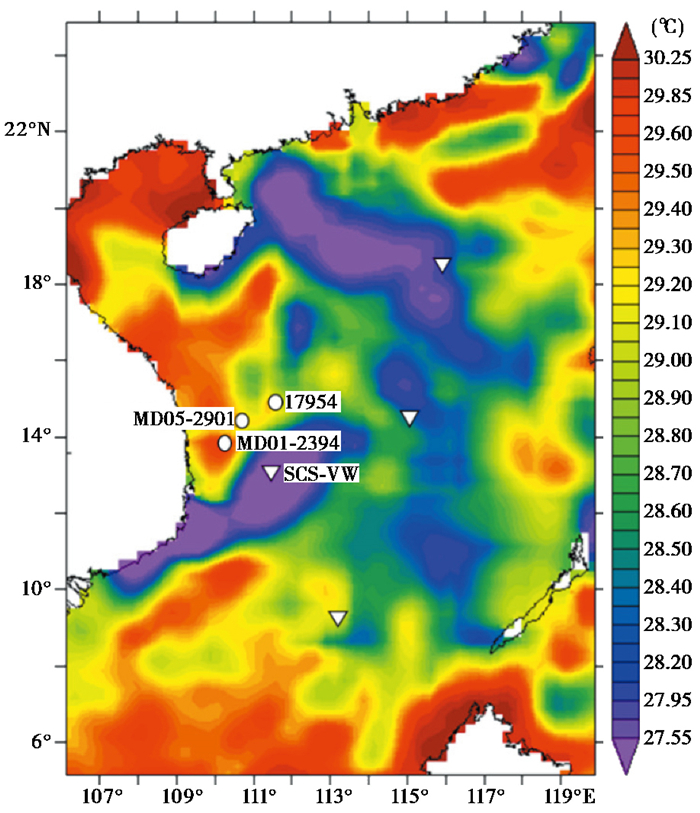
浮游有孔虫具备分布广泛、丰度高且对海洋环境变化敏感度高的特点,基于对现代夏季风系统和上升流发育的观测,很多研究通过有孔虫组成变化来重建南海西南部上升流的强度,并推测过去夏季风的演化[5~7],研究材料主要有“国际海洋全球变化”计划IMAGES中法合作MARCO-POLO航次的MD01-2394和MD05-2901钻孔,以及中德合作“太阳号” SONNE 95航次的17954钻孔(图 1)。但是,由于缺乏对现代南海西南部上升流区有孔虫群落的观测资料,文献中所使用的古上升流指标多采用其他海区的研究数据。
|
图 1 南海西南部SCS-VW沉积物捕获器站位和已发表的南海北部SCS-N-03站[14]、中部[15]、南部[2]的沉积物捕获器位置(三角),以及用于古上升流研究的IMAGES MD01-2394(13°47.54′N,110°15.56′E)、MD05-2901(14°22.503′N,110°44.6′E)、SONNE 17954(14°47.8′N,111°31.5′E)站位位置(圆圈) 底图是2014年7月21日表层海水温度分布图,数据来自NOAA最佳内插0.25°日分辨率SST结合AVHRR数据 Fig. 1 Locations of the sediment trap SCS-VW in this study and the published traps in northern SCS-N-03[14], central[15] and southern[2] of South China Sea(SCS)(triangle), as well as the published cores for paleo-upwelling study:IMAGES MD01-2394, MD05-2901 and SONNE 17954(circle). The map shows the SST distribution on 21st July, 2014 based on NOAA Optimum Interpolation 1/4 Degree Daily SST Blended with AVHRR data |
研究时间序列沉积物捕获器或浮游生物拖网是掌握现代浮游有孔虫对上升流活动真实响应的最好途径。浮游有孔虫对全世界上升流的响应具有很强的区域性,Globigerina bulloides是最被熟知的上升流指示种,它在阿拉伯海[8~9]、南加利福尼亚[10]以及北大西洋伊比利亚沿岸[11]均被作为上升流指示种。然而在中加利福尼亚沿岸上升流区,Neogloboquadrina pachyderma却是上升流指示种而非G.bulloides[12]。在半封闭的南海,G.bulloides因丰度太少而不适合作为上升流的指示种,而偏向使用Neogloboquadrina dutertrei[13]。尽管已有位于南海北[14]、中[15]、南部[2]的沉积物捕获器资料(图 1),但缺乏南海西南部上升流区的直接观测数据。因此,本研究将通过分析2014年4月14日至11月1日放置于南海西南部上升流区的沉积物捕获器中浮游有孔虫的群落组成,探讨其对2014年西南夏季风的响应记录。
1 材料与方法本研究样品来自自然资源部第二海洋研究所于2014年4月14日至11月1日布放于南海西南部SCS-VW(13°00′N,111°30′E;见图 1)站位的时间序列沉积物捕获器(Mark VI)。沉积物捕获器位于水深1000 m,收集面积0.509 m2,采集间隔为15 d或30 d,共9个样品(每个样品的采集时间见图 2的x轴坐标)。样品罐在沉积物捕获器布放前装满同水深层位的过滤海水、添加35 g/L氯化钠和3.3 g/L的氯化汞溶液以抑制微生物降解。收集得到的样品通过高精度旋转分离器(McLane WSD-10)进行分样,得到用于浮游有孔虫分析的沉积物样品约60~100 mg,后将样品过63 μm筛子清洗,在60 ℃下烘干。研究在实体显微镜下对壳径大于150 μm的浮游有孔虫进行鉴定。浮游有孔虫的属种分类鉴定依据Saito等[16]以及Schiebel和Hemleben[17]的文献描述。统计各属种的相对百分含量(%),再结合属种个数、捕获器的采集面积以及收集天数来计算各种的通量(枚/m2/d)。根据分析时段的主要浮游有孔虫组成,研究以Globigerinoides ruber、Globigerinoides sacculifer和Globigerinita glutinata含量之和来表示混合层种总含量,用N.dutertrei、Pulleniatina obliquiloculata和Globorotalia scitula含量之和来表示温跃层种总含量。样品过滤去水自然干后称重,根据重量、采集面积和收集天数计算得颗粒总通量(mg/(m2 ·d))。
|
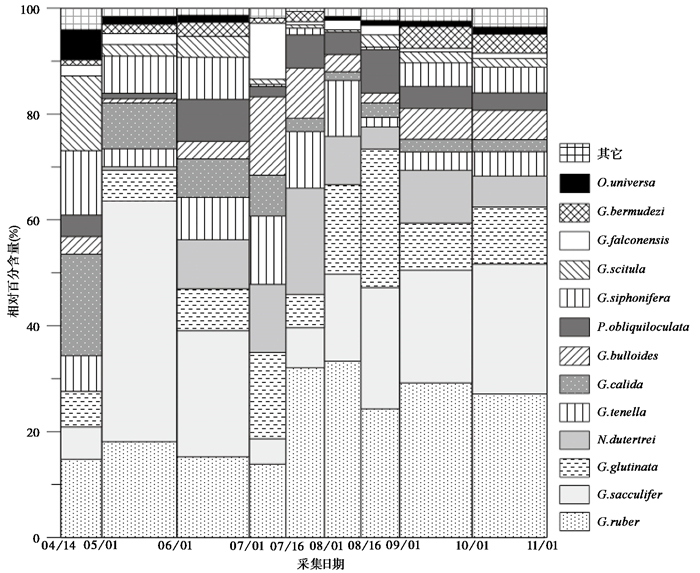
图 2 2014年4月14日~11月1日SCS-VW站位浮游有孔虫群落组成分子含量变化 Fig. 2 Variations of the planktonic foraminiferal species content from 14th April to 1st November, 2014 |
由于缺乏配套的实测水文环境数据,文中所用的日分辨率表层海水温度数据来自NOAA最佳内插0.25°日分辨率表层海水温度数据结合AVHRR数据(12°54′N,111°24′E;网址http://apdrc.soest.hawaii.edu/)。矢量风速数据来自NOAA时间序列数据库NCEP/NCAR再分析项目[18](12°30′N,112°30′E),月均总风速由径向和纬向风速计算而得。混合层深度和盐度数据来自夏威夷大学亚太数据研究中心Argo数据的3×3区间平均混合层月均数据(13°30′N,112°30′E;网址http://apdrc.soest.hawaii.edu)。叶绿素浓度数据采用NOAA的MODIS卫星4×4分辨率月平均数据(以13°N,111°30′E为中心的16个像元均值;网址https://oceandata.sci.gsfc.nasa.gov/)。
2 结果与讨论 2.1 浮游有孔虫群落组成9个样品分别全定量鉴定浮游有孔虫151~497枚不等,共12属18种。其中,以G.ruber(平均百分含量23.12 %)和G.sacculifer(平均百分含量19.21 %)为优势种(图 2),常见浮游有孔虫有G.glutinata(平均百分含量11.76 %)、N.dutertrei(平均百分含量8.00 %)、Globoturborotalita tenella(平均百分含量6.90 %)、Globigerinella calida(平均百分含量6.04 %)、G.bulloides(平均百分含量5.36 %)、P.obliquiloculata(平均百分含量4.57 %)、Globigerinella siphonifera(平均百分含量4.30 %)、G.scitula(平均百分含量3.15 %)和Globigerina falconensis(平均百分含量2.28 %);另外,平均百分含量不足2 %的浮游有孔虫有Globorotalia bermudezi、Orbulina universa、Beella digitata、Globorotalia menardii、Globorotalia theyeri、Gallitellia vivans以及N.pachyderma。
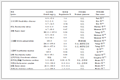
2.2 浮游有孔虫对上升流发育的响应根据来自NOAA和Argo所得的卫星数据(表 1),2014年越南岸外的径向风在5月份转向、纬向风在6月份转向。二者风速都在6月份显著加强,西南夏季风形成。总风速在8月有所下降后至9月降至夏季风前水平(图 3)。西南季风盛行时在南海西南部引起显著上升流,处于盛夏本该升温的6~8月SST下降至28 ℃左右(表 1和图 3)。如图 1选取的7月21日区域SST分布图所示,南海西南部出现了强烈的冷水上涌,而SCS-VW沉积物捕获器的位置正处于冷涡中心。同时,混合层深度也在6~8月变浅至表层20 m以内,上升流的发育给表层水带来营养物质,使叶绿素含量升高(表 1和图 3)。有研究表明现代夏季风降雨引起的湄公河等河流的径流输入会将营养物质传输至南海西南部上升流区域[19],但本研究SCS-VW站位位置的混合层盐度在6~8月处于高值(表 1),即该站位在研究时段中夏季表层水的营养物质主要来源于次表层上升流的向上供应。综合以上海洋环境数据的变化,本研究以2014年6~8月视为研究海区上升流发育阶段(图 3阴影区域)。

|
图 3 3 SCS-VW站位捕获器样品中总物质和有孔虫通量、百分含量变化与表层海水温度变化对比 直方图为通量、线条图为浮游有孔虫百分含量;阴影区为上升流发育时期 Fig. 3 Variations of the total mass flux and planktonic foraminiferal flux/content, and comparison with the sea surface temperature. Histogram represents foraminiferal flux and dots represent foraminiferal percentage; shaded area indicates the upwelling period |
|
表 1 南海西南部上升流区2014年全年的海洋环境数据(见材料与方法) Table 1 Oceanographic data(see the materials and methods) for the upwelling area in the year 2014 in the southwest SCS, monthly-averaged SST was calculated from daily SST |
如图 3所示,颗粒总通量和有孔虫总通量均在上升流发育期增加,体现了有孔虫总通量主要受季风影响的表层初级生产力所控制。在上升流的发育过程中,G.ruber、G. glutinata、N.dutertrei、G. tenella、G.bulloides、P. obliquiloculata和G.falconensis的通量和百分含量均显著增加。G.ruber是适应性很强的世界广布性种,食物广泛,在富营养的上升流区和寡营养的亚热带水团里都有大量分布[20];G.ruber是现代南海的优势种之一,在已发表的南海捕获器数据中几乎全年分布,基本呈双峰模式(在冬、夏两个季风期含量高)分布[2, 14~15, 21],说明其在南海的含量变化主要响应于季风引起的初级生产力的提高。同样地在本研究中,G.ruber也在夏季风期上升流发育时丰度增高,体现了它对表层水中营养盐增高的响应。G.glutinata主要食硅藻,在世界各海域的高丰度总是与高营养盐向表层水的输入有关[22~24],它的通量在南海中、南部的沉积物捕获器显示的全年分布中也是在东北季风和西南季风期最高,与表层生产力一致[2, 15, 21]。在本研究中,G.glutinata含量在上升流发育晚期8月才达到最高,可能除了受生产力的影响之外,该种还较多地受到了其他因素的影响。N.dutertrei专食植物,其最大丰度常在叶绿素含量最大层(DCM)附近[20, 24],南海北部拖网显示它在生产力更高的陆架区丰度更高[25],且它在南海北部的通量主要在冬季[14],在ODP1148钻孔中被用来指示东亚冬季风的强度变化[26];其在南海中、南部呈夏、冬双峰模式分布[2, 15, 21],在上升流区17954钻孔中被用来指示古上升流的强度[6]。在本研究上升流发育期间,N.dutertrei的含量显著增加,6~8月的平均含量仅次于优势种G.ruber和G.sacculifer,这期间它的通量更是超过了G.sacculifer而仅次于G.ruber,对上升流发育给出了很好的反馈。G.tenella未被南海的其他沉积物捕获器研究报道过,仅在南海春、秋季的拖网中见零星分布[27~29],它在西北太平洋捕获器中的夏季和秋季出现高通量分布,且与有机碳通量和蛋白石含量没有关系[30]。在本研究中,G.tenella对上升流活动做出了很好的响应,但可能因为它在世界各海域丰度均不高,文献中对其生态习性的描述很少。G.bulloides是机会种,藻类是其重要的食物[17],它在西北太平洋捕获器中的丰度变化与有机物和生物蛋白石的通量非常吻合[30~31],是最被熟知的低纬海域上升流指示种[32~33]。G.bulloides的丰度在南海北部和中部的捕获器中主要在冬季,与其冬季种的习性有关[14~15, 21];在南沙海域捕获器中呈双峰分布,但其含量最高时也仅在10 %左右,其含量在南海表层样中仅5 % ~10 % [34]。类似地,本研究中G.bulloides在7月的含量升高至10 %左右,因而该种不适合作为南海上升流区的标志种[13, 21]。P.obliquiloculata食藻类,其成体最大现存量在温跃层和DCM附近[35],在南海北、中部捕获器的分布主要在冬季,为冬季种[14~15, 21],春、秋季拖网中含量都很少[27, 36],但它在南部捕获器中的夏季也有峰值[2]。P.obliquiloculata的含量在本研究上升流期稍有提高(10 %以下),变化幅度不大。G.falconensis在阿拉伯海被作为东北季风和西南季风上升流的标志种[37],它在琉球群岛捕获器中通量分布在冬季,是冬季水层混合的指示种[38],但其未见于南海的其他沉积物捕获器资料中,在春季拖网中零星分布[27, 36],本研究中它仅在7月上旬可见一含量峰值(10 %)。综合来看,本研究中食植物喜高营养盐属种的含量和通量在南海西南部上升流发育期增加,考虑到它们对上升流的响应程度和在群落中的占比,本文认为N.dutertrei可能最适合作为南海西南夏季风生上升流的指示种,且上述其他属种具有很重要的参考价值。
另外,风速和SST均在6月就发生了显著改变,但上述有孔虫的响应基本均滞后了一个月(图 3),而浮游有孔虫的生命周期约为一个月[39],因此我们观察到的这种滞后很可能是对有孔虫生命周期的体现。这种滞后在其他沉积物捕获器研究中也有体现:孟加拉湾捕获器中西南季风上升流指示种G.bulloides的含量也是在季风盛行晚期达到峰值,对风速的响应存在滞后[9]。位于加利福尼亚湾连续7年的捕获器资料显示很多属种的丰度对SST和蛋白石的变化都会滞后2周[40]。
为了评价浮游有孔虫对上层水体结构变化的响应,本研究计算了混合层种(G.ruber、G. sacculifer和G. glutinata)以及温跃层种(N.dutertrei、P. obliquiloculata和G.scitula)的含量变化。结果显示,上升流盛行期温跃层变浅(见表 1),混合层变薄,混合层种总含量减少而温跃层种总含量增多(图 3)。由于实际水体中影响浮游有孔虫分布的环境因素非常复杂,因此并不是每个种都遵循了这一变化规律,如混合层种G.ruber和G. glutinata的含量反而增多了,同时温跃层种G.scitula的含量减少了,可能是营养水平或其他因素更占主导地位。因此,多个混合层种/温跃层种的总含量变化或许可以作为上升流发育的指标之一。
相对而言,G.sacculifer、G.calida、G.siphonifera和G.scitula则更多地在南海西南季风形成前出现,它们的通量和百分含量在上升流盛行时都减小了。G.sacculifer是现代南海的另一个优势种,它在南海其他各个捕获器中基本呈双峰模式分布[2, 14~15, 21],可能表明其对初级生产力的响应。但是在本研究中,G.sacculifer的通量和含量在富营养的上升流期却减少了。G.sacculifer是广温广盐种,食桡足类,被认为是寡营养表层水中最频繁出现的属种之一[20, 32]。本研究中G.sacculifer的含量在5月份最高,正是一年中叶绿素的低值期(表 1),且它在西北太平洋捕获器中的含量峰值也与初级生产力的高值期不匹配[30];另外,相比G.ruber而言,G. sacculifer适宜的生活水温更高一些[28]。因此上升流区SST的降低以及G.sacculifer对营养的需求不高可能导致了其在本研究中上升流盛行时通量和含量的降低。G.calida和G. siphonifera在南海其他捕获器中均未见报道。在本研究中,G.calida和G. siphonifera的通量在4月、5月比较大,这两个月的百分含量分别为19.19 %和8.65 %,以及12.12 %和7.04 %,与南海南部4月、5月的拖网研究结果相似[27, 36],而由于受较低的陆源营养盐控制,南海南部在春季属于叶绿素的低值区[27]。有报道称G.calida更多地在中营养和贫营养的水体和季节中出现[17],而G.siphonifera在西北太平洋捕获器中通量变化也与初级生产力无关[30~31]。因此,南海西南部G.calida和G. siphonifera通量和含量在西南季风期间均有所降低,可能显示了它们适应中、低营养的海洋环境。G.scitula在南海已发表的拖网研究中均为零星分布[28~29, 36],西北太平洋捕获器中G.scitula在8月和9月通量最大,也正是一年中生产力最低期[41]。因此,综合来看,在上升流发育期中、寡营养浮游有孔虫的丰度和含量均出现了下降。
西南季风结束后,有孔虫的群落组成趋向于稳定(图 2),G.ruber和G. sacculifer在9月至10月持续共占据了群落50 %的含量。而在上升流发育前以及过程中,群落变化却很大,可见这期间水文环境的变化比较剧烈。
2.3 对古上升流重建的启示前人在对南海西南部17954钻孔进行研究时,通过浮游有孔虫转换函数来计算海水表层温度,并利用冷水种N.pachyderma和Globorotalia inflata和暖水种G.sacculifer和P.obliquiloculata的含量变化来指示表层海水古温度变化;利用浅层水种(G.ruber、G.sacculifer和G.glutinata)和深层水种(N.dutertrei、N.pachyderma和G.menardii)的含量变化来指示温跃层深度的变化;利用高营养种N.dutertrei和G.bulloides的含量并结合有机碳通量和计算的表层初级古生产力来指示古生产力的变化,得到结论:相较于相邻的两个冰期,MIS 5期在总体上表现出表层水温度降低、温跃层变浅,表层水生产力变大的特征,表明可能受到上升流加强的影响,指示夏季风的增强[6~7, 42]。然而,以上各个指标在MIS 5期内的细节变化上却不太一致,对比发现表层初级古生产力、N.dutertrei %和深层水种%之间吻合较好(正相关),而G.sacculifer %与它们反相关(图 3),这些刚好也在本研究中得到了验证。而且它们的变化也与17954钻孔中G.ruber的δ 13C在MIS 5期所体现的表层水营养状况的变化较类似[19]。因此,本研究认为可以通过重建生产力相关的指标如喜营养种N.dutertrei的含量变化以及温跃层的深度变化来获取古上升流的信息。
而不论是利用浮游有孔虫转换函数来计算SST还是分析冷水种N.pachyderma和G. inflata的百分含量,其结果都与生产力和水层结构的指标在细节上差别很大。另外,它们的变化也与钻孔17954[19, 43]和MD05-2901[44]的U37k′-SST记录不一致[45]。在对钻孔MD01-2394的另一项研究中,G.inflata被用来作为夏季风上升流的指标[5]。然而,G.inflata在本研究中夏季上升流发育期的样品中并没有出现,G.inflata常常分布在水文锋面和涡流附近,被认为是中营养水体的机会种[22, 46~48]。它仅在南海南部4月份的个别拖网中有过报道,含量在10 %以下[27],但在表层样中有出现[36]。G.inflata以较高的通量出现在西北太平洋捕获器的冬季样品中[30~31]。Yu等[49]也曾利用MD01-2394钻孔中N.dutertrei和G. inflata的冷水组合来指示冬季风引起的冬季更混合的水体环境。而N.pachyderma也仅在本研究中夏季上升流发育期出现几枚。在南海已发表的捕获器和生物拖网资料中,南海南部春季拖网中有报道过零星出现的N.pachyderma[36]和N.incompta[27]。因此,本研究认为G.inflata和N. pachyderma可能偏向于集中在冬季或冷水的环境且丰度低,不推荐作为越南岸外夏季上升流的指示种。
尽管如此,由于本研究的沉积物捕获器样品材料采集时间仅涉及2014年4月14日至11月1日。另外考虑到不同年份海洋环境的差异,评价南海西南部海区浮游有孔虫对夏季风驱上升流的响应,尚需要更加完整年度以及更长时间尺度上的时间序列记录。并可以通过其季节性和年际变化上识别出区域性气候变化对浮游有孔虫群落的影响,从而更加可靠地应用于古海洋学研究中。
3 结论本研究利用位于南海西南部现代夏季上升流区1000 m水深的沉积物捕获器于2014年4月14日至11月1日所采集的材料,通过将各样品中浮游有孔虫属种的通量和百分含量变化与区域气候环境资料做对比,为古上升流与夏季风研究提供了现代依据。
卫星数据表明2014年越南岸外的西南风在6月显著加强,风速在8月有所下降后在9月降至夏季风前水平。西南夏季风盛行时在南海西南部引起显著的上升流,导致6~8月表层海水温度下降至28 ℃左右,混合层深度变浅至20 m以内,以及表层水叶绿素含量的升高。
本研究从沉积物捕获器材料中共鉴定出浮游有孔虫12属18种,其中以G.ruber和G. sacculifer为优势种。颗粒总通量和浮游有孔虫总通量都对南海西南部夏季上升流的发育做出了很好的响应。其中,食植物喜高营养种G.ruber、G. glutinata、N.dutertrei、G. tenella、G.bulloides、P. obliquiloculata和G.falconensis的通量和百分含量在2014年南海西南部夏季上升流盛行期增高,响应于表层初级生产力的增高;而中-寡营养种G. sacculifer、G.calida、G. siphonifera的通量和含量均在此期间减少。因此初级生产力可能是控制该区浮游有孔虫通量变化最重要的因素,利用高生产力种如N.dutertrei的含量变化来进行南海西南部过去上升流活动(西南夏季风)的重建,应该是目前最可靠的方法之一。
另外,混合层种G.ruber、G. sacculifer和G.glutinata的总含量随上升流发育期混合层的变浅而降低,而温跃层种N.dutertrei、P. obliquiloculata和G.scitula的总含量增高,因而混合层种和温跃层种的总含量变化指示的温跃层深度变化可以作为上升流发育的另一重要指标。
致谢: 感谢科考船“天鹰”号和“向阳红10”号全体船员和科考队员帮助布放与回收沉积物捕获器。感谢河海大学王桂芬老师和中国科学院南海海洋研究所徐文龙在叶绿素数据获取上的帮助,感谢审稿专家和编辑部杨美芳老师宝贵的修改意见。
| [1] |
Liu K K, Chao S Y, Shaw P T, et al. Monsoon-forced chlorophyll distribution and primary production in the South China Sea:Observations and a numerical study[J]. Deep-Sea Research Part Ⅰ:Oceanographic Research Papers, 2002, 49(8): 1387-1412. DOI:10.1016/S0967-0637(02)00035-3 |
| [2] |
万随, 翦知盡, 成鑫荣, 等. 南沙海区浮游有孔虫通量及其壳体化学性质的季节变化[J]. 中国科学:地球科学, 2010, 40(7): 881-892. Wan Sui, Jian Zhimin, Cheng Xinrong, et al. Seasonal variations in planktonic foraminiferal flux and the chemical properties of their shells in the southern South China Sea[J]. Science China:Earth Sciences, 2010, 40(7): 881-892. |
| [3] |
Xie S, Xie Q, Wang D, et al. Summer upwelling in the South China Sea and its role in regional climate variations[J]. Journal of Geophysical Research:Oceans, 2003, 108(C8): 3261. DOI:10.1029/2003JC001867 |
| [4] |
Tang D L, Kawamura H, Dien T V, et al. Offshore phytoplankton biomass increase and its oceanographic causes in the South China Sea[J]. Marine Ecology Progress Series, 2004, 268: 31-41. DOI:10.3354/meps268031 |
| [5] |
Yu P S, Mii H S, Murayama M, et al. Late Quaternary planktic foraminifer fauna and monsoon upwelling records from the western South China Sea, near the Vietnam margin(IMAGES MD012394)[J]. Terrestrial, Atmospheric and Oceanic Sciences, 2008, 19(4): 347-362. DOI:10.3319/TAO.2008.19.4.347(IMAGES) |
| [6] |
Huang B, Jian Z, Cheng X, et al. Foraminiferal responses to upwelling variations in the South China Sea over the last 220000 years[J]. Marine Micropaleontology, 2003, 47(1): 1-15. |
| [7] |
Jian Z, Huang B, Kuhnt W, et al. Late Quaternary upwelling intensity and East Asian monsoon forcing in the South China Sea[J]. Quaternary Research, 2001, 55(3): 363-370. DOI:10.1006/qres.2001.2231 |
| [8] |
Peeters F J C, Brummer G J A, Ganssen G. The effect of upwelling on the distribution and stable isotope composition of Globigerina bulloides and Globigerinoides ruber (planktic foraminifera) in modern surface waters of the NW Arabian Sea[J]. Global and Planetary Change, 2002, 34(3): 269-291. |
| [9] |
Stoll H M, Arevalos A, Burke A, et al. Seasonal cycles in biogenic production and export in northern Bay of Bengal sediment traps[J]. Deep-Sea Research Part Ⅱ:Topical Studies in Oceanography, 2007, 54(5): 558-580. |
| [10] |
Field D B, Baumgartner T R, Charles C D, et al. Planktonic foraminifera of the California current reflect 20th-century warming[J]. Science, 2006, 311(5757): 63-66. |
| [11] |
Salgueiro E, Voelker A, Abrantes F, et al. Planktonic foraminifera from modern sediments reflect upwelling patterns off Iberia:Insights from a regional transfer function[J]. Marine Micropaleontology, 2008, 66(3): 135-164. |
| [12] |
Davis C V, Hill T M, Russell A D, et al. Seasonality in planktic foraminifera of the central California coastal upwelling region[J]. Biogeosciences, 2016, 13(18): 5139-5150. DOI:10.5194/bg-13-5139-2016 |
| [13] |
Jian Z, Tian J, Sun X. Upper water structure and paleo-monsoon[M]//Wang P, Li Q. The South China Sea: Paleoceanography and Sedimentology. Dordrecht: Springer Netherlands, 2009: 297-394.
|
| [14] |
王小华, 陈荣华, 赵庆英, 等. 2009-2010年南海北部浮游有孔虫通量和稳定同位素季节变化及其对东亚季风的响应[J]. 海洋地质与第四纪地质, 2014, 34(1): 103-115. Wang Xiaohua, Chen Ronghua, Zhao Qingying, et al. The influence of East Asian monsoon on seasonal variations in planktonic foraminiferal flux and stable isotope in the northern South China Sea during 2009-2010[J]. Marine Geology & Quaternary Geology, 2014, 34(1): 103-115. |
| [15] |
陈荣华, 郑玉龙, Wiesner M G, 等. 1993~1996年南海中部海洋沉降颗粒通量的季节和年际变化[J]. 海洋学报(中文版), 2006, 28(3): 72-80. Chen Ronghua, Zheng Yulong, Wiesner M G, et al. Seasonal and annual variations of marine sinking particulate flux during 1993-1996 in the central South China Sea[J]. Acta Oceanologica Sinica, 2006, 28(3): 72-80. |
| [16] |
Saito T, Thompson P R, Breger D. Systematic Index of Recent and Pleistocene Planktonic Foraminifera[M]. Tokyo, Japan: University of Tokyo Press, 1981: 145-146.
|
| [17] |
Schiebel R, Hemleben C. Planktic Foraminifers in the Modern Ocean[M]. Switzerland: Springer Nature, 2017: 20-87.
|
| [18] |
Kalnay E, Coauthors. The NCEP/NCAR reanalysis 40-year project[J]. Bulletin of the American Meteorological Society, 1996, 77: 437-472. DOI:10.1175/1520-0477(1996)077<0437:TNYRP>2.0.CO;2 |
| [19] |
Wang L, Sarnthein M, Erlenkeuser H, et al. East Asian monsoon climate during the Late Pleistocene:High-resolution sediment records from the South China Sea[J]. Marine Geology, 1999, 156(1): 245-284. |
| [20] |
Schiebel R, Zeltner A, Treppke U F, et al. Distribution of diatoms, coccolithophores and planktic foraminifers along a trophic gradient during SW monsoon in the Arabian Sea[J]. Marine Micropaleontology, 2004, 51(3): 345-371. |
| [21] |
陈荣华, 翦知盡, 郑玉龙, 等. 南海中部浮游有孔虫通量的季节变化[J]. 同济大学学报(自然科学版), 2000, 28(1): 73-77. Chen Ronghua, Jian Zhimin, Zheng Yulong, et al. Seasonal variations of the plantonic foraminifera flux in the central South China Sea[J]. Journal of Tongji University (Natural Science), 2000, 28(1): 73-77. |
| [22] |
Chapman M R. Seasonal production patterns of planktonic foraminifera in the NE Atlantic Ocean:Implications for paleotemperature and hydrographic reconstructions[J]. Paleoceanography, 2010, 25(1): PA1101. |
| [23] |
Schiebel R, Waniek J, Bork M, et al. Planktic foraminiferal production stimulated by chlorophyll redistribution and entrainment of nutrients[J]. Deep-Sea Research Part Ⅰ:Oceanographic Research Papers, 2001, 48(3): 721-740. DOI:10.1016/S0967-0637(00)00065-0 |
| [24] |
Schmuker B, Schiebel R. Planktic foraminifers and hydrography of the eastern and northern Caribbean Sea[J]. Marine Micropaleontology, 2002, 46(3): 387-403. |
| [25] |
Lin H L, Hsieh H Y. Seasonal variations of modern planktonic foraminifera in the South China Sea[J]. Deep-Sea Research Part Ⅱ:Topical Studies in Oceanography, 2007, 54(14): 1634-1644. |
| [26] |
Jian Z, Zhao Q, Cheng X, et al. Pliocene-Pleistocene stable isotope and paleoceanographic changes in the northern South China Sea[J]. Palaeogeography, Palaeoclimatology, Palaeoecology, 2003, 193(3): 425-442. |
| [27] |
安佰正, 李铁刚, 刘健, 等. 南海南部上层水体浮游有孔虫的组成与分布特征[J]. 海洋地质与第四纪地质, 2019, 39(1): 124-133. An Baizheng, Li Tiegang, Liu Jian, et al. Assemblage and distribution of planktonic foraminifera in the upper water layer of southern South China Sea[J]. Marine Geology & Quaternary Geology, 2019, 39(1): 124-133. |
| [28] |
罗琼一, 金海燕, 翦知盡, 等. 南海现代浮游有孔虫的垂直分布及其古海洋学意义[J]. 第四纪研究, 2015, 35(6): 1342-1353. Luo Qiongyi, Jin Haiyan, Jian Zhimin, et al. Vertical distribution of living planktonic foraminifera in the northern South China Sea and its paleoceanograohic implications[J]. Quaternary Sciences, 2015, 35(6): 1342-1353. |
| [29] |
向荣, 陈木宏, 张兰兰, 等. 南海北部秋季活体浮游有孔虫的组成与分布[J]. 地球科学——中国地质大学学报, 2010, 35(1): 1-10. Xiang Rong, Chen Muhong, Zhang Lanlan, et al. Compositions and distribution of living planktonic foraminifera in Autumn waters of the northern South China Sea[J]. Earth Science-Journal of China University of Geosciences, 2010, 35(1): 1-10. |
| [30] |
Mohiuddin M M, Nishimura A, Tanaka Y, et al. Seasonality of biogenic particle and planktonic foraminifera fluxes:Response to hydrographic variability in the Kuroshio Extension, northwestern Pacific Ocean[J]. Deep-Sea Research Part Ⅰ:Oceanographic Research Papers, 2004, 51(11): 1659-1683. DOI:10.1016/j.dsr.2004.06.002 |
| [31] |
Eguchi N O, Ujiié H, Kawahata H, et al. Seasonal variations in planktonic foraminifera at three sediment traps in the subarctic, transition and subtropical zones of the central North Pacific Ocean[J]. Marine Micropaleontology, 2003, 48(1-2): 149-163. DOI:10.1016/S0377-8398(03)00020-3 |
| [32] |
Conan S M H, Brummer G J A. Fluxes of planktic foraminifera in response to monsoonal upwelling on the Somalia Basin margin[J]. Deep-Sea Research Part Ⅱ:Topical Studies in Oceanography, 2000, 47(9): 2207-2227. |
| [33] |
Seears H A, Darling K F, Wade C M. Ecological partitioning and diversity in tropical planktonic foraminifera[J]. BMC Evolutionary Biology, 2012, 12(54): 1-15. |
| [34] |
Pflaumann U, Jian Z. Modern distribution patterns of planktonic foraminifera in the South China Sea and Western Pacific:A new transfer technique to estimate regional sea-surface temperatures[J]. Marine Geology, 1999, 156(1-4): 41-83. DOI:10.1016/S0025-3227(98)00173-X |
| [35] |
Watkins J M, Mix A C, Wilson J. Living planktic foraminifera:Tracers of circulation and productivity regimes in the central equatorial Pacific[J]. Deep-Sea Research PartⅡ:Topical Studies in Oceanography, 1996, 43(4): 1257-1282. |
| [36] |
崔喜江, 向荣, 郑范, 等. 南海南部活体浮游有孔虫分布特征及其影响因素初探[J]. 热带海洋学报, 2006, 25(4): 25-30. Cui Xijiang, Xiang Rong, Zheng Fan, et al. A preliminary study of living planktonic foraminifera distribution and its affecting factors in southern South China Sea[J]. Journal of Tropical Oceanography, 2006, 25(4): 25-30. |
| [37] |
Schulz H, von Rad U, Ittekkot V. Planktic foraminifera, particle flux and oceanic productivity off Pakistan, NE Arabian Sea: Modern analogues and application to the palaeoclimatic record[M]//Clift P D, Kroon D, Gaedicke C, et al. The Tectonic and Climatic Evolution of the Arabian Sea Region. London: Geological Society, Special Publications(195), 2002: 499-516.
|
| [38] |
Xu X, Yamasaki M, Oda M, et al. Comparison of seasonal flux variations of planktonic foraminifera in sediment traps on both sides of the Ryukyu Islands, Japan[J]. Marine Micropaleontology, 2005, 58(1): 45-55. |
| [39] |
Bé, A W H. An ecological, zoogeographic and taxonomic review of recent planktonic Foraminifera[M]//Ramsay A T S. Oceanic Micropalaeontology. London: Academic Press, 1977: 1-100.
|
| [40] |
Davis C V, Fuqua L, Pride C, et al. Seasonal and interannual changes in planktic foraminiferal fluxes and species composition in Guaymas Basin, Gulf of California[J]. Marine Micropaleontology, 2019, 149: 75-88. DOI:10.1016/j.marmicro.2019.05.001 |
| [41] |
Sagawa T, Kuroyanagi A, Irino T, et al. Seasonal variations in planktonic foraminiferal flux and oxygen isotopic composition in the western North Pacific:Implications for paleoceanographic reconstruction[J]. Marine Micropaleontology, 2013, 100: 11-20. DOI:10.1016/j.marmicro.2013.03.013 |
| [42] |
黄宝琦, 翦知盡. 越南岸外晚第四纪上升流与东亚夏季风变迁[J]. 第四纪研究, 1999(6): 518-525. Huang Baoqi, Jian Zhimin. Late Quaternary coastal upwelling and variations of the East Asian Summer Monsoon off the Vietnam coast[J]. Quaternary Sciences, 1999(6): 518-525. DOI:10.3321/j.issn:1001-7410.1999.06.004 |
| [43] |
Pelejero C, Grimalt J O, Heilig S, et al. High-resolution U37k' temperature reconstructions in the South China Sea over the past 220 kyr[J]. Paleoceanography, 1999, 14(2): 224-231. DOI:10.1029/1998PA900015 |
| [44] |
李丽, 王慧, 李建如, 等. 南海西部45万年来的表层水温变化[J]. 科学通报, 2009, 54(9): 1269-1277. Li Li, Wang Hui, Li Jianru, et al. Changes in sea surface temperature in western South China Sea over the past 450 ka[J]. Chinese Science Bulletin, 2009, 54(9): 1269-1277. |
| [45] |
Sadatzki H, Sarnthein M, Andersen N. Changes in monsoon-driven upwelling in the South China Sea over glacial Terminations Ⅰ and Ⅱ:A multi-proxy record[J]. International Journal of Earth Sciences, 2015, 105(4): 1273-1285. |
| [46] |
Lončarić N, van Iperen J, Kroon D, et al. Seasonal export and sediment preservation of diatomaceous, foraminiferal and organic matter mass fluxes in a trophic gradient across the SE Atlantic[J]. Progress in Oceanography, 2007, 73(1): 27-59. |
| [47] |
Storz D, Schulz H, Waniek J J, et al. Seasonal and interannual variability of the planktic foraminiferal flux in the vicinity of the Azores Current[J]. Deep-Sea Research Part Ⅰ:Oceanographic Research Papers, 2009, 56(1): 107-124. |
| [48] |
Retailleau S, Schiebel R, Howa H. Population dynamics of living planktic foraminifers in the hemipelagic southeastern Bay of Biscay[J]. Marine Micropaleontology, 2011, 80(3): 89-100. |
| [49] |
Yu P S, Huang C C, Chin Y, et al. Late Quaternary East Asian Monsoon variability in the South China Sea:Evidence from planktonic foraminifera faunal and hydrographic gradient records[J]. Palaeogeography, Palaeoclimatology, Palaeoecology, 2006, 236(1): 74-90. |
2 Key Laboratory of Marine Ecosystem and Biogeochemistry, State Oceanic Administration Second Institute of Oceanography, Ministry of Natural Resources, Hangzhou 310012, Zhejiang)
Abstract
The Asian monsoon plays a pivotal role in the climate change of the South China Sea(SCS), inducing a prominent upwelling activity off Vietnam in the southwestern SCS when modern summer monsoon prevails. As a credible tool for paleoceanographic reconstruction, planktonic foraminifera is widely used in paleo-upwelling studies worldwide. However, the in-situ response of planktonic foraminifera to the summer upwelling induced by modern southwest summer monsoon in the southwestern SCS is still unclear, which hinders more accurate reconstruction of the paleo-summer monsoon variation by deciphering the upwelling activity through planktonic foraminifera.In this study, we explored the response of planktonic foraminifera to the summer upwelling activity in the southwestern SCS by comparing the variations in the flux and percentage of planktonic foraminifera from a time series sediment trap SCS-VW(13°00'N, 111°30'E) deployed within the summer upwelling area operated from 14th April to 1st November, 2014 with the in-situ sea surface temperature, wind speed and chlorophyll data from NOAA(National Oceanic and Atmospheric Administration)and Argo(Array for Real-time Geostrophic Oceanography). The development of the upwelling activity in the southwestern SCS was characterized by the decreased sea surface temperature and the depth of the thermocline, as well as the increased wind speed and surface water chlorophyll from June to August, 2014.151~497 foraminiferal specimens were identified from each of the 9 samples, belonging to 12 genera and 18 species. The flux and percentage of high-productivity species(G.ruber, G.glutinata, N.dutertrei, G.tenella, G.bulloides, P.obliquiloculata and G.falconensis)increased and the low-productivity species(G.sacculifer, G.calida and G.siphonifera)decreased during the upwelling prevailing period. Additionally, the total abundance of the mixed layer species(G.ruber, G.sacculifer and G.glutinata)decreased and that of thermocline species(N.dutertrei, P.obliquiloculata and G.scitula)increased in response to the shoaling thermocline. In conclusion, primary productivity serves as the most important control on the response of the planktonic foraminifera in the upwelling area, high productivity species such as Neogloboquadrina dutertrei might be one of the most reliable indicators for the upwelling activity in the southwestern SCS. Moreover, total abundance of mixed layer/thermocline species could also be used as an indicator of thermocline variation induced by the upwelling activity.