 2020, Vol.40


2 西安交通大学全球变化研究院, 陕西 西安 710054;
3 南京师范大学地理科学学院, 江苏 南京 210023)
黄土是第四纪气候记录的重要载体,建立准确的黄土地层年代是第四纪研究的重要内容。20世纪80年代,Heller和Liu[1]以及刘东生等[2]通过古地磁方法建立了2.4Ma以来洛川等黄土地层的基本年代框架。随后学者们基于粒度、磁化率等气候替代性指标,通过轨道调谐的方法建立了宝鸡、洛川等黄土-古土壤地层序列的年代标尺[3~5];90年代以后,碳十四和释光等独立测年方法逐步应用于黄土堆积,并获得了更为准确的地层年代。然而放射性碳测年方法受限于测年范围(小于50ka),测年应用存在较大的局限性[6~7],只能测定S0和L1中上部的黄土地层年代。21世纪以来,光释光技术在一定程度上突破了碳十四方法的测年范围限制[8~10],可以测定S0、L1和S1黄土地层的准确年代[11]。利用光释光测年技术,Wang等[12~13]甚至获得了B/M界线附近黄土地层的年龄,Li等[14~15]和Chen等[16]获得了S5的地层年代(大约500ka)。释光技术在黄土研究中得到了广泛应用,如帕米尔高原上的瓦恰盆地黄土[17],毛乌素沙地中的黄土-古土壤剖面[18],东海嵊山岛上的风尘黄土剖面[19]等,但更多的测年研究显示其测年上限仍然难超过S2的地层年代(大约200ka)[20~24]。
钙结核是黄土堆积中的次生物质,在黄土堆积中分布广泛。国内外有诸多学者对黄土钙结核进行过年代研究,如利用ESR[25]、释光[26]等对钙结核进行绝对定年研究,前者测年误差达到30 %,后者测年结果较好,但测年范围受限于释光测年方法的上限。也有学者尝试铀系不平衡测年法测定钙结核年代,Rowe和Maher[27]应用等时线法对洛川和刘家坡黄土钙结核进行了年代测定,但年代结果误差较大,分别达到33 %和25 %,显示洛川和刘家坡的钙结核样品难以通过铀系不平衡测年法获得可靠的年代;Durand等[28]通过对印度Coimbatore和Gundlupet两个地点多个钙结核的子样品进行研究,认为U-Th测年可以获得成土碳酸盐的绝对年代,为半干旱地区的成土过程研究提供年代控制。
通过大量野外调查,我们发现秦岭南麓汉江上游黄土钙结核内壁附着有析出的纯净致密的碳酸盐晶体,而秦岭以北黄土钙结核基本不含碳酸盐晶体,两区域的黄土钙结核在形态和结构上存在明显差异。我们认为秦岭南麓钙结核中纯净的碳酸盐晶体可能适合于铀系不平衡测年法,并且可能为秦岭南麓黄土地层的定年研究提供新的认识。本文在秦岭南麓汉江上游的柳陂剖面采集了6件钙结核样品进行铀系不平衡测年的研究。
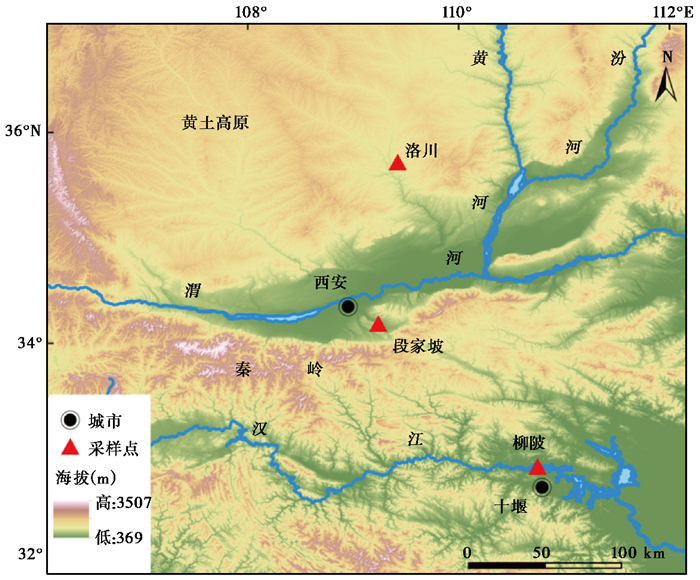
1 地层与样品采集 1.1 研究地点与地层柳陂剖面(32°50′00.80″N,110°45′02.64″E;海拔180m)位于我国中部湖北省十堰市郧阳区柳陂镇汉江上游的南岸(图 1)。
|
图 1 采样区域地形及采样点位置(柳陂、段家坡及洛川黄土剖面) Fig. 1 DEM of the investigated area and the locations of Liubei, Duanjiapo, and Luochuan loess sections |
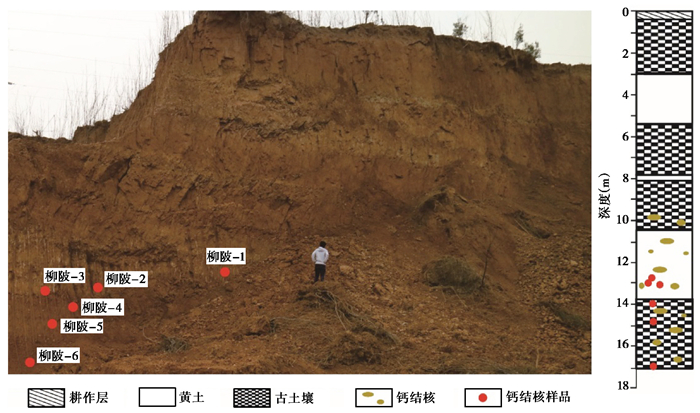
柳陂剖面厚约17m,由上至下可分为8层(图 2),地层描述如下:
|
图 2 柳陂黄土剖面及钙结核样品采样位置 Fig. 2 The Liubei loess section and carbonate nodules sampling |
第1层:耕作层,0~0.4m,棕色(7.5YR4/3),人为扰动比较强烈,疏松、呈团粒状,多虫孔,根系发育;
第2层:古土壤层,0.4~3.0m,棕色至深棕色(7.5YR4/4~7.5YR 4/6),粘土质,裂隙发育,有较多铁锰斑块及胶膜,质密,少量植物根系;
第3层:黄土层,3.0~5.4m,深黄棕色(10YR4/4~10YR4/6),粉砂到粘土质,团块状,含有较多细小球粒状铁锰结核,少量植物根系;
第4层:古土壤层,5.4~7.8m,棕色(7.5YR3/3),粘土质,裂隙发育,含铁锰胶膜斑点及斑块,上部含有少量青灰色条带;
第5层:黄土层,7.8~8.2m,亮黄棕色(10YR5/6),粉砂到粘土质,团块状,质密,含铁锰斑点;
第6层:古土壤层,8.2~10.5m,棕色至深棕色(7.5YR4/4~7.5YR4/6),粘土质,裂隙发育,含铁锰胶膜,质密,中部夹杂灰白色条带(7.5YR7/1),从中上部(9m左右)开始往下零星发育灰白色(7.5YR8/3)钙质结核碎块,数量较少,体积较小,大部分样品呈椭球体,长轴不超过5cm,在古土壤地层的下部零星分布,完整的钙结核内壁含较多碳酸盐晶体;
第7层:黄土层,10.5~13.8m,棕色至深黄棕色(10YR4/4~10YR4/6),粉砂到粘土质,块状结构,质密,含零星铁锰斑点,灰白色钙结核发育相对增多,被棕色古土壤紧密包裹,内含白色或透明碳酸盐晶体,也有部分钙结核内部不含有碳酸盐晶体,钙结核在这一地层分布相对密集,形态呈长条状,椭球体,球体等,长轴较长,最长可达15cm以上;
第8层:古土壤层,13.8~17.0m,棕色(7.5YR4/4),粘土质,含铁锰胶膜,钙结核分布相对较多,主要分布在古土壤地层的中上部,形态与总体呈现椭球状或球状,外部包裹块状、质密的棕色古土壤,层位下部钙结核数量极少,零星分布,底部出现深黄色粉砂。
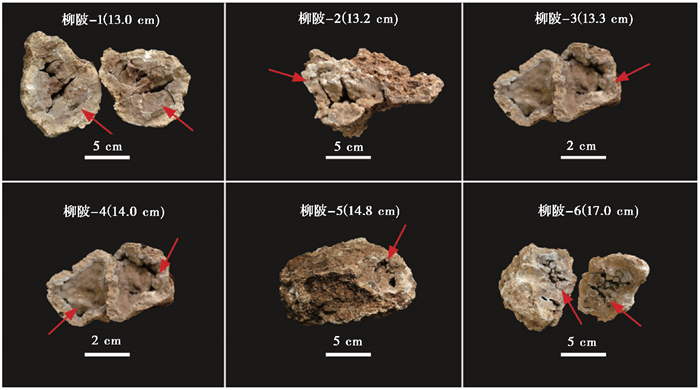
1.2 样品采集从剖面顶部往下,以10cm为间隔连续采集171个样品用于磁化率测试。钙结核主要出露于9~17m的位置,我们同时采集了6件样品用于铀系测年研究(图 3),样品深度分别为13.0m、13.2m、13.3m、14.0m、14.8m和17.0m,编号对应为柳陂-1至柳陂-6。
|
图 3 柳陂剖面钙结核 Fig. 3 Carbonate nodules in Liubei loess section |
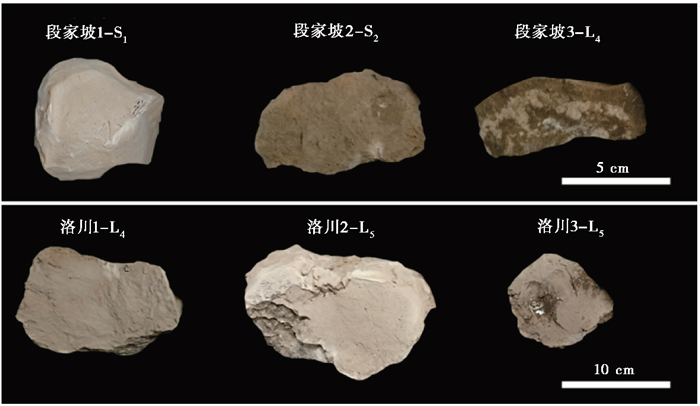
同时在蓝田段家坡剖面S1、S2和L4层位,以及洛川坡头剖面L4顶部和S5中部分别各自采集3件钙结核样品(图 4),用于对比分析。
|
图 4 洛川与段家坡剖面钙结核样品 Fig. 4 Carbonate nodules in Luochuan and Duanjiapo loess sections |
秦岭南麓的黄土堆积地层较薄,成壤作用较强、颜色偏棕红[29~30],在这些地层中广泛分布着大量的钙结核。这些黄土中的钙结核呈现球状或者块状,直径或长轴普遍较长,最长可超过20cm;被棕色或褐色古土壤紧密包裹,颜色以棕色和灰白色为主;整体较为封闭,内部存有空隙,内壁附着白色透明的碳酸盐晶体(图 3)。秦岭以北的洛川和段家坡黄土剖面中的钙结核基本成层分布,形态多样,有同心圆状,棱块状等;颜色呈灰白色或棕色(图 4);但整体表现为均质结构,结核内部没有空隙,不含碳酸盐晶体。对比发现:地理位置越往南的黄土钙结核越偏向于棕色或者包裹在棕褐色的古土壤中,钙结核内部也越容易出现空隙和碳酸盐晶体。
2 实验方法铀系不平衡测年法,又被称为U-Th测年法或230 Th测年法,依赖于238U的衰变以及234 U和230 Th之间的不平衡体系来计算年龄,是一种重要的第四纪测年方法[31]。运用质谱技术,U-Th测年法的测年范围为几十年到600ka,并可实现高精度(约1 ‰)的U和Th的同位素分析[32]。目前,铀系定年法常用于碳酸盐矿物,如洞穴石笋[33~35]、钙板[36]等,均是良好的定年材料。
柳陂6件钙结核样品内部均充填相对纯净致密的碳酸盐晶体。首先通过刻刀等工具,从钙结核内壁上分离出足量的钙酸盐晶体;然后,通过放大镜挑选出纯净的晶体颗粒,置于小型离心管中,装满超纯水,用超声波清洗45min;清洗后,倒掉离心管上清液,再重新装满超纯水,重复上述步骤;最后,用烘箱烘干样品。
6件碳酸盐样品的化学实验和U-Th同位素分析分别在南京师范大学地理科学学院同位素实验室(样品:柳陂-1、柳陂-2、柳陂-3和柳陂-4)和西安交通大学全球变化研究院同位素实验室(样品:柳陂-5和柳陂-6)完成,2处实验室化学流程基本一致。首先,称量样品质量,并加入14mol/L的硝酸溶解样品,然后加入233 U-236 U-229 Th spike稀释剂,进行回流、蒸干,使样品与稀释剂充分混合均匀。将蒸干后的样品用2mol/L的盐酸溶解后,加入FeCl3和氨水进行共沉淀。再用7mol/L的硝酸溶解沉淀,继而通过AG1-X8阴离子交换树脂对样品进行U-Th分离。在分离后的U和Th组分溶液中加入高氯酸,再加入14mol/L的硝酸,蒸干,重复此过程3次(重复过程中不再加入高氯酸)。最后加入1滴14mol/L的硝酸蒸样品至半干状态,加入弱硝酸+氢氟酸混合酸溶解、混匀,分别进行上机测量。测试仪器为多接收器电感耦合等离子体质谱仪(MC ICP-MS)。
对于磁化率样品,将采集得到的粉样置于实验室通风阴凉处自然风干,而后用塑料勺子取出部分样品(大于10g)放入纸袋中,置入烘箱(40℃)烘干为止。将烘干的粉样磨碎成粉末后,称取10g左右的样品装入样品盒中,利用Bartington MS2磁化率测量仪来测量470 Hz低频磁化率,记录其测量前后的2个本底值,每个样品分别测量3次,去掉本底值后取其平均值,作为样品最终的磁化率值。
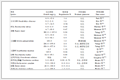
3 结果 3.1 铀系法测年结果钙结核的230 Th年龄结果如表 1所示。6件钙结核碳酸盐样品中,柳陂-2和柳陂-3并未得到年龄结果,只有柳陂-1、柳陂-4、柳陂-5和柳陂-6得到了有效的结果。可能是在前处理时提取的样品不够纯净,导致未能得到柳陂-2和柳陂-3的年龄结果。所测其他4件样品238U含量总体维持在1×10⁻⁶g/g到2×10-6g/g左右,而232 Th含量则总体略高,处于12×10-9g/g到81×10-9g/g之间,但得到年龄的4件样品的230 Th/232 Th的活度(activity)比值均处于59~278之间,均显著大于20,显示所有4件样品的230 Th年龄结果都是可信的。
|
表 1 柳陂剖面钙结核碳酸盐样品的230Th年龄结果 Table 1 230 Th ages of four carbonate nodules from Liubei loess section in this study |
4件钙结核的230 Th年龄跨度较大,初始年龄跨度为117~357ka,校正年龄跨度为距今116~356ka。值得注意的是,柳陂-4与柳陂-5样品的深度比较接近(分别为14.0m和14.8m),但年龄结果差距较大,230 Th年龄分别为130ka和304ka。同时由于化学处理时,柳陂-5和柳陂-6的U和Th样品量较少,在仪器测试中的测量时间较短,导致年龄结果误差相对较大,但整体而言可以指示钙结核碳酸盐的年龄。
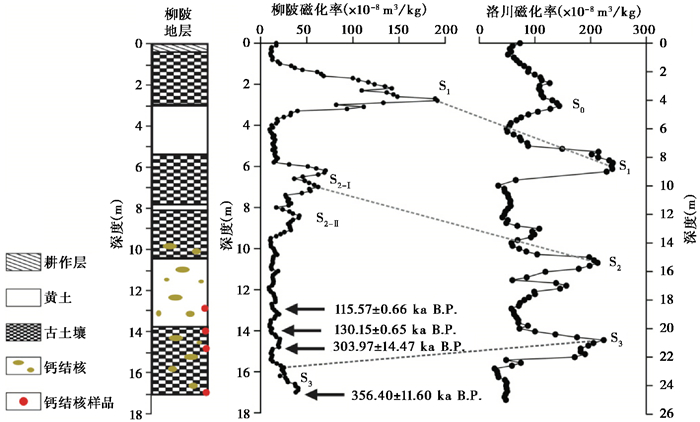
3.2 磁化率结果据柳陂剖面的磁化率结果(图 5),低频磁化率数值的变化范围为9.0×10⁻⁸~91.5×10⁻⁸m3/kg之间,平均值为33.3×10-8m3/kg,最高值出现在2.8m处,最低值出现在11.9m处。第一层古土壤和第二层古土壤对应的磁化率数值有明显的波动,但自9.5m往下,磁化率波动不明显,与洛川黄土剖面的磁化率[37]对比存在一定困难。基于钙结核的铀系年龄指示相应层位最年轻年代的假设,剖面底部的年代可能老于356ka。根据柳陂剖面和洛川标准剖面的磁化率变化曲线的对比,初步判断柳陂的地层含有4层古土壤,分别对应洛川剖面的S1、S2-Ⅰ、S2-Ⅱ和S3(图 5)。由于铀系年龄可能代表黄土堆积层的最小年龄,所以剖面底部地层也可能老于S3,剖面或表现为更老的地层序列。
|
图 5 柳陂剖面地层、磁化率、230 Th年龄以及与洛川剖面磁化率[35]对比 Fig. 5 Pedostratigraphy, magnetic susceptibility, and 230 Th ages of the Liubei loess section and magnetic susceptibility comparison with the Luochuan section |
在黄土研究中,磁化率被认为是重要的气候代用指标[2, 6, 38~40]。磁化率数值高低可用来鉴别黄土-古土壤旋回变化[41~42]。在野外观察中,柳陂剖面0~9m处的沉积序列的颜色变化与磁化率变化基本一致,可以大致反映地层变化,磁化率高值对应古土壤层,低值对应黄土层。自9m以下,磁化率值较低,比较稳定,难以准确辨别黄土-古土壤的变化趋势。柳陂地区现多年平均降水量在870mm左右,年均温在16℃左右。这表明9m以下磁化率数值较低可能与丰沛的降水和黄土潜育化有关[43~48]。同时,从9m以下,内含碳酸盐晶体的钙结核开始出现,对比秦岭以北的黄土地层中的钙结核缺少这种碳酸盐晶体,推测这与当地湿润的气候环境,降水或碳酸盐的淋溶作用有关。对柳陂剖面而言,这可能也意味着,单独将磁化率作为黄土-古土壤地层划分的代用指标时,存在不确定性,结合绝对测年结果十分必要。
4.2 钙结核的铀系年龄指示意义钙结核是一种次生的成土碳酸盐,在黄土堆积过程中以及堆积后的成土和次生变化中形成的[49]。它的成因复杂,与气候条件有关,在土壤发育时,降雨导致上层土壤中的CaCO3反复被淋洗,到达一定深度后析出碳酸钙,从而形成钙结核[50~52]。
赵景波[53]认为在黄土高原气候相对湿润的东南部地区,CaCO3在地层中会以钙结核的形式出现。钙结核的形成与降雨量有关,降雨量一般在400~800mm左右可形成钙结核[54~55]。因此,对于钙结核内部的碳酸盐晶体而言,其形成与当地的气候环境存在一定关系,在相对湿润的气候条件下,钙结核内部会析出纯净致密的碳酸盐晶体,并相对持久地保存。
钙结核一般晚于地层形成,年龄最多与地层年龄一致[56~57]。柳陂剖面钙结核中结晶析出碳酸盐晶体,存在一定程度的重结晶现象,必然指示钙结核的最小年龄。由于这种碳酸盐晶体的具体形成过程难以厘清,应用铀系法可能会对碳酸盐晶体的年龄产生低估。本文测定的四件柳陂钙结核样品,其深度位置分别为13m(柳陂-1)、14m(柳陂-4)、14.8m(柳陂-5)和17cm(柳陂-6),对应的年龄结果分别为:115.57±0.66ka、130.15±0.65ka、303.97±14.47ka和356.40±11.60ka。年龄基本是随地层深度的增加而不断变老。值得注意的是前3个样品的深度和年龄:柳陂-1和柳陂-4的深度差为1m,年龄差为15ka,而柳陂-4和柳陂-5两个样品深度相差仅0.8m,然而年龄结果却相差170ka。年龄结果差距悬殊可能是钙结核复杂的形成机制所致,在明确钙结核形成过程的基础上,或可更好地认识钙结核的年龄。但基于钙结核年龄年轻于同一地层年龄的假设,当前可以通过对同一层位中多个钙结核进行年代测试,最老的钙结核的年龄或可判断相应地层最年轻的年龄。
本文对柳陂剖面黄土钙结核内部的碳酸盐晶体进行铀系年代分析,我们发现内部附着有碳酸盐晶体的钙结核适合于铀系测年。在气候更为湿润的秦岭以南地区,这种有碳酸盐晶体析出的钙结核在黄土地层中应当不是个例,但是在秦岭以北的黄土高原,钙结核中少有析出这种碳酸盐晶体,应用铀系测年法的难度较大,误差可能较高。因此用钙结核进行铀系测年可能主要适合于秦岭以南的黄土定年研究,可指示地层的最年轻年龄,并且356ka的230 Th年龄已经远超过了碳十四和释光的测年范围,表明铀系测年法在钙结核的测年应用前景是相对较好的。
5 结论通过对秦岭南麓汉江流域黄土堆积调查,我们发现汉江流域黄土地层中存在很多内壁附着有结晶良好的碳酸盐晶体的钙结核。这些碳酸盐晶体是适合于铀系不平衡测年法的,并且230 Th年龄结果可以作为钙结核的最年轻年龄,对地层年龄有指示意义,其测年范围已经超过碳十四和释光的测年范围。
柳陂黄土剖面的4件钙结核230 Th年龄结果,均可指示对应地层的最小年龄,所以柳陂黄土堆积剖面底部的形成年龄老于356ka,结合野外地层描述,磁化率曲线和230 Th年龄,我们初步推断柳陂黄土剖面的地层序列为S1、L2、S2-Ⅰ、S2-Ⅱ、L3和S3。
致谢: 感谢匿名评审人对本文提出的宝贵意见和建议;感谢鹿化煜教授的建议和指导,感谢郭小奇、曾琼萱、鹿艺鸣在野外采样工作的帮助;感谢编辑赵淑君老师的悉心指导!
| [1] |
Heller F, Liu T S. Magnetostratigraphical dating of loess deposits in China[J]. Nature, 1982, 300(5891): 431-433. DOI:10.1038/300431a0 |
| [2] |
刘东生, 等. 黄土与环境[M]. 北京: 科学出版社, 1985: 1-481. Liu Tunsheng, et al. Loess and the Environment[M]. Beijing: Science Press, 1985: 1-481. |
| [3] |
Lu H Y, Liu X D, Zhang F Q, et al. Astronomical calibration of loess-paleosol deposits at Luochuan, central Chinese Loess Plateau[J]. Palaeogeography, Palaeoclimatology, Palaeoecology, 1999, 154(3): 237-246. DOI:10.1016/S0031-0182(99)00113-3 |
| [4] |
Ding Z L, Derbyshire E, Yang S L, et al. Stacked 2.6-Ma grain size record from the Chinese loess based on five sections and correlation with the deep-sea δ18O record[J]. Paleoceanography, 2002, 17(3): 5-1-5-21. |
| [5] |
Heslop D, Langereis C G, Dekkers M J. A new astronomical timescale for the loess deposits of Northern China[J]. Earth and Planetary Science Letters, 2000, 184(1): 125-139. DOI:10.1016/S0012-821X(00)00324-1 |
| [6] |
Zhou W J, Zhou M F, Head J. 14C chronology of Beizhuangcun sedimentation sequence since 30, 000 years B.P.[J]. Chinese Science Bulletin, 1990, 35(7): 567-572. |
| [7] |
Zhou W J, Donahue D, Jull A J T. Radiocarbon AMS dating of pollen concentrated from eolian sediments:Implication for monsoon climate changes since the Late Quaternary[J]. Radiocarbon, 1997, 39(1): 19-26. DOI:10.1017/S0033822200040868 |
| [8] |
Lai Z P. Testing the use of an OSL standardised growth curve(SGC)for determination on quartz from the Chinese Loess Plateau[J]. Radiation Measurements, 2006, 41(1): 9-16. DOI:10.1016/j.radmeas.2005.06.031 |
| [9] |
Lai Z P. Chronology and the upper dating limit for loess samples from Luochuan section in the Chinese Loess Plateau using quartz OSL SAR protocol[J]. Journal of Asian Earth Sciences, 2010, 37(2): 176-185. DOI:10.1016/j.jseaes.2009.08.003 |
| [10] |
Lu Y C, Wang X L, Wintle A G. A new OSL chronology for dust accumulation in the last 130, 000 yr for the Chinese Loess Plateau[J]. Quaternary Research, 2007, 67(1): 152-160. DOI:10.1016/j.yqres.2006.08.003 |
| [11] |
鹿化煜, Stevens T, 弋双文, 等. 高密度光释光测年揭示的距今约15-10 ka黄土高原侵蚀事件[J]. 科学通报, 2006, 51(23): 2767-2772. Lu Huayu, Stevens T, Yi Shuangwen, et al. An erosional hiatus in Chinese loess sequence revealed by closely spaced optical dating[J]. Chines Science Bulletin, 2006, 51(18): 2253-2259. |
| [12] |
Wang X L, Lu Y C, Wintle A G. Recuperated OSL dating of fine-grained quartz in Chinese loess[J]. Quaternary Geochronology, 2006, 1(2): 89-100. DOI:10.1016/j.quageo.2006.05.020 |
| [13] |
Wang X L, Wintle A G, Lu Y C. Testing a single-aliquot protocol for recuperated OSL dating[J]. Radiation Measurements, 2007, 42(3): 380-391. DOI:10.1016/j.radmeas.2006.12.015 |
| [14] |
Li B, Jacobs Z, Roberts R G, et al. Extending the age limit of luminescence dating using the dose-dependent sensitivity of MET-pIRIR signals from K-feldspar[J]. Quaternary Geochronology, 2013, 17(1): 55-67. |
| [15] |
Li B, Roberts R G, Jacobs Z, et al. A single-aliquot luminescence dating procedure for K-feldspar based on the dose-dependent MET-pIRIR signal sensitivity[J]. Quaternary Geochronology, 2014, 20(4): 51-64. |
| [16] |
Chen Y, Li S H, Li B, et al. Maximum age limitation in luminescence dating of Chinese loess using the multiple-aliquot MET-pIRIR signals from K-feldspar[J]. Quaternary Geochronology, 2015, 30: 207-212. DOI:10.1016/j.quageo.2015.01.002 |
| [17] |
张博譞, 陈杰, 覃金堂, 等. 帕米尔高原瓦恰盆地黄土的石英光释光测年[J]. 第四纪研究, 2018, 38(3): 636-645. Zhang Boxuan, Chen Jie, Qin Jintang, et al. Quartz optically stimulated luminescence dating of loess from Waqia Basin in the Pamir Plateau[J]. Quaternary Sciences, 2018, 38(3): 636-645. |
| [18] |
楚纯洁, 赵景波, 周金风. 毛乌素沙地中部黄土-古土壤剖面沉积特征与地层划分[J]. 第四纪研究, 2018, 38(3): 623-635. Chu Chunjie, Zhao Jingbo, Zhou Jinfeng. Sedimentary characteristics and stratigraphic division of the loess-paleosol section in Wushen County, the central Mu Us dune field in North China[J]. Quaternary Sciences, 2018, 38(3): 623-635. |
| [19] |
任少芳, 郑祥民, 周立旻, 等. 基于光释光测年的东海嵊山岛风尘黄土环境敏感粒度组分研究[J]. 第四纪研究, 2018, 38(3): 646-658. Ren Shaofang, Zheng Xiangmin, Zhou Limin, et al. Analysis of environmentally sensitive grain-size component of loess on the Shengshan Island in East China Sea based on optically stimulated luminescence dating[J]. Quaternary Sciences, 2018, 38(3): 646-658. |
| [20] |
Yi S W, Lu H Y, Stevens T. SAR TT-OSL dating of the loess deposits in the Horqin dunefield(Northeastern China)[J]. Quaternary Geochronology, 2012, 10(7): 56-61. |
| [21] |
Yi S W, Buylaert J P, Murray A S, et al. High resolution OSL and post-IR IRSL dating of the last interglacial-glacial cycle at the Sanbahuo loess site(Northeastern China)[J]. Quaternary Geochronology, 2015, 30: 200-206. DOI:10.1016/j.quageo.2015.02.013 |
| [22] |
Sun X F, Lu H Y, Wang S J, et al. Ages of Liangshan Paleolithic sites in Hanzhong Basin, Central China[J]. Quaternary Geochronology, 2012, 10: 380-386. DOI:10.1016/j.quageo.2012.04.014 |
| [23] |
Sun X F, Lu H Y, Wang S J, et al. Early human settlements in the southern Qinling Mountains, Central China[J]. Quaternary Science Reviews, 2017, 164(15): 168-186. |
| [24] |
Sun X F, Lu H Y, Wang S J, et al. Hominin distribution in glacial-interglacial environmental changes in the Qinling Mountains range, Central China[J]. Quaternary Science Reviews, 2018, 198(15): 37-55. |
| [25] |
陈以健, 刘桂芬, 高钧成, 等. 洛川黄土剖面钙结核的ESR测年[J]. 核技术, 1993, 16(4): 204-207. Chen Yijian, Liu Guifen, Gao Juncheng, et al. ESR dating of calcareous nodule from a loess profile in Luochuan of China[J]. Nuclear Techniques, 1993, 16(4): 204-207. |
| [26] |
Zhang J J, Li S H, Sun J M, et al. Fake age hiatus in a loess section revealed by OSL dating of calcrete nodules[J]. Journal of Asian Earth Sciences, 2018, 155(15): 139-145. |
| [27] |
Rowe P J, Maher B A. 'Cold' stage formation of calcrete nodules in the Chinese Loess Plateau:Evidence from U-series dating and stable isotope analysis[J]. Palaeogeography, Palaeoclimatology, Palaeoecology, 2000, 157(1): 109-125. |
| [28] |
Durand N, Hamelin B, Deschamps P, et al. Systematics of U-Th disequilibrium in calcrete profiles:Lessons from Southwest India[J]. Chemical Geology, 2016, 446(23): 54-69. |
| [29] |
Sun X F, Li Y H, Feng X B, et al. Pedostratigraphy of aeolian deposition near the Yunxian Man site on the Hanjiang River terraces, Yunxian Basin, Central China[J]. Quaternary International, 2016, 400(2): 187-194. |
| [30] |
Sun X F, Jia X, Lu H Y, et al. A modified depositional hypothesis of the Hanjiang loess in the southern Qinling Mountains, Central China[J]. Progress in Physical Geography, 2017, 41(6): 775-787. DOI:10.1177/0309133317738711 |
| [31] |
Ivanovich M, Harmon R S. Uranium Series Disequilibrium:Application to Environment Problems in the Earth Sciences[M]. Oxford: Clarendon Press, 1992: 34-61.
|
| [32] |
Cheng H, Edwards L R, Shen C C, et al. Improvements in 230Th dating, 230Th and234 U half-life values, and U-Th isotopic measurements by multi-collector inductively coupled plasma mass spectrometry[J]. Earth and Planetary Science Letters, 2013, 371-372: 82-91. DOI:10.1016/j.epsl.2013.04.006 |
| [33] |
Cheng H, Edwards R L, Sinha A, et al. The Asian monsoon over the past 640, 000 years and ice age terminations[J]. Nature, 2016, 534(7609): 640-646. DOI:10.1038/nature18591 |
| [34] |
崔梦月, 洪晖, 孙晓双, 等. 福建仙云洞石笋记录的新仙女木突变事件结束时的缓变特征[J]. 第四纪研究, 2018, 38(3): 711-719. Cui Mengyue, Hong Hui, Sun Xiaoshuang, et al. The gradual change characteristics at the end of the Younger Dryas event inferred from a speleothem record from Xianyun cave, Fujian Province[J]. Quaternary Sciences, 2018, 38(3): 711-719. |
| [35] |
王权, 汪永进, 刘殿兵, 等. DO 3事件的湖北神农架高分辨率年纹层石笋记录[J]. 第四纪研究, 2017, 37(1): 108-117. Wang Quan, Wang Yongjin, Liu Dianbing, et al. The DO 3 event in Asian monsoon climates evidenced by an annually laminated stalagmite from Qingtian Cave, Mt. Shennongjia[J]. Quaternary Sciences, 2017, 37(1): 108-117. |
| [36] |
Shen G J, Tu H, Xiao D, et al. Age of Maba hominin site in Southern China:Evidence from U-series dating of Southern Branch Cave[J]. Quaternary Geochronology, 2014, 23: 56-62. DOI:10.1016/j.quageo.2014.06.004 |
| [37] |
Lu H Y, Zhang F Q, Liu X D, et al. Periodicities of palaeoclimatic variations recorded by loess-paleosol sequences in China[J]. Quaternary Science Reviews, 2004, 23(18-19): 1891-1900. DOI:10.1016/j.quascirev.2004.06.005 |
| [38] |
Heller F, Liu T S. Magnetism of Chinese loess deposits[J]. Geophysical Journal of the Royal Astronomical Society, 1984, 77(1): 125-141. DOI:10.1111/j.1365-246X.1984.tb01928.x |
| [39] |
贾广菊, 徐树建, 孔凡彪, 等. 山东大黑山岛北庄黄土沉积特征及其环境演变[J]. 第四纪研究, 2017, 37(3): 522-534. Jia Guangju, Xu Shujian, Kong Fanbiao, et al. The sedimentary characteristics and environmental evolution of the Beizhuang loess in the Daheishan Island, Shandong Province[J]. Quaternary Sciences, 2017, 37(3): 522-534. |
| [40] |
郭飞, 王婷, 刘宇明, 等. 临夏黄土记录的26万年来季风快速变化[J]. 第四纪研究, 2019, 39(3): 557-564. Guo Fei, Wang Ting, Liu Yuming, et al. Rapid Asian monsoon changes recorded by loess depositions in Linxia since 260 ka B.P[J]. Quaternary Sciences, 2019, 39(3): 557-564. |
| [41] |
安芷生, Kukla G, 刘东生. 洛川黄土地层学[J]. 第四纪研究, 1989(2): 155-168. An Zhisheng, Kukla G, Liu Tungsheng. Loess stratigraphy in Luochuan of China[J]. Quaternary Sciences, 1989(2): 155-168. DOI:10.3321/j.issn:1001-7410.1989.02.006 |
| [42] |
Kukla G, An Z S. Loess stratigraphy in Central China[J]. Palaeogeography, Palaeoclimatology, Palaeoecology, 1987, 72(89): 203-225. |
| [43] |
刘秀铭, 夏敦胜, 刘东生, 等. 中国黄土和阿拉斯加黄土磁化率气候记录的两种模式探讨[J]. 第四纪研究, 2007, 27(2): 210-220. Liu Xiuming, Xia Dunsheng, Liu Tungsheng, et al. Discussion on two models of paleoclimatic records of magnetic susceptibility of Alaskan and Chinese loess[J]. Quaternary Sciences, 2007, 27(2): 210-220. DOI:10.3321/j.issn:1001-7410.2007.02.006 |
| [44] |
刘秀铭, 刘东生, 夏敦胜, 等. 中国与西伯利亚黄土磁化率古气候记录——氧化和还原条件下的两种成土模式分析[J]. 中国科学:地球科学, 2007, 37(10): 1382-1391. Liu Xiuming, Liu Tungsheng, Xia Dunsheng, et al. The analysis of two different pedogenesis models in reductive and oxidative conditions record by Chinese and Siberia loess[J]. Science in China(Series D), 2007, 37(10): 1382-1391. |
| [45] |
吕厚远, 韩家懋, 吴乃琴, 等. 中国现代土壤磁化率分析及其古气候意义[J]. 中国科学(B辑), 1994, 24(12): 1291-1297. Lü Houyuan, Han Jiamao, Wu Naiqin, et al. Analysis on magnetism and paleoclimate meaning in modern soil of China[J]. Science in China(Series B), 1994, 24(12): 1291-1297. |
| [46] |
赵军, 鹿化煜, 王晓勇, 等. 东秦岭地区黄土堆积的岩石磁学特征及磁化率增强机制探索[J]. 沉积学报, 2008, 26(6): 1052-1062. Zhao Jun, Lu Huayu, Wang Xiaoyong, et al. Magnetic properties of loess deposit in eastern Qinling Mountains and an investigation on the magnetic susceptibility enhancement[J]. Acta Sedmentologica Sinica, 2008, 26(6): 1052-1062. |
| [47] |
Lu H Y, Sun X F, Wang S J, et al. Ages for hominin occupation in Lushi Basin, middle of South Luo River, Central China[J]. Journal of Human Evolution, 2011, 60(5): 612-617. DOI:10.1016/j.jhevol.2010.12.009 |
| [48] |
Sun X F, Lu H Y, Wang S J, et al. Age of newly discovered Paleolithic assemblages at Liuwan site Luonan Basin, Central China[J]. Quaternary International, 2014, 347(9): 193-199. |
| [49] |
滕志宏, 刘荣谟, 陈苓, 等. 中国黄土地层中的钙质结核研究[J]. 科学通报, 1990, 35(13): 1008-1011. Teng Zhihong, Liu Rongmo, Chen Ling, et al. Studies on calcareous nodules in Chinese loess stratum[J]. Chinese Science Bulletin, 1990, 35(13): 1008-1011. |
| [50] |
张瑜, 熊尚发, 丁仲礼, 等. 中新世以来六盘山邻区黄土-红粘土成土碳酸盐碳氧同位素记录及其对C4植物早期扩张的指示[J]. 第四纪研究, 2011, 31(5): 800-811. Zhang Yu, Xiong Shangfa, Ding Zhongli, et al. Carbon-oxygen isotope records of pedogenic carbonate from the Early Miocene-Pleistocene loess-red clay in the vicinity of the Liupanshan region and its implications for the early origin of C4 plants in the Chinese Loess Plateau[J]. Quaternary Sciences, 2011, 31(5): 800-811. DOI:10.3969/j.issn.1001-7410.2011.05.05 |
| [51] |
赵景波. 风化淋滤带地质新理论:CaCO3淀积深度理论[J]. 沉积学报, 2000, 18(1): 29-35. Zhao Jingbo. A new geological theory about eluvial zone:Theory illuvial on depth of CaCO3[J]. Acta Sedimentologica Sinica, 2000, 18(1): 29-35. DOI:10.3969/j.issn.1000-0550.2000.01.006 |
| [52] |
Yang S L, Ding Z L, Gu Z Y. Acetic acid-leachable elements in pedogenic carbonate nodules and links to the East-Asian summer monsoon[J]. Catena, 2014, 117: 73-80. DOI:10.1016/j.catena.2013.06.030 |
| [53] |
赵景波. 黄土地层中的CaCO3与环境[J]. 沉积学报, 1993(1): 136-142. Zhao Jingbo. CaCO3 and sedimentary environment of loess strata[J]. Acta Sedimentologica Sinica, 1993(1): 136-142. |
| [54] |
韩家懋, 姜文英, 吴乃琴, 等. 黄土中钙核的碳氧同位素研究:(一)氧同位素及其古环境意义[J]. 第四纪研究, 1995(2): 130-138. Han Jiamao, Jiang Wenying, Wu Naiqin, et al. Carbon and oxygen isotope compositions of carbonate concretions in loess part 1:Oxygen isotope and paleotemperature[J]. Quaternary Sciences, 1995(2): 130-138. DOI:10.3321/j.issn:1001-7410.1995.02.005 |
| [55] |
韩家懋, 姜文英, 吕厚远, 等. 黄土中钙结核的碳氧同位素研究:(二)碳同位素及其古环境意义[J]. 第四纪研究, 1995(4): 367-377. Han Jiamao, Jiang Wenying, Lü Houyuan, et al. Carbon and oxygen isotope compositions of carbonate concretions in loess part 2:Oxygen isotope and paleotemperature[J]. Quaternary Sciences, 1995(2): 367-377. |
| [56] |
Ding Z L, Yang S L. C3/C4 vegetation evolution over the last 7.0 Myr in the Chinese Loess Plateau:Evidence from pedogenic carbonate δ13C[J]. Palaeogeography, Palaeoclimatology, Palaeoecology, 2000, 160(3): 291-299. DOI:10.1016/S0031-0182(00)00076-6 |
| [57] |
He W M, He H M, Zhu M Y, et al. Calcium nodules as a proxy for Quaternary paleoclimate change on China's Loess Plateau[J]. PLoS One, 2015, 10(12): e0143928. DOI:10.1371/journal.pone.0143928 |
2 Institute of Global Environmental Change, Xi'an Jiaotong University, Xi'an 710049, Shaanxi;
3 School of Geography, Nanjing Normal University, Nanjing 210023, Jiangsu)
Abstract
Loess distributed along the Hanjiang River Valley in the Southern Qinling Mountains comprises extensive carbonate nodules. These carbonate nodules enclose pure and dense carbonate crystals, which are different from that in the Chinese Loess Plateau. U-series, which can be applied to carbonate materials, is an important dating method used in the Quaternary. In this study, we used the U-series method to date the carbonate nodules in the Liubei loess section. The Liubei section (32°50'00.80"N, 110°45'02.64"E; 180 m a.s.l.) is located in Liubei Town, Shiyan City, Hubei Province. The depth of the Liubei section is 17 m, which could be divided into three loess and four paleosol layers. We dated the carbonate crystal using six carbonate nodule samples. However, only four samples could be dated because the other two samples failed in the chemical procedure. The four samples were dated 115.57±0.66 ka, 130.15±0.65 ka, 303.97±14.47 ka and 356.40±11.60 ka and increased with the section depth. Based on the 230Th dating results and the magnetic susceptibility correlation with the Luochuan loess section, we deduce that the Liubei section is composed of S1, L2, S2-Ⅰ, S2-Ⅱ, L3 and S3. According to this study, we suggest that the carbonate nodules could provide an absolute age support for the loess in the southern Qinling Mountain Range. Although the carbonate nodule mechanism is complex, and the 230Th age of carbonate crystals could indicate the minimum age of the corresponding loess deposition