 2019, Vol.39


2 南京大学地球科学与工程学院, 表生地球化学教育部重点实验室, 江苏 南京 210023)
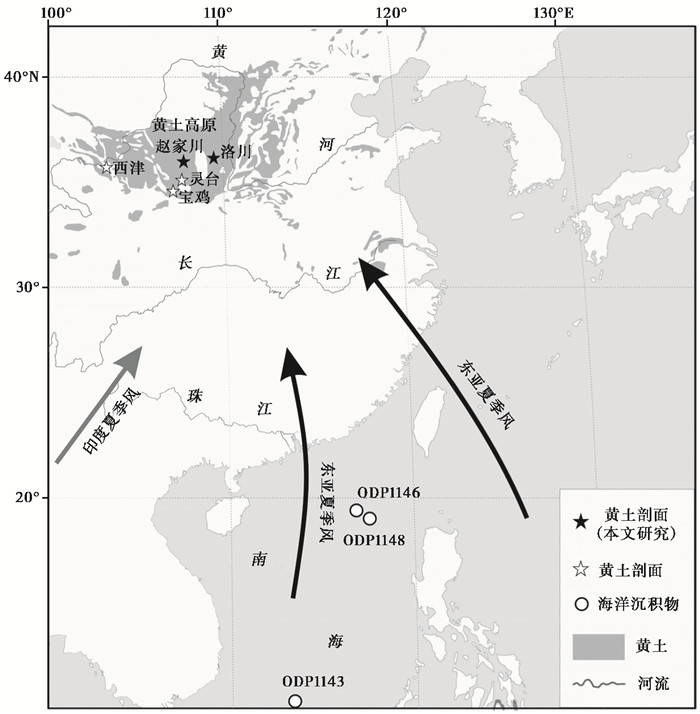
在全球季风系统中,东亚季风是唯一的中高纬度季风系统(图 1),西至青藏高原东侧,强盛时期甚至影响河西走廊[1~3]和新疆地区[4],北达中蒙边界和东北地区,东临日本北海道地区,约15亿人在此居住。在北半球夏季,受海陆热力差驱动,热带印度洋和西太平洋暖池的暖湿气流向北传输到东亚地区,提供了必不可少的降水。东亚地区独特的季风气候下形成了世界较早的农耕文化[5],孕育了中华文明[6]。研究过去东亚季风降水的变迁及其与全球温度的联系[7],特别是处在与现在接近的第四纪暖的间冰期时期,例如早更新世间冰期时期(2.6~1.6 Ma)[8~9],有助于理解东亚季风动力学,为未来季风降水模型预测提供参数及约束。然而,暖的早更新世间冰期时期(2.6~1.6 Ma),东亚夏季风演化仍存在争议:一种观点认为早更新世间冰期时期夏季风弱,中晚更新世间冰期时期强[10~14];另一种观点与之相反,认为早更新世间冰期时期夏季风强,中晚更新世间冰期时期弱[15~16]。
|
图 1 研究区位置 本文研究剖面为黑色填充五角星,本文提及的黄土剖面为白色五角星,南海沉积物钻孔为圆圈 Fig. 1 Map of the study area. Our study loess profiles are labeled using the black stars, and previous published loess sections and marine cores mentioned in the text are labeled by white stars and circles, respectively |
第一种观点被黄土高原和中国南海的多个夏季风替代性指标重建记录所证实,主要包括磁性矿物、铁氧化物、碳酸盐和元素等指标。具体地,基于黄土高原洛川[10]、灵台[17]和西峰剖面[18]的磁化率变化,推断2.6 Ma以来东亚夏季风仅在0.55 Ma之后突然增强,西宁盆地两个黄土钻孔的磁化率记录[19]却显示东亚夏季风在1.2~1.0 Ma和0.8 Ma阶段性地增强,西津剖面频率磁化率[20]显示东亚夏季风在1.24 Ma、0.87 Ma和0.62 Ma这3个时间段突然增强,洛川和段家坡剖面多个磁学参数记录显示0.6 Ma之后东亚夏季风突然增强[21]。
西峰和长武剖面的游离铁与全铁比值显示1.2 Ma至0.8 Ma夏季风稳定,0.8 Ma到0.5 Ma期间逐渐增强,最后0.5 Ma以来夏季风大体上减弱[22];灵台剖面游离铁与全铁比值表明0.8 Ma以来东亚夏季风强,其他时期较弱[23~24];洛川与灵台剖面的Rb/Sr比值[13]、铁氧化物含量[11]与针铁矿/赤铁矿比值[12]显示早更新世间冰期时期为“干夏季风”模式,中晚更新世为“湿夏季风”模式;朝那剖面的碳酸盐含量[25]记录了2.6~1.5 Ma和1.5~0 Ma阶段性增强的东亚夏季风;洛川、灵台和宝鸡剖面的碳酸盐淋溶指标也显示早更新世间冰期夏季风降水少,中晚更新世间冰期夏季风降水多[14];Sun等[26]联合灵台剖面的磁化率和碳酸盐含量建立了过去7 Ma的夏季风指数,结果显示间冰期东亚夏季风在2.75 Ma和1.25 Ma逐渐增强;西峰和镇远剖面中生物微钙体的Sr/Ca比值[27~28]记录了过去1.5 Ma以来间冰期时期稳定的季风降水。
南海地区一些记录也显示早更新世间冰期时期夏季风较弱,例如,大洋钻探计划(ODP)1146钻孔浮游有孔虫的种类[29]、ODP1143粘土矿物和生物成因的蛋白石质量累积速率[30]、ODP1148钻孔的矿物比值[31]、ODP1146的Ba/Al比值[32]和ODP1143钻孔的K/Al和Ti/Al比值[33]等指标,均记录了早更新世间冰期弱的夏季风;ODP1146和ODP1148钻孔的粘土矿物比值记录了1.2~2.0 Ma弱的夏季风[34]。
早更新世间冰期强夏季风的观点也得到一些陆相和海洋记录的支持。黄土高原靖边黄土剖面中 > 63 μm组分的百分含量[15]可反演毛乌素沙地进退历史,发现在2.6 Ma、1.2 Ma、0.7 Ma和0.2 Ma时期毛乌素沙地阶段性地向南扩张,表明东亚夏季风阶段性地减弱;交道[35]和靖边[36]剖面中细粒亚铁磁性颗粒自2.6 Ma以来逐渐减少,指示东亚夏季风逐渐变弱;灵台黄土剖面高分辨率酸不溶相元素比值记录显示1.5~0.6 Ma东亚夏季风几乎无变化,0.6 Ma以来逐渐减弱[37];朝那黄土剖面化石花粉记录的古植被信息显示3 Ma以来黄土高原地区逐步干旱[16]。北京昌平地区河湖相沉积中低分辨率孢粉记录[38]显示疏林草地植被覆盖度在1.68~1.25 Ma之间减少,1.25~0.96 Ma之间再恢复,0.96~0.50 Ma转变为针叶林,表明早更新世湿润,中晚更新世干旱。南海ODP1143的赤铁矿与针铁矿比值[39]记录了2.6 Ma以来逐渐减弱的亚洲夏季风,特别是1 Ma以来。
综上所述,对于暖的早更新世间冰期时期(2.6~1.6 Ma),东亚夏季风演化仍存在争议,可能由夏季风替代性指标的多解性而致。例如,黄土中磁化率响应季风降水存在阈值[40~41],同时也响应温度的变化[42]和氧化还原条件的改变[43~44],这些均会影响土壤磁化率的变化;类似地,土壤中铁氧化物的形成也存在降水阈值[45~46]及受温度的影响[44];植物孢粉具有易传播的特点[47],导致该指标具有多解性,同时,黄土中化石孢粉容易被氧化[48]而不易保存,这些因素均会致使基于黄土中化石花粉的古植被重建存在较大不确定;硅酸盐组分的元素及其比值均与粒度、新鲜物质加入和物源变化有关[49];黄土的粒度与空气流动状态[50~51]和粉尘搬运距离有关[15, 52~54]。因此,需要更多的夏季风记录进行对比论证研究。
古土壤层中酸溶相元素是最活跃的组分之一,对季风降水敏感[55],过去对酸溶相元素的研究分辨率较低,很难完整地反应更新世季风降水的变化[56~57]。因此,本文利用黄土高原中部洛川和赵家川剖面古土壤层中酸溶相元素组成及相应比值的重建间冰期时期东亚夏季风的强度变化,并提供新的更新世间冰期时期东亚夏季风记录,进而探讨暖的早更新世间冰期时期东亚夏季风的强弱变化及背后的机理。
1 样品与方法样品采集于黄土高原经典的洛川(LC:35.76°N,109.42°E)和赵家川(ZJC:35.73°N,107.73°E)剖面,其中,洛川和赵家川黄土古土壤序列分别厚约136 m[58]和约178 m[59],选取两个剖面样品共205个,其中洛川剖面134个样品,赵家川剖面71个样品,几乎覆盖所有古土壤层,采样间隔平均约7 ka(图 2),两个剖面的年龄模式参考Sun等[59]。两个剖面的现代年均降水量(MAP)分别约为620 mm和560 mm,70%以上受控于夏季(5~9月)降水。元素分析的具体流程如下:称取0.5 g样品,放置于50 ml的离心管中,加入0.1 mol/L几乎不溶解硅酸盐组分的醋酸[55, 60]溶液40 ml,搅拌约2 h,离心,用移液枪取上清液并稀释40倍,上机测试。仪器为南京大学表生地球化学教育部重点实验室电感耦合等离子发射光谱仪,主要测试钙(Ca)、镁(Mg)、锶(Sr)、锰(Mn)等元素含量,测试误差为±10%。
|
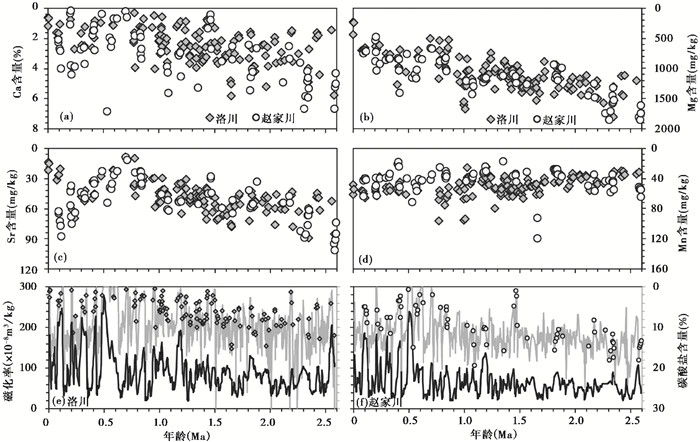
图 2 洛川和赵家川剖面古土壤层中酸溶相的Ca (a)、Mg (b)、Sr (c)、Mn (d)元素含量分布与洛川(e)和赵家川(f)剖面的磁化率(黑色曲线)与碳酸盐(灰色曲线)分布[14] Fig. 2 Variations of Ca (a), Mg (b), Sr (c) and Mn (d) elements exacted by acetic acid in the paleosol layers and distribution of magnetic susceptibly (black lines) and carbonate (grey lines) in the Luochuan (e) and Zhaojiachuan (f) sections[14], respectively |
洛川和赵家川剖面古土壤层中酸溶相Ca、Mg、Sr和Mn元素含量如图 2所示,两个剖面酸溶相组分均以Ca元素(平均2.6%)占主导,其次为Mg元素(平均1116.5 mg/kg),含量最低为Sr(平均49.5 mg/kg)和Mn(平均47.6 mg/kg)元素。相对于赵家川剖面,Ca、Mg和Sr元素含量在洛川剖面更低。例如,洛川剖面Ca元素平均含量为2.4% (n=134),低于赵家川剖面的3.2% (n=71);类似地,洛川和赵家川剖面Mg平均含量分别为1088.6 mg/kg和1168.6 mg/kg,Sr元素平均含量分别为48.0和52.3 mg/kg。不同于以上3个元素,Mn元素平均含量在洛川剖面(50.2 mg/kg)高于赵家川剖面(42.9 mg/kg)。
在时间尺度上,洛川和赵家川剖面中Ca、Mg和Sr元素含量均为早更新世(1.6~2.6 Ma)高,中晚更新世低(图 2)。这两个剖面中Ca元素均值在早更新世分别为3.1%和4.6%,逐渐下降到约0.5 Ma的0.8%和2.2%,最后约0.5 Ma两个剖面分别为1.6%和2.4%;Mg元素均值在早更新世分别为1284.1 mg/kg和1566.5 mg/kg,0.5 Ma以来分别为731.2 mg/kg和828.4 mg/kg;Sr元素平均含量在早更新世分别为57.5 mg/kg和67.2 mg/kg,之后逐渐下降,直至约0.5 Ma的23.7 mg/kg和34.3 mg/kg,最后0.5 Ma分别为36.9 mg/kg和54.2 mg/kg。
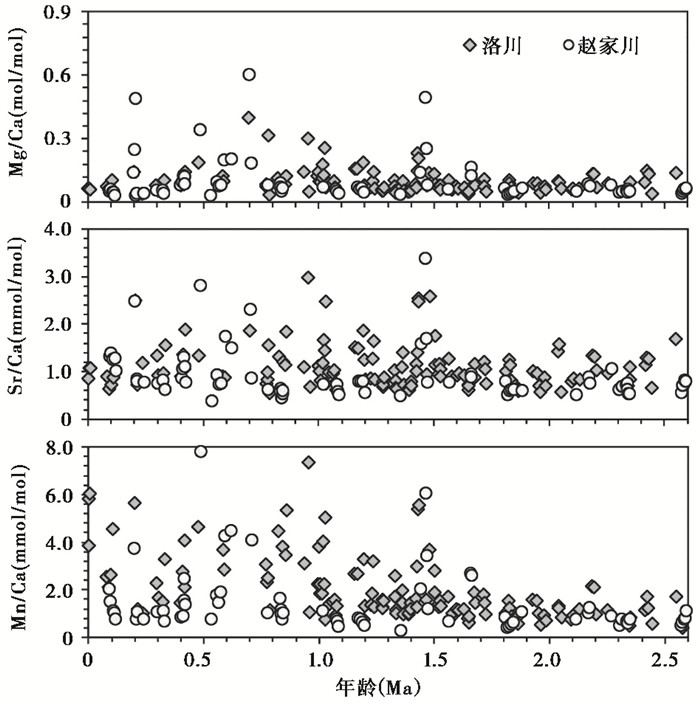
除了元素含量,元素比值也记录了古环境信息。洛川和赵家川剖面的Mg/Ca比值(mol/mol)的范围为0.03~1.14,均值为0.10(n=205);Sr/Ca(mmol/mol)比值均值为1.12 (0.36~5.56);Mn/Ca比值(mmol/mol)均值为2.12 (0.24~22.20)(图 3)。在时间尺度上,2.6 Ma以来Mg/Ca、Sr/Ca和Mn/Ca比值的变化趋势相似,早更新世时期变化幅度和比值较小,中晚更新世较大。例如洛川剖面的Mg/Ca(mol/mol)比值在早更新世为0.08 (0.04~0.15,n=96),中晚更新世为0.12 (0.03~0.51,n=38)。
|
图 3 洛川和赵家川剖面古土壤层中酸溶相Mg/Ca、Sr/Ca和Mn/Ca比值 Fig. 3 Variations of Mg/Ca, Sr/Ca and Mn/Ca molar ratios in the acetic acid leachable component of the paleosol layers in the Luochuan and Zhaojiachuan sections |
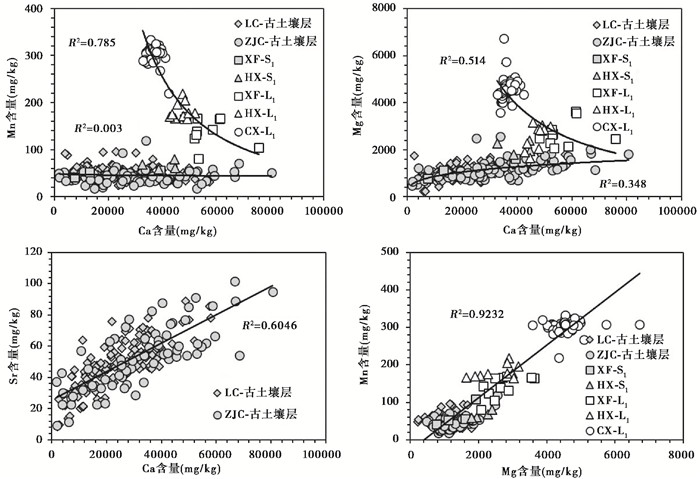
解译古土壤层中酸溶相元素含量及比值的古气候意义需厘清这些元素的来源及控制因素[56]。根据连续提取实验结果[56, 61],弱酸主要溶解碳酸盐相、吸附相和可溶相中的元素,例如Ca、Mg、Mn和Sr等元素,几乎无法溶解硅酸盐组分。Ca含量与Sr含量呈现显著的正相关关系(图 4),相关系数R2达0.61(n=205)。这可能由于Sr和Ca离子的价态相同且离子半径接近,导致两者地球化学性质相似[61]。因此Sr主要来自于碳酸盐组分,连续提取实验也证实Ca和Sr主要来自于碳酸盐相,硅酸盐组分贡献相对较少[56, 61]。
|
图 4 酸溶相中Ca元素含量与Mg、Sr、和Mn元素含量及Mg与Mn元素含量的散点图 其中西峰(XF)、环县(HX)和曹岘(CX)的数据引自Li等[57] Fig. 4 Plots between Ca concentration and Mg, Sr and Mn concentrations as well as between Mg and Mn concentrations. The data from XF, HX and CX referred to Li et al. [57] |
古土壤层中Ca含量与Mg和Mn含量的相关关系(图 4)相对较差(R2 < 0.35),但是Mg与Mn含量则存在显著的正相关(图 4,R2=0.92),表明Mg和Mn元素受相同的地球化学过程控制。连续提取实验表明不论黄土层还是古土壤层,Mn含量随着溶液pH的下降,溶解出来的Mn含量增加[56],因此Mg和Mn离子可能主要来自于粘土矿物吸附相。另外,弱风化的赵家川剖面的Sr含量(52.3 mg/kg)比洛川剖面(48.0 mg/kg)高,类似地,Mg与Ca元素均是赵家川剖面更高,这也支持Ca、Mg和Sr主要来自于碳酸盐和/或吸附相[62]。总的来说,这些元素主要与碳酸盐相和吸附相有关[61~62]。
酸溶相的元素比值常用于指示过去的水文状况,易受原生和次生碳酸盐比例的影响[57]。黄土中碎屑碳酸盐主要来自于潜在源区的海相或盐湖相碳酸盐[63~64],其具有高的Mn、Mg和Sr等元素[57, 63],特别是白云石矿物,具有高的Mg/Ca比[56]。当碎屑碳酸盐中的这些离子被溶解释放之后,Mn2+离子立刻被氧化成Mn4+,而Mn4+、Mg2+和Sr2+离子在方解石中的分配系数均远低于1,因此土壤溶液中这些离子很难再次进入次生碳酸盐中,导致次生碳酸盐中的Mg、Mn和Sr含量与Mg/Ca、Mn/Ca和Sr/Ca比值远低于碎屑碳酸盐[57, 63]。例如,黄土中蜗牛壳体(纯的次生碳酸盐)[63]的Mn/Ca比值(mmol/mol)为约0.06,Mg/Ca比值(mmol/mol)约为1,Sr/Ca比值(mmol/mol)为0.8左右,电子探针结果显示这3个元素比值在沙漠方解石中分别高达1.73~7.84、5和1.05[63]。
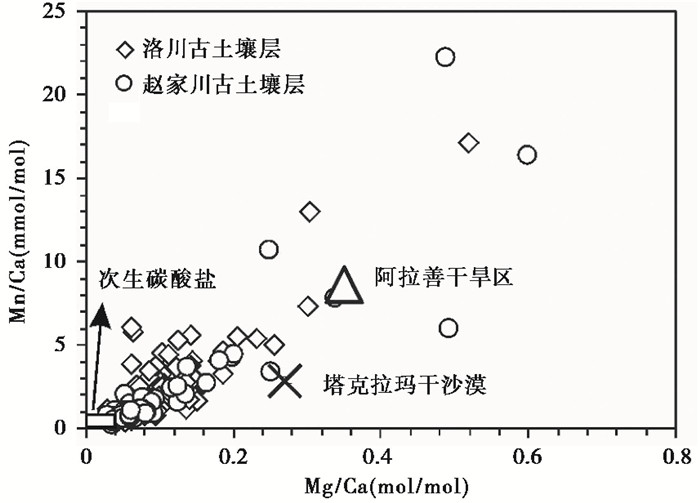
洛川和赵家川剖面中酸溶相元素比值大体上与发表的古土壤层[57]结果一致,除了少数样品的Mn/Ca和Mg/Ca比值很高,甚至超过它们在沙漠源区的比值(图 5)[57, 63]。然而,黄土高原中南部剖面中古土壤层经历了更强的化学风化[14],同时,在选择样品的时候,仅挑选不含白云石的样品,即两个剖面的古土壤层为次生碳酸盐,至少为次生碳酸盐主导,特别是S5时期,碳酸盐几乎被完全溶解[14],而我们结果却显示该时期这些元素比值较高(图 2和3),表明两个剖面古土壤中高Mn/Ca和Mg/Ca比值不只与碎屑与次生碳酸盐比例有关。
|
图 5 赵家川和洛川剖面古土壤层与黄土中次生碳酸盐和主要沙漠源区[57]的酸溶相Mn/Ca与Mg/Ca比值对比 Fig. 5 Plots between Mn/Ca and Mg/Ca ratios in the acetic acid leachable components from paleosol layers in Luochuan and Zhaojiachuan sections(this study), secondary carbonate of loess and mainly deserts[57] |
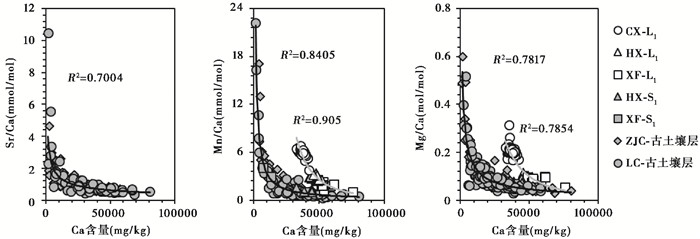
事实上,这些元素比值还受碳酸盐含量的影响。黄土中元素Ca含量主要受碳酸盐控制[65],因此我们选择Ca元素含量代替碳酸盐含量。如图 6所示,两个剖面古土壤层中Mn/Ca、Sr/Ca和Mg/Ca比值均与Ca含量呈现很好的负相关关系(R2 > 0.7,n=205),当Ca含量高时,这3个元素比值均较低,反之亦然。这可能主要由于Ca元素含量变化导致,图 2显示Ca元素含量变化巨大,可达100倍以上。需要注意的是古土壤层与黄土层中这些元素比值与Ca含量的相关关系存在差异,随着Ca含量的下降,元素比值在黄土层中比古土壤层中大(图 6),这可能与酸溶实验中未完全溶解碳酸盐有关。例如,在曹岘剖面L1黄土层中,碳酸盐含量约15% ~20% [66],换算成Ca元素含量应为60000~80000 mg/kg,而Li等[57]发表的数据仅为约40000 mg/kg,也低于更湿润的环县和西峰剖面L1黄土层(图 4)。这或许与L1黄土层中相对难溶的白云石矿物较多,致使弱酸溶解实验中碳酸盐矿物未被完全溶解有关[66]。综上,古土壤层中元素Mg/Ca、Sr/Ca和Mn/Ca可能主要反映碳酸盐含量的变化。
|
图 6 黄土高原多剖面黄土层(白色填充)与古土壤层(灰色填充)中Ca含量与Sr/Ca、Mg/Ca和Mn/Ca的关系 其中西峰(XF)、环县(HX)和曹岘(CX)的数据引自Li等[57] Fig. 6 Correlations between Ca concentration and Sr/Ca、Mg/Ca and Mn/Ca in the acetic acid leachable components of paleosol layers(gray)and loess layers(white)on the Chinese Loess Plateau. The data from XF, HX and CX cited from Li et al. [57] |
赵家川和洛川剖面古土壤层中酸溶相Ca、Mg、Sr和Mn元素及其比值与碳酸盐矿物含量的变化类似(图 2),主要受季风降水控制[14, 66]:当降水大时,土壤中矿物(例如碳酸盐)发生溶解,部分离子被雨水带出土壤,部分离子在土壤剖面向下迁移并形成新的矿物,例如方解石和粘土矿物,部分离子残留在原地再沉淀形成次生矿物和/或被粘土矿物等吸附。而土壤中矿物的溶解程度与渗透水及其pH值有关,pH受植被覆盖度及类型控制。黄土高原现代表土结果显示植被覆盖度及类型主要受控于季风降水的变化[67~68];类似地,在温度变化很小的全新世时期[69],植被类型(碳同位素)和覆盖度(有机碳含量)变化剧烈且与季风降水密切相关[67, 70]。特别地,室内实验研究表明,当其他的条件保持不变,增加一次20~30 mm的降水事件之后,25 cm深处的土壤CO2浓度突然升高了约9倍[71],这可能主要受微生物作用和植物呼吸作用的影响[72]。另外,当降水量越大,矿物溶解出的离子被渗透水迁出土壤进入河流越多,相反,残留在土壤中的可溶性离子(例如Ca、Mg、Sr和Mn等)越少[73]。因此,降水量越大,土壤中碳酸盐和酸溶相离子被带离土壤就越多,残留则越少,因此,Ca、Mg、Mn和Sr含量越高指示季风降水越少,反之亦然。综上,土壤中残留的元素含量及比值主要受控于季风降水,但不能完全排除温度的影响。
除此之外,地下水过程也会影响土壤中酸溶相元素的变化,但黄土是一种排水优良的土壤,黄土高原多个剖面中对渗透水敏感的碳酸盐含量变化具有可对比性[14],而洛川和赵家川剖面磁化率和碳酸盐指标等均呈现明显的黄土-古土壤旋回(图 2),因此排除地下水作用对元素的改造。需要注意的是,这些元素很容易在土壤剖面迁移,因此只能获得间冰期时期的平均值;同时,由于本文的分辨率相对较低,很难可靠地对比间冰期之间的夏季风强度变化,但不影响早更新世与中晚更新世时期季风强度的对比。
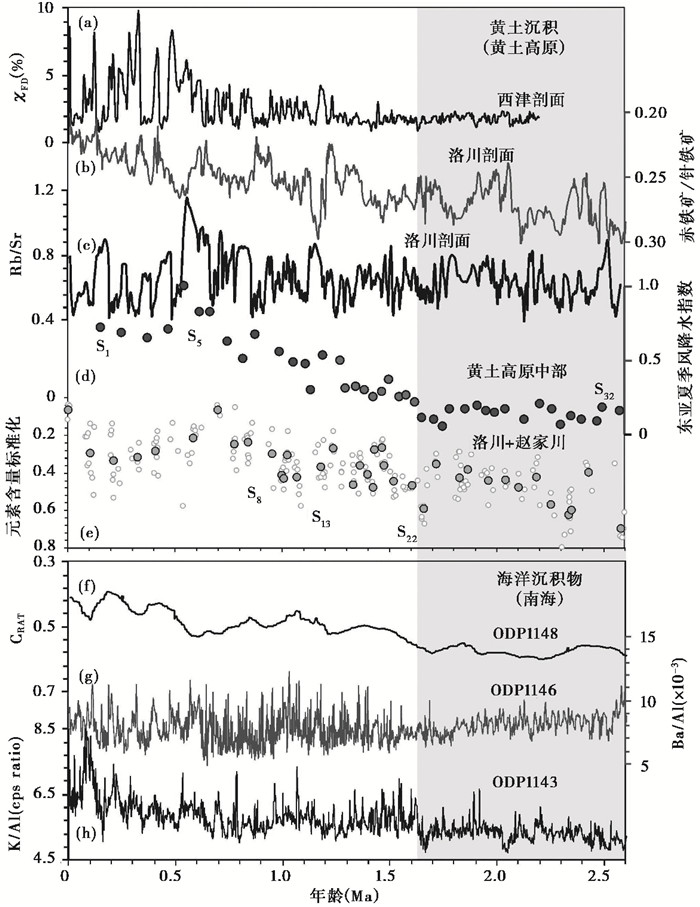
3.2 早更新世间冰期时期东亚夏季风强度重建元素含量及其比值均可记录东亚夏季风演化,但是由于Mg/Ca、Sr/Ca和Mn/Ca比值主要反映元素Ca含量的变化,因此本文只考虑用元素含量重建过去夏季风降水变化。为了更好地展示元素含量记录的东亚夏季风信息,我们把两个剖面的元素含量标准化并合并(图 7),同时计算古土壤层的平均值。其中元素含量标准化值越高,指示夏季风越弱,相反,代表夏季风越强。基于酸溶相元素含量的变化,重建了过去2.6 Ma以来间冰期东亚季风强度的演变历史。结果显示在早更新世时期,元素含量标准化值约为0.50(n=63),中晚更新世时期为0.32(n=143),显示早更新世时期东亚夏季风较弱,中晚更新世间冰期夏季风较强。
|
图 7 更新世间冰期时期酸溶相元素重建的夏季风记录(e)与其他季风记录(a~d和f~h)对比 黄土高原地区西津剖面频率磁化率(χFD)[20] (a)、洛川剖面赤铁矿与针铁矿比值[12] (b)、洛川剖面Rb/Sr比值[13] (c)和黄土高原中部地区基于碳酸盐溶解阶段模型重建的间冰期季风降水指数(d)[14];南海ODP1148的CRAT(绿泥石/(绿泥石+针铁矿+赤铁矿))[31] (f)、ODP1146的Ba/Al比值[32] (g)和ODP1143的K/Al比值[33] (h)典型的古土壤层标注在(d)和(e)底部,(e)中灰色填充的圆圈为古土壤层平均值;阴影部分指示早更新世时期 Fig. 7 Comparison between our record (e) with other EASM records on the CLP(a~d)and South China Sea(f~h). The χFD% in the Xijin section (a)[20], Hematite/Goethite ratio in the LC section (b)[12], Rb/Sr ratio in the LC section (c)[13], dissolution phases of carbonate in the central CLP (d)[14]. Similarly, from top to bottom, the CRAT(chlorite/(chlorite +hematite +goethite))in ODP1148 (f)[31], Ba/Al ratio in ODP1146 (g)[32] and K/Al ratio in ODP1143 (h)[33] in the South China Sea. Typical paleosol layers are labeled at the bottom of (d) and (e). The black circles filled with gray in (e) represent the mean normalized elemental ratios in each paleosol layer. The vertical gray band indicates the Early Pleistocene period |
基于古土壤层中酸溶相元素含量重建的东亚夏季风记录与许多黄土高原和南海地区的夏季风记录大体一致,均表现为早更新世时期夏季风较弱,中晚更新世时期夏季风较强(图 7)。例如黄土高原地区磁化率[10, 20, 59]、Rb/Sr比值[13]和铁氧化物[11~12]与南海的元素与矿物比值[31~33]等指标记录的早更新世弱的夏季风。2.6 Ma以来逐渐下降的洛川剖面赤铁矿/针铁矿比值[12]和南海ODP1148钻孔绿泥石/(绿泥石+赤铁矿+针铁矿)比值[31, 74]均指示逐渐增强的东亚夏季风(图 7)。特别地,最近基于黄土高原中部多剖面的碳酸盐淋溶指标重建的东亚季风降水演变[14]与我们的结果接近。
但在某些时间段,一些夏季风记录与我们的结果存在差异。例如,黄土高原磁化率、南海ODP钻孔的Ba/Al和K/Al比值记录的东亚夏季风在1.6~0.5 Ma之间没有明显的变化[12, 20, 32~33],与我们大体上增强的夏季风结果不一致(图 7)。值得注意的是,不同剖面黄土磁化率突然增加的时间段也不一致,在南部宝鸡剖面为0.35 Ma左右、在中部灵台和洛川剖面为0.55 Ma[14],而在西北曹岘剖面则发生在0.43 Ma[75]。这或是因为磁化率的形成机制复杂[76~77]或温度信号的干扰[42, 78]或存在降水阈值[40~41],元素比值易受物源变化的影响[79]。
同时,也有一些记录与我们的结果呈现相反的趋势。例如黄土高原沙漠与黄土过渡带区靖边剖面的粒度显示2.6 Ma以来毛乌素沙漠阶段性地向南扩张,暗示东亚夏季风逐渐减弱[15],但黄土粒度不止受夏季风有关的沙漠进退影响,也受到冬季风强度的影响[50~51, 80]。黄土高原地区朝那剖面的化石孢粉记录显示2.6 Ma以来阶段性的变干[16],但是黄土中孢粉的保存程度会极大地影响该记录的可靠性,特别是时间久远的早更新世时期,化石孢粉经历了上百万年的破坏,其失真性大大增加[48]。南海ODP1143钻孔沉积物的赤铁矿与针铁矿比值也显示东亚季风逐渐减弱[39],但该指标存在气候阈值[46],同时铁氧化物的定量也受碳酸盐含量变化的影响[81]。
3.3 弱的早更新世间冰期东亚夏季风的机制探讨结合夏季风记录和模拟工作,驱动构造尺度东亚夏季风变化的假说主要为:1)北半球冰盖/温度的变化,冰量增长和温度下降会促使冷气团南移,减弱东亚夏季风,特别是中纬度地区[15, 82];2)青藏高原的阶段性隆升,高原隆升增加海陆压力差,导致东亚夏季风增强[83];3)热赤道或热带辐合带南北移动,由于北半球陆地多而南半球海洋多,陆地的比热远大于海洋,因此全球温度增加会导致热赤道或者热带辐合带北移,反之亦然[84];4)赤道太平洋沃克环流的变化,东西赤道太平洋的海表温差变化会引起沃克环流的变化,当两侧温差较大时,沃克环流加强,导致东亚大部分区域季风降水增多,类似于现在的拉尼娜现象,反之则减少[14]。
首先,温度/冰量对构造尺度东亚夏季风的影响[15, 82]。在冰期间冰期时间尺度,东亚夏季风与全球温度或冰量耦合,即暖的间冰期东亚夏季风越强,冷的冰期夏季风弱[10, 66, 85]。在构造时间尺度上,2.6 Ma以来北半球冰量增加[86]且大体上变冷[8~9],应导致北半球夏季风强度减弱[15, 87]。但我们记录却显示逐渐增强的夏季风(图 7),表明全球温度的变化不是导致早更新世弱夏季风的主要原因。其次,青藏高原隆升对构造时间尺度东亚夏季风的影响[83],气候模式结果显示青藏高原阶段性隆升会突然增强亚洲夏季风[83, 88~89],然而青藏高原到达接近现在的高度主要发生在中新世或之前[90~91],更新世时期发生大范围隆升还缺乏翔实的证据,这些表明2.6 Ma以来间冰期东亚季风降水演变与青藏高原隆升关联较小。再次,热赤道或热带辐合带南北移动也会影响东亚夏季风强度[84],2.6 Ma以来北半球冰量的增加[86],模拟结果显示热赤道或热带辐合带应向南移动[92],致使东亚夏季风减弱[68],与逐渐增强的东亚夏季风相反(图 7),暗示其不是早更新世弱夏季风的主要因素。
最后,赤道太平洋沃克环流对构造时间尺度东亚夏季风的影响[14]。赤道太平洋沃克环流主要与ENSO有关,ENSO是年际尺度上对东亚季风影响最大的因素之一[93~94],其由暖相厄尔尼诺和冷相拉尼娜态交替组成[95],在冷相的拉尼娜态的时候,东赤道太平洋冷舌海表温度较低,上涌增强,温跃层较薄,东西太平洋海表温度梯度增加,导致太平洋沃克环流增强,西北太平洋副高北移,华北地区(包括黄土高原)降水增加[96~97];相反,在厄尔尼诺态的时候,东赤道太平洋冷舌海表温度较高,上涌减弱,温跃层较厚,太平洋沃克环流减弱,副高南移,华北地区季风降水减少[96~97]。例如,在强厄尔尼诺态的时候(例如1998年和2015~2016年),黄土高原地区发生极端干旱[98],在强拉尼娜态的时候则呈现相反的特征[99],该现象也与模拟结果一致[100]。
仪器记录同样显示自1951年到2015年,当厄尔尼诺高频发生的时候,黄土高原地区的MAP在十年尺度上呈现下降的趋势[99]。在百年时间尺度上,东亚季风强度变化也与ENSO有关[101],在千年尺度上,强的类厄尔尼诺态抑制了早全新世(11~8 ka)和晚全新世(5~0 ka)黄土高原地区季风降水;相反,拉尼娜态促进了中全新世黄土高原地区的强降水[102]。赤道太平洋沃克环流对构造尺度东亚夏季风的影响也在西太平洋暖池地区的海洋记录中被发现[103~104]。最近,Meng等[14]提出赤道太平洋沃克环流影响了更新世间冰期时期东亚大陆季风降水的演变,也就是将类似现代赤道太平洋沃克环流对黄土高原地区季风降水影响的机制作用在更长的构造时间尺度上。
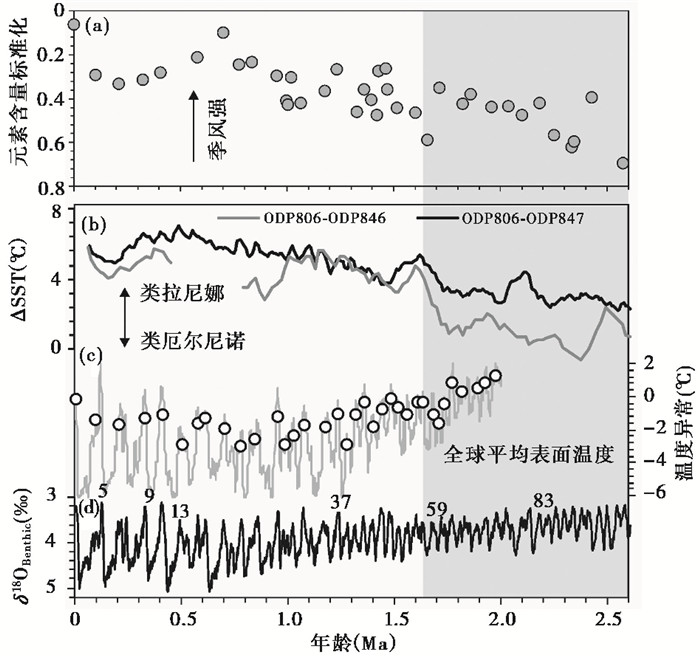
在构造时间尺度,赤道太平洋沃克环流常常用东西海表温度梯度表示[105~107]。西太平洋暖池地区主要包括ODP806钻孔[105, 108]和MD97 - 2140钻孔[109] Mg/Ca和链烯酮(U37K′)重建的海表温度记录,东赤道太平洋冷舌地区包括ODP849钻孔[108]和ODP846[106]链烯酮及ODP847钻孔Mg/Ca重建的海表温度记录[105]。尽管某些钻孔的分辨率较低,但是逐渐增加的东西赤道太平洋海表温度梯度与其他多个钻孔的结果接近[107]。这可能是因为东赤道太平洋海表温度响应亚极地的变冷而逐渐变冷[106, 110],而西赤道太平洋暖池的海表温度则相对恒定[106]。因此,2.6 Ma以来东西赤道太平洋海表温度梯度逐渐增加。更大的温度梯度指示发生更强的沃克环流以及高频的类拉尼娜态,相反,更小的温度梯度则指示发生弱的沃克环流与高频的类厄尔尼诺态[105~107]。
|
图 8 2.6 Ma以来黄土高原酸溶相元素含量与全球其他记录的对比 (a)酸溶相元素含量标准化;(b)东西赤道太平洋海表温度梯度变化[105~106];(c)全球平均表面温度变化[8];(d)深海氧同位素记录[86],其中(c)中白色填充的黑色圆圈指示间冰期的平均温度 Fig. 8 Comparison of EASM derived from normalized elements concentration in the acetic acid leachable components of paleosol layers with global temperature changes since 2.6 Ma. (a)Normalized elements concentration in the acetic acid leachable components of paleosol layers. The zonal SST gradients (b) between ODP806 and the ODP847[105], between ODP806 and ODP846[105~106] are represented by a black line and a gray line, respectively. (c)Global average surface temperatures anomaly(in ℃)as temperature from present(light gray line)and the interglacial average in black circles filled with white[8]. (d)A stack of 57 global δ18 O of benthic foraminifera[86]. The labels in (d) indicate main Marine Oxygen Isotope Stages |
基于此,我们比较了2.6 Ma以来间冰期东亚夏季风的演变与赤道太平洋沃克环流的变化。赤道太平洋海表温度梯度的变化与东亚夏季风记录变化一致,早更新世间冰期时期(1.6~2.6 Ma)弱的沃克环流对应黄土高原和南海地区弱的东亚夏季风;中晚更新世时期,较大的东西太平洋海表温度梯度对应黄土高原和南海地区强的东亚夏季风(图 8)。同时,自中更新世以来,风成黄土开始广泛堆积意味着长江中下游[111~112]和东北地区[113~115]开始变干。这与现代观察显示沃克环流的变化导致东亚季风降水存在正负正模式特征一致[116~117],这些均表明构造时间尺度上东亚夏季风降水受赤道太平洋沃克环流强度变化的影响。
总体上,暖的早更新世间冰期时期,黄土高原和南海地区东亚季风降雨少,中晚更新世时期,这两个地区降水较多,长江中下游和东北地区降水较少。支持赤道太平洋的沃克环流对2.6 Ma以来间冰期东亚大陆地区季风降水变化的影响[14]。遗憾的是,除了黄土高原和南海地区以外,东亚其他地区缺少连续的早更新世东亚季风的记录,限制了我们理解早更新世东亚季风降水的空间变化特征。
4 结论洛川和赵家川剖面古土壤层中酸溶组分以Ca元素(平均2.64%)为主,Mg元素(平均1116.5 mg/kg)次之,Sr元素(平均49.5 mg/kg)最低。在空间尺度上,洛川剖面Ca元素平均含量(2.35%,n=134)低于赵家川剖面(3.2%,n=71);类似地,洛川剖面Mg和Sr平均含量低于赵家川剖面。在时间尺度上,洛川和赵家川剖面中Ca元素均值在早更新世分别为3.1%和4.6%,逐渐下降到50万年左右的0.8%和2.2%,之后50万年左右分别为1.6%和2.4%;Mg元素均值在早更新世分别为1284.1 mg/kg和1566.5 mg/kg,中晚更新世分别低于731.2 mg/kg和828.4 mg/kg;Sr元素平均含量在早更新世分别为57.5 mg/kg和67.2 mg/kg,中晚更新世分别低于36.9 mg/kg和54.2 mg/kg。总体上,这3个元素均为早更新世含量高,中晚更新世含量低。Mg/Ca、Sr/Ca和Mn/Ca比值主要受Ca含量控制,呈现与元素含量相反的变化特征。两个剖面古土壤层中元素及其比值均指示暖的早更新世间冰期时期黄土高原地区东亚夏季风较弱,中晚更新世时期夏季风较强,该结果与过去许多夏季风重建一致,支持赤道太平洋沃克环流的变化影响了2.6 Ma以来间冰期时期东亚夏季风强度这一假说。
致谢: 衷心感谢审稿专家提出的宝贵建议与编辑部赵淑君和杨美芳老师对本文的编校。
| [1] |
Long H, Lai Z, Fuchs M, et al. Timing of Late Quaternary palaeolake evolution in Tengger Desert of Northern China and its possible forcing mechanisms[J]. Global and Planetary Change, 2012, 92-93: 119-129. DOI:10.1016/j.gloplacha.2012.05.014 |
| [2] |
Zhang H C, Peng J L, Ma Y Z, et al. Late Quaternary palaeolake levels in Tengger Desert, NW China[J]. Palaeogeography, Palaeoclimatology, Palaeoecology, 2004, 211(1-2): 45-58. DOI:10.1016/j.palaeo.2004.04.006 |
| [3] |
李保生, Hormann Jurgent, 陈德牛, 等. 全新世大暖期时中国夏季风向西北大幅度漂移的一个古生物地层学证据[J]. 地球环境学报, 2010, 1(2): 133-138. Li baosheng, Hormann Jurgent, Chen Deniu, et al. A bio-stratigraphy evidence of summer monsoon drift on a large scale toward NW China during the Holocene Megathermal[J]. Journal of Earth Environment, 2010, 1(2): 133-138. |
| [4] |
Cheng H, Zhang P, Spötl C, et al. The climatic cyclicity in semiarid-arid Central Asia over the past 500, 000 years[J]. Geophysical Research Letters, 2012, 39(1): 1-5. |
| [5] |
任继周, 张自和. 华夏农耕文化探源——兼论以粮为纲[J]. 世界科技研究与发展, 2003, 25(2): 21-26. Ren Jizhou, Zhang Zihe. The culture of Chinese agriculture culture[J]. World Science and Technology Research & Development, 2003, 25(2): 21-26. DOI:10.3969/j.issn.1006-6055.2003.02.004 |
| [6] |
吕厚远, 张健平. 关中地区的新石器古文化发展与古环境变化的关系[J]. 第四纪研究, 2008, 28(6): 1050-1060. Lü Houyuan, Zhang Jianping. Neolithic cultural evolution and Holocene climate change in the guanzhong basin, Shaanxi, China[J]. Quaternary Sciences, 2008, 28(6): 1050-1060. DOI:10.3321/j.issn:1001-7410.2008.06.010 |
| [7] |
丁一汇, 孙颖, 刘芸芸, 等. 亚洲夏季风的年际和年代际变化及其未来预测[J]. 大气科学, 2003, 37(2): 253-280. Ding Yihui, Sun Ying, Liu Yunyun, et al. Interdecadal and interannual variabilities of the Asian summer monsoon and its projection of future change[J]. Chinese Journal of Atmospheric Sciences, 2003, 37(2): 253-280. |
| [8] |
Snyder C W. Evolution of global temperature over the past two million years[J]. Nature, 2016, 538(7624): 226-228. DOI:10.1038/nature19798 |
| [9] |
Herbert T D, Peterson L C, Lawrence K T, et al. Tropical ocean temperatures over the past 3.5 million years[J]. Science, 2010, 328(5985): 1530-1534. DOI:10.1126/science.1185435 |
| [10] |
An Z, Liu T, Lu Y, et al. The long-term paleomonsoon variation recorded by the loess-paleosol sequence in Central China[J]. Quaternary International, 1990, 7: 91-95. |
| [11] |
Ji J, Balsam W, Chen J. Mineralogic and climatic interpretations of the Luochuan loess section(China)based on diffuse reflectance spectrophotometry[J]. Quaternary Research, 2001, 56(1): 23-30. DOI:10.1006/qres.2001.2238 |
| [12] |
Balsam W, Ji J, Chen J. Climatic interpretation of the Luochuan and Lingtai loess sections, China, based on changing iron oxide mineralogy and magnetic susceptibility[J]. Earth and Planetary Science Letters, 2004, 223(3-4): 335-348. DOI:10.1016/j.epsl.2004.04.023 |
| [13] |
Chen J, Wang Y, Chen Y, et al. Rb and Sr geochemical characterization of the Chinese loess stratigraphy and its implications for palaeomonsoon climate[J]. Acta Geologica Sinica(English Edition), 2000, 74(2): 279-288. |
| [14] |
Meng X, Liu L, Wang X T, et al. Mineralogical evidence of reduced East Asian summer monsoon rainfall on the Chinese Loess Plateau during the Early Pleistocene interglacials[J]. Earth and Planetary Science Letters, 2018, 486: 61-69. DOI:10.1016/j.epsl.2017.12.048 |
| [15] |
Ding Z, Derbyshire E, Yang S, et al. Stepwise expansion of desert environment across Northern China in the past 3.5 Ma and implications for monsoon evolution[J]. Earth and Planetary Science Letters, 2005, 237(1): 45-55. |
| [16] |
Wu F, Fang X, Ma Y, et al. Plio-Quaternary stepwise drying of Asia:Evidence from a 3-Ma pollen record from the Chinese Loess Plateau[J]. Earth and Planetary Science Letters, 2007, 257(1-2): 160-169. DOI:10.1016/j.epsl.2007.02.029 |
| [17] |
Ding Z, Xiong S, Sun J, et al. Pedostratigraphy and paleomagnetism of a~7.0 Ma eolian loess-red clay sequence at Lingtai, Loess Plateau, north-Central China and the implications for paleomonsoon evolution[J]. Palaeogeography, Palaeoclimatology, Palaeoecology, 1999, 152(1): 49-66. |
| [18] |
Liu X, Liu T, Xu T, et al. The Chinese loess in Xifeng, Ⅰ. The primary study on magnetostratigraphy of a loess profile in Xifeng area, Gansu Province[J]. Geophysical Journal, 1988, 92(2): 345-348. DOI:10.1111/j.1365-246X.1988.tb01146.x |
| [19] |
Lu H, Wang X, Wang X, et al. Palaeoclimatic changes in northeastern Qinghai-Tibetan Plateau revealed by magnetostratigraphy and magnetic susceptibility analysis of thick loess deposits[J]. Netherlands Journal of Geosciences, 2012, 91(1-2): 189-198. DOI:10.1017/S001677460000158X |
| [20] |
Zhang J, Li J, Guo B, et al. Magnetostratigraphic age and monsoonal evolution recorded by the thickest Quaternary loess deposit of the Lanzhou region, western Chinese Loess Plateau[J]. Quaternary Science Reviews, 2016, 139: 17-29. DOI:10.1016/j.quascirev.2016.02.025 |
| [21] |
Bloemendal J, Liu X, Sun Y, et al. An assessment of magnetic and geochemical indicators of weathering and pedogenesis at two contrasting sites on the Chinese Loess Plateau[J]. Palaeogeography, Palaeoclimatology, Palaeoecology, 2008, 257(1-2): 152-168. DOI:10.1016/j.palaeo.2007.09.017 |
| [22] |
Guo Z, Biscaye P, Wei L, et al. Summer monsoon variations over the last 1.2 Ma from the weathering of loess-soil sequences in China[J]. Geophysical Research Letters, 2000, 27(12): 1751-1754. DOI:10.1029/1999GL008419 |
| [23] |
Ding Z L, Yang S L, Sun J M, et al. Iron geochemistry of loess and red clay deposits in the Chinese Loess Plateau and implications for long-term Asian monsoon evolution in the last 7.0 Ma[J]. Earth and Planetary Science Letters, 2001, 185(1-2): 99-109. DOI:10.1016/S0012-821X(00)00366-6 |
| [24] |
Yang S, Ding Z. Seven million-year iron geochemistry record from a thick eolian red clay-loess sequence in Chinese Loess Plateau and the implications for paleomonsoon evolution[J]. Chinese Science Bulletin, 2001, 46(4): 337-340. DOI:10.1007/BF03187199 |
| [25] |
Chen X, Fang X, An Z, et al. An 8.1 Ma calcite record of Asian summer monsoon evolution on the Chinese central Loess Plateau[J]. Science in China(Series D), 2007, 50(3): 392-403. DOI:10.1007/s11430-007-0016-x |
| [26] |
Sun Y, An Z, Clemens S C, et al. Seven million years of wind and precipitation variability on the Chinese Loess Plateau[J]. Earth and Planetary Science Letters, 2010, 297(3): 525-535. |
| [27] |
Li T, Liu F, Abels H A, et al. Continued obliquity pacing of East Asian summer precipitation after the mid-Pleistocene transition[J]. Earth and Planetary Science Letters, 2017, 457: 181-190. DOI:10.1016/j.jpgl.2016.09.045 |
| [28] |
李涛, 李高军. 斜度驱动第四纪冰期-间冰期转换——来自中国黄土的证据[J]. 第四纪研究, 2018, 38(5): 1111-1119. Li Tao, Li Gaojun. Obliquity pacing of deglaciations in the Pleistocene:Evidence from the Chinese loess deposits[J]. Quaternary Sciences, 2018, 38(5): 1111-1119. |
| [29] |
汪品先, 翦知湣, 赵泉鸿, 等. 南海演变与季风历史的深海证据[J]. 科学通报, 2003, 48(21): 2228-2239. Wang Pinxian, Jian Zhimin, Zhao Quanhong, et al. Evolution of the South China Sea and monsoon history revealed in deep-sea records[J]. Chinese Science Bulletin, 2003, 48(21): 2549-2561. |
| [30] |
Wan S, Li A, Clift P D, et al. Development of the East Asian summer monsoon:Evidence from the sediment record in the South China Sea since 8.5 Ma[J]. Palaeogeography, Palaeoclimatology, Palaeoecology, 2006, 241(1): 139-159. DOI:10.1016/j.palaeo.2006.06.013 |
| [31] |
Clift P D, Hodges K V, Heslop D, et al. Correlation of Himalayan exhumation rates and Asian monsoon intensity[J]. Nature Geoscience, 2008, 1(12): 875-880. DOI:10.1038/ngeo351 |
| [32] |
Clemens S C, Prell W L, Sun Y, et al. Southern Hemisphere forcing of Pliocene δ18O and the evolution of Indo-Asian monsoons[J]. Paleoceanography, 2008, 23(4): 1-15. |
| [33] |
Tian J, Xie X, Ma W, et al. X-ray fluorescence core scanning records of chemical weathering and monsoon evolution over the past 5 Myr in the southern South China Sea[J]. Paleoceanography, 2011, 26(4): 1-17. |
| [34] |
刘志飞, 赵玉龙, 王轶婕, 等. 南海第四纪东亚季风演化的粘土矿物指标[J]. 第四纪研究, 2017, 37(5): 921-933. Liu Zhifei, Zhao Yulong, Wang Yijie, et al. Clay mineralogical proxy of the East Asian monsoon evolution during the Quaternary in the South China Sea[J]. Quaternary Sciences, 2017, 37(5): 921-933. |
| [35] |
Deng C, Vidic N J, Verosub K L, et al. Mineral magnetic variation of the Jiaodao Chinese loess/paleosol sequence and its bearing on long-term climatic variability[J]. Journal of Geophysical Research:Solid Earth, 2005, 110(B3): 1-17. |
| [36] |
Deng C, Shaw J, Liu Q, et al. Mineral magnetic variation of the Jingbian loess/paleosol sequence in the northern Loess Plateau of China:Implications for Quaternary development of Asian aridification and cooling[J]. Earth and Planetary Science Letters, 2006, 241(1): 248-259. |
| [37] |
Yang S, Ding F, Ding Z. Pleistocene chemical weathering history of Asian arid and semi-arid regions recorded in loess deposits of China and Tajikistan[J]. Geochimica et Cosmochimica Acta, 2006, 70(7): 1695-1709. DOI:10.1016/j.gca.2005.12.012 |
| [38] |
Jiang H, Guo G, Cai X, et al. A pollen record of the Mid-Pleistocene Transition from Beijing, North China[J]. Journal of Quaternary Science, 2013, 28(7): 720-728. DOI:10.1002/jqs.v28.7 |
| [39] |
Zhang Y G, Ji J, Balsam W, et al. Mid-Pliocene Asian monsoon intensification and the onset of Northern Hemisphere glaciation[J]. Geology, 2009, 37(7): 599-602. DOI:10.1130/G25670A.1 |
| [40] |
Han J, Lü H, Wu N, et al. The magnetic susceptibility of modern soils in China and its use for paleoclimate reconstruction[J]. Studia Geophysica et Geodaetica, 1996, 40(3): 262-275. DOI:10.1007/BF02300742 |
| [41] |
Balsam W L, Ellwood B B, Ji J, et al. Magnetic susceptibility as a proxy for rainfall:Worldwide data from tropical and temperate climate[J]. Quaternary Science Reviews, 2011, 30(19-20): 2732-2744. DOI:10.1016/j.quascirev.2011.06.002 |
| [42] |
Porter S C, Hallet B, Wu X, et al. Dependence of near-surface magnetic susceptibility on dust accumulation rate and precipitation on the Chinese Loess Plateau[J]. Quaternary Research, 2001, 55(3): 271-283. DOI:10.1006/qres.2001.2224 |
| [43] |
Hu P, Liu Q, Heslop D, et al. Soil moisture balance and magnetic enhancement in loess-paleosol sequences from the Tibetan Plateau and Chinese Loess Plateau[J]. Earth and Planetary Science Letters, 2015, 409: 120-132. DOI:10.1016/j.jpgl.2014.10.035 |
| [44] |
Cornell R M, Schwertmann U. The Iron Oxides:Structure, Properties, Reactions, Occurrences and Uses[M]. Weinheim: John Wiley & Sons, 2003: 433-468.
|
| [45] |
Long X, Ji J, Balsam W. Rainfall-dependent transformations of iron oxides in a tropical saprolite transect of Hainan Island, South China:Spectral and magnetic measurements[J]. Journal of Geophysical Research, 2011, 116(F3): 1-15. |
| [46] |
Long X, Ji J, Barrón V, et al. Climatic thresholds for pedogenic iron oxides under aerobic conditions:Processes and their significance in paleoclimate reconstruction[J]. Quaternary Science Reviews, 2016, 150: 264-277. DOI:10.1016/j.quascirev.2016.08.031 |
| [47] |
Li Y, Ge Y, Xu Q, et al. Airborne pollen assemblages and weather regime in the central-eastern Loess Plateau, China[J]. Atmospheric Environment, 2015, 106: 92-99. DOI:10.1016/j.atmosenv.2015.01.066 |
| [48] |
Zhang W, Lu H, Li C, et al. Pollen preservation and its potential influence on paleoenvironmental reconstruction in Chinese loess deposits[J]. Review of Palaeobotany and Palynology, 2017, 240: 1-10. DOI:10.1016/j.revpalbo.2017.01.002 |
| [49] |
Xiong S, Ding Z, Zhu Y, et al. A~6 Ma chemical weathering history, the grain size dependence of chemical weathering intensity, and its implications for provenance change of the Chinese loess-red clay deposit[J]. Quaternary Science Reviews, 2010, 29(15-16): 1911-1922. DOI:10.1016/j.quascirev.2010.04.009 |
| [50] |
Xiao J, Zheng H, Zhao H. Variation of winter monsoon intensity on the Loess Plateau, Central China during the last 130, 000 years:Evidence from grain size distribution[J]. Quaternary Research, 1992, 31(1): 13-19. DOI:10.4116/jaqua.31.13 |
| [51] |
鹿化煜, 安芷生. 黄土高原黄土粒度组成的古气候意义[J]. 中国科学(D辑), 1998, 41(3): 278-283. Lu Huayu, An Zhisheng. Paleoclimatic significance of grain size of loess-palaeosol deposit in Chinese Loess Plateau[J]. Science in China(Series D), 1998, 41(6): 626-631. |
| [52] |
Tsoar H, Pye K. Dust transport and the question of desert loess formation[J]. Sedimentology, 1987, 34(1): 139-153. DOI:10.1111/sed.1987.34.issue-1 |
| [53] |
董欣欣, 杨石岭, 唐自华, 等. 基于黄土粒度估算粉尘源区-沉积区距离的新方法[J]. 中国科学:地球科学, 2016, 46(10): 1406-1412. Dong Xinxin, Yang Shiling, Tang Zihua, et al. A grain-size-based model for dust source-to-sink distance reconstruction:A case study from Chinese loess[J]. Science in China:Earth Sciences, 2016, 46(10): 1406-1412. |
| [54] |
杨石岭, 丁仲礼. 黄土高原黄土粒度的空间变化及其古环境意义[J]. 第四纪研究, 2017, 37(5): 934-944. Yang Shiling, Ding Zhongli. Spatial changes in grain size of loess deposits in the Chinese Loess Plateau and implications for palaeoenvironment[J]. Quaternary Sciences, 2017, 37(5): 934-944. |
| [55] |
刘连文, 王洪涛, 陈旸, 等. 黄土醋酸淋溶实验及其碳酸盐组分的地球化学特征[J]. 岩石矿物学杂志, 2002, 21(1): 69-73. Liu Lian, Wang Hongtao, Chen Yang, et al. Chemical leaching of loess deposits in China and its implications for carbonate composition[J]. Acta Petrologica et Mineralogica, 2002, 21(1): 69-73. DOI:10.3969/j.issn.1000-6524.2002.01.009 |
| [56] |
刘连文. 3.6 Ma来黄土高原东亚季风演化的矿物与元素地球化学研究[D]; 南京: 南京大学博士论文, 2002: 32-47. Liu Lianwen. The Evolution History of East Asian Monsoon on the Loess Plateau during the Last 3.6 Ma Based on Mineralogical and Elemental Geochemistry Studies[D]. Nanjing: The Doctoral Dissertation of Nanjing University, 2002: 32-47. http://d.wanfangdata.com.cn/Thesis/Y452280 |
| [57] |
Li G, Chen J, Chen Y. Primary and secondary carbonate in Chinese loess discriminated by trace element composition[J]. Geochimica et Cosmochimica acta, 2013, 103: 26-35. DOI:10.1016/j.gca.2012.10.049 |
| [58] |
Lu H, Liu X, Zhang F, et al. Astronomical calibration of loess-paleosol deposits at Luochuan, central Chinese Loess Plateau[J]. Palaeogeography, Palaeoclimatology, Palaeoecology, 1999, 154(3): 237-246. DOI:10.1016/S0031-0182(99)00113-3 |
| [59] |
Sun Y, Clemens S C, An Z, et al. Astronomical timescale and palaeoclimatic implication of stacked 3.6-Myr monsoon records from the Chinese Loess Plateau[J]. Quaternary Science Reviews, 2006, 25(1-2): 33-48. DOI:10.1016/j.quascirev.2005.07.005 |
| [60] |
Yang J, Chen J, An Z, et al. Variations in 87Sr/86Sr ratios of calcites in Chinese loess:A proxy for chemical weathering associated with the East Asian summer monsoon[J]. Palaeogeography, Palaeoclimatology, Palaeoecology, 2000, 157(1): 151-159. |
| [61] |
刘连文, 陈骏, 陈旸, 等. 黄土的连续提取实验及Rb/Sr值意义[J]. 土壤学报, 2002, 39(1): 65-70. Liu Lianwen, Chen Jun, Chen Yang, et al. Sequential extraction procedure of loess and paleosol and the implications of Rb/Sr ratios[J]. Acta Pedologica Sinica, 2002, 39(1): 65-70. DOI:10.3321/j.issn:0564-3929.2002.01.010 |
| [62] |
Yang S, Ding Z, Gu Z. Acetic acid-leachable elements in pedogenic carbonate nodules and links to the East-Asian summer monsoon[J]. Catena, 2014, 117: 73-80. DOI:10.1016/j.catena.2013.06.030 |
| [63] |
李高军.东亚风尘物源地球化学示踪研究[D]; 南京: 南京大学博士论文, 2010: 48-61. Li Gaojun. Trace the Source Regions of East Asia Dust Using Geochemical Tools[D]. Nanjing: The Doctoral Dissertation of Nanjing University, 2010: 48-61. http://d.wanfangdata.com.cn/Thesis/Y2372428 |
| [64] |
Li G, Chen J, Chen Y, et al. Dolomite as a tracer for the source regions of Asian dust[J]. Journal of Geophysical Research, 2007, 112(D17): 1-7. |
| [65] |
Meng X, Liu L, Zhao W, et al. Distant Taklimakan Desert as an important source of aeolian deposits on the Chinese Loess Plateau as evidenced by carbonate minerals[J]. Geophysical Research Letters, 2019, 46(9): 4854-4862. DOI:10.1029/2018GL081551 |
| [66] |
Meng X, Liu L, Balsam W, et al. Dolomite abundance in Chinese loess deposits:A new proxy of monsoon precipitation intensity[J]. Geophysical Research Letters, 2015, 42(23): 10391-10398. DOI:10.1002/2015GL066681 |
| [67] |
An Z, Huang Y, Liu W, et al. Multiple expansions of C4 plant biomass in East Asia since 7 Ma coupled with strengthened monsoon circulation[J]. Geology, 2005, 33(9): 75-78. |
| [68] |
Yang S, Ding Z, Li Y, et al. Warming-induced northwestward migration of the East Asian monsoon rain belt from the Last Glacial Maximum to the mid-Holocene[J]. Proceedings of the National Academy of Sciences of the United States of America, 2015, 112(43): 13178-13183. DOI:10.1073/pnas.1504688112 |
| [69] |
Peterse F, Prins M A, Beets C J, et al. Decoupled warming and monsoon precipitation in East Asia over the last deglaciation[J]. Earth and Planetary Science Letters, 2011, 301(1-2): 256-264. DOI:10.1016/j.epsl.2010.11.010 |
| [70] |
Lu H, Yi S, Liu Z, et al. Variation of East Asian monsoon precipitation during the past 21 ky and potential CO2 forcing[J]. Geology, 2013, 41(9): 1023-1026. DOI:10.1130/G34488.1 |
| [71] |
Rochette P, Desjardins R L, Pattey E. Spatial and temporal variability of soil respiration in agricultural fields[J]. Canadian Journal of Soil Science, 1991, 71(2): 189-196. DOI:10.4141/cjss91-018 |
| [72] |
Funke B R, Harris J O. Early respiratory responses of soil treated by heat or drying[J]. Plant and Soil, 1968, 28(1): 38-48. DOI:10.1007/BF01349176 |
| [73] |
Zamanian K, Pustovoytov K, Kuzyakov Y. Pedogenic carbonates:Forms and formation processes[J]. Earth-Science Reviews, 2016, 157: 1-17. DOI:10.1016/j.earscirev.2016.03.003 |
| [74] |
Clift P D, Giosan L, Blusztajn J, et al. Holocene erosion of the Lesser Himalaya triggered by intensified summer monsoon[J]. Geology, 2008, 36(1): 79-82. DOI:10.1130/G24315A.1 |
| [75] |
Sun Y, Chen J, Clemens S C, et al. East Asian monsoon variability over the last seven glacial cycles recorded by a loess sequence from the northwestern Chinese Loess Plateau[J]. Geochemistry, Geophysics, Geosystems, 2006, 7(12): 1-16. |
| [76] |
Liu Q, Deng C, Torrent J, et al. Review of recent developments in mineral magnetism of the Chinese loess[J]. Quaternary Science Reviews, 2007, 26(3-4): 368-385. DOI:10.1016/j.quascirev.2006.08.004 |
| [77] |
Guo X, Banerjee S K, Wang R, et al. Why magnetite is not the only indicator of past rainfall in the Chinese Loess Plateau?[J]. Geophysical Journal International, 2018, 213(3): 2128-2137. DOI:10.1093/gji/ggy097 |
| [78] |
Maher B A, Thompson R, Zhou L P. Spatial and temporal reconstructions of changes in the Asian palaeomonsoon:A new mineral magnetic approach[J]. Earth and Planetary Science Letters, 1994, 125(1): 461-471. |
| [79] |
Clift P D, Wan S, Blusztajn J. Reconstructing chemical weathering, physical erosion and monsoon intensity since 25 Ma in the northern South China Sea:A review of competing proxies[J]. Earth-Science Reviews, 2014, 130: 86-102. DOI:10.1016/j.earscirev.2014.01.002 |
| [80] |
Hao Q, Wang L, Oldfield F, et al. Delayed build-up of Arctic ice sheets during 400, 000-year minima in insolation variability[J]. Nature, 2012, 490(7420): 393-396. DOI:10.1038/nature11493 |
| [81] |
Balsam W, Ji J, Renock D, et al. Determining hematite content from NUV/Vis/NIR spectra:Limits of detection[J]. American Mineralogist, 2014, 99(11-12): 2280-2291. DOI:10.2138/am-2014-4878 |
| [82] |
Lu H, Guo Z. Evolution of the monsoon and dry climate in East Asia during late Cenozoic:A review[J]. Science China:Earth Sciences, 2014, 57(1): 70-79. DOI:10.1007/s11430-013-4790-3 |
| [83] |
An Z, Kutzbach J E, Prell W L, et al. Evolution of Asian monsoons and phased uplift of the Himalaya-Tibetan Plateau since Late Miocene times[J]. Nature, 2001, 411(6833): 62-66. DOI:10.1038/35075035 |
| [84] |
Broecker W S, Putnam A E. Hydrologic impacts of past shifts of Earth's thermal equator offer insight into those to be produced by fossil fuel CO2[J]. Proceedings of the National Academy of Sciences of the United States of America, 2013, 110(42): 16710-16715. DOI:10.1073/pnas.1301855110 |
| [85] |
Liu T, Ding Z. Chinese loess and the paleomonsoon[J]. Annual Review of Earth and Planetary Sciences, 1998, 26(1): 111-145. DOI:10.1146/annurev.earth.26.1.111 |
| [86] |
Lisiecki L E, Raymo M E. A Pliocene-Pleistocene stack of 57 globally distributed benthic δ18 O records[J]. Paleoceanography, 2005, 20(1): 1-17. |
| [87] |
张仲石, 燕青, 张冉, 等. 第四纪北半球冰盖发育与东亚气候的遥相关[J]. 第四纪研究, 2017, 37(5): 1009-1016. Zhang Zhongshi, Yan Qing, Zhang Ran, et al. Teleconnection between Northern Hemisphere ice sheets and East Asian climate during Quaternary[J]. Quaternary Sciences, 2017, 37(5): 1009-1016. |
| [88] |
Kutzbach J E, Guetter P J, Ruddiman W F, et al. Sensitivity of climate to Late Cenozoic uplift in Southern Asia and the American west:Numerical experiments[J]. Journal of Geophysical Research:Atmospheres, 1989, 94(D15): 18393-18407. DOI:10.1029/JD094iD15p18393 |
| [89] |
Kutzbach J E, Prell W L, Ruddiman W F. Sensitivity of Eurasian climate to surface uplift of the Tibetan Plateau[J]. The Journal of Geology, 1993, 101(2): 177-190. DOI:10.1086/648215 |
| [90] |
Coleman M, Hodges K. Evidence for Tibetan Plateau uplift before 14 Myr ago from a new minimum age for east-west extension[J]. Nature, 1995, 374(6517): 49-52. DOI:10.1038/374049a0 |
| [91] |
Su T, Farnsworth A, Spicer R A, et al. No high Tibetan Plateau until the Neogene[J]. Science Advances, 2019, 5(3): 1-8. |
| [92] |
Chiang J C, Bitz C M. Influence of high latitude ice cover on the marine Intertropical Convergence Zone[J]. Climate Dynamics, 2005, 25(5): 477-496. DOI:10.1007/s00382-005-0040-5 |
| [93] |
Wang B, Wu R, Fu X. Pacific-East Asian teleconnection:how does ENSO affect East Asian climate?[J]. Journal of Climate, 2000, 13(9): 1517-1536. DOI:10.1175/1520-0442(2000)013<1517:PEATHD>2.0.CO;2 |
| [94] |
王志远, 王江林, 张诗茄, 等. 不同时间尺度影响下的北半球夏季风空间特征及其可能影响机制[J]. 第四纪研究, 2018, 38(6): 1494-1506. Wang Zhiyuan, Wang Jianglin, Zhang Shijia, et al. Impact of different timescales on the characteristics and mechanisms of the Northern Hemisphere Summer Monsoon:Based on the CESM results[J]. Quaternary Sciences, 2018, 38(6): 1494-1506. |
| [95] |
McPhaden M J, Zebiak S E, Glantz M H. ENSO as an integrating concept in Earth science[J]. Science, 2006, 314(5806): 1740-1745. DOI:10.1126/science.1132588 |
| [96] |
Chang C P, Zhang Y S, Li T. Interannual and interdecadal variations of the East Asian summer monsoon and tropical Pacific SSTs. Part Ⅰ:Roles of the subtropical ridge[J]. Journal of Climate, 2000, 13(24): 4310-4325. DOI:10.1175/1520-0442(2000)013<4310:IAIVOT>2.0.CO;2 |
| [97] |
张冲, 赵景波, 罗小庆, 等. 近60年ENSO事件与甘肃气候灾害相关性研究[J]. 干旱区资源与环境, 2011, 25(11): 106-113. Zhang Chong, Zhao Jingbo, Luo Xiaoqing, et al. Correlation between ENSO events and climate impacts in Gansu for 60 years[J]. Journal of Arid Land Resources and Environment, 2011, 25(11): 106-113. |
| [98] |
肖莺, 任永建, 杜良敏. 2015/2016年海洋和大气环流异常对中国夏季降水的影响[J]. 自然资源学报, 2016, 31(12): 1995-2004. Xiao Ying, Ren Yongjian, Du Liangmin. Oceanic and atmospheric circulation anomalies in 2015 and 2016 and their impacts on summer precipitation in China[J]. Journal of Natural Resources, 2016, 31(12): 1995-2004. DOI:10.11849/zrzyxb.20161133 |
| [99] |
Li H J, Gao J E, Zhang H C, et al. Response of extreme precipitation to solar activity and El Niño events in typical regions of the Loess Plateau[J]. Advances in Meteorology, 2017, 2017(3): 1-9. |
| [100] |
Jin R, Wu Z, Zhang P. Tibetan Plateau capacitor effect during the summer preceding ENSO:From the Yellow River climate perspective[J]. Climate Dynamics, 2017, 2017(24): 1-15. |
| [101] |
赵侃, 陈仕涛, 崔英方, 等. 神农架石笋记录的近200年东亚季风变化及其ENSO响应[J]. 地理研究, 2015, 34(1): 74-84. Zhao Kan, Chen Shitao, Cui Yingfang, et al. East Asian monsoon changes and its ENSO response revealed by a 200-year stalagmite record from Yongxing Cave on the Mountain Shennongjia[J]. Geographicla Research, 2015, 34(1): 74-84. |
| [102] |
Rao Z, Jia G, Li Y, et al. Asynchronous evolution of the isotopic composition and amount of precipitation in North China during the Holocene revealed by a record of compound-specific carbon and hydrogen isotopes of long-chain n-alkanes from an alpine lake[J]. Earth and Planetary Science Letters, 2016, 446: 68-76. DOI:10.1016/j.jpgl.2016.04.027 |
| [103] |
Zhang Y G, Ji J, Balsam W L, et al. High resolution hematite and goethite records from ODP1143, South China Sea:Co-evolution of monsoonal precipitation and El Niño over the past 600, 000 years[J]. Earth and Planetary Science Letters, 2007, 264(1-2): 136-150. DOI:10.1016/j.epsl.2007.09.022 |
| [104] |
Yu Z, Wan S, Colin C, et al. Co-evolution of monsoonal precipitation in East Asia and the tropical Pacific ENSO system since 2.36 Ma:New insights from high-resolution clay mineral records in the West Philippine Sea[J]. Earth and Planetary Science Letters, 2016, 446: 45-55. DOI:10.1016/j.epsl.2016.04.022 |
| [105] |
Wara M W, Ravelo A C, Delaney M L. Permanent El Niño -Like conditions during the Pliocene warm period[J]. Science, 2005, 309(5735): 758-761. DOI:10.1126/science.1112596 |
| [106] |
Martínez-Garcia A, Rosell-Melé A, McClymont E L, et al. Subpolar link to the emergence of the modern equatorial Pacific cold tongue[J]. Science, 2010, 328(5985): 1550-1553. DOI:10.1126/science.1184480 |
| [107] |
Zhang Y G, Pagani M, Liu Z. A 12-million-year temperature history of the Tropical Pacific Ocean[J]. Science, 2014, 344(6179): 84-87. |
| [108] |
McClymont E L, Rosell-Melé A. Links between the onset of modern Walker Circulation and the mid-Pleistocene climate transition[J]. Geology, 2005, 33(5): 389-392. DOI:10.1130/G21292.1 |
| [109] |
de Garidel-Thoron T, Rosenthal Y, Bassinot F, et al. Stable sea surface temperatures in the Western Pacific warm pool over the past 1.75 million years[J]. Nature, 2005, 433(7023): 294-298. DOI:10.1038/nature03189 |
| [110] |
Koutavas A. Temperature correlations between the eastern equatorial Pacific and Antarctica over the past 230, 000 years[J]. Earth and Planetary Science Letters, 2018, 485: 43-54. DOI:10.1016/j.jpgl.2017.12.041 |
| [111] |
Li X, Han Z, Lu H, et al. Onset of Xiashu loess deposition in Southern China by 0.9 Ma and its implications for regional aridification[J]. Science China:Earth Sciences, 2017, 61(3): 256-269. |
| [112] |
Wang X, Lu H, Zhang H, et al. Distribution, provenance, and onset of the Xiashu Loess in Southeast China with paleoclimatic implications[J]. Journal of Asian Earth Sciences, 2017, 55: 180-187. DOI:10.1016/j.jseaes.2017.11.022 |
| [113] |
曾琳, 鹿化煜, 弋双文, 等. 我国东北地区黄土堆积的磁性地层年代与古气候变化[J]. 科学通报, 2011, 56(27): 2267-2275. Zeng Lin, Lu Huayu, Yi Suangwen, et al. Magnetostratigraphy of loess in Northeastern China and paleoclimatic changes[J]. Chinese Science Bulletin, 2011, 56(27): 2267-2275. |
| [114] |
Zeng L, Lu H, Yi S, et al. New magnetostratigraphic and pedostratigraphic investigations of loess deposits in north-East China and their implications for regional environmental change during the mid-Pleistocene climatic transition[J]. Journal of Quaternary Science, 2016, 31(1): 20-32. DOI:10.1002/jqs.v31.1 |
| [115] |
Sun M, Zhang X, Tian M, et al. Loess deposits since Early Pleistocene in Northeast China and implications for desert evolution in East China[J]. Journal of Asian Earth Sciences, 2018, 155: 164-173. DOI:10.1016/j.jseaes.2017.09.013 |
| [116] |
Li J, Xie S P, Cook E R, et al. El Niño modulations over the past seven centuries[J]. Nature Climate Change, 2013, 3(9): 822-826. DOI:10.1038/nclimate1936 |
| [117] |
Yuan Y, Yang S. Impacts of different types of El Niño on the East Asian climate:Focus on ENSO cycles[J]. Journal of Climate, 2012, 25(21): 7702-7722. DOI:10.1175/JCLI-D-11-00576.1 |
2 Key Laboratory of Surficial Geochemistry, Ministry of Education, School of Earth Sciences and Engineering, Nanjing University, Nanjing 210023, Jiangsu)
Abstract
During the warm interglacial periods, the change of East Asian summer monsoon (EASM) intensity has been widely concerned, such as the warm Early Pleistocene interglacial periods (1.6~2.6 Ma). Here, we present the distributions of acetic acid-leachable elements (Ca, Mg, Sr and Mn) and their ratios (Mg/Ca, Sr/Ca and Mn/Ca) in the paleosol samples on the Chinese Loess Plateau (CLP) to reconstruct the interglacial EASM changes since 2.6 Ma. Total of 205 paleosol samples were collected from typical Luochuan (35.76°N, 109.42°E; 136 m in depth) and Zhaojiachuan (35.73°N, 107.73°E; 178 m in depth) loess-paleosol sequences with average 7 ka sampling interval. These elements were extracted by 0.1 mol/L acetic acid reacting with 4 hours. The results show that the acid-soluble elemental components of paleosol layers in both sections are dominated by Ca (average 2.6%), and then followed by Mg (average 1116.5 mg/kg) as well as Sr (average 49.5 mg/kg) and Mn (average 47.6 mg/kg) at minimum. Their distributions and related ratios mainly reflect monsoon precipitation changes, e.g., higher elemental concentrations and lower elemental ratios indicate stronger EASM intensity and vice versa. Three elemental concentrations during interglacial periods are higher during the Early Pleistocene than during the mid-Late Pleistocene. In contrast, the molar ratios of Mg/Ca, Sr/Ca and Mn/Ca increase generally from the Early Pleistocene to the mid-Late Pleistocene interglacial periods. Our records document that the weak interglacial EASM during the Early Pleistocene and hereafter strong EASM, generally consistent to many previously published EASM records from CLP and South China Sea. Our results also support the hypothesis presented recently that weak Equatorial Pacific Walker Circulation as a result of weak EASM during the Early Pleistocene interglacial periods.