 2019, Vol.39


2 南京师范大学地理科学学院, 江苏 南京 210023)
小冰期(Little Ice Age, 简称LIA)处在中世纪暖期和现代暖期之间,是近1000年来的研究热点。研究小冰期事件的发生时间、变化特征和驱动机制对理解全球变暖的原因具有重要参考作用。小冰期发生的时间约为1300~1900 A.D.[1],在不同的区域发生和结束的时间并不相同。小冰期发生时,北高纬区域、低纬高山的冰川前进[2],全球温度大致降低[3~4],南北两极大气环流发生明显变化[5]。在幅员辽阔的中国大陆,西北干旱区和东部季风区在小冰期的降水量呈相反状态,受西风带影响的西北内陆降水增加,而东亚季风区的降水减少[6]。近来的研究又发现即使在东亚季风区,南北方降水也呈相反状态,北方降水减少呈干旱状态,而南方降水增多,呈湿润状态[7~9]。不同于上述季风区南北方的降水格局,Liang等[10]指出小冰期时中国南方干旱而北方湿润。因此,关于东亚季风区小冰期事件的气候特征还不确定,需要更多记录的积累和进一步区域气候记录的对比研究。
洞穴石笋分布广泛,分辨率高,是研究小冰期空间特征的有效载体[11~16]。例如,季风边缘区的甘肃万象洞和黄爷洞记录一致显示小冰期时降水减少[13~14],对应于太阳活动减弱期和中国及北半球温度降低的时期;北京石花洞年纹层记录也显示此时中国温度呈降低状态[11];秦岭山脉的石笋记录[16]和中国南部石笋[12]分别记录了湿润和干旱的气候环境。以上这些记录显示小冰期内部存在明显气候振荡,至少存在3次气候振荡旋回[15],但是,目前对小冰期事件内部特征的区域对比研究较少,还未形成统一表述。研究小冰期内部结构的区域性是理解小冰期事件的空间分布特征和驱动机制的重要方面,本文基于湖北永兴洞高分辨率石笋氧同位素记录,探讨了小冰期事件在中国季风区的区域响应特征和可能的驱动力。
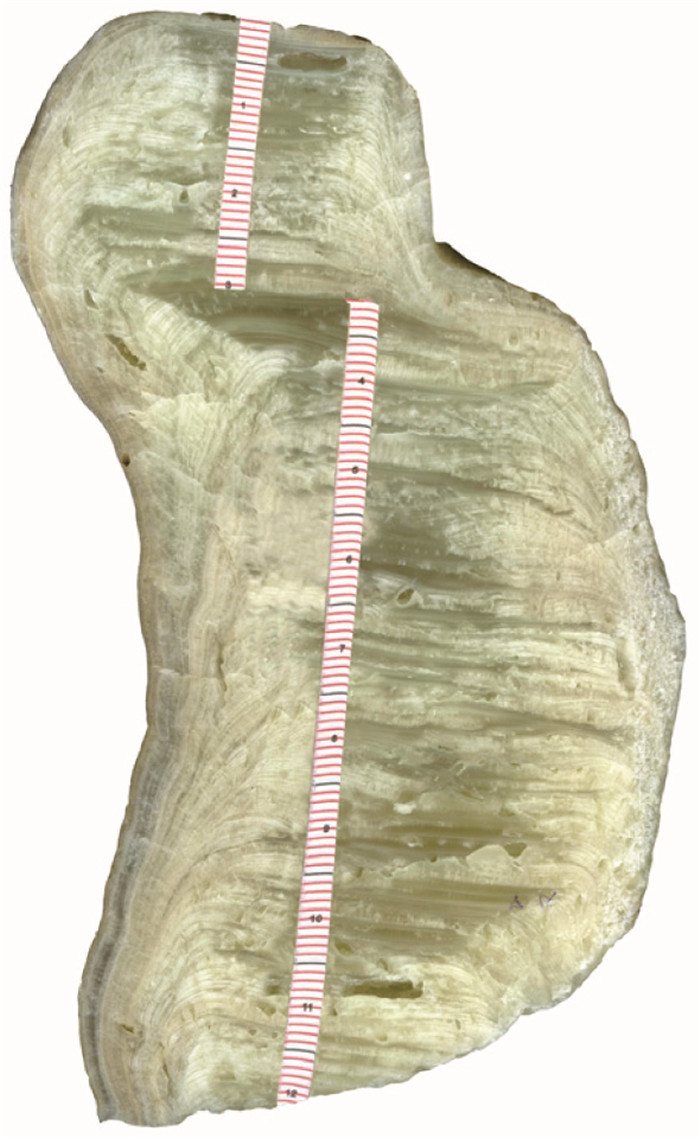
1 研究区域、材料与方法本文所用石笋(编号YX275)采自于湖北省神农架保康县歇马镇的永兴洞(31°35′N,111°14′E;见图 1),处于东亚季风系统控制下的长江中游地区[17]。该区域气候属于亚热带湿润气候,年均温约8℃,年均降水量为1500~2000mm,其中50 %以上降水集中在夏季(6~8月),冬季(12~2月)降水量较少,仅占全年降水量的5 %。该区岩溶分布广泛,以碳酸盐类岩石为主[18],洞穴上覆厚约50m的志留纪灰岩,土壤发育,植被繁盛,以多年生木本植物和灌木丛草本植物为主。洞口海拔约800m,洞长约500m。由于洞口狭窄,洞内外空气交流不畅,洞内月均温度为14℃左右,相对湿度接近100 %。YX275石笋外形呈圆柱状,总长120mm,外部直径35~55mm。沿生长轴切开并抛光,发现近轴部透明而近边缘区多呈淡黄白色,大部分层段发育有纹层,质地致密(图 2)。

|
图 1 湖北永兴洞与其他洞穴地理位置示意图 Fig. 1 Locations of the Yongxing Cave and other sites mentioned in the paper |
|
图 2 永兴洞YX275石笋抛光面照片 Fig. 2 Polished surface of stalagmite YX275 from Yongxing Cave |
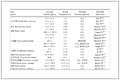
在石笋抛光面上,沿着生长轴用直径为0.9mm牙钻分别从距顶4mm、24mm、41mm、60mm、82mm、96mm和107mm处获取7个铀系年代样(单个样品重约55~60mg),由南京师范大学同位素质谱实验室MC-ICP-MS Neptune型电离质谱仪测试,化学实验方法参照Shen等[19]和Shao等[20],年龄误差为±2σ(表 1)。用直径0.5mm钻头沿生长中心轴方向每1mm钻取一个样品(重约30μg),共获得120组氧碳同位素数据。利用碳酸盐自动进样装置与FinniganMAT-253型质谱仪联机完成测试,分析误差小于0.06 ‰ (±1σ),VPDB标准,由南京师范大学同位素质谱实验室完成。
|
表 1 永兴洞YX275石笋230Th测年结果* Table 1 U-series dating results of stalagmite YX275 in Yongxing Cave |
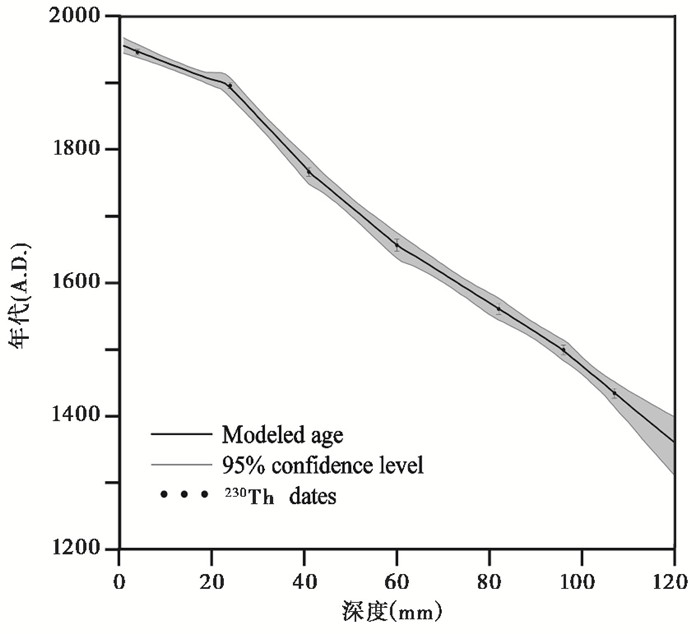
表 1为YX275石笋的U/Th年龄同位素数据和年代结果。样品238U含量在523×10-9~648×10-9之间变化,232Th含量在166×10-12~594×10-12之间变化。较高的238U及相对较低232 Th含量,提高了绝对年龄的测年精度,误差仅为4~9a(相对误差为1 % ~6 %)。年龄结果显示,YX275石笋生长覆盖的时段为15到20世纪。本文采用MOD-AGE模型建立年龄时标[21](图 3)。该模式依据实测U系及深度数据等的正态分布对模型年龄和深度值进行Monte-Carlo模拟。年龄-深度变化曲线(图 3)显示,YX275石笋生长于1361~1955A.D.时段,对应于小冰期时期。此外,基于7个230 Th年龄和其对应的深度建立该石笋生长速率曲线,发现在石笋发育期间,生长速率在131~397μm/a之间变化,平均生长速率为222μm/a。
|
图 3 石笋YX275年龄模式图 黑点及垂直误差棒分别为实测年龄及对应2σ误差;中间线为年龄模式,两侧线为95 %置信度范围 Fig. 3 Age model of stalagmite YX275.The black dot and vertical bar indicate 230 Th ages and errors, respectively. The middle solid line denotes the modeled age frame. The gray shading indicates 95 % confidence level |
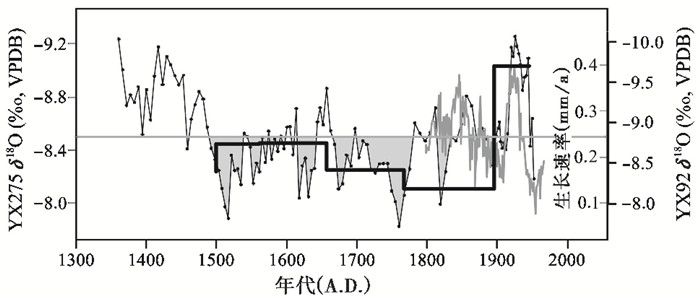
图 4显示了YX275石笋δ18O的变化过程。δ18O在-7.8 ‰ ~-9.3 ‰范围内波动,平均值为-8.5 ‰,平均分辨率约为5a。在1361~1517A.D.时段,δ18O逐渐正偏;在1517~1912A.D.时段,δ18O相对偏正,70 %以上的值高于平均值;在1912~1944A.D.,δ18O逐步偏负,达到整个时段最负值;在1944~1955A.D.的数十年间,δ18O快速正偏。整体上,整个曲线呈“U”形,在此大趋势上叠加了百年-数十年尺度的振荡。
|
图 4 石笋YX275δ18O(黑点实线)与其生长速率(黑实线)、YX92δ18O记录[22](灰实线)对比 灰色水平线指示YX275石笋δ18O的平均值(-8.5 ‰),灰色阴影部分指示δ18O高于平均值的部分 Fig. 4 Comparison of the YX275δ18O record(black line with dots)with its growth rate(black line)and the YX92δ18O record[22](gray line).The gray horizontal indicates the average value of YX275δ18O. The gray shading marks theδ18O values larger than the average |
石笋YX275的δ18O值未发生明显动力分馏。同一区域不同石笋δ18O记录具有重现性意味着非气候因素对同位素值的变化影响较小,其变化主要受相同的外部气候环境因子控制[23]。将YX275与同一洞穴YX92的δ18O记录[22]进行对比(图 4),发现二者在整体趋势、变幅以及十年际尺度波动的持续时间上均呈现出一致的变化特征。如二者在约1920A.D.时,均显示出显著的负偏波动,且持续时间接近,均为约30a。此重复性检验表明石笋YX275δ18O的变化主要记录了气候变化。
目前东亚季风区石笋δ18O所指示的气候意义仍存在争议[24~29],其完整的理解还需更多数据的累积和分析。本文基于以下考虑,认为YX275石笋δ18O指示东亚夏季风降水量变化。YX275石笋δ18O记录与其生长速率变化的一致性,指向了石笋δ18O反映了东亚夏季风降水量的变化。如图 4所示,石笋YX275的生长速率在δ18O整体偏正的1517~1912A.D.时段较低,平均为186μm/a,而在1912~1944A.D.δ18O偏负的时期生长速率较快,达到397μm/a。这二者的负对应关系在其他区域如南阿曼石笋[30~31]、董哥洞石笋[15]及北美西部石笋记录中[32]等均有体现,表明石笋δ18O信号在区域气候中的体现。永兴洞石笋沉积速率受渗水量(大致响应于局地降水量)影响显著;该洞现代滴水监测显示洞穴滴水快速响应于季节性降水变化,夏季的滴水速率明显高于冬季,并且夏季碳酸盐沉积量也显著多于冬季[33]。在洞穴滴水与大气降水δ18O变化方面,5个滴水点在连续监测的2014年10月~2016年9月之间的滴水δ18O平均值(-8.4 ‰)与湿季(5~9月)降水δ18O平均值(-8.3 ‰)极为一致,反映滴水δ18O主要继承了湿季降水的δ18O信号,因此,在同位素分馏平衡的前提下,永兴洞石笋δ18O可用来解释湿季降水δ18O值变化[33]。监测数据还显示,降水δ18O值与降水量总体上呈负相关,在夏季降水量较大时,δ18O明显偏负(-8.4 ‰),而在冬季降水量较少时,δ18O相对偏正(-5 ‰)[33]。由此分析,夏季风带来的降水量变化是影响永兴洞石笋氧同位素组成的主要因素,一般来说,降水量较多时,δ18O偏负,反之则偏正。尽管不能排除水汽源的变化对δ18O的影响[27],但是YX275石笋δ18O与生长速率的对应变化突出了季风降水对石笋δ18O的主要贡献。
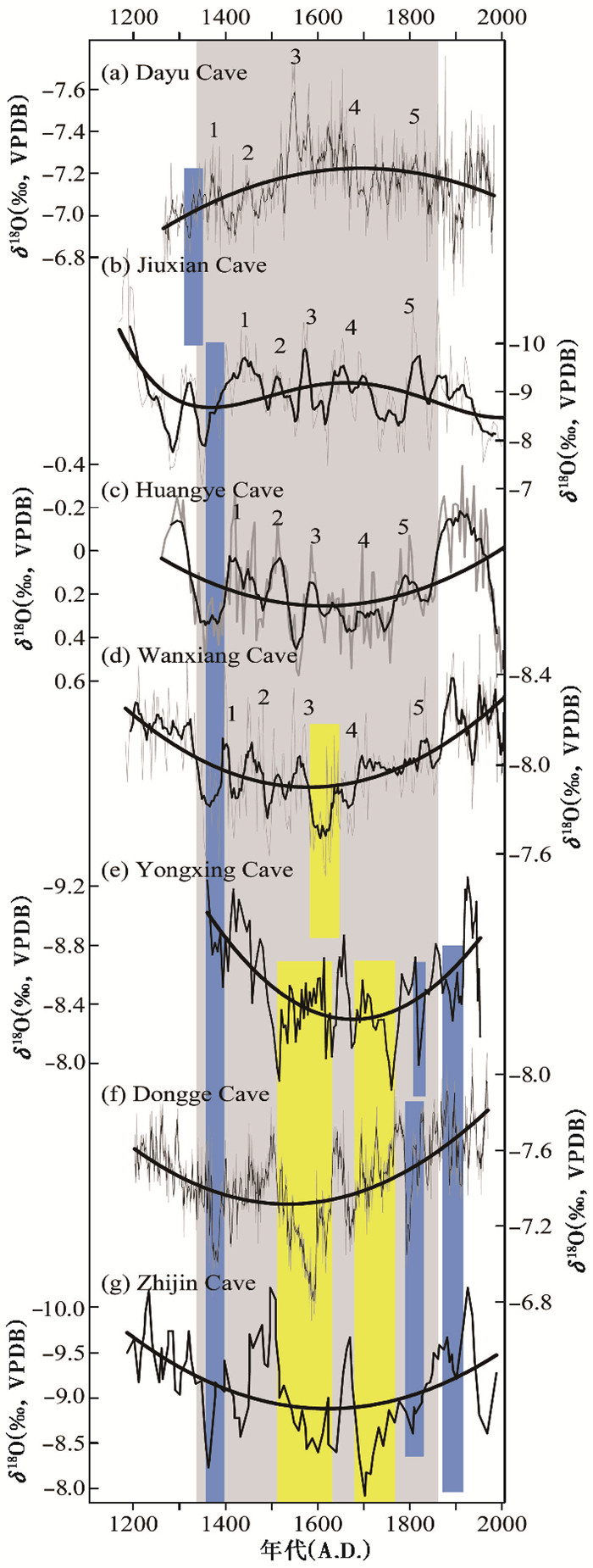
3 讨论 3.1 洞穴石笋记录的小冰期气候变化高精度定年的石笋YX275δ18O记录显示小冰期时东亚夏季风降水显著减小。在1360~1517A.D.时段,δ18O值快速正偏,对应于小冰期开始时东亚夏季风降水迅速减弱的变化;在1517~1912A.D.δ18O整体维持在最正偏状态,对应于小冰期时东亚夏季风水文循环的显著减弱期;1912A.D.之后δ18O值快速负偏,指示了小冰期结束时东亚夏季风降水快速增强。东亚夏季风区其他记录也记录到小冰期季风水文循环减弱的变化。如图 5,位于季风进退敏感的季风边缘区的陕西九仙洞(33°34′N,109°6′E)[34]、甘肃黄爷洞(33°35′N,105°07′E)[14]和万象洞石笋(33°19′N,105°00′E) [13]的δ18O记录均清晰地显示了季风水文循环显著减弱的变化。在这3个洞穴记录中,稍有差别的是九仙洞石笋记录在小冰期结束时未呈现出季风水文循环增强的变化。值得注意的是,此区域的大鱼洞(33°08′N,106°18′E)石笋δ18O记录呈现出小冰期时季风降水量增强的变化特征[7, 35],这一差异是否与该洞所在的海拔高度显著低于其他3个洞穴海拔而引起降水分布的差异有关(大鱼洞海拔高度870m,万象洞、黄爷洞和九仙洞海拔高度分别为1200m、1650m和1495m),还需要进一步证实。除这些北方的洞穴记录外,山西公海湖泊沉积物磁学参数[36]、北方夏季降水(5~9月平均降水)的数字模拟结果[37]均显示小冰期时东亚季风水循环减弱的变化。相同的季风水循环减弱变化也显示在中国南方区域,如贵州的董哥洞(25°17′N,108°05′E) [15]、织金洞石笋(26°38′~26°52′N,105°44′~106°11′E)[38]的δ18O记录均显示出小冰期时夏季风降水减弱的特征。在小冰期,以上石笋δ18O记录均呈现“下凹型”的整体变化(图 5,多项式拟合的粗实线),提供了中国从北到南在百年尺度上部分记录小冰期时季风水循环减弱变化的证据,暗示小冰期时东亚夏季风水循环发生明显变化。但是,也有学者认为在东亚季风区石笋记录的小冰期气候特征呈相反状态[10, 16],样品分辨率、年代的不确定性、地形因素、局域气候差异等因素可能是导致小冰期不同认识的主要原因。不同区域的洞穴对各气候环境因子响应的差异性也增加了对比的复杂性。
|
图 5 小冰期时不同洞穴石笋δ18O记录对比 (a)和(b)为陕西大鱼洞[7, 35]和九仙洞石笋[34]δ18O记录,(c)和(d)分别为甘肃东部黄爷洞[14]和万象洞石笋[13]δ18O记录,(e)湖北省永兴洞YX275石笋δ18O记录,(f)和(g)分别为贵州董哥洞DX1[15]和织金洞石笋[38]δ18O记录;黑色粗实线为各石笋记录的多项式拟合结果;蓝色和黄色阴影部分为石笋记录的小冰期内5次季风降水减弱事件;数字1~5为北方石笋记录的小冰期内5次气候振荡旋回 Fig. 5 Comparison of different stalagmiteδ18O records from multiple caves in East Asian monsoon region.(a)and(b)Speleothemδ18O records from Dayu[7, 35] and Jiuxian[34] caves from Shaanxi Province; (c)and(d) Stalagmiteδ18O records from Huangye[14] and Wanxiang[13] caves, eastern Gansu Province; (e)YX275δ18O record(this study); (f) and(g) Stalagmiteδ18O records from Dongge[15] and Zhijin[38] caves in Guizhou Province, respectively. The thick black line is the polynomial fitting result. Blue and yellow shadows indicate the five weak monsoon precipitation episodes during the Little Ice Age. The numbers(1~5)are five climate oscillation cycles recorded by stalagmites from the Northern China |
需要指出的是,以上记录因定年精度、分辨率及局地气候等差异在小冰期持续时间上存在一定差异。定年相对精准、平均分辨率达5年的永兴洞石笋的δ18O记录显示湖北小冰期发生于1360~1944A.D.,持续时间达580年;而其他大鱼洞、九仙洞、万象洞、董哥洞、织金洞石笋记录中小冰期持续时间略长,达600~700年。小冰期气候变化研究综述中提到的小冰期约发生在1400~1900A.D.,持续时间约500年[39],与永兴洞记录较为接近。
高分辨率的永兴洞石笋记录刻画了湖北小冰期内部百年-数十年尺度的气候振荡特征。YX275石笋δ18O显示小冰期从开始到结束存在2次持续时间较长(百年)和3次持续较短的季风降水减弱事件。约从1480A.D.开始,YX275δ18O在<40年内从-8.8 ‰增加至-7.8 ‰,之后一直维持在一个较高水平(高于平均值),到1630A.D.时在<30年内从-8.0 ‰减少至-8.9 ‰,这次规模较大的弱季风降水事件持续约150年。其中,在1613~1643A.D.期间发生的次级季风降水减弱波动,对应于1638~1641A.D.中国东部大范围显著干旱的气候[40]。此严重干旱事件在一定程度上可能造成了明朝末期农业经济衰退,导致农民起义,从而加速了明朝灭亡[13, 15, 40~42]。在1480~1630A.D.期间,贵州董哥洞[15]和织金洞石笋[38]δ18O记录也显示出相似的持续时间达百年的显著季风降水减弱变化,表明此时期中国湖北和贵州的季风降水在百年-数十年尺度上同步减弱变化。另外一次持续时间达百年的季风降水减弱变化发生在1660~1780A.D.。织金洞石笋δ18O记录显示出波幅达1.5 ‰的正偏振荡,相对来说董哥洞石笋δ18O正偏的程度较小,约0.5 ‰,弱于前一次百年尺度弱季风降水事件。尽管如此,永兴洞石笋、董哥洞石笋和织金洞石笋记录均呈现出季风降水减弱的振荡特征。不同的是,北方的大鱼洞、九仙洞、黄爷洞和万象洞记录在小冰期内部这种百年尺度季风降水减弱的变化则不太显著(图 5)。中国南北方石笋记录在小冰期内部百年尺度的气候差异表明小冰期气候在中国的复杂性。印度-太平洋暖池的海表温度记录[43~45]显示此时期平均海表温度下降达0.5℃,可能是我国南方小冰期内部这一百年尺度季风降水减弱变化的一个重要原因。中国南北部百年尺度的气候差异也发生在中世纪暖期。Liu等[36]发现中世纪暖期内部并不稳定,存在一个明显的百年尺度气候事件。这一事件在北部表现为干旱状态,而在南部呈现为湿润的状态。这一南涝北旱的配置与现代季风降水分布一致,Liu等[36]提出印度-太平洋暖池海温负异常是造成中世纪暖期内部(1000~1100A.D.)这一百年尺度事件发生的潜在原因。而本研究中我国南部小冰期内部的夏季风降水减弱变化在北部区域的对应表现并不太显著,此响应上的差异是否与中世纪暖期和小冰期气候边界背景不同有关还需要今后进一步研究。
小冰期内3次持续时间较短的季风水循环减弱波动分别发生在约1370A. D.、1820A. D.和1890A. D.。发生在1370A.D.左右的季风降水减弱振荡在时间上大致对应于万象洞石笋记录的“元末弱季风时期”(1350~1380A.D.),此外,其他洞穴如大鱼洞、九仙洞、黄爷洞、董哥洞和织金洞记录均清晰地记录了这一季风水循环减弱波动。Sinha等[46]通过综合分析亚洲季风区石笋、海洋、树轮记录,指出此时期亚洲季风显著减弱,造成区域严重干旱。以1820A.D.为中心(1811~1833A.D.)的季风水循环减弱振荡在定年误差范围内与董哥洞石笋记录的1785~1805A.D.弱季风降水事件相对应,且二者持续时间也较为一致,均约20年。织金洞记录[38]尽管分辨率较低,但也显示出对应的季风降水减弱特征。此外,四川黑竹沟洞石笋[47]、阿曼石笋[48]、达索普冰芯[49]以及亚洲树轮[50]记录中对这一波动均有体现,可能与18世纪后期的强厄尔尼诺事件有关[51]。发生在1890A.D.前后的夏季风降水减弱变化是小冰期结束前的最后一次波动。尽管此时期YX275石笋δ18O仅呈现约0.5 ‰正偏,在变幅上弱于1820A.D.时的波动,但是同一洞穴的YX92石笋记录呈现出清晰的1 ‰正偏(图 4),同时董哥洞和织金洞石笋δ18O也呈现出一定幅度的正偏,表明此次夏季风水循环减弱信号是区域性的气候特征。
上述石笋记录对比结果表明在百年尺度上中国南北部小冰期大致呈现出一致的季风降水减弱特征,但在数十年尺度上存在区域差异。湖北永兴洞、贵州董哥洞和织金洞石笋δ18O记录均呈现出5次相对应的夏季风降水减弱事件(图 5黄色和蓝色阴影部分)。在这些事件中,中国北部石笋记录,仅对1370A.D.前后的元末弱季风降水事件表现显著,而其他4次事件的表现不太显著。有趣的是,北部大鱼洞、九仙洞、黄爷洞和万象洞石笋δ18O记录在小冰期内部的波动特征相对一致,均存在5次数十年尺度的水文振荡旋回,呈现了北部小冰期内部气候的不稳定特征。中国南北部记录在小冰期内部的差异可归因于区域气候的不对等性。例如,万象洞石笋δ18O记录与陇西(万象洞以北约150km)历史文献重建的干/湿指数[52]变化一致,同时与邻近的武都气象站点近50年来降水量变化的相关性较高(r=-0.64)[13];织金洞石笋δ18O记录与贵阳历史时期干/湿指数(现代降水记录已校准)的变化相一致[38]。但是,陇西[52]与贵阳历史时期干/湿指数[53~54]在数十年尺度上并不一致,且武都与贵阳两气象站点近50年降水资料的统计分析也显示出全年和夏季降水存在着一定差异[13, 53~54]。鉴于此,上述不同洞穴记录在短时间尺度的差异在一定程度上可能反映了东亚夏季风降水变化的区域分布特征。
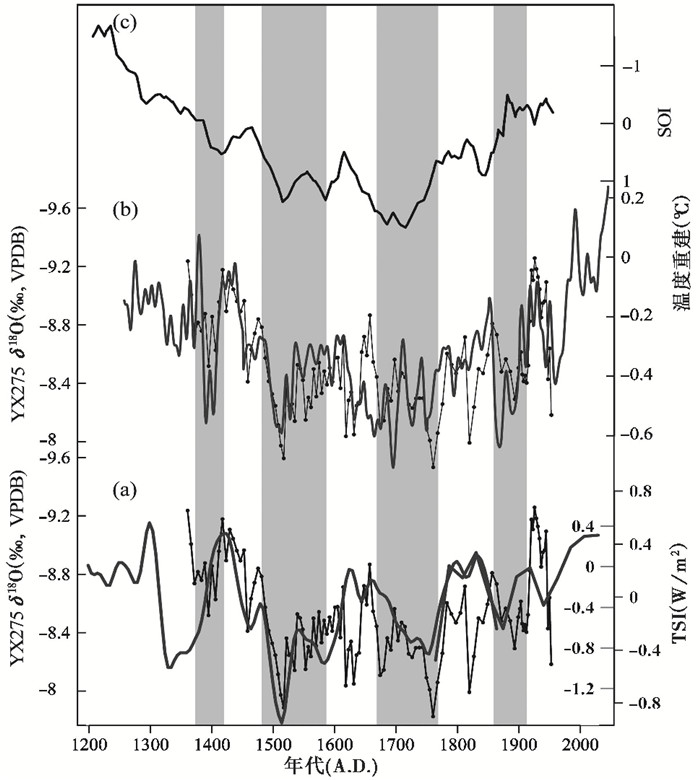
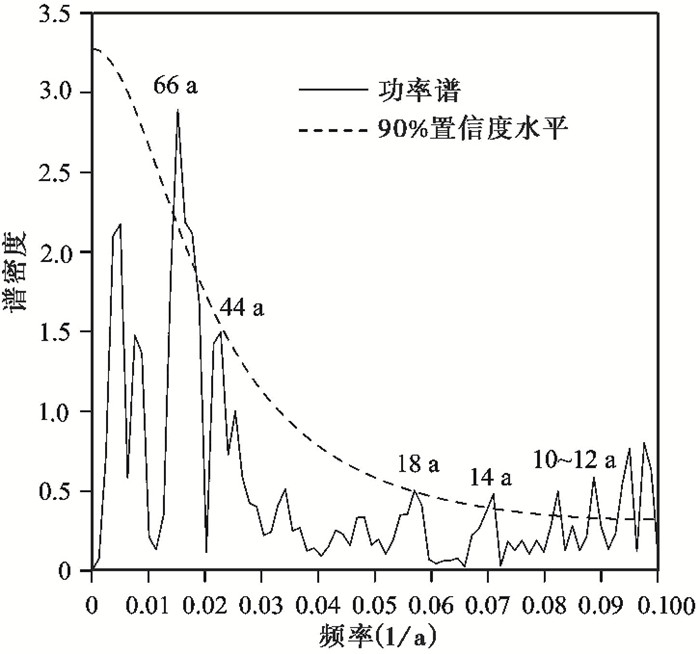
3.2 小冰期季风变化机制分析众多研究表明太阳活动是全新世亚洲季风气候变化的主要驱动因子[12~13, 55]。如Zhang等[13]利用甘肃万象洞石笋δ18O记录与太阳活动指标对比研究,发现二者具有较好的相关性。本文将永兴洞石笋δ18O记录与太阳总辐照度(TSI)[56~57]进行对比(图 6),结果显示在1370A. D.前后、1480~1641A.D.、1660~1780A.D.以及1890A.D.前后的δ18O值的正偏变化,可能依次对应于太阳活动的Wolf Minimum(1270~1350A.D.)、Spörer Minimum(1420~1570A.D.)、Maunder Minimum(1645~1715A.D.)和Dalton Minimum(1790~1820A.D.)。在发生时间上,永兴洞石笋记录的时标略滞后于太阳总辐照度(约50年),这是否与热带印度-太平洋海表温度对太阳总辐照度变化的响应时间有关还需进一步研究。但是,石笋曲线与太阳总辐照度在百年-数十年尺度的一致变化似乎证实了太阳活动对小冰期时季风降水减弱变化的重要驱动作用。YX275石笋δ18O序列的功率谱分析结果进一步支持了太阳总辐照度的驱动作用。如图 7所示,石笋δ18O存在约66a、44a、18a和10~14a的变化周期(置信度超过90 %),除44a周期外,其余周期接近于太阳活动的68a、22a海尔周期和11a黑子活动周期[60]。模拟结果显示小冰期时全球季风减弱,此变化可归因于太阳辐照度减少[37]。陆地比热容显著小于海洋比热容,太阳总辐照度减少会降低陆地-海洋热对比,从而降低海陆间压力差,引起季风水循环减弱的变化。
|
图 6 永兴洞YX275石笋δ18O记录(a和b,点状黑实线)与太阳总辐照度(TSI)记录[56~57](a,深灰色)、北半球温度记录[58](b,深灰色)以及南方涛动指数(SOI)记录[59](c)对比 灰色阴影部分指示4次弱季风水循环期与TSI降低和北半球降温变化相一致 Fig. 6 Comparison of the YX275 record(a and b, black lines with dots), total solar irradiance[56~57](a, dark gray), Northern Hemisphere temperature[58](b, dark gray), and the Southern Oscillation Index[59](c).The gray shadows indicate four weak hydro-climatic variability episodes, which correspond to the decreased TSI and the lower temperature in the Northern Hemisphere |
|
图 7 YX275石笋δ18O功率谱分析结果 虚线为90%置信度水平 Fig. 7 Power spectral analysis of the YX275δ18O data.The dot line indicates the 90 % confidence level |
早期研究表明全新世亚洲季风变化在百年尺度上与北高纬气候联系紧密[12]。为进一步研究东亚季风水循环与地表温度间的耦合关系,将永兴洞石笋δ18O记录与北半球温度序列[58]进行对比(图 6)。如将永兴洞石笋记录的时标系统向老移动约50年,发现在百年尺度上小冰期时的季风水循环减弱变化与北半球降温相一致,甚至在十年尺度波动上二者也表现出一定的对应关系。例如发生在1500A.D.和1700A.D.前后的十年尺度的振荡在这两个记录中的变化一致。此外,二者之间较高的相关系数(r=-0.45,n=100,P<0.05)也进一步证实这种紧密耦合特征。值得一提的是,北半球温度与太阳辐照度的变化也极为一致,如小冰期内部4次太阳辐照度极小值,均与北半球降温相一致。因此,太阳总辐照度是北半球温度和东亚夏季风变化的根本驱动因子。北半球温度的变化也可对东亚季风强度有一定影响,通过影响大气中的水汽含量和季风系统进入内陆的程度进而影响着东亚的水循环[37]。
厄尔尼诺-南方涛动(El Niño-Southern Oscillation,简称ENSO)对东亚季风变化起着重要调节作用[61]。如图 6所示,石笋YX275δ18O记录与南方涛动指数(Southern Oscillation Index,简称SOI)[59]在百年-数十年尺度上的波动较为相似。小冰期SOI呈正值,指示太平洋沃克环流(Pacific Walker Circulation,简称PWC)强盛,呈类La Niña态,对应于东亚夏季风的减弱期(高石笋δ18O值),这种对应关系指示了PWC和东亚夏季风的密切联系。东亚夏季风与PWC的耦合变化可能与哈德利环流(Hadley Circulation)和西北太平洋副高的变化相关[61~62]。如在El Niño(PWC变弱)成熟期之后的夏季,亚洲东北部出现阻塞高压,同时西北太平洋副热带高压向西延伸,促使东亚夏季风加强[61]。
4 结论基于7个绝对定年的230 Th年代和平均分辨率达5a的δ18O数据,永兴洞长120mm的YX275石笋提供了1361~1955A.D.时段的东亚夏季风降水变化记录。该石笋δ18O在-7.8 ‰ ~-9.3 ‰范围内波动,平均值为-8.5 ‰,整体呈现出先缓慢增大后减小的长期趋势变化特征。其中,在1517~1912A.D.时段,δ18O整体维持在最正偏状态,70 %以上的值高于平均值,指示了小冰期时东亚夏季风水文循环的显著减弱变化。该记录与中国其他区域石笋δ18O记录变化大致一致,指示小冰期发生时东亚夏季风水循环发生明显变化。永兴洞石笋δ18O记录的小冰期内部存在2次百年尺度(1480~1630A. D.和1660~1780A.D.)和3次数十年尺度(约1370A. D.、1820A. D.和1890A. D.)的季风降水减弱事件。这5次显著季风降水减弱事件与南方贵州董哥洞和织金洞石笋记录变化一致,然而不同于北方大鱼洞、九仙洞、黄爷洞和万象洞石笋记录中的5次季风数十年尺度的小幅度旋回特征,表明小冰期时中国南北部夏季风降水在短时间尺度上可能存在着区域差异。
在百年-数十年尺度上,永兴洞石笋δ18O与TSI记录、北半球温度记录在长期趋势和变化幅度上均较为一致,除过发生在约1820A.D.时的季风降水减弱事件外,其余4次季风降水减弱事件均与TSI极小值和北半球温度降低相对应。这些对应关系说明太阳总辐照度和北半球温度变化对东亚夏季风水文变化有重要驱动作用。永兴洞石笋δ18O序列的功率谱分析结果显示存在约66a、44a、18a和10~14a的变化周期,除44a周期外,其余周期均接近于太阳活动周期,进一步支持小冰期时季风短尺度水文循环变化受太阳活动控制。
致谢: 感谢审稿专家和编辑部杨美芳老师提出的建设性修改意见,使论文得以完善。
| [1] |
Soon W, Baliunas S. Proxy climatic and environmental changes of the past 1000 years[J]. Energy & Environment, 2003, 23(2): 233-296. |
| [2] |
Miller G H, Alley R B, et al. Temperature and precipitation history of the Arctic[J]. Quaternary Science Reviews, 2010, 29(15): 1679-1715. |
| [3] |
Bradley R S, Jones P D. "Little Ice Age" summer temperature variations:Their nature and relevance to recent global warming trends[J]. The Holocene, 1993, 3(4): 367-376. DOI:10.1177/095968369300300409 |
| [4] |
王绍武, 叶瑾琳, 龚道溢. 中国小冰期的气候[J]. 第四纪研究, 1998(1): 54-64. Wang Shaowu, Ye Jinlin, Gong Daoyi. Climate in China during the Little Ice Age[J]. Quaternary Sciences, 1998(1): 54-64. DOI:10.3321/j.issn:1001-7410.1998.01.007 |
| [5] |
Kreutz K J, Mayewski P A, Meeker L D, et al. Bipolar changes in atmospheric circulation during the Little Ice Age[J]. Science, 1997, 277(5330): 1294-1296. DOI:10.1126/science.277.5330.1294 |
| [6] |
Chen F H, Chen J H, Holmes J, et al. Moisture changes over the last millennium in arid Central Asia:A review, synthesis and comparison with monsoon region[J]. Quaternary Science Reviews, 2010, 29(7): 1055-1068. |
| [7] |
Tan L C, Cai Y J, Cheng H, et al. Summer monsoon precipitation variations in Central China over the past 750 years derived from a high-resolution absolute-dated stalagmite[J]. Palaeogeography, Palaeoclimatology, Palaeoecology, 2009, 280(3-4): 432-439. DOI:10.1016/j.palaeo.2009.06.030 |
| [8] |
Chen J H, Chen F H, Feng S, et al. Hydroclimatic changes in China and surroundings during the Medieval Climate Anomaly and Little Ice Age:Spatial patterns and possible mechanisms[J]. Quaternary Science Reviews, 2015, 107: 98-111. DOI:10.1016/j.quascirev.2014.10.012 |
| [9] |
Xu H, Lan J, Sheng E, et al. Hydroclimatic contrasts over Asian monsoon areas and linkages to tropical Pacific SSTs[J]. Scientific Reports, 2016, 6: 33177. DOI:10.1038/srep33177 |
| [10] |
Liang F, Brook G A, Kotlia B S, et al. Panigarh cave stalagmite evidence of climate change in the Indian Central Himalaya since AD 1256:Monsoon breaks and winter southern jet depressions[J]. Quaternary Science Reviews, 2015, 124: 145-161. DOI:10.1016/j.quascirev.2015.07.017 |
| [11] |
Tan M, Liu T S, Hou J Z, et al. Cyclic rapid warming on centennial-scale revealed by a 2650-year stalagmite record of warm season temperature[J]. Geophysical Research Letters, 2003, 30(12): 1617. |
| [12] |
Wang Y J, Cheng H, Edwards R L, et al. The Holocene Asian monsoon:Links to solar changes and North Atlantic climate[J]. Science, 2005, 308(5723): 854-857. DOI:10.1126/science.1106296 |
| [13] |
Zhang P Z, Cheng H, Edwards R L, et al. A test of climate, sun, and culture relationships from an 1810-year Chinese cave record[J]. Science, 2008, 322(5903): 940-942. DOI:10.1126/science.1163965 |
| [14] |
Tan L C, Cai Y J, An Z S, et al. Centennial-to decadal-scale monsoon precipitation variability in the semi-humid region, Northern China during the last 1860 years:Records from stalagmites in Huangye Cave[J]. The Holocene, 2011, 21(2): 287-296. DOI:10.1177/0959683610378880 |
| [15] |
Zhao K, Wang Y J, Edwards R L, et al. A high-resolved record of the Asian Summer Monsoon from Dongge Cave, China for the past 1200 years[J]. Quaternary Science Reviews, 2015, 122(15): 250-257. |
| [16] |
Tan L C, Cai Y J, Cheng H, et al. Centennial-to decadal-scale monsoon precipitation variations in the upper Hanjiang River region, China over the past 6650 years[J]. Earth and Planetary Science Letters, 2018, 482: 580-590. DOI:10.1016/j.epsl.2017.11.044 |
| [17] |
Wang B, Lin H. Rainy season of the Asian-Pacific summer monsoon[J]. Journal of Climate, 2002, 15(4): 386-396. DOI:10.1175/1520-0442(2002)015<0386:RSOTAP>2.0.CO;2 |
| [18] |
Du Q D, Wang Z J, Wang J, et al. Geochronology and geochemistry of tuff beds from the Shicaohe Formation of Shennongjia Group and tectonic evolution in the northern Yangtze Block, South China[J]. International Journal of Earth Sciences, 2016, 105(2): 521-535. DOI:10.1007/s00531-015-1182-2 |
| [19] |
Shen C C, Edwards R L, Cheng H, et al. Uranium and thorium isotopic concentration measurements by magnetic sector inductively coupled plasma massspectrometry[J]. Chemical Geology, 2002, 185(3): 165-178. |
| [20] |
Shao Q F, Bahain J J, Wang W, et al. Coupled ESR and U-series dating of Early Pleistocene Gigantopithecus faunas at Mohui and Sanhe caves, Guangxi, Southern China[J]. Quaternary Geochronology, 2015, 30(B): 524-528. |
| [21] |
Hercman H, Pawlak J. MOD-AGE:An age-depth model construction algorithm[J]. Quaternary Geochronology, 2012, 12(12): 1-10. |
| [22] |
赵侃, 陈仕涛, 崔英方, 等. 神农架石笋记录的近200年东亚季风变化及其ENSO响应[J]. 地理研究, 2015, 34(1): 74-84. Zhao Kan, Chen Shitao, Cui Yingfang, et al. East Asian monsoon changes and its ENSO response revealed by a 200-year stalagmite record from Yongxing Cave on the Mountain Shennongjia[J]. Geographical Research, 2015, 34(1): 74-84. |
| [23] |
Dorale J A, Liu Z H. Limitations of Hendy test criteria in judging the paleoclimatic suitability of speleothems and the need for replication[J]. Journal of Cave and Karst Studies, 2009, 71(1): 73-80. |
| [24] |
Wang Y J, Cheng H, Edwards R L, et al. A high-resolution absolute-dated Late Pleistocene monsoon record from Hulu Cave, China[J]. Science, 2001, 294(5550): 2345-2348. DOI:10.1126/science.1064618 |
| [25] |
Cheng H, Sinha A, Wang X F, et al. The global Paleo-monsoon as seen through speleothem records from Asia and the Americas[J]. Climate Dynamics, 2012, 39(5): 1045-1062. DOI:10.1007/s00382-012-1363-7 |
| [26] |
汪永进, 刘殿兵. 亚洲古季风变率和机制的洞穴石笋档案[J]. 科学通报, 2016, 61(9): 938-951. Wang Yongjin, Liu Dianbing. Speleothem records of Asian paleomonsoon variability and mechanisms[J]. Chinese Science Bulletin, 2016, 61(9): 938-951. |
| [27] |
Pausata F S, Battisti D S, Nisancioglu K H, et al. Chinese stalagmite δ18O controlled by changes in the Indian monsoon during a simulated Heinrich event[J]. Nature Geoscience, 2011, 4(7): 474-480. DOI:10.1038/ngeo1169 |
| [28] |
谭明. 环流效应:中国季风区石笋氧同位素短尺度变化的气候意义——古气候记录与现代气候研究的一次对话[J]. 第四纪研究, 2009, 29(5): 851-862. Tan Ming. Circulation effect:Climatic significance of the short term variability of the oxygen isotopes from monsoonal China-Dialogue between paleoclimate records and modern climate research[J]. Quaternary Sciences, 2009, 29(5): 851-862. DOI:10.3969/j.issn.1001-7410.2009.05.01 |
| [29] |
张键, 李廷勇. "雨量效应"与"环流效应":近1 ka亚澳季风区石笋和大气降水δ18O的气候意义[J]. 第四纪研究, 2018, 38(6): 1532-1544. Zhang Jian, Li Tingyong. "Amount effect" vs."Circulation effect":The climate significance of precipitation and stalagmite δ18O in the Asian-Australian monsoon region over the past 1 ka[J]. Quaternary Sciences, 2018, 38(6): 1532-1544. |
| [30] |
Burns S J, Fleitmann D, Mudelsee M, et al. A 780-year annually resolved record of Indian Ocean monsoon variation from a speleothem from South Oman[J]. Journal of Geophysical Research, 2002, 107(D20): ACL-9. |
| [31] |
Fleitmann D, Burns S J, Neff U, et al. Palaeoclimatic interpretation of high-resolution oxygen isotope profiles derived from annually laminated speleothems from Southern Oman[J]. Quaternary Science Reviews, 2004, 23(7-8): 935-945. DOI:10.1016/j.quascirev.2003.06.019 |
| [32] |
Asmerom Y, Polyak V J, Rasmussen J B T, et al. Multi-decadal to multicentury scale collapses of Northern Hemisphere monsoons over the past millennium[J]. Proceedings of the National Academy of Sciences of the United States of America, 2013, 110(24): 9651-9656. DOI:10.1073/pnas.1214870110 |
| [33] |
Wang Q, Wang Y J, Zhao K, et al. The transfer of oxygen isotopic signals from precipitation to drip water and modern calcite on the seasonal time scale in Yongxing Cave, Central China[J]. Environmental Earth Sciences, 2018, 77(12): 474. DOI:10.1007/s12665-018-7607-z |
| [34] |
Cai Y J, Tan L C, Cheng H, et al. The variation of summer monsoon precipitation in Central China since the last deglaciation[J]. Earth and Planetary Science Letters, 2010, 291(1-4): 21-31. DOI:10.1016/j.epsl.2009.12.039 |
| [35] |
Tan L C, Cai Y J, An Z S, et al. A Chinese cave links climate change, social impacts, and human adaptation over the last 500 years[J]. Scientific Report, 2015, 5: 12284. DOI:10.1038/srep12284 |
| [36] |
Liu J B, Chen F H, Chen J H, et al. Weakening of the East Asian summer monsoon at 1000-1100 A.D. within the Medieval Climate Anomaly:Possible linkage to changes in the Indian Ocean-Western Pacific[J]. Journal of Geophysical Research:Atmospheres, 119(5): 2209-2219. DOI:10.1002/2013JD021199 |
| [37] |
Liu J, Kuang X Y, Wang B, et al. Centennial variations of the global monsoon precipitation in the last millennium:Results from ECHO-G model[J]. Journal of Climate, 2009, 22(9): 2356-2371. DOI:10.1175/2008JCLI2353.1 |
| [38] |
Kuo T S, Liu Z Q, Li H C, et al. Climate and environmental changes during the past millennium in central western Guizhou, China as recorded by stalagmite ZJD-21[J]. Journal of Asian Earth Sciences, 2011, 40(6): 1111-1120. DOI:10.1016/j.jseaes.2011.01.001 |
| [39] |
王劲松, 陈发虎, 杨保, 等. 小冰期气候变化研究新进展[J]. 气候变化研究进展, 2006, 2(1): 21-27. Wang Jinsong, Chen Fahu, Yang Bao, et al. New advances in research on the Little Ice Age climate change[J]. Advances in Climate Change Research, 2006, 2(1): 21-27. DOI:10.3969/j.issn.1673-1719.2006.01.004 |
| [40] |
Shen C, Wang W C, Hao Z, et al. Exceptional drought events over Eastern China during the last five centuries[J]. Climatic Change, 2007, 85(3-4): 453-471. DOI:10.1007/s10584-007-9283-y |
| [41] |
Cook E R, Anchukaitis K J, Buckley B M, et al. Asian monsoon failure and megadrought during the last millennium[J]. Science, 2010, 328(5977): 486-489. DOI:10.1126/science.1185188 |
| [42] |
Zheng J Y, Xiao L B, Fang X Q, et al. How climate change impacted the collapse of the Ming Dynasty[J]. Climate Change, 2014, 127(2): 169-182. DOI:10.1007/s10584-014-1244-7 |
| [43] |
Stott L, Cannariato K, Thunell R, et al. Decline of surface temperature and salinity in the western tropical Pacific Ocean in the Holocene epoch[J]. Nature, 2004, 431(7004): 56-59. DOI:10.1038/nature02903 |
| [44] |
Oppo D W, Rosenthal Y, Linsley B K. 2, 000-year-long temperature and hydrology reconstructions from the Indo-Pacific Warm Pool[J]. Nature, 2009, 460(7259): 1113-1116. DOI:10.1038/nature08233 |
| [45] |
Dang H W, Jian Z M, Bassinot F, et al. Decoupled Holocene variability in surface and thermocline water temperatures of the Indo-Pacific Warm Pool[J]. Geophysical Research Letters, 2012, 39(1): L01701. |
| [46] |
Sinha A, Stott L, Berkelhammer M, et al. A global context for megadroughts in monsoon Asia during the past millennium[J]. Quaternary Science Reviews, 2011, 30(1-2): 47-62. DOI:10.1016/j.quascirev.2010.10.005 |
| [47] |
蒋文静, 赵侃, 陈仕涛, 等. 小冰期十年际尺度亚洲季风变化的四川黑竹沟洞石笋记录[J]. 第四纪研究, 2017, 37(1): 118-129. Jiang Wenjing, Zhao Kan, Chen Shitao, et al. Decadal climate oscillations during the Little Ice Age of stalagmite record from Heizhugou Cave, Sichuan[J]. Quaternary Sciences, 2017, 37(1): 118-129. |
| [48] |
Fleitmann D, Burns S J, Neff U, et al. Palaeoclimatic interpretation of high-resolution oxygen isotope profiles derived from annually laminated speleothems from Southern Oman[J]. Quaternary Sciences Reviews, 2004, 23(7-8): 935-945. DOI:10.1016/j.quascirev.2003.06.019 |
| [49] |
Thompson L G, Yao T, Mosley-Thompson E, et al. A high-resolution millennial record of the South Asian monsoon from Himalayan ice cores[J]. Science, 2000, 289(5486): 1916-1919. DOI:10.1126/science.289.5486.1916 |
| [50] |
Cook E R, Anchukaitis K J, Buckley B M, et al. Asian monsoon failure and megadrought during the last millennium[J]. Science, 2010, 328(5977): 486-489. DOI:10.1126/science.1185188 |
| [51] |
Quinn W H. A study of Southern Oscillation-related climatic activity for AD 622-1990 incorporating Nile River flood data[M]//Diaz H F, Markgraf V eds. El Niño, Historical and Palaeoclimatic Aspects of the Southern Oscillation. Cambridge: Cambridge University Press, 1992: 119-149.
|
| [52] |
Tan L C, Cai Y J, Liang Y, et al. Precipitation variations of Longxi, northeast margin of Tibetan Plateau since AD 960 and their relationship with solar activity[J]. Climate of the Past, 2008, 4(1): 9-28. |
| [53] |
中央气象局气象科学研究院. 中国近五百年旱涝分布图集[M]. 北京: 地图出版社, 1981: 1-320. Research Institute of Meteorology, Central Meteorological Administration. Yearly Charts of Dryness/Wetness in China for the Last 500-Year Period[M]. Beijing: SinoMap Press, 1981: 1-320. |
| [54] |
张德二, 李小泉, 梁有叶. 《中国近五百年旱涝分布图集》的再续补(1993-2000年)[J]. 应用气象学报, 2003, 14(3): 379-384. Zhang De'er, Li Xiaoquan, Liang Youye. Continuation(1993-2000)of the yearly charts of dryness/wetness in China for the last 500 years period[J]. Journal of Applied Meteorological Science, 2003, 14(3): 379-384. DOI:10.3969/j.issn.1001-7313.2003.03.015 |
| [55] |
Neff U, Burns S J, Mangini A, et al. Strong coherence between solar variability and the monsoon in Oman between 9 and 6 kyr ago[J]. Nature, 2001, 411(6835): 290-293. DOI:10.1038/35077048 |
| [56] |
Steinhilber F, Beer J, Frohlich C. Total solar irradiance during the Holocene[J]. Geophysical Research Letters, 2009, 36: L19704. DOI:10.1029/2009GL040142 |
| [57] |
Steinhilber F, Abreu J A, Beer J, et al. 9, 400 years of cosmic radiation and solar activity from ice cores and tree rings[J]. Proceedings of the National Academy of Sciences of the United States of America, 2012, 109(16): 5967-5971. DOI:10.1073/pnas.1118965109 |
| [58] |
Mann M E, Zhang Z H, Rutherford S, et al. Global signatures and dynamical origins of the Little Ice Age and medieval climate anomaly[J]. Science, 2009, 326(5957): 1256-1260. DOI:10.1126/science.1177303 |
| [59] |
Yan H, Sun L G, Wang Y H, et al. A record of the Southern Oscillation Index for the past 2, 000 years from precipitation proxies[J]. Nature Geoscience, 2011, 4(9): 611-614. DOI:10.1038/ngeo1231 |
| [60] |
Damon P E, Peristykh A N. Radiocarbon calibration and application to geophysics, solar physics, and astrophysics[J]. Radiocarbon, 2016, 42(1): 137-150. |
| [61] |
Wang Y, Wang B, Oh J. Impact of the preceding El Niño on the East Asian summer atmosphere circulation[J]. Journal of the Meteorological Society of Japan, 2001, 79(1B): 575-588. DOI:10.2151/jmsj.79.575 |
| [62] |
Wang C. Atmospheric circulation cells associated with the El Niño-Southern Oscillation[J]. Journal of Climate, 2002, 15(4): 399-419. DOI:10.1175/1520-0442(2002)015<0399:ACCAWT>2.0.CO;2 |
2 College of Geography Science, Nanjing Normal University, Nanjing 210023, Jiangsu)
Abstract
It is of great importance to know the structure and forcing of the Little Ice Age(LIA) for deciphering the causes of global warming and extreme events over the modern times. Here a high-resolution stalagmite record form Yongxing Cave(31°35'N, 111°14'E; 800 m above sea level) is provided to characterize the hydro-climatic during the LIA.The cave is located in Xiema Town, Mt. Shennongjia, in Hubei Province, Central China. The cave is about 500 m in length, and overlain by about 50 m of Silurian limestone. The vegetation above the cave is dense, primarily covered with perennial woody plants and shrub herbaceous plants. The cave has a narrow entrance, thus the cave relative humidity is close to 100%. The site is dominated by East Asian monsoon. The annual atmospheric temperature is approximately 8℃, and annual precipitation ranges from 1500~2000 mm. More than 50% of the annual precipitation falls in the summer seasons from June to August. Stalagmite YX275 is 120 mm in length, and 35~55 mm in diameter. When halved and polished, the central growth axis shows translucent calcite and the margin displays yellowish white throughout the whole sample.The subsamples, weighing about 30 μg and 60 mg respectively, were obtained along the growth axis for the stable isotope and U/Th date analyses. The measurements for U/Th dating were performed by inductively coupled plasma mass spectrometry(ICP-MS) on a Finnigan-MAT Element at the Isotope Laboratory of Nanjing Normal University and the δ18O data were produced by the MAT-253 mass spectrometer fitted with a Kiel Carbonate Device in that Isotope Laboratory. Precision of δ18O is 0.06 ‰, at the 1-sigma level.We construct the time-series of the East Asian summer monsoon precipitation by using a total of 120 δ18O data and 7 230Th dates. The chronology for the time-series was established using the MOD-AGE model, and it showed that the stalagmite grew from 1361~1955 A.D., spanning the LIA. The YX275 δ18O record ranges from -7.8 ‰ to -9.3 ‰, with an average value of -8.5 ‰, and displays a long-term hollow shape. The higher δ18O values occurred over the LIA, suggesting less summer monsoon precipitation. The less monsoon precipitation inferred from the YX275 record is supported by a large number of cave records from northern and southern China. These cave records consistently indicate that the weak monsoon precipitation during the LIA. Within the LIA, monsoonal fluctuations are recognized on the centennial and multi-decadal scale. A total of five weak precipitation episodes are detected, which are correlated with the Dongge and Zhijin records in Southern China. However, these monsoon precipitation decreases are not mirrored in the Dayu, Jiuxian, Huangye and Wanxiang records in Northern China. The northern records are marked by five low-amplitude monsoon cycles across the LIA. The contrast between the northern and southern records indicates the existence of the inconsistent monsoon precipitation behaviors between different regions on the centennial and multi-decadal scale. Nevertheless, the Yongxing cave record generally shows a similar shape to the total solar irradiance and Northern Hemisphere temperature. These similarities indicate an influence of the solar irradiance and northern temperature on the hydrological cycle in East Asian region during the LIA.