 2019, Vol.39


2 江苏省大规模复杂系统数值模拟重点实验室, 南京师范大学数学科学学院, 江苏 南京 210023;
3 青岛海洋科学与技术试点国家实验室海洋-气候-同位素模拟开放工作室, 山东 青岛 266237;
4 中国科学院地球环境研究所黄土与第四纪地质国家重点实验室, 陕西 西安 710061)
政府间气候变化专门委员会第五次报告(Intergovernmental Panel on Climate Change Fifth Assessment Report,简称IPCC-AR5)进一步确认了近百年全球变暖的事实[1~2]。未来数十年,全球将进一步升温,全球变暖对东亚地区的社会经济的可持续发展已经产生了深刻影响。对于近代全球变暖究竟是历史气候变化的一个自然发展阶段,还是人类活动所致,目前仍存在较大争议[3~5]。由于现代观测资料时间较短,只能给出有限时间内的气候变化背景,并不能揭示现代气候变暖中自然和人为的相对贡献,难以阐明现代暖期的历史地位[6]。全新世作为距今最近的地质年代,其气候变化与人类社会的发展有着密切关系。目前已有的全球和区域重建序列都证明全新世曾出现过大暖期[7~9],其气候环境特征和变化情况,有可能为当今全球增温提供一个历史参照,把全新世大暖期作为未来气候变化的历史相似型,对于预测未来变暖情景下气候变化具有重要科学意义,对于区分人类与自然的作用,促进社会经济的可持续发展具有重要现实意义[10]。
为了更好地理解暖期的成因和历史地位,并对未来气候变化趋势进行科学预估,气候模式的开发与气候模拟研究便应运而生。经过数十年的发展,气候模式已经成为研究过去气候变化机理、预估未来气候变化的重要工具[11~14]。世界气候研究计划(World Climate Research Programme,简称WCRP)组织的耦合模式比较计划(Coupled Model Intercomparison Project,简称CMIP)为研究气候变化机理和预测未来气候变化提供了重要的工具[15]。耦合模式比较计划第五阶段(CMIP5)的试验根据辐射强迫变化而设定了不同的温室气体典型浓度路径(Representative Concentration Pathways,简称RCPs),包括低浓度路径(RCP2.6)、中浓度路径(RCP4.5和RCP6.0)和高浓度路径(RCP8.5)。每种情景都提供了一种受社会经济条件等影响的温室气体排放情景,并给出到2100年相应的辐射强迫值[12, 16~17]。Sillmann等[18]研究表明,RCP8.5情景下温度和降水指数变化明显;Bao[19]研究发现RCP4.5和RCP8.5温室气体排放情景下东亚夏季降水和环流都将增强;张莉等[20]研究发现,在RCP2.6、RCP4.5和RCP8.5温室气体排放情景下全球和中国年平均地表气温均将继续升高,21世纪末的升温幅度随着辐射强迫的增大而增大。
全新世时期地球轨道参数改变所引起的太阳辐射增强[21~23]与现代暖期温室气体增加对气候有着类似的增温效应[24]。Renssen等[25]研究发现全新世大暖期作为最近的一个地质温暖期,可作为未来气候变暖情景下21世纪末期气候变化特征的潜在类比;张冉和刘晓东[26]研究发现东亚地区全新世暖期夏季降水变化在一定程度上可作为未来夏季降水变化的历史相似型,但Renssen等[25]同时也指出全新世大暖期并不具有全球同步性和一致性,使其无法成为全球大多数地区预测未来气候的参考。那么东亚地区作为全球季风气候最为显著的地区之一,全新世大暖期是否可以作为未来变暖情景下该区气候变化的历史相似型?本文利用基于通用气候系统模式(Community Climate System Model,简称CCSM)开展的全新世气候演变的瞬变积分模拟试验结果,通过与RCP4.5未来变暖情景下的模拟结果进行对比,探究东亚地区在全新世暖期鼎盛期和未来变暖情景下这两个暖期夏季降水和气温等气候要素变化的空间分布型及其影响机制。
1 资料与方法 1.1 资料CCSM是由美国国家科学基金会(National Science Foundation,简称NSF)和美国能源部(Department of Energy,简称DOE)共同资助,美国国家大气研究中心(National Center for Atmospheric Research,简称NCAR)开发的全球气候模式。CCSM模式包括大气、陆地、海洋、海冰和中央耦合器5个组成部分[27]。CCSM自1996年发布以来,经历了多次改进和发展,模式的整体性能不断提高,可以合理地模拟过去气候变化并预测未来气候变化[27~31]。
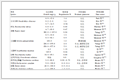
本文分析的数据均为CCSM模式的模拟结果(见表 1,可由网站https://www.earthsystemgrid.org/project/ccsm.html下载,包括地表气温、降水、海平面气压、海表温度和风场的模拟结果),其中全新世阶段的试验数据来源于利用CCSM3[30]进行的过去21000年气候演变瞬变积分模拟试验(Simulation of Transient Climate Evolution over the last 21000 years, 简称TraCE-21ka)[32~34]的全强迫试验(All forcing run,简称AF)、太阳辐射单因子敏感性试验(Orbital forcing run,简称ORB)、温室气体单因子敏感性试验(Atmospheric Greenhouse Gases forcing run,简称GHG)、淡水注入单因子敏感性试验(Meltwater forcing run,简称MWF)和大陆冰盖单因子敏感性试验(Ice Sheets and Paleogeography forcing run,简称ICE)的结果;这套资料在古气候模拟领域具有里程碑式的意义,是目前最好的古气候瞬变积分模拟资料。TraCE-21ka全强迫试验的外强迫条件包括温室气体[35]、地球轨道参数[36]、大陆冰盖[37]和淡水注入[34]。由于本文分析需要夏季月平均资料,而TraCE-21ka的海表温度数据为10年平均,缺少夏季海表温度的月平均资料,故而本文对比了10年平均的地表气温和海表面温度空间场(图略),发现两者差距较小,因此本文使用地表温度来代替全新世阶段的海表温度数据。目前IPCC已经识别了4类RCPs (包括RCP2.6、RCP4.5、RCP6.0和RCP8.5),RCP2.6情景下辐射强迫将在2100年前达到3 W/m2,随后出现下降;RCP8.5情景下的辐射强迫在2100年前超过8.5 W/m2,并在之后的一段时间内持续上升;RCP4.5和RCP6.0情景下的辐射强迫在2100年前后分别大致稳定在4.5 W/m2和6.0 W/m2[1]。从未来温室气体排放量、浓度和辐射强迫时间变化趋势来看,RCP4.5情景下温室气体走势将在2040年达到目标水平,在2070年趋于稳定[1, 38],这种温室气体排放趋势与东亚未来经济发展趋势较为一致,符合东亚各国政府应对气候变化的政策措施,且RCP4.5情景能更好地模拟综合开发过程,将社会经济情景与气候变化结果有机统一起来[39],因此本文未来变暖情景下的试验数据采用参加CMIP5的CCSM4[31]模式模拟的RCP4.5温室气体排放情景下的试验结果,研究时段为2006~2100年;同时为了方便对比分析,本文还使用CCSM4历史气候模拟试验(文中以CCSM4-history表示)和TraCE-21ka在1961~1990年的月平均资料作为参照。本文中的东亚地区范围是22.5°~45.0°N,100°~122°E,本文中定义夏季为每年的6~8月。
|
表 1 本文所使用的CCSM模拟试验简介 Table 1 The brief introduction of CCSM simulation experiments used in this study |
在进行全新世气候变化分析之前,首先对模式模拟结果进行评估,我们选取北半球中高纬的温度重建资料(表 2)与TraCE-AF模拟的北半球中高纬的地表气温进行对比。由于重建资料的温度距平基准时段不同,因此在验证模拟性能之前,先对重建和模拟结果进行标准化处理。图 1是标准化处理后的模拟和重建的全新世北半球中高纬的温度时间序列,可以看出模拟结果可以较好地模拟出全新世的温度变化,且变幅都在重建结果的不确定范围之内。
|
|
表 2 重建的北半球中高纬温度序列简介 Table 2 The brief introduction of reconstructed temperature at the mid-high latitude of the northern hemisphere |

|
图 1 模式模拟与重建(见表 2)的全新世北半球中高纬的标准化温度时间序列 Fig. 1 Comparison of standardized annual mean temperature in simulation and reconstruction(see Table 2)over Northern Hemisphere mid-high latitude during the Holocene |
同时已有研究已经证实TraCE-21ka能够较好地模拟大尺度环流和降水的空间形态[45],且对东亚季风的演变有一定的模拟能力[46~47];CCSM4对东亚地区的气候态模拟效果基本合理,可用于东亚地区的模拟工作[48]。因此认为本文所使用的CCSM模式可以合理地模拟全新世暖期鼎盛期与未来变暖情景下东亚地区的主要气候特征。
1.3 方法因为CCSM3和CCSM4中的海洋模式并不是规则的经纬度网格,因此采用双线性插值方法将各海洋模式插值到与对应的大气模式相一致的分辨率格点上。同时为了保证全新世暖期鼎盛期与未来变暖情景下的研究时段的一致性,我们从全新世的全强迫模拟试验结果中选取了全新世夏季最暖的100年进行分析。从图 2a看出,全新世东亚地区最暖的夏季出现在9 ka B.P.前后,这与Kutzbach[21]的研究结果基本一致。为了更加清晰地显示9 ka B.P.前后全新世暖期鼎盛期东亚地区夏季地表气温的变化趋势,截取10~9 ka B.P.时段的气温时间序列,进行标准化处理(图略)。根据气温距平大于1倍标准差,且持续时间长度大于100年,挑选出全新世夏季最暖的100年(9180~9081 a B.P.,图 2b),本文对全新世暖期鼎盛期气候变化的分析都是基于9180~9081 a B.P.这一时段的模拟结果进行的(下文以TraCE-AF表示)。通过比较全新世暖期鼎盛期和RCP4.5未来变暖情景下东亚地区夏季地表气温和降水的空间分布特征及其异同,结合TraCE-ORB、TraCE-GHG、TraCE-ICE和TraCE-MWF的试验结果,分析全新世暖期鼎盛期东亚夏季降水和地表气温的主要影响因子;最后利用空间距平场等研究全新世暖期鼎盛期和未来变暖情景下东亚夏季降水的影响机制及其异同。

|
图 2 全新世(a)和全新世暖期鼎盛期(b)东亚地区夏季地表气温的时间序列(单位:℃) 红线为101年滑动平均,蓝线为5年滑动平均 Fig. 2 Time series of simulated JJA mean temperature over East Asia during the Holocene and the Holocene Thermal Maximum(unit:℃). Solid red line is the 101-year running mean time series and solid blue line is the 5-year running mean time series |
对比TraCE-AF全新世暖期鼎盛期和RCP4.5情景下东亚地区夏季地表气温的空间距平场(图 3)可以发现,全新世暖期鼎盛期(图 3a)东亚地区的夏季地表气温呈现同心圆状分布,高值中心出现在北纬35°附近,最大升温达到3.3 ℃,这与地球轨道参数改变所引起的岁差周期日射强迫变化有密切关系[49~51];而在RCP4.5情景下(图 3b)东亚地区的夏季地表气温距平表现为全区一致上升,增温幅度由东南往西北递增,具有纬向分布的特征。全新世暖期鼎盛期东亚大部分地区因日射增强而升温,但低纬地区有微弱降温,这与Liu等[52]的研究结果基本一致。

|
图 3 全新世暖期鼎盛期(a)和21世纪(b)东亚地区夏季地表气温的空间距平场(相对于1961~1990年,单位:℃) Fig. 3 The simulated patterns of JJA mean surface temperature anomalies(relative to 1961~1990, unit:℃)over East Asia during the Holocene Thermal Maximum (a) and the 21st century (b) |
由TraCE-AF全新世暖期鼎盛期和RCP4.5未来变暖情景下东亚地区夏季降水的空间距平场(图 4)可以看出,全新世暖期鼎盛期(图 4a)和未来变暖情景下(图 4b)东亚地区夏季降水的空间分布特征有着明显差异,全新世暖期鼎盛期东亚夏季降水的变幅明显大于未来变暖情景下的变幅。全新世暖期鼎盛期东亚地区的夏季降水呈现南北反向的变化特征,表现为“南负北正”的偶极子分布形态,降水增加最多的区域位于华北地区,华南地区降水减少最多;而在RCP4.5未来变暖情景下东亚地区的夏季降水呈现出三极子形势,表现为华南地区和华北地区增加,而黄淮和江淮地区降水减少。

|
图 4 全新世暖期鼎盛期 (a)和21世纪(b)东亚地区夏季降水的空间距平场(相对于1961~1990年,单位:mm/天) Fig. 4 The simulated patterns of JJA mean precipitation anomalies(relative to 1961~1990, unit: mm/day) over East Asia during the Holocene Thermal Maximum (a) and the 21st century (b) |
已有研究表明,未来全球变暖的主要原因是人为温室气体排放浓度增加,使得全球的总辐射强迫为正值,导致气候系统变暖[1~2],而东亚地区夏季降水的变化是由气候变暖背景下动力学和热力学因子共同作用导致的[53]。对于全新世暖期鼎盛期,通过对比TraCE-AF、TraCE-ORB、TraCE-GHG、TraCE-ICE和TraCE-MWF这5个试验中全新世东亚夏季地表气温和降水的时间序列(图 5),可以看出地球轨道参数对全新世暖期鼎盛期(浅蓝色阴影部分)夏季地表气温和降水的影响最大;同样对于整个全新世阶段而言,东亚地区夏季地表气温和降水对地球轨道参数强迫的响应最大,该区地球轨道参数试验与全强迫试验的夏季地表气温和降水的相关系数分别达到0.92和0.69,均通过0.01显著性检验,这与前人研究结果基本一致[49~51, 54]。

|
图 5 TraCE-21ka全强迫试验和单因子试验模拟的东亚地区全新世夏季地表气温距平(a,单位:℃)和降水距平(b,单位:mm/天)时间序列,相对于12000~0 a B.P.年的平均值 Fig. 5 Time series of simulated JJA mean surface temperature anomalies(a, unit:℃)and precipitation anomalies(b, unit: mm/day)derived from the AF run and four single forcing runs of TraCE-21ka over East Asia during the Holocene, relative to the average of 12000~0 a B.P. |
为了探讨全新世暖期鼎盛期和未来变暖情景下夏季降水变化的成因机制,分别对上述两个时期的海平面气压场(SLP)和850 hPa风场(图 6)、850 hPa水汽通量及其散度(图 7),以及海温场(图 8)做了距平分析。已有许多研究表明中国东部地区降水主要来源于印度洋-太平洋区域[55],因此本文的研究区域主要集中在(30°S~80°N,70°E~120°W)区域。

|
图 6 全新世暖期鼎盛期(a)和21世纪(b)夏季海平面气压(填色,单位:hPa)和850 hPa风场(矢量,单位:m/s)的空间距平场(相对于1961~1990年) Fig. 6 The simulated patterns of JJA mean sea level pressure anomalies(color area, unit: hPa)and 850 hPa wind anomalies (vector, unit: m/s)during the Holocene Thermal Maximum (a) and the 21st century (b)(relative to 1961~1990) |

|
图 7 全新世暖期鼎盛期(a)和21世纪(b)夏季850 hPa水汽通量(矢量,单位:103kg/(m·s))及其散度(填色,单位:10-8kg/(m2 ·s))的空间距平场(相对于1961~1990年) Fig. 7 The simulated patterns of JJA mean 850 hPa water vapor flux anomalies(vector, unit:103kg/(m ·s)) and its divergence anomalies(color area, unit:10-8kg/(m2 ·s))during the Holocene Thermal Maximum (a) and the 21st century (b)(relative to 1961~1990) |

|
图 8 全新世暖期鼎盛期(a)和21世纪(b)夏季平均海表温度空间距平场(相对于1961~1990年,单位:℃) Fig. 8 The simulated patterns of JJA mean sea surface temperature anomalies during the Holocene Thermal Maximum (a) and the 21st century (b)(relative to 1961~1990, unit:℃) |
从图 6可以看出,全新世暖期鼎盛期副高偏强,中国北方地区存在一个低压气旋,在渤海和日本南部存在一个高压反气旋(图 6a),使中国东部偏南气流强劲,中国北方特别是华北地区得到丰沛的来自海洋的水汽补充,从而导致降水增加;而在中国南方地区,虽然南风异常,但其将大量水汽输送到北方,在南方并不利于降水,因此降水相对减少。在RCP4.5未来变暖情景下副高偏弱,日本海、渤海和黄海北部地区存在低压中心,形成气旋(图 6b),将太平洋水汽输送到华北地区,使华北地区夏季降水增多;而在黄淮和江淮地区,到来自内陆的干燥气流,导致该地区夏季降水减少;华南地区,西风加强,受到来自印度洋的暖湿气流影响,降水有所增加。
850hPa水汽通量散度负异常对应中低空的水汽辐合,有利于成云致雨,而水汽通量散度正异常则对应相反情况。通过对比两个时期夏季850 hPa水汽通量及其散度异常(图 7a和7b),结合图 6中海平面气压和850 hPa风场的空间距平场,可以看到在全新世暖期鼎盛期中国北方受偏南风影响,形成反气旋性水汽通量环流,中国北方处于水汽辐合区,有利于该地区产生降水;而中国南方地区则处于水汽辐散区,降水减少。在RCP4.5未来变暖情景下华南地区和中国北方处于水汽辐合区,降水增加;而江淮和黄淮地区处于水汽辐散区,降水减少。
从全新世暖期鼎盛期(图 8a)和RCP4.5未来变暖情景下(图 8b)全球夏季平均海表温度空间距平场来看,全新世暖期鼎盛期的海表温度变幅要强于RCP4.5未来变暖情景下的变幅。在全新世暖期鼎盛期,一次大规模冰融水进入太平洋[56],大部分海域呈现降温的变化形式(除北冰洋及北太平洋以外),高值中心出现在太平洋北部,呈现类似太平洋年代际振荡(Pacific Decadal Oscillation,简称PDO)冷位相的模态,有利于形成“南旱北涝”的降水分布格局[57]。而在RCP4.5情景下,温室气体排放增加,大气稳定度增加,引起沃克环流(Walker Circulation)削弱,海表温度升高,高值中心出现在北太平洋。同时需要指出的是,东亚夏季降水是极其复杂的,太平洋ENSO循环、热带印度洋全区一致型海温模态、热带印度洋海温异常偶极子、南印度洋偶极子、北大西洋海温三极子模态均可以影响东亚夏季降水[58]。
4 结论与讨论 4.1 结论本文利用CCSM模式模拟的全新世和RCP4.5未来变暖情景下的气候模拟试验数据,对比了全新世暖期鼎盛期和RCP4.5温室气体排放情景下东亚地区夏季地表气温和降水的空间分布特征,并在此基础上分析了东亚地区全新世暖期鼎盛期和RCP4.5未来变暖情景下东亚夏季降水的空间分布特征的异同及其成因机制,主要结论如下:
(1) 全新世东亚地区最暖的夏季出现在9 ka B.P.前后,这与地球轨道参数变化有关。
(2) 两个时期夏季地表气温的空间分布差异显著。RCP4.5未来变暖情景下21世纪东亚地区的夏季地表气温呈上升趋势,具有纬向分布特征;而在全新世暖期鼎盛期东亚地区的夏季温度呈现同心圆状分布,高值中心出现在北纬35°附近,低纬表现为微弱降温。
(3) 全新世暖期鼎盛期和未来变暖情景下东亚地区夏季降水的空间分布有明显差异,全新世暖期鼎盛期东亚地区的夏季降水表现为“南负北正”的偶极子分布形态,而在RCP4.5未来变暖情景下呈现出三极子形势,全新世最暖期鼎盛期东亚夏季降水的变化幅度明显强于RCP4.5未来变暖情景下的变化幅度。
(4) 全新世暖期鼎盛期副高偏强,中国东部偏南气流强劲,有利于形成“南旱北涝”的降水分布格局。而在RCP4.5未来变暖情景下副高偏弱,有利于形成“南北涝-中间旱”的降水分布格局。
综上所述,全新世暖期鼎盛期与未来变暖情景下东亚地区夏季气温和降水的变化特征具有显著差异;前者的主控因子是地球轨道参数,而后者是温室气体浓度。
4.2 讨论本文的研究结果是基于CCSM气候系统模式的模拟资料得出的,需要指出的是CCSM气候系统模式在不同分辨率下对于东亚地区的气候模拟能力具有水平分辨率依赖性,不同水平分辨率对不同要素的模拟能力存在一定差异[59]。同时由于模式本身在物理过程、计算能力、数据读取等方面的改进,CCSM4对东亚夏季大气环流的整体模拟能力优于CCSM3[60];另外,同时由于气候模式在次网格过程参数化、气溶胶和云辐射过程模拟等方面均存在较大不确定性[1, 61],导致模拟结果存在一定的模式依赖性。因此,研究结果有待于模式的改进、更多模式的模拟验证以及继续获得高精度的代用资料。
致谢: 感谢世界气候研究计划耦合模拟工作组所提供的模拟结果(见表 1),以及美国国家大气研究中心提供的气候分析和对比方法。感谢审稿人细心指出本文的不足之处,并详细提供了建设性修改建议,编辑杨美芳老师为完善本文写作提出了宝贵意见,在此一并致谢。
| [1] |
IPCC. Climate Change 2013: The Physical Science Basis[M/OL]. Cambridge: Cambridge University Press, in press. 2013-09-30[2013-09-30]. https://www.ipcc.ch/report/ar5/wg1/.
|
| [2] |
秦大河, Thomas Stocker. IPCC第五次评估报告第一工作组报告的亮点结论[J]. 气候变化研究进展, 2014, 10(1): 1-6. Qin Dahe, Thomas Stocker. Highlights if the IPCC Working Group Ⅰ Fifth Assessment Report[J]. Advances in Climate Change Research, 2014, 10(1): 1-6. DOI:10.3969/j.issn.1673-1719.2014.01.001 |
| [3] |
Ammann C M, Joos F, Schimel D S, et al. Solar influence on climate during the past millennium:Results from transient simulations with the NCAR Climate System Model[J]. Proceedings of the National Academy of Sciences of the United States of America, 2007, 104(10): 3713-3718. DOI:10.1073/pnas.0605064103 |
| [4] |
Mann M E, Zhang Z, Hughes M K, et al. Proxy-based reconstructions of hemispheric and global surface temperature variations over the past two millennia[J]. Proceedings of the National Academy of Sciences of the United States of America, 2008, 105(36): 12352-12357. |
| [5] |
Fernández-Donado L, González-Rouco J F, Raible C C, et al. Large-scale temperature response to external forcing in simulations and reconstructions of the last millennium[J]. Climate of the Past, 2013, 9(1): 393-421. DOI:10.5194/cp-9-393-2013 |
| [6] |
王志远, 刘健. 过去2000年全球典型暖期特征与机制的模拟研究[J]. 第四纪研究, 2014, 34(6): 1136-1145. Wang Zhiyuan, Liu Jian. Modeling study on the characteristics and mechanisms of global typical warm periods over the past 2000 years[J]. Quaternary Sciences, 2014, 34(6): 136-1145. |
| [7] |
Marcott S A, Shakun J D, Clark P U, et al. A reconstruction of regional and global temperature for the past 11, 300 years[J]. Science, 2013, 339(6124): 1198-1201. DOI:10.1126/science.1228026 |
| [8] |
方修琦, 侯光良. 中国全新世气温序列的集成重建[J]. 地理科学, 2011, 31(4): 385-393. Fang Xiuqi, Hou Guangliang. Synthetically reconstructed Holocene temperature change in China[J]. Scientia Geogarphyica Sinica, 2011, 31(4): 385-393. |
| [9] |
吴海斌, 李琴, 于严严, 等. 全新世中期中国气候格局定量重建[J]. 第四纪研究, 2017, 37(5): 982-998. Wu Haibin, Li Qin, Yu Yanyan, et al. Quantitative climate reconstruction in China during the mid-Holocene[J]. Quaternary Sciences, 2017, 37(5): 982-998. |
| [10] |
彭晓莹, 钟巍, 赵引娟, 等. 全新世大暖期气候环境特征及其机制的再认识[J]. 华南师范大学学报(自然科学版), 2005(2): 52-60. Peng Xiaoying, Zhong Wei, Zhao Yinjuan, et al. Preliminary research in the Holocene Hypsithermal climate change[J]. Journal of South China Normal University(Natural Science Edition), 2005(2): 52-60. DOI:10.3969/j.issn.1000-5463.2005.02.010 |
| [11] |
陈晓晨, 徐影, 许崇海, 等. CMIP5全球气候模式对中国地区降水模拟能力的评估[J]. 气候变化研究进展, 2014, 10(3): 217-225. Chen Xiaochen, Xu Ying, Xu Chonghai, et al. Assessment of precipitation simulation in China by CMIP5 multi-models[J]. Advances in Climate Change Research, 2014, 10(3): 217-225. DOI:10.3969/j.issn.1673-1719.2014.03.011 |
| [12] |
Taylor K E, Stouffer R J, Meehl G A. An overview of CMIP5 and the experiment design[J]. Bulletin of the American Meteorological Society, 2012, 93(4): 485-498. DOI:10.1175/BAMS-D-11-00094.1 |
| [13] |
姜大膀, 田芝平. 末次冰盛期和全新世中期东亚地区水汽输送的模拟研究[J]. 第四纪研究, 2017, 37(5): 999-1008. Jiang Dabang, Tian Zhiping. Last Glacial Maximum and mid-Holocene water vapor transport over East Asia:A modeling study[J]. Quaternary Sciences, 2017, 37(5): 999-1008. |
| [14] |
王志远, 王江林, 张诗茄, 等. 不同时间尺度影响下的北半球夏季风空间特征及其可能影响机制[J]. 第四纪研究, 2018, 38(6): 1494-1506. Wang Zhiyuan, Wang Jianglin, Zhang Shijia, et al. Impact of different timescales on the characteristics and mechanisms of the Northern Hemisphere Summer Monsoon:Based on the CESM results[J]. Quaternary Sciences, 2018, 38(6): 1494-1506. |
| [15] |
辛晓歌, 吴统文, 张洁. BCC气候系统模式开展的CMIP5试验介绍[J]. 气候变化研究进展, 2012, 8(5): 69-73. Xin Xiaoge, Wu Tongwen, Zhang Jie. Introduction of CMIP5 experiments carried out by BCC climate system model[J]. Advances in Climate Change Research, 2012, 8(5): 69-73. |
| [16] |
Moss R H, Edmonds J A, Hibbard K A, et al. The next generation of scenarios for climate change research and assessment[J]. Nature, 2010, 463(7282): 747-756. DOI:10.1038/nature08823 |
| [17] |
Vuuren D P V, Edmonds J, Kainuma M, et al. The representative concentration pathways:An overview[J]. Climatic Change, 2011, 109(1-2): 5-31. DOI:10.1007/s10584-011-0148-z |
| [18] |
Sillmann J, Kharin V V, Zwiers F W, et al. Climate extremes indices in the CMIP5 multi model ensemble:Part 2. Future climate projections[J]. Journal of Geophysical Research:Atmospheres, 2013, 118(6): 2473-2493. DOI:10.1002/jgrd.50188 |
| [19] |
Bao Qing. Projected changes in Asian summer monsoon in RCP scenarios of CMIP5[J]. Atmospheric and Oceanic Science Letters, 2012, 5(1): 43-48. DOI:10.1080/16742834.2012.11446959 |
| [20] |
张莉, 丁一汇, 吴统文, 等. CMIP5模式对21世纪全球和中国年平均地表气温变化和2℃升温阈值的预估[J]. 气象学报, 2013, 71(6): 1047-1060. Zhang Li, Ding Yihui, Wu Tongwen, et al. The 21st century annual mean surface air temperature change and the 2℃ warming threshold over the globe and China as projected by the CMIP5 models[J]. Acta Meteorologica Sinica, 2013, 71(6): 1047-1060. |
| [21] |
Kutzbach J E. Monsoon climate of the Early Holocene:Climate experiment with the Earth's orbital parameters for 9000 years ago[J]. Science, 1981, 214(4516): 59-61. DOI:10.1126/science.214.4516.59 |
| [22] |
张肖剑, 靳立亚. 全新世南亚高压南北移动及其与亚洲夏季风降水的关系[J]. 第四纪研究, 2018, 38(5): 1244-1254. Zhang Xiaojian, Jin Liya. Meridional migration of the South Asian High and its association with Asian summer monsoon precipitation during the Holocene[J]. Quaternary Sciences, 2018, 38(5): 1244-1254. |
| [23] |
焦腾腾, 李佳瑞, 陈婕, 等. 全新世北大西洋海面温度变化趋势:观测-模拟对比研究[J]. 第四纪研究, 2016, 36(3): 747-757. Jiao Tengteng, Li Jiarui, Chen Jie, et al. Changing trends of sea surface temperatures in the North Atlantic during the Holocene:A study of model-data comparison[J]. Quaternary Sciences, 2016, 36(3): 747-757. |
| [24] |
俞飞.基于PMIP模拟的中东亚地区中全新世气候变化机制研究[D].兰州: 兰州大学硕士论文, 2011: 1-5. Yu Fei. Studies on Mid-Holocene Climate Change in Central and East Asia Based in PMIP2 Simulations[D]. Lanzhou: The Master's Thesis of Lanzhou University, 2011: 1-5. http://cdmd.cnki.com.cn/article/cdmd-10730-1011140235.htm |
| [25] |
Renssen H, Seppä H, Crosta X, et al. Global characterization of the Holocene Thermal Maximum[J]. Quaternary Science Reviews, 2012, 48(7): 7-19. |
| [26] |
张冉, 刘晓东. 中全新世暖期与未来气候变暖情景下东亚夏季降水变化相似型分析[J]. 地理科学, 2009, 29(5): 679-683. Zhang Ran, Liu Xiaodong. An analogy analysis of summer precipitation change patterns between mid-Holocene and future climatic warming scenarios over East Asia[J]. Scientia Geographica Sinica, 2009, 29(5): 679-683. |
| [27] |
马洁华, 王会军. 一个基于耦合气候系统模式的气候预测系统的研制[J]. 中国科学:地球科学, 2014, 44(8): 1689-1700. Ma Jiehua, Wang Huijun. Design and testing of a global climate prediction system based on a coupled climate model[J]. Science China:Earth Sciences, 2014, 44(8): 1689-1700. |
| [28] |
Boville B A, Gent P R. The NCAR climate system model, Version one[J]. Journal of Climate, 1998, 11(6): 1115-1130. DOI:10.1175/1520-0442(1998)011<1115:TNCSMV>2.0.CO;2 |
| [29] |
Kiehl J T, Gent P R. The community climate system model, Version 2[J]. Journal of Climate, 2004, 17(19): 3666-3682. DOI:10.1175/1520-0442(2004)017<3666:TCCSMV>2.0.CO;2 |
| [30] |
Collins W D, Bitz C M, Blackmon M L, et al. The community climate system model version 3(CCSM3)[J]. Journal of Climate, 2006, 19(11): 2122-2143. DOI:10.1175/JCLI3761.1 |
| [31] |
Gent P R, Danabasoglu G, Donner L J, et al. The community climate system model version 4[J]. Journal of Climate, 2011, 24(19): 4973-4991. DOI:10.1175/2011JCLI4083.1 |
| [32] |
Liu Z, Otto-Bliesner B L, He F, et al. Transient simulation of last deglaciation with a new mechanism for Bølling-Allerøod warming[J]. Science, 2009, 325(5938): 310-314. DOI:10.1126/science.1171041 |
| [33] |
Liu Z, Zhu J, Rosenthal Y, et al. The Holocene temperature conundrum[J]. Proceedings of the National Academy of Sciences of the United States of America, 2014, 111(34): 3501-3505. DOI:10.1073/pnas.1407229111 |
| [34] |
He F. Simulating Transient Climate Evolution of the Last Deglaciation with CCSM3[D]. Madison: The PhD's Thesis of University of Wisconsin-Madison, 2011: 15-56.
|
| [35] |
Joos F, Spahni R. Rates of change in natural and anthropogenic radiative forcing over the past 20, 000 years[J]. Proceedings of the National Academy of Sciences of the United States of America, 2008, 105(5): 1425-1430. DOI:10.1073/pnas.0707386105 |
| [36] |
Berger A L. Long-term variations of daily insolation and Quaternary climatic changes[J]. Journal of Meteorology, 1978, 35(12): 2362-2367. |
| [37] |
Peltier W R. Global glacial isostasy and the surface of the ice-age Earth:The ICE-5G(VM2)model and GRACE[J]. Annual Review of Earth and Planetary Sciences, 2004, 20(32): 111-149. |
| [38] |
Riahi K, Nakicenovic N. Greenhouse gases-integrated assessment[J]. Technological Forecasting and Social Change, 2007, 74(7): 231-239. |
| [39] |
高超, 张正涛, 陈实, 等. RCP4.5情景下淮河流域气候变化的高分辨率模拟[J]. 地理研究, 2014, 33(3): 467-477. Gao Chao, Zhang Zhengtao, Chen Shi, et al. The high-resolution simulation of climate change model under RCP4.5 scenarios in the Huaihe River Basin[J]. Geographical Research, 2014, 33(3): 467-477. |
| [40] |
Kobashi T, Menviel L, Jeltsch-Thömmes A, et al. Volcanic influence on centennial to millennial Holocene Greenland temperature change[J]. Scientific Reports, 2017, 7(1): 1441. DOI:10.1038/s41598-017-01451-7 |
| [41] |
Isono D, Yamamoto M, Irino T, et al. The 1500-year climate oscillation in the midlatitude North Pacific during the Holocene[J]. Geology, 2009, 37(7): 591-594. DOI:10.1130/G25667A.1 |
| [42] |
Marsicek J, Shuman B N, Bartlein P J, et al. Reconciling divergent trends and millennial variations in Holocene temperatures[J]. Nature, 2018, 554(7690): 92-96. DOI:10.1038/nature25464 |
| [43] |
Vinther B M, Buchardt S L, Clausen H B, et al. Holocene thinning of the Greenland ice sheet[J]. Nature, 2009, 461(7262): 385-388. DOI:10.1038/nature08355 |
| [44] |
Alley R B. The Younger Dryas cold interval as viewed from central Greenland[J]. Quaternary Science Reviews, 2000, 19(1-5): 0-226. |
| [45] |
于天雷. TraCE-21ka模拟的误差评估及对其东亚夏季风演变的模拟改进[D].南京: 南京信息工程大学博士论文, 2018: 14-28. Yu Tianlei. The Error Evaluation of TraCE-21ka and Improvement of Its Simulation on East Asian Summer Monsoon Evolution[D]. Nanjing: The PhD's Thesis of Nanjing University of Information Science and Technology, 2018: 14-28. http://cdmd.cnki.com.cn/Article/CDMD-10300-1018140124.htm |
| [46] |
Liu Z, Wen X, Brady E C, et al. Chinese cave records and the East Asia summer monsoon[J]. Quaternary Science Reviews, 2014, 83: 115-128. DOI:10.1016/j.quascirev.2013.10.021 |
| [47] |
Wen X, Liu Z, Wang S, et al. Correlation and anti-correlation of the East Asian summer and winter monsoons during the last 21, 000 years[J]. Nature Communications, 2016, 7: 11999. DOI:10.1038/ncomms11999 |
| [48] |
田芝平, 姜大膀, 张冉, 等. CCSM4.0的长期积分试验及其对东亚和中国气候模拟的评估[J]. 大气科学, 2012, 36(3): 619-632. Tian Zhiping, Jiang Dabang, Zhang Ran, et al. Long-term climate simulation of CCSM4.0 and evaluation of its performance over East Asia and China[J]. Chinese Journal of Atmospheric Sciences, 2012, 36(3): 619-632. |
| [49] |
刘晓东, 石正国. 岁差对亚洲夏季风气候变化影响研究进展[J]. 科学通报, 2009, 54(20): 3097-3107. Liu Xiaodong, Shi Zhengguo. Effect of precession on the Asian summer monsoon evolution:A systematic review[J]. Chinese Science Bulletin, 2009, 54(20): 3097-3107. |
| [50] |
刘艳, 孙颖, Harrison S P. 全新世初期气候的数值模拟研究[J]. 地球物理学报, 2007, 50(5): 1337-1350. Liu Yan, Sun Ying, Harrison S P. A numerical simulation study on the Early Holocene climate[J]. Chinese Journal of Geophysics, 2007, 50(5): 1337-1350. DOI:10.3321/j.issn:0001-5733.2007.05.009 |
| [51] |
Wang Y J, Cheng H, Edwards R L, et al. A high-resolution absolute-dated Late Pleistocene monsoon record from Hulu Cave, China[J]. Science, 2001, 294(5550): 2345-2348. DOI:10.1126/science.1064618 |
| [52] |
Liu Z, Ottobliesner B, Kutzbach J, et al. Coupled climate simulation of the evolution of global monsoons in the Holocene[J]. Journal of Climate, 2003, 16(15): 2472-2490. DOI:10.1175/1520-0442(2003)016<2472:CCSOTE>2.0.CO;2 |
| [53] |
孙颖, 丁一汇. 未来百年东亚夏季降水和季风预测的研究[J]. 中国科学(D辑:地球科学), 2009, 39(11): 1487-1504. Sun Ying, Ding Yihui. Projection of future changes in summer precipitation and monsoon in East Asia[J]. Science in China(Series D:Earth Sciences), 2009, 39(11): 1487-1504. |
| [54] |
王绍武, 黄建斌, 闻新宇, 等. 全新世中国夏季降水量变化的两种模态[J]. 第四纪研究, 2009, 29(6): 1086-1094. Wang Shaowu, Huang Jianbin, Wen Xinyu, et al. Two modes of summer precipitation variation of Holocene in China[J]. Quaternary Sciences, 2009, 29(6): 1086-1094. |
| [55] |
刘诗桦.印度洋-太平洋SSTA特征及与我国中东部降水异常的遥相关[D].上海: 华东师范大学硕士论文, 2018: 1-7. Liu Shiye. The Characteristics of Indo-Pacific SSTA and Its Teleconnection to the Anomaly Precipitation over Central-Eastern China[D]. Shanghai: The Master's Thesis of East China Normal University, 2018: 1-7. |
| [56] |
Yokoyama Y, Lambeck K, Deckker P D, et al. Timing of the Last Glacial Maximum from observed sea-level minima[J]. Nature, 2001, 406(6797): 713-716. |
| [57] |
Yang Q, Ma Z, Fan X, et al. Decadal modulation of precipitation patterns over East China by sea surface temperature anomalies[J]. Journal of Climate, 2017, 30(17): 7017-7033. DOI:10.1175/JCLI-D-16-0793.1 |
| [58] |
陈丽娟, 袁媛, 杨明珠, 等. 海温异常对东亚夏季风影响机理的研究进展[J]. 应用气象学报, 2013, 24(5): 521-532. Chen Lijuan, Yuan Yuan, Yang Mingzhu, et al. A review of physical mechanisms of the global SSTA impact on EASM[J]. Journal of Applied Meteorological Science, 2013, 24(5): 521-532. DOI:10.3969/j.issn.1001-7313.2013.05.002 |
| [59] |
田芝平, 姜大膀. 不同分辨率CCSM4对东亚和中国气候模拟能力分析[J]. 大气科学, 2013, 37(1): 171-186. Tian Zhiping, Jiang Dabang. Evaluation of the performance of low-to high-resolution CCSM4 over East Asia and China[J]. Chinese Journal of Atmospheric Sciences, 2013, 37(1): 171-186. |
| [60] |
张宏芳, 高红燕, 杨新, 等. 东亚夏季大气环流模拟的对比分析:CCSM3和CCSM4[J]. 资源科学, 2014, 36(9): 1852-1859. Zhang Hongfang, Gao Hongyan, Yang Xin, et al. Comparing CCSM3 and CCSM4 simulations of summer atmospheric circulation over East Asia[J]. Resources Science, 2014, 36(9): 1852-1859. |
| [61] |
吴迪, 严登华. SRES情景下多模式集合对淮河流域未来气候变化的预估[J]. 湖泊科学, 2013, 25(4): 565-575. Wu Di, Yan Denghua. Projections of future climate change over Huaihe River basin by multimodel ensembles under SRES scenarios[J]. Journal of Lake Sciences, 2013, 25(4): 565-575. DOI:10.3969/j.issn.1003-5427.2013.04.015 |
2 Jiangsu Provincial Key Laboratory for Numerical Simulation of Large Scale Complex Systems, School of Mathematical Science, Nanjing Normal University, Nanjing 210023, Jiangsu;
3 Open Studio for the Simulation of Ocean-Climate-Isotope, Pilot National Laboratory for Marine Science and Technology(Qingdao), Qingdao 266237, Shandong;
4 State Key Laboratory of Loess and Quaternary Geology, Institute of Earth Environment, Chinese Academy of Science, Xi'an 710061, Shaanxi)
Abstract
Based on the simulation of the Holocene from Community Climate System Model version 3(CCSM3) and the simulation of the 21st century in Representative Concentration Pathway 4.5(RCP4.5 or 2006~2100 C.E.) from Community Climate System Model version 4(CCSM4), the historical simulations from CCSM3 and CCSM4 also be used in this study. We selected the warmest 100 years through the Holocene(HW100 or 9180~9081 a B. P.) and analyzed the spatial distribution of surface air temperature and precipitation in summer(JJA) over East Asia(22.5°~45.0°N, 100°~122°E) between the HW100 and RCP4.5 by using the differential analysis, and the potential mechanism of the climatic variation has been discussed as well.The results indicate that:(1) the period around 9 ka BP has witnessed the warmest summer through the Holocene in the East Asia, which concerns the variation of Earth orbit parameters; (2) An overall rise of average summer surface temperature in the East Asia through the 21st century has been discovered under the RCP4.5 greenhouse gas emission scenario while that in the peak of the Holocene warm period has been found to be a concentric circle pattern; (3) Evident differences exist between the two above-mentioned scenarios, with the distribution of summer precipitation being a dipole pattern(negative in South and positive in North) in HW100 and a triple one under RCP4.5 scenario, and the variation of the former is much more fluctuant; (4) Strength of subtropical high has also been detected to differ:a stronger one has been found in HW100 with a powerful southerly flow throughout Eastern China while that under RCP4.5 scenario seems to be weaker.