 2019, Vol.39


我国南方旧石器时代文化遗物和古人类化石的发现,为认识南方旧石器文化类型和古人类在我国南方乃至东亚地区的发展提供了宝贵材料[1~4],极大丰富了我国旧石器时代考古和古人类学的研究。自2015年来,湖南省文物考古研究所在湖南省北部赤山岛地区开展调查工作,先后发现10余处旧石器地点[5]。赤山岛枫树嘴(28°56′47″N,112°17′22″E)是首次在湖南省确认含似阿舍利技术类型石器的旧石器遗址之一,这一发现是长江中游及华南地区旧石器考古的重要进展[5]。赤山岛在我国南北、东西向人类迁徙和文化交流中起着重要的枢纽作用,为研究洞庭湖区及东亚地区更新世气候环境与古人类文化及独特适应模式的演进提供了重要的研究材料[5]。因此,运用多种测年手段获得该遗址的准确年代甚为重要。
光释光(Optically Stimulated Luminescence,简称OSL)定年是过去30余年来发展起来的一种测年技术[6]。其基本原理是:沉积物颗粒见光后,矿物中积累的释光信号被清零,埋藏后不断接受周围环境中放射性核素产生的辐照,射线能量在矿物中积累,在实验室通过光激发以释光形式释放出来。通过实验室建立辐照响应曲线,可将积累的释光信号强度转化为所接受的辐照总能量,即等效剂量,而矿物中每年可接受到的辐照能量可通过测量沉积物中放射性核素的含量而得到,即年剂量或剂量率。二者比值即为样品自最后一次见光以来被埋藏的时间,据此可以确定沉积物的埋藏年代[7]。因其运用沉积物中普遍存在的长石和石英矿物作为测年材料,释光测年技术应用领域十分广泛,其中考古遗址定年是最重要的应用之一[7~9]。
基于石英矿物的光释光单片再生剂量法(Single-Aliquot Regenerative-dose,简称SAR)的发展,大大提高了等效剂量(Equivalent Dose,简称De)测量的准确度和精度[10~12]。由于红外光线可以激发长石产生释光信号但不能激发石英释光信号,对于混合矿物,可先对样品进行红外激发,然后再进行蓝光激发,即红外激发后蓝光释光法(post-IR OSL SAR)[13]进行等效剂量测量。
前人研究表明,石英OSL SAR法在高剂量区存在年龄低估问题,这制约了石英OSL SAR法的可靠测年上限,对于黄土沉积物而言,其可靠的测年上限仅为50~70ka[14~21];post-IR OSL SAR法也常常受到混合矿物中长石信号的干扰,影响其测年结果的准确性[22~24]。相比之下,长石矿物的红外释光信号有着更高的饱和剂量,理论上测年上限更老,但因其存在异常衰减的问题[25],长石样品红外释光年龄常出现低估。虽然研究者们提出了若干异常衰减校正的方法[26~28],但是这些校正方法仅适用于等效剂量处于生长曲线线性区的年轻样品(约20~50ka或低剂量率时的100ka[29]),对于老样品(非线性生长曲线区),这些校正方法并不适用或者不可靠[30~31]。Thomsen等[32]研究发现红外激发后再进行一步采用高温红外激发可获得稳定的释光信号,从而提出红外激发后高温红外释光单片再生剂量法(post-IR IRSL SAR法),目前已得到广泛的应用[29, 33~34],近几年,在许多考古遗址的定年研究中(比如河南灵井许昌人遗址、印度尼西亚Liang Bua遗址等)也取得了重要的成果[35~38]。
本文研究的赤山岛枫树嘴旧石器遗址文化层位于遭受化学风化作用强烈的红土和网纹红土中,沉积物粒径较细[39]。Zhang等[39]对该地点4个层位的5个沉积物样品中细粒石英进行光释光测年,得到的年龄为70~120ka。其中大量含似阿舍利技术类型石器的第3层和第4层上部的年龄分别为81.4±3.1ka和98.0±3.5ka;并认为该地区沉积物细粒组分中长石信号弱,难以进行长石测年研究[39]。然而,Zhou等[40]在研究希腊红层沉积物时,利用细粒混合矿物中的长石组分进行定年,说明遭受强烈风化的沉积物中仍存在可用于释光测年的长石IRSL信号。
本文利用Zhang等[39]实验中提取出的细粒混合矿物,对其中长石信号进行系统研究,并尝试应用post-IR IRSL SAR和post-IR OSL SAR法进行释光测年,目的是探索适用于遭受强烈风化作用的沉积物释光测年的方法,为今后在类似地区开展释光年代学工作提供参考。
1 样品采集与实验室测量 1.1 样品采集与前处理枫树嘴遗址的地层自上而下分为5层[5, 39]。第2层为褐红色粉砂质粘土(均质红土);第3层为黄红色网纹土;第4层为深红褐色网纹土。遗址中的石制品主要出自第3层和第4层上部;本研究中的3个样品分别来自该遗址文化层的第2层、第3层和第4层。样品实验室编号分别为L3204 (0.35m)、L3205 (0.87m)和L3206 (1.64m),野外编号与Zhang等[39]研究一致。野外采样和样品前处理,已由前人研究完成[39],本研究使用的是4~11μm细粒混合矿物。
1.2 释光测量光释光测量在Risø TL/OSL DA-15型自动释光测量仪上完成。蓝光激发光源波段为470±30 nm,使用的激发功率为45mW/cm2,红外激发光源波段为875±40 nm,相应使用的激发功率为135mW/ cm2。post-IR OSL SAR法使用的滤光片为Hoya U-340,post-IR IRSL SAR法使用的滤光片为Corning 7-59+Schott BG39组合。释光信号通过EMI 9235QA光电倍增管探测。所有人工放射性辐照由安装在该仪器上的放射性β源(90 Sr/90Y)完成,其剂量率为约0.051Gy/s。
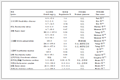
等效剂量测量使用两种测量程序分别见表 1和表 2。对于post-IR IRSL SAR技术,信号强度的计算利用光释光信号衰减曲线前4 s信号减去作为背景值的最后20 s信号均值;而在应用post-IR OSL SAR技术时,信号强度的计算利用光释光信号衰减曲线前2s信号减去作为背景值的最后10 s信号均值。
|
表 2 混合矿物红外后蓝光释光单片再生剂量法测量程序[13] Table 2 Post-IR OSL SAR protocol |
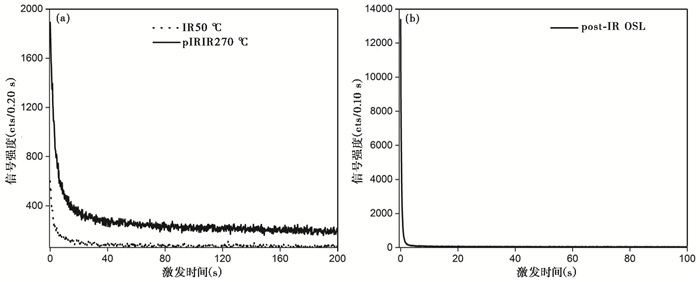
图 1a显示样品L3205的红外激发释光天然信号衰减曲线,从中可以看出IR50℃与pIRIR270℃的信号强度都比较弱,初始信号强度分别为600 cts/0.2 s和1890 cts/0.2 s;图 1b为样品L3205天然信号post-IR OSL衰减曲线,从中可以看出该样品post-IR OSL信号强度强,衰减快,初始信号强度为13400 cts/0.1 s。
|
图 1 L3205样品(a)IR50℃和pIRIR270℃自然信号衰减曲线以及(b)post-IR OSL自然信号衰减曲线 Fig. 1 (a)Decay curves of IR50℃ and pIRIR270℃ natural signals and (b)decay curve of post-IR OSL natural signal of sample L3205 |
前人对实验测得的石英释光信号衰减曲线进行组分分析,发现其信号是由衰减速率不同的指数衰减曲线叠加而成[41~42],如方程(1)所示:

|
(1) |
其中,I(t)为时间t时的信号值,If、Im、Is分别表示快中慢组分在t=0时初始释光信号强度,bf、bm、bs分别为快、中、慢组分的衰减速率,I0为背景值。
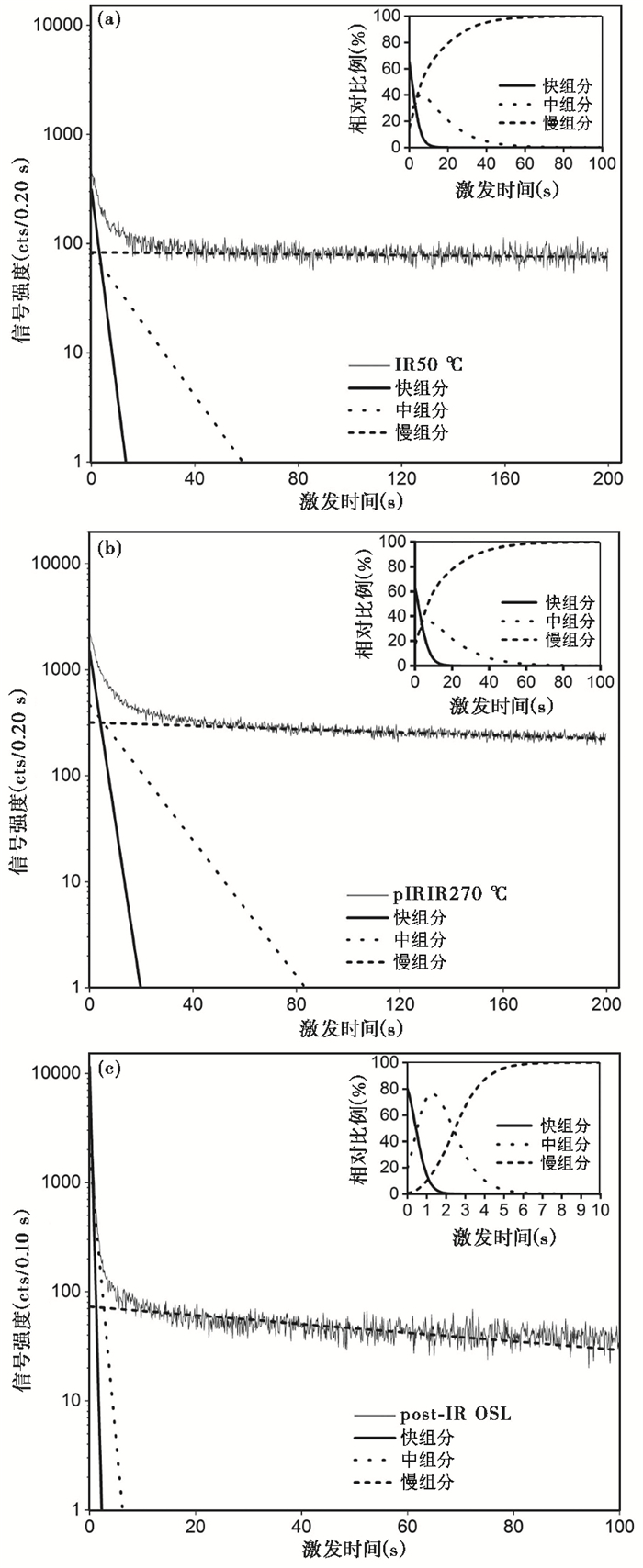
本研究对混合矿物的IR50℃、pIRIR270℃和post-IR OSL信号按照石英信号的分解方法进行分解,结果如图 2a、2b和2c所示,IR50℃、pIRIR270℃和post-IR OSL信号均可由“快、中、慢”三组分组成。所测样品的IR50℃信号与pIRIR270℃信号衰减曲线及其分解出的快中慢组分相似。IR50℃初始信号以快组分为主,占60 %,20 s内衰退至背景水平,中组分初始占比20 %,60 s内衰退至背景水平(图 2a); pIRIR270℃初始信号同样以快组分为主,占60 %,20 s内衰退至背景水平,中组分初始占比20 %,80 s内衰退至背景水平(图 2b)。
|
图 2
L3205样品恒定光源激发的自然剂量光释光信号衰减曲线的分解
(a)IR50℃信号分解曲线;(b)pIRIR270℃信号分解曲线;(c)post-IR OSL信号分解曲线 主图中的插图表示不同组分的相对比例随激发时间的变化 Fig. 2 Decomposition of decay curves of natural signal stimulated by continuous wave luminescence for sample L3205. Changes of the relative contribution of different component with time are shown in the upper inset. (a)IR50℃ signal; (b)pIRIR270℃ signal; (c)post-IR OSL signal |
样品的post-IR OSL自然信号衰减曲线与前人报道的不同(图 2c)[13, 22],其快组分在激发开始时占比80 %,在2s内迅速衰退至背景水平,中组分初始占比20 %,在6s内衰退至背景水平。post-IR OSL信号快组分衰减常数τf(τf=1/bf)与前人石英OSL信号快组分的衰减常数相近,分别为0.24 s-1和0.3~0.37 s-1[22]。本研究中,样品的post-IR OSL衰减曲线具有明显的石英OSL衰减曲线特征,说明样品经强烈化学风化后,混合矿物中长石含量小,导致post-IR OSL信号中长石贡献小。
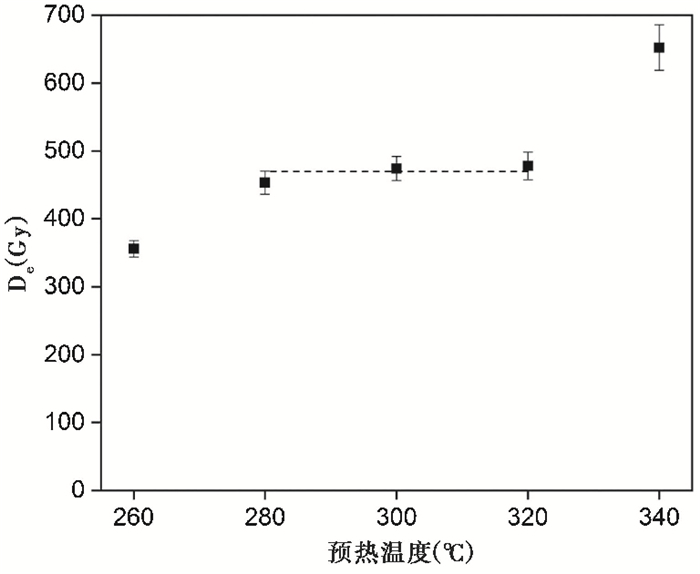
2.2 预热坪与剂量恢复为了确定本研究中样品的post-IR IRSL SAR法测试条件,选择样品L3204进行预热坪实验,采用的预热温度介于260~340℃(20℃间隔),各温度条件下至少测量3个测片。如图 3所示,在280~320℃出现等效剂量坪区,因此选择300℃作为预热温度。除此之外,结合激发温度坪实验结果以及样品post-IR IRSL信号较弱的特点,本研究采用300℃为预热温度,在50℃低温红外激发100 s后在270℃高温条件下红外激发得到的pIRIR270℃信号进行等效剂量测量。
|
图 3 样品L3204细粒混合矿物post-IR IRSL法预热坪实验 Fig. 3 Preheat test on fine-grained polymineral post-IR IRSL protocol for sample L3204 |
为进一步检验该方法的适用性,选取L3205样品细粒混合矿物3个测片进行剂量恢复实验。将样品(自然释光信号)在Hönle UVACUBE 400型太阳模拟灯下晒退12 h,然后给予600Gy的辐照剂量,使用post-IR IRSL SAR法(pIRIR270℃)测量程序(表 1)进行等效剂量测定(检测剂量约250Gy),测得等效剂量与给定剂量值(600Gy)的比值(剂量恢复率)为1.02±0.02,3个测片回授率均小于5 %,循环率在0.9~1.1之间。以上结果表明,post-IR IRSL SAR法(pIRIR270℃)适合用于本研究中细粒混合矿物等效剂量的测量。
在残余剂量检测实验中,选择样品L3205细粒混合矿物的3个测片,将其自然释光信号在Hönle UVACUBE 400型太阳灯下晒退12 h,然后利用表 1的程序进行测量。残余剂量结果在19.8~32.1Gy之间,平均值为28.0±3.3Gy,考虑到样品的等效剂量较大,残余剂量对其影响可以忽略。
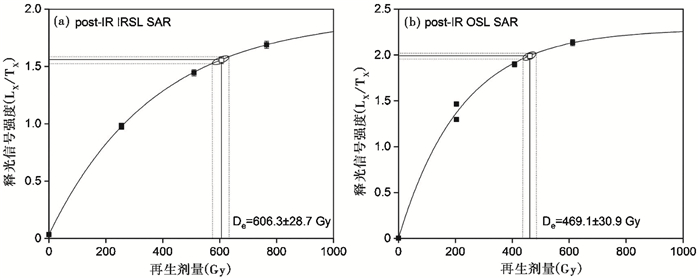
2.3 测年结果图 4a和4b分别为代表性样品L3205细粒混合矿物post-IR IRSL SAR法和post-IR OSL SAR法光释光信号生长曲线。该样品的post-IR IRSL SAR法等效剂量值高于post-IR OSL SAR法所得等效剂量值,而post-IR OSL法的辐射剂量响应曲线相比于post-IR IRSL法,更趋近于非线性区。
|
图 4 样品L3205细粒混合矿物(a)post-IR IRSL SAR方法与(b)post-IR OSL SAR方法的光释光信号生长曲线 Lx/Tx代表经灵敏度校正后的光释光信号强度,实心符号:再生剂量;空心符号:自然剂量 Fig. 4 Dose response curves of (a) post-IR IRSL SAR signal and (b) post-IR OSL signal for fine-grained polymineral of sample L3205(Lx/Tx represent the sensitivity-corrected OSL signals; closed symbols: regenerative dose; open symbols: natural dose) |
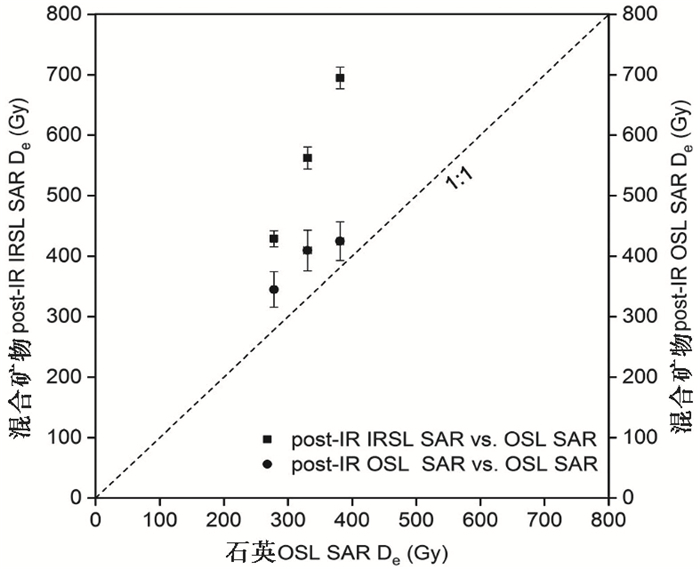
表 3给出post-IR IRSL SAR法和post-IR OSL SAR法测得的L3204~L3206细粒混合矿物样品的等效剂量,图 5将本研究所得的结果与前人石英OSL SAR法等效剂量测量结果[39]进行对比。样品的post-IR IRSL SAR法和post-IR OSL SAR法等效剂量均随着深度的增加而增加,post-IR OSL法的等效剂量在误差范围内没有显著增加(尤其是L3205和L3206样品),同一样品的post-IR OSL法等效剂量值低于post-IR IRSL SAR法所测值。
|
|
表 3 赤山岛枫树嘴旧石器遗址剖面post-IR IRSL SAR法和post-IR OSL SAR法等效剂量结果 Table 3 Equivalent dose data of fine-grained polyminerals from the Fengshuzui Paleolithic site of Chishan Island with post-IR IRSL SAR and post-IR OSL SAR protocol |
|
图 5 细粒混合矿物post-IR IRSL SAR法和post-IR OSL SAR法等效剂量值与细粒石英OSL SAR法[39]等效剂量值对比 Fig. 5 Equivalent doses of post-IR IRSL SAR and post-IR OSL SAR for fine-grained polyminerals compared with that of fine-grained quartz OSL SAR[39] |
据Zhang等[39]的研究,L3204、L3205和L3206样品的石英OSL SAR法年代结果分别为67.9±2.4ka、81.4±3.1ka和98.0±3.5ka。虽然石英信号稳定,但是其较低的饱和剂量决定了测年上限,可能使石英OSL SAR测年结果出现年龄低估的现象。目前,不同学者在对石英测年上限的认识上仍然存在差异。Zhou和Shackleton[14]认为中国黄土细粒石英等效剂量测量上限为200Gy;覃金堂和周力平[15]发现中粒石英OSL SAR法剂量结果在较老样品(70ka)中存在30 % ~50 %的低估;Buylaert等[16~17]对中国黄土粗粒石英测年认为其测量上限为120~150Gy;Lai等[19]发现中粒石英的辐照响应曲线到700Gy仍未出现饱和,但他们认为可靠的石英OSL SAR法测量上限仍然是约230Gy(约70ka)左右;Qiu和Zhou[20]测量河南邙山黄土石英的结果表明,该地区L1黄土底部石英OSL SAR年代为68.6±4.9ka,而L2黄土以下的OSL SAR年代出现明显低估,不再随深度增加而系统增大;Timar-Gabor等[21]也报道了罗马尼亚、塞尔维亚和中国等地区的黄土不同粒级的石英都存在高剂量区(>100Gy)年龄低估问题并认为这是全球普遍现象;Li等[36]在许昌人遗址沉积物测年结果显示,石英OSL SAR法在样品较老时(等效剂量>200Gy)的测年结果会出现一定程度的低估,粒级越细石英低估程度越大。因此,石英年代低估的原因有多种解释,如中慢组分的热不稳定性导致粗粒石英结果低估[43]或自然和实验室内剂量率效应的影响[18, 44]。
表 3中post-IR OSL等效剂量的标准误差比pIRIR270℃大,表明post-IR OSL各测片之间离散程度较大,这很可能是因为以石英信号为主的post-IR OSL天然释光信号更接近剂量响应曲线饱和区,虽生长曲线仍未饱和,但剂量已经超过石英的实际测量上限,此时再生剂量信号与检测剂量信号比值(Lx/Tx)稍小变动也会导致等效剂量较大的差异。同时,混合矿物post-IR OSL SAR法等效剂量值比石英OSL SAR法所测结果略高10 % ~25 %,但依然比post-IR IRSL SAR方法测量的等效剂量低15 % ~40 %,说明样品中含有少量长石会影响post-IR OSL SAR法等效剂量的测量[22~24],故使用以石英信号为主的post-IR OSL SAR信号对该地区沉积物进行等效剂量测量依然可能出现低估。
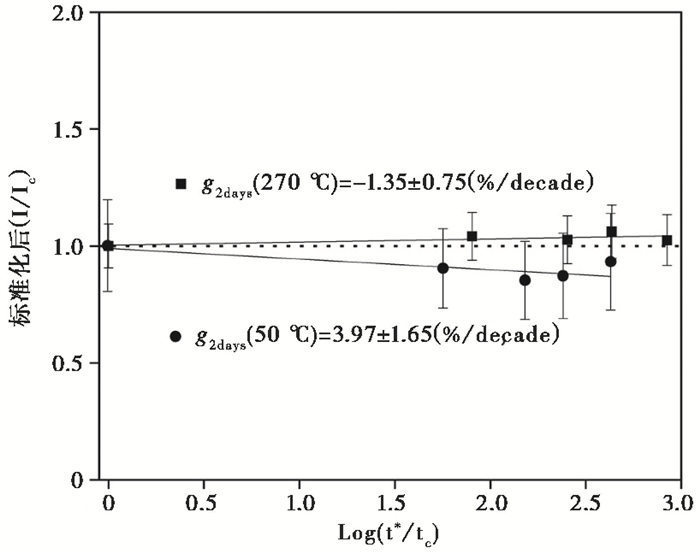
在使用混合矿物长石IR50℃与pIRIR270℃信号进行等效剂量测量时,需要考虑异常衰减对长石信号的影响。本文利用Auclair等[28]的方法测量其异常衰减速率(g值):实验室使用L3204样品5个测片,在太阳灯下晒退12 h后给予51.0Gy的β剂量,经300℃预热后,在暗室中分别储存1天、3天、5天、7天和10天后,测量其IR50℃与pIRIR270℃信号并计算其g值,最后归一到g2days值(图 6)。该样品IR50℃的g2days值为3.97±1.65 % /decade,而pIRIR270℃信号的g2days值为-1.35±0.75 % /decade,表明IR50℃信号存在异常衰减,而pIRIR270℃信号没有明显的异常衰减,pIRIR270℃信号具有良好的稳定性。
|
图 6 样品L3204细粒混合矿物post-IR IRSL SAR法IR50℃与pIRIR270℃信号的异常衰退实验结果(g2days) tc=2天,t*为样品在实验室辐照一半剂量的时间到下一次再激发时间的间隔 Fig. 6 Anomalous-fading test data of IR50℃ and pIRIR270℃ signals for fine-grained polymineral Sample L3204(g2days). tc=2 days, t* represents the time from the sample irradiated half fixed dose to the beginning of the irradiation next time(unit:2 days) |
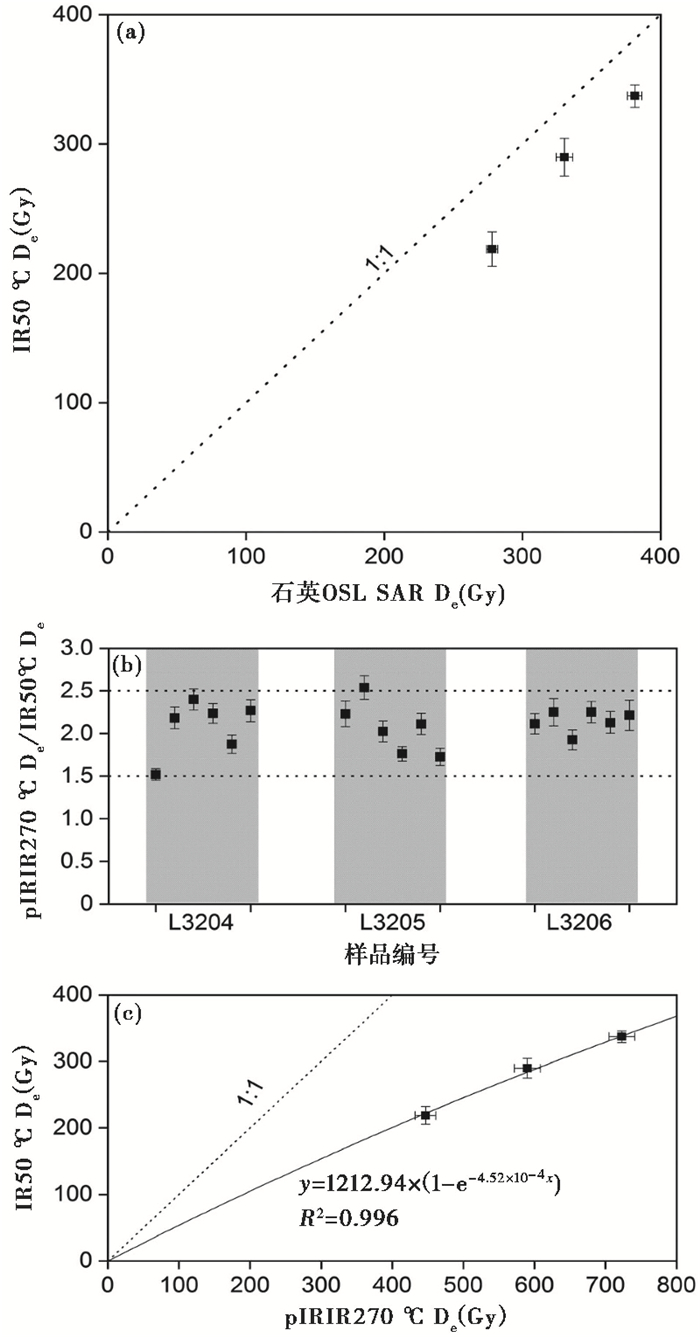
晒退不完全也是影响光释光定年准确性的重要因素。图 7a显示细粒混合矿物post-IR IRSL SAR法IR50℃的等效剂量值要比细粒石英SAR法等效剂量结果低,说明异常衰减对长石IR50℃的等效剂量影响要比不完全晒退大。Thiel等[34]发现同一个黄土剖面中,晒退良好的样品的IR50℃和pIRIR290℃的等效剂量比值具有一致性。Buylaert等[45]发现阿根廷Laguna Potrok Aike湖泊沉积物良好晒退样品未经校正的IR50℃和pIRIR290℃信号的平均等效剂量值具有良好的指数拟合关系,如方程(2)所示:

|
(2) |
|
图 7 (a) 细粒混合矿物post-IR IRSL SAR法IR50℃等效剂量值与细粒石英OSL SAR法等效剂量值对比;(b)样品IR50℃和pIRIR270℃信号的等效剂量比值;(c)样品IR50℃和pIRIR270℃的平均等效剂量指数拟合关系 Fig. 7 (a)Comparison of equivalent dose results from fine-grained quartz OSL SAR and fine-grained polymineral IR50℃ in post-IR IRSL SAR measurement (b) the ratio of the De values for the IR50℃ signal and the pIRIR270℃ signal for all samples; (c)index fitting relationship of averaged uncorrected IR50℃ and pIRIR270℃ De values |
本研究中L3204、L3205、L3206样品的IR50℃和pIRIR270℃的等效剂量比值分别为2.08±0.12、2.06±0.11和2.15±0.05,都比较接近(图 7b)。此外,这3个样品的IR50℃和pIRIR270℃信号的平均等效剂量值具有良好的指数关系(图 7c)。据以上判断,本研究中沉积物样品长石信号未完全晒退可能性较小,不会对测年结果造成影响。
综上所述,在化学风化强烈的地区,虽然石英相对富集,但是运用石英信号为主post-IR OSL SAR方法测年仍然要考虑长石对该信号的影响,该方法与石英OSL SAR法同样可能存在年龄低估的问题,样品越老,低估程度越大。本研究中采用的post-IR IRSL SAR法,所有测片循环比率的平均值为1.00±0.03,回授率平均值为2.69 % ±0.3 %,等效剂量随着深度的增加而增加。预热坪实验、剂量恢复实验、残余剂量检测以及异常衰减实验检测均表明post-IR IRSL法更适用于年龄较老并受化学风化作用影响较大的沉积物样品。
根据Zhang等[39]研究中所得放射性元素含量和含水量,计算细粒混合矿物剂量率,并得到赤山岛枫树嘴旧石器遗址文化层第2层、第3层和第4层上部的细粒混合矿物post-IR IRSL SAR法年龄分别为89±6ka、118±8ka和152±9ka。对于含石制品最多的第3层和第4层上部这两个层位而言,石英OSL SAR法年龄较本研究所得的post-IR IRSL SAR低了30 % ~35 % (约35~55ka);对于所有的3个样品,比前人所得的石英OSL SAR法年龄老30 % ~55 % (约20~55ka)。前人研究表明强烈化学风化地区沉积物剂量率介于1.5~5.6Gy/ka[40, 46],导致如此大幅度波动的因素尚不明确[39]。目前尚不知本研究中的3个细粒混合矿物样品的剂量率(高达4.6~4.8Gy/ka)是否受到化学风化的强烈影响,若剂量率被高估,则本研究所获得post-IR IRSL SAR法年龄也可能存在一定程度的低估。
据此,赤山岛发现的似阿舍利技术类型的石器最晚出现在倒数第二次冰期(MIS 6)后期至末次间冰期(MIS 5)早期,这一年代稍早于湖南道县福岩洞现代人牙齿化石年龄(80~120ka)[4]。如果本研究测得的枫树嘴遗址沉积物年龄代表似阿舍利技术类型石器制造者生活的时代,那么说明倒数第二次冰期在赤山岛有古人类的存在,他们与福岩洞现代人是什么关系?赤山岛枫树嘴旧石器遗址在连接我国阿舍利技术传统遗址分布区中扮演着怎样重要的角色?本研究不仅对未来赤山岛枫树嘴旧石器遗址的研究具有重要意义,也为早期现代人在中国乃至东亚的出现和扩散研究提出了新的问题。本项工作是利用我国南方强烈化学风化地区的考古遗址沉积物中混合矿物进行定年的一个尝试,对最近使用石英定年的研究工作[46]亦有一定的参考价值,即风化残余长石的post-IR IRSL信号可能用于释光定年。
3 结论本文利用post-IR IRSL SAR法和post-IR OSL SAR法对湖南北部赤山岛枫树嘴旧石器遗址受强烈化学风化影响的沉积物细粒混合矿物进行光释光信号特征和年代学研究。结果如下:
(1) 该遗址细粒混合矿物的post-IR IRSL信号以快组分为主,未发现细粒混合矿物长石IR50℃和pIRIR270℃信号存在未完全晒退的证据,因而可用于遭受强烈化学风化作用的沉积物样品测年。post-IR OSL信号的衰减与石英OSL信号相似,说明该信号以石英为主,长石信号贡献小。
(2) 本研究获得了该遗址文化层第3层以及第4层上部沉积物中长石组分的释光年龄,分别为118±8ka和152±9ka,较前人获得的细粒石英的OSL SAR年龄高出约35~55ka,表明石英OSL SAR法在该遗址测年存在低估问题。
(3) 倒数第二次冰期(MIS 6)后期至末次间冰期(MIS 5)早期生存于赤山岛的似阿舍利技术类型石器制造者与福岩洞遗址现代人的关系是未来我国旧石器时代考古学和古人类学需要研究的新课题。
致谢: 感谢张家富提供枫树嘴旧石器遗址的沉积物细粒混合矿物样品;感谢李悦天在实验中的帮助,以及年小美、覃金堂、高攀、邱凤钺、张家富和评审专家对论文提出修改意见。
| [1] |
王幼平. 更新世环境与中国南方旧石器文化发展[M]. 北京: 北京大学出版社, 1997: 171. Wang Youping. The Environment of Pleistocene and the Palaeolithic Cultural Development in Southern China[M]. Beijing: Peking University Press, 1997: 171. |
| [2] |
Hou Y M, Potts R, Yuan B Y, et al. Mid-Pleistocene Acheulean-like stone technology of the Bose Basin, South China[J]. Science, 2000, 287(5458): 1622-1626. DOI:10.1126/science.287.5458.1622 |
| [3] |
Liu W, Jin C Z, Zhang Y Q, et al. Human remains from Zhirendong, South China, and modern human emergence in East Asia[J]. Proceedings of the National Academy of Sciences of the United States of America, 2010, 107(45): 19201-19206. DOI:10.1073/pnas.1014386107 |
| [4] |
Liu W, Martinon-Torres M, Cai Y J, et al. The earliest unequivocally modern humans in Southern China[J]. Nature, 2015, 526(7575): 696-699. DOI:10.1038/nature15696 |
| [5] |
李意愿.湖南沅江赤山岛与西洞庭盆地旧石器考古取得重要收获[N].中国文物报, 2017-02-24(8). Li Yiyuan. Important achievements in paleolithic archaeology of Chi Shan Island and West Dongting Basin, Yuanjiang, Hunan, China[N]. China Cultural Relics News, 2017-02-24(8). |
| [6] |
Huntley D J, Godfrey-Smith D I, Thewalt M L M. Optical dating of sediments[J]. Nature, 1985, 313(5998): 105-107. DOI:10.1038/313105a0 |
| [7] |
Aitken M J. Introduction to Optical Dating:The Dating of Quaternary Sediments by the Use of Photon-stimulated Luminescence[M]. London: Oxford University Press, 1998: 1-267.
|
| [8] |
Lian O B, Roberts R G. Dating the Quaternary:Progress in luminescence dating of sediments[J]. Quaternary Science Reviews, 2006, 25(19-20): 2449-2468. DOI:10.1016/j.quascirev.2005.11.013 |
| [9] |
Roberts H M. The development and application of luminescence dating to loess deposits:A perspective on the past, present and future[J]. Boreas, 2008, 37(4): 483-507. DOI:10.1111/bor.2008.37.issue-4 |
| [10] |
Murray A S, Roberts R G. Measurement of the equivalent dose in quartz using a regenerative-dose single-aliquot protocol[J]. Radiation Measurements, 1998, 29(5): 503-515. DOI:10.1016/S1350-4487(98)00044-4 |
| [11] |
Murray A S, Wintle A G. Luminescence dating of quartz using an improved single-aliquot regenerative-dose protocol[J]. Radiation Measurements, 2000, 32(1): 57-73. DOI:10.1016/S1350-4487(99)00253-X |
| [12] |
Murray A S, Wintle A G. The single aliquot regenerative dose protocol:Potential for improvements in reliability[J]. Radiation Measurements, 2003, 37(4): 377-381. |
| [13] |
Banerjee D, Murray A S, Bøtter-Jensen L, et al. Equivalent dose estimation using a single aliquot of polymineral fine grains[J]. Radiation Measurements, 2001, 33(1): 73-94. DOI:10.1016/S1350-4487(00)00101-3 |
| [14] |
Zhou L P, Shackleton N J. Photon-stimulated luminescence of quartz from loess and effects of sensitivity change on palaeodose determination[J]. Quaternary Science Reviews, 2001, 20(5-9): 853-857. DOI:10.1016/S0277-3791(00)00024-X |
| [15] |
覃金堂, 周力平. 沙漠边缘厚层黄土上部光释光测年的初步研究[J]. 第四纪研究, 2007, 27(4): 546-552. Qin Jintang, Zhou Liping. Opically stimulated luminescence dating of upper of a loess section at Caoxian near the northern dessert of China[J]. Quaternary Sciences, 2007, 27(4): 546-552. DOI:10.3321/j.issn:1001-7410.2007.04.010 |
| [16] |
Buylaert J P, Vandenberghe D, Murray A S, et al. Luminescence dating of old (> 70 ka) Chinese loess:A comparison of single- aliquot OSL and IRSL techniques[J]. Quaternary Geochronology, 2007, 2(1-4): 9-14. DOI:10.1016/j.quageo.2006.05.028 |
| [17] |
Buylaert J P, Murray A S, Vandenberghe D, et al. Optical dating of Chinese loess using sand-sized quartz:Establishing a time frame for Late Pleistocene climate changes in the western part of the Chinese Loess Plateau[J]. Quaternary Geochronology, 2008, 3(1-2): 99-113. DOI:10.1016/j.quageo.2007.05.003 |
| [18] |
Qin J T, Zhou L P. Stepped-irradiation SAR:A viable approach to circumvent OSL equivalent dose underestimation in last glacial loess of Northwestern China[J]. Radiation Measurements, 2009, 44(5-6): 417-422. DOI:10.1016/j.radmeas.2009.06.008 |
| [19] |
Lai Z P. Chronology and the upper dating limit for loess samples from Luochuan section in the Chinese Loess Plateau using quartz OSL SAR protocol[J]. Journal of Asian Earth Sciences, 2010, 37(2): 176-185. DOI:10.1016/j.jseaes.2009.08.003 |
| [20] |
Qiu F Y, Zhou L P. A new luminescence chronology for the Mangshan loess-palaeosol sequence on the southern bank of the Yellow River in Henan, Central China[J]. Quaternary Geochronology, 2015, 30: 24-33. DOI:10.1016/j.quageo.2015.06.014 |
| [21] |
Timar-Gabor A, Buylaert J P, Guralnik B, et al. On the importance of grain size in luminescence dating using quartz[J]. Radiation Measurements, 2017, 106: 464-471. DOI:10.1016/j.radmeas.2017.01.009 |
| [22] |
Zhou L P, Fu D P, Zhang J F. An analysis of the components of the luminescence signals of selected polymineral and quartz samples from loess in Western China and southern Tajikistan, and their suitability for optical dating[J]. Quaternary Geochronology, 2010, 5(2-3): 149-153. DOI:10.1016/j.quageo.2009.05.008 |
| [23] |
Zhang J F, Zhou L P. Optimization of the 'double SAR' procedure for polymineral fine grains[J]. Radiation Measurements, 2007, 42(9): 1475-1482. DOI:10.1016/j.radmeas.2007.06.007 |
| [24] |
张克旗. 新疆昆仑山北坡黄土细颗粒混合矿物IRSL,[J]. 第四纪研究, 2012, 32(3): 527-534. Zhang Keqi. Prelimary studies on dating using IRSL and[post-IR] OSL signals from fine-grained polyminerals and osl signal from fine-grained quartz in loess at norther slope of Kun Lun Mts., Xinjiang[J]. Quaternary Sciences, 2012, 32(3): 527-534. DOI:10.3969/j.issn.1001-7410.2012.03.19 |
| [25] |
Wintle A G. Anomalous fading of thermoluminescence in mineral samples[J]. Nature, 1973, 245(5421): 143-144. DOI:10.1038/245143a0 |
| [26] |
Huntley D J, Lamothe M. Ubiquity of anomalous fading in K-feldspars and the measurement and correction for it in optical dating[J]. Canadian Journal of Earth Sciences, 2001, 38(7): 1093-1106. DOI:10.1139/e01-013 |
| [27] |
Lamothe M, Auclair M, Hamzaoui C, et al. Towards a prediction of long-term anomalous fading of feldspar IRSL[J]. Radiation Measurements, 2003, 37(4): 493-498. |
| [28] |
Auclair M, Lamothe M, Huot S. Measurement of anomalous fading for feldspar IRSL using SAR[J]. Radiation Measurements, 2003, 37(4): 487-492. |
| [29] |
Li B, Jacobs Z, Roberts R G, et al. Review and assessment of the potential of post-IR IRSL dating methods to circumvent the problem of anomalous fading in feldspar luminescence[J]. Geochronometria, 2014, 41(3): 178-201. DOI:10.2478/s13386-013-0160-3 |
| [30] |
Kars R H, Wallinga J, Cohen K M. A new approach towards anomalous fading correction for feldspar IRSL dating-Tests on samples in field saturation[J]. Radiation Measurements, 2008, 43(2-6): 786-790. DOI:10.1016/j.radmeas.2008.01.021 |
| [31] |
Li B, Li S H. Investigations of the dose-dependent anomalous fading rate of feldspar from sediments[J]. Journal of Physics D- Applied Physics, 2008, 41(22): 225502-225517. DOI:10.1088/0022-3727/41/22/225502 |
| [32] |
Thomsen K J, Murray A S, Jain M, et al. Laboratory fading rates of various luminescence signals from feldspar-rich sediment extracts[J]. Radiation Measurements, 2008, 43(9): 1474-1486. |
| [33] |
Buylaert J P, Murray A S, Thomsen K J, et al. Testing the potential of an elevated temperature IRSL signal from K-feldspar[J]. Radiation Measurements, 2009, 44(5): 560-565. |
| [34] |
Thiel C, Buylaert J P, Murray A, et al. Luminescence dating of the Stratzing loess profile (Austria)-Testing the potential of an elevated temperature post-IR IRSL protocol[J]. Quaternary International, 2011, 234(1): 23-31. |
| [35] |
Sutikna T, Tocheri M W, Morwood M J, et al. Revised stratigraphy and chronology for Homo floresiensis at Liang Bua in Indonesia[J]. Nature, 2016, 532(7599): 366-369. DOI:10.1038/nature17179 |
| [36] |
Li Z Y, Wu X J, Zhou L P, et al. Late Pleistocene archaic human crania from Xuchang, China[J]. Science, 2017, 355(6328): 969-972. DOI:10.1126/science.aal2482 |
| [37] |
Westaway K E, Louys J, Awe R D, et al. An early modern human presence in Sumatra 73, 000-63, 000 years ago[J]. Nature, 2017, 548(7667): 322-325. DOI:10.1038/nature23452 |
| [38] |
Westaway K E, Morwood M J, Sutikna T, et al. Homo floresiensis and the Late Pleistocene environments of eastern Indonesia:Defining the nature of the relationship[J]. Quaternary Science Reviews, 2009, 28(25): 2897-2912. |
| [39] |
Zhang J F, Li Y Y, Han Y S, et al. Luminescence dating of weathered sediments from the Paleolithic site of Fengshuzui in northern Hunan Province, China[J]. Quaternary Geochronology, 2019, 49: 211-217. DOI:10.1016/j.quageo.2018.07003 |
| [40] |
Zhou L P, Andel T H V, Lang A. A luminescence dating study of open-air Palaeolithic sites in western Epirus, Greece[J]. Journal of Archaeological Science, 2000, 27(7): 609-620. DOI:10.1006/jasc.1999.0484 |
| [41] |
Smith B W, Rhodes E J. Charge movements in quartz and their relevance to optical dating[J]. Radiation Measurements, 1994, 23(2-3): 329-333. DOI:10.1016/1350-4487(94)90060-4 |
| [42] |
Bailey R M, Smith B W, Rhodes E J. Partial bleaching and the decay form characteristics of quartz OSL[J]. Radiation Measurements, 1997, 27(2): 123-136. DOI:10.1016/S1350-4487(96)00157-6 |
| [43] |
Li B, Li S H. Comparison of De estimates using the fast component and the medium component of quartz OSL[J]. Radiation Measurements, 2006, 41(2): 125-136. DOI:10.1016/j.radmeas.2005.06.037 |
| [44] |
Bailey R M, Armitage S J, Stokes S. An investigation of pulsed-irradiation regeneration of quartz OSL and its implications for the precision and accuracy of optical dating(Paper Ⅱ)[J]. Radiation Measurements, 2005, 39(4): 347-359. DOI:10.1016/j.radmeas.2004.07.004 |
| [45] |
Buylaert J P, Murray A S, Gebhardt A C, et al. Luminescence dating of the PASADO core 5022-1D from Laguna Potrok Aike (Argentina) using IRSL signals from feldspar[J]. Quaternary Science Reviews, 2013, 71(1): 70-80. |
| [46] |
Hu Y, Marwick B, Zhang J F, et al. Late Middle Pleistocene Levallois stone-tool technology in Southwest China[J]. Nature, 2019, 565(7737): 82-85. DOI:10.1038/s41586-018-0710-1 |
Abstract
Sediments from some of the archaeological sites in South China which have undergone strong chemical weathering are fine and hard to isolate feldspar extracts. Hence fine-grained quartz has been utilized for luminescence dating. Here we report a study which was specifically designed to probe the infrared stimulated luminescence (IRSL)signals from feldspar fractions in the polymineral fine-grains from three of the samples, from archaeological Layers 2, 3 and 4 at Fengshuizui site (28°56'47"N, 112°17'22"E) of Chishan Island in northern Hunan, South China. The IRSL signals, albeit relatively weak, were observed, so were post-IR IRSL and post-IR OSL signals. This prompted us an opportunity of using feldspar signals for dating the strong chemically weathered sediments at the site. Both the infrared and post-IR OSL measurements of these samples showed a dominant fast component. The application of the single-aliquot regeneration dose (SAR)protocol to the IRSL and post-IR IRSL signals as well as that of post-IR OSL signals was then made for dating. On the account of the weak IRSL and post-IR IRSL signals apparently due to the strong weathering and on the basis of the dose recovery test, a protocol employing measurement temperatures of 50℃ and 270℃ was used for the determination of the post-IR IRSL equivalent dose (pIRIR270℃ De). As the post-IR OSL signals in these samples were intense and decayed fast, an attempt was also made to obtain equivalent doses (post-IR OSL De)for comparison. We obtained pIRIR270℃ De values of 418.8±13.2 Gy, 562.3±18.2 Gy and 694.8±17.9 Gy for the three samples respectively. The corresponding post-IR OSL De values are 345.0±29.4 Gy, 409.6±33.7 Gy and 424.7±32.2 Gy respectively. These De values are all higher than the respective De values of 278.1±3.9 Gy, 330.4±6.0 Gy and 381.2±5.1 Gy published previously for the fine-grained quartz. Using our post-IR IRSL signals and assuming minimal effects of the strong weathering on the dose rate calculation based on the previous dating study, the luminescence ages are 89±6 ka, 118±8 ka and 152±9 ka, i.e. about 30%~55% (ca. 20~55 ka)older than those previously published. The possibility of age overestimation using the infrared luminescence signals was assessed by the comparison of the De values obtained with different measurement conditions. No evidence of poor bleaching of IRSL and post-IR IRSL signals was found. As most archaeological materials at the Fengshuzui site were found in Layer 3 and upper Layer 4, our results thus date the occurrence of the Acheulean-like stone tools from final part of penultimate glaciation (MIS 6)into the last interglacial (MIS 5). This is different from the ages within MIS 5 for Layers 3 and 4 at the Fengshuzui site estimated before. Our results also suggest that the human occupation at Fengshuzui site predates that at the Fuyan Cave site in Daoxian, southern Hunan around 80~120 ka. Methodologically, wherever possible, feldspar remains should be used for the OSL dating of strongly weathered sediments in South China. This study raises questions concerning the species of the human who made the Acheulean-like stone tools at Chishan Island and their interaction with the modern human found at Fuyan Cave. These will be exciting topics for Paleolithic archaeology and paleoanthropology studies in the future.