 2019, Vol.39


2 防沙治沙教育部工程研究中心, 北京师范大学地理科学学部, 北京 100875;
3 环境演变与自然灾害教育部重点实验室, 北京师范大学地理科学学部, 北京 100875;
4 陕西师范大学地理科学与旅游学院, 陕西 西安 710062;
5 辽宁师范大学, 城市与环境学院, 辽宁 大连 116029)
20世纪80年代后,古土壤作为重建古环境的重要信息源受到普遍关注[1~2];通过古土壤的理化性质和发生学特性可以追溯古土壤形成时期的气候和环境特点[3~4]。毛乌素沙地位于中国季风区边缘,兼具气候环境敏感性和生态环境脆弱性。近几十年来,围绕沙地的变迁与气候环境变化开展了大量研究,这些研究更多关注沙地边界的进退[5]、风沙活动[6]以及气候的干湿波动[7~8]。其中,有研究认为毛乌素沙地古土壤的最佳发育期为早中全新世[9~10]。但总体上,明确涉及到古土壤稳定成壤期的较少[11~12],不同时期古土壤发育程度的研究更是少之又少。
位于毛乌素沙地东南缘的榆林镇北台地区沉积了典型的黄土-古土壤-风成砂序列,受到研究者的普遍关注。高尚玉等[13]首先对本区的风成砂-古土壤序列进行了多指标分析,明确提出毛乌素沙地全新世以来存在6次强度不同的固定成壤阶段,全部固定成壤的最佳期有3个阶段;之后鲁瑞洁等[14]、Lu等[15]、Chen等[16]和Jia等[17]对黄土-古土壤-风成砂序列及其记录的气候环境变迁进行了研究,但这些研究对于古土壤的发育关注相对较少。本研究选取镇北台地区典型风成砂-古土壤沉积序列,基于AMS 14C和光释光(OSL)测年结果,对沉积物不同古土壤层位的化学元素进行分析,并结合土壤发育的指标——土壤微形态、磁化率和有机质等,探讨毛乌素沙地东南缘全新世以来成壤强度变化特征及其演化历史。
1 研究区概况榆林镇北台地区位于毛乌素沙地东南边缘[13](图 1),气候由亚洲夏季风和冬季风环流交替控制,是典型的半干旱、半湿润气候过渡区[7]。年平均温度8.4℃,年平均降水量400mm,降水变率大,约87 %的降雨量集中在夏季[16],属于温带季风气候。土壤以盐碱土、草甸土和风沙土为主,古土壤为砂质黑垆土[19]。植被类型为中温带荒漠草原,以灌木为主[20]。

|
图 1 毛乌素沙地东南缘沉积剖面位置(虚线为季风边界,引自文献[18]) Fig. 1 Location of the sections in the southeast margin of the Mu Us Desert(dashed line shows the present limit of the Asiansummer monsoon influence in modern times, which cited from reference[18]) |
本文研究的ZBT剖面厚度为524cm,按照古土壤2cm、风成砂5cm的间隔自上而下对ZBT剖面进行系统采样,共采集古土壤样品156个,风成砂样品58个。选择古土壤层采集6个AMS 14C年代样品,在风成砂层采集3个OSL年代样品建立整个剖面的年代序列。选择发育较好的古土壤层不同位置,将环刀以横纵两个方向打入未受干扰的古土壤层,纵向1个,横向两个。在4个不同位置(图 2)采集原状土土样共12个做土壤微形态分析,中间层位古土壤由于土层较薄,未取原状土土样。

|
图 2 ZBT剖面地层和年代记录 Fig. 2 Lithological column/log and chronology of ZBT profile |
化学元素测定在中国科学院西北生态环境资源研究院沙漠与沙漠化重点实验室完成。测量仪器为荷兰帕纳科公司生产的Axios型X射线荧光光谱仪。将样品烘干后研磨过75μm筛,称取4g样品放入外直径32mm的制样模具中,在30t的压力下压成模片,进行测量。土壤薄片的制备在河北廊坊寒武纪地质技术有限公司完成,其鉴定则在华北理工大学矿业工程学院宋土顺教授指导下利用Leica显微镜完成。磁化率和有机质(TOC)在北京师范大学地表过程与资源生态国家重点实验室完成测定。
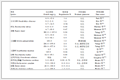
2.2 沉积剖面年代ZBT剖面AMS 14C年代测定在美国Beta实验室完成(表 1),测年材料为沉积物有机质;OSL年代测定在北京大学城市与环境学院光释光实验室完成(表 2)。AMS 14C年代数据利用IntCal 13树轮校准曲线进行日历年校正[21],误差范围为2σ。其中261~265cm处OSL年龄为5800±400a B.P.,出现倒置,与整体年代结果不符,不予采用。综合AMS14和OSL测年结果,推测ZBT剖面古土壤底部年龄为10cal.ka B.P.,顶部年龄为3.2cal.kaB.P.。
|
表 1 ZBT剖面AMS 14C测年结果及校正年代 Table 1 AMS 14C dating results of ZBT profile |
|
|
表 2 ZBT剖面OSL测年结果 Table 2 OSL dating results of ZBT profile |
镇北台(ZBT)剖面(38°20′N,109°44′E)位于毛乌素沙地东南与黄土高原交界处,属于陕西省榆林市镇北台地区。剖面位于由河流下切而出的河谷右岸,表层植被为沙蒿(Artemisia desertorum Spreng.)与禾本科植物。根据剖面岩性变化特征,将剖面自上而下划分为7个地层单元(图 2),岩性特征描述如下:
(1) SH:0~20cm,现代生草层,浅黄棕色,富现代植物根系和虫孔;
(2) P1:20~197cm,古土壤层,深黄棕色,紧实,可见植物根系、假菌丝体和虫孔;
(3) A1:197~237cm,风成砂层,灰棕色,松散,偶见植物根系;
(4) P2:237~248cm,古土壤层,深黄棕色,紧实,富植物根系和白色假菌丝体;
(5) A2:248~278cm,风成砂层,灰棕色,松散,偶见植物根系和钙粒;
(6) P3:278~384cm,弱发育砂质古土壤层,浅黄棕色,288~338cm发育略好,颜色较深;
(7) A3:384~524cm,风成砂层,浅灰棕色,细砂、粗砂互层,494~500cm颜色较上下层偏白。
3.2 常量元素含量特征地层中主要的造岩元素Si、Al、Fe、Mn、Ca、Mg、K、Na等都以氧化物的形式存在[22]。表 3列出了ZBT剖面主要氧化物在不同地层中的含量。根据主要氧化物的平均含量,ZBT剖面中主要的元素含量排序为SiO2>Al2O3>Na2O>K2O>Fe2O3>CaO>MgO。常量元素的变异系数(CV)反映了剖面化学元素含量的离散程度[23],整个剖面各元素变异系数较小(0.04 % ~0.45 %),风成砂层和古土壤层化学成分较为一致。其中Fe2O3、MgO和CaO在整个剖面中变化相对较大,而SiO2、Al2O3、Na2O和K2O的含量在整个剖面中较为稳定。常量元素中,K元素CV值最小。整体来说,SiO2、Na2O和K2O含量在古土壤层含量低于风成砂层,表现为相对亏损;而Al2O3、Fe2O3、MgO、CaO等则反之,在古土壤层相对富集。表生地球化学元素中Si元素在温湿条件下淋失较多,在剖面中表现为古土壤层含量低于风层砂层含量。而Al、Fe元素相对稳定,在化学风化过程中,由于温暖湿润气候条件下其余元素多被淋溶,Al2O3、Fe2O3在古土壤层中表现为相对富集。Ca、Mg元素相对活跃,其淋溶迁移与降水量密切相关,但变化程度不同,一般在半干旱的环境中易积累[24],ZBT剖面古土壤沉积时期,降水较风成砂层形成时期增多,造成了CaO、MgO在古土壤层的相对富集。Na、K元素在半干旱半湿润的环境中较为稳定,但在温湿条件下依旧少量淋失,古土壤层含量较风层砂层低。
|
|
表 3 ZBT剖面常量元素含量及其与其他沉积物对比 Table 3 Geochemical elements(oxides)and parameters of ZBT section, compared to other sediments |
对比ZBT剖面主要化学元素含量与上陆壳(UCC)的平均化学成分[25](图 3),除Si元素相对富集外,其余6种常量元素较UCC化学元素平均值都有不同程度的亏损,其中Fe、Mg、Ca这3种元素在剖面中的含量与UCC元素平均值差异较大,Na、K元素差异较小。ZBT剖面具有富硅、贫铁、贫镁、贫钙的特征,源区物质可能富含Si元素而其他6种常量元素相对淋失。除物源的化学成分影响外,剖面化学元素特征也可能与物质在搬运、沉积过程中受到的机械作用和后期的成壤作用有关。

|
图 3 ZBT剖面风成砂、古土壤层常量元素平均含量的UCC标准化值分布图 Fig. 3 The UCC-normalized pattern of major elements of the aeolian-palaeosol sequences in ZBT section |
受物源的影响,剖面中元素的绝对含量有时并不能真实反映剖面后期风化成壤过程中的地球化学元素行为[6, 27]。为了进一步探究古土壤层的发育情况并消除物源带来的误差,根据公式(1)[28]来计算剖面中古土壤层和风成砂层其他常量元素的变化率百分数,从而获知元素的迁移与富集程度。

|
(1) |
XS和IS分别代表样品中元素Ⅹ和参比元素Ⅰ的含量,XL和IL分别代表上述元素在原始母质中的含量。
由于剖面风化前的原始母质成分未知,本文选取风化程度最弱的A3层数据近似代表母质成分,选取ZBT剖面中变异系数最小的K元素作为参照元素。结果表明(图 4),古土壤层中的Al、Fe、Mg、Ca元素相对富集。Al、Fe、Mg、Ca这4种元素的富集程度依次为P1层最高,P2层居中,P3层最低。而Si、Na元素为迁移元素。其中Si元素在古土壤层和风成砂层中都表现为迁移状态,程度大体相同。而Na元素在迁移能力方面则表现为P1 > P3>P2。综合常量元素在各层的迁移富集状况,P1层古土壤发育相对较好,P2、P3层发育较弱。

|
图 4 ZBT剖面各层常量元素相对于K元素的迁移率(%) Fig. 4 Migration ratios(%)of major elements of ZBT profile calculated relative to the stable element K |
通过土壤微形态可以直观的识别土壤沉积物的质地和结构[29~31]。ZBT剖面土壤微形态特征显示整个剖面以砂粒为主,主要矿物为石英、长石、云母和岩屑矿物(图 5)。土壤形成过程就是不稳定矿物受到风化被分解,颗粒变细或消失的过程[31]。选取不同古土壤层位典型土壤发育特征图片可以直观看出不同古土壤层发育程度在质地上表现出的明显差别。通过土壤微形态特征(图 5),P3阶段砂粒含量约86 %,粉砂含量约8 %,粘粒矿物含量6 %左右,其中矿物岩屑含量约5 %。斜长石绢云母化普遍发育,镜下的土壤粘粒较少。P1阶段砂粒含量约81 %,粉砂含量约9 %,粘粒矿物8 %左右,其中矿物岩屑含量约为8 %。斜长石绢云母化加深,长石粘土化,发现成壤作用粘土风化的产物(胶结物)以及粘土后生作用产物(泥岩岩屑)。综合ZBT剖面指示植被覆盖度的TOC指标和化学元素相关土壤指标对3层古土壤发育程度进行进一步探讨(图 5)。

|
图 5 ZBT剖面土壤微形态(图中红色区域为土壤粘粒,(c)中黄色部分为胶结物,(d)中黄色部分为泥岩岩屑)和环境指标变化 Fig. 5 Soil micromorphology (the red area is clay and the yellow area is cement (c) and mudstone (d)) and environmental variation indicators of ZBT profile |
(1) P3阶段:有机质含量(1.1 % ~3.2 %)偏低,此阶段后期有机质含量明显升高。CIA指数均值为51.55,(Al2O3+Fe2O3)/(CaO+Na2O+MgO+K2O)均值1.7,表明淋溶较弱。SiO2/(Al2O3+Fe2O3)均值5.9、Na/K均值1.68,2个指标均值较高,后期其值降低。反映气候向暖湿转变,成壤作用开始增强但较微弱。
(2) P2阶段:有机质含量(1.4 % ~3.1 %)较上一阶段有所增高。CIA指数均值为51.19,(Al2O3+Fe2O3)/(CaO+Na2O+MgO+K2O)均值1.79,相对偏低。SiO2/(Al2O3+Fe2O3)均值5.3、Na/K均值1.79,较上一阶段风化加强但土壤粘化程度较弱。此阶段成壤作用稍有增强。
(3) P1阶段:有机质含量(0.5 % ~5.3 %)较高,最低值和最高值均为3个阶段极值。CIA指数均值为52.61,(Al2O3+Fe2O3)/(CaO+Na2O+MgO+K2O)均值1.7,相对较高。SiO2/(Al2O3+Fe2O3)均值5.0、Na/K均值1.57,为3个古土壤阶段中最低值。各指标曲线均波动明显,表明此阶段气候相对暖湿,成壤作用较强,但整体并不稳定。
4 讨论 4.1 毛乌素沙地东南缘风化成壤程度毛乌素沙地东南缘全新世以来受东亚季风的影响[16],砂质古土壤主要受夏季风控制形成。对比同处在东亚季风控制下神木市JJ剖面(38°44.594′N,110°10.044′E)的CIA值(49.01~53.44)[6]和Shenmu剖面(38°54.267′N,110°27.1′E)的CIA值(43~57)[8],ZBT剖面的CIA值介于43.74~62.59(图 5和6)。CIA指数是判断沉积物化学风化程度的指标,其值介于50~65之间,反映了较低的化学风化程度[32~34]。就同区域不同剖面位置来看,ZBT剖面风化程度较好,但波动较大,可能是地形和相对位置不同造成了区域内部风化成壤程度的差异。相较下蜀黄土[35]和宣城红土[33]等土壤,ZBT剖面风化程度相对接近UCC和洛川黄土[36]。以上这一特征同样反映在ZBT剖面风成砂与古土壤样品的A-CN-K三角模型图中(图 6)。ZBT剖面数据点集中分布于上陆壳(UCC)至陆源页岩(PAAS)的化学风化趋势线上,风化趋势与A-CN连线平行指示了斜长石的初级风化阶段,表明斜长石最先风化分解。在A-CN-K三角图中的投影点位置可以看出其经历的化学风化仍处在去Ca、Na的初级化学风化阶段,对应了ZBT剖面的古土壤矿物中多是斜长石风化和蚀变的镜下特征。自全新世以来毛乌素沙地东南缘受东亚夏季风影响,与贾飞飞等[37]在毛乌素沙漠东南缘湖沼相沉积物粒度记录的结果一致;但由于东亚夏季风对内陆影响偏弱,风化程度依旧偏低,属于弱化学风化阶段。

|
图 6 ZBT剖面沉积物A-CN-K三角图 图中所列剖面在4.1中涉及到 Fig. 6 A-CN-K ternary diagram of section in ZBT. The profiles listed in the figure 6 are detailed in 4.1 |
虽然毛乌素沙地东南缘风化成壤作用较弱,其成壤强度依然随气候的冷暖变化呈现出一定规律。根据ZBT剖面3层古土壤发育的相关指标,结合年代数据,对毛乌素沙地东南缘全新世以来的成壤环境阶段进行划分(图 7)。

|
图 7 ZBT剖面古土壤发育的环境指标变化与其他古气候记录对比 (a)ZBT剖面重建古降水[38];(b)毛乌素沙地古土壤分布比例[39];(c)ZBT地区重建古降水[16];(d)岱海全新世暖湿程度恢复[40] Fig. 7 Compared the degree of palaeosol development from ZBT profile with other paleoclimate records. (a)Reconstructed precipitation for the ZBT profile[38]; (b)Proportion of palaeosol distribution in the Mu Us Desert[39]; (c)Paleo-rainfall reconstruction for the ZBT area[16]; (d)Holocene warm/humid condition in Daihai Lake[40] |
10.0~8.1 cal.ka B.P.,古土壤中粗颗粒明显,粘粒含量低。CIA指数和SiO2/(Al2O3+Fe2O3)等化学风化指数表明化学风化微弱,相较下伏风成砂无明显变化。土壤粘化作用程度指标Na/K开始逐渐变小,表明成壤作用开始但程度微弱[6]。而TOC值的逐渐增长也表明这一阶段植被覆盖度增加,间接证明气候向温湿转变,成壤作用加强。位于榆林市镇北台地区(38°19.783′N,109°43.933′E)重建的古降水记录[38]显示,这一时期降水开始逐渐增多。Wu等[41]认为10ka以后,毛乌素沙地沙丘大部分固定,创造了成壤的基本条件。镇北台东北部的神木市DBY剖面(38°48.6′N,109°23.4′E)也在这一时段发育了较好的古土壤层[42],表明此期间毛乌素沙地不止一处开始发育古土壤。同样受东亚夏季风影响的岱海,湖泊沉积物孢粉显示这一阶段在干草和灌木中出现了阔叶林树种[40],植被的变化也反映出此阶段土壤的肥力有所增强。
6.9 cal.ka B.P.左右,古土壤层各指标明显与风成砂层形成对比,SiO2/(Al2O3+Fe2O3)表明古土壤发育程度加强。反映成壤作用下磁性矿物增多的磁化率明显增大,成壤作用加强[43]。位于神木市的杨桃峁剖面(38°48′N,110°20′E)也在7.8~6.9kaB.P.发育了程度较好的古土壤[44]。岱海湖泊沉积物孢粉也显示在7.2~6ka B.P.气候温暖且湿度提高,成壤作用加强[40]。
5.5~3.7 cal.ka B.P.,古土壤中粘粒发育明显,并发育胶结物、泥岩岩屑等成壤作用较强的产物。CIA指数和SiO2/(Al2O3+Fe2O3)表明化学风化加深,Na/K的逐渐减小也反映了成壤作用的逐渐加强。(Al2O3+Fe2O3)/(CaO+Na2O+MgO+K2O)指数反映本阶段淋失程度最强,气候较为温暖湿润,导致化学元素大量淋失。各指标曲线都表明此阶段为成壤作用最强的阶段,但可以看出曲线的波动较大,明显具有不稳定性。降水量在本阶段虽略有下降[16],但区域内可能迎来了最适宜古土壤发育的水热组合条件,导致成壤作用加强。位于榆林市SDG剖面(38°19′ N,109°43′E)的粘粒含量和化学元素也反映了这一期间气候温暖湿润,但存在干冷变动[14]。沙地边缘的靖边地区TOC指标也呈现出明显的高值,表明区域内植被覆盖度较高[45]。毛乌素沙地内部古土壤的占比也在6~4ka B.P.达到一个鼎盛的阶段[39]。岱海地区在6.0~5.1ka B.P.气候暖湿,5~4ka B.P.气候波动明显[40],也对应了本文中成壤强度具有不稳定性的特征。
5 结论通过对毛乌素沙地东南缘ZBT剖面化学元素与土壤微形态等指标的分析,结论如下:
(1) ZBT剖面化学元素氧化物以SiO2、Al2O3和Na2O为主,具有富硅、贫铁、贫镁、贫钙的特征。整个剖面处于初级化学风化阶段,风化成壤作用整体较弱。P1层古土壤成壤作用较P2、P3层古土壤强。
(2) ZBT剖面主要矿物为石英、长石、云母和岩屑矿物,成壤作用较强的P1层古土壤可见胶结物和泥岩岩屑等土壤形成物。
(3) 毛乌素沙地东南缘成壤强度整体较弱,但随气候的冷暖变化呈现出一定的变化规律:10.0~8.1kaB.P.,成壤微弱,气候向暖湿转变;6.9ka B.P.左右,成壤作用稍有加强,暖湿程度提高;5.5~3.7kaB.P.,成壤作用最强,气候相对暖湿,水热配比好,但此阶段气候具有明显不稳定性。
| [1] |
Bradley R S. Paleoclimatology:Reconstructing Climates of the Quaternary[M]. New York: Elsevier, 1999: 4-8.
|
| [2] |
Bader N E, Spencer P K, Bailey A S, et al. A loess record of pre-Late Wisconsin glacial outburst flooding, Pleistocene paleoenvironment, and Irvingtonian fauna from the Rulo site, southeastern Washington, USA[J]. Palaeogeography, Palaeoclimatology, Palaeoecology, 2016, 462: 57-69. DOI:10.1016/j.palaeo.2016.08.042 |
| [3] |
Fitzsimmons K E, Magee J W, Amos K J. Characterisation of aeolian sediments from the Strzelecki and Tirari Deserts, Australia:Implications for reconstructing palaeoenvironmental conditions[J]. Sedimentary Geology, 2009, 218(1-4): 61-73. DOI:10.1016/j.sedgeo.2009.04.004 |
| [4] |
Compostella C, Mariani G S, Trombino L. Holocene environmental history at the treeline in the Northern Apennines, Italy:A micromorphological approach[J]. The Holocene, 2014, 24(4): 393-404. DOI:10.1177/0959683613518588 |
| [5] |
孙继敏, 丁仲礼, 刘东生. 50万年来沙漠-黄土边界带的环境演变[J]. 干旱区地理, 1995, 18(4): 1-9. Sun Jimin, Ding Zhongli, Liu Tungsheng. Environmental changes in the desert-loess transitional zone of North China since 50 Ma[J]. Arid Land Geography, 1995, 18(4): 1-9. DOI:10.3321/j.issn:1000-6060.1995.04.001 |
| [6] |
Liu B, Jin H L, Sun L Y, et al. Geochemical evidence for Holocene millennial-scale climatic and environmental changes in the south-eastern Mu Us Desert, Northern China[J]. International Journal of Earth Sciences, 2015, 104(7): 1889-1900. DOI:10.1007/s00531-015-1161-7 |
| [7] |
Liu B, Jin H L, Sun L Y, et al. Geochemical characteristics of Holocene aeolian deposits and their environmental significance in the Mu Us Desert, Northern China[J]. Geological Journal, 2016, 51(3): 325-337. DOI:10.1002/gj.v51.3 |
| [8] |
Wen X H, Li B S, Zheng Y M, et al. Early Holocene multi-centennial moisture change reconstructed from lithology, grain-size and chemical composition data in the eastern Mu Us Desert and potential driving forces[J]. Palaeogeography, Palaeoclimatology, Palaeoecology, 2016, 459: 440-452. DOI:10.1016/j.palaeo.2016.07.035 |
| [9] |
Sun J M, Li S H, Peng H, et al. Holocene environmental changes in the central Inner Mongolia, based on single-aliquot-quartz optical dating and multi-proxy study of dune sands[J]. Palaeogeography, Palaeoclimatology, Palaeoecology, 2006, 233(1-2): 51-62. DOI:10.1016/j.palaeo.2005.09.016 |
| [10] |
Lu H Y, Miao X D, Zhou Y L, et al. Late Quaternary aeolian activity in the Mu Us and Otindag dune fields(North China) and lagged response to insolation forcing[J]. Geophysical Research Letters, 2005, 32(21): 2465-2475. |
| [11] |
Mason J A, Lu H Y, Zhou Y L, et al. Dune mobility and aridity at the desert margin of Northern China at a time of peak monsoon strength[J]. Geology, 2009, 37(10): 947-950. DOI:10.1130/G30240A.1 |
| [12] |
马冀, 岳乐平, 杨利荣, 等. 毛乌素沙漠东南缘全新世剖面光释光年代及古气候意义[J]. 第四纪研究, 2011, 31(1): 120-129. Ma Ji, Yue Leping, Yang Lirong, et al. OSL dating of Holocene sequence and palaeoclimate change record in southeastearn margin of Mu Us Desert, North China[J]. Quaternary Sciences, 2011, 31(1): 120-129. DOI:10.3969/j.issn.1001-7410.2011.01.16 |
| [13] |
高尚玉, 陈渭南, 靳鹤龄, 等. 全新世中国季风区西北缘沙漠演化初步研究[J]. 中国科学(B辑), 1993, 23(2): 202-208. Gao Shangyu, Chen Weinan, Jin Heling, et al. Study on evolution of the northwestern margin monsoon region of the desert, Holoence, China[J]. Science in China (Series B), 1993, 23(2): 202-208. |
| [14] |
鲁瑞洁, 王亚军, 张登山. 毛乌素沙地15 ka以来气候变化及沙漠演化研究[J]. 中国沙漠, 2010, 30(2): 273-277. Lu Ruijie, Wang Yajun, Zhang Dengshan. Climate changes and desert evolution of Mu Us Desert since 15 ka BP[J]. Journal of Desert Research, 2010, 30(2): 273-277. |
| [15] |
Lu H Y, Yi S W, Liu Z Y, et al. Variation of East Asian monsoon precipitation during the past 21 k.y. and potential CO2 forcing[J]. Geology, 2013, 41(9): 1023-1026. DOI:10.1130/G34488.1 |
| [16] |
Chen Y Y, Lu H Y, Yi S W, et al. A preliminary quantitative reconstruction of precipitation in southern Mu Us sandy land at margin of Asian monsoon-dominated region during Late Quaternary[J]. Journal of Geographical Sciences, 2015, 25(3): 301-310. DOI:10.1007/s11442-015-1169-8 |
| [17] |
Jia F F, Lu R J, Gao S Y, et al. Holocene aeolian activities in the southeastern Mu Us Desert, China[J]. Aeolian Research, 2015, 19: 267-274. DOI:10.1016/j.aeolia.2015.01.002 |
| [18] |
高由禧. 东亚季风的若干问题[M]. 北京: 科学出版社, 1962: 78-87. Gao Youxi. Several Problems of East Asian Monsoon[M]. Beijing: Science Press, 1962: 78-87. |
| [19] |
陈渭南, 高尚玉. 毛乌素沙地全新世地层化学元素特点及其古气候意义[J]. 中国沙漠, 1994, 14(1): 22-30. Chen Weinan, Gao Shangyu. On the Holocene geochemical landscape characteristics and its paleoclimatic meaning, Mu Us Sand Sea[J]. Journal of Desert Research, 1994, 14(1): 22-30. DOI:10.3321/j.issn:1000-694X.1994.01.009 |
| [20] |
赵宣, 韩霁昌, 王欢元, 等. 毛乌素沙漠-黄土高原过渡带土壤养分空间异质性[J]. 生态学报, 2016, 36(22): 7446-7452. Zhao Xuan, Han Jichang, Wang Huanyuan, et al. Soil nutrient spatial heterogeneity in the Mu Us Desert-Loess Plateau transition zone[J]. Acta Ecologica Sinica, 2016, 36(22): 7446-7452. |
| [21] |
Reimer P J, Bard E, Bayliss A, et al. IntCal 13 and Marine 13 radiocarbon age calibration curves 0-50000 years cal BP[J]. Radiocarbon, 2013, 55(4): 1869-1887. DOI:10.2458/azu_js_rc.55.16947 |
| [22] |
高尚玉, 董光荣, 李保生. 陕西榆林地区古风成沙地层中化学元素含量变化与气候环境[J]. 中国沙漠, 1985, 5(3): 25-30. Gao Shangyu, Dong Guangrong, Li Baosheng. The content changes of chemical elements in the loess section of eolian sands and the climatic environments in Yulin region, Shaanxi Province[J]. Journal of Desert Research, 1985, 5(3): 25-30. |
| [23] |
卞鸿雁, 庞奖励, 黄春长, 等. 汉江上游谷地与渭河谷地黄土化学风化程度比较[J]. 地理研究, 2014, 33(4): 654-664. Bian Hongyan, Pang Jiangli, Huang Chunchang, et al. A comparative study of chemical weathering intensity and element transport features of loess-palaeosol in the upper reaches of Hanjiang and Weihe river valleys, China[J]. Geographical Research, 2014, 33(4): 654-664. |
| [24] |
靳鹤龄, 苏志珠, 孙忠. 浑善达克沙地全新世中晚期地层化学元素特征及其气候变化[J]. 中国沙漠, 2003, 23(4): 366-371. Jin Heling, Su Zhizhu, Sun Zhong. Characters of chemical elements in strata of Middle and Late Holocene in Hunshandake Desert and the indicating climatic changes[J]. Journal of Desert Research, 2003, 23(4): 366-371. DOI:10.3321/j.issn:1000-694X.2003.04.005 |
| [25] |
Tayloy S R, Mclennan S M. The Continental Crust:Its Composition and Evolution[M]. Oxford: Blackwell Press, 1985: 227.
|
| [26] |
邵菁清, 杨守业. 化学蚀变指数(CIA)反映长江流域的硅酸盐化学风化与季风气候[J]. 科学通报, 2012, 57(11): 933-942. Shao Jingqing, Yang Shouye. Does chemical index of alteration (CIA) reflect silicate weathering and monsoonal climate in the Changjiang River basin?[J]. Chinese Science Bulletin, 2012, 57(10): 1178-1187. |
| [27] |
Brimhall G H, Lewis C J, Ague J J, et al. Metal enrichment in bauxites by deposition of chemically mature aeolian dust[J]. Nature, 1988, 333(6176): 819-824. DOI:10.1038/333819a0 |
| [28] |
陈骏, 季峻峰, 仇纲, 等. 陕西洛川黄土化学风化程度的地球化学研究[J]. 中国科学(D辑), 1997, 27(6): 531-536. Chen Jun, Ji Junfeng, Chou Gang, et al. Geochemical studies of the intensities of chemical weathering in the Luochuan loess, Shaanxi Province[J]. Science in China (Series D), 1997, 27(6): 531-536. DOI:10.3321/j.issn:1006-9267.1997.06.004 |
| [29] |
Mahmoodi S, Heidari A, Masihabadi M H, et al. Soil-landscape relationship as indicated by micromorphological data on selected soils from Karaj Basin, Iran[J]. Journal of Agriculturalence & Technology, 2007, 9(2): 153-164. |
| [30] |
Eze P N, Meadows M E. Texture contrast profile with stonelayer in the Cape Peninsula, South Africa:Autochthony and polygenesis[J]. Catena, 2014, 118: 103-114. DOI:10.1016/j.catena.2014.01.014 |
| [31] |
何毓蓉, 张丹. 土壤微形态研究理论与实践[M]. 北京: 地质出版社, 2015: 3-4. He Yurong, Zhang Dan. Theory and Practice of Soil Micromorphology[M]. Beijing: Geological Publishing House, 2015: 3-4. |
| [32] |
Nesbitt H W, Young G M. Early Proterozoic climates and plate motions inferred from major element chemistry of lutites[J]. Nature, 1982, 299(5885): 715-717. DOI:10.1038/299715a0 |
| [33] |
李徐生, 杨达源, 鹿化煜. 皖南风尘堆积序列氧化物地球化学特征与古气候记录[J]. 海洋地质与第四纪地质, 1999, 19(4): 75-82. Li Xusheng, Yang Dayuan, Lu Huayu. Oxide-geochemistry features and paleoclimatic record of the aeolian-dust depositional sequence in southern Anhui[J]. Marine Geology & Quaternary Geology, 1999, 19(4): 75-82. |
| [34] |
Bian H Y, Pang J L, Huang C C, et al. Geochemical characterization of loess-paleosol sequences:Comparison between the upper reaches of the Hanjiang and Weihe River valleys, China[J]. Journal of Geographical Sciences, 2017, 27(1): 95-108. DOI:10.1007/s11442-017-1366-8 |
| [35] |
李徐生, 韩志勇, 杨守业, 等. 镇江下蜀土剖面的化学风化强度与元素迁移特征[J]. 地理学报, 2007, 62(11): 1174-1184. Li Xusheng, Han Zhiyong, Yang Shouye, et al. Chemical weathering intensity and element migration features of the Xiashu Loess profile in Zhenjiang[J]. Acta Geographica Sinica, 2007, 62(11): 1174-1184. |
| [36] |
陈骏, 安芷生, 刘连文, 等. 最近2.5 Ma以来黄土高原风尘化学组成的变化与亚洲内陆的化学风化[J]. 中国科学:地球科学(D辑), 2001, 31(2): 136-145. Chen Jun, An Zhisheng, Liu Lianwen, et al. Variations in chemical compositons of the eolian dust in Chinese Loess Plateau over the past 2.5 Ma and chemical weathering in the Asian inland[J]. Science in China(Series D), 2001, 31(2): 136-145. |
| [37] |
贾飞飞, 鲁瑞洁, 高尚玉. 毛乌素沙漠东南缘湖沼相沉积物粒度特征记录的12.2 cal. ka B. P.以来的区域环境变化[J]. 第四纪研究, 2018, 38(5): 1211-1220. Jia Feifei, Lu Ruijie, Gao Shangyu. Environmental changes recorded from grain-size characteristics of the lacustrine-peat sediments from southeastern margin of Mu Us Desert since 12.2 cal. ka B. P.[J]. Quaternary Sciences, 2018, 38(5): 1211-1220. |
| [38] |
Liu X K, Lu R J, Lv Z Q, et al. Magnetic susceptibility of surface soils in the Mu Us Desert and its environmental significance[J]. Aeolian Research, 2017, 25: 127-134. DOI:10.1016/j.aeolia.2017.04.003 |
| [39] |
Zhao S, Xia D S, Jin H L, et al. Long-term weakening of the East Asian summer and winter monsoons during the mid-to Late Holocene recorded by aeolian deposits at the eastern edge of the Mu Us Desert[J]. Palaeogeography, Palaeoclimatology, Palaeoecology, 2016, 457: 258-268. DOI:10.1016/j.palaeo.2016.06.011 |
| [40] |
Xiao J L, Xu Q H, Nakamura T, et al. Holocene vegetation variation in the Daihai Lake region of north-central China:A direct indication of the Asian monsoon climatic history[J]. Quaternary Science Reviews, 2004, 23(14): 1669-1679. |
| [41] |
Wu J, Lu H Y, Yi S W, et al. Establishing a high-resolution luminescence chronology for the Zhenbeitai sand-loess section at Yulin, North-Central China[J]. Quaternary Geochronology, 2019, 49: 78-54. DOI:10.1016/j.quageo.2018.03.013 |
| [42] |
Zhou Y L, Lu H Y, Zhang J F, et al. Luminescence dating of sand-loess sequences and response of Mu Us and Otindag sand fields(North China) to climatic changes[J]. Journal of Quaternary Sciences, 2009, 24(4): 336-344. DOI:10.1002/jqs.v24:4 |
| [43] |
Maher B A, Thompson R. Mineral magnetic record of the Chinese loess and paleosols[J]. Geology, 1991, 19: 3-6. DOI:10.1130-/0091-7613(1991)019<0003:MMROTC>2.3.CO;2 |
| [44] |
周杰, 周卫健, 陈惠忠, 等. 新仙女木时期东亚夏季风降水不稳定的证据[J]. 科学通报, 1999, 44(2): 205-208. Zhou Jie, Zhou Weijian, Chen Huizhong, et al. Evidence for Asian summer monsoon precipitation instability of Younger Dryas[J]. Chinese Science Bulletin, 1999, 44(2): 205-208. DOI:10.3321/j.issn:0023-074X.1999.02.021 |
| [45] |
Xiao J L, Nakamura T, Lu H Y, et al. Holocene climate changes over the desert/loess transition of north-central China[J]. Earth and Planetary Science Letters, 2002, 197(1): 11-18. |
2 Engineering Center of Desertification and Blown-Sand Control of Ministry of Education, Faculty of Geographical Science, Beijing Normal University, Beijing 100875;
3 Key Laboratory of Environmental Change and Natural Disaster of Ministry of Education, Faculty of Geographical Science, Beijing Normal University, Beijing 100875;
4 School of Geography and Tourism, Shaanxi Normal University, Xi'an 710062, Shaanxi;
5 School of Urban and Environmental Sciences, Liaoning Normal University, Dalian 116029, Liaoning)
Abstract
Palaeosol is an important source of information for the reconstruction of paleoenvironment because of its rich environmental information. There is no clear explanation for the degree of development of palaeosol in the southeastern margin of the Mu Us Desert. This paper selected a typical aeolian-palaeosol sequence (ZBT profile:38°20'N, 109°44'E) located at junction of the southeastern margin of the Mu Us Desert and the Loess Plateau. ZBT profile belongs to Zhenbeitai area of Yulin City, Shaanxi Province. ZBT profile was 524 cm in depth, and 156 samples were taken at an interval of 2 cm in palaeosol section, while 58 samples were taken at an interval of 5 cm in aeolian section. Based on the 6 dates of AMS 14C and 3 dates of OSL, it is speculated that the age of bottom of the paleosol is 10 cal.ka B. P., and the age of the top is 3.2 cal.ka B. P. The characteristics of major elements in the sediments and the intensity of the soil were analyzed. The results showed that the major elements of ZBT profile were SiO2, Al2O3 and Na2O, indicated that the section is always in the primary weathering stage with leaching Ca and Na from CIA index, which indicated that may be a relatively arid climate environment since the Holocene in the region, and the weathering effect was weak, but there were a small cold and warm climate cycling. The soil micromorphology also showed that the weathering of the ZBT profile was relatively weak. The main minerals were quartz, feldspar, mica and lithic minerals of palaeosol. Pedogenesis product such as cements and mudstones can be seen. The changes in the intensity of pedogenesis were consistent with the characteristics of chemical elements:From 10.0 cal.ka B.P. to 8.1 cal.ka B.P., the pedogenesis were weak, and the climate shifted to warm and humid; At about 6.9 cal.ka B. P., the pedogenesis were slightly strengthened; From 5.5 cal.ka B.P. to 3.7 cal.ka B. P., pedogenesis were the strongest, the climate was relatively warm and humid, chemical and biological weathering strengthened, but this stage was obvious instability.