 2019, Vol.39


2 中国地震局地质研究所, 地震动力学国家重点实验室, 北京 100029)
北京时间2016年11月25日22时24分,在新疆克孜勒苏柯尔克孜自治州阿克陶县木吉盆地西北部发生了中强地震,造成1人死亡,多人受伤,大量房屋倒塌。中国地震台网(CENC)测定的震级为MS6.7,震中位于39.27°N,74.04°E,震源深度10 km(http://www.cea.gov.cn/publish/dizhenj/464/515/20161125231007712890916/index.html)。根据美国地质调查局(USGS)的震源机制反演结果显示,本次地震属于走滑拉张型地震,地震震中距离阿克陶县165 km,震中海拔3700 m,周边多个市、县震感强烈,地震不仅在山区引发了大量的山体崩塌、滑坡等次生地质灾害,而且还在极震区维日麻村和布拉克村引发了强烈的砂土液化和地裂缝,是这两个地区房屋财产损失最主要的诱因之一。砂土液化是一种常见的地震地质灾害[1~4]。砂土液化是指粒间无内聚力的松散砂体,主要靠粒间摩擦力维持本身的稳定性和承受外力。当受到震动时,粒间剪力使砂粒间产生滑移,改变排列状态。如果砂土原处于非紧密排列状态,就会有变为紧密排列状态的趋势;如果砂的孔隙是饱水的,要变密实就需要从孔隙中排出一部分水,如果砂粒很细则整个砂体渗透性不良,瞬间振动变形需要从孔隙中排出的孔隙水来不及排出砂体之外,结果必然使砂体中空隙水压力孔隙上升,砂粒至今的有效正应力就随之而降低,当空隙水压力上升到使砂粒间有效正应力降为零时,砂粒就会悬浮于水中,砂体也就完全丧失了强度和承载能力,这种砂水悬浮液在上覆土层压力作用下,可能冲破土层薄弱部位喷到地表,这就是喷砂冒水。
迄今为止,已经在众多的地震中发现了砂土液化现象,例如1964年的日本新滹MW7.5地震[5],砂土液化引起了大量的砂沸、地基承载力丧失、不均匀沉降等,该次地震中仅由砂土液化造成的损失就超过10亿美元;1989年普里塔MW6.9地震[6]、1999年台湾集集MW7.5地震[7~9],不同地震发生的砂土液化具有明显的差异性,同时对建筑物的工程结构也产生了不同程度的破坏。
木吉盆地属于帕米尔高原内部的断陷拉分盆地,平均海拔在3300 m以上,冬季平均气温约为- 10 ℃,而夏季平均气温约为29 ℃,该地区存在季节性冻土。季节性冻土[10]是指在年平均气温高于0 ℃的地区,冬季气温下降至0 ℃之下后结冻,并在春季解冻的土壤,是土壤与气温相互作用的结果。本次地震导致极震区冻土区发生了大面积的砂土液化,陈永明等[11]对昆仑山口西MS8.1地震调查时发现冻土区的砂土液化现象,是冻土下部融土层发生液化。冻土地区同震发生的砂土液化现象较少,相较昆仑山口西MS8.1大型破坏性地震所释放的能量,阿克陶MS6.7地震释放的能量较小,但同样诱发了一定范围的砂土液化。季节性冻土地区发生的砂土液化存在一定的差异性,本文通过分析阿克陶MS6.7地震现场考察得到的数据,分析砂土液化与地裂缝之间的关系,探讨了季节性冻土区砂土液化的特点。
1 地震地质概况震区位于新疆克孜勒苏柯尔克孜自治州阿克陶县,北部涉及到喀什地区乌恰县,震中海拔3700 m左右。截止2016年11月30日24时,新疆地震台网共记录到阿克陶地震余震553次,其中5.0~5.9级地震1次,4.0~4.9级地震2次,3.0~3.9级地震43次,最大余震为5.0级。余震主要分布在主震的南侧,呈近东西向,与木吉断裂的走向近一致。
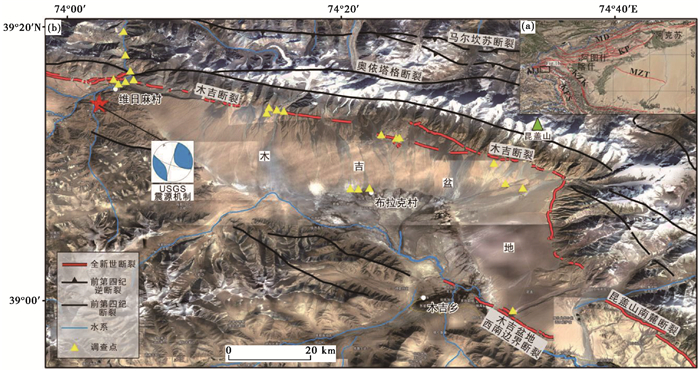
阿克陶县位于我国新疆维吾尔自治区西部与吉尔吉斯斯坦和塔吉克斯坦接壤,地震宏观震中位于木吉乡,极震区烈度达Ⅷ度,大地构造上处于塔里木南缘晚古生代活动陆缘[12],帕米尔构造结内,是印度板块向欧亚板块碰撞的两个支点之一,是板块动力作用最强烈、地震活动最频繁的地区之一[13~15],距离震中100 km内,发生过17次6级以上地震,主要为2016年6月26日吉尔吉斯斯坦MW6.4地震、2015年10月26日兴都库什MW7.5地震以及1975年乌恰7.3级地震。本次地震的发震构造为木吉断裂,该断裂为公格尔山拉张系的北端的转换断层,分布在昆盖山南麓山前(图 1和2),长度超过100 km,走向NWW,断面近直立,以右旋走滑为主,带有一定的正断层分量。沿断层一线发育有清晰的断层三角面,常见冰碛堆积物和冲沟被右旋断错,为一条全新世活动断裂[16~23]。公格尔山拉张系断裂有历史记录以来发生的最大地震为1895年7月5日的塔什库尔干7级地震,形成了约27 km长的同震地表破裂带[21, 24]。该区域活动构造研究程度较低,对断裂一线进行了较为密集的踏勘,共30余个调查点(图 1)。
|
图 1
木吉盆地卫星影像解译
(a)区域构造断裂图;(b)木吉盆地卫星影像图 MD——迈丹断裂(Maidan fault),KP——柯坪断裂(Keping fault),MZT——玛扎塔格断裂(Mazatage fault),KZK——卡兹克阿尔卡特断裂(Kazike-arte fault),KES——公格尔山拉张系(Kongur Extension System),MJ——木吉断裂(Muji fault)) Fig. 1 (a)Geological structure map of the Western Pamirs; (b)Seismic intensity and seismic geological hazard survey points of the 2016 Akto earthquake in map view of the Muji basin |
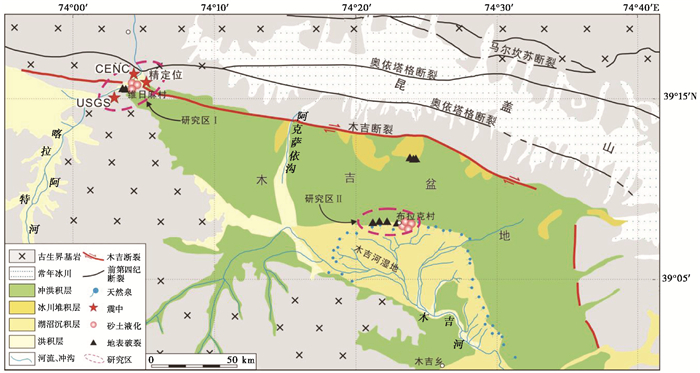
|
图 2 研究区地质构造图 Fig. 2 Geological structure map of the Muji basin |
阿克陶MS6.7地震引起的砂土液化主要集中在震中维日麻村(研究区Ⅰ)和极震区内的布拉克村(研究区Ⅱ)(图 2):维日麻村的砂土液化发生在喀拉阿特河高河漫滩上,喷出物质主要为粉砂、粉土;布拉克村的砂土液化形成于昆盖山山前洪积扇前缘与木吉河湿地交汇的沼泽地区,土质以饱和的粉土为主。震后笔者对研究区Ⅰ、Ⅱ进行了细致的砂土液化调查与统计,分析砂土液化的形成机制,总结了高原季节性冻土地区砂土液化的特点。
2.1 砂土液化特征 2.1.1 研究区Ⅰ对震中维日麻村(图 2)进行实地调查后,发现在喀拉阿特河的南岸T1阶地上发育大面积呈片状分布的泉(图 3a和3b),泉眼中为灰黑色粉土、粉砂,土质松散,含水量较高,部分泉眼结冻。本次地震引起的砂土液化以泉眼和地裂缝(图 3a和3d)喷发两种形式为主,砂土液化涉及面积1000 m2,对T1阶地上各类型的砂土液化进行统计分析(表 1):统计T1阶地上原有泉眼108个,本次地震有21个泉眼发生了砂土液化,约占总数的20 %,喷砂口直径为0.05~0.2 m,喷出锥最大高度为15 cm;统计砂土液化喷沙锥的总覆盖面积约为36.1 m2,沿泉眼形成砂土液化的面积约为21.5 m2,占砂土液化总面积的80 %,其余为沿地裂缝形成的砂土液化。
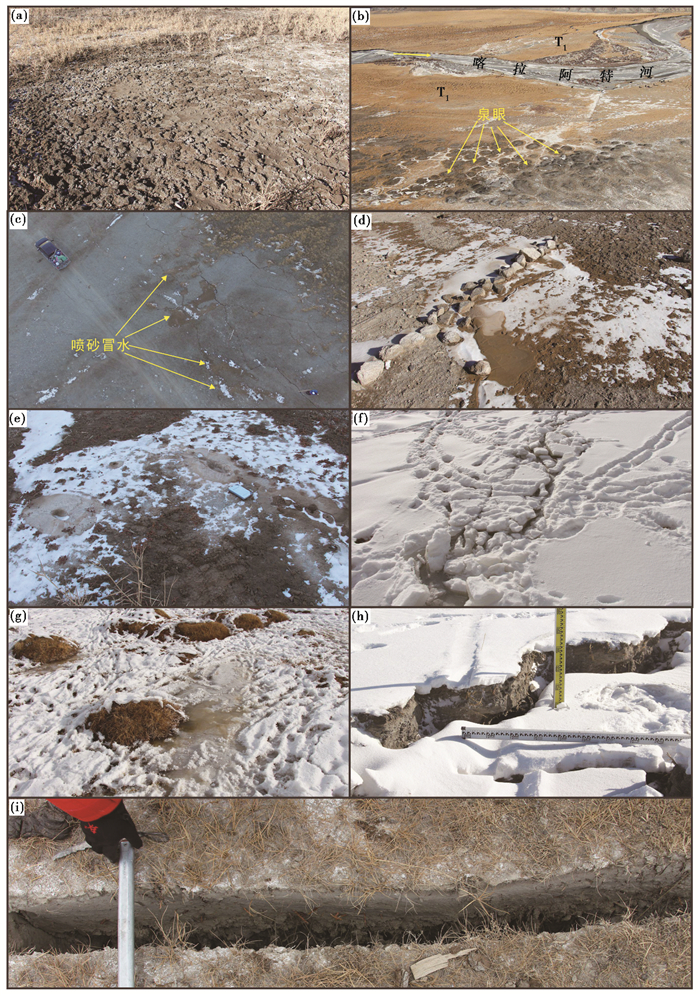
|
图 3 阿克陶地震砂土液化与地裂缝的照片 (a)喀拉阿特河T1阶地上的泉眼;(b)喀拉阿特河T1阶地上泉眼的分布;(c)震中研究区Ⅰ沿同震地裂缝发育的砂土液化;(d)沿地裂缝发育的砂土液化特征;(e)震中喷砂冒水喷出锥特征;(f)研究区Ⅱ布拉克村地裂缝特征,裂缝中液体已结冻;(g)研究区Ⅱ布拉克村沿草甸形成的喷砂冒水特征;(h)研究区Ⅱ布拉克村地裂缝特征,塔尺总长为5 m,深入近3 m;(i)研究区Ⅰ喀拉阿特河T1阶地地裂缝 Fig. 3 Field photographs of Akto MS6.7 earthquake. (a)The primary spring at the epicenter; (b)Distribution of primary spring in the epicenter; (c)and (d) Liquefaction originating from ground fissures in the epicenter; (e)The characteristics of sand volcano; (f) and (g) Sand liquefaction in the Bulake Village of study area Ⅱ; (h)The ground fissure in the Bulake Village of study area Ⅱ; (i)The characteristics of ground fissure in the epicenter |
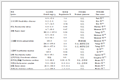
|
表 1 研究区Ⅰ砂土液化调查统计 Table 1 A summary of field observations and measurements of sand liquefaction in the study area Ⅰ |
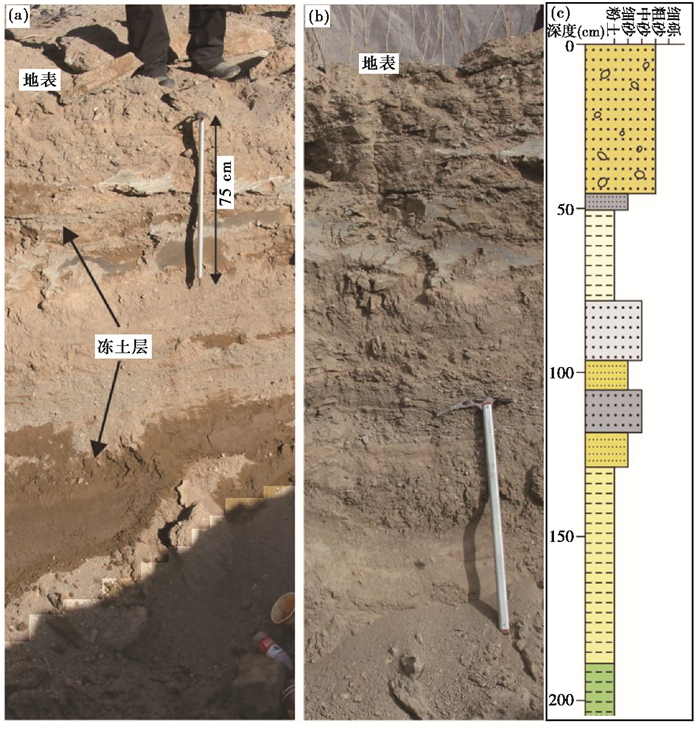
为清楚研究区Ⅰ砂土液化物质来源及机理,在喀拉阿特河T1阶地上开挖探槽,开挖后剖面受到阳光照射温度升高,冻土层部分发生融化(图 4a),揭露出冻土层的厚度约为1.7 m及融土层的界线(图 4a),探槽柱状图(图 4b和图 4c)显示地表 2 m内以粉土、粉砂为主,1.8 m的位置揭露饱和未冻结的灰绿色粉土层,结合喷出锥堆积物质的颗粒级配和颜色特征(图 3e),初步推断研究区Ⅰ砂土液化喷出物质主要源自该套地层。
|
图 4 喀拉阿特河T1阶地探槽剖面及解译图 (a)探槽内揭露出的冻土层;(b)探槽剖面照片;(c)探槽内地层柱状图 Fig. 4 (a)The trench at the epicenter to expose the frozen soil; (b)The trench at the epicenter; (c)The stratigraphic histogram of the trench shown in (b) |
研究区Ⅱ位于布拉克村(图 2),现场调查发现了片状分布的砂土液化,地震当时气温为- 15 ℃,因此未发现喷砂、喷砂锥,但在沼泽区草甸根部存在大量的全新涌出物并结冻(图 3g),初步推断:该地位于沼泽地区,地下水位较浅,在低温下结冻形成大面积的冰层,致使喷砂冒水的喷出物质只能沿着未结冻的草甸根部喷出,喷出后迅速结冻,因此在地表的影响面积较小。
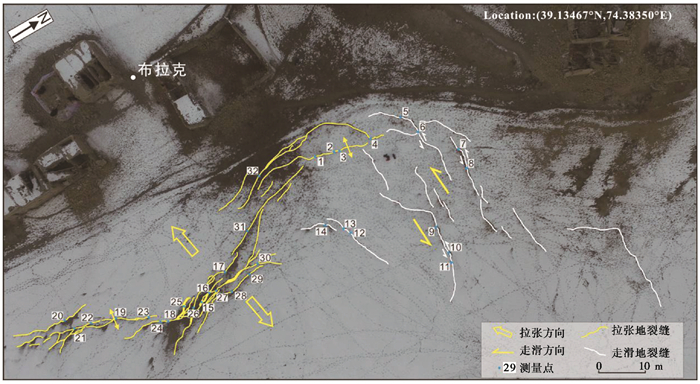
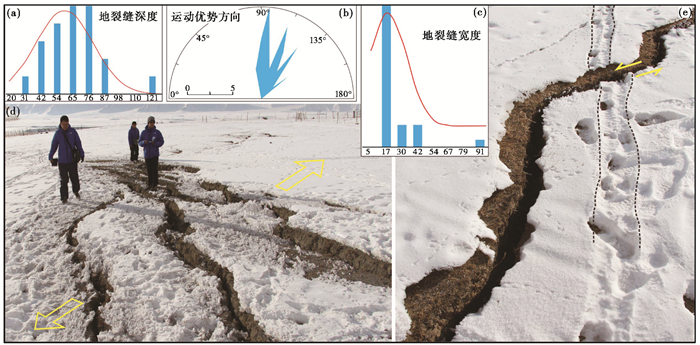
2.2 同震地裂缝同震地裂缝主要分布在研究区Ⅰ喀拉阿特河T1阶地上(图 3i)和研究区Ⅱ布拉克村北侧昆盖山洪积扇前缘上(图 5、图 3f和3h),这些地裂缝的规模和特征因发育地点不同而不同,在研究区Ⅰ地裂缝主要以拉张性质为主,兼具少量的走滑位移(图 3i);研究区Ⅱ内的地裂缝主要以重力拉张性质为主(图 6d和图 3h)。昆盖山山前洪积扇前缘发育的地裂缝,绵延长度近3 km,分布宽度近30 m,走向近EW,南侧为木吉河湿地,地形坡降大。为清楚地裂缝破裂特征,利用无人机对典型地段进行航拍(图 5),对该研究区内的地裂缝进行解译和测量(表 2)。
|
图 5 研究区Ⅱ地裂缝影像解译 黄色的地裂缝是拉张形成的,白色的地裂缝带有走滑位移,图中的编号见表 2 Fig. 5 The interpretation of ground fissure in the study area Ⅱ. Yellow and white lines indicate the extension and strike-slip ground fissures, respectively. The number in the map is the identifier of the measurement point(see Table 2) |
|
图 6 研究区Ⅱ地裂缝各参数统计图(a,b,c)及不同运动特征地裂缝(d,e) Fig. 6 Different parameters of the ground fissures in study area Ⅱ(a, b, c); (d)and (e) are photographs illustrating the characteristics of the ground fissures |
|
|
表 2 研究区Ⅱ布拉克村地裂缝实地测量参数 Table 2 Measurements of ground fissures in the Bulake Village of study area Ⅱ |
季节性冻土区一些河流、湖泊和沼泽区周围及其之下都存在融区[25~26]。研究区Ⅱ海拔高、土层厚度小、冻土下部存在融土区,地震发生时融土首先发生变形,从而引起上部冻土发生变形,由于冻土厚度较小,融土层由于较为松散,且含水量较高对地震动作用具有放大效应,融土层发生砂土液化后,导致地基土失稳,因此地表更加容易产生地裂缝。
3 结论与讨论 3.1 结论通过对阿克陶MS6.7地震现场进行科学考察,统计砂土液化与地裂缝的相关数据,总结砂土液化特征,得到以下几点认识:
(1) 2016年12月25日新疆阿克陶MS6.7地震的发震构造为公格尔山拉张系的北端的木吉断裂,断裂分布在昆盖山南麓山前,总长度超过100 km,走向NW,断面近直立,倾向NE,以右旋走滑为主,带有一定的正断层分量。
(2) 研究区Ⅰ维日麻村的砂土液化主要是在泉眼上复发形成,发生砂土液化的泉眼占总数的20 %,统计砂土液化喷沙锥的总覆盖面积约为36.1 m2,沿泉眼形成砂土液化的面积约为21.5 m2,占总面积的60 %,其余为沿地裂缝形成的砂土液化。研究区Ⅱ布拉克村地表冻结,砂土液化的喷出物质主要沿草甸的根系喷出,发育面积较大。
(3) 研究区Ⅱ地裂缝主要以拉张性质为主兼具少量走滑(图 6e),SN向地裂缝以拉张为主(图 6d),最大拉张量为80 cm,裂缝最大深度为120 cm。统计地裂缝的各项参数(深度、宽度、运动方向),发现地裂缝的深度主要分布在60~75 cm,宽度集中在17 cm,拉张和走滑的运动方向分布在90°~135°区间内呈环形展布,明显具有向东运动的痕迹(图 6a、6b和6c;表 2)。
3.2 讨论本次地震位于高海拔、高寒、季节性冻土山区,根据现场调查结果发现,该地区发育的砂土液化不同于平原地区的,总结、讨论如下几点认识:
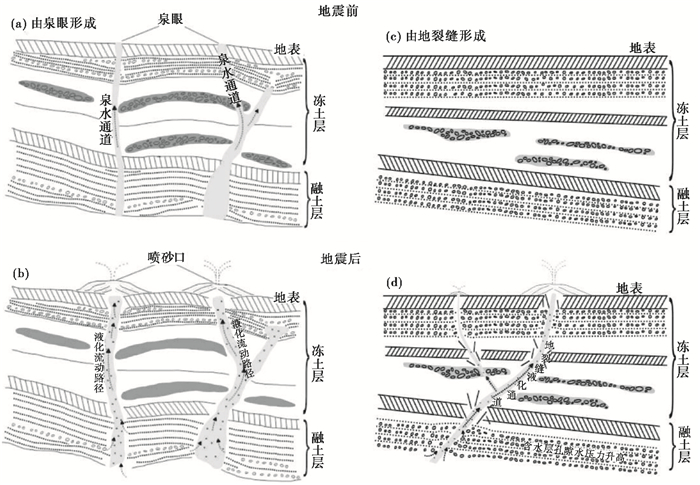
3.2.1 砂土液化的成因本次地震砂土液化主要有两种类型:1)沿泉眼喷出形成;2)沿同震地裂缝喷出形成。根据现场实地调查结果,初步分析两种类型砂土液化的形成机理(图 7)[27]。由泉眼形成的砂土液化机理:在地表结冻后,泉眼与下部融土层存在已有的泉水通道(图 7a),地震发生后下部融土层发生砂土液化,液化物质沿泉水通道向上喷出地表(图 7b)。沿地裂缝形成的砂土液化机理:季节性冻土地区冬季地表下一定厚度地层结冻,其下部存在未冻结的融土层(图 7c),地震时融土层发生砂土液化,同震地裂缝断错了冻土层形成通道使得液化物质可以穿过冻土喷出地表(图 7d)。
|
图 7 冻土区砂土液化发育机理(改自Liu-Zeng等[27]) (a)地震前泉眼的分布特征;(b)地震后沿泉眼形成的砂土液化;(c)震前冻土层与融土层分布特征;(d)震后沿地裂缝形成的砂土液化特征 Fig. 7 Schematic diagrams illustrating the conceptual model of the liquefaction of frozen soil during a strong earthquake(modified from Liu-Zeng et al., 2016[27]). (a)and (c) illustrate the relationship between the frozen and unfrozen soil layers before the earthquake; (b)and (d) illustrate how sand liquefaction reaches the surface during the earthquake: part of the liquefaction travels along the original faults while the rest passes through the coseismic ground fissures |
在研究区Ⅰ、Ⅱ实地调查发现砂土液化主要沿泉眼发育,但少量砂土液化由同震地裂缝喷出(图 3c和3d),昆仑山口西8.1级地震冻土地区也发现了同样的砂土液化现象,可见此类沿地裂缝喷出的喷砂冒水是冻土地区砂土液化的特征之一,冻土下部为融土层,在地震动作用下,融土层中孔隙水压力增大,引起砂土液化变形,但无法突破冻土层,只能沿已有通道喷出地表(图 6)。
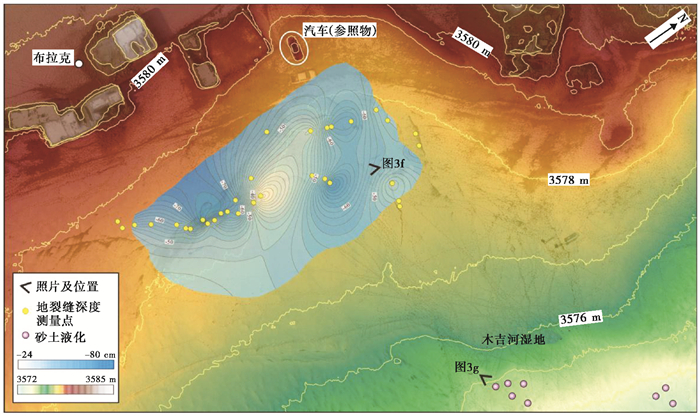
结合相关专家[11]在昆仑山口西8.1级地震现场对冻土地区震害的调查,总结得到在冻土下部存在融土的地区,地裂缝的深度基本反映该地区冻土层的厚度,对研究区Ⅱ的地裂缝深度进行统计,反演冻土层厚度(图 8),地裂缝深度主要分布在60~75 cm,厚度由西向东沿地形坡向依次减小,并且在最东侧沼泽区发育一定面积的砂土液化,说明在研究区Ⅱ冻土深度与砂土液化存在正相关性,即砂土液化发生在冻土厚度最小直至为零的区域,该区域地表水结冻,但其下部存在融区,地震动作用下融区发生砂土液化表现至地表(图 8)。研究区Ⅱ布拉克村地裂缝的拉张应力朝向木吉河湿地,具有强烈的重力拉张作用痕迹(图 3h和图 6d),造成这种现象的原因初步判断是:冻土层下融土层在地震动作用下引起砂土液化导致冻土产生变形,加之研究区位于冲积扇与湿地交界位置,地形坡度变化较大,因此地裂缝以向湿地方向的拉张运动为主。
|
图 8 研究区Ⅱ布拉克村冻土等深线图 图中蓝色区域为实测地裂缝反演冻土深度等深线(等深线精度,10 cm) Fig. 8 Contour map(10 cm interval)showing the thickness of the frozen soil layer(blue area)in the Bulake Village of study area Ⅱ |
在平原地区同等级别的地震,在河、湖等饱和、半饱和砂土层中会产生一定面积的砂土液化,而在高原季节性冻土地区同等级别的地震还未发现过如此大面积的砂土液化,本次地震的砂土液化与地裂缝是否可以作为判定地震烈度等级的一个依据,尤其是在人烟稀少、房屋种类单一的高海拔地区?
致谢: 感谢阿克陶县木吉乡党委及政府对野外科考的大力支持和帮助。感谢评审人和编辑部老师细致的修改建议。
| [1] |
Sarma S K, Ambraseys N. Liquefaction of soils induced by earthquakes[J]. Bulletin of the Seismological Society of America, 1969(59): 651. |
| [2] |
Ishihara K. Liquefaction and flow failure during earthquakes[J]. Géotechnique, 1993, 43(3): 351-451. DOI:10.1680/geot.1993.43.3.351 |
| [3] |
Wang Chiyuen. Liquefaction beyond the Near Field[J]. Seismological Research Letters, 2007, 78(5): 512-517. DOI:10.1785/gssrl.78.5.512 |
| [4] |
Holzer T L, Jayko A S, Hauksson E, et al. Liquefaction caused by the 2009 Olancha, California(USA), M5.2 earthquake[J]. Engineering Geology, 2010, 116(1-2): 184-188. DOI:10.1016/j.enggeo.2010.07.009 |
| [5] |
Iwasaki T. Soil liquefaction studies in Japan:State-of-the-art[J]. Soil Dynamics & Earthquake Engineering, 1986, 5(1): 2-68. |
| [6] |
Sims J D, Garvin C D. Recurrent liquefaction induced by the 1989 Loma Prieta earthquake and 1990 and 1991 aftershocks:Implications for paleoseismicity studies[J]. Bulletin of the Seismological Society of America, 1995, 85(1): 51-65. |
| [7] |
王彦斌, 王永, 李建成, 等. 1999年台湾集集大地震的地表断层破裂特征[J]. 地震地质, 2000, 22(2): 97-103. Wang Yanbin, Wang Yong, Lee Jiancheng, et al. Characteristics of ground ruptures caused by the 1999 M7.3 earthquake of Jiji, Taiwan[J]. Seismology and Geology, 2000, 22(2): 97-103. DOI:10.3969/j.issn.0253-4967.2000.02.001 |
| [8] |
Wang Chiyuen, Dreger D S, Wang Chungho, et al. Field relations among coseismic ground motion, water level change and liquefaction for the 1999 Chi-Chi (MW=7.5) earthquake, Taiwan[J]. Geophysical Research Letters, 2003, 30(17): HLS 1.1-HLS 1.4. |
| [9] |
Manga M. Coseismic release of water from mountains:Evidence from the 1999(MW=7.5) Chi-Chi, Taiwan, earthquake[J]. Geology, 2004, 32(9): 769-772. DOI:10.1130/G20753.1 |
| [10] |
周幼吾, 郭东信, 邱国庆, 等. 中国冻土[M]. 北京: 科学出版社, 2000: 110-134. Zhou Youwu, Guo Dongxin, Qiu Guoqing, et al. The Frozen Soil in China[M]. Beijing: Science Press, 2000: 110-134. |
| [11] |
陈永明, 王兰民, 代炜, 等. 2001年昆仑山口西8.1级地震区的冻土及地震破坏特征[J]. 中国地震, 2004, 20(2): 161-169. Chen Yongming, Wang Lanmin, Dai Wei, et al. The frozen soils and devastating characteristics of west Kunlun Mountains pass MS8.1 earthquake area in 2001[J]. Earthquake Research in China, 2004, 20(2): 161-169. DOI:10.3969/j.issn.1001-4683.2004.02.006 |
| [12] |
何国琦.中国新疆及邻区大地构造图[Z].北京: 地质出版社, 2004. He Guoqi. The Tectonic Map of China and Adjacent Regions[Z]. Beijing: Geological Publishing House, 2004. |
| [13] |
Fan Guanwei, Ni J F, Wallace T C. Active tectonics of the Pamirs and Karakorum[J]. Journal of Geophysical Research, 1994, 99(99): 7131-7160. |
| [14] |
Sippl C, Schurr B, Tympel J, et al. Deep burial of Asian continental crust beneath the Pamir imaged with local earthquake tomography[J]. Earth and Planetary Science Letters, 2013, 384(384): 165-177. |
| [15] |
Schurr B, Ratschbacher L, Sippl C, et al. Seismotectonics of the Pamir[J]. Tectonics, 2015, 33(8): 1501-1518. |
| [16] |
Strecker M, Frisch W, Hamburger M, et al. Quaternary deformation in the eastern Pamirs, Tadzhikistan and Kyrgyzstan[J]. Tectonics, 1995, 14(5): 1061-1079. DOI:10.1029/95TC00927 |
| [17] |
Coutand I, Strecker M R, Arrowsmith J R, et al. Late Cenozoic tectonic development of the intramontane Alai Valley(Pamir-Tien Shan region, Central Asia):An example of intracontinental deformation due to the Indo-Eurasia collision[J]. Tectonics, 2002, 21: 1053-1071. |
| [18] |
Robinson A C, Yin A, Manning C E, et al. Tectonic evolution of the northeastern Pamir:Constraints from the northern portion of the Cenozoic Kongur Shan extensional system, Western China[J]. Geological Society of America Bulletin, 2004, 116(7): 953. DOI:10.1130/B25375.1 |
| [19] |
Robinson A C, Yin A, Manning C E, et al. Cenozoic evolution of the eastern Pamir:Implications for strain-accommodation mechanisms at the western end of the Himalayan-Tibetan orogen[J]. Geological Society of America Bulletin, 2007, 119(7): 882-896. |
| [20] |
陈杰, 李涛, 李文巧, 等. 帕米尔构造结及邻区的晚新生代构造与现今变形[J]. 地震地质, 2011, 33(2): 241-259. Chen Jie, Li Tao, Li Wenqiao, et al. Late Cenozoic and present tectonic deformation in the Pamir salient, Northwest China[J]. Seismology and Geology, 2011, 33(2): 241-259. DOI:10.3969/j.issn.0253-4967.2011.02.001 |
| [21] |
李文巧, 陈杰, 袁兆德, 等. 帕米尔高原1895年塔什库尔干地震地表多段同震破裂与发震构造[J]. 地震地质, 2011, 33(2): 260-276. Li Wenqiao, Chen Jie, Yuan Zhaode, et al. Coseismic surface ruptures of multi segments and seismogenic fault of the Tashkorgan earthquake in Pamir, 1895[J]. Seismology and Geology, 2011, 33(2): 260-76. DOI:10.3969/j.issn.0253-4967.2011.02.002 |
| [22] |
Chen J, Schoenbohm L M, Yuan Z, et al. Holocene slip rate along the northern Kongur extensional system, Chinese Pamir[C]. Agu Fall Meeting Abstracts, 2011: T43F-2447
|
| [23] |
Li Tao, Chen Jie, Thompson J A, et al. Equivalency of geologic and geodetic rates in contractional orogens:New insights from the Pamir Frontal Thrust[J]. Geophysical Research Letters, 2012, 39(15): L15305. |
| [24] |
冯先岳. 新疆古地震[M]. 乌鲁木齐: 新疆科技卫生出版社, 1997: 33-34. Feng Xianyue. The Paleoearthquakes in Xinjiang Region[M]. Árümqi: Sci-Tech and Public Health Press of Xinjiang, 1997: 33-34. |
| [25] |
黄以职.青藏公路沿线多年冻土融区调查的地球物理方法[C]//中国科学院兰州冰川冻土研究所.青藏冻土研究论文集.北京: 科学出版社, 1983: 247-256. Huang Yizhi. The geophysical investigation on the talik in permafrost area along the Qinghai-Xizang highway[C]//Lanzhou Institute of Glaciology and Geocryology, Chinese Academy of Sciences. Collected Papers on Permafrost Studies of Qinghai-Xizang Plateau. Beijing: Science Press, 1983: 247-254. |
| [26] |
吴吉春, 盛煜, 赵林, 等. 柴达木盆地中的砂楔及其意义[J]. 第四纪研究, 2018, 38(1): 86-96. Wu Jichun, Sheng Yu, Zhao Lin, et al. Characteristics and implication of sand-wedges in Qaidam Basin, northeast Qinghai- Tibetan Plateau[J]. Quaternary Sciences, 2018, 38(1): 86-96. |
| [27] |
Liu-Zeng Jing, Wang Peng, Zhang Zhihui, et al. Liquefaction in western Sichuan Basin during the 2008 MW7.9 Wenchuan earthquake, China[J]. Tectonophysics, 2016, 694: 214-238. |
2 State Key Laboratory of Earthquake Dynamics, Institute of Geology, China Earthquake Administration, Beijing 100029)
Abstract
Soil liquefaction is a type of coseismic hydrological change triggered by earthquakes, and its occurrence results in major property damage and casualties. The dynamics of coseismic hydrological changes are not fully understood. In order to address this, we studied coseismic deformations such as liquefaction and ground fissures that occurred as a result of strong seismic activity during the 2016 MS6.7 Akto earthquake, which took place in the interior of the Pamir Plateau in northwestern China. That is the Pamir tectonic knot, one of the two tectonic plates that the India plate collided with the Eurasian plate. This region is one of the most active areas in mainland China. The seismogenic structure of the earthquake in the preliminary determine is Muji dextral-slip fault which located in the north of Kongur extension system. There are 2 macroscopic epicenter in the earthquake, that is Weirima Village and Bulake Village. There are developed a lot of geological hazard in the macroscopic epicenter. This paper presents a systematic survey of the frozen soil liquefaction and ground fissures caused by this earthquake. The majority of liquefaction sites near the Karaat River are located on the T1 terrace, in Bulake Village, and are adjacent to the alluvial fan of the Kungai Mountain. Sand liquefaction is mainly distributed in the south of Kalaarte River, and area of sand liquefaction is 1000 m2. We find that the liquefaction was caused by the original spring and coseismic ground fissure during the earthquake. Approximately 80% of the liquefaction sites are formed along the original spring in the epicenter. The maximum height of sand boils is 15 cm. The remaining 20% of the liquefaction sites are formed along the coseismic ground fissure. Our results suggest that the frozen soil layer impedes liquefied material in the lower unfrozen soil layer from reaching the surface, and the material formed from liquefaction is consequentially channeled through the primary fault and coseismic ground fissures. Liquefaction associated with the Akto earthquake demonstrates the importance of accounting for the possibility of a series of coseismic geological disasters, such as soil liquefaction and ground fissures, in areas with similar geology, altitude, and temperature. The ground fissures are distributed as net shape on the flood plain of Kalaarte River at Weirima Village. In the Bulake Village, the main movement features of the ground fissure are tension and sinistral slip, and the direction of ground fissures are 90~135 degree. The ground fissures associated with sand liquefaction is an important cause of serious damage to the building.