 2019, Vol.39


2 西北大学大陆动力学国家重点实验室, 陕西 西安 710069)
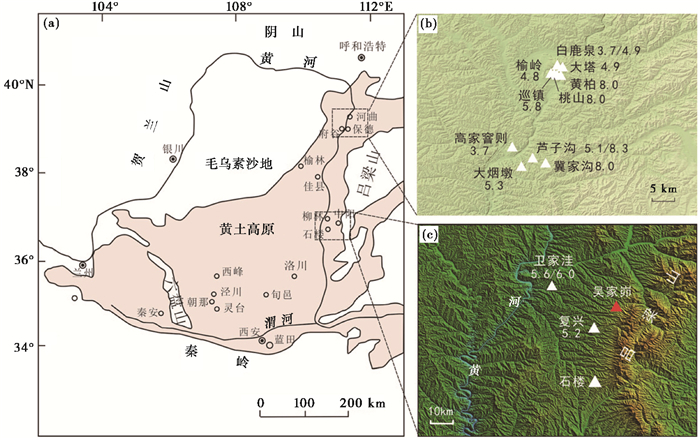
西北地区粉尘物质的研究直接关系着亚洲内陆干旱化发展的过程,近年来备受关注。目前在塔里木盆地、蒙古南部、阿尔金等地发现了始新世-渐新世的粉尘物质[1~4],并将其与西北内陆干旱化的研究相联系。黄土高原的粉尘物质是研究东亚以及相邻地区新近纪气候变化的良好载体。在黄土高原,渐新世晚期到中新世早期的粉尘物质(22~25 Ma)在六盘山以西的陇东盆地开始堆积[5~6],而六盘山以东的黄土高原则在晚中新世(8~11 Ma)开始大规模保存粉尘物质[7~24](图 1)。造成如此差异的主要原因是8~11 Ma之前鄂尔多斯高原一直处于隆升剥蚀的状态,这种持久抬升接受剥蚀的环境不利于粉尘物质和冲积物的堆积,之后鄂尔多斯高原内部出现差异隆升,在山前低洼地段开始堆积新近纪沉积物[25~27]。
|
图 1
黄土高原东部及吕梁山西麓主要红粘土剖面位置图
(a)黄土高原主要红粘土剖面位置(黑色空心圆圈表示剖面位置);(b)保德-河曲一带红粘土剖面(白色三角形)及其中所含砾石层的古地磁年龄[17, 29, 38, 41];(c)柳林-石楼一带红粘土剖面位置(白色三角形)及其中所含砾石层的古地磁年龄[28, 30] (红色三角形表示此次研究的吴家峁剖面的位置) Fig. 1 (a)The location of the red clay sections(hollow circle)on the Chinese Loess Plateau. (b)Red clay sections(white triangle)in the Baode-Hequ area and paleomagnetic age of the interbedded gravel layers[17, 29, 38, 41]. (c)Red clay sections(white triangle)in Liulin-Shilou area and paleomagnetic age of the interbedded gravel layers[28, 30](red triangle shows the location of the studied Wujiamao section) |
吕梁山西麓地处黄土高原东部边缘,在新近纪堆积了厚层红粘土(图 1),近年来磁性地层学研究认为吕梁山西麓红粘土的起始年龄约为7~11 Ma[17, 20~21, 28~31]。但受山体隆升的影响,吕梁山西麓红粘土沉积特征存在较大的差异。受吕梁山快速隆升的影响,地表遍遭剥蚀,加之植被疏矮,基岩疏松,在风力以及流水的交互作用下,产生的大量砾、砂、粉尘物质,混入到早期红粘土中导致红粘土的下部普遍存在有水流作用的痕迹,表现为含有数层砾石层[25~26]。这些砾石层不仅广泛分布,其空间分布特征、成分与毗邻基岩区高度耦合表明砾石层是吕梁山前的冲积扇相堆积,是吕梁山新生代隆升剥蚀的产物[32]。有学者在北部保德、府谷一带的研究认为这些砾石层是古黄河来回波动的堆积物[33~41](图 1b);也有学者认为在中上新世保德-河曲一带存在一个古湖,一直持续到3.7 Ma左右,古湖被切穿,黄河形成[29, 42~43]。吕梁山前砾石层到底是什么原因形成的?不同地区砾石层又有何异同?本文将在之前研究结果的基础上[26, 28, 30, 32](图 1c),结合最新的吴家峁剖面的磁性地层结果和沉积特征,对比研究吕梁山前红粘土和砾石层的堆积过程,并在此基础上探讨吕梁山新近纪以来的隆升。
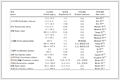
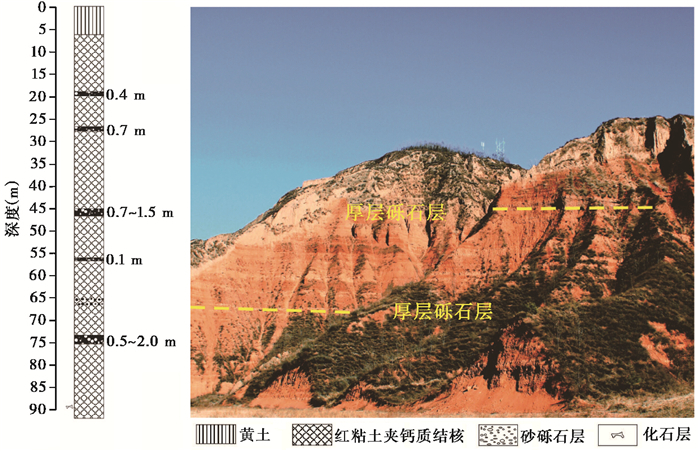
1 地层剖面描述吴家峁剖面(37°15′43.07″N,111°03′22.15″E;海拔1175 m)位于山西省吕梁市中阳县吴家峁村(图 1c)。地貌上为具基岩基座的黄土梁峁,黄土梁峁顶部有10~30 m厚的更新世黄土,下伏为新近纪红粘土,底部为基岩。吴家峁剖面新近纪堆积厚91.1 m(表 1和图 2)。剖面由40余层红棕色、红褐色红粘土和钙质结核、钙板层组成。19.5 m以下含有若干层(6层)砂砾石层,砂砾石层大部分较薄,在5~20 cm之间。有两层较厚,分别位于45.5~46.2 m和74.7~75.2 m处,在区域上比较稳定,延伸较远,最厚处达1.5~2.0 m(图 2)。
|
表 1 吴家峁剖面地层特征 Table 1 The stratigraphy features of Wujiamao section |
|
图 2 吴家峁红粘土剖面野外特征 Fig. 2 The field characteristics of Wujiamao red clay section |
吴家峁剖面厚91.1 m,上部从与黄土接触部位开始采集,下部采至支沟沟口。红粘土沿主沟锄沟两侧均有分布,至石盘上村(直线距吴家峁约8 km)见二叠系石盒子组砂岩出露。推测吴家峁剖面新近纪红粘土厚度至少在100 m以上,但缺乏明显的标志层,沿沟两侧出露的下部层位未采样。吴家峁剖面底部含有一层化石层,化石层已经被老乡挖龙骨破坏,只获得了极少数有鉴定意义的化石。整个剖面按10 cm间隔采样,共采集古地磁样品911个。
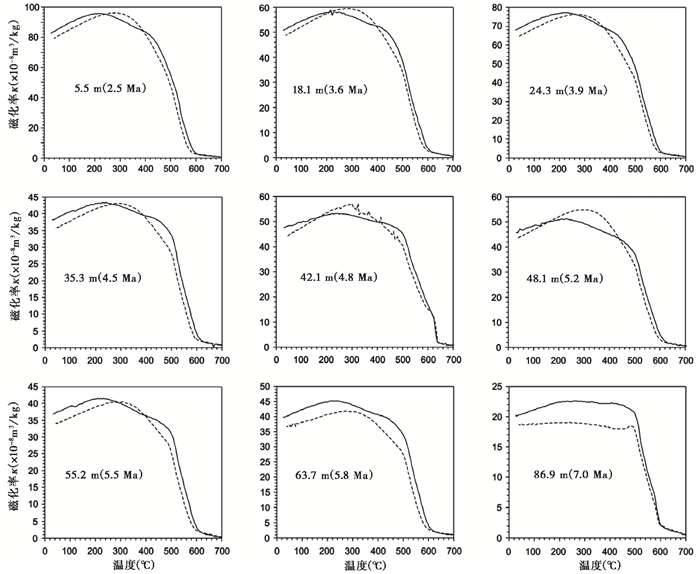
为了判定剩磁携带的矿物特征,选取了部分样品进行了磁化率随温度变化(κ-T)实验,实验在中国科学院地质与地球物理研究所岩石磁学与古地磁实验室使用捷克Agico公司生产的KLY-3卡帕桥磁化率仪及其附带的CS-3温度控制系统测量。取研磨后的样品约200 mg装入玻璃样品管,设定温度区间为25 ℃至700 ℃,在加热过程中连续测量样品的磁化率,之后从700 ℃降温至25 ℃,并连续测量样品的磁化率。为了避免样品被空气氧化,加热和冷却过程均在氩气环境中进行。
由κ-T曲线(图 3)可知,随着温度的升高,磁化率逐渐变大,加热到220 ℃左右时磁化率达到最大值,随后逐渐减小。220 ℃之前的磁化率逐渐增加显示细颗粒亚铁磁性矿物的逐渐解阻[44]。而后的逐渐下降表明热磁性质不稳定的磁赤铁矿开始转变为赤铁矿[45~46]。450~590 ℃下降明显,接近最低值,是因为接近了磁铁矿的居里点温度。590~680 ℃之间磁化率有较小的变化,说明有赤铁矿的存在。冷却曲线趋势和加热曲线相似,从680 ℃时缓慢上升,至580 ℃开始明显上升,直到300~350 ℃,然后缓慢下降,说明加热过程中并未发生显著的矿物相转变。其中86.9 m(7.0 Ma)的样品表现出和其他样品不同的κ-T曲线,可能是该样品中主要为较大的多畴铁磁性颗粒(MD)导致[44, 47]。由此可见吴家峁剖面红粘土样品中主要载磁矿物为赤铁矿和磁铁矿,含有少量磁赤铁矿和细颗粒亚铁磁性矿物。
|
图 3 吴家峁红粘土剖面中典型样品的κ-T曲线(实线和虚线分别代表加热和冷却曲线) Fig. 3 Temperature-dependent of magnetic susceptibility for selected samples from Wujiamao red clay section. The solid(dotted)line represent heating(cooling)curves in κ-T curves |
剩磁分析在加拿大埃尔伯特大学古地磁实验室完成,选用2G-755型超导磁力仪进行剩磁测量。样品测量天然剩磁后,采用ASC热退磁系统进行退磁,以20~50 ℃为间隔逐步加热到690 ℃。样品退磁及剩磁测量均在零磁空间(< 8 nT)中进行。
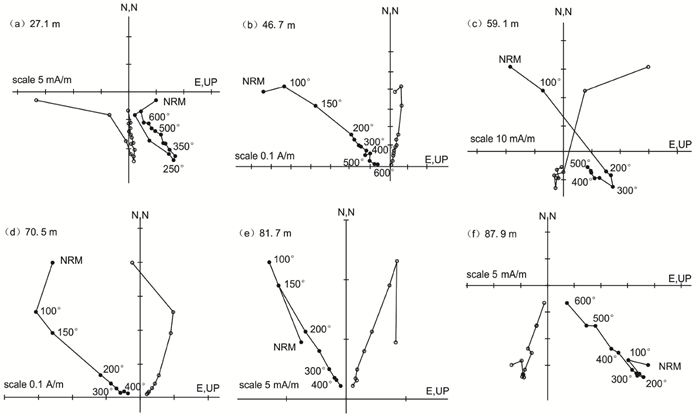
图 4显示了吴家峁剖面部分代表性样品的剩磁矢量正交投影图,所有样品以200~300 ℃为界限,分出低温和高温两个剩磁分量。其中可视为次生磁滞剩磁的第一个分量在300 ℃以下可被完全清洗。第二分量在300 ℃以后稳定指向原点,代表了特征剩磁的方向。
|
图 4 吴家峁剖面代表样品的退磁曲线(实心和空心分别表示垂直和水平投影) Fig. 4 Orthogonal thermal demagnetization plots of typical samples at Wujiamao, and small solid(open)symbols refer to the projection on the vertical(horizontal)plane in geographic coordinates |
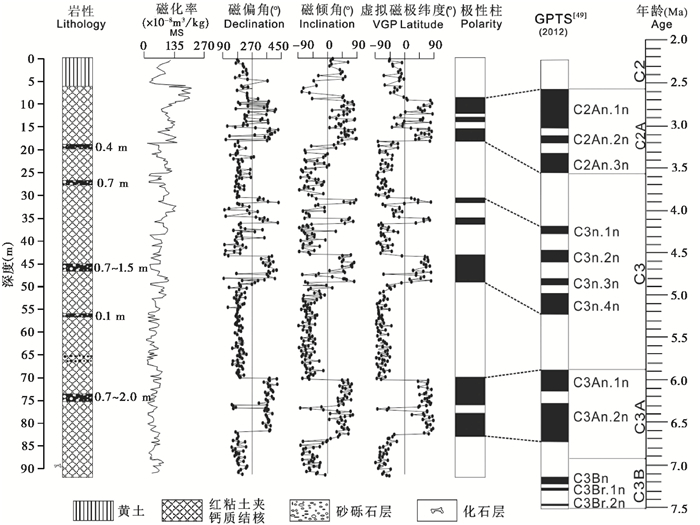
特征剩磁的方向通过主成分分析法计算得出,选用具有稳定组分的多个退磁温度(最少3个)的剩磁矢量进行拟合[48]。本文采用强迫直线通过原点法确定特征剩磁。由特征剩磁获得的磁倾角和磁偏角计算虚拟磁极纬度,并得到剖面的磁极性序列,与标准极性柱[49]进行对比(图 5)。
|
图 5 吴家峁剖面的古地磁结果 从左至右依次为深度、地层特征、磁化率、磁偏角、磁倾角、VGP纬度、磁极性序列、标准极性年表[49] Fig. 5 Lithology and magnetostratigraphy of the Wujiamao section. Profiles of depth, lithostratigraphy, magnetic susceptibility, declination, inclination, virtual geomagnetic pole latitudes, polarity zonation of Wujiamao and standard polarity scale[49] from left to right in the Wujiamao section |
古地磁结果显示吴家峁剖面共记录了9个负极性段和8个正极性段(图 5):顶部的黄土(0~7.5 m)记录了松山负极性带的底部;高斯正极性带(C2A)对应于剖面的7.5~17.7 m,其中又包括C2An.1n、C2An.2n和C2An.3n这3个正极性亚带及期间的负极性亚带;吉尔伯特负极性带(C3)对应于剖面的17.7~70.1 m,清楚地记录了C3n.1n和C3n.2n正极性亚带;之下剖面中记录了一个长的正极性亚带,对应了C3n.3n至C3n.4n之间的极性段,由于下部粘土层中含有砂砾石层,记录不好或者缺失了小段地层,导致漏掉了其中的C3n.3r;剖面底部结束于一个负极性段,对应于C3An. 2r负极性亚带,其上极性段对应于C3An. 1n、C3An.2n以及其中的负极性亚带C3An. 1r。根据沉积速率估算,吴家峁剖面底部年龄约为7.1 Ma。在剖面的底部发现了一层化石层,经西北大学地质系李永项博士鉴定,主要有Hipparion sp.(三趾马)、Cervavitus sp.(鹿,似祖鹿?)和Vulpes sp.(犬科,狐?),时代应为中新世晚期。根据古地磁结果,该化石层的年龄约为7.0 Ma,这也证明了古地磁结果的准确性。
4 讨论 4.1 吕梁山西麓红粘土中砾石层的成因对吕梁山前红粘土中砾石层的成因目前存在3种认识:第一种认为砾石层是吕梁山前冲积扇相堆积,是吕梁山新生代隆升剥蚀产物[30, 32];第二种观点认为吕梁山前红粘土中砾石层系古黄河或者古南北向水系的沉积物,标志着山陕峡谷南北向水系或者古黄河的形成[33~41];第三种观点认为砾石层是内陆湖泊相堆积物,标志着古黄河的雏形[29, 42~43]。
后两种观点直接或间接地关系着黄河的形成,我们对得出该观点的研究区和研究剖面[33~43]进行了分析,发现了如下特征:1)都集中在吕梁山西麓北部保德-河曲一带。除了神木邱家鄢[38]、府谷高家窨则[39]外,其他剖面都位于现今黄河以东(图 1b)。且距离现今黄河非常近,直线距离一般都不超过10 km,大部分均在5 km之内。与之相反,黄河西岸远离黄河的府谷老高川[11]和佳县[12]等剖面中则并没有发现厚层砾石层,佳县剖面甚至没有水流沉积物。2)砾石层多处于红粘土沉积的底部,砾石层厚度较大,一般都在2 m以上,最厚可达15 m左右。其中砾石以灰岩为主,一般占到70 %以上。3)水流沉积物厚度较大,不仅含有砾石层,而且有粉砂层、细砂层等组合类型,部分剖面夹杂有还原环境下灰绿色泥岩沉积。
此次吴家峁剖面中的砾石层和前人在北部保德-河曲一带[33~43]的砾石层除了少数特征相似外,其他特征差异较大。吴家峁剖面位于吕梁山西麓中段,含有数层砾石层,分别位于74.7~75.2 m、66.7~66.8 m、65.0~65.2 m、56.8~56.9 m、45.5~46.2 m、26.8~26.9 m和19.5~19.9 m处,对应的古地磁年龄分别为6.2 Ma、5.9 Ma、5.8 Ma、5.5 Ma、4.9 Ma、4.0 Ma和3.7 Ma。砾石根据其成分特征可分两类,一类以砂岩、粉砂岩、泥岩为主要成分,厚度较薄;个别层位砾石在钙质结核层、砂质粘土层中胶结,隐约成层。另一类砾石成分以灰岩为主,砂泥岩次之,在吴家峁剖面主要发育有两层,砾石层厚度较大,走向上延伸较远,比较稳定,形成明显的陡坎,厚度在0.5~2.0 m之间变化(表 2)。
|
|
表 2 吴家峁剖面砾石层的沉积特征及年龄 Table 2 The sedimentary characteristics and ages of the gravel layers in Wujiamao section |
通过与前人在吕梁山西麓北部保德-河曲一带砾石层[33~43]的对比,结合之前我们在区域上对砾石层的统计和分析[32]以及此次对吴家峁剖面中砾石层特征的研究,我们认为吕梁山西麓中段红粘土层中的砾石层是吕梁山隆升剥蚀的产物,而非古黄河和内陆湖泊的沉积物。
首先从距离上来说,吴家峁剖面距离现今黄河约40 km,距离较远,古黄河不太可能波动幅度如此之大;相反,吴家峁剖面距离吕梁山体较近,约5 km。而且就目前的研究来说,无论黄河形成于中上新世还是更新世[50~52],其形成年代也晚于吕梁山形成的时间[53~56]。发源于吕梁山前的近东西向河流从优先程度来讲,较南北向河流优先发育。
其次,吴家峁剖面中的砾石层沉积特征更符合山前堆积物的特征[32, 57]。吴家峁剖面中砾石层层数多,但厚度小,而且砾石成分存在差异,有的层位以灰岩为主,有的层位以砂泥岩为主,更符合小流域洪水沉积的特征。而且吴家峁剖面中的砾石层基本不存在砾石层向砂层过渡的沉积序列。多数砾石层是孤零零夹在红粘土沉积中。部分砾石层在后期沉积中成为了红粘土层淀积层的格架,钙质结核或者红粘土充填在砾石层中。
再次,吕梁山西麓中段目前发现的新近纪沉积物的分布范围和沉积特征不支持黄河中游中段曾经存在古湖泊。目前虽然我们在吕梁山西麓中段的柳林复兴[30]、柳林卫家洼[28]、石楼沙窑1)等地红粘土中均发现了水流作用的痕迹,但区域上变化非常大。就某一个小区域来说,砂砾石层等粗颗粒沉积物变化也非常大,很快就相变为细颗粒物质或者尖灭至红粘土中。
1)《石楼县测区1 ︰ 5万区域地质调查报告》,2015,山西省地质调查院
此外,砾石层的岩性、厚度变化较大。在柳林县坪头村一带砾石成分除砂岩、灰岩外还有少量花岗斑岩、花岗闪长岩、流纹岩、玄武岩、辉绿玢岩、辉长岩等。隰县下李、午城一带砾石成分以灰岩、石英砂岩为主,次为变质岩类2)。河流未经过深变质岩及火成岩区,晋陕谷地中段砾石中深变质岩和火成岩没有相应的物源区,而东部吕梁山恰恰可以为其提供物源[32]。
2)《大宁县测区1 ︰ 5万区域地质调查报告》,2014,山西省地质调查院
4.2 吕梁山新近纪的抬升前人对吕梁山隆升时间的研究多基于山体本身,通过裂变径迹等方法获取。李建星等[54]认为吕梁山新生代隆升过程可分为58±3 Ma、40±3 Ma、30±3 Ma、23±3 Ma和10±3 Ma这5个阶段;赵俊峰等[55~56]认为吕梁山区显生宙的隆升活动主要发生在早白垩世晚期以来,可进一步分为缓慢抬升(120~65 Ma)、加速抬升(65~23 Ma)及强烈抬升(23 Ma以来)这3个隆升演化阶段,新生代以来是其最主要的隆升时期;而任星民等[58]认为吕梁山地区经历了两次主要的构造隆升期(晚侏罗世-早白垩世、渐新世至今)及其中间的缓慢隆升期。此外,李建星等[53]还结合山前沉积物将吕梁山及邻区中新世以来的隆升分为约23 Ma区域性隆升和8.35~6.70 Ma的差异隆升,并认为晚期的隆升导致吕梁山初现,吕梁山东、西开始差异演化。
前已述及,吕梁山中段山前红粘土中的砾石层主要为吕梁山隆升剥蚀的产物,本文通过吴家峁剖面中的几层砾石层探讨吕梁山新近纪的隆升。吴家峁剖面明显由上下两部分组成,类似的堆积物在吕梁山西麓较为发育。上部为典型的风成红粘土,与黄土高原其他红粘土剖面表现出相同或者相似的特征;下部则明显经受过水流作用的搬运和侵扰,在红粘土中出现了数层砂砾石层,显示了红粘土堆积早期有水流作用的参与。
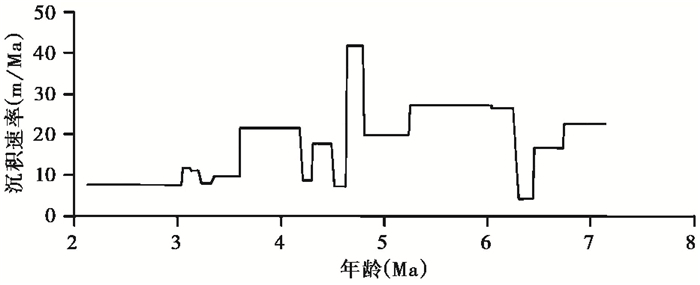
从古地磁年龄得知,吴家峁剖面砾石层主要集中在6.2~3.7 Ma之间。之前在柳林复兴剖面也发现了厚约2~3 m的砾石层,其古地磁年龄为5.2 Ma[30],而柳林卫家洼剖面也发现有类似的两层砾石层,古地磁年龄为大致7.8~8.0 Ma[32]。实际上,卫家洼剖面在8.1~5.6 Ma之间堆积物均显示有水流作用参与,夹有泥岩、粉砂岩、细砂岩等层位。结合前面的分析可知,这些粗颗粒水流沉积物均为吕梁山快速隆升剥蚀的产物。由此推断,在8.1~3.7 Ma,吕梁山有较强烈的抬升作用。吴家峁剖面沉积速率在约3.6 Ma左右也出现了较明显的变化(图 6),总体上> 3.6 Ma较 < 3.6 Ma明显变大。沉积速率的突变说明此时吕梁山西麓的沉积物质发生了突变,有大量近源物质的参与。石楼地区红粘土锆石U- Pb地球化学结果也显示,在约5.7 Ma以来,红粘土中粗颗粒锆石明显增加,物源分析显示来自东侧的吕梁山体的锆石的含量也明显增加,表明此时吕梁山体有明显的隆升[59]。
|
图 6 吴家峁剖面沉积速率变化图 Fig. 6 The sedimentation rate of Wujiamao section |
通过研究黄土高原东部吕梁山西麓中部厚91.1 m的吴家峁红粘土剖面,认为剖面明显由上下两部分组成。上部为棕红色、深红褐色粘土,其中夹有多层钙质结核层,与黄土高原典型风成红粘土显示出类似的特征;剖面下部则明显夹杂有砂质粘土层、砂砾石层和化石层,显示出山前冲积扇相堆积的特征。
岩石磁学结果表明,该剖面沉积物主要的载磁矿物是赤铁矿和磁铁矿,此外还含有少量磁赤铁矿和细颗粒亚铁磁性矿物。古地磁年代学结果显示,剖面的起止年龄为7.1~2.6 Ma。所含6层砾石层的古地磁年龄分别为6.2 Ma、5.9 Ma、5.8 Ma、5.5 Ma、4.9 Ma、4.0 Ma和3.7 Ma,其中6.2 Ma和4.9 Ma两层砾石层较厚。底部所含的化石层的年龄约为7.0 Ma。
通过对吴家峁剖面砾石层的沉积特征进行分析,并与北部保德-河曲一带前人已有的成果进行对比,认为吕梁山西麓中部山前红粘土中的砾石层是吕梁山山体隆升剥蚀的产物,而非古黄河或者古湖泊沉积物。结合柳林卫家洼和复兴剖面的古地磁年龄和沉积特征的结果,推断在约8.1~3.7 Ma时吕梁山山体有较强烈的抬升。
致谢: 非常感谢加拿大埃尔伯特大学的Vadim Kravchinsky教授在样品测试中给予的帮助;感谢评审专家和杨美芳老师对文章提出的宝贵意见。
| [1] |
Sun J M, Zhang Z Q, Zhang L Y. New evidence on the age of the Taklimakan Desert[J]. Geology, 2009, 37(2): 159-162. DOI:10.1130/G25338A.1 |
| [2] |
Sun J M, Windley B F. Onset of aridification by 34 Ma across the Eocene-Oligocene transition in Central Asia[J]. Geology, 2015, 43(11): 1015-1018. DOI:10.1130/G37165.1 |
| [3] |
Zheng H B, Wei X C, Tadad R, et al. Late Oligocene-early Miocene birth of the Taklimakan Desert[J]. Proceedings of the National Academy of Sciences of the United States of America, 2015, 112(25): 7662-7667. DOI:10.1073/pnas.1424487112 |
| [4] |
Li J X, Yue L P, Roberts A P, et al. Global cooling and enhanced Eocene Asian mid-latitude interior aridity[J]. Nature Communication, 2018, 9: 3026. DOI:10.1038/s41467-018-05415-x |
| [5] |
Guo Z T, Ruddiman W F, Hao Q Z, et al. Onset of Asian desertification by 22 Myr ago inferred from loess deposits in China[J]. Nature, 2002, 416(6877): 159-163. DOI:10.1038/416159a |
| [6] |
Qiang X K, An Z S, Song Y G, et al. New eolian red clay sequence on the western Chinese Loess Plateau linked to onset of Asian desertification about 25 Ma ago[J]. Science China:Earth Sciences, 2011, 54(1): 136-144. DOI:10.1007/s11430-010-4126-5 |
| [7] |
Ding Z L, Sun J M, Liu T S, et al. Wind-blown origin of the Pliocene red clay formation in the central Loess Plateau, China[J]. Earth and Planetary Science Letters, 1998, 161(1-4): 135-143. DOI:10.1016/S0012-821X(98)00145-9 |
| [8] |
Sun D H, An Z S, Shaw J, et al. Magnetostratigraphy and paleoclimatic of Late Tertiary aeolian sequences in the Chinese Loess Plateau[J]. Geophysical Journal International, 1998, 134(1): 207-212. DOI:10.1046/j.1365-246x.1998.00553.x |
| [9] |
宋友桂, 方小敏, 李吉均, 等. 六盘山东麓朝那剖面红粘土年代及其构造意义[J]. 第四纪研究, 2000, 20(5): 457-463. Song Yougui, Fang Xiaomin, Li Jijun, et al. Age of red clay at Chaona section near Eastern Liupan Mountain and its tectonic significance[J]. Quaternary Sciences, 2000, 20(5): 457-463. DOI:10.3321/j.issn:1001-7410.2000.05.006 |
| [10] |
杨石岭, 侯圣山, 王旭, 等. 泾川晚第三纪红粘土的磁性地层及其与灵台剖面的对比[J]. 第四纪研究, 2000, 20(5): 423-434. Yang Shiling, Hou Shenshan, Wang Xu, et al. Completeness and continuity of the Late Tertiary red clay sequence in Northern China:evidence from the correlation of magnetostratigraphy and pedostratigraphy between Jingchuan and Lingtai[J]. Quaternary Sciences, 2000, 20(5): 423-434. DOI:10.3321/j.issn:1001-7410.2000.05.003 |
| [11] |
张云翔, 薛祥煦, 岳乐平. 陕西府谷老高川新第三纪"红层"的划分与时代[J]. 地层学杂志, 1995, 19(3): 214-219. Zhang Yunxiang, Xue Xiangxu, Yue Leping. Age and division of Neogene "Red Bed" of Laogaochuan, Fugu County, Shaanxi[J]. Journal of Stratigraphy, 1995, 19(3): 214-219. |
| [12] |
Qiang X K, Li Z X, Powell C M, et al. Magnetostratigraphic record of the Late Miocene onset of the East Asian monsoon, and Pliocene uplift of northern Tibet[J]. Earth and Planetary Science Letters, 2001, 187(1-2): 83-93. DOI:10.1016/S0012-821X(01)00281-3 |
| [13] |
An Z S, Kutzbach J E, Prell W L, et al. Evolution of Asian monsoons and phased uplift of the Himalaya-Tibetan Plateau since Late Miocene times[J]. Nature, 2001, 411(6833): 62-66. DOI:10.1038/35075035 |
| [14] |
陈宝群, 孙东怀, 安芷生. 蓝田白鹿原晚第三纪风成红粘土序列的古季风气候记录[J]. 陕西师范大学学报(自然科学版), 2001, 29(4): 112-117. Chen Baoqun, Sun Donghuai, An Zhisheng. Palaeoclimatic record from red clay sequence at Bailuyuan of Lantian, Shaanxi Province[J]. Journal of Shaanxi Normal University (Natural Science Edition), 2001, 29(4): 112-117. |
| [15] |
Liu X M, Rolph T, An Z S, et al. Paleoclimatic significance of magnetic properties on the Red Clay underlying the loess and paleosols in China[J]. Palaeogeography, Palaeoclimatology, Palaeoecology, 2003, 199(1): 153-166. |
| [16] |
Guo Z T, Peng S Z, Hao Q Z, et al. Late Miocene-Pliocene development of Asian aridification as recorded in the Red-Earth formation in Northern China[J]. Global and Planetary Change, 2004, 41(3-4): 135-145. DOI:10.1016/j.gloplacha.2004.01.002 |
| [17] |
岳乐平, 邓涛, 张云翔, 等. 保德阶层型剖面磁性地层学研究[J]. 地层学杂志, 2004, 28(1): 48-51. Yue Leping, Deng Tao, Zhang Yunxiang, et al. Magnetostratigraphy of stratotype section of the Baode stage[J]. Journal of Stratigraphy, 2004, 28(1): 48-51. DOI:10.3969/j.issn.0253-4959.2004.01.006 |
| [18] |
王先彦, 鹿化煜, 弋双文, 等. 晚新生代洛川典型风尘堆积序列的延伸[J]. 海洋地质与第四纪地质, 2006, 26(1): 89-92. Wang Xianyan, Lu Huayu, Yi Shuangwen, et al. Extension of the typical aeolian sequences at Luochuan, central Chinese Loess Plateau[J]. Marine Geology & Quaternary Geology, 2006, 26(1): 89-92. |
| [19] |
Song Y G, Fang X M, Torii M, et al. Late Neogene rock magnetic record of climatic variation from Chinese eolian sediments related to uplift of the Tibetan Plateau[J]. Journal of Asian Earth Sciences, 2007, 30(2): 324-332. DOI:10.1016/j.jseaes.2006.10.004 |
| [20] |
Zhu Y M, Zhou L P, Mo D W, et al. A new magnetostratigraphic framework for Late Neogene Hipparion Red Clay in the eastern Loess Plateau of China[J]. Palaeogeography, Palaeoclimatology, Palaeoecology, 2008, 268(1-2): 47-57. DOI:10.1016/j.palaeo.2008.08.001 |
| [21] |
Xu Y, Yue L P, Li J X, et al. An 11-Ma-old red clay sequence on the eastern Chinese Loess Plateau[J]. Palaeogeography, Palaeoclimatology, Palaeoecology, 2009, 284(3): 383-391. |
| [22] |
孙蕗, 岳乐平, 王建其, 等. 黄土高原北部晚新近纪"吴起古湖"的古地磁年代学与古环境记录[J]. 地球物理学报, 2010, 53(6): 1451-1462. Sun Lu, Yue Leping, Wang Jianqi, et al. Palaeomagnetic chronology and paleoenvironmental records of Late Neogene Wuqi paleolake in northern Chinese Loess Plateau[J]. Chinese Journal of Geophysics, 2010, 53(6): 1451-1462. |
| [23] |
Wang B, Zheng H B, He Z, et al. Middle Miocene eolian sediments on the southern Chinese Loess Plateau dated by magnetostratigraphy[J]. Palaeogeography, Palaeoclimatology, Palaeoecology, 2014, 411(1): 257-266. |
| [24] |
鹿化煜, 张瀚之, 王逸超, 等. 渭河盆地新生代沉积序列与亚洲季风气候起源演化[J]. 第四纪研究, 2018, 38(5): 1057-1067. Lu Huayu, Zhang Hanzhi, Wang Yichao, et al. Cenozoic depositional sequence in the Weihe Basin(Central China):A long-term record of Asian monsoon precipitation from the greenhouse to icehouse Earth[J]. Quaternary Sciences, 2018, 38(5): 1057-1067. |
| [25] |
Yue L P, Li J X, Zheng G Z, et al. Evolotion of the Ordos Plateau and environmental effects[J]. Science China:Earth Sciences, 2007, 50(Suppl.Ⅱ): 19-26. |
| [26] |
徐永, 李建星, 潘峰, 等. 吕梁山西麓红粘土的起始堆积时间及沉积过程[J]. 第四纪研究, 2016, 36(5): 1114-1124. Xu Yong, Li Jianxing, Pan Feng, et al. The basal ages and deposit process of the red clay in the west piedmont of the Lüliang Mountains[J]. Quaternary Sciences, 2016, 36(5): 1114-1124. |
| [27] |
Wang B, Kaakinen A, Clift P D. Tectonic controls of the onset of aeolian deposits in Chinese Loess Plateau-A preliminary hypothesis[J]. International Geology Review, 2017, 60(8): 945-955. DOI:10.1080/00206814.2017.1362362 |
| [28] |
李建星, 岳乐平, 徐永, 等. 再搬运红粘土的发现及地质意义[J]. 沉积学报, 2009, 27(6): 1184-1190. Li Jianxing, Yue Leping, Xu Yong, et al. Discovery and geological significance of red clay in the Liulin section in the west part of Lüliang Mountains[J]. Acta Sedimentologica Sinica, 2009, 27(6): 1184-1190. |
| [29] |
Pan B T, Hu Z B, Wang J P, et al. A magnetostratigraphic record of landscape development in the eastern Ordos Plateau, China:Transition from Late Miocene and Early Pliocene stacked sedimentation to Late Pliocene and Quaternary uplift and incision by the Yellow River[J]. Geomorphology, 2011, 125(1): 225-238. DOI:10.1016/j.geomorph.2010.09.019 |
| [30] |
徐永, 岳乐平, 李建星, 等. 吕梁山西麓复兴剖面红粘土的磁性地层学研究[J]. 地层学杂志, 2013, 37(1): 33-40. Xu Yong, Yue Leping, Li Jianxing, et al. Magnetostratigraphy of Late Neogene red clays in the Fuxing area of western foothills of the Lüliang Mountains[J]. Journal of Stratigraphy, 2013, 37(1): 33-40. |
| [31] |
Ao H, Roberts A, Dekkers M J, et al. Late Miocene-Pliocene Asian monsoon intensification linked to Antarctic ice-sheet growth[J]. Earth and Planetary Science Letters, 2016, 444: 75-87. DOI:10.1016/j.epsl.2016.03.028 |
| [32] |
李建星, 岳乐平, 徐永, 等. 从山前砾石看黄河形成与吕梁山隆升[J]. 地理科学, 2009, 27(4): 582-586. Li Jianxing, Yue Leping, Xu Yong, et al. Uplift of Lüliang Mountains and evolution of Huanghe River-Evidence from gravel beds in piedmont[J]. Scientia Geographica Sinica, 2009, 27(3): 518-524. |
| [33] |
李长江. 晋陕蒙交界地区晚第三纪沉积特征与地貌演化[J]. 水土保持研究, 2003, 10(3): 121-129. Li Changjiang. Neogene sediments and geomorphic evolution in the border area between Shanxi, Shaanxi and Inner Mongolia[J]. Research of Soil and Water Conservation, 2003, 10(3): 121-129. |
| [34] |
王小燕, 邱维理, 张家富, 等. 晋陕峡谷北段保德-府谷地区唐县面上冲积物的特征及其地貌意义[J]. 第四纪研究, 2013, 33(4): 715-722. Wang Xiaoyan, Qiu Weili, Zhang Jiafu, et al. Features of the alluvium on Tangxian surface near Baode-Fugu and its geomorphologic implications in the Northern Jinshan Gorge, Yellow River[J]. Quaternary Sciences, 2013, 33(4): 715-722. DOI:10.3969/j.issn.1001-7410.2013.04.09 |
| [35] |
刘运明, 李有利, 吕红华, 等. 从阶地砾石的统计特征看保德至克虎段河流演化[J]. 地理科学, 2007, 27(4): 567-572. Liu Yunming, Li Youli, Lü Honghua, et al. Implication of statistical features of terrace pebbles to river evolution from Baode County to Kehu Town[J]. Scientia Geographica Sinica, 2007, 27(4): 567-572. DOI:10.3969/j.issn.1000-0690.2007.04.019 |
| [36] |
刘运明, 李有利, 吕红华, 等. 黄河山陕峡谷保德-克虎段高阶地砾石层的初步研究[J]. 北京大学学报(自然科学版), 2007, 43(6): 808-815. Liu Yunming, Li Youli, Lü Honghua, et al. Preliminary study of alluvial pebbles on high terraces of the Yellow River from Baode to Kehu in Shanxi-Shaanxi Gorge[J]. Acta Scientiarum Naturalium Universitatis Pekinensis, 2007, 43(6): 808-815. DOI:10.3321/j.issn:0479-8023.2007.06.013 |
| [37] |
刘运明, 李有利. 山西保德黄河最高阶地形成的时代[J]. 地理与地理信息科学, 2007, 23(1): 101-108. Liu Yunming, Li Youli. Formation age of the highest terrace of the Yellow River in Baode area[J]. Geography and Geo-Information Science, 2007, 23(1): 101-10838. DOI:10.3969/j.issn.1672-0504.2007.01.024 |
| [38] |
刘运明. 神木邱家鄢最高阶地的年代及对中游黄河演化的指示[J]. 安庆师范学院学报(自然科学版), 2014, 20(4): 115-120. Liu Yunming. Magnetostratigraphy of red clay and silt layer of Qiujiayan section, Shenmu County and its implications to the formation of the Yellow River[J]. Journal of Anqing Teachers College(Natural Science Edition), 2014, 20(4): 115-120. |
| [39] |
刘运明. 保德-府谷地区晚第三系砾石层的分布与成因[J]. 池州学院学报, 2016, 30(3): 70-72. Liu Yunming. Distribution and its factors of Late Tertiary conglomerates in Baode-Fugu County[J]. Journal of Chizhou University, 2016, 30(3): 70-72. |
| [40] |
刘运明, 李有利, 周葆华. 晋陕峡谷北部盘塘-黑峪口地区黄河阶地序列及其形成年代[J]. 北京大学学报(自然科学版), 2016, 52(2): 257-264. Liu Yunming, Li Youli, Zhou Baohua. Terrace sequences and their formation ages in Pantang-Heiyukou area, northern Shanxi-Shaanxi Gorge, China[J]. Acta Scientiarum Naturalium Universitatis Pekinensis, 2016, 52(2): 257-264. |
| [41] |
刘运明. 山西河曲地区新近纪砾石层的磁性地层年代与成因[J]. 第四纪研究, 2017, 37(3): 597-611. Liu Yunming. Magnetostratigraphy and origin of Neogene conglomerate in Hequ, Shanxi Province[J]. Quaternary Sciences, 2017, 37(3): 597-611. |
| [42] |
Pan B T, Hu Z B, Wang J P, et al. The approximate age of the planation surface and the incision of the Yellow River[J]. Palaeogeography, Palaeoclimatology, Palaeoecology, 2012(356-357): 54-61. |
| [43] |
潘保田, 胡振波, 胡小飞, 等. 晋陕峡谷北段晚新生代河流演化初步研究[J]. 第四纪研究, 2012, 32(1): 111-121. Pan Baotian, Hu Zhenbo, Hu Xiaofei, et al. Time-slice of the fluvial evolution in the northern Jinshaan Gorge during Late Cenozoic[J]. Quaternary Sciences, 2012, 32(1): 111-121. DOI:10.3969/j.issn.1001-7410.2012.01.12 |
| [44] |
Liu Q S, Roberts A P, Larrasoaña J C, et al. Environmental magnetism:Priciples and applications[J]. Reviews of Geophysics, 2012, 50(4): RG4002. DOI:10.1029/2012RG000393 |
| [45] |
邓成龙, 刘青松, 潘永信, 等. 中国黄土环境磁学[J]. 第四纪研究, 2007, 27(2): 193-209. Deng Chenlong, Liu Qingsong, Pan Yongxin, et al. Environmental magnetism of Chinese loess-paleosol sequences[J]. Quaternary Sciences, 2007, 27(2): 193-209. DOI:10.3321/j.issn:1001-7410.2007.02.005 |
| [46] |
姜兆霞, 刘青松. 赤铁矿的定量化及其气候意义[J]. 第四纪研究, 2016, 36(3): 676-689. Jiang Zhaoxia, Liu Qingsong. Quantification of hematite and its climatic significances[J]. Quaternary Sciences, 2016, 36(3): 676-689. |
| [47] |
Deng C L, Shaw J, Liu Q S, et al. Mineral magnetic variation of the Jingbian loess/paleosol sequence in the northern Loess Plateau of China: Implications for Quaternary development of Asian aridification and cooling[J]. Earth and Planetary Science Letters, 241(1-2): 248-259.
|
| [48] |
Kirschvink J L. The least-squares line and plane and the analysis of palaeomagnetic data[J]. Geophysical Journal of the Royal Astronomical Society, 1980, 62(3): 699-718. DOI:10.1111/gji.1980.62.issue-3 |
| [49] |
Gradstein F M, Ogg J G, Schmitz M, et al. The Geologic Time Scale[M]. Amsterdam: Elsevier, 2012.
|
| [50] |
张珂. 河流的竞争——以汾河与晋陕黄河形成演化为例[J]. 第四纪研究, 2012, 32(5): 859-865. Zhang Ke. Fluvial competition:Exemplified by formation and evolution of the Fen River and Jinshan Yellow River[J]. Quaternary Sciences, 2012, 32(5): 859-865. DOI:10.3969/j.issn.1001-7410.2012.05.04 |
| [51] |
袁宝印, 汤国安, 周力平, 等. 新生代构造运动对黄土高原地貌分异与黄河形成的控制作用[J]. 第四纪研究, 2012, 32(5): 829-838. Yuan Baoyin, Tang Guoan, Zhou Liping, et al. Control action on the geomorphic differentiation in Loess Plateau and the formation of Yellow River by Cenozoic tectogenesis[J]. Quaternary Sciences, 2012, 32(5): 829-838. DOI:10.3969/j.issn.1001-7410.2012.05.01 |
| [52] |
王书兵, 蒋复初, 傅建利, 等. 关于黄河形成时代的一些认识[J]. 第四纪研究, 2013, 33(4): 705-714. Wang Shubing, Jiang Fuchu, Fu Jianli, et al. Some knowledge of the formation of the Yellow River[J]. Quaternary Sciences, 2013, 33(4): 705-714. DOI:10.3969/j.issn.1001-7410.2013.04.08 |
| [53] |
李建星, 岳乐平, 刘池洋, 等. 中新世以来吕梁山及邻区构造-沉积演化[J]. 地层学杂志, 2013, 37(1): 93-100. Li Jianxing, Yue Leping, Liu Chiyang, et al. The tectonic-sedimentary evolution of the Lüliang Mountains since the Miocene[J]. Journal of Stratigraphy, 2013, 37(1): 93-100. |
| [54] |
李建星, 刘池洋, 岳乐平, 等. 吕梁山新生代隆升的裂变径迹证据及其隆升机制探讨[J]. 中国地质, 2015, 42(4): 960-972. Li Jianxing, Liu Chiyang, Yue Leping, et al. Apatite fission track evidence for the Cenozoic uplift of the Lüliang Mountains and a discussion on the uplift mechanism[J]. Geology in China, 2015, 42(4): 960-972. DOI:10.3969/j.issn.1000-3657.2015.04.013 |
| [55] |
赵俊峰, 刘池洋, 王晓梅, 等. 吕梁山地区中-新生代隆升演化探讨[J]. 地质论评, 2009, 55(5): 663-672. Zhao Junfeng, Liu Chiyang, Wang Xiaomei, et al. Uplifting and evolution characteristics in the Lüliang Mountain and its adjacent area during the Meso-Cenozoic[J]. Geological Review, 2009, 55(5): 663-672. DOI:10.3321/j.issn:0371-5736.2009.05.008 |
| [56] |
赵俊峰, 刘池洋, Nigel Mountney, 等. 吕梁山隆升时限与演化过程研究[J]. 中国科学:地球科学, 2015, 45(10): 1427-1438. Zhao Junfeng, Liu Chiyang, Mountney N, et al. Timing of uplift and evolution of the Lüliang Mountains, North China Craton[J]. Science China:Earth Sciences, 2015, 45(10): 1427-1438. |
| [57] |
温振玲, 胡小飞, 潘保田, 等. 金塔南山河流砾石特征指示的青藏高原东北缘地貌演化[J]. 第四纪研究, 2016, 36(4): 907-916. Wen Zhenling, Hu Xiaofei, Pan Baotian, et al. The fluvial gravels features of Jinta'nanshan Mountains and its implication on the landform evolution in the NE Tibetan Plateau[J]. Quaternary Sciences, 2016, 36(4): 907-916. |
| [58] |
任星民, 朱文斌, 朱晓青, 等. 山西吕梁山地区中-新生代隆升剥露过程:磷灰石裂变径迹证据[J]. 地球科学与环境学报, 2015, 37(4): 63-73. Ren Xingmin, Zhu Wenbin, Zhu Xiaoqing, et al. Mesozoic-Cenozoic uplift-exhumation history in Lüliangshan area of Shanxi:Evidences from apatite fission track[J]. Journal of Earth Science and Environment, 2015, 37(4): 63-73. DOI:10.3969/j.issn.1672-6561.2015.04.010 |
| [59] |
Pan F, Li J X, Xu Y, et al. Uplift of the Lüliang Mountains at ca. 5.7 Ma:Insights from provenance of the Neogene eolian red clay of the eastern Chinese Loess Plateau[J]. Palaeogeography, Palaeoclimatology, Palaeoecology, 2018, 502(1): 63-73. |
2 State Key Laboratory of Continental Dynamics, Northwest University, Xi'an 710069, Shaanxi)
Abstract
Thick red clay were deposited in the west piedmont of the Lüliang Mountains during the Neogene period. Previous studies have more focused on the eolian deposits and its paleoclimate information. Here, we described and interpret an 91.1-m-thick red clay sequence which interbedded with 6 gravel layers in the lower part in west piedmont of the Lüliang Mountains. The studied section was named Wujiamao and located in the Zhongyang County, Shanxi, with the coordinate and elevation of 37°15'43.07"N, 111°03'22.15"E and 1175 m a.s.l. The upper part of the red clay with deep reddish brown color, which are similar with other red clay deposits on the Chinese Loess Plateau. The lower part of red clay deposits were interbedded with several gravel layers which can be attribute to runoff transporting in the early period of red clay deposit. These gravel layers recorded the uplift of the Lüliang Mountains in Neogene. Based on magnetostratigraphy and sedimentology studies in the Wujiamao red clay section, the deposit process of the red clay and uplift events of the Lüliang Mountains were discussed. Rock magnetic results demonstrate that the magnetic carriers of the red clay deposits in Wujiamao section are mainly magnetite and hematite. The magnetostratigraphy results show that the paleomagnetic age of the red clay in Wujiamao section spans between 7.1 Ma and 2.6 Ma. The age of the gravel layers are 6.2 Ma, 5.9 Ma, 5.8 Ma, 5.5 Ma, 4.9 Ma, 4.0 Ma and 3.7 Ma, respectively. The gravel layers with the age of 6.2 Ma and 4.9 Ma are thicker, more stable and farther extending than others. The age of the fossil layer between 89.7 m to 89.1 m is about 7.0 Ma. The gravel layers in the red clay were the denudation and accumulation products of growth of the Lüliang Mountains based on the studies of the gravel layers in Wujiamao and compared with other sections which located in the northern part of the west piedmont of the Lüliang Mountains. Our results indicate that the Lüliang Mountains had uplift rapidly from 8.1 Ma to 3.7 Ma, based on magnetostratigraphy and sedimentology studies of the red clay sections at Wujiamao, Fuxing and Weijiawa in the middle part of the west piedmont of the Lüliang Mountains. Our current studies don't support the idea of the gravel layers were the deposits of the ancient Yellow River or a paleolake.