 2018, Vol.38


2 中国科学院青藏高原研究所, 北京 100101;
3 Polar Terrestrial Environmental Systems, Alfred Wegener Institute for Polar and Marine Research in the Helmholtz Association, Telegraphenberg A43, 14473 Potsdam, Germany)
晚冰期是末次冰期向全新世转换的过渡时期,探讨晚冰期以来气候的变化过程及形成机制,有助于预测未来的环境变化趋势[1~2],因而成为全球古气候古环境演化的热点问题之一。河北安固里淖位于东南季风的边缘地区(图 1),对气候的响应敏感,研究湖区古植被和古气候的演化历史,对于了解东南季风的变迁具有重要的科学意义[3~4]。因此,前人利用安固里淖沉积岩芯对该地区的古气候演化做了大量的研究工作,如翟秋敏等[5]通过安固里淖的年纹层重建了湖区8500年以来的环境变化过程;姜加明等[6]根据湖泊沉积物粒度、碳酸盐与TOC含量探讨了湖区近400年来的气候变迁;马龙等[7]利用总有机碳含量及其碳同位素指标重建了安固里淖近400年来的气候环境演变格局;Wang等[8]和Liu等[9]分别利用磁学和孢粉指标探讨了安固里淖全新世的气候环境演化特征;阳小兰等[10]运用孢粉及其地球化学记录对安固里淖近5000年来的气候变化做了较为详细的研究。但以下问题仍存在分歧,需做深入的研究和探讨:1)利用安固里淖沉积物全有机质进行的14C测年是否存在“碳库效应”?翟秋敏等[5]、Wang等[8]和Liu等[9]认为不存在“碳库效应”,而阳小兰等[10]则认为存在2000年左右的“碳库效应”。2)孢粉组合存在明显的不同,阳小兰等[10]的研究认为5000年以来,木本花粉含量整体上都在50 %以上,而Liu等[9]的研究结果却表明,自全新世以来,木本花粉的含量平均仅为20 %左右。3)对晚冰期以来东南季风和西南季风演化的认识还存在不同观点,Hong等[11~12]通过对比东北和西南泥炭纤维素的同位素记录,指出全新世东南季风和西南季风的演化并不一致,并呈反相关系;而Wang等[13]将南海与阿拉伯海钻孔记录进行对比,显示出从小尺度气候变化事件到气候变化趋势东南季风与西南季风呈同步变化;段福才等[14]将不同纬度石笋记录进行对比,也显示出13 ka以来东南季风和西南季风呈同相位变化。因此,晚冰期以来,安固里淖气候演化的重建能够为这一争论提供科学依据。本文将以河北安固里淖18.4 m的沉积岩芯(图 2)为研究对象,通过AMS 14C测年和孢粉指标分析,重建晚冰期以来的古植被和古气候演化历史,并探讨其驱动机制[15~16]。这对于了解我国华北地区自晚冰期向全新世转变的气候状况,以及轨道尺度上我国东南季风的演化具有重要的科学意义。

|
图 1 安固里淖地理位置示意图 Fig. 1 Location of the Anguli-Nuur Lake |

|
图 2 安固里淖岩芯的岩性特征及年代随深度的变化 Fig. 2 Lithology and depth-age model of the core from the Anguli-Nuur Lake |
安固里淖(AGL)位于河北省张家口市张北县西北部(41°18′~41°24′N,114°20′~114°27′E;图 1),是华北地区第一大高原内陆湖泊[5],地处内蒙古高原—燕山山地—华北平原的过渡带,以及季风气候与大陆气候、干旱与半干旱地区的交接带[7]。湖盆呈浅碟状,湖底平坦。湖面海拔1312 m,长11.6 km,宽4.1 km,面积47.6 km2,最大水深4 m,平均水深2.5 m,蓄水量1.19×10⁸ m3[6]。属于中温带大陆性半干旱季风气候,多年平均气温2.6 ℃,年平均降水量401.6 mm,蒸发量1500~2000 mm[7],蒸发量远大于降水量,降水主要集中于6~8月[6]。冬春季盛行偏北风,湖水由地表径流和湖面降水补给,主要有三台河、黑水河汇入。植被类型以温带草原为主,尤以耐旱的蒿属(Artemisia)、藜科(Chenopodiaceae)占优势。安固里淖在1999~2004年迅速干涸[17~18]。
2 材料与方法 2.1 样品采集2010年11月,利用国产的百米陆地钻机(机型XY-1B),在安固里淖中心(41°20′44″N,114°22′40″E;海拔1301.5 m)采得一根长为38 m的岩芯,取心率为90 %左右。在野外对采得的岩芯以不同的取样间隔进行分样,0~60 cm的取样间隔为1 cm,其余均为2 cm。本文采用了上部18.4 m的岩芯进行晚冰期气候环境演化的重建。根据岩性的变化特征,可将剖面自下而上分为4个沉积单元(图 2):A,18.4~16.4 m,主要由黑色泥构成,底部发现少量植物残体,在17.6 m左右处发现白钠镁矾;B,16.4~15 m,主要由灰色泥构成,其中16.2 m左右处发现少量植物残体,在15.8 m左右发现芒硝;C,15~1.4 m,主要由黑色泥构成,在10~6 m左右处发现斜碳钠钙石;D,1.4~0 m,主要由灰绿色泥构成。
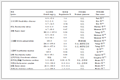
2.2 AMS 14C测年选取不同深度的全有机质、炭屑、植物残体(表 1),在新西兰国家同位素测试中心拉夫特放射性实验室,进行加速器质谱(AMS)的14C测年。
|
表 1 安固里淖剖面AMS 14C测年结果 Table 1 Results of AMS 14C dating in the core of Anguli-Nuur Lake |
18.4 m以上的岩芯以6 cm的间隔进行孢粉取样,共分析256个样品。孢粉样品采用氢氟酸和筛除法进行提取,视岩性差异称取30~150 g的样品,首先用10 %的盐酸除去碳酸钙,然后加入浓度为5 %的氢氧化钾溶液去除腐殖质等有机质,将样品洗至中性,加入40 %的浓氢氟酸去除硅酸盐,用超声波振荡器以及7 μm孔径的网布筛滤,收集网上的残余物,经小试管净化,最后将提取好的样品加入甘油制片,在显微镜下鉴定统计[19~21]。孢粉样品鉴定时,参照《中国植物孢粉形态》[22]中的孢粉图版和现代孢粉标准片对比进行,除少量样品未能统计到300粒外,其他样品所统计的孢粉总数均在300粒以上。孢粉的数量以百分比和浓度来进行表示,本文孢粉百分比的计算以陆生植物花粉总和为基数,浓度外加石松孢子法进行计算[9, 23]。
3 结果与讨论 3.1 年代中国西部干旱半干旱地区湖泊大都为咸水湖或盐湖,利用这些湖泊中的有机碳进行的放射性碳测年一般受到碳库效应的影响[24]。然而,来自安固里淖沉积物的碳/氮(C/N)通常超过10(图 2),这表明湖泊沉积的有机质由内外源混合组成[25~26],但来源于外源的陆生植物所占的比例较高。2个植物残体的δ13C值明显偏正,分别为- 10.2 ‰和-10.7 ‰ (表 1),以及C/N比大于10,表明这两个植物残体来自陆生的C4植物[25~27],其14C测年结果不受碳库效应的影响。炭屑为陆源植物燃烧剩余的残体,陆生植物直接利用大气中的CO2合成自身有机质,因此其14C测年一般不受碳库效应的影响。采用Bacon模型对表 1中的14C测年进行年代序列的建立[28](图 2),从图 2中可以看出,3个全有机质14C测年的数据较好地落在了6个炭屑和2个植物残体14C测年的年代-深度线上,而自动剔除了深度在2.11 m和6.11 m深处的有机质测年,且明显偏老,可能表明这两个测年受到了碳库效应的影响,最终年代序列的建立采用了6个炭屑、2个植物残体和3个全有机质的测年。计算结果表明,岩芯18.4 m底部年龄达到14.3 cal.ka B.P.。
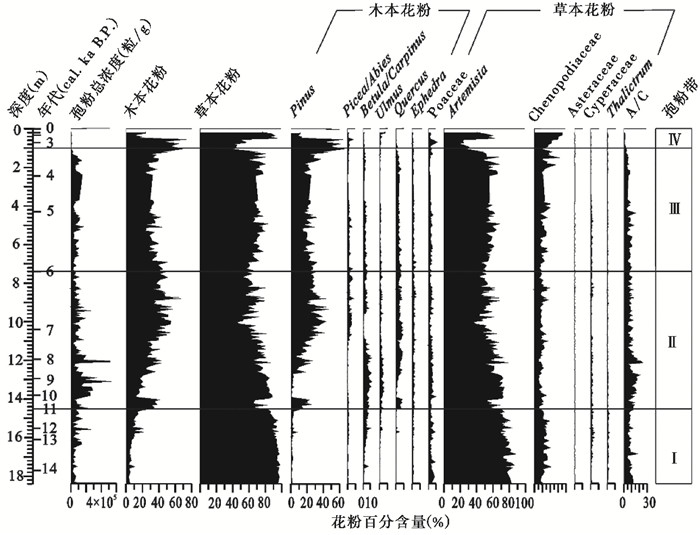
3.2 晚冰期以来湖区植被与气候环境演化经鉴定,安固里淖岩芯中存在70个孢粉种类,按照不少于两个样品的百分比大于0.5 %的标准,选取12个孢粉属种进行分析,包括:松属(Pinus)、云杉/冷杉(Picea/Abies)、桦木属(Betula)、榆属(Ulmus)、栎属(Quercus)、麻黄属(Ephedra)、禾本科(Poaceae)、蒿属(Artemisia)、藜科(Chenopodiaceae)、菊科(Asteraceae)、莎草科(Cyperaceae)、唐松草属(Thalictrum)等,涉及针叶乔木、落叶乔木、灌木和草本植物。总的来看,花粉总浓度较高,波动于1781~518845粒/g,平均为70572粒/g。植被组成以蒿属和藜科为代表的草本植物占绝对优势,同时松属、云杉属等针叶乔木也占一定的比重,桦木属、榆属、栎属等落叶乔木所占比例相对较低。
松属花粉是最主要的乔木花粉类型(0~60 %),其中234个样品中的含量低于30 %,约占所有样品(256个样品)的91 %。中国北方现代花粉研究发现松属花粉为超代表性花粉类型,低于30 %的花粉含量往往不能代表采样点周边松林的存在,应为长距离搬运而来[29]。因此,本文未选松属为主的乔木花粉含量来解释湿度变化。Zhao等[30]通过对我国干旱半干旱地区蒿藜比值(A/C)与降水、植被类型等关系的研究认为:降水量 < 450~500 mm、蒿藜总百分含量超过45 %~50 %时,A/C值可用于指示干旱半干旱区的有效湿度和植被类型。安固里淖地区现在的年平均降水量为401.6 mm,钻孔中,除个别样品的蒿藜总百分含量小于50 %外,绝大多数蒿藜总百分含量均大于50 %,最高可达91 %,因此,安固里淖岩芯沉积物中的A/C值,能够较好地指示研究区的有效湿度和植被类型。
根据孢粉浓度、不同属种的比例以及A/C值的变化,可将安固里淖岩芯的孢粉组合自下而上划分为4个孢粉带,并根据这4个孢粉带对晚冰期以来的植被和气候演化特征讨论如下(图 3):
|
图 3 安固里淖岩芯孢粉组合 Fig. 3 Pollen assemblages of the core from the Anguli-Nuur Lake |
Ⅰ带(18.40~14.55 m;14.3~11.0 cal.ka B.P.),花粉浓度偏低,平均为55812粒/g。以松属和云杉属为代表的针叶乔木较少,基本都只占花粉百分含量的0.41 %~1.73 %,桦木属、榆属都开始出现,特别是桦木属在这一阶段的百分含量达到7.93 %,木本花粉含量总占比较低,为3.27 %~21.41 %,但自下而上,百分含量呈现逐渐升高的趋势;以蒿属和藜科为代表的草本花粉含量在80 %以上,在中后期出现不断递减的趋势,草本花粉中,尤以蒿属为主,含量达70 %左右,其次是藜科,含量为11 %左右;其他草本花粉如禾本科、菊科、莎草科等含量较低,且变化不大,A/C值较高,平均为7.66。
孢粉浓度整体偏低,植被以蒿属等草本植物为主,木本植物较少,A/C值较高,表明该时期的植被类型以疏林草原植被为主,气候偏干。
Ⅱ带(14.55~7.40 m;11.0~6.0 cal.ka B.P.)花粉总浓度达到最大值,平均为88245粒/g。木本花粉的含量急剧增高,波动于11.68 %~49.15 %之间,其中尤以松属花粉的含量增加为主,桦木属、栎属、榆属等花粉的含量可达10 %左右,云杉属在后期也大量出现,麻黄属的百分含量也略有增加,最高达3.78 %左右;草本花粉含量降至60 %左右,蒿属花粉与Ⅰ带相比有所降低,百分含量在41.29 %~66.67 %左右,藜科百分含量基本在3.45 %~8.59 %左右;其他草本花粉如莎草科和唐松草属也较前期相比有所减少,菊科与前期相比变化不大,A/C值达到最大,平均为9.23。
孢粉浓度达到最大值,植被虽仍以草本植物为主,A/C值达到最大,7.0 cal.ka B.P.左右,木本植物迅速生长,此时湖区的降水很可能超过500 mm,A/C值不再适用,但木本花粉含量接近50 %,表明此时的水热组合条件达到最好。总之,该时期的植被类型以森林草原植被为主,气候整体湿润。
Ⅲ带(7.40~1.00 m;6.0~3.2 cal.ka B.P.)花粉总浓度比Ⅱ带时期明显下降,与Ⅰ带基本相当,平均为59945粒/g。以松属、云杉、桦木属、榆属、栎属为主的木本花粉含量在这一阶段不断减少,占比为24.76 %~36.86 %,麻黄属的含量有所降低,在1.52 %左右;草本花粉含量在这一阶段不断增高,基本在65 %以上,草本花粉中,仍以蒿属为主,含量达60 %左右,藜科较Ⅱ带含量有所增高,为5.14 %~19.17 %;其他草本花粉如禾本科、莎草科、唐松草属变化不大,A/C值降低,平均为6.26。
孢粉浓度整体偏低,植被以蒿属和藜科为代表的草本植物为主,木本植物松属和云杉属仍有发展,A/C值较低,表明该时期的植被类型以疏林草原植被为主,气候偏湿。
Ⅳ带(1.00~0 m;3.2~0 cal.ka B.P.)花粉总浓度降到最低,平均仅为4584粒/g。在3.17~2.10 cal.ka B.P.期间,松属的百分含量达到43.9 %左右,导致木本花粉含量较前一时期明显增加,为44.53 %,但后期急剧下降,含量只占15.34 %,而栎属、桦木属在这一阶段百分含量不断减少,桦木属只占0.40 %~1.42 %;草本花粉包括蒿属和藜科前期占比均较低,后期百分含量不断增加,基本与Ⅰ带相当,占78 %左右,蒿属变化不大,含量在57 %左右,但藜科百分含量达到最大值,占到11.25 %~33.47 %,致使A/C值降到最低,平均为1.43。
孢粉浓度达到最低,植被以草本植物占绝对优势,A/C值降到最低,表明该时期的植被类型以荒漠草原植被为主,气候整体干旱。值得一提的是该带在约3.0 cal.ka B.P.时,松属花粉的含量明显增高,但这一带的花粉浓度却很低,表明这段时间湖泊周围植被生长状况恶化;此外,3.0 cal.ka B.P.以来,该湖的沉积速率明显降低(图 2),也可能反映降水和入湖径流量降低,进而导致径流携带的泥砂减少。
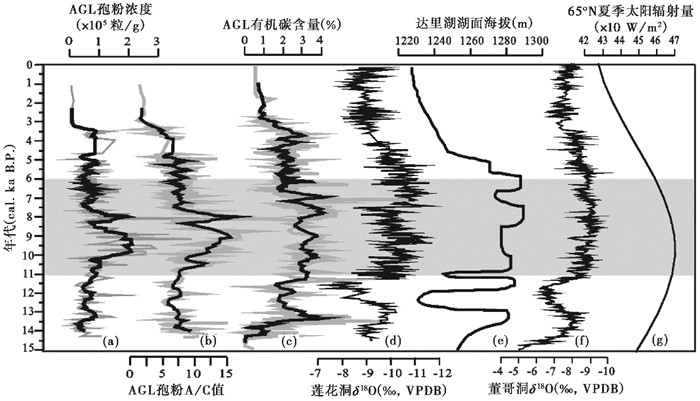
3.3 区域对比及驱动机制目前,对中国受东南季风影响的干旱半干旱地区全新世大暖期所处的阶段有很多的争议,施雅风等[31]根据中国全新世古湖泊、古植被、古土壤等资料的总结,认为中国全新世大暖期应处于中全新世,对应时间为8.5~3.0 14C ka B.P.;之后一些学者研究认为[32~33],受东南季风影响的地区,其气候的适宜期出现在中全新世,而受西南季风影响的地区,气候的适宜期自早全新世出现,并持续至中全新世。近些年来,来自东南季风区不同纬度的记录显示[34~36],早中全新世气候暖湿。安固里淖湖区孢粉总浓度、A/C值以及有机碳含量[37](图 4a~4c),在11.0~6.0 cal.ka B.P.期间出现最大值,其后二者出现波动下降趋势,同样地,对受东南季风影响的莲花洞石笋记录研究[34](图 4d)以及达里湖晚冰期以来的湖面水位高程研究[35](图 4e)表明,莲花洞石笋记录的变化趋势与安固里淖相似,而达里湖在早中全新世出现高水位,6 cal.ka B.P.之后湖水水位出现不断下降趋势,将安固里淖和莲花洞的记录以及达里湖湖面水位高程变化同受西南季风影响的董哥洞石笋记录[38]进行对比(图 4f),发现它们具有较好的一致性。所以我们认为地处东南季风影响区的安固里淖自晚冰期以来的气候演化模式,与受西南季风影响区的演化模式基本一致,表明晚冰期以来东南季风和西南季风在轨道时间尺度上的演化具有一致性[39],它们都与北半球夏季太阳辐射量的变化同步[40](图 4g)。研究表明太阳辐射量增加会加大海陆热力差异,进而增大亚洲夏季风的强度[41],使得更多的水汽被输送到中国北方;反之亦然。全新世早中期太阳辐射量的增加,以及中晚期太阳辐射量的减少,可能是导致我国东南季风和西南季风早中全新世气候湿润、中晚全新世气候干旱的主要原因。
|
图 4 晚冰期以来安固里淖孢粉浓度(a)、A/C值(b)、有机碳含量[37] (c)与莲花洞石笋δ18O[34] (d)、达里湖湖面海拔高度[35] (e)、董哥洞石笋δ18O[38] (f)、及65°N夏季太阳辐射量变化[40] (g)的对比 Fig. 4 Correlations of the pollen concentrations (a), the A/C ratios (b), TOC content[37] (c)in Anguli-Nuur Lake, Lianhua cave speleothem δ18O records[34] (d), Lake level of Dali Lake[35] (e), Dongge cave speleothem δ18O records[38] (f)and the 65°N summer insolation[40] (g)since the late glacial period |
通过对河北安固里淖18.4 m沉积岩芯的AMS 14C测年和孢粉分析,重建了研究区晚冰期以来的植被演替和气候变化。年代序列的建立采用了不受碳库效应影响的6个炭屑、2个植物残体和3个全有机质的14C测年,得到14.3 cal.ka B.P.晚冰期以来湖区植被以蒿属和藜科为代表的草本植物为主,蒿属和藜科花粉的含量之和大都在50 %以上,最大可达91 %;松属花粉是最主要的乔木花粉类型,但含量大都低于30 %。植被和气候演化特征分4个阶段:1)晚冰期(14.3~11.0 cal.ka B.P.)湖区植被类型为疏林草原,气候偏干,并逐步好转,向湿润化方向发展;2)早中全新世(11.0~6.0 cal.ka B. P.)植被类型发育为森林草原,气候湿润;3)中全新世-晚全新世期间(6.0~3.2 cal.ka B. P.),植被类型为疏林草原,气候偏湿;4)晚全新世(3.2~0 cal.ka B.P.),植被类型发育为荒漠草原,气候干旱。安固里淖孢粉记录的东南季风区晚冰期气候偏湿、早中全新世气候湿润、中晚全新世气候向干旱化方向发展的气候特征,与西南季风的演化模式基本一致,表明在轨道尺度上晚冰期以来东南季风和西南季风的演化并无明显的差别。太阳辐射在早中全新世达到最大,引起的海陆热力差异,是导致安固里淖地区早中全新世气候暖湿的主要原因。同西南季风一样,太阳辐射是东南季风演化的主要驱动要素。
致谢: 感谢审稿专家和编辑部杨美芳提出的建设性修改意见!
| [1] |
王燕, 赵志中, 乔彦松, 等. 川北若尔盖高原红原泥炭剖面孢粉记录的晚冰期以来古气候古环境演化[J]. 地质通报, 2006, 25(7): 827-832. Wang Yan, Zhao Zhizhong, Qiao Yansong, et al. Paleoclimatic and paleoenvironmental evolution since the Late Glacial epoch as recorded by sporopollen from the Hongyuan peat section on the Zoigê Plateau, northern Sichuan, China[J]. Geological Bulletin of China, 2006, 25(7): 827-832. DOI:10.3969/j.issn.1671-2552.2006.07.009 |
| [2] |
贾红娟, 汪敬忠, 秦小光, 等. 罗布泊地区晚冰期至中全新世气候特征及气候波动事件[J]. 第四纪研究, 2017, 37(3): 510-521. Jia Hongjuan, Wang Jingzhong, Qin Xiaoguang, et al. Climate and abrupt events recorded in the Lop Nur region from late glacial to the Middle Holocene[J]. Quaternary Sciences, 2017, 37(3): 510-521. |
| [3] |
凌光久, 贾玉连, 马春梅, 等. 内蒙古黄旗海中晚全新世(3580-1630 cal.a B.P.)气候环境记录[J]. 第四纪研究, 2016, 36(2): 257-267. Ling Guangjiu, Jia Yulian, Ma Chunmei, et al. Mid-Late Holocene (3580-1630 cal.a B. P.) climate and environment records from Huangqihai Lake in Inner Mongolia[J]. Quaternary Sciences, 2016, 36(2): 257-267. |
| [4] |
刘思丝, 黄小忠, 强明瑞, 等. 孢粉记录的青藏高原东北部更尕海地区中晚全新世植被和气候变化[J]. 第四纪研究, 2016, 36(2): 247-256. Liu Sisi, Huang Xiaozhong, Qiang Mingrui, et al. Vegetation and climate change during the Mid-Late Holocene reflected by the pollen record from Lake Genggahai, northeastern Tibetan Plateau[J]. Quaternary Sciences, 2016, 36(2): 247-256. |
| [5] |
翟邱敏, 李容全, 郭志永. 坝上高原安固里淖粒度年纹层与环境变化[J]. 地理科学, 2002, 22(3): 331-335. Zhai Qiumin, Li Rongquan, Guo Zhiyong. Annual laminations of grain size in Angulinuo Lake and the environmental changes in Bashang plateau[J]. Scientia Geographica Sinica, 2002, 22(3): 331-335. DOI:10.3969/j.issn.1000-0690.2002.03.013 |
| [6] |
姜加明, 吴敬禄, 沈吉. 安固里淖沉积物记录的气候环境变迁[J]. 地理科学, 2004, 24(3): 346-351. Jiang Jiaming, Wu Jinglu, Shen Ji. Lake sediment records of climatic and environmental change in Angulinao Lake[J]. Scientia Geographica Sinica, 2004, 24(3): 346-351. DOI:10.3969/j.issn.1000-0690.2004.03.015 |
| [7] |
马龙, 吴敬禄. 安固里淖湖积物中总有机碳含量及其碳同位素意义[J]. 自然资源学报, 2009, 24(6): 1099-1104. Ma Long, Wu Jinglu. Environmental significance from organic carbon and its isotope of Angulinao Lake sediment[J]. Journal of Natural Resources, 2009, 24(6): 1099-1104. DOI:10.3321/j.issn:1000-3037.2009.06.017 |
| [8] |
Wang H Y, Liu H Y, Zhu J L, et al. Holocene environmental changes as recorded by mineral magnetism of sediments from Anguli-Nuur Lake, southeastern Inner Mongolia Plateau, China[J]. Palaeogeography, Palaeoclimatology, Palaeoecology, 2010, 285(1): 30-49. |
| [9] |
Liu H Y, Yin Y, Zhu J L, et al. How did the forest respond to Holocene climate drying at the forest-steppe ecotone in Northern China?[J]. Quaternary International, 2010, 227(1): 46-52. DOI:10.1016/j.quaint.2010.05.003 |
| [10] |
阳小兰, 张茹春, 张振, 等. 安固里淖湖近5000年来环境变化的孢粉及地球化学沉积记录[J]. 第四纪研究, 2017, 37(1): 130-142. Yang Xiaolan, Zhang Ruchun, Zhang Zhen, et al. Environmental change since 5000 cal.a B.P. in the Anguli-Nuur Lake area based on palynological and geochemical records[J]. Quaternary Sciences, 2017, 37(1): 130-142. |
| [11] |
Hong Y T, Hong B, Lin Q H, et al. Correlation between Indian Ocean summer monsoon and North Atlantic climate during the Holocene[J]. Earth and Planetary Science Letters, 2003, 211(3): 371-380. |
| [12] |
Hong Y T, Hong B, Lin Q H, et al. Inverse phase oscillations between the East Asian and Indian Ocean summer monsoons during the last 12000 years and paleo-EI Niño[J]. Earth and Planetary Science Letters, 2005, 231(3): 37-346. |
| [13] |
Wang L, Sarnthein M, Erlenkeuser H, et al. East Asian monsoon climate during the Late Pleistocene:High-resolution sediment records from the South China Sea[J]. Marine Geology, 1999, 156(1-4): 245-284. DOI:10.1016/S0025-3227(98)00182-0 |
| [14] |
段福才, 汪永进, 董进国, 等. 13 ka以来东亚夏季风演变过程和全新世适宜期问题[J]. 地球化学, 2009, 38(2): 105-113. Duan Fucai, Wang Yongjin, Dong Jinguo, et al. Long-term of East Asian summer monsoon over the last 13 ka and a preliminary discussion on Holocene Optimum[J]. Geochimica, 2009, 38(2): 105-113. DOI:10.3321/j.issn:0379-1726.2009.02.001 |
| [15] |
胡亚楠, 许清海, 张生瑞, 等. 泥河湾盆地籍箕滩剖面记录的6400年以来环境变化与人类活动影响[J]. 第四纪研究, 2015, 35(4): 946-959. Hu Yanan, Xu Qinghai, Zhang Shengrui, et al. Environmental changes and human impact since 6400 cal.a B.P. from Jijitan profile in Nihewan Basin[J]. Quaternary Sciences, 2015, 35(4): 946-959. |
| [16] |
韩鹏, 刘兴起. 内蒙古中东部查干淖尔湖流域7000年以来的气候演变[J]. 第四纪研究, 2017, 37(6): 1381-1390. Han Peng, Liu Xingqi. The climate evolution inferred from Chagan-Nuur in middle-east part of Inner Mongolia since the last 7000 years[J]. Quaternary Sciences, 2017, 37(6): 1381-1390. |
| [17] |
李全.安固里淖干涸析因——兼论内陆河流域经济社会发展模式的抉择[C]//中国科协2005年学术年会论文集, 2005. Li Quan. The cause of Angulinao lake dried-up-The choice of social and economic development pattern in the inland river valley[C]//Proceedings of the China Association of Science and Technology in 2005, 2005. |
| [18] |
乔彦肖, 刘芳圆. 卫星遥感初探安固里淖退缩-干涸历程[J]. 河北省科学院学报, 2006, 23(4): 73-76. Qiao Yanxiao, Liu Fangyuan. Primary exploration the course of the recession-dry of the Anguli Lake using satellite remote sensing[J]. Journal of the Heibei Academy of Sciences, 2006, 23(4): 73-76. DOI:10.3969/j.issn.1001-9383.2006.04.021 |
| [19] |
温锐林, 肖举乐, 常志刚, 等. 全新世呼伦湖区植被与气候变化的孢粉记录[J]. 第四纪研究, 2010, 30(6): 1105-1115. Wen Ruilin, Xiao Jule, Chang Zhigang, et al. Holocene vegetation and climate changes reflected by the pollen record of Hulun Lake, north eastern Inner Mongolia[J]. Quaternary Sciences, 2010, 30(6): 1105-1115. DOI:10.3969/j.issn.1001-7410.2010.06.05 |
| [20] |
程波, 朱艳, 陈发虎, 等. 石羊河流域表土孢粉与植被的关系[J]. 冰川冻土, 2004, 26(1): 81-88. Cheng Bo, Zhu Yan, Chen Fahu, et al. Relationship between the surface pollen and vegetation in Shiyang River drainage Northwest China[J]. Journal of Glaciology and Geocryology, 2004, 26(1): 81-88. DOI:10.3969/j.issn.1000-0240.2004.01.012 |
| [21] |
黄小忠, 赵艳, 程波, 等. 新疆博斯腾湖表层沉积物的孢粉分析[J]. 冰川冻土, 2004, 26(5): 1000-0240. Huang Xiaozhong, Zhao Yan, Cheng Bo, et al. Modern pollen analysis of the surface sediments from the Bosten Lake, Xinjiang, China[J]. Journal of Glaciology and Geocryology, 2004, 26(5): 1000-0240. |
| [22] |
王伏雄, 钱南芬, 张玉龙, 等. 中国植物花粉形态[M]. 北京: 科学出版社, 1995: 1-461. Wang Fuxiong, Qian Nanfen, Zhang Yulong, et al. Pollen Flora of China[M]. Beijing: Science Press, 1995: 1-461. |
| [23] |
许清海, 肖举乐, 中村俊夫, 等. 全新世以来岱海盆地植被演替和气候变化的孢粉学证据[J]. 冰川冻土, 2004, 26(1): 73-80. Xu Qinghai, Xiao Jule, Nakamura Toshio, et al. Pollen evidence of vegetation and climate changes in Daihai Lake area during the Holocene[J]. Journal of Glaciology and Geocryology, 2004, 26(1): 73-80. DOI:10.3969/j.issn.1000-0240.2004.01.011 |
| [24] |
Hou J Z, D'Andrea W J, Liu Z H. The influence of 14C reservoir age on interpretation of paleolimnological records from the Tibetan Plateau[J]. Quaternary Science Reviews, 2012, 48(0): 67-79. |
| [25] |
Krishnamurthy R V, Bhattacharya S K, Kusumgar S. Palaeoclimatic changes deduced from 13C/12C and C/N ratios of Karewa Lake sediments[J]. Nature, 1986, 323(6084): 150-152. DOI:10.1038/323150a0 |
| [26] |
Meyers P A, Ishiwatari R. Organic matter accumulation records in lake sediments[M]//Lerman A, lmboden D M, Gat J R. Physics and Chemistry of Lakes. Berlin: Springer, 1995: 279-328.
|
| [27] |
张恩楼, 孙伟伟, 刘恩峰, 等. 末次冰盛期以来洱海沉积物元素碳同位素特征与区域植被组成变化[J]. 第四纪研究, 2017, 37(5): 1027-1036. Zhang Enlou, Sun Weiwei, Liu Enfeng, et al. Vegetation change reconstructed by a stable isotope record of elemental carbon from Lake Erhai, Southwest China since the Last Glacial Maximum[J]. Quaternary Sciences, 2017, 37(5): 1027-1036. |
| [28] |
Blaauw M, Christen J A. Flexible paleoclimate age-depth models using an autoregressive gamma process[J]. Bayesian Analysis, 2011, 6(6): 457-474. |
| [29] |
Xu Q H, Li Y C, Yang X L, et al. Quantitative relationship between pollen and vegetation in Northern China[J]. Science in China(Series D), 2007, 50(4): 582-599. DOI:10.1007/s11430-007-2044-y |
| [30] |
Zhao Y, Liu H Y, Li F R, et al. Application and limitation of the Artemisia/Chenopodiaceae pollen ratio in arid and semi-arid China[J]. The Holocene, 2012, 22(12): 1385-1392. DOI:10.1177/0959683612449762 |
| [31] |
施雅风, 孔昭宸, 王苏民, 等. 中国全新世大暖期鼎盛阶段的气候与环境[J]. 中国科学(B辑), 1993, 23(8): 865-873. Shi Yafeng, Kong Zhaochen, Wang Sumin, et al. The climate and environment of the Holocene optimum in China[J]. Science in China(Series B), 1993, 23(8): 865-873. |
| [32] |
Herzschuh U. Palaeo-moisture evolution in monsoonal Central Asia during the last 50, 000 years[J]. Quaternary Science Reviews, 2006, 25(1-2): 163-178. DOI:10.1016/j.quascirev.2005.02.006 |
| [33] |
Wang Y, Liu X, Herzschuh U. Asynchronous evolution of the Indian and East Asian summer monsoon indicated by Holocene moisture patterns in monsoonal Central Asia[J]. Earth-Science Reviews, 2010, 103(3-4): 135-153. DOI:10.1016/j.earscirev.2010.09.004 |
| [34] |
Dong J, Shen C C, Wang H C, et al. Reconciliation of hydroclimate sequences from the Chinese Loess Plateau and low-latitude East Asian summer monsoon regions over the past 14, 500 years[J]. Palaeogeography, Palaeoclimatology, Palaeoecology, 2015, 435(3): 127-135. |
| [35] |
Goldmith Y, Broecker W S, Xu H, et al. Northward extent of East Asian monsoon covaries with intensity on orbital and millennial timescales[J]. Proceedings of the National Academy of Sciences of the United States of America, 2017, 114(8): 1817-1821. DOI:10.1073/pnas.1616708114 |
| [36] |
Chen F H, Xu Q H, Chen J H, et al. East Asian summer monsoon precipitation variability since the last deglaciation[J]. Scientific Reports, 2015(5): 11186. |
| [37] |
Li J F, Liu X Q. Orbital-and suborbital-scale changes in the East Asian summer monsoon since the last deglaciation[J]. The Holocene, 2018. DOI:10.1177/0959683618771479 |
| [38] |
Dykoski C A, Edwards R L, Cheng H, et al. A high-resolution, absolute-dated Holocene and deglacial Asian monsoon record from Dongge cave, China[J]. Earth and Planetary Science Letters, 2005, 233(1-2): 71-86. DOI:10.1016/j.epsl.2005.01.036 |
| [39] |
周罛, 胡超涌, 黄俊华, 等. 同步变化的东亚季风与印度季风:来自年层石笋氧同位素的证据[J]. 地球学报, 2008, 29(6): 761-764. Zhou Chong, Hu Chaoyong, Huang Junhua, et al. Asynchronous variation of Indian monsoon and East Asian monsoon:Evidence from high-resolution oxygen isotope records of laminated speleothems[J]. Acta Geoscientica Sinica, 2008, 29(6): 761-764. DOI:10.3321/j.issn:1006-3021.2008.06.016 |
| [40] |
Berger A, Loutre M F. Insolation values for the climate of the last 10 million years[J]. Quaternary Science Reviews, 1991, 10(4): 297-317. DOI:10.1016/0277-3791(91)90033-Q |
| [41] |
Overpeck J, Anderson D, Trumbore S, et al. The southwest Indian Monsoon over the last 18000 years[J]. Climate Dynamics, 1996, 12(3): 213-225. DOI:10.1007/BF00211619 |
2 Institue of Tibetan Plateau Research, Chinese Academy of Sciences, Beijing 100101;
3 Polar Terrestrial Environmental Systems, Alfred Wegener Institute for Polar and Marine Research in the Helmholtz Association, Telegraphenberg A43, 14473 Potsdam, Germany)
Abstract
Located in the marginal area of southeast monsoon, the Anguli-Nuur Lake is sensitive to respond to climate, so it is one of the ideal regions to study the evolution of paleoclimate and paleoenvironment. A 38-m-long drilling core were obtained from the center of Anguli-Nuur Lake(41°20'44"N, 114°22'40"E; 1301.5 m a.s.l.). In this paper, we used the upper 18.4 m sediment core. 256 subsamples were collected for pollen analysis. The chronology was based on AMS 14C dating on bulk organic carbon of 3 samples, charcoal of 6 samples, and plant material of 2 samples. The age at the bottom of the core is 14.3 cal.ka B.P. All fossil pollen spectra show high frequencies of Artemisia, and Chenopodiaceae which sum up to more than 50% in most samples. Tree pollen taxa are dominated by Pinus, but its percentage is mostly less than 30%. Based on AMS 14C dating and pollen data, we reconstructed the vegetation and climate evolution since the Late Glacial period. The main vegetation was steppe with sparse forest between 14.3 cal.ka B.P. and 11.0 cal.ka B.P., indicating a dry climate. The vegetation shifted to forest steppe from 11.0 cal.ka B.P. to 6.0 cal.ka B.P., and the climate was humid. During 6.0~3.2 cal.ka B.P., Anguli-Nuur Lake area was dominated by sparse forest steppe again, but the climate was a little wet. The vegetation was characterized by desert steppe and the climate was dry between 3.2~0 cal.ka B.P. Generally speaking, the climate has experienced a dry to wet during the late glacial to Early-Middle Holocene and then gradually become dry process after Middle Holocene, and the Holocene climatic optimum culminated was found in the early and Middle Holocene. Comparisons with other records indicate that the climatic evolution of southeast monsoon region revealed by Anguli-Nuur Lake is quite similar to the evolution of the Southwest monsoon at orbital timescale since the Late Glacial period. The Northern Hemisphere summer insolation probably is the main driving force for the evolution of southeast and southwest monsoon.