 2018, Vol.38

2 中国科学院青海盐湖研究所, 青海省盐湖地质与环境重点实验室, 青海 西宁 810008;
3 中国地质大学(武汉)地球科学学院, 湖北 武汉 430074;
4 兰州大学资源环境学院, 西部环境教育部重点实验室, 甘肃 兰州 730000;
5 临沂大学资源与环境学院, 山东 临沂 276000;
6 中国科学院青藏高原研究所, 北京 100101)
青藏高原东北缘处在东亚夏季风、印度夏季风及盛行西风的交汇区,对全球气候变化极为敏感[1~4]。因此,青藏高原东北缘湖泊演化研究对全球气候变化模型的完善有重要意义。前期学者对该区域湖泊演化的研究主要集中在对钻孔岩芯沉积物的研究和湖岸堤贝壳和有机质的碳十四(14C)测年上。前人研究结果表明高湖面出现在氧同位素第3阶段晚期(MIS 3a,即4.0~2.8万年前),但随着光释光(OSL)测年方法的进步和广泛应用,近来的研究结果表明高湖面出现在更早的间冰期[5~8]。自2008年以来,中国西北地区超过15个湖泊湖岸堤的光释光测年结果显示这些湖泊高湖面出现在氧同位素第5阶段(MIS 5,即13.0~7.1万年前[9])。高湖面时期的光释光和14C年代差异可能主要是因为4万年已经接近14C测年的上限,极少量年轻碳的污染就会使14C年龄偏年轻很多[8, 10]。最新的测年研究表明这些区域湖泊的最高湖面出现于MIS 5时期[5~8],甚至更早[11~12]。然而,MIS 3时期(5.7~2.9万年前[9])有无高湖面及其相对于MIS 5时期和全新世高湖面的规模仍不清楚。此外,一些研究者认为MIS 3时期的高湖面与全新世高湖面接近或者持平,但是一些古环境记录却显示MIS 3时期的有效湿度并没有中全新世高[13~17]。最后,MIS 5、MIS 3时期和全新世高湖面的对比研究极少,不同时期高湖面出现的驱动因子差异性的研究更少。因此,对晚第四纪青藏高原东北部湖泊演化的系统、深入研究亟待开展。
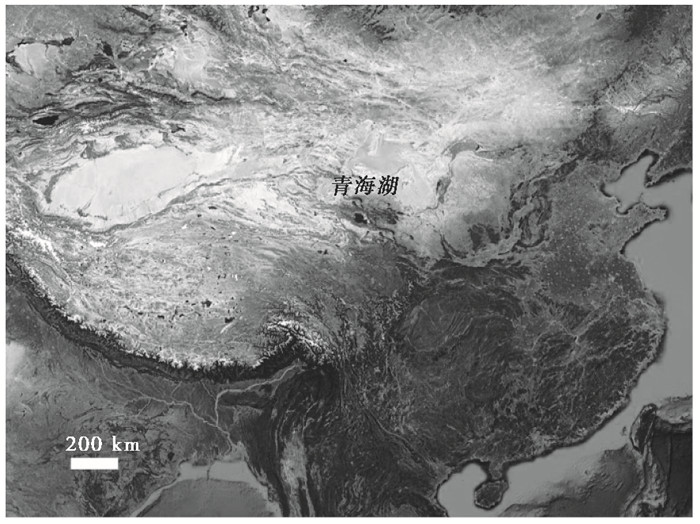
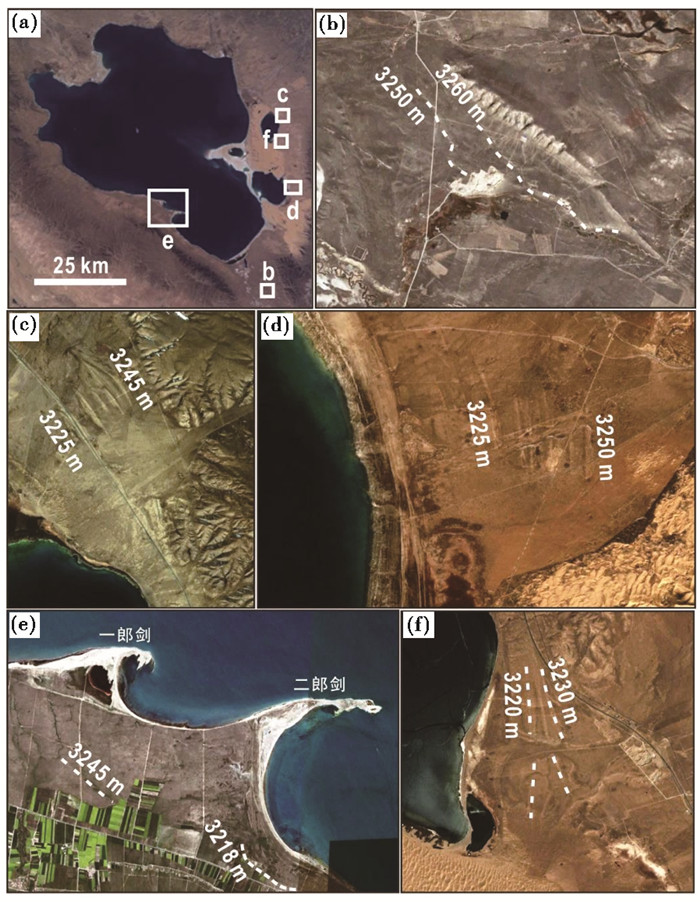
青海湖位于青藏高原东北缘(图 1和图 2a),是我国最大的内陆封闭湖泊(图 2a),其对区域和全球气候变化非常敏感[1~4, 18~20],是古环境科学家关注的热点地区之一。关于青海湖的形成和演化历史,古环境和地貌研究者已经开展了大量研究[21~29]。20世纪60年代,陈克造等[21]在论述青海湖形成和演化的论文中提到青海湖湖东有湖岸堤发育,最高的湖岸堤拔当时湖面51 m(海拔约3257 m),并认为这些湖岸堤是在全新世湖泊退宿过程中形成的;之后,一些学者认为青海湖最高一级湖岸堤拔湖140余米,主要分布在青海湖南岸江西沟一带,通过14C测年认为高湖面出现在距今4~3万年前[22~25]。陈发虎等[26]研究了青海湖南岸哈拉力黄土剖面和较低的三级湖滨堆积阶地,认为青海湖全新世湖面波动幅度不超过30 m;他们通过高程分析认为青海湖湖水外溢的最低高度拔湖103 m,一旦湖泊水位高于此高度,将通过克土垭口向东流入湟水流域。陈克造等[22]在青海湖湖芯钻孔(QH85-14C孔)7 m处发现了厚约2 m的黄土状沉积,通过14C测年认为末次冰期冰盛期时(2.4~1.8万年前)青海湖的水位非常低,甚至可能是被强风夷平的“干化面”。这一结论也得到了青海湖近期湖芯钻探结果的证实[30]。
|
图 1 青海湖位置概图 Fig. 1 Location of Qinghai Lake |
|
图 2 青海湖卫星影像(a)以及从遥感影像识别出的湖岸堤(b~f) Fig. 2 Remnant high-level shoreline features surround the Qinghai Lake identified from satellite images, and the Qinghai Lake (a) and the locations of satellite images of(b~f) |
Madsen等[2]考察青海湖四周的湖岸堤后认为最高的湖岸堤拔湖56~66 m,更高处的砾石沉积为冲洪积物,并且基于多片石英光释光测年结果认为拔湖36 m以上的湖岸堤形成于MIS 5时期;最近,Liu等[4]用单片石英光释光测年方法测定了青海湖周边拔湖20 m以下的湖岸堤、冲积物、湖相沉积和风成沉积,重建了末次冰消期以来的湖面水位波动曲线,发现青海湖在末次冰消期距今1.6~1.2万年前出现高湖面,湖面水位高出现在6.0~7.4 m,全新世的最高湖面出现在距今约5100年前,当时的湖面水位高出现在最少9.1 m。综上可知,青海湖MIS 3时期的湖泊水位高度依然未知,而已有高湖面研究结果的争执点就在MIS 3时期有无高湖面及高湖面的拔湖高度上。为了更好的理解青海湖末次间冰期以来的湖泊演化及其对古环境变化的响应过程,本研究根据50余个光释光测年结果[2, 4, 31~36],重建了约13万年以来青海湖的湖面变化历史。这些样品采自青海湖四周不同海拔和不同沉积环境的湖相沉积物中。我们重新评估了之前学者们重建的不一致的湖面变化结果,给出了更加完整的湖面水位波动曲线,以期可作为了解末次间冰期以来青藏高原湖泊演化的一个参考。
1 青海湖简介青海湖(中心坐标为36.88°N,100.20°E)面积4473 km2,湖面海拔3194 m(2012年10月)。青海湖东西长约106 km,南北宽约63 km,湖泊周长约360 km。位于湖泊北缘刚察的气象站监测数据显示多年平均气温为- 0.3 ℃,最高月平均气温10.9 ℃(7月),最低月平均气温- 13.5 ℃(1月)[37]。流域年平均降水约360 mm,年平均蒸发量为约830 mm[38]。青海湖流域河网发育,较大的入湖河流有布哈河(约占河流补给量一半)、沙柳河、哈尔盖河、泉吉河和黑马河。中更新世晚期,局部构造抬升切断日月山东侧湖泊外流的水径,使青海湖成为一个封闭湖泊[23, 39]。研究发现,明朝期间(距今300~680年)青海湖湖面海拔可达约3202 m[40],18世纪中期可能达到约3205 m[22],在接下来的125年里,湖面水位持续下降[41]。
2 青海湖古湖岸堤特征及分布在过去的十余年间,我们对青海湖四周出露的湖岸堤、近岸沉积、风成以及冲洪积剖面进行了系统的考察与测年。青海湖四周的湖岸堤根据它们所处的海拔高度、地貌特征和测年结果可分为3组。第一组湖岸堤分布在海拔3220~3260 m之间,因受后期地貌过程的侵蚀和改造,在湖南岸、东岸和北岸不连续分布、且大范围被后期冲积物覆盖而出露地点较少,但是出露的湖岸堤比低海拔的两组湖岸堤沉积特征更明显。青海湖东部的最高级湖岸堤(海拔约3250~3260 m,拔湖约56~66 m)主要由与浪蚀台地相关的沙坝和沙嘴复合而成(图 2b)[2, 31~33, 36]。该组湖岸堤在青海湖东北岸为湖面下降过程中形成的一系列特征明显的岸线[2, 31](图 2c、2d和2f),在青海湖南岸为被第四纪冲洪积物所覆盖的近岸湖相沉积和湖岸前积含砂砾石层[2, 31](图 2e)。
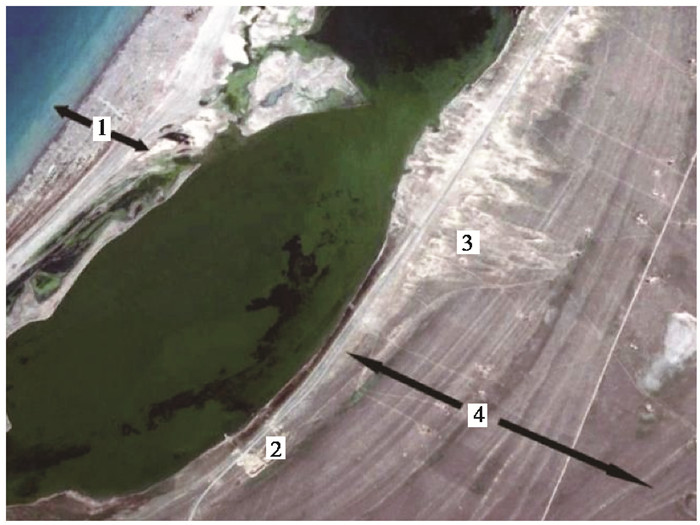
第二组湖岸堤分布在海拔3206~3215 m之间,在青海湖东部沿岸为保存较好的障壁沙坝,在青海湖南岸二郎剑沙嘴则为滨线坝(图 2e)。沙坝沉积被后期的冲洪积物和黄土所覆盖。在倒淌河入湖口处海拔约3210~3213 m之间也发现地貌形态保存良好的障壁沙坝,这些沙坝可能为同一期高湖面时快速堆积形成(图 3)。在洱海东侧的采石坑中,湖滨前积砂和砾石层覆盖在钙质胶结的湖相砂质砾石层之上,揭示了多个湖相沉积旋回。
|
图 3 青海湖洱海东侧倒淌河入湖口处沙坝的卫星影像图 (1)全新世-现代湖岸堤;(2)EH2和EH3采样点位置;(3)全新世-近代风暴潮改造过的MIS 3时期湖岸堤;(4)MIS 3时期障壁沙坝 Fig. 3 Satellite image of barrier bars at the mouth of the Daotang River on the eastern margin of Qinghai Lake: (1)Holocene-modern shoreline features; (2)EH2 and EH3 sampling locality; (3)Area of Holocene-modern storm surge reworking of MIS 3 shoreline features; (4)MIS 3 barrier bars |
第三组湖岸堤分布在海拔3194~3205 m之间,环湖都保存有这组年轻的湖岸地貌(图 3)。这些湖岸堤上植被稀少,没有黄土或有一层薄于1 m的全新世黄土覆盖[4, 34]。
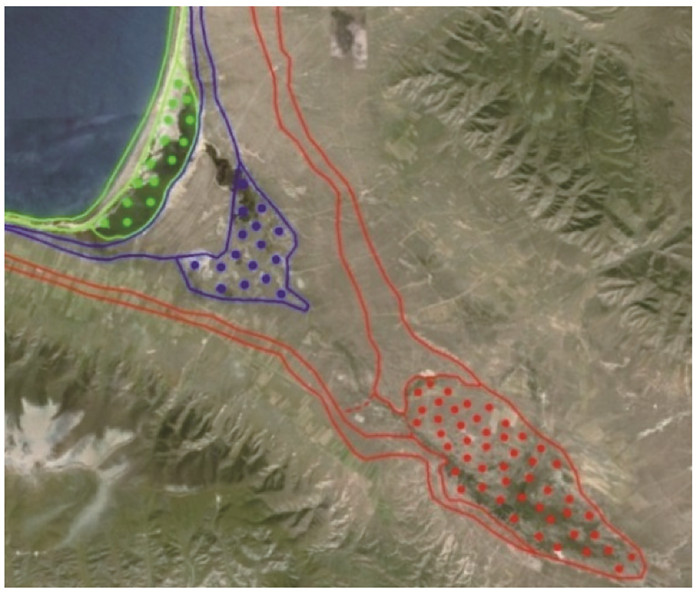
在倒淌河沿岸也保存有与以上3组湖岸堤相对应的湖岸沉积物。这3组湖岸沉积在倒淌河谷地表现为湖岸堤、障壁沙坝和沙嘴,在湖岸堤的离湖侧形成湾后潟湖(图 4)。
|
图 4
倒淌河入湖口处障壁沙坝/潟湖复合沉积
绿色线:全新世复合沙坝沉积(海拔约3194~3205 m);蓝色:MIS 3时期复合沙坝沉积(海拔约3210~3213 m);红色:MIS 5时期复合沙坝沉积(海拔约3230~3260 m) MIS 5时期和MIS 3时期的海拔高程基于一些出露的剖面确定 Fig. 4 Barrier bar/back bay lagoon complexes in the mouth of the Daotang "River". Green:Holocene complex at 3194~3205 m; Blue:MIS 3 complex at 3210~3213 m; Red:MIS 5 complex at 3230~3260 m. The MIS 5 and MIS 3 shoreline elevations are estimated from the elevations of relatively few exposures not buried under Late Quaternary alluvium |
从航空影像上也发现青海湖东南部湖底有湖岸堤地貌特征[23]。后期的沉积物常常覆盖在之前的湖岸沉积物之上,在有些地方后期沉积过程对之前的沉积物进行了改造,从而形成了更为复杂的湖岸地貌。
3 剖面概况及光释光测年样品采集采样剖面的海拔除一处之外都是用差分GPS测定的。在大多情况下,湖相沉积物被表层黄土所覆盖,对于这些点的海拔,我们通过地表的海拔简单进行校正。然而,许多湖岸堤的海拔(如沙坝等)在形成时比当时的湖面水位高1 m甚至几米。这些湖岸地貌是风暴作用形成的,所以他们的海拔受到多种因素控制,比如湖泊面积、起浪区范围以及风的强度等[42];此外,沙嘴和近岸湖相沉积的海拔可能比真实的湖面水位低1~2 m。本研究在评估湖面水位时也将这些影响因素考虑在内。
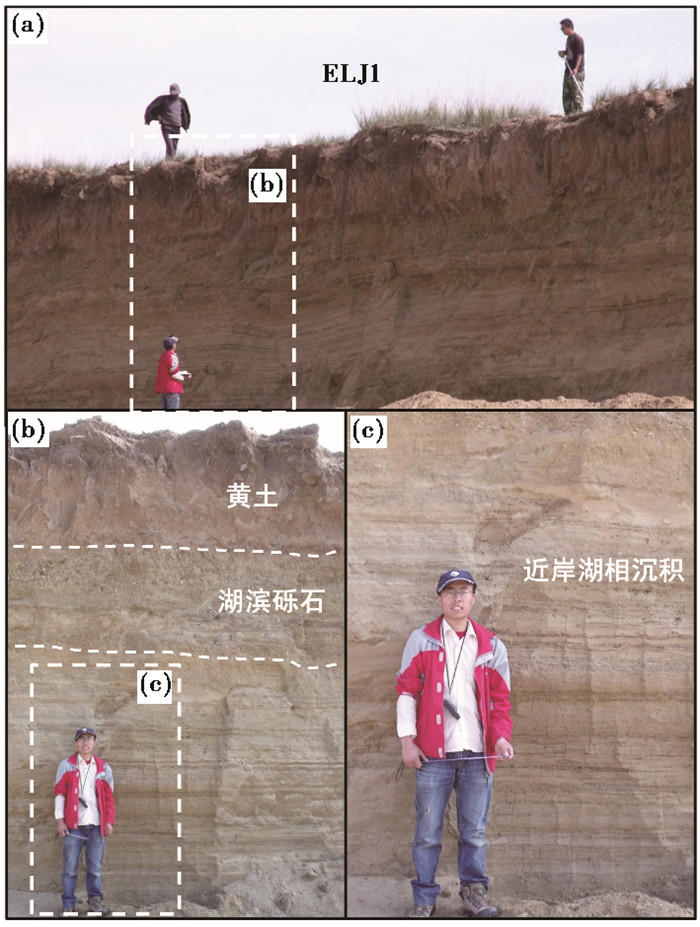
3.1 二郎剑采样点 3.1.1 ELJ1剖面ELJ1剖面位于青海湖南岸二郎剑旅游景区西侧的沙嘴根部(36.645°N,100.432°E;海拔3206.4 m),剖面出露约10 m厚的沉积地层。剖面顶部约1.2 m为风成黄土,其底部14C年代为约17.9 cal.ka B.P.[23],黄土中部的石英OSL年代为约13.8和11.9 ka[35]。黄土之下1.2~3.1 m之间为一层磨圆为次圆-圆的湖滨前积含砂砾石层,与上覆黄土不整合接触(图 5)。在含砂砾石层的砂质透镜体中采了一个OSL测年样品(ELJ1-C)。砾石层之下3.1~5.9 m之间为一套近岸砂沉积,5.9 m之下为有波纹层理的浅灰绿色深水湖相粉砂质粘土(图 5)。在近岸砂沉积中采了5个OSL测年样品(ELJ1-D至ELJ1-H),在深水湖相沉积物中采了2个OSL测年样品(ELJ1-I和ELJ1-J)。
|
图 5 (a) 二郎剑采样点ELJ1剖面上部正视图 (b)和(c)分别是(a)和(b)图中白色方框的放大图 Fig. 5 (a)Front view of the upper part of ELJ1 section. Note that (b) and (c) are the enlarge show of the white rectangle area in (a) and (b) |
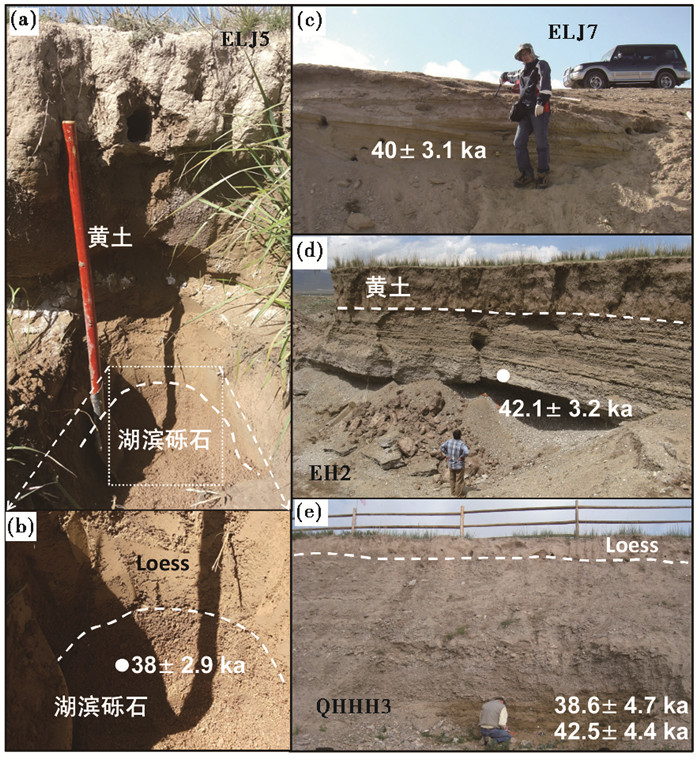
在二郎剑沙嘴内部的一个沙坝中人工挖坑采集了1个OSL测年样品(36.638°N,100.434°E;海拔3207.4 m)。剖面上部1.1 m为致密的黄土沉积,之下0.4 m为分选和磨圆程度较好的含中砂细砾石湖滨沉积,无层理,沉积物松散(图 6a)。OSL测年样品采自含中砂较多的层位(图 6b)。
|
图 6 青海湖MIS 3时期的湖岸堤和近岸沉积物 (a)和(b)为ELJ5采样剖面黄土之下的湖岸堤含砂砾石沉积;(c)ELJ7采样点全新世湖岸粗砂沉积之下的层状砂沉积;(d)EH2剖面黄土之下的湖岸含砂砾石和砾石层;(e)QHHH3剖面黄土和冲洪积物之下具波纹状层理的砂层 Fig. 6 Qinghai Lake localities with shoreline or nearshore sediments dating to MIS 3: (a)and (b) Shoreline sandy gravels underlying surface loess at locality ELJ5; (c)Bedded sands and gravels underlying Holocene-modern shoreline coarse sands at locality ELJ7; (d)Shoreline gravels and sandy gravels underlying surface loess at locality EH2; (e)Ripple-laminated sands underlying surface loess and bajada alluvium at locality QHHH3 |
这两个剖面位于二郎剑沙嘴内部(地理坐标分别为36.597°N,100.464°E;约3201.4 m和36.597°N,100.466°E;约3198.2 m)。剖面顶部约0.4 m为松散无明显层理的粗砂沉积,之下约0.8 m为不整合接触的低角度斜层理湖滨前积中粗砂夹细砾石层。我们在ELJ6和ELJ7剖面的湖滨前积中粗砂层各采集了一个OSL测年样品(图 6c)。
3.2 洱海边采样点(EH2和EH3剖面)这两个剖面位于青海湖倒淌河入湖口处湖岸线上挖掘的取石坑中,相距30 m(36.548°N,100.725°E),海拔介于约3211~3214 m(图 6d)。剖面顶部1.1~1.4 m为风成黄土,之下约5 m为层状未胶结的细-中砾石层,分选和磨圆较好,为湖滨沉积(图 6d)。黄土底部的OSL年代为约13.1 ka[31]。剖面出露的地层与湖岸堤展布方向平行,砾石层具水平层理,在与湖岸堤走向有一定夹角的出露剖面湖滨前积沉积有斜层理,层理向沙坝的边缘方向倾斜。我们在层状砾石层夹的薄砂层中采集了2个OSL测年样品。
3.3 一五一景点采样点(QHHH1和QHHH3剖面)此采样点位于青海湖南岸冲积扇前缘一五一旅游景区内(36.581°N,100.497°E)。由于QHHH剖面的海拔高程没用差分GPS测定,本研究通过10 m等高线的地形图和谷歌地球地表海拔以及水平追溯已知高程的湖岸堤来确定。QHHH1剖面表层0.8 m为黄土,之下为5.2 m厚的冲积物,再往下1 m为类似近岸湖相沉积的粗砂与砾石互层,砂层有波纹状层理。冲积物上部砂楔的OSL年代为约18.4 ka[32]。我们在厚约0.2 m的近岸砂层中采集了1个OSL测年样品。在该剖面对侧出露的QHHH3剖面中约0.8 m厚有次水平层理的湖相砂层中采集了2个OSL测年样品(海拔分别为约3197 m和约3198 m)(图 6e)。
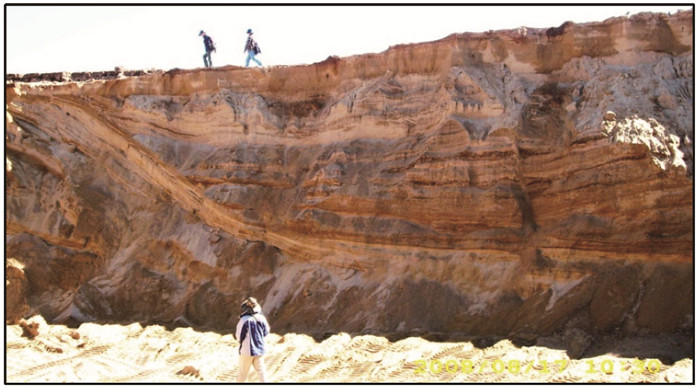
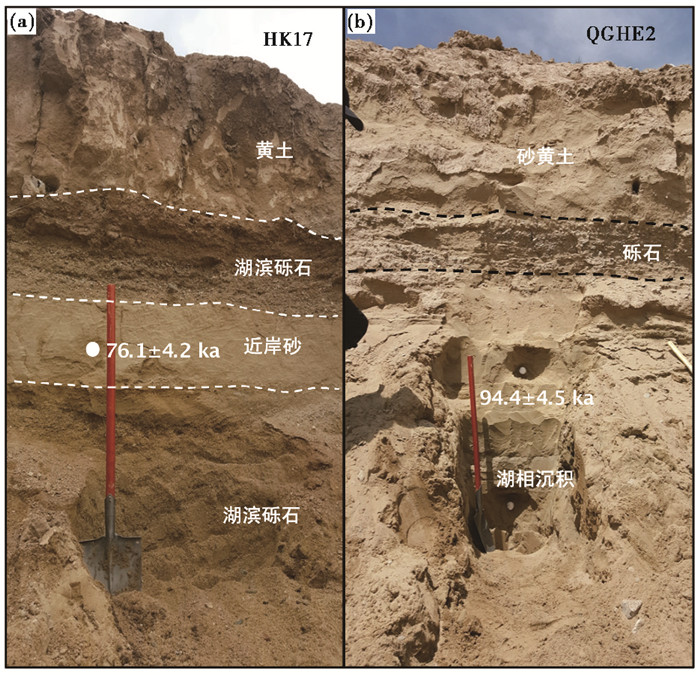
3.4 倒淌河谷地采样点(HK剖面)这个采样点位于青海湖的最东边(36.495°N,100.848°E;海拔约3250~3260 m),采样剖面位于最高一级湖岸堤上的取砂坑中(图 7)。剖面出露的沉积物为一套湖岸高角度前积砂和细砾石层,垂直厚度超过10 m。湖岸砂层之上覆盖有一层约0.5 m厚的冲积物,再往上为约1 m厚的全新世黄土。湖岸砂层与之上的沉积物呈明显的不整合接触。我们已经测定了这个取砂坑中10个湖岸砂沉积物的石英OSL年代(HK1-5剖面[31]),年龄介于54~110 ka[31~33, 36]。但是这些样品的石英OSL年代已经趋于饱和,故只能指示最小年龄。为了得到湖滨沉积更精准的年代,2014年我们在此取砂坑海拔约3255 m的湖滨砂中采集了QH14-1和QH14-2样品用于钾长石Post-IR IRSL测年;2017年夏天,我们在此取砂坑海拔约3250 m的湖相近岸砂层中采集了HK17测年样品(图 8a)。
|
图 7 HK采样剖面出露的湖滨前积砂层 (海拔约3255 m)(图中人高约1.7 m) Fig. 7 Foreset bedded sands in the ca. 3255 m spit exposed at locality Hongkou. The person is ca. 1.7 m in height |
|
图 8 青海湖东岸HK17 (a)和QGHE2 (b)采样剖面照片 Fig. 8 The photos of sampling sections of HK17 (a)and QGHE2 (b)at the eastern margin of the Qinghai Lake |
此采样点位于青海湖东北缘尕海湖以东,托勒火车站附近的取石坑内(36.975°N,100.639°E;海拔3228~3233 m)。剖面顶部1.7 m为质地松软的砂黄土,夹杂小砾石(图 8b);1.7~2.1 m为湖岸粗砂和砾石沉积,有水平层理,砾径2~3 cm,磨圆程度为次圆;2.1~2.6 m为一套含砾粗砂层;再往下2.60~2.95 m为近岸粗砂沉积,具低角度斜层理,其中QGHE2-17测年样品采自于该砂层距地表2.8 m处;2.95~3.45 m为近岸细砂沉积物,有次水平层理;3.45~3.80 m可见4层砂质粘土层;3.8 m以下为湖岸堤砾石层,砾径为3~4 cm,砾石的分选和磨圆程度好(图 8b),向下未见底。
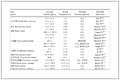
4 光释光测年野外采样和实验处理流程在Liu等[4, 31, 33]的论文中有详细叙述。石英的提取用重液分离加氢氟酸刻蚀的方法。本文运用单片再生法测定38~63 μm粒径石英获得其OSL年代[43]。等效剂量、剂量率以及OSL年代在表 1中列出,已报道的青海湖高湖面年代数据请参见之前文章[2, 4, 31~36]。
|
表 1 放射性剂量测量及石英光释光测年结果 Table 1 Quartz optically stimulated luminescence(OSL)ages and associated dosimetry data |
随着对中国西北湖岸堤OSL测年的深入研究,学者们发现老于约8万年的石英OSL年代结果可能存在低估。中国西北部的石英OSL饱和剂量一般在150~200 Gy,假设剂量率为2.5 Gy/ka,那么对应的年代为6~8万年[44]。石英OSL年代的低估同样可以在等效剂量超过2D0(D0指饱和特征剂量)的老样品中出现[45~48]。这个问题可以通过新开发出来的post-IR IRSL钾长石测年方法来规避[49~52]。这种测年方法能很好的解决钾长石近红外释光(IRSL)信号异常衰减这一难题,其可靠的测年上限可达约20万年[50~54]。因此,我们对部分石英OSL年龄超过6万年的样品用post-IR IRSL测年方法测定其钾长石年龄,用以评估石英OSL年代是否因等效剂量接近饱和剂量而使年龄被低估,对小于6万年的石英OSL年龄本研究认为其结果是准确的。
我们用钾长石post-IR IRSL测年方法测定了3个采自HK剖面和1个采自QGHE2剖面的湖滨和近岸砂样品。为了评估不同实验室之间的测年差异,2个样品在兰州大学光释光测年实验室测定,另外2个在临沂大学光释光测年实验室测定。采样过程中,我们将直径4 cm的不锈钢钢管水平砸入新鲜剖面中,拔出采样管之后立即用黑色的布、铝箔和胶带封好,以避免样品见光和含水量的改变。钾长石post- IR IRSL测年方法的实验室处理流程参见前人论文[50]。钾长石等效剂量的测定用post-IR IRSL单片法[51]。对HK剖面的QH14-1和QH14-2样品,90~125 μm粒径的钾长石制成2 mm的测片,每个样品在兰州大学光释光测年实验室测了6个测片的等效剂量,取平均后计算年龄;对HK17和QGHE2-17样品,150~180 μm粒径的钾长石制成2 mm的测片,每个样品在临沂大学光释光测年实验室测4个测片的等效剂量,取平均值计算年龄。外部剂量率通过测定样品周缘沉积物中的铀、钍和钾的含量并通过Guérin等[55]文中的公式来计算。内部剂量率通过采用钾含量12.5±0.5 %和铷含量400±100 ppm来计算[56]。宇宙射线对剂量率的贡献通过样品的经纬度、海拔和埋藏深度来确定。我们在50 ℃和290 ℃的激发温度下用post-IR IRSL钾长石测年方法来测定样品的等效剂量,g-vaule值用1±0.02 %每10年来校正长石异常衰减,最后得到HK17的年代为76.1±4.2 ka。我们通过MET- post- IR IRSL长石测年方法来测定QGHE2-17样品的等效剂量,这个等效剂量没有再进行校正。放射性元素U、Th、K的含量和钾长石post-IR IRSL290的年代结果见表 2。
|
|
表 2 长石post-IR IRSL290测年样品放射性剂量测量及测年结果 Table 2 The feldspar post-IR IRSL290 dosimetry and dating results |
我们已经获得了48个较高海拔的湖岸堤和近岸湖相沉积物的石英OSL年代[2, 4, 31~33, 36]。其中有19个石英OSL年龄可能饱和,另外有23个年龄在测试中未发现饱和,但是超过石英OSL测年方法的上限(6~8万年)。这23个年龄介于8万年到14万年之间,我们认为这些年代落在MIS 5时期,即距今7.1~13万年之间。我们在HK采样点(海拔约3255 m)采的3个样品、在QGHE2采样点(海拔约3230 m)采的1个样品的钾长石年龄依次为74.71±4.38 ka、76.1±4.2 ka、92.63±5.05 ka和94.4±4.5 ka(见表 2)。这些年龄表明青海湖最高湖面出现在MIS 5晚期,同时也验证了已报道石英OSL年代的准确性。
在这48个石英OSL年代中,有6个采自二郎剑沙嘴的ELJ1剖面(剖面顶部拔湖约12.4 m)。这个剖面自下而上反映了湖泊退缩的过程,即剖面底部为深水湖相含砂粘土沉积,往上为近岸湖相砂层夹细砾石,再往上为湖岸前积含砂砾石层(图 5)。这6个OSL年龄约束了湖泊的退缩历史。剖面最底部的深水湖相沉积物年龄为约9.3和9.0万年,近岸砂的年龄为约7.6万年,上部湖岸堤含砂砾石沉积物的年龄为约6.8万年。年代随深度递增说明较年轻的石英OSL年龄可能是相对可靠的,同样也反映了MIS 5a时期湖泊的退缩过程,在MIS 5晚期(约7.1万年前)湖面水位可能接近现在湖面。
尽管我们对青海湖四周的古湖岸堤做了很多测年,我们并没有测得MIS 4(约7.1~5.7万年)和MIS 3(约5.7~2.9万年)早期的湖相沉积年代,可能是MIS 4时期的湖岸堤被后期高湖面时期的地貌过程改造所致。但是目前我们认为这个阶段的湖面水位近于或者低于现在湖面,因为近期发表的文章提出青藏高原东北缘的气候在MIS 4和MIS 2 (2.9~1.2万年)期间是干冷的,使得之前间冰期/间冰阶堆积的黄土被侵蚀向东搬运[30, 57]。我们推测在MIS 3早期,湖面水位有可能达到3210~3211 m或者更高。EH2和EH3剖面(海拔约3210.5 m)湖岸含砂砾石沉积物的年代为约4.2和4.1万年,表明了湖泊稍有退缩。与此同时,QHHH1、QHHH3、ELJ6和ELJ7剖面的测年结果分别约为4.3万年、4.0万年、3.9万年、3.8万年和3.4万年,表明此时的湖面位于或者低于约3200 m,低于全新世的最高湖面水位(全新世最高湖面≥ 3203 m)。我们难以判断这些沉积物是否反映了湖面的快速变化(或下降)过程。
我们也没有测得气候干冷的MIS 2时期的湖岸堤,但是湖芯钻孔记录表明在距今3万至1.8万年之间青海湖可能只有几米深[4, 30, 58~60],比如,钻孔沉积在距今2.0~1.8万年出现了风成砂和类黄土沉积物,表明当时的青海湖可能分裂成了2个独立的小湖[4, 30, 59~60]。由于末次冰盛期的气候异常干冷,在海拔约3300 m和现在湖泊之间发育了大量砂楔,它们的年龄介于3.0万至1.6万年之间[2, 32, 36, 61]。
Long等[62]近期用石英OSL测年方法和钾长石post-IR IRSL测年方法测定了青海湖东岸和南岸湖相沉积物的年代,他们很多剖面和本研究以及我们之前报道的剖面点重叠,他们认为高湖面出现在MIS 3早期。然而,他们的结论更多是基于石英光释光年龄得出的,长石的post-IR IRSL年龄显示高湖面出现在MIS 4和MIS 5a时期(参见Long等[62] 图 7)。并且,本研究和之前发表的年代[2, 4, 31~33, 36]在计算光释光年龄时假设湖滨粗砂、近岸砂和细砂粘土在埋藏期间的含水量分别为10±5 %、15±5 %和20±5 %,而Long等[62]对所有样品均采用10±10 %的含水量来计算年龄,这一差别也会使年龄产生5 % ~10 %的差异。如果将埋藏期间的含水量设为一致,则Long等[62]的年代就会落在MIS 4早期和MIS 5晚期,与我们的年龄差异进一步缩小。
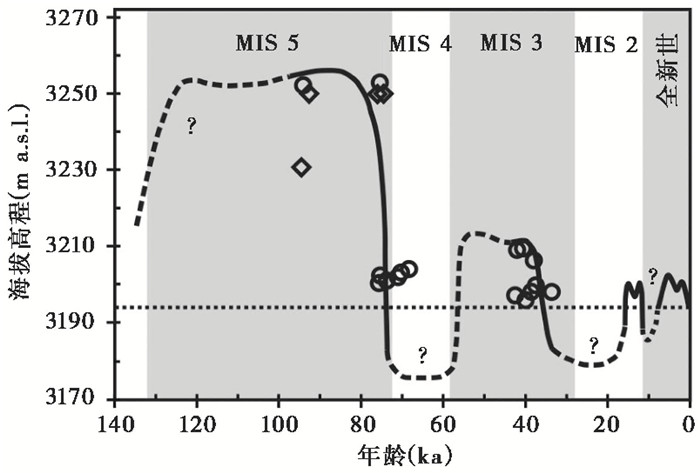
6 青海湖晚第四纪湖面水位波动历史重建通过综合本文年代/海拔数据和之前已发表的OSL年代结果以及现有的钻孔岩芯记录,我们重建了青海湖13万年以来的湖面变化曲线(图 9)。青海湖湖面水位在MIS 5晚期某个时期开始下降,由于老于8万年的石英OSL年龄的精确性难以评估,准确的湖面水位下降时间难以确定。湖岸堤OSL年龄表明湖面水位在MIS 5中晚期存在波动,但是湖面波动的详细阶段及波动过程仍不清楚。我们认为青海湖湖面水位在约9万年(MIS 5a)时达到至少约3255 m,对应东亚夏季风的增强时期[14, 63],但是最高湖面(海拔约3260 m)出现的时间还未确定。在约7.6万年前湖面水位开始下降,并且在7.6~6.8万年期间湖面水位持续下降至低于3206 m(图 9)。
|
图 9 晚第四纪13万年(130 ka)以来青海湖湖面水位变化曲线,数据来源于本文和文献[2, 4, 31~36] 圆圈代表本文中湖岸堤平均石英OSL年代/海拔;空心菱形代表钾长石post-IR IRSL年代/海拔;实线代表重建的较可靠的湖面水位变化;虚线代表推测的湖面水位变化;黑色的点线代表现代湖面(海拔3194 m) Fig. 9 Qinghai Lake water level fluctuation curve for the last ca.130 ka based on data reported here and in papers[2, 4, 31~36]. Dots represent mean quartz OSL ages/elevations for shoreline samples reported here. Open rhombus represent K-feldspar post-IR IRSL ages/elevations. Solid lines indicate increased confidence in lake surface reconstructions; dotted lines represent tentative reconstructions. Black dotted line represent modern lake level at 3194 m a.s.l. |
MIS 4时期(7.1~5.7万年)的湖面水位难以确定,由于没有这一时期的湖岸堤测年数据,且这一时期青藏高原北部气候干旱寒冷[57],我们认为当时的湖面水位应低于现在湖面。随后在MIS 3早中期的某个时段湖面水位上涨到约3213 m(具体的年代还不能确定)。在约4.2万年时湖面稍微下降至约3210 m,之后在约3.9万年时水位快速下降到约3200 m(也可能低于3198 m)(图 9)。由于缺乏更精确的年代约束,这一时期的湖面变化过程是推测的,但是却能与青藏高原北部其他指示MIS 3后期干旱加剧的环境记录很好的对应[17]。最后,海拔约3198 m处的近岸砂沉积OSL年代为约3.3万年(QHHH1剖面),表明MIS 3末期湖面在此海拔高度波动变化。
已报道的的湖岸堤测年结果表明末次冰盛期后约1.6万至1.2万年之间青海湖湖面水位上涨到约3201 m[4],这与Wang等[64]重建的高湖面年代很接近(约1.7~1.5万年和约1.3~1.2万年),这时的高湖面可能是冰川、冻土融水补给湖泊所致[4]。同样地,我们重建的结果与湖心钻孔记录指示的湖面在1.5万年超过3199 m和1.2万年超过3200.8 m的研究结果[59]相一致。早全新世湖面下降,青海湖出现低湖面,之后在距今6~5 ka期间,湖面水位上涨至全新世最高点,即湖面海拔达3203 m甚至更高,当时湖面水位高出现在至少9.1 m(图 9)[4]。倒淌河入湖口处MIS 3时期形成的较低的沙坝被后期风暴潮所改造的地貌特征(图 3)也表明了较低海拔处的湖岸堤是可能是被后期重建的[2]。基于湖岸沉积物测年重建的全新世湖面变化与一些基于钻孔岩芯的研究结果不一致,这些研究[3, 30, 65]认为湖面快速上涨只出现在距今1.2万年以来,且高湖面出现在早全新世。另外一些基于湖心钻孔沉积的研究[66]则认为高湖面出现在中晚全新世,与我们湖岸堤测年得出的结果[4]一致。青海湖中全新世出现高湖面与东亚夏季风影响区以及中亚干旱区全新世大暖期的时间段是一致的,当时的降水和温度都比现在高[4, 13]。晚全新世(约3.7 ka)以来湖面水位经历了多次的上涨与下降波动,这期间青海湖在罗马暖期(约2.0 ka)或19世纪后期出现最高湖面[34](海拔3202.3 m),高出现在湖面约8 m。
7 讨论 7.1 青藏高原湖泊晚第四纪湖面水位波动历史20世纪80年代,科学家通过卫星影像和野外考察发现西藏许多湖泊四周都有大规模的湖岸堤分布,最高湖岸堤拔湖超过300 m[67];之后,通过14C测年,学者们认为青藏高原在4.0~2.8万年前出现过大范围的湖泊扩张[22, 25, 68~70],这一时期被称为“泛湖期”或“大湖期”。近十几年来,大量的湖岸堤年代学研究又把大湖期的时间向前推到MIS 5时期。甜水海拔湖90~100 m的最高湖岸堤的热释光年龄为11万年[71]。甜水海钻孔的碳酸盐元素地球化学指标分析发现,最近13万年以来,甜水海的湖水盐度在间冰期降低,冰期升高,指示湖泊在间冰期扩张,冰期收缩[72];结则茶卡最高级湖岸堤形成于12~9万年前,之后湖泊开始收缩,在1.4万年前形成盐湖[73];对扎布耶盐湖SZK02孔的研究认为最高湖面出现在9~8万年前,在7.7~5.9万年期间湖泊收缩,在MIS 3a期间(4.3~3.6万年)再次出现高湖面,在2.9~1.2万年期间气候干冷,湖泊萎缩[74];对塔若错高位湖岸堤和湖相沉积进行光释光测年发现其在MIS 3a时期出现过高湖面[75];对纳木错湖岸堤沉积进行铀系、14C和电子自旋共振(ESR)测年发现其在距今11.5~4.0万年之间发育古大湖,之后湖泊萎缩,大湖解体[76~77];对色林错高位湖岸堤进行宇生核素36 Cl测年发现最高湖面出现在MIS 6和MIS 5e时期[11];柴达木盆地托素湖和尕海湖岸堤光释光测年发现最高湖面出现在MIS 5a时期,在MIS 3时期也出现过高湖面[78]。由以上青藏高原已发表的高湖面年代可知,晚第四纪最高湖面出现在MIS 5时期(个别湖泊最高湖面出现在MIS 5e时期,多数湖泊出现在MIS 5a时期),MIS 3时期青藏高原上一些湖泊出现过高湖面,当时的湖泊范围要小于MIS 5时期,但MIS 3时期的湖泊范围比全新世高湖面时期大还是小依然未知。本研究重建的青海湖晚第四纪高湖面变化曲线显示MIS 5a时期的最高湖泊水位拔现在湖面56~66 m,MIS 3高湖面时期的湖泊水位拔现在湖面13~17 m,全新世最高湖面出现在距今5100年前,当时湖面水位高出现在至少9.1 m[4](图 9)。虽然青海湖处在青藏高原东北部,受到西风带和亚洲夏季风的交替影响,而青藏高原南部的湖泊主要受印度夏季风的影响,但在冰期-间冰期时间尺度上西风带南北大幅度摆动影响青藏高原大部分地区[79]的情形下,青海湖的演化历史亦可以作为青藏高原其他湖泊演化的一个相似形,以供参考。
7.2 地貌演化过程对湖岸堤保存的影响地貌演化与环境变化对青藏高原东北缘湖泊差异演化的解释具有同等重要性。祁连山北麓湖泊的演化与祁连山南麓湖岸堤记录的青海湖的演化并不完全一致,这可能与它们地貌演化过程的差异有很大关系。黑河和石羊河终端湖在MIS 5a时期出现高湖面[80~82]与青海湖一致,但这两个湖泊都没有MIS 3阶段高湖面的记录。我们认为很有可能是这些湖泊MIS 3高湖面时期的湖泊范围和全新世高湖面时期相近的缘故。我们在青海湖周边只发现了3处较好的MIS 3时期高湖面记录,而其他湖岸堤有可能被全新世高湖面时期的沉积物改造或者掩埋,抑或是被后期的冲洪积物掩盖。Reheis等[42]文中提到大湖时期的湖岸堤和沙坝入口处的海拔取决于诸如盛行风向、风暴强度、起浪区范围和沉积物等因素。在这些因素的影响下,湖岸沉积物沉积时的高度相对于平均湖面水位可能会有几米高差。如图 3所示,全新世至近代的风暴潮可以到达MIS 3时期的沙坝,并对这些沙坝沉积物进行改造。同样的原因,对于黑河和石羊河的终端湖,保存下来的MIS 3时期形成的湖岸堤很少,也很难辨别。另外,青海湖现在快速发展旅游业,大量的道路修筑就地挖掘取石/砂坑也让很多埋藏的湖岸堤沉积物暴露了出来,我们可以很方便地环湖考察和取样。而对于祁连山北缘的湖泊来说是没有这种便利条件的。
8 结论本研究通过对青海湖四周湖岸堤进行系统的考察和光释光测年,并结合前人研究结果,重建了青海湖MIS 5以来的高湖面历史。由于石英光释光测年受测年上限(6~8万年)所限,使我们很难仅基于石英光释光测年结果判断高湖面出现的时期。我们对老于6万年的4个样品进行了长石post-IR IRSL测年(这种测年方法的测年上限可达20万年),结果验证了青海湖石英光释光年代框架的准确性。本研究主要得到以下结论:1)青海湖在MIS 5时期出现高湖面,MIS 5a高湖面时期的湖面水位介于海拔3220 m至3260 m之间(拔湖约26 m至66 m之间);2)MIS 3时期的最高湖面出现在早于4.2万年,当时湖面水位海拔可达3212~3213 m。随后湖面在约4.2万年开始缓慢下降至约3210 m,继而在约3.9万年前快速下降到约3204 m,之后的MIS 3a时期湖面稳定在3204~3198 m之间。MIS 3时期的最高湖面比全新世最高湖面高6~9 m;3)全新世最高湖面出现在距今约5100年前,当时湖面水位高出现在至少9.1 m[4]。晚全新世(3.7 ka)以来湖面水位发生了多次波动[34],其中在罗马暖期(约2.0 ka)或19世纪后期,出现了最高湖面(高出现在湖面约8 m);4)在青海湖四周没有找到任何MIS 4和MIS 2时期的湖岸和湖相沉积。
致谢: 感谢David Rhode、Jeff Brantingham、李方亮、David Page、Charles Perreault、孙永娟、樊启顺、魏海成、安福元、张彪和隆浩在野外考察和采样中的帮助。同时特别感谢4位审稿专家提出的建设性修改意见和杨美芳老师的细心编审及提出的修改意见。
| [1] |
Benn D I, Owen L A. The role of the Indian summer monsoon and the mid-latitude westerlies in Himalayan glaciation:Review and speculative discussion[J]. Journal of the Geological Society, London, 1998, 155(2): 353-363. DOI:10.1144/gsjgs.155.2.0353 |
| [2] |
Madsen D B, Ma H Z, Rhode D, et al. Age constraints on the Late Quaternary evolution of Qinghai Lake, Tibetan Plateau[J]. Quaternary Research, 2008, 69(2): 316-325. DOI:10.1016/j.yqres.2007.10.013 |
| [3] |
An Z S, Colman S M, Zhou W J, et al. Interplay between the Westerlies and Asian monsoon recorded in Lake Qinghai sediments since 32 ka[J]. Scientific Reports, 2015, 2(8): 619. |
| [4] |
Liu X J, Lai Z P, Madsen D B, et al. Last deglacial and Holocene lake level variations of Qinghai Lake, northeastern Qinghai-Tibetan Plateau[J]. Journal of Quaternary Science, 2015, 30(3): 245-257. DOI:10.1002/jqs.v30.3 |
| [5] |
Fan Q S, Ma H Z, Hou G L. Late Pleistocene lake and glaciation evolution on the northeastern Qinghai-Tibetan Plateau:A review[J]. Environmental Earth Sciences, 2012, 66(2): 625-634. DOI:10.1007/s12665-011-1271-x |
| [6] |
Lai Z P, Mischke S, Madsen D B. Paleoenvironmental implications of new OSL dates on the formation of the "Shell Bar" in the Qaidam Basin, northeastern Qinghai-Tibetan Plateau[J]. Journal of Paleolimnology, 2014, 51(2): 197-210. DOI:10.1007/s10933-013-9710-1 |
| [7] |
Long H, Shen J. Underestimated 14C-based chronology of Late Pleistocene high lake-level events over the Tibetan Plateau and adjacent areas:Evidence from the Qaidam Basin and Tengger Desert[J]. Science China:Earth Sciences, 2014, 58(2): 183-194. |
| [8] |
Mischke S, Madsen D B, Zhang C, et al. Reply to comment by Zhang(2014):The Shell Bar in the Qaidam Basin:Fluvial or lake deposit, and OSL versus 14C age data[J]. Journal of Paleolimnology, 2015, 53(3): 335-344. DOI:10.1007/s10933-014-9817-z |
| [9] |
Lisiecki L E, Raymo M E. A Pliocene-Pleistocene stack of 57 globally distributed benthic δ18O records[J]. Paleoceanography, 2005, 20(1): 1-16. DOI:10.1029/2004PA00107 |
| [10] |
Long H, Shen J, Wang Y, et al. High-resolution OSL dating of a Late Quaternary sequence from Xingkai Lake(NE Asia):Chronological challenge of the "MIS 3a Mega-paleolake" hypothesis in China[J]. Earth and Planetary Science Letters, 2015, 428: 281-292. DOI:10.1016/j.epsl.2015.07.003 |
| [11] |
Shi X H, Furlong K P, Kirby E, et al. Evaluating the size and extent of paleolakes in central Tibet during the Late Pleistocene[J]. Geophysical Research Letters, 2017, 44(11): 5476-5485. DOI:10.1002/2017GL072686 |
| [12] |
Li G Q, Madsen D B, Jin M, et al. Orbital scale lake evolution in the Ejina Basin, central Gobi Desert, China revealed by K-feldspar luminescence dating of paleolake shoreline features[J]. Quaternary International, 2018, 482: 109-121. DOI:10.1016/j.quaint.2018.03.040 |
| [13] |
Herzschuh U, Kürschner H, Mischke S. Temperature variability and vertical vegetation belt shifts during the last~50, 000 yr in the Qilian Mountains(NE margin of the Tibetan Plateau, China)[J]. Quaternary Research, 2006, 66(1): 133-146. DOI:10.1016/j.yqres.2006.03.001 |
| [14] |
Ning Y F, Liu W G, An Z S. A 130-ka reconstruction of precipitation on the Chinese Loess Plateau from organic carbon isotopes[J]. Palaeogeography, Palaeoclimatology, Palaeoecology, 2008, 270(1): 59-63. |
| [15] |
Jiang H, Mao X, Xu H, et al. Last glacial pollen record from Lanzhou(Northwestern China) and possible forcing mechanisms for the MIS 3 climate change in Middle to East Asia[J]. Quaternary Science Reviews, 2011, 30(5): 769-781. |
| [16] |
Long H, Lai Z P, Fuchs M, et al. Palaeodunes intercalcated in loess strata from the western Chinese Loess Plateau:Timing and palaeoclimatic implications[J]. Quaternary International, 2012, 263: 37-45. DOI:10.1016/j.quaint.2010.12.030 |
| [17] |
Long H, Fuchs M, Yang L, et al. Abrupt sand-dune accumulation at the northeastern margin of the Tibetan Plateau challenges the wet MIS 3a inferred from numerous lake-highstands[J]. Scientific Reports, 2016, 6: 25820. DOI:10.1038/srep25820 |
| [18] |
张彭熹, 张保珍, 钱桂敏, 等. 青海湖全新世以来古环境参数研究[J]. 第四纪研究, 1994(3): 226-237. Zhang Pengxi, Zhang Baozhen, Qian Guimin, et al. The study of paleoclimatic parameter of Qinghai Lake since Holocene[J]. Quaternary Sciences, 1994(3): 226-237. |
| [19] |
余俊清, Kelts K. 末次冰消期晚期青藏高原东北部气候变化[J]. 第四纪研究, 2002, 22(3): 413-423. Yu Junqing, Kelts K. Climatic change in the northeastern Qinghai-Tibet Plateau during the late glacial/Holocene transition[J]. Quaternary Sciences, 2002, 22(3): 413-423. |
| [20] |
柳中晖, 周爱锋, 刘卫国. 近千年来青海湖水热变化再重建[J]. 第四纪研究, 2017, 37(5): 974-981. Liu Zhonghui, Zhou Aifeng, Liu Weiguo. Further reconstruction of temperature and salinity changes in Lake Qinghai over the past millennium[J]. Quaternary Sciences, 2017, 37(5): 974-981. |
| [21] |
陈克造, 黄第藩, 梁狄刚. 青海湖的形成和发展[J]. 地理学报, 1964, 30(3): 34-53. Chen Kezao, Huang Dipan, Liang Digang. The formation and evolution of Qinghai Lake[J]. Acta Geographica Sinica, 1964, 30(3): 34-53. |
| [22] |
陈克造, Bowler J M, Kelts K. 四万年来青藏高原的气候变迁[J]. 第四纪研究, 1990(1): 21-31. Chen Kezao, Bowler J M, Kelts K. Palaeoclimatic evolution within the Qinghai-Xizang(Tibet) Plateau in the last 40, 000 years[J]. Quaternary Sciences, 1990(1): 21-32. DOI:10.3321/j.issn:1001-7410.1990.01.003 |
| [23] |
袁宝印, 陈克造, Bowler J M, 等. 青海湖的形成与演化趋势[J]. 第四纪研究, 1990(3): 233-243. Yuan Baoyin, Chen Kezao, Bowler J M, et al. The formation and evolution of the Qinghai Lake[J]. Quaternary Sciences, 1990(3): 233-243. DOI:10.3321/j.issn:1001-7410.1990.03.005 |
| [24] |
王苏民, 施雅风. 晚第四纪青海湖演化研究析视与讨论[J]. 湖泊科学, 1992, 4(3): 1-9. Wang Sumin, Shi Yafeng. Review and discussion on the Late Quaternary evolution of Qinghai Lake[J]. Journal of Lake Sciences, 1992, 4(3): 1-9. |
| [25] |
Zhang H C, Peng J L, Ma Y Z, et al. Late Quaternary palaeolake levels in Tengger Desert, NW China[J]. Palaeogeography, Palaeoclimatology, Palaeoecology, 2004, 211(1-2): 45-58. DOI:10.1016/j.palaeo.2004.04.006 |
| [26] |
陈发虎, 汪世兰, 张维信, 等. 青海湖南岸全新世黄土剖面、气候信息及湖面升降探讨[J]. 地理科学, 1991, 11(1): 76-85. Chen Fahu, Wang Shilan, Zhang Weixin, et al. The loess profile at south bank, climatic information and lake-level fluctuations of Qinghai Lake during the Holocene[J]. Scientia Geographica Sinica, 1991, 11(1): 76-85. |
| [27] |
刘卫国, 王政, 李祥忠. 内源贡献对青海湖碳同位素指标量化的影响[J]. 第四纪研究, 2016, 36(3): 623-629. Liu Weiguo, Wang Zheng, Li Xiangzhong. The contribution of aquatic plants to sedimentary n-alkanes δ13C values using to qualify compositions of terrigenous plants in Lake Qinghai on the northeastern Qinghai-Tibetan Plateau[J]. Quaternary Sciences, 2016, 36(3): 623-629. |
| [28] |
王欢业, 刘卫国, 张传伦, 等. 青海湖钻孔沉积物中的羟基甘油二烷基甘油四醚类化合物及其环境意义[J]. 第四纪研究, 2017, 37(5): 1151-1160. Wang Huanye, Liu Weiguo, Zhang Chuanlun, et al. Hydroxylated glycerol dialkyl glycerol tetraethers in Lake Qinghai sediments and their paleoclimate implications[J]. Quaternary Sciences, 2017, 37(5): 1151-1160. |
| [29] |
陶涛, 王超群, 戚帮申, 等. 青海湖鸟岛北原生砂楔的发现及其古气候意义[J]. 第四纪研究, 2016, 36(5): 1246-1252. Tao Tao, Wang Chaoqun, Qi Bangshen, et al. Fossil sand wedges of north Niaodao in Qinghai Lake:Discovery and paleoclimatic implications[J]. Quaternary Sciences, 2016, 36(5): 1246-1252. |
| [30] |
Jin Z D, An Z S, Yu J M, et al. Lake Qinghai sediment geochemistry linked to hydroclimate variability since the last glacial[J]. Quaternary Science Reviews, 2015, 122: 63-73. DOI:10.1016/j.quascirev.2015.05.015 |
| [31] |
刘向军.晚第四纪青海湖湖面变化光释光年代学[D].西宁: 中国科学院青海盐湖研究所博士论文, 2011: 110-150. Liu Xiangjun. The Late Quaternary Lake Level History of Qinghai Lake Based on Quartz Optically Stimulated Luminescence[D]. Xining: The Doctoral Dissertation of Qinghai Institute of Salt Lakes, Chinese Academy of Sciences, 2011: 110-150. http://www.wanfangdata.com.cn/details/detail.do?_type=degree&id=Y2166673 |
| [32] |
Liu X J, Lai Z P. Optical dating of sand wedges and ice-wedge casts from Qinghai Lake area on the northeastern Qinghai-Tibetan Plateau and its palaeoenvironmental implications[J]. Boreas, 2013, 42(2): 333-341. DOI:10.1111/bor.2013.42.issue-2 |
| [33] |
Liu X J, Lai Z P, Fan Q S, et al. Timing for high lake levels of Qinghai Lake in the Qinghai-Tibetan Plateau since the last interglaciation based on quartz OSL dating[J]. Quaternary Geochronolgy, 2010, 5(2): 218-222. |
| [34] |
Liu X J, Lai Z P, Madsen D B, et al. Lake level variations of Qinghai Lake in northeastern Qinghai-Tibetan Plateau since 3.7 ka based on OSL dating[J]. Quaternary International, 2011, 236(1): 57-64. |
| [35] |
Liu X J, Lai Z P, Yu L P, et al. Luminescence chronology of aeolian deposits from the Qinghai Lake area in the northeastern Qinghai-Tibetan Plateau and its palaeoenvironmental implications[J]. Quaternary Geochronology, 2012, 10: 37-43. DOI:10.1016/j.quageo.2012.01.016 |
| [36] |
Rhode D, Ma H Z, Madsen D B, et al. Paleoenvironmental and archaeological investigation at Qinghai Lake, Western China:Geomorphic and chronometric evidence of lake level history[J]. Quaternary International, 2010, 218(1): 29-44. |
| [37] |
马万里. 青海省志——青海湖志[M]. 青海: 青海人民出版社, 1998: 10-50. Ma Wanli. The History of Qinghai Province-Qinghai Lake Chronicles[M]. Qinghai: Qinghai People's Press, 1998: 10-50. |
| [38] |
Li X Y, Ma Y J, Huang Y M, et al. Evaporation and surface energy budget over the largest high-altitude saline lake on the Qinghai-Tibet Plateau[J]. Journal of Geophysical Research:Atmospheres, 2016, 121(18): 10470-10485. DOI:10.1002/jgrd.v121.18 |
| [39] |
潘保田. 贵德盆地地貌演化与黄河上游发育研究[J]. 干旱区地理, 1994, 17(3): 43-50. Pan Baotian. Research upon the geomorphologic evolution of the Guide Basin and the development of the Yellow River[J]. Arid Land Geography, 1994, 17(3): 43-50. |
| [40] |
Wang Y J, Jin Z D, Zhou L, et al. Stratigraphy and otolith microchemistry of the naked carp Gymnocypris przewalskii(Kessler) and their indication for water level of Lake Qinghai during the Ming Dynasty of China[J]. Science China:Earth Sciences, 2014, 57(10): 2512-2521. DOI:10.1007/s11430-014-4836-1 |
| [41] |
Colman S M, Yu S Y, An Z S, et al. Late Cenozoic climate changes in China's western interior:A review of research on Lake Qinghai and comparison with other records[J]. Quaternary Science Reviews, 2007, 26(17): 2281-2300. |
| [42] |
Reheis M C, Adams K D, Oviatt C G, et al. Pluvial lakes in the Great Basin of the western United States-A view from the outcrop[J]. Quaternary Science Reviews, 2014, 97: 33-57. DOI:10.1016/j.quascirev.2014.04.012 |
| [43] |
Murray A S, Wintle A G. Luminescence dating of quartz using an improved single-aliquot regenerative-dose protocol[J]. Radiation Measurements, 2000, 32(1): 57-73. DOI:10.1016/S1350-4487(99)00253-X |
| [44] |
Buylaert J P, Murray A S, Vandenberghe D, et al. Optical dating of Chinese loess using sand-sized quartz:Establishing a time frame for Late Pleistocene climate changes in the western part of the Chinese Loess Plateau[J]. Quaternary Geochronology, 2008, 3(1-2): 99-113. DOI:10.1016/j.quageo.2007.05.003 |
| [45] |
Buylaert J P, Vandenberghe D, Murray A S. Luminescence dating of old(> 70 ka) Chinese loess:A comparison of single-aliquot OSL and IRSL techniques[J]. Quaternary Geochronology, 2007, 2(1): 9-14. |
| [46] |
Chapot M S, Roberts H M, Duller G A T, et al. A comparison of natural-and laboratory-generated dose response curves for quartz optically stimulated luminescence signals from Chinese loess[J]. Radiation Measurements, 2012, 47(11-12): 1045-1052. DOI:10.1016/j.radmeas.2012.09.001 |
| [47] |
Lai Z P. Chronology and the upper dating limit for loess samples from Luochuan section in the Chinese Loess Plateau using quartz OSL SAR protocol[J]. Journal of Asian Earth Sciences, 2010, 37(2): 176-185. DOI:10.1016/j.jseaes.2009.08.003 |
| [48] |
覃金堂, 周力平. 沙漠边缘厚层黄土上部光释光测年的初步研究[J]. 第四纪研究, 2007, 27(4): 546-552. Qin Jintang, Zhou Liping. Optically stimulated luminescence dating of upper part of a thick loess section at Caoxian near the northern desert of China[J]. Quaternary Sciences, 2007, 27(4): 546-552. DOI:10.3321/j.issn:1001-7410.2007.04.010 |
| [49] |
Buylaert J P, Murray A S, Thomsen K J, et al. Testing the potential of an elevated temperature IRSL signal from K-feldspar[J]. Radiation Measurements, 2009, 44(5): 560-565. |
| [50] |
Li B, Li S H. Luminescence dating of K-feldspar from sediments:A protocol without anomalous fading correction[J]. Quaternary Geochronology, 2011, 6(5): 468-479. DOI:10.1016/j.quageo.2011.05.001 |
| [51] |
Thiel C, Buylaert J P, Murray A, et al. Luminescence dating of the Stratzing loess profile(Austria)-Testing the potential of an elevated temperature post-IR IRSL protocol[J]. Quaternary International, 2011, 234(1): 23-31. |
| [52] |
Buylaert J P, Jain M, Murray A S, et al. A robust feldspar luminescence dating method for Middle and Late Pleistocene sediments[J]. Boreas, 2012, 35(3): 435-451. |
| [53] |
Chen Y W, Li S H, Li B, et al. Maximum age limitation in luminescence dating of Chinese loess using the multiple-aliquot MET-pIRIR signals from K-feldspar[J]. Quaternary Geochronology, 2015, 30: 207-212. DOI:10.1016/j.quageo.2015.01.002 |
| [54] |
Roberts H M. Testing post-IR IRSL protocols for minimising fading in feldspars, using Alaskan loess with independent chronological control[J]. Radiation Measurements, 2012, 47(9): 716-724. DOI:10.1016/j.radmeas.2012.03.022 |
| [55] |
Guérin G, Mercier N, Nathan R, et al. On the use of the infinite matrix assumption and associated concepts:A critical review[J]. Radiation Measurements, 2012, 47(9): 778-785. DOI:10.1016/j.radmeas.2012.04.004 |
| [56] |
Huntley D J, Baril M R. The K content of the K-feldspars being measured in optical dating or in thermoluminescence dating[J]. Ancient TL, 1997, 15(1): 11-13. |
| [57] |
Liu X J, Xiao G Q, E C Y, et al. Accumulation and erosion of aeolian sediments in the northeastern Qinghai-Tibetan Plateau and implications for provenance to the Chinese Loess Plateau[J]. Journal of Asian Earth Sciences, 2017, 135: 166-174. DOI:10.1016/j.jseaes.2016.12.034 |
| [58] |
Li X Z, Liu W G. Lake evolution and hydroclimate variation at Lake Qinghai(China) over the past 32 ka inferred from ostracods and their stable isotope composition[J]. Journal of Paleolimnology, 2017, 58(3): 299-316. DOI:10.1007/s10933-017-9979-6 |
| [59] |
Shen J, Liu X Q, Wang S M, et al. Palaeoclimatic changes in the Qinghai Lake area during the last 18, 000 years[J]. Quaternary International, 2005, 136(1): 131-140. DOI:10.1016/j.quaint.2004.11.014 |
| [60] |
Yu Junqing. Lake Qinghai, China: A Multi-proxy Investigation on Sediment Cores for the Reconstructions of Paleoclimate and Paleoenvironment since the Marine Isotope Stage 3[D]. Darmstadt: The Dissertation of Faculty of Materials and Geoscience, Technical University of Darmstadt, 2005: 63-101.
|
| [61] |
Porter S C, Singhvi A, An Z S, et al. Luminescence age and palaeoenvironmental implications of a Late Pleistocene ground wedge on the northeastern Tibetan Plateau[J]. Permafrost and Periglacial Processes, 2001, 12(2): 203-210. DOI:10.1002/(ISSN)1099-1530 |
| [62] |
Long H, Tsukamoto S, Buylaert J P, et al. Late Quaternary OSL chronologies from the Qinghai Lake(NE Tibetan Plateau):Inter-comparison of quartz and K-feldspar ages to assess the pre-depositional bleaching[J]. Quaternary Geochronology, 2018. DOI:10.1016/j.quageo.2018.05.003 |
| [63] |
Johnson K R, Ingram B L, Sharp W D, et al. East Asian summer monsoon variability during Marine Isotope Stage 5 based on speleothem δ18O records from Wanxiang cave, Central China[J]. Palaeogeography, Palaeoclimatology, Palaeoecology, 2006, 236(1): 5-19. |
| [64] |
Wang H Y, Dong H L, Zhang C L, et al. Deglacial and Holocene archaeal lipid-inferred paleohydrology and paleotemperature history of Lake Qinghai, northeastern Qinghai-Tibetan Plateau[J]. Quaternary Research, 2015, 83(1): 116-126. DOI:10.1016/j.yqres.2014.10.003 |
| [65] |
Liu X J, Colman S M, Brown E T, et al. Abrupt deglaciation on the northeastern Tibetan Plateau:Evidence from Lake Qinghai[J]. Journal of Paleolimnology, 2014, 51(2): 223-240. DOI:10.1007/s10933-013-9721-y |
| [66] |
Liu W, Li X, An Z S, et al. Total organic carbon isotopes:A novel proxy of lake level from Lake Qinghai in the Qinghai-Tibet Plateau, China[J]. Chemical Geology, 2013, 347: 153-160. DOI:10.1016/j.chemgeo.2013.04.009 |
| [67] |
陈兆恩, 林秋雁. 青藏高原湖泊涨缩的新构造运动意义[J]. 地震, 1993, 2(1): 31-40. Chen Zhaoen, Lin Qiuyan. Significance of neotectonic movement of lake extension and shrinkage in Qinghai-Tibet Plateau[J]. Earthquake, 1993, 2(1): 31-40. |
| [68] |
李炳元. 青藏高原大湖期[J]. 地理学报, 2000, 55(2): 174-182. Li Bingyuan. The last greatest lakes on the Xizang(Tibetan) Plateau[J]. Acta Geographica Sinica, 2000, 55(2): 174-182. DOI:10.3321/j.issn:0375-5444.2000.02.005 |
| [69] |
施雅风, 刘晓东, 李炳元, 等. 距今40-30 ka青藏高原特强夏季风事件及其与岁差周期关系[J]. 科学通报, 1999, 44(4): 1475-1480. Shi Yafeng, Liu Xiaodong, Li Bingyuan, et al. A very strong summer monsoon event during 30-40 ka BP in the Qinghai-Xizang(Tibet) Plateau and its relation to processional cycle[J]. Chinese Science Bulletin, 1999, 44(20): 1851-1858. |
| [70] |
郑绵平, 袁鹤然, 赵希涛, 等. 青藏高原第四纪泛湖期与古气候[J]. 地质学报, 2006, 80(2): 169-180. Zheng Mianping, Yuan Heran, Zhao Xitao, et al. The Quaternary Pan-lake(overflow) period and paleoclimate on the Qinghai-Tibet Plateau[J]. Acta Geologica Sinica, 2006, 80(2): 169-180. |
| [71] |
李世杰, 张宏亮, 施雅风, 等. 青藏高原甜水海盆地MIS 3阶段湖泊沉积与环境变化[J]. 第四纪研究, 2008, 28(1): 122-131. Li Shijie, Zhang Hongliang, Shi Yafeng, et al. A high resolution MIS 3 environmental change record derived from lacustrine deposit of Tianshuihai Lake, Qinghai-Tibet Plateau[J]. Quaternary Sciences, 2008, 28(1): 122-131. DOI:10.3321/j.issn:1001-7410.2008.01.013 |
| [72] |
周厚云.最近135 ka甜水海碳酸盐元素指标变化与湖泊环境演化[D].广州: 中国科学院广州地球化学研究所博士论文, 2004: 77-94. Zhou Houyun. Elemental Geochemistry of Carbonate Cement from Core TS95 and Environmental Evolution of Lake Tianshuihai since 135 ka B.P.[D]. Guangzhou: The Doctoral Dissertation of Guangzhou Institute of Geochemistry, Chinese Academy of Sciences, 2004: 77-94. http://cdmd.cnki.com.cn/Article/CDMD-80165-2004108883.htm |
| [73] |
杨俊峰, 崔霄峰, 卢书炜, 等. 藏西北结则茶卡湖晚更新世以来演化及气候环境[J]. 新疆地质, 2005, 23(1): 59-63. Yang Junfeng, Cui Xiaofeng, Lu Shuwei, et al. Evolution of Jiezechaka Lake and the climatic environment of the Late Pleistocene in northwestern Tibet[J]. Xinjiang Geology, 2005, 23(1): 59-63. DOI:10.3969/j.issn.1000-8845.2005.01.013 |
| [74] |
刘俊英, 郑绵平, 袁鹤然, 等. 西藏扎布耶湖区128-1.4 ka BP的微体古生物与环境气候变化[J]. 地质学报, 2007, 81(12): 1618-1635. Liu Junying, Zheng Mianping, Yuan Heran, et al. Microfossils and climatic and environmental changes in the Zabuye Lake area, Tibet, From 128 to 1.4 ka BP[J]. Acta Geologica Sinica, 2007, 81(12): 1618-1635. DOI:10.3321/j.issn:0001-5717.2007.12.003 |
| [75] |
Alivernini M, Lai Z P, Frenzel P, et al. Late Quaternary lake level changes of Taro Co and neighbouring lakes, southwestern Tibetan Plateau, based on OSL dating and ostracod analysis[J]. Global and Planetary Change, 2018, 166: 1-18. DOI:10.1016/j.gloplacha.2018.03.016 |
| [76] |
朱大岗, 孟宪刚, 赵希涛, 等. 纳木错湖相沉积与藏北高原古大湖[J]. 地球学报, 2001, 22(2): 150-155. Zhu Dagang, Meng Xiangang, Zhao Xitao, et al. Nam Tso lacustrine sediments and the ancient big lake in northern Tibet Plateau[J]. Acta Geoscientia Sinica, 2001, 22(2): 150-155. |
| [77] |
赵希涛, 朱大岗, 严富华, 等. 西藏纳木错末次间冰期以来的气候变迁与湖面变化[J]. 第四纪研究, 2003, 23(1): 41-52. Zhao Xitao, Zhu Dagang, Yan Fuhua, et al. Climatic change and lake-level variation of Nam Co, Xizang since the last interglacial stage[J]. Quaternary Sciences, 2003, 23(1): 41-52. DOI:10.3321/j.issn:1001-7410.2003.01.005 |
| [78] |
Fan Q S, Ma H Z, Cao G C, et al. Geomorphic and chronometric evidence for high lake level history in Gahai Lake and Toson Lake of north-eastern Qaidam Basin, north-eastern Qinghai-Tibetan Plateau[J]. Journal of Quaternary Science, 2012, 27(8): 819-827. DOI:10.1002/jqs.v27.8 |
| [79] |
Zhu L P, Lv X M, Wang J B, et al. Climate change on the Tibetan Plateau in response to shifting atmospheric circulation since the LGM[J]. Scientific Reports, 2015, 5: 13318. DOI:10.1038/srep13318 |
| [80] |
Li G Q, Jin M, Duan Y W, et al. Quartz and K-feldspar luminescence dating revealed Marine Isotope Stage 5 megalake in Juyanze Basin, central Gobi-desert, China[J]. Palaeogeography, Palaeoclimatology, Palaeoecology, 2015, 440: 96-109. DOI:10.1016/j.palaeo.2015.08.033 |
| [81] |
Long H, Lai Z P, Fuchs M, et al. Timing of Late Quaternary palaeolake evolution in Tengger Desert of Northern China and its possible forcing mechanisms[J]. Global and Planetary Change, 2012, 92-93: 119-129. DOI:10.1016/j.gloplacha.2012.05.014 |
| [82] |
Jin M, Li G, Li F, et al. Holocene shorelines and lake evolution in Juyanze Basin, southern Mongolian Plateau, revealed by luminescence dating[J]. The Holocene, 2015, 25(12): 1898-1911. DOI:10.1177/0959683615591349 |
 , Lai Zhongping3
 , David B. Madsen2,4, Li Guoqiang4, Yu Lupeng5, Huang Chang3, Chen Fahu4,6
2 Key Laboratory of Salt Lake Geology and Environment of Qinghai Province, Qinghai Institute of Salt Lakes, Chinese Academy of Sciences, Xining 810008, Qinghai;
3 School of Earth Sciences, Chinese University of Geosciences(Wuhan), Wuhan 430074, Hubei;
4 Key Laboratory of Western China's Environmental System(Ministry of Education), College of Earth Environmental Sciences, Lanzhou University, Lanzhou 730000, Gansu;
5 College of Resources and Environment, Linyi University, Linyi 276000, Shandong;
6 Institute of Tibetan Plateau Research, Chinese Academy of Sciences, Beijing 100101)
Abstract
Recent Optically Stimulated Luminescence(OSL) dating of numerous closed-basin lake shorelines in northwestern China has shown that the "Greatest Lakes" period in the region occurred during MIS 5 or earlier, rather than during MIS 3. However, this shift in the chronology of lake highstands means that we now know little about the relative responses of lakes in northwestern China and Qinghai-Tibetan Plateau to East Asian Summer Monsoon(EASM) shifts during various late Quaternary interglacial/interstadial periods. Qinghai Lake is the largest brackish lake in China, located within a closed-basin, on the northeastern Qinghai-Tibetan Plateau. Its size and proximity to three climate systems (EASM, Indian Summer Monsoon, and Westerlies) makes it sensitive to global climate changes. We have conducted geomorphic and stratigraphic survey around the Qinghai Lake for more than ten years, and dated more than one hundred sedimentary samples by OSL dating. In total, about 50 shoreline or lacustrine sediment ages were reported during the past several years. As the quartz OSL ages may approach their upper dating limits(saturation level) at about 60~80 ka, we conducted K-feldspar dating(post-IR IRSL) for another four shoreline and near-shore sediments(their quartz OSL ages lie in MIS 5a stage) due to the post-IR IRSL dating can get reliable burial ages as old as 200 ka, and the K-feldspar dating results in accordance with previously reported quartz OSL ages. Then we reconstruct a detailed history of Qinghai Lake highstands using OSL dating of shoreline, lacustrine, alluvial, and aeolian deposits spanning MIS 5~Present. Our results indicate:(1) The highest lake levels(26~66 m above modern) occurred during MIS 5; (2) MIS 3 lake levels initially reached ca. 3213 m, but fell during the latter half of MIS 3 to near or below mid-Holocene levels(≥ 3203 m); (3) The Holocene highest highstand occurred between ca. 5~6 ka when the lake level was ≥ 9.1 m above present, with a second highstand reaching 3202.3 m occurring during the Late Holocene at ca. 2 ka. This shoreline history suggests higher lake levels are primarily associated with an enhanced EASM, and that the overall lake levels have decreased over the last three interglacial/interstadial cycles.