 2018, Vol.38


2 中国科学院南京地质古生物研究所, 资源地层学与古地理学重点实验室, 江苏 南京 210008)
长江三角洲地区人口密集,是中国第一大经济区。近年来,由于全球变暖导致的海平面上升[1~3],威胁着该地区的可持续发展[4~5]。为了维持长江三角洲地区繁荣和稳定,迫切需要了解该地区的地层结构、沉积环境及演化历史。自20世纪70年代以来,学者利用沉积地层[6~8]、层序地层学[9~11]、微体古生物[12~13]、孢粉[14~15]、地球化学[16]等系统总结了现代长江三角洲的发育过程和地层结构。长江三角洲在末次冰期低海面时有两类沉积相,下切河谷的河床相及古河谷间地的河漫滩相[8~9]。末次冰消期以来,海水入侵长江古河谷低洼处,长江携带的沉积物在河流和潮流的共同作用下形成了现代的长江三角洲[9~16]。但学者对三角洲形成及演化过程的认识仍存在较大的差异[17~19]。Hori等[17]通过长江三角洲地区3个高分辨率钻孔的岩性、结构构造及地层对比,对黄桥地区的HQ98孔全新世自下而上识别出7种沉积相,分别为潮汐河道、潮坪、河口湾、前三角洲、三角洲前缘、潮坪、表层土壤,认为全新世以来长江三角洲经历了河口湾及三角洲两大沉积体系;李保华等[18]通过对HQ98孔附近的HQ03孔系统的微体古生物分析,发现黄桥地区在早全新世的沉积相为河漫滩相,河口湾顶部不具备典型的三角洲层序。为了更好的了解长江三角洲的沉积环境及演化历史,需要在该地区开展更多的高分辨率地层研究。本文通过对黄桥砂坝北部TZK3孔沉积物的沉积特征、微体古生物的系统分析及AMS 14C、OSL测年,并结合前人的研究成果,探明了黄桥砂坝在早全新世的沉积环境,并讨论了该地区末次冰期以来沉积环境的演化过程及黄桥砂坝发育的主要影响因素。
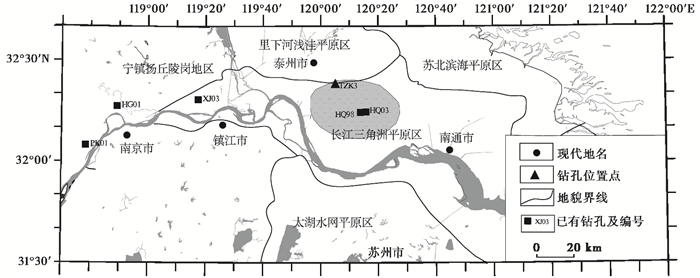
1 材料与方法TZK3孔(32°23′N,120°05′E;地面标高4 m),位于长江三角洲北部的泰州市姜堰区大丁村(图 1),于2015年3月实施钻探取样,钻探进尺728.59 m,岩芯在岩芯库对半切开后,一半用于采样,另一半用于拍照和岩性描述,本次研究仅对上部70 m的岩芯进行了沉积特征和沉积相分析。
|
图 1 钻孔位置图 Fig. 1 Map showing the position of the core TZK3 |
AMS 14C测试样品主要为贝壳,共选取8个样品送往波兰AMS 14C实验室进行测年,通过Calib 7.1软件[20]校正为日历年龄;另外在69.5~69.7 m处采取光释光样品1件,在南京师范大学OSL实验室完成测试。有孔虫和介形虫鉴定由林景星教授完成,在实验室按1.0~1.5 m间距对微体古生物分样,共获得微体古生物分析样品50件。将样品晾干后,称取50 g干样放入烧杯,然后加入浓度13 %的双氧水泡24 h,倒入200目(直径0.074 mm)的筛子中用清水冲洗,将样品用水冲移到烧杯中,然后倒入装有滤纸的漏斗滤水,待样品滤干和彻底干透后,进行有孔虫、介形虫挑选和属种鉴定、统计,并对沉积物中的大化石(贝壳)进行了鉴定。
2 结果 2.1 沉积特征及微体古生物结果TZK3孔0~70 m有孔虫生物量非常低、个体非常小、壳薄、纹饰弱,有孔虫丰度变化较大,为0~207枚/50 g,简单分异度为0~4,物种单一。以喜暖浅水种Ammonia beccarii/Ammonia tepida类为主,见少量半咸水浅水种Nonion tisburyensis、沿岸种属Elphidium advenum,零星见暖水浅水种Pseudorotalia gaimardii、Elphidiella kiangsuensis、Ammonia annectens及Cibrononion incertum、Bulimina marginata、Florilus spp.等。下部零星见陆相介形虫Ilyocypris bradyi及Ilyocypris sp.。
根据前人的研究成果,Ammonia beccarii/Ammonia tepida类是集中分布在水深20 m以内的近岸浅水种,广泛分布于半咸水的环境中,如河口、潮坪等环境[21~23]。Ilyocypris bradyi和Ilyocypris sp.为陆相介形虫化石,为广温性浅水种,较喜温暖,生存于淡水或微咸水的沉积环境里[24~26]。
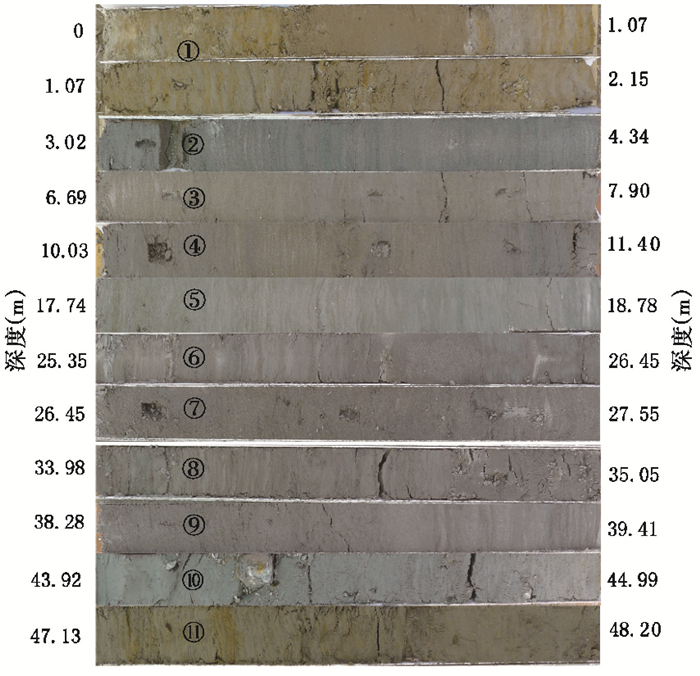
根据岩性、结构构造及有孔虫、介形虫鉴定结果,将钻孔自上而下可分为11层(图 2和图 3):

|
图 2 TZK3孔有孔虫和介形虫垂向分布 Fig. 2 The vertical distribution of foraminifera and ostracods in the core TZK3 |
|
图 3 TZK3孔各沉积层典型段落层的沉积特征 Fig. 3 Sedimentary characteristics of typical sections of each sediment layer in the core TZK3 |
① 0~2.55 m:灰黄色粉砂,斑点状、顺层潴育化发育,含少量粘土及有机质,该沉积单元为河漫滩-表土环境,为三角洲平原相的海积-冲积平原亚相;
② 2.55~6.20 m:灰色粉砂,局部见灰绿色粉砂纹层富集形成的水平层理,有孔虫丰度为12~170枚/50 g,其中以Ammonia beccarii/Ammonia tepida类为主,含有少量Nonion tisburyensis及Elphidium advenum,为河口砂质沉积;
③ 6.2~9.1 m:灰色细砂,含少量Ammonia beccarii/Ammonia tepida类,零星见Elphidium advenum,略见浅灰色的水平层理,为河口砂质沉积;
④ 9.10~15.68 m:灰色粉砂,见少量Ammonia beccarii/Ammonia tepida类,零星见Nonion tisburyensis、Cribrononion incertum和Bulimina marginata,局部见浅灰色粉砂纹层富集的水平层理,局部见贝壳及碎片,为河口砂质沉积;
⑤ 15.68~21.16 m:灰色细砂,含有少量Ammonia beccarii/Ammonia tepida类及Nonion tisburyensis,零星见Cribrononion incertum、Bulimina marginata、Elphidiella kiangsuensis、Ammonia annectens、Florilus spp.和Pseudorotalia gaimardii,局部见贝壳及碎片,发育浅灰色粉砂纹层富集的水平层理,为河口砂质沉积;
⑥ 21.16~29.50 m:灰色细砂、粉砂,含有少量Ammonia beccarii/Ammonia tepida类,零星见Ammonia annectens、Nonion spp.和Elphidium advenum等,含有大量贝壳及碎片,为河口砂质沉积;
⑦ 29.50~37.95 m:灰色细砂、粉砂、粉砂与含粘土粉砂互层,局部层位含粘土粉砂呈薄层状产出,呈千层饼状。零星含有Ammonia sp.、Cribrononion sp.和Cribrononion incertum,个体非常小,含有植物碎片,在37.35 m处见一植物种子;
⑧ 37.95~43.92 m:灰色粉砂、细砂、局部夹薄层深灰色含粘土粉砂,层厚一般1 cm左右,最厚2 cm左右,夹灰绿色细砂薄层,层厚一般3~5 cm左右,水平层理发育。未见有孔虫,零星见异地沉积的贝壳碎片及植物残体,与下部地层有侵蚀接触面,为河床沉积;
⑨ 43.92~44.99 m:灰绿色含钙质结核含粘土粉砂,钙质结核3 % ~5 %左右,一般1~2 cm大小,最大可达3~4 cm,呈不规则状,含有少量陆相介形虫Ilyocypris bradyi、Ilyocypris sp.及植物碎片;
⑩ 44.99~46.05 m:灰黄色粉砂,局部夹锈黄色斑点、斑块,含有大量贝壳碎片,见完整的小海贝1个及海相腹足类口盖2个,在沉积后期暴露地表氧化成灰黄色;
⑪ 46.05~70.00 m:灰色粉砂、细砂、含砾中粗砂,见锈黄色斑点、斑块,局部含有砾石约10 %左右,粒径一般为2~3 mm,最大可达1 cm左右,为长英质,磨圆较好,不含有孔虫,见少量的陆相腹足类碎片及陆相贝壳碎片,为河床相沉积。
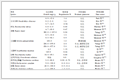
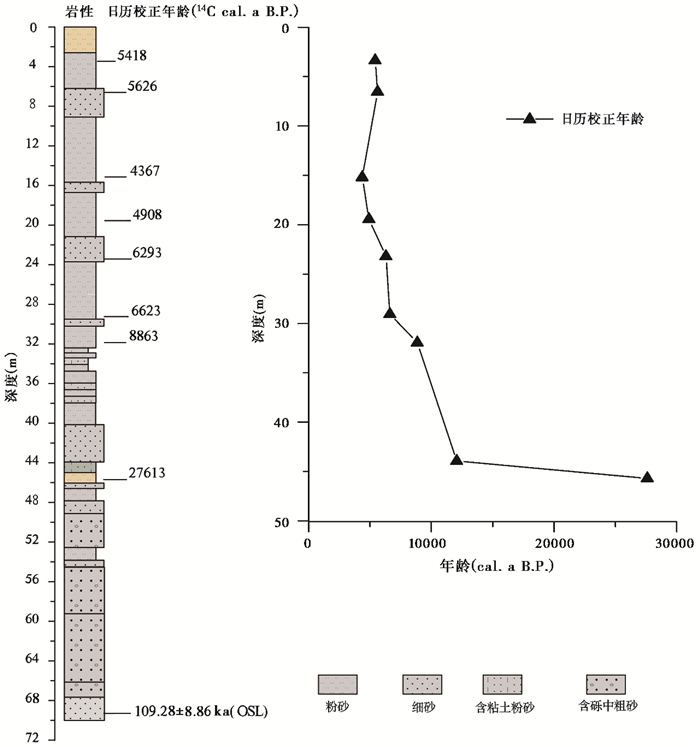
2.2 年代结果AMS 14C测年结果基本符合上新下老的沉积序列(表 1),但是TZK3-1、TZK3-2的年龄比TZK3-3的年龄大,这是由于在此时期,沉积速率高,地层中的TZK1-1及TZK3-2的贝壳可能是原地或近源贝壳的再次沉积,因此,将测试的最小年龄作为河口砂坝结束的年龄,约为4300 cal.a B.P.。钻孔的深度-年龄图如图 4所示,4367~8863 cal. a B.P.的沉积速率变化较大,为1.28~17.8 mm/a,平均沉积速率为3.73 mm/a。由于31.95~40.15 m为灰色粉砂、粉砂与含粘土粉砂互层、粉砂夹含粘土粉砂,沉积连续,无明显间断面。因此,用4367~8863 cal.a B.P.的平均沉积速率推算43.92 m的底界,为12076 cal.a B.P.。长江三角洲地区广泛分布一层暗绿色亚粘土层(第一硬粘土层),形成时代为12~25 cal.ka B.P.[27~32],为全新统与更新统界线的标志层[6],因此,43.92~44.99 m的灰绿色含钙质结核层含粘土粉砂层应为MIS 2阶段沉积的。44.99~46.05 m岩性为灰黄色粉砂,含有大量的贝壳及碎片,见完整的小海贝及海相腹足类口盖,遭受海侵作用,45.7 m的日历校正年龄为27613 cal.a B.P.。已有的研究表明,MIS 3阶段中晚期,长江三角洲地区存在较强的海侵作用[33~35]。因此,此层对应MIS 3阶段滆湖海侵。
|
表 1 TZK3孔AMS 14C年代序列及CALIB7.1校正结果 Table 1 AMS 14C dating of the core TZK3 |
|
图 4 TZK3孔年龄-深度图 Fig. 4 Age-depth model of the core TZK3 based on AMS 14C dating |
69.5~69.7 m处通过测试获得的光释光(OSL)的年龄为109.28±8.86 ka。因此,TZK3孔46.05~70.00 m对应MIS 4阶段。
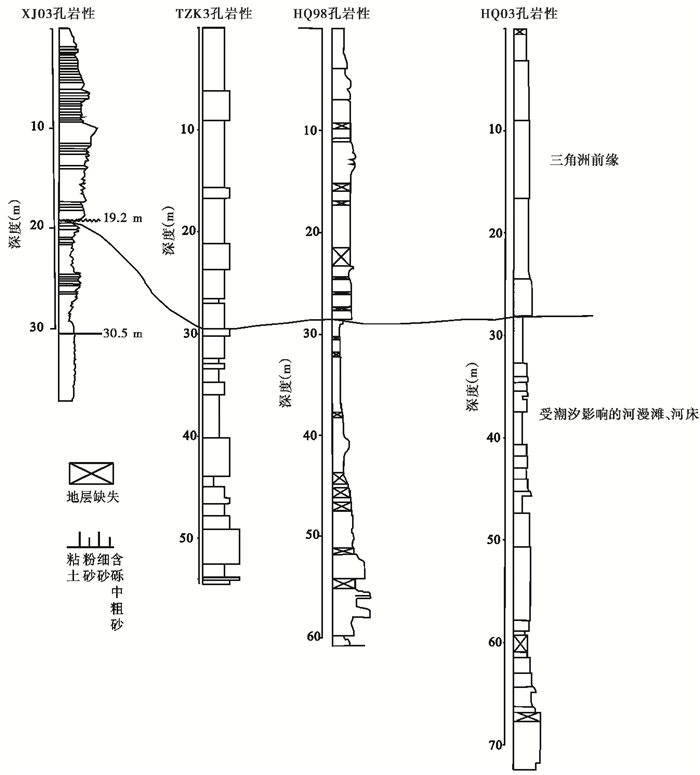
3 讨论 3.1 长江三角洲沉积环境的演变过程根据TZK3孔的沉积特征、微体古生物结果及AMS 14C、OSL测年,并结合前人的XJ03[36]、HQ98[17]和HQ03[18]孔的地层特征(图 5),其中将Hori等[17]原文中的14C年龄用Calib7.1进行校正。将TZK3孔70 m自下而上分为6个沉积单元。
|
图 5 全新世长江三角洲红桥XJ03[36]、黄桥HQ98[17]、HQ03孔[18]与TZK3孔地层结构对比 Fig. 5 Stratigraphic correlation between cores Hongqiao XJ03, Huangqiao HQ98, HQ03 and TZK3 |
(1) 70.00~46.05 m(MIS 4):沉积物颗粒较粗,不含有孔虫,表明水动力较强,基本没有海洋作用的影响。在末次冰期早期,全球的海平面比现在海平面约低60~80 m[37],南黄海发育陆相沉积[38]。长江的纵比降较大,以垂向侵蚀为主,在现长江的中下游地区发育宽阔的河谷,沉积砂砾层的粗颗粒沉积,研究区为河床相的沉积环境。
(2) 46.05~44.99 m(MIS 3):已有研究表明,MIS 3阶段气候较MIS 4阶段更为温湿[39],但比现代海平面低40~80 m,南黄海为滨海-浅海相沉积[38],长江三角洲地区普遍发育海侵层,海水影响南达镇江、常州、北至小纪、昭关一带[40],TZK3孔沉积物颗粒变细,不含有孔虫,见小海贝及海相腹足类口盖,表明研究区受海洋作用较弱,位于河口湾后部,为河口相沉积。
(3) 44.99~43.92 m(MIS 2):发育灰绿色含粉砂粘土,不含有孔虫和介形虫。在末次冰期最盛期(LGM),全球海平面下降至现今的-130 m[41],长江三角洲地区发育古河谷及河谷间地,古河谷发育粗颗粒的砂砾层,TZK3孔位于古河谷间地,发育区内分布普遍的第一硬粘土层[29~31],为古土壤化的河漫滩[29]。南京地区的PK01孔、HG01孔和红桥地区的XJ03孔均存在硬粘土层[36],而黄桥地区的HQ03、HQ98孔未发现古土壤层,在该时期其位于古河谷,表明在末次冰期晚期,长江古河谷发育的北界在镇江-泰州一带。
(4) 43.92~37.95 m(12.1~10.5 cal.ka B.P.):晚冰期以来,由于北半球太阳辐射的增加[42],全球海平面上升,长江古河床的纵比降变小,以垂向侵蚀转变为侧向侵蚀,河床变宽,叠加在原河床两侧的古河谷间地上,沉积灰色粉砂、细砂,局部夹含粘土粉砂薄层,未见有孔虫,研究区发育河床。
(5) 37.95~29.50 m(10.5~6.9 cal.ka B.P.):至全新世早-中期,海平面继续上升,海侵速度大于沉积物的堆积速度,海岸线继续向西移,研究区发育灰色粉砂、细砂、粉砂与含粘土粉砂互层。在黄桥地区,该时期对应发育的为灰色泥质层,Hori等[17]将HQ98的这层泥质层,其沉积相定为河口湾、前三角洲;但相邻的HQ03孔的微体古生物结果表明,该层不含有孔虫,见植物碎片,钙核发育,为河漫滩沉积[18]。TZK3孔的微体古生物也表明,6.9~10.5 cal.ka B.P.,零星见个体非常小的有孔虫及植物碎片,其主体为陆相沉积,而不是前三角洲相。由于沉积物含有潮汐作用影响的水平层理,因此,将此层的沉积相划分为受潮汐作用影响的河漫滩。
(6) 29.5~0 m(6.9~4.3 cal.ka B.P.):6900 cal.a B.P.以后,虽然海平面继续上升,但是由于亚洲季风的增强[43~44],降水增加,长江中上游的侵蚀能力得以增强,沉积物的堆积速度大于海平面的上升速度。海岸线向东推进,在红桥和黄桥地区开始发育河口砂坝。
3.2 黄桥砂坝的形成及主要控制因素全新世早中期,长江口退至镇江、扬州一带,形成了一个以长江古河谷为主体的河谷湾[6],当长江水流摆脱原来狭窄河岸的束缚而注入广阔的河谷湾时,因断面的突然扩大而导致入海的水流因底部的摩擦不断损耗能量[45],并以24.8°扩散角迅速扩展[46];亚洲季风增强,中国东部呈现暖湿的气候特征[47~48],区域降水增加,增加了长江的径流量和含砂量,大量物质在河口地区沉积,于7.5~6.0 14C ka B.P.[40],形成红桥砂坝,红桥砂坝的主体形成以后,长江口东至在泰州-黄桥一带,长江口的泥砂重复上述的动力过程,7600 cal.a B.P.开始在黄桥地区(HQ98孔)发育河口砂坝[17],长江三角洲属中等强度的潮汐河口,落潮流速大于涨潮流速,涨潮时主流偏南,落潮时主流偏北[40],有利于泥砂在中间缓流区淤积,砂坝在落潮流和长江径流共同作用下,不断向北淤积,于6900 cal.a B.P.扩张至最北端,TZK3孔开始出现大量有孔虫,发育灰色粉砂、细砂的河口砂质沉积,表明黄桥砂坝开始形成的年龄为7600~6900 cal.a B.P.。
中国东部湖泊[44]、泥炭[49]、石笋[50]、孢粉[17]以及其他地区记录[51~53]的亚洲夏季风在4200 cal.a B.P.突发性的减弱,降水减少,河流两岸的侵蚀作用减弱,导致长江上游向中下游携带的物质变少,减弱了河流的搬运能力,砂/泥比降低,更多的粘土物质搬运至河口;另一方面,由于砂质成分不断堆积,当砂坝顶部接近中潮位后,开始沉积细颗粒物质,黄桥地区(HQ98)在4700 cal.a B.P.[17]逐渐出露地表,由于落潮流的影响,北部出露地表的时候较晚,TZK3孔约在4300 cal.a B.P.出露地表,发育灰黄色粉砂,顺层潴育化发育,含有少量粘土及有机质,植物生长,形成三角洲平原相。因此,黄桥砂坝发育的年龄为7600~4300 cal.a B.P.,主要受亚洲季风和长江径流、河口潮汐流的共同影响。
3.3 最大海泛面最大海泛面(Maximum Flooding Surface,简称MFS)是海侵范围达到最大时的沉积面[54],其下为向陆进积的河口湾沉积体系,其上为向海进积的三角洲沉积体系[55]。潮成砂层的底部由于巨大的潮流冲刷与下部地层形成不整合面[19],红桥砂坝的XJ03孔[36]及黄桥砂坝HQ98[17]、HQ03[18]分别在19.0 m、28.1 m和29.0 m均存在不整合面,界面上部覆盖分选较好的砂层,含有大量有孔虫,底界年龄7.0~7.4 cal.ka B.P.,较老的沉积物可能被强烈的潮流作用所侵蚀。界面下部为黑灰色粘土质粉砂[36]、灰色泥质沉积[18]的河漫滩相。表明红桥砂坝和黄桥砂坝不具前三角洲的沉积相,为潮成砂坝。TZK3孔并不存在此不整合面,沉积连续,29.5 m处大量有孔虫的出现,其年龄为6900 cal.a B.P.,表明从该层位钻孔开始受到海水作用的影响。
HQ03从7600 cal.a B.P.开始受海洋作用较明显[18],红桥的HG01孔8.0 cal.ka B.P.出现咸水腹足类壳体,红桥的XJ03在7400 cal.a B.P.由河漫滩沉积转换为三角洲前缘[36]。JD01孔从7.0 cal.ka B.P.开始受到海侵作用的影响[56],表明海侵面是在沉积过程中是穿时的,但最大海泛面在时间上是等时的,为海岸线向陆移动最远时的沉积面,TZK3孔大量有孔虫出现的层位且没有层位缺失,表明该位置可能是海水影响内陆的最北端,因此,推测长江三角洲地区的最大海侵约6900 cal.a B.P.;与来自杭嘉湖地区的BHQ孔的结果基本一致[57],即为全新世大暖期鼎盛期,期间湖水达到最高。
4 结论TZK3孔的沉积特征、微体古生物结果及系统的AMS 14C、OSL测年,揭示了TZK3孔自下而上包含6个沉积阶段:70.00~46.05 m(MIS 4)沉积物颗粒较粗,灰色砂砾层,不含有孔虫,见少量的陆相腹足类碎片及陆相贝壳碎片,为河床相沉积;46.05~44.99 m(MIS 3)灰黄色粉砂,不含有孔虫,见贝壳碎片、小海贝、海相腹足类口盖,对应滆湖海侵,研究区受海洋作用较弱,位于河口湾后部,为河口相沉积;44.99~43.92 m(MIS 2);灰绿色含粘土粉砂,含有少量钙质结核、陆相介形虫Ilyocypris bradyi、Ilyocypris sp.及植物碎片,为第一硬土层,沉积环境为古土壤化的河漫滩;43.92~37.95 m(12.1~10.5 cal.ka B.P.)为灰色粉砂、细砂,局部夹含粘土粉砂薄层,与下部地层不整合接触,未见有孔虫,为河床沉积;37.95~29.50 m(10.5~6.9 cal.ka B.P.)灰色细砂、粉砂、粉砂与含粘土粉砂互层,局部呈千层饼状,零星见个体非常小的有孔虫及植物碎片分布,发育水平潮汐层理,沉积相为受潮汐影响的河漫滩;29.5~0 m(6.9~4.3 cal.ka B.P.)灰色粉砂、细砂,含有大量有孔虫,以Ammonia beccarii/Ammonia tepida类为主,为河口砂质沉积。和红桥砂坝的XJ03孔、黄桥砂坝的HQ98、HQ03孔对比研究表明:长江三角洲的最大海泛面为6.9 cal.ka B.P.,黄桥砂坝发育的年龄为7.6~4.3 cal.ka B.P.,为潮成砂坝,黄桥砂坝的发育主要受亚洲季风和长江径流、河口潮汐流的共同影响。
致谢: 感谢同行评审专家和编辑部老师提出的宝贵修改意见!
| [1] |
Milne G A, Gehrels W R, Hughes C W et al. Identifying the causes of sea-level change. Nature Geoscience, 2009, 2(7): 471-478. DOI:10.1038/ngeo544 |
| [2] |
Nicholls R J, Cazenave A. Sea-level rise and its impact on coastal zones. Science, 2010, 328(5985): 1517-1520. DOI:10.1126/science.1185782 |
| [3] |
谢志仁, 袁林旺. 略论全新世海面变化的波动性及其环境意义. 第四纪研究, 2012, 32(6): 1065-1077. Xie Zhiren, Yuan Linwang. Fluctuation characteristics of Holocene sea-level change and its environmental implications. Quaternary Sciences, 2012, 32(6): 1065-1077. |
| [4] |
陈中原, 刘演, 陈静等. 大河三角洲全新世海平面研究中的若干重要问题——以长江、尼罗河和密西西比河三角洲为例. 第四纪研究, 2015, 35(2): 275-280. Chen Zhongyuan, Liu Yan, Chen Jing et al. The key issues of Holocene sea-level study of mega-deltas:Examples from Changjiang River, the Nile River and the Mississippi River. Quaternary Sciences, 2015, 35(2): 275-280. |
| [5] |
程和琴, 陈祖军, 阮仁良等. 海平面变化与城市安全——以上海市为例. 第四纪研究, 2015, 35(2): 363-373. Cheng Heqin, Chen Zujun, Ruan Renliang et al. Sea level Change and city safety-The Shanghai as an example. Quaternary Sciences, 2015, 35(2): 363-373. |
| [6] |
王靖泰, 郭蓄民, 许世远等. 全新世长江三角洲的发育. 地质学报, 1981(1): 67-81. Wang Jingtai, Guo Xumin, Xu Shiyuan et al. Evolution of the Holocene Changjiang delta. Acta Geologica Sinica, 1981(1): 67-81. |
| [7] |
郭蓄民. 长江河口地区晚更新世晚期以来沉积环境的变迁. 地质科学, 1983(4): 402-408. Guo Xumin. Evolution of sedimentary environment of the Changjiang estuary area since the late stage of Late Pleistocene. Scientia Geologica Sinica, 1983(4): 402-408. |
| [8] |
李从先, 王靖泰, 李萍. 长江三角洲沉积相的初步研究. 同济大学学报:自然科学版, 1979(2): 1-14. Li Congxian, Wan Jingtai, Li Ping. Preliminary study on sedimentary facies and sequence of the Yangtze delta. Journal of Tongji University(Natural Science), 1979(2): 1-14. |
| [9] |
李从先, 张桂甲. 晚第四纪长江三角洲高分辨率层序地层学的初步研究. 海洋地质与第四纪地质, 1996, 16(3): 13-24. Li Congxian, Zhang Guijia. A primary study on high-resolution sequence stratigraphy of Late Quaternary in the Yangtze River delta area. Marine Geology & Quaternary Geology, 1996, 16(3): 13-24. |
| [10] |
李从先, 张桂甲. 下切古河谷高分辨率层序地层学研究的进展. 地球科学进展, 1996, 11(2): 216-219. Li Congxian, Zhang Guijia. Progress on high resolution sequence stratigraphy in incised paleovalley. Advance in Earth Sciences, 1996, 11(2): 216-219. |
| [11] |
张家强, 张桂甲, 李从先. 长江三角洲晚第四纪地层层序特征. 同济大学学报:自然科学版, 1998, 26(4): 438-442. Zhang Jiaqiang, Zhang Guijia, Li Congxian. Characteristics of the Late Quaternary stratigraphic sequence in the Changjiang River delta area. Journal of Tongji University(Natural Science), 1998, 26(4): 438-442. |
| [12] |
王张华, 丘金波, 冉莉华等. 长江三角洲南部地区晚更新世年代地层和海水进退. 海洋地质与第四纪地质, 2004, 24(4): 1-8. Wang Zhanghua, Qiu Jinbo, Ran Lihua et al. Chronostratigraphy and transgression/regression during Late Pleistocene in the southern Changjiang(Yangtze) River delta plain. Marine Geology & Quaternary Geology, 2004, 24(4): 1-8. |
| [13] |
杨达源, 陈可锋, 舒肖明. 深海氧同位素第3阶段晚期长江三角洲古环境初步研究. 第四纪研究, 2004, 24(5): 525-530. Yang Dayuan, Chen Kefeng, Shu Xiaoming. A preliminary study on the paleoenvironment during MIS 3 in the Changjiang delta region. Quaternary Sciences, 2004, 24(5): 525-530. |
| [14] |
刘金陵. 根据孢粉资料推论长江三角洲地区12000年以来的环境变迁. 古生物学报, 1996, 35(2): 136-154. Liu Jinling. Use of pollen profiles to show the last 12000 years of environmental changes in the Yangtze River delta. Acta Palaeontologica Sinica, 1996, 35(2): 136-154. |
| [15] |
Yi S, Saito Y, Zhao Q et al. Vegetation and climate changes in the Changjiang(Yangtze River) delta, China, during the past 13, 000 years inferred from pollen records. Quaternary Science Reviews, 2003, 22(14): 1501-1519. DOI:10.1016/S0277-3791(03)00080-5 |
| [16] |
韦桃源, 陈中原, 魏子新等. 长江河口区第四纪沉积物中的地球化学元素分布特征及其古环境意义. 第四纪研究, 2006, 26(3): 397-405. Wei Taoyuan, Chen Zhongyuan, Wei Zixin et al. The distribution of geochemical trace elements in the Quaternary sediments of the Changjiang River mouth and the paleoenvironmental implications. Quaternary Sciences, 2006, 26(3): 397-405. |
| [17] |
Hori K, Saito Y, Zhao Q et al. Sedimentary facies of the tide-dominated paleo-Changjiang(Yangtze) estuary during the last transgression. Marine Geology, 2001, 177(3-4): 331-351. DOI:10.1016/S0025-3227(01)00165-7 |
| [18] |
李保华, 王强, 李从先. 长江三角洲亚三角洲地层结构对比. 古地理学报, 2010, 12(6): 685-698. Li Baohua, Wang Qiang, Li Congxian. Correlation of stratigraphic architecture of sub-deltas of Changjiang River delta. Journal of Palaeogeography, 2010, 12(6): 685-698. |
| [19] |
李从先, 范代读. 全新世长江三角洲的发育及其对相邻海岸沉积体系的影响. 古地理学报, 2009, 11(1): 115-122. Li Congxian, Fan Daidu. Development of the Holocene Changjiang Delta and its influence on adjacent coastal sedimentary systems. Journal of Palaeogeography, 2009, 11(1): 115-122. |
| [20] |
Stuiver M, Reimer P J. A computer program for radiocarbon age calibration. Radiocarbon, 1986, 28(2B): 1022-1030. DOI:10.1017/S0033822200060276 |
| [21] |
汪品先, 章纪军, 赵泉鸿等. 东海底质中的有孔虫与介形虫. 北京: 海洋出版社, 1988: 1-325. Wang Pinxian, Zhang Jijun, Zhao Quanhong et al. Foraminifera and Ostracods in Sediments in the East China Sea. Beijing: China Ocean Press, 1988: 1-325. |
| [22] |
汪品先, 闵秋宝, 卞云华. 南黄海西北部底质中有孔虫、介形虫分布规律及其地质意义[C]//汪品先, 等著. 海洋微体古生物论文集. 北京: 海洋出版社, 1980: 84-100. Wang Pinxian, Min Qiubao, Bian Yunhua. A preliminary study of foraminiferal and ostracod assemblages of the Yellow Sea[C]//Wang Pinxian, et al. Papers on Marine Micropaleontology. Beijing: China Ocean Press, 1980: 84-100. |
| [23] |
闫晓洁, 胥勤勉, 范友良等. 渤海湾西北岸HG01孔晚更新世以来的微体化石特征及沉积演化过程. 第四纪研究, 2017, 37(1): 97-107. Yan Xiaojie, Xu Qinmian, Fan Youliang et al. Microfossil assemblages characteristics and sedimentary evolution of HG01 borehole in the northwest coast of Bohai Bay since Late Pleistocene. Quaternary Sciences, 2017, 37(1): 97-107. |
| [24] |
李守军, 崔肖辉, 徐华等. 莱州湾晚第四纪介形虫分布特征与沉积环境演化. 第四纪研究, 2016, 36(6): 1475-1488. Li Shoujun, Cui Xiaohui, Xu Hua et al. Distribution characteristics of ostracods and evolution of the sedimentary environment of the Late Quaternary in the Laizhou Bay, Bohai Sea. Quaternary Sciences, 2016, 36(6): 1475-1488. |
| [25] |
Staplin F L. Pleistocene ostracoda of Illinois Pleistocene ostracoda of Illinosis; Part 2, Subfamilies Cycloprinae, Cypridopinae, Ilyocyprinae; families Darwinulidae and Cytheridae; stratigraphic ranges and assemblage patterns. Journal of Palaeontology, 1963, 37(4): 1164-1203. |
| [26] |
张虎才, 王强, 彭金兰等. 柴达木察尔汗盐湖贝壳堤剖面介形类组合及其环境意义. 第四纪研究, 2008, 28(1): 103-111. Zhang Hucai, Wang Qiang, Peng Jinlan et al. ostracod assemblages and their paleoenvironmental significance from shell bar section of paleolake Qarhan, Qaidam Basin. Quaternary Sciences, 2008, 28(1): 103-111. |
| [27] |
覃军干, 吴国瑄, 郑洪波等. 从孢粉、藻类化石组合看长江三角洲第一硬质粘土层的成因及其古环境意义. 第四纪研究, 2004, 24(5): 546-554. Qin Jungan, Wu Guoxuan, Zheng Hongbo et al. Palynomorph assemblages, origin and palaeoenvironmental significance of the upper most hard clay in the deltaic area of the Changjiang River. Quaternary Sciences, 2004, 24(5): 546-554. |
| [28] |
邓兵, 李从先, 张经等. 长江三角洲古土壤发育与晚更新世末海平面变化的耦合关系. 第四纪研究, 2004, 24(2): 222-230. Deng Bing, Li Congxian, Zhang Jing et al. Correlation of paleosol development in the Changjiang delta with sea level fluctuations in the Late Pleistocene. Quaternary Sciences, 2004, 24(2): 222-230. |
| [29] |
邓兵, 李从先. 长江三角洲地区第一古土壤层及其古气候记录. 海洋地质与第四纪地质, 1999, 19(3): 29-37. Deng Bing, Li Congxian. Paleoclimate recorded in the first layer of paleosoil in Yangtze Delta area. Marine Geology & Quaternary Geology, 1999, 19(3): 29-37. |
| [30] |
陈报章, 李从先, 业治铮. 长江三角洲北翼全新统底界和"硬粘土层"的讨论. 海洋地质与第四纪地质, 1991, 11(2): 37-46. Chen Baozhang, Li Congxian, Ye Zhizheng. Holocene bottom boundary and hard clay band in the northern flank of the Changjiang River delta. Marine Geology & Quaternary Geology, 1991, 11(2): 37-46. |
| [31] |
李从先, 闵秋宝, 孙和平. 长江三角洲南翼全新世地层和海侵. 科学通报, 1986, 31(21): 1650-1653. Li Congxian, Min Qiubao, Sun Heping. Holocene strata and transgressions at the southern flank of the Yangtze delta. Chinese Science Bulletin, 1986, 31(21): 1650-1653. |
| [32] |
孙顺才, 伍贻范. 太湖形成演变与现代沉积作用. 中国科学(B辑), 1987, 17(12): 1329-1339. Sun Shuncai, Wu Yifan. Formation and evolution of Taihu Lake and modern sedimentation. Science in China(Series B), 1987, 17(12): 1329-1339. |
| [33] |
闵秋宝, 汪品先. 论上海地区的第四纪海进. 同济大学学报:自然科学版, 1979(2): 109-128. Min Qiubao, Wang Pinxian. Quaternary transgression in Shanghai region. Journal of Tongji University(Natural Science), 1979(2): 109-128. |
| [34] |
于革, 叶良涛, 廖梦娜等. 我国沿海平原晚更新世海侵的定量重建、模拟与机制研究. 第四纪研究, 2016, 36(3): 711-721. Yu Ge, Ye Liangtao, Liao Mengna et al. Quantitative reconstruction, simulation and mechanism study on the Late Pleistocene marine transgressions. Quaternary Sciences, 2016, 36(3): 711-721. |
| [35] |
王张华, 赵宝成, 陈静等. 长江三角洲地区晚第四纪年代地层框架及两次海侵问题的初步探讨. 古地理学报, 2008, 10(1): 99-110. Wang Zhanghua, Zhao Baocheng, Chen Jing et al. Chronostratigraphy and two transgressions during the Late Quaternary in Changjiang delta area. Journal of Palaeogeography, 2008, 10(1): 99-110. |
| [36] |
Song B, Li Z, Saito Y et al. Initiation of the Changjiang(Yangtze) delta and its response to the mid-Holocene sea level change. Palaeogeography, Palaeoclimatology, Palaeoecology, 2013(388): 81-97. |
| [37] |
Lambeck K, Chappell J. Sea level change through the Last Glacial cycle. Science, 2001, 292(5517): 679-686. DOI:10.1126/science.1059549 |
| [38] |
Liu J, Saito Y, Kong X et al. Delta development and channel incision during marine isotope stages 3 and 2 in the western South Yellow Sea. Marine Geology, 2010, 278(1): 54-76. |
| [39] |
Marcott S A, Shakun J D, Clark P U et al. A reconstruction of regional and global temperature for the past 11, 300 years. Science, 2013, 339(6124): 1198-1201. DOI:10.1126/science.1228026 |
| [40] |
吴标云, 李从先. 长江三角洲第四纪地质. 北京: 海洋出版社, 1987: 136. Wu Biaoyun, Li Congxian. Quaternary Geology of the Changjiang Delta. Beijing: China Ocean Press, 1987: 136. |
| [41] |
Imbrie J, Hays J D, Martinson D G, et al. The orbital theory of Pleistocene climate: Support from a revised chronology of the marine δ18O record[M]//Berger A L, Imbrie J, Hays J et al. Milankovitch and Climate(Part 1): Understanding the Response to Astronomical Forcing. Dordrecht: Reidel Publishing Company, 1984: 269-305.
|
| [42] |
Berger A, Loutre M F. Insolation values for the climate of the last 10 million years. Quaternary Science Reviews, 1991, 10(4): 297-317. DOI:10.1016/0277-3791(91)90033-Q |
| [43] |
Dykoski C A, Edwards R L, Cheng H et al. A high-resolution, absolute-dated Holocene and deglacial Asian monsoon record from Dongge cave, China. Earth and Planetary Science Letters, 2005, 233(1): 71-86. |
| [44] |
申洪源, 贾玉连, 李徐生等. 内蒙古黄旗海不同粒级湖泊沉积物Rb, Sr组成与环境变化. 地理学报, 2006, 61(11): 1208-1217. Shen Hongyuan, Jia Yulian, Li Xusheng et al. Environmental change inferred from distribution of Rb and Sr in different grain size fractions from lacustrine sediments in Huangqihai Lake, Inner Mongolia. Acta Geographica Sinica, 2006, 61(11): 1208-1217. |
| [45] |
孙志林, 金元欢. 分汊河口的形成机理. 水科学进展, 1996, 7(2): 144-150. Sun Zhilin, Jin Yuanhuan. Mechanism of formation of an anabranched estuary. Advances in Water Science, 1996, 7(2): 144-150. |
| [46] |
Wright L D. River deltas[M]//Davis R A. Coastal Sedimentary Environments. New York: Spring-Verlag, 1978: 5-68.
|
| [47] |
舒军武, 王伟铭, 陈炜. 太湖平原西北部全新世以来植被与环境变化. 微体古生物学报, 2007, 24(2): 210-221. Shu Junwu, Wang Weiming, Chen Wei. Holocene vegetation and environment changes in the NW Taihu plain, Jiangsu Province, East China. Acta Micropalaeontologica Sinica, 2007, 24(2): 210-221. |
| [48] |
王伟铭, 舒军武, 陈炜等. 长江三角洲地区全新世环境变化与人类活动的影响. 第四纪研究, 2010, 30(2): 233-244. Wang Weiming, Shu Junwu, Chen Wei et al. Holocene environmental changes and human impact in the Yangtze River delta area, East China. Quaternary Sciences, 2010, 30(2): 233-244. |
| [49] |
Hong Y T, Wang Z G, Jiang H B et al. A 6000-year record of changes in drought and precipitation in northeastern China based on a δ13C time series from peat cellulose. Earth and Planetary Science Letters, 2001, 185(1): 111-119. |
| [50] |
Tan M, Cai B. Preliminary calibration of stalagmite oxygen isotopes from eastern monsoon China with northern Hemisphere temperatures. Pages News, 2005, 13(2): 16-17. DOI:10.22498/pages.13.2 |
| [51] |
刘思丝, 黄小忠, 强明瑞等. 孢粉记录的青藏高原东北部更尕海地区中晚全新世植被和气候变化. 第四纪研究, 2016, 36(2): 247-256. Liu Sisi, Huang Xiaozhong, Qiang Mingrui et al. Vegetation and climate change during the Mid-Late Holocene reflected by the pollen record from Lake Genggahai, northeastern Tibetan Plateau. Quaternary Sciences, 2016, 36(2): 247-256. |
| [52] |
马明明, 葛伟亚, 李春海等. 福建霞浦钻孔沉积物记录的约7800 a B.P.以来海平面波动的磁学响应. 第四纪研究, 2016, 36(5): 1307-1318. Ma Mingming, Ge Weiya, Li Chunhai et al. Magnetic responses to sea-level fluctuations since about 7800 a B.P. recorded by core sediments at Xiapu, Fujian. Quaternary Sciences, 2016, 36(5): 1307-1318. |
| [53] |
牛蕊, 周立旻, 孟庆浩等. 贵州草海南屯泥炭记录的中全新世以来的气候变化. 第四纪研究, 2017, 37(6): 1357-1369. Niu Rui, Zhou Limin, Meng Qinghao et al. The paleoclimate variations of the Nantun peat in the Caohai area since the Middle Holocene. Quaternary Sciences, 2017, 37(6): 1357-1369. |
| [54] |
Catuneanu O. Principles of Sequence Stratigraphy. Oxford, UK: Elsevier's Science & Technology Rights, 2006: 375.
|
| [55] |
Hori K, Tanabe S, Saito Y et al. Delta initiation and Holocene sea-level change:Example from the Song Hong(Red River) delta, Vietnam. Sedimentary Geology, 2004, 164(3): 237-249. |
| [56] |
Li Z, Song B, Saito Y, et al. Sedimentary facies and geochemical characteristics of Jiangdou core JD01 from the upper delta plain of Changjiang(Yangtze) delta[C]//Amorosi A. Proceedings of the 27th IAS Meeting of Sedimentologists. Bologna, Italy: Medimond, 2009: 55-65.
|
| [57] |
章云霞, 叶玮, 马春梅等. 浙江北湖桥孔色度记录的早-中全新世环境变化. 第四纪研究, 2016, 36(5): 1331-1342. Zhang Yunxia, Ye Wei, Ma Chunmei et al. Environment variabilities archived by color of the drill core Beihuqiao in Hangjiahu Plain during Early-Mid Holocene, China. Quaternary Sciences, 2016, 36(5): 1331-1342. |
2 Key Laboratory of Economic Stratigraphy and Palaeogeography, Nanjing Institute of Geology and Palaeontology, Chinese Academy of Sciences, Nanjing 210008, Jiangsu)
Abstract
The core TZK3 is located in the southeast Taizhou City(32°23'N, 120°05'E), the north of Changjiang River delta. The lithology of the core is composed of silt and silty sand. Clay, sand, coarse sand and gravel are also found. In this study, for the upper part of the core(70 m-thick sediment), 50 samples were taken for micro-paleontology test with interval of 1.0~1.5 m, and 8 samples for AMS C-14 and 1 sample OSL dating, respectively. The results show that the core TZK3 can be divided into 6 sedimentary units from bottom to top:(1) 70.00~46.05 m(MIS 4), the lithology is gray silt, fine sand, coarse sand and gravel, indicating river bed phase. The age is 109.28±8.86 ka in 69.5~69.7 m through OSL dating, showing deposition stage is MIS 4. (2) 46.05~44.99 m(MIS 3), silt with sea shell fragments and shellfish, indicating a weak ocean influence, such as the estuary. The calendar calibration age is 27613 cal.a B.P. in 45.7 m, corresponding to the Gehu transgression. (3) 44.99~43.92 m(MIS 2), the lithology gray-green clay with silt. There is plant debris and a small amount of ostracods in the sediment, such as Ilyocypris bradyi and Ilyocypris sp., suggesting a paleosoil. (4) 43.92~37.95 m, with an age of 12.1~10.5 cal.ka B.P., gray silt and fine sand with horizontal bedding from the river bed. There is shell fragments moving from other place and erosion surface with lower strata. (5) 37.95~29.50 m, with an age of 10.5~6.9 cal.ka B.P., gray silt, fine sand and silt with horizontal bedding. The sediment contains plant debris and foraminifera with small form, such as Ammonia sp., Cribrononion sp., Cribrononion incertum. In this phase, the sea level continued to rise, the transgression rate was higher than the sedimentation rate of the sediments, and the coastline continued to move westward. The study area was covered by floods from the tidal. (6) Whose with the depth of 29.5~0 m, with an age of 6.9~4.3 cal.ka B.P., silt containing a lot of foraminifera, such as Ammonia beccarii/Ammonia tepida Group. Due to the increase in the Asian monsoon and precipitation, the capacity can be enhanced in the upper reaches of the Changjiang River. The sediment accumulation rate accelerated, and the coastline move to the east. The study area began to develop Huangqiao estuary sand dam. Compared with the records in the Changjiang estuary, the maximum transgression of the Changjiang River delta occurred at 6.9 cal.ka B.P. and the age of the Huangqiao sand bar was developed at 7.6~4.3 cal.ka B.P., which is mainly affected by the Asian monsoon, estuary tide and runoff in the Changjiang River.