 2018, Vol.38


2 中国地质大学(北京)地球科学与资源学院, 北京 100083;
3 中国科学院地质与地球物理研究所, 北京 100029)
长江三角洲地区是我国东部沿海新近纪火山活动比较典型的地区之一,也是环太平洋新生代火山岩带的重要组成部分[1],在大地构造上位于郯庐断裂带东侧的下扬子板块。新近纪期间,江苏南京及其周边地区经历了一系列火山喷发活动,形成了以碱性基性和碱性超基性为主的多期火山岩[2~3],其中又以长江以北的南京六合及其周边区域最为发育[2~4]。野外地表调查发现,这些新近纪玄武岩有的直接覆盖在构成古长江三角洲的砂砾层之上,有的则被古长江的砂砾石层切割覆盖。因此,该区火山岩的期次与时代对于限定古长江演化历史至关重要。
自20世纪40年代起,前人通过K-Ar定年、植物化石、磁性地层学等多种手段分析了南京地区新近纪火山岩的活动特征、期次与时代,并将该区的新近纪玄武岩大致划分为3期[1~5]:六合组(约14 Ma前喷发)、黄岗组(约10 Ma前喷发)和方山组(约3.5 Ma前喷发)。由于在早期的研究中,划分火山活动期次的主要依据是火山岩的K-Ar年龄数据[2],因为方法的局限性,结果的不确定性较大。而近年来尽管有学者对该区的部分玄武岩做了新的Ar-Ar测年研究[6],但整体来说,关于六合地区古火山锥玄武岩精确的年代数据还相对较少。由于该区火山岩的形成时代与古长江演化密切相关[6~7],因而获取新的更准确的火山岩测年数据尤为关键。本文在前人研究基础上,利用Ar-Ar测年方法对南京六合地区的方山、灵岩山和奶山玄武岩进行了年龄测定,以期新的数据有助于更好地认识该区的玄武岩活动期次与时代,并为古长江砂砾层形成时代提供更好的年龄限定。
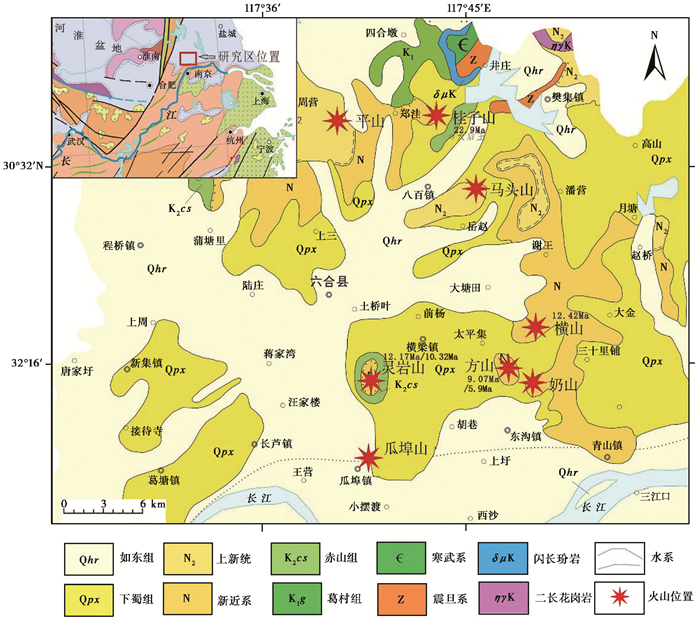
1 区域地质概况南京长江北岸六合地区分布着十余座大小不同的新近纪火山锥(图 1),六合方山、灵岩山和奶山均坐落于六合城区东南方向的古长江冲积平原上,地貌和形态上,方山和灵岩山均为截头圆锥状,其上部的玄武岩覆盖在厚约40~50 m的古长江砂砾层之上,奶山则为相互依傍的两座锥状山的组合,其玄武岩被古长江砂砾石层所切割。六合地区出露的新近纪以来地层主要为洞玄观组(N1d)、六合组(N1l)、黄岗组(N1h)、雨花台组(N2y)、方山组(N2f)和下蜀土(Qpx)等,其中六合组和雨花台组主要为一套河流相的棕黄色、灰黄色的砂砾石层夹砂层,上被玄武岩或者下蜀土覆盖[4]。前人将南京地区方山和灵岩山的火山岩系分为上、下玄武岩两部分,命名为“方山组”,定为中新世-上新世,主要由玄武岩、凝灰质砂砾岩和火山集块岩组成[5]。
|
图 1 六合地区火山位置图 图中玄武岩年龄来自文献[2, 6, 8]研究数据 Fig. 1 Location map of volcanoes in Liuhe area, the basalt age in the map is derived from previous research data[2.6.8] |
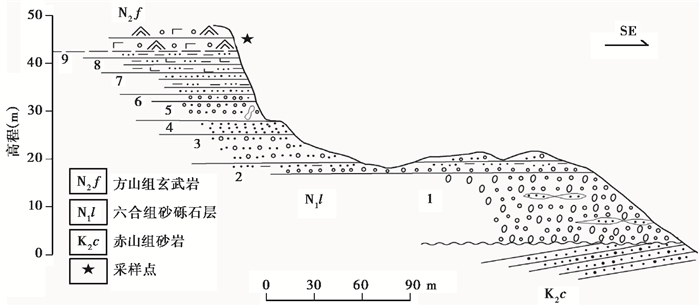
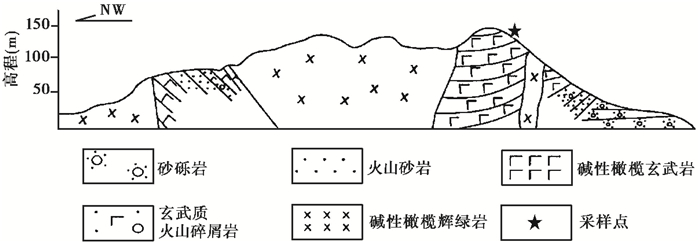
为了进一步更好地认识六合地区新近纪玄武岩的期次与时代,并限定该区古长江三角洲的形成时代,重点采集了六合地区的方山(采样点:32°18′29.07″N,118°59′20.80″E;海拔171 m)、灵岩山(采样点:32°17′49.69″N,118°53′24.95″E;海拔102 m)和奶山(采样点:32°17′59.16″N,119°00′24.69″E;海拔124 m)共3个不同火山锥的玄武岩Ar-Ar年龄样品。样品选自新鲜出露面,岩性均为方山组灰黑色碱性玄武岩,质地坚硬,呈致密块状构造(图 2和图 3)。以灵岩山地质剖面为例岩性描述如下:
|
图 2 灵岩山地质剖面及采样位置(据毕治国等[7]修编) Fig. 2 The geological profile and sampling position of Lingyan Mountain, revised from Bi et al., 1977[7] |
|
图 3 六合方山地质剖面及采样位置(据方邺森等[4]修编) Fig. 3 The geological profile and sampling position of Liuhe Fangshan, revised from Fang et al., 1979[4] |
1.灰白色砾石夹薄层粗砂;
2.棕黄色含砂砾卵石夹薄层细砂;
3.棕黄、灰黄色含砾细砂;
4.橘黄、灰黄色细砂;
5.棕黄色含砂砾石;
6.灰黄、棕黄色含砂细砾夹砾细砂扁豆体;
7.灰黄、橘黄色细砂、粉砂与粉红色粉砂质泥岩韵律互层;
8.土黄色厚层钙质粉砂质泥岩;
9.砖红色厚层含粉砂泥岩。
样品的处理与测试在美国俄勒冈州立大学地质、海洋与大气科学学院氩年代学实验室(OSU Argon Geochronology Lab CEOAS Oregon State University,Corvallis,USA)完成。野外采集的样品首先通过粉碎、筛选等前期处理,然后送至TRIGA核反应堆进行照射,照射后的样品通过CO2 10 W,激光器阶段加热释放出气体,之后在惰性气体质谱仪MAP-215/ 50进行Ar同位素分析[9]。
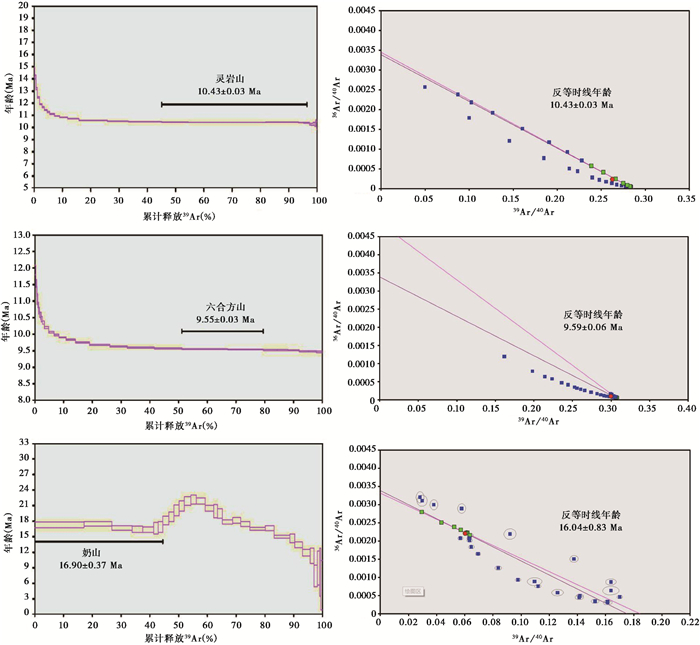
测试结果显示(图 4),奶山玄武岩样品在前部加温阶段组成一个平坦的年龄坪,坪年龄为16.90±0.37 Ma,相应的36Ar/40Ar-39Ar/40Ar等时线年龄为16.04±0.83 Ma(MSWD=1.83);六合方山样品在连续加温阶段组成一个平坦的年龄坪,坪年龄为9.55±0.03 Ma,反等时线年龄为9.59±0.06 Ma(MSWD=0.18);灵岩山样品的坪谱平坦,坪年龄为10.43±0.03 Ma,反等时线年龄为10.43±0.03 Ma(MSWD=0.38)。3个样品的坪年龄与反等时线年龄几乎完全一致,而且初始40Ar/36Ar值为285.8~305.1,与一般采用的现代空气氩比值(295.5±5)相近,反映所测样品的年龄真实可靠,年龄结果可以代表玄武岩的喷出时代。
|
图 4 玄武岩Ar-Ar年龄坪谱(左)与反等时线(右)年龄 Fig. 4 Ar-Ar ages spectra(left)and inverse isochron(right)of basalts |
长江作为中国第一大河,世界第三大河流,其年龄到底有多老?对于长江的形成和演化历史,近几年来尽管取得了大量的成果[10~13],但仍然是科学家们研究、关注和争议的焦点。新近纪期间,伴随古长江的演化,南京六合地区发育了多期玄武岩古火山锥。上述Ar-Ar定年结果证实,六合方山为中新世晚期火山活动喷发而成,这与陈道公和彭子成[8]所测玄武岩年龄相近,而并非部分研究所认为的上新世火山岩[2];灵岩山与前人测年结果相近,并指示其与六合方山玄武岩为近乎同期的火山活动产物,奶山玄武岩前人未有定年数据,此次是首次获得,结果表明其形成于中新世中期。
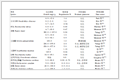
根据新获取的3个不同地点的火山岩定年结果,结合前人资料及地表调查可知(表 1),南京六合地区在距今16~17 Ma左右和9~10 Ma左右的中新世中期和晚期先后经历了两次火山活动(注:是根据测年结果明显不同确定的),但该区在上新世期间是否存在火山活动仍需进一步研究。
|
表 1 玄武岩定年对比表 Table 1 Comparison table of basalt age |
根据赵希涛等[14]近年来对六合地区的新近纪玄武岩与古长江三角洲的河流相冲积物覆盖和切割关系的调查结果以及新的玄武岩的定年数据,可进一步确定该区广泛分布的一套下伏于方山和灵岩山玄武岩之下,但切割了奶山火山锥的古长江砂砾石层[14],应形成于距今约16~10 Ma间,这明显比最近提出的古长江诞生时间更晚[6],但显著的早于现在长江三角洲的地层形成时代[15~16],这说明古长江自形成以来可能经历了多期演化,并在南京一带的下游地区经历过大范围摆动,从而形成不同时代且分布范围差异较大的长江沉积物。因此,关于古长江发育的期次及其与中国东部构造地貌的演化关系问题仍有待于进一步深入研究。
4 结论利用Ar-Ar定年方法获取的长江三角洲地区南京六合方山、灵岩山和奶山3个地点的精确测年结果,表明这3个不同地点的玄武岩坪年龄分别为9.55±0.03 Ma、10.43±0.03 Ma和16.90±0.37 Ma。新的数据表明新近纪期间,六合地区至少经历了距今16~17 Ma左右和9~10 Ma左右两个期次的火山活动,其中奶山为较老一期,属中新世中期,六合方山与灵岩山同属中新世晚期。结合六合地区的新近纪玄武岩与古长江三角洲的河流相冲积物存在的覆盖和切割关系,新的玄武岩定年数据可以证实,分布在六合地区的古长江三角洲砂砾石层应形成于距今约16~10 Ma间。这一新的认识进一步说明,古长江自形成以来可能经历了多期演化,并在南京一带的下游地区经历过大范围摆动,从而在长江下游地区形成了不同时代且分布范围差异较大的长江沉积物。
致谢: 感谢审稿专家和编辑部老师建议性的修改意见!
| [1] |
周新民, 陈图华. 江苏及皖东新生代玄武质岩石岩石化学和矿物成分的研究. 南京大学学报(自然科学版), 1978(3): 92-116. Zhou Xinmin, Chen Tuhua. An investigation of petrochemistry and mineral composition of Cenozoic basaltic rocks in Jiangsu and eastern Anhui Province. Journal of Nanjing University(Natural Sciences), 1978(3): 92-116. |
| [2] |
邵家骥, 黄姜侬, 杨忠元等. 南京地区新生代玄武岩的期次、层序及时代. 地质论评, 1989, 35(2): 97-106. Shao Jiaji, Huang Jiangnong, Yang Zhongyuan et al. The division and age of basalts in the Nanjing area. Geological Review, 1989, 35(2): 97-106. |
| [3] |
周新民, 陈图华. 南京附近新生代玄武岩火山锥及其喷发特征. 南京大学学报(自然科学版), 1980, 16(2): 85-105. Zhou Xinmin, Chen Tuhua. Cenozoic basalt volcanic cones and their characters of the eruption in the vicinity of Nanjing. Journal of Nanjing University(Natural Sciences), 1980, 16(2): 85-105. |
| [4] |
方邺森, 彭渡呜, 林承毅. 江苏六合方山玄武岩及其捕虏体的研究. 南京大学学报(自然科学版), 1979(3): 57-75. Fang Yesen, Peng Duming, Lin Chengyi. The study of basalt and its xenolith of Mt. Fang in Liuhe County, Jiangsu Province. Journal of Nanjing University(Natural Sciences), 1979(3): 57-75. |
| [5] |
程裕琪, 沈永和. 江苏江宁方山第三纪火山岩. 中国地质学会会志, 1948(28): 108-152. Cheng Yuqi, Shen Yonghe. The Tertiary volcanic rocks of Fangshan, Jiangning, Jiangsu. Bulletin of Geological Society of China, 1948(28): 108-152. |
| [6] |
Zheng H, Clift P D, Wang P et al. Pre-Miocene birth of the Yangtze River. Proceedings of the National Academy of Sciences of the United States of America, 2013, 110(19): 7556-7561. DOI:10.1073/pnas.1216241110 |
| [7] |
毕治国, 于振江, 邱占祥. 南京附近的哺乳动物化石和上第三系的划分. 古脊椎动物与古人类, 1977, 15(2): 126-139. Bi Zhiguo, Yu Zhenjiang, Qiu Zhanxiang. First discovery of mammal remains from Upper Tertiary deposits near Nanjing. Vertebrata PalAsiatica, 1977, 15(2): 126-139. |
| [8] |
陈道公, 彭子成. 皖苏若干新生代火山岩的钾氩年龄和铅锶同位素特征. 岩石学报, 1988, 4(2): 5-14. Chen Daogong, Peng Zicheng. K-Ar ages and Pb, Sr isotopic characteristics of some Cenozoic volcanic rocks from Anhui and Jiangsu provinces, China. Acta Petrologica Sinica, 1988, 4(2): 5-14. |
| [9] |
裴军令, 刘锋, 胡云壮等. 河北平原第四纪火山岩时代. 中国地质, 2015, 42(6): 1765-1773. Pei Junling, Liu Feng, Hu Yunzhuang et al. Timing of Quaternary volcanic rocks in Hebei Plain. Geology in China, 2015, 42(6): 1765-1773. |
| [10] |
郑洪波, 王平, 何梦颖等. 长江东流水系建立的时限及其构造地貌意义. 第四纪研究, 2013, 33(4): 621-630. Zheng Hongbo, Wang Ping, He Mengying et al. Timing of the establishment of the east-flowing Yangtze River and tectonic-geomorphic implications. Quaternary Sciences, 2013, 33(4): 621-630. |
| [11] |
Zheng H, Jia J, Chen J et al. Forum Comment:Did incision of the Three Gorges begin in the Eocene?. Geology, 2011. DOI:10.1130/G31944C.1 |
| [12] |
Jia Juntao, Zheng Hongbo, Huang Xiangtong et al. Detrital zircon U-Pb ages of Late Cenozoic sediments from the Yangtze delta:Implication for the evolution of the Yangtze River. Chinese Science Bulletin, 2010, 55(15): 1520-1528. DOI:10.1007/s11434-010-3091-x |
| [13] |
Fan Daidu, Li Congxian, Yokoyama Kazumi et al. Monazite age spectra in the Late Cenozoic strata of the Changjiang delta and its implication on the Changjiang run-through time. Science in China(Series D), 2005, 48(10): 1718-1727. DOI:10.1360/01YD0447 |
| [14] |
赵希涛, 吴中海, 胡道功等. 长江三角洲地区晚新生代地质与环境研究进展述评. 地质力学学报, 2017, 23(1): 1-64. Zhao Xitao, Wu Zhonghai, Hu Daogong et al. Reviews on the research of Late Cenozoic geology and environment of the Yangtze River delta area. Journal of Geomechanics, 2017, 23(1): 1-64. |
| [15] |
陈静, 王哲, 王张华等. 长江三角洲东西部晚新生代地层中的重矿物差异及其物源意义. 第四纪研究, 2007, 27(5): 50-58. Chen Jing, Wang Zhe, Wang Zhanghua et al. Heavy mineral distribution and its provenance implication in Late Cenozoic sediments in western and eastern area of the Changjiang River delta. Quaternary Sciences, 2007, 27(5): 50-58. |
| [16] |
张丹, 王张华, 卫巍等. 长江三角洲地区晚新生代沉积物岩石磁学特征及其物源指示意义. 第四纪研究, 2009, 29(2): 308-317. Zhang Dan, Wang Zhanghua, Wei Wei et al. Rock magnetic properties and source indications of Late Cenozoic sediments in Yangtze delta area. Quaternary Sciences, 2009, 29(2): 308-317. |
2 College of Earth Science and Resources, China University of Geosciences(Beijing), Beijing 100083;
3 Institute of Geology and Geophysics, Chinese Academy of Sciences, Beijing 100029)
Abstract
The Neogene basaltic volcanic cone and the paleo Changjiang River delta sand gravel layer are widely distributed in Liuhe area, Nanjing, Jiangsu. And it is located in the lower Changjiang plate which is on the east side of the Tanlu Fault Zone. Some basalts directly overlay above the gravel layer of the ancient Changjiang River delta, while some are cut and covered by the latter. The relationship between the two and the age of formation is of great significance to the understanding of the formation and evolution of the ancient Changjiang River delta. In this paper, the 40Ar-39Ar method was used to determine the age of the basalts in the Nai Mountain(32°17'59.16″N, 119°00'24.69″E), the Liuhe Fangshan(32°18'29.07″N, 118°59'20.80″E) and the Lingyan Mountain(32°17'49.69″N, 118°53'24.95″E), which is located in the ancient Changjiang River alluvial plain in southeast of Liuhe. In the landscape, Fangshan and Lingyan Mountain are truncated conical shape, and the basalts overlay above the gravel layer of the ancient Changjiang River. Nai Mountain is a combination of two cone hills which leaned on each other, and it's basalt is cut by the ancient sand gravel layer of the Changjiang River. The samples were selected from fresh appearance from the three mountains, hard texture, and massive structure. The samples were processed and tested at the Argon Chronology Laboratory of the Institute of Geology, Oceanology and Atmospheric Sciences, Oregon State University, United States. The Ar-Ar result shows that, the age of the basalt in Nai Mountain is 16.90±0.37 Ma, which is obtained for the first time in the history. Liuhe Fangshan and Lingyan Mountain got a flat age spectrum, which is 9.55±0.03 Ma and 10.43±0.03 Ma, which is approximately close to the results of previous K-Ar dating. The new age result indicates that, there are at least two volcano eruptions in Miocene in Liuhe area, Nai Mountain basalt is earlier formed than which in Liuhe Fangshan and Lingyan Mountain. Combined with previous research results, the Neogene volcanic activity era in Liuhe area has been more precise, and the two periods of volcanic activity are limited to about 16~17 Ma and 9~10 Ma. There is still need for further research on whether there are third periods of volcanic activity during Pliocene. During the period of the two phases of basalt, a set of paleo Changjiang River delta deposits were widely developed in this area. The Ar-Ar geochronology is helpful for the study of volcanic activity and the stages of gravel formation and the evolution of the ancient Changjiang River.