 2018, Vol.38


2 云南财经大学旅游文化产业研究院, 云南 昆明 650221)
青藏高原周缘的古堰塞湖沉积是目前学术界研究的一个热点[1~5],确定这些古堰塞湖沉积的分布范围和形成年代对探讨区域新构造运动[6]、地质灾害风险评价[7],甚至文明演变的原因[8]都有重要意义。在高原东南缘的金沙江永胜金江街涛源段,有一套被称为“寨子村”的古堰塞湖沉积近年来受到学术界的关注[9~10]。早期的研究认为这套地层是普通的“昔格达组沉积”[11],之后有学者将其与金沙江水系演化联系起来,认为它记录了金沙江早更新世河流袭夺的重要历史[9]。汶川地震以后,随着它的堰塞湖沉积特征逐渐被揭示出来[12],学术界开始意识到了这套古湖沉积未必与金沙江水系袭夺有关[12]。年代学研究是理清这些问题的基础,然而,以往有关金沙江古堰塞湖的年代研究却十分薄弱。为了准确地了解寨子村古堰塞湖的年代,笔者采用光释光(OSL)测年技术对这套堰塞湖沉积物进行了系统的年代学研究。
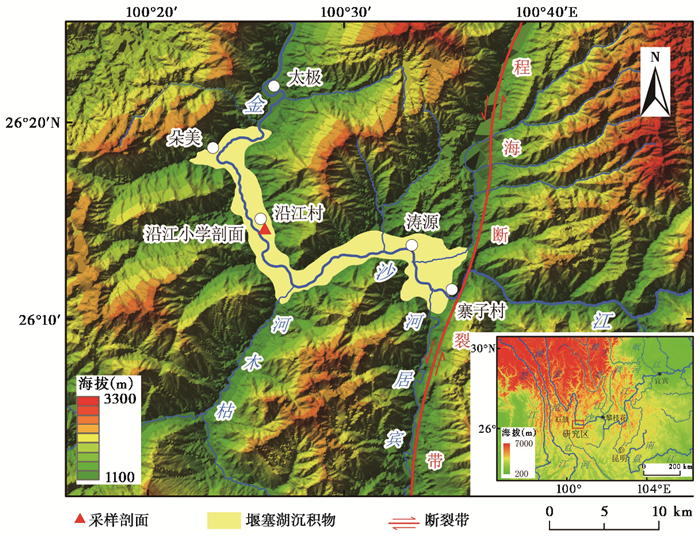
1 研究区概况及工作剖面研究区位于青藏高原东南缘金沙江中游的金江街段,北临程海,南接宾川盆地,宾居河、枯木河在此汇入金沙江(图 1)。程海断裂带[13]是研究区最重要的活动断裂带,该断裂带以西的河谷较宽,谷坡发育5级以上阶地,除第一、二级阶地为堆积阶地外,其他阶地均为基座阶地,基座为二叠系玄武岩。论文所指的寨子村古堰塞湖沉积就堆积在第二级阶地上(图 1和2)。
|
图 1 研究区位置及寨子村古堰塞湖沉积分布 Fig. 1 Location of the study area and Zhaizicun paleo-dammed lake sediments |
|
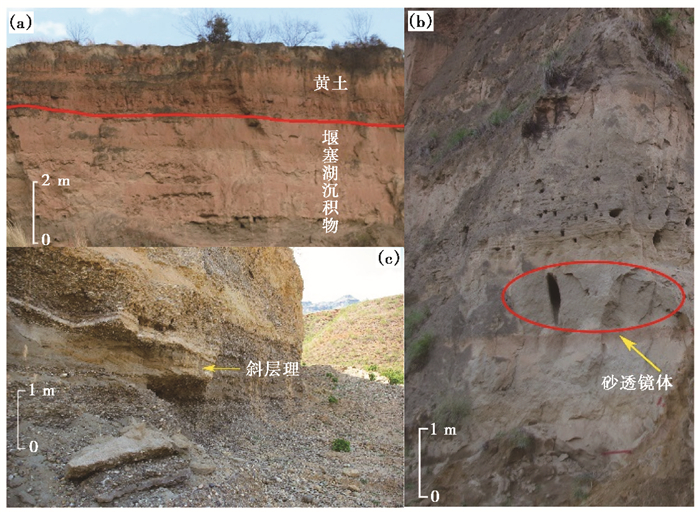
图 2 沿江小学剖面地层特征 (a)上部黄土和堰塞湖沉积层;(b)中、下部河漫滩相粉砂层;(c)底部砾石层 Fig. 2 Stratigraphic characteristics of Yanjiangxiaoxue section. (a)Loess and dammed lake deposits in the upper layer; (b)Over bank silts in the middle and lower layers; (c)Gravels with sands in the lower layer |
程海断裂带以东河谷狭窄,谷坡陡峻,基岩除了有二叠系玄武岩外还有中生界碳酸盐岩和碎屑沉积岩。在程海断裂带横切金沙江干流的部位,河谷东岸有两个明显的弧形滑坡面,在先前的研究中认为是形成寨子村古堰塞湖的滑坡遗迹,滑动面对岸的台地则是堵江堰塞的滑坡坝体[10]。
寨子村古堰塞湖残留滑坡坝体海拔标高1280 m[10]。堰塞湖沉积物在靠近坝体处(寨子村附近)较厚,可见厚度至少10 m,顶部发育古土壤,之上有2 m左右黄土沉积,黄土顶面海拔标高1250 m。溯江而上古堰塞湖沉积逐渐变薄,在朵美附近尖灭消失。工作剖面选在云南省永胜县涛源镇沿江村沿江小学附近(26°14′54.034″N,100°25′32.114″E),因为在这里开挖出了堰塞湖沉积层底部的河流相砂砾石层,有利于获取堰塞湖沉积的底界年龄,而其他地方开挖程度不够,看不到沉积物的底界。该剖面顶部海拔标高1245 m(差分GPS测量数据,小数点后数字省略)厚度15 m。自上而下分别是黄土沉积、堰塞湖沉积、阶地河漫滩相粉砂沉积和河床相砾石层沉积,具体描述如下:
0~ 2 m:黄土沉积。主要由粉砂质长石、石英碎屑组成,含碳酸钙。无水平层理,垂直节理发育。底部有红褐色古土壤,古土壤下部可见含碳酸钙结核的淀积层。前人研究表明该黄土地层具有明显的湿陷性,是我国纬度分布最低的黄土[14](图 2a)。
2~9 m:古堰塞湖沉积。主要由粉砂、细砂和一定数量的粗砂碎屑物质组成,水平层理明显,无砂砾石透镜体(图 2a)。
9~ 13 m:粒度较上部堰塞湖沉积粗,主要由粗粉砂、细砂物质组成,含一定数量的粗砂、细砾石透镜体,属河漫滩相沉积(图 2b)。
13 m以下:河床相砂砾石层。上部为粗砂层、砾石含量较少,下部为砾石层,可见到一定数量的斜层理。砾石磨圆度为次圆、岩石类型主要有玄武岩、辉长岩、碳酸盐岩、砂岩以及片麻岩等,与现代金沙江河滩砾石一致(图 2c)。
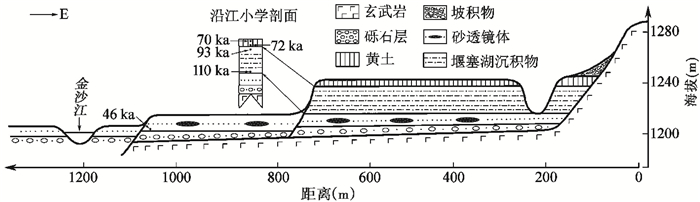
2 研究方法地层接触关系显示寨子村古堰塞湖沉积上覆于金沙江第二级阶地T2(图 3)。从以前的研究资料[15]推断,金沙江的第二级阶地的形成时代不会早于晚更新世,因此我们选用光释光(OSL)测年技术测定古堰塞湖的沉积年代。实践证明,OSL测年技术是确定时代在30 ka以上,但不老于晚更新世的湖相沉积物年龄的最可靠的测年方法之一[16~17],并在滑坡、湖泊以及沙漠等测年研究中广泛应用[18~20]。
|
图 3 寨子村古堰塞湖沉积沿江小学剖面 Fig. 3 The Yanjiangxiaoxue section of Zhaizicun ancient dammed lake sediment |
对沿江小学剖面进行了系统的光释光年代学采样,分别在距剖面顶部0.8 m(黄土地层中部)、1.5 m(古土壤顶部)、2.0 m(古堰塞湖地层顶部)和9.0 m(古堰塞湖地层底部)处采集光释光年代学样品;另外,为了更好的从地貌上进行年代学控制,我们还采集了T2阶地之下T1阶地细砂透镜体的光释光年代,采样全程避光。
样品在中国地质科学院水文地质与环境地质研究所测试,样品经过H2O2、HCl和氟硅酸处理后,分离出粒径4~11 μm的石英颗粒进行释光信号的测定。释光信号采用美国Daybreak公司生产的2200型光释光/热释光测量仪测量,该设备蓝光光源波长470 nm,半宽5 nm,最大功率60 mW/cm2,测片辐照在801E辐照仪进行,放射源为β放射源Sr-90。样品等效剂量采用简单多片再生法测定,在环境剂量率推算中,U、Th、K的含量采用ICP-MS测定,样品含水量为实测值。
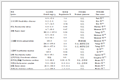
3 研究结果测定结果显示,寨子村古堰塞湖沉积物底部OSL年龄为110.5±4.7 ka B.P. (深9 m),顶部为93.4±3.9 ka B.P. (深2 m),上覆黄土地层底部古土壤顶OSL年龄为72.7±4.4 ka B.P. (深1.5 m),黄土地层中部年龄为70.0±2.9 ka B.P. (深0.8 m);T1阶地细砂透镜体的OSL年龄为46.6±2.8 ka B.P. (表 1)。结果表明,寨子村古堰塞湖沉积形成于110 ka B.P.,结束于93 ka B.P.,在73 ka B.P.之后黄土地层开始堆积,46 ka B.P.之后河流下切T1阶地形成。
|
表 1 金沙江寨子村古堰塞湖沉积物光释光测年结果 Table 1 The OSL dating results of the Zhaizicun ancient dammed lake sediments in Jinsha River |
在整个研究剖面中,测年结果未出现底部年龄老于顶部年龄的倒置现象。另外,T1阶地没有寨子村古堰塞湖沉积物堆积,这与T1阶地的形成时代晚于古堰塞湖沉积时代的测年结果(表 1)是一致的。
4 讨论 4.1 寨子村古堰塞湖沉积地层的厘定关于寨子村湖相沉积的研究可以追溯到20世纪90年代,当时笼统地认为在金沙江金江街段(涛源镇)存在一套早、中更新统湖相地层,而这套地层构成了晚更新世阶地的基座[10],但当时并没有指出它是滑坡堵江堰塞形成的。2008年汶川地震之后,有学者意识到了这套湖相地层可能是堰塞湖沉积,并在下游峡谷段找到了相应的滑坡坝体和滑坡遗迹[10]。然而这些研究对于这套古堰塞湖沉积物的具体分布范围和与相邻的地层接触关系却描述的比较含糊甚至有些是矛盾的。比较突出一个方面是,过去的研究没有考虑滑坡坝体海拔标高仅为1280 m的事实,而将堆积在海拔1500 m高度的湖相地层也认为是寨子村滑坡形成的古堰塞湖沉积物[10],这显然应属于两套堰塞湖沉积,因为一次滑坡堵江的堰塞湖沉积物是很难堆积在比滑坡堵江坝体还高的位置上的。其实在金沙江金江街段古堰塞湖沉积物应该不止寨子村一套,我们在寨子村滑坡坝体下游的鲁迪拉电站附近也发现有一定数量的湖相地层残留,这显然与寨子村滑坡无关。在地层接触关系方面,早期的学者认为金沙江金江街的湖相地层形成时代比金沙江的阶地要老,常表现为阶地的基座[11]。然而我们的调查发现,寨子村古堰塞湖沉积物与T2阶地河流相沉积物的接触关系是上覆,而不是下伏,因此它不能视为河流阶地的基座。不过,在金江街段我们也的确发现了部分湖相沉积物顶部覆盖有河流相沉积物的情况,但是这些沉积物的分布高度大多在海拔1400 m以上,而且在寨子村滑坡坝的下游也有分布,明显与寨子村古堰塞湖沉积物不是一套地层。因此,需给寨子村古堰塞湖沉积物作一个空间分布的厘定,即堆积在海拔1280 m以下,金沙江第二级阶地上的湖相沉积应是由寨子村滑坡堵塞金沙江形成的寨子村古堰塞湖沉积物,寨子村古堰塞湖沉积物不是金沙江阶地的基座而是上覆于阶地河流相沉积物之上的湖相沉积。另外,20世纪80年代发现的云南涛源黄土[14],现在看来主要堆积在堰塞湖沉积的顶部,是堰塞湖沉积结束后干热河谷局地气候的产物。
4.2 寨子村古堰塞湖地层与昔格达组的关系在确定寨子村古堰塞湖沉积为滑坡堵江沉积之前,有部分学者认为这套湖相地层是与下游160 km处的昔格达组是一套地层,属“泛湖沉积”,但遗憾的是他们并没有对这套地层开展年代学研究[9]。昔格达组最早是袁复礼[21]以攀枝花市盐边县红格乡昔格达村出露点命名的一套以粉砂或粉砂质粘土为主的微成岩新生代湖相地层(昔格达纹泥)。在早先的区域地质调查中,人们普遍把堆积在金沙江中游,由粉砂、粉砂质粘土和粘土构成的灰黄色晚新生代湖相地层都称为昔格达组[10, 22]。总体来说,传统认为的昔格达组普遍分布在寨子村古滑坡坝下游,海拔多在1500 m以上,且常表现为河流阶地的基座,顶部覆盖河流相沉积物,这些特征与寨子村古堰塞湖沉积物大相径庭。古地磁测年结果显示,大渡河泸定海子坪段的昔格达组年代为4.2~2.6 Ma[23],汉源富林段的昔格达组年代为3.27~1.78 Ma[24],安宁河冕宁段的昔格达组年代为3.58~2.60 Ma[25],金沙江渡口清香坪至昔格达村段的昔格达组年代为3.28~2.12 Ma[26]。除了古地磁外,在攀枝花段还开展过昔格达组的宇生核素测年,结果显示时代为1.34~1.58 Ma[9]。这些测年数据表明尽管不同地点的昔格达组地层年代存在一定差异,但总体而言形成年代不会晚于早更新世;另外,从昔格达村的出露剖面来看,昔格达组地层被多期断层切割错动[26],时代也不会太年轻。在众多文献中只有袁复礼先生在20世纪50年代认为昔格达组的时代可能在第四纪中期或后期[21],但缺乏绝对测年数据支撑。
因此,从沉积物分布特征和年代上(93~110 ka B.P.)可以断定昔格达组与寨子村古堰塞湖沉积完全不是一套地层。以往将寨子村古堰塞湖沉积与昔格达组作为一个延续上百千米的同一个大湖的沉积来看待[9]是缺乏年代学证据支持的。尽管目前学术界对现代金沙江水系的形成时代有不同看法[27~31],支持形成于早更新世的学者也不少[32~35],但将寨子村古堰塞湖沉积作为早更新世金沙江水系袭夺的证据在年代学层面上是不合适的。至于传统认为的昔格达组,尤其是时代老于早更新世的昔格达组是否也是堰塞湖沉积,还有待深入探究。
5 结论(1) 野外调查表明,寨子村古堰塞湖沉积是一套堆积于金沙江第二级阶地(T2)之上,主要由粉砂和细砂物质组成的,具明显水平层理结构和沿江分布特征的湖相地层,其顶部有黄土沉积。
(2) OSL测年结果显示,寨子村古堰塞湖沉积顶部年龄为93 ka B.P.,底部为110 ka B.P.,上覆黄土地层底部古土壤顶部年代73 ka B.P.,古土壤之上0.7 m处黄土年代为70 ka B.P.,表明寨子村古堰塞湖沉积形成时代为晚更新世,在时代上与学术界普遍认为的昔格达组不是一套地层,不能作为反映早更新世古金沙江河流袭夺的证据。
致谢 感谢审稿老师对文章修改提出的建设性的意见!
| 1 |
Schwanghart W, Bernhardt A, Stolle A et al. Repeated catastrophic valley infill following medieval earthquakes in the Nepal Himalaya. Science, 2016, 351(6269): 147-150. DOI:10.1126/science.aac9865 |
| 2 |
Xu Hongyan, Jiang Hanchao, Yu Song et al. OSL and pollen concentrate 14C dating of dammed lake sediments at Maoxian, east Tibet, and implications for two historical earthquakes in AD 638 and 952. Quaternary International, 2015, 371: 290-299. DOI:10.1016/j.quaint.2014.09.045 |
| 3 |
Chen Jian, Dai Fuchu, Lü Tongyan et al. Holocene landslide-dammed lake deposits in the upper Jinsha River, SE Tibetan Plateau and their ages. Quaternary International, 2013, 298: 107-113. DOI:10.1016/j.quaint.2012.09.018 |
| 4 |
Korup O, Montgomery D R. Tibetan Plateau river incision inhibited by glacial stabilization of the Tsangpo gorge. Nature, 2008, 455(7214): 786-789. DOI:10.1038/nature07322 |
| 5 |
李海龙, 张岳桥. 滑坡型堰塞湖形成与保留条件分析——基于文献总结和青藏高原东缘南北向深切河谷研究. 第四纪研究, 2015, 35(1): 71-87. Li Hailong, Zhang Yueqiao. Analysis of the controlling factors of landslide damming and dam failure:An analysis based on literature review and the study on the meridional river system of eastern Tibetan Plateau. Quaternary Sciences, 2015, 35(1): 71-87. |
| 6 |
Wang Ping, Zhang Bin, Qiu Weili et al. Soft-sediment deformation structures from the Diexi paleo-dammed lakes in the upper reaches of the Minjiang River, east Tibet. Journal of Asian Earth Sciences, 2011, 40(4): 865-872. DOI:10.1016/j.jseaes.2010.04.006 |
| 7 |
Delaney K B, Evans S G. The 2000 Yigong landslide (Tibetan Plateau), rockslide-dammed lake and outburst flood:Review, remote sensing analysis, and process modeling. Geomorphology, 2015, 246: 377-393. DOI:10.1016/j.geomorph.2015.06.020 |
| 8 |
Wu Qinglong, Zhao Zhijun, Liu Li et al. Outburst flood at 1920 BCE supports historicity of China's Great Flood and the Xia Dynasty. Science, 2016, 353(6299): 579-582. DOI:10.1126/science.aaf0842 |
| 9 |
Kong Ping, Granger D E, Wu Fuyuan et al. Cosmogenic nuclide burial ages and provenance of the Xigeda paleo-lake:Implications for evolution of the middle Yangzi River. Earth and Planetary Science Letters, 2009, 278(1): 131-141. |
| 10 |
李乾坤, 徐则民, 张家明. 永胜金沙江寨子村古滑坡和古堰塞湖的发现. 山地学报, 2011, 29(6): 729-737. Li Qiankun, Xu Zemin, Zhang Jiaming. The ancient landslide and dammed lake found in the Jinsha River near Zhaizicun, Yongsheng, Yunnan, China. Journal of Mountain Science, 2011, 29(6): 729-737. |
| 11 |
程捷. 金沙江奔子栏-金江街段发育史探讨. 华东地质学院院报, 1994, 17(3): 234-241. Cheng Jie. Discussion on the evolutionary history of Jinsha River form Ben Zilan to Jin Jiangjie in northwest Yunnan. Journal of East China Geological Institute, 1994, 17(3): 234-241. |
| 12 |
徐则民, 刘文连, 黄润秋. 滑坡堵江的地貌效应. 第四纪研究, 2013, 33(3): 490-500. Xu Zemin, Liu Wenlian, Huang Runqiu. Geomorphological effects of landslide damming. Quaternary Sciences, 2013, 33(3): 490-500. |
| 13 |
国家地震局地质研究所, 云南省地震局. 滇西北地区活动断裂. 北京: 地震出版社, 1990: 106-109. Institute of Geology, China Earthquake Administration, Earthquake Bureau of Yunnan Province. Activity Broken in Northwest of Yunnan. Beijing: Seismological Press, 1990: 106-109. |
| 14 |
罗光照, 沈林. 云南涛源黄土的成因及湿陷性. 工程勘察, 1984(5): 14-16. Luo Guangzhao, Shen Lin. The cause of formation and collapsibility loess of Taoyuan in Yunnan Province. Geotechnical Inversting & Surveying, 1984(5): 14-16. |
| 15 |
苏怀, 明庆忠, 潘保田等. 金沙江河谷-水系发育的年代学框架分析与探讨. 山地学报, 2013, 31(6): 685-692. Su Huai, Ming Qingzhong, Pan Baotian et al. The analysis and discussions on the chronological frame of Jinshajiang River valley-drainage. Journal of Mountain Science, 2013, 31(6): 685-692. |
| 16 |
Guo Xiaohua, Sun Zheng, Lai Zhongping et al. Optical dating of landslide-dammed lake deposits in the upper Yellow River, Qinghai-Tibetan Plateau, China. Quaternary International School of Tourism and Geographical Sciences, 2016, 392: 233-238. |
| 17 |
Liu Weiming, Lai Zhongping, Hu Kaiheng et al. Age and extent of a giant glacial-dammed lake at Yarlung Tsangpo gorge in the Tibetan Plateau. Geomorphology, 2015, 246: 370-376. DOI:10.1016/j.geomorph.2015.06.034 |
| 18 |
周保, 彭建兵, 赖忠平等. 黄河上游特大型滑坡群发特性的年代学研究. 第四纪研究, 2014, 34(2): 346-353. Zhou Bao, Peng Jianbing, Lai Zhongping et al. Research on geochronology of super large landslide in the upper Yellow River. Quaternary Sciences, 2014, 34(2): 346-353. |
| 19 |
隆浩, 张静然. 晚第四纪湖泊演化光释光测年. 第四纪研究, 2016, 36(5): 1191-1203. Long Hao, Zhang Jingran. Luminescence dating of Late Quaternary lake-levels in Northern China. Quaternary Sciences, 2016, 36(5): 1191-1203. |
| 20 |
耿建伟, 赵晖, 王兴繁等. 历史时期额济纳盆地水系与绿洲演变过程及其机制研究. 第四纪研究, 2016, 36(5): 1204-1215. Geng Jianwei, Zhao Hui, Wang Xingfan et al. Oasis and drainage network evolution processes and mechanisms of Ejina Basin during historical period. Quaternary Sciences, 2016, 36(5): 1204-1215. |
| 21 |
袁复礼. 中国西南区第四纪地质的一些资料. 中国第四纪研究, 1958(2): 130-140. Yuan Fuli. Some information on Quaternary geology in Southwest China. Chinese Quaternary Research, 1958(2): 130-140. |
| 22 |
刘慧军, 聂德新. 昔格达地层研究综述. 地球科学进展, 2004, 6(19): 80-82. Liu Huijun, Nie Dexin. The overview of the Xigeda strata study. Advances in Earth Science, 2004, 6(19): 80-82. |
| 23 |
蒋复初, 吴锡浩, 肖华国等. 四川泸定昔格达组时代及其新构造意义. 地质学报, 1999, 73(1): 1-6. Jiang Fuchu, Wu Xihao, Xiao Huaguo et al. On the age of the Xigeda Formation in Luding, Sichuan, and its neotectonic significance. Acta Geologica Sinica, 1999, 73(1): 1-6. |
| 24 |
钱方, 徐树金, 陈富斌等. 昔格达组磁性地层的研究. 山地研究, 1984, 2(4): 275-282. Qian Fang, Xu Shujin, Chen Fubin et al. Study on the paleomagnetism of the Xigeda Formation. Journal of Mountain Research, 1984, 2(4): 275-282. |
| 25 |
姚海涛, 赵志中, 乔彦松等. 四川冕宁昔格达组磁性地层学初步研究及意义. 第四纪研究, 2007, 27(1): 74-84. Yao Haitao, Zhao Zhizhong, Qiao Yansong et al. Magetostratigraphic dating of the Xigeda Formation in Mianning, Sichuan and its significance. Quaternary Sciences, 2007, 27(1): 74-84. |
| 26 |
李糲, 刘行松, 杨美娥等. 昔格达层构造变形形成因素分析. 中国地震, 1985, 1(3): 39-46. Li Ping, Liu Xingsong, Yang Mei'e et al. Analysis on the formative factors of the tectonic deformation of the Xigeda Group. Earthquake Research in China, 1985, 1(3): 39-46. |
| 27 |
McPhillips D, Hoke G D, Zeng Jingliu et al. Dating the incision of the Yangtze River gorge at the First Bend using three-nuclide burial ages. Geophysical Research Letters, 2016, 43(1): 101-110. DOI:10.1002/2015GL066780 |
| 28 |
Zheng Hongbo, Clift Peter D, Wang Ping et al. Pre-Miocene birth of the Yangtze River. Proceedings of the National Academy of Sciences of the United States of America, 2013, 110(19): 7556-7561. DOI:10.1073/pnas.1216241110 |
| 29 |
Wang Yingmin, Xu Qiang, Li Dong et al. Late Miocene Red River submarine fan, northwestern South China Sea. Chinese Science Bulletin, 2011, 56(14): 1488-1494. DOI:10.1007/s11434-011-4441-z |
| 30 |
Clift P D, Blusztajn J, Nguyen A D. Large-scale drainage capture and surface uplift in eastern Tibet-SW China before 24 Ma inferred from sediments of the Hanoi Basin, Vietnam. Geophysical Research Letters, 2006, 33(19): 1-5. |
| 31 |
Wei Honghong, Wang E, Wu Guoli et al. No sedimentary records indicating southerly flow of the paleo-upper Yangtze River from the first bend in southeastern Tibet. Gondwana Research, 2016, 32: 93-104. DOI:10.1016/j.gr.2015.02.006 |
| 32 |
Kong Ping, Zheng Yong, Caffee M W. Provenance and time constraints on the formation of the first bend of the Yangtze River. Geochemistry, Geophysics, Geosystems, 2012, 13(6): 1-15. |
| 33 |
杨达源, 李徐生. 金沙江东流的研究. 南京大学学报(自然科学), 2001, 37(3): 317-322. Yang Dayuan, Li Xusheng. Study on the eastward flow of the Jinsha River. Journal of Nanjing University (Natural Science), 2001, 37(3): 317-322. |
| 34 |
张叶春, 李吉均, 朱俊杰等. 晚新生代金沙江形成时代与过程研究. 云南地理环境研究, 1998, 10(2): 43-48. Zhang Yechun, Li Jijun, Zhu Junjie et al. Studies on development of Jinsha River during Late Cenozoic. Yunnan Geographic Environment Research, 1998, 10(2): 43-48. |
| 35 |
吴锡浩. 青藏高原东南部地貌边界与金沙江水系发育. 山地研究, 1989, 7(2): 75-84. Wu Xihao. On morphologic boundary of the southeastern Qinghai-Xizang Plateau and development of Jinsha River system. Journal of Mountain Science, 1989, 7(2): 75-84. |
2 Research Institute of Tourism and Culture Industry, Yunnan University of Finance and Economics, Kunming 650221, Yunan)
Abstract
In recent years, the Zhaizicun ancient dammed lake sediments in the Jiniangjie reach of Jinsha River have increasely attracted attention in academia. In general, there are two types of understanding about the sediments at the present moment. One view holds that the Zhaizicun lacustrine sediments are part of Xigeda ancient lake sediments (Xigeda Formation)and they can be used to reconstruct the river-capturing history of Jinsha River (the upper reaches of the Yangtze River)in Early Pleistocene. The other view argues that the formation of the lacustrine sediment, which have the characteristics of distribution along the Jinsha River, is attributed to the blockage of Jinsha River by a massive landslide, furthermore the landslide dams causing the river to be blocked also can been found in the downstream of the lacustrine sediments. However, these hypotheses lack accurate chronology data support currently. Here we repot the latest stratigraphy and chronology research results from Yanjiangxiaoxue section (26°14'54.034″N, 100°25'32.114″E), where the top and bottom of the lacustrine strata expose completely, on the basis of optical stimulated luminescence (OSL)measurements data. The ages of the top and the bottom of the Zhaizicun ancient dammed lake sediments, which overlie the second terrace of Jinsha River and are gradually thinner from landslide dams toward the upstream, are 93 ka B.P. and 110 ka B.P. respectively. About 2 m of loess cover the lacustrine sediment, the age of the top of the paleosoil developing in the bottom of the loess is 73 ka B.P. This new evidence indicates that Zhaizicun ancient dammed lake sediments deposited not in Early Pleistocene but in Later Pleistocene and they should not be correlated with Xigeda Formation, whose age accepted widely in academia is Early Pleistocene. Therefore, the capturing history of Jinsha River in Early Pleistocene cannot been recorded by Zhaizicun ancient dammed lake sediments.