 2017, Vol.37


② 中国地质大学(武汉), 武汉 430074;
③ 南宁博物馆, 南宁 530219)
现代人起源研究一直是国际学术界争论热点话题,多数人认为现代人起源于非洲,继而扩散到全球[1, 2]。东亚地区,特别是中国,近年来出土的一批距今5~10万年间的古人类遗址引起了现代人起源研究新争论[3~7],且这些古人类遗址地点多集中在中国南方[8~17](图 1)。
在之前的研究中,对东亚地区早期现代人开展了多方面的研究,取得了一系列新的发现和认识。这些研究包含对古人类化石、石器、动物群、年代学以及环境等多方面的研究[18~38]。如Liu等[3]对湖南道县福岩洞开展古人类年代学及形态学研究工作,认为其代表东亚地区最早的现代人,挑战了非洲早期现代人6万年前进入中国的观点;陆那洞、智人洞、黄龙洞遗址发现的古人类牙齿化石,以及对其进行年代学和形态学研究工作的结果,均支持中国在5~10万年间不缺乏现代人化石[4~7, 15]。
早期现代人在东亚地区的出现和扩散,华南地区无疑是一个非常重要的地区。近年对现代人在中国出现与演化研究一个重要进展就是确认早期现代人化石地点,如陆那洞[7]、土博[11]和智人洞[4],这些地点较多位于华南地区。最近发现的现代人化石地点,包括湖南道县福岩洞遗址[3],以及之前发现的广西柳江[12]、平乐鸡母岩[15]等地点也都位于中国华南地区。由此可见,华南很可能是东亚地区现代人形成与扩散的中心区域,早期现代人以及完全现代类型的人类都可能首先在华南地区出现,然后向华北地区扩散。
上述对中国早期现代人的研究取得了极为丰厚的成果,对于我们了解早期现代人在中国提供了事实依据。但是,前人研究对古人类生活环境背景等研究涉及较少[39~44],而古环境背景变化是人类演化中一个重要因素,对早期现代人的起源和扩散有着重要的意义。基于此,我们对广西地区早期现代人遗址陆那洞遗址采用多种环境分析指标进行古环境的重建,讨论古环境和人类演化的关系,试图揭示现代人演化框架下的环境背景。

|
图 1 中国南方区域早期现代人遗址分布图 底图改自王绍武和黄建斌[45];不同颜色代表不同干湿度,蓝色代表相对干燥;数据代表遗址:1.黄龙洞(Huanglong cave:33°07′62.8″N,110°13′04.3″E)[6];2.福岩洞(Fuyan cave:25°39′02.7″N,111°28′49.2″E)[14];3.鸡母岩(Mujiyan cave:24°29′52.8″N,110°50′0.79″E)[15];4.柳江人(Liujiang site:24°10′59″N,109°25′56″E)[12];5.咁前洞(Ganqian cave:24°13′22″N,109°05′14″E)[11];6.智人洞(Zhiren cave:23°17′13.6″N,107°30′45.1″E)[4];7.陆那洞(Luna cave:23°36′48″N,106°58′1″E)[7] Fig. 1 Early modern human sites in South China. The Figure is from Wang Shaowu and Huang Jianbin[45], different colors represent different humidities in the figure, blue represents relative dry. The data represents the sites |
陆那洞遗址(23°36′48″N,106°58′1″E)位于广西田东县祥周镇模范村模范屯西南约500m,海拔高度为162m,距地面高约30m。洞口朝东,洞穴南北倾斜,洞穴深3~5m,宽10m,高1~4m;洞内保留有较多堆积物。该遗址于2003年考古调查时发现,于2004年、2008年进行系统发掘。陆那洞遗址堆积物保存完好,厚度约0.5~2.0m,包含3个文化层,沉积物主要以浅褐色粘土为主,包含一些石灰岩和角砾岩。洞内出土大量哺乳动物化石,包括长臂猿(未定种)(Hylobates sp.)、猕猴(未定种)(Macaca sp.)、大熊猫包氏亚种(Ailuropoda melanoleuca baconi(Woodward,1915))、东方剑齿象(Stegodon orientalis Owen,1870)、中国犀(Rhinoceros sinensis Owen,1870)、鹿科属种未定(Cervidae gen. et sp. Indet.)、牛科属种未定(Bovidae gen. et sp. Indet.)、野猪(Sus scrofa Linnaeus,1758)、豪猪(未定种)(Hystrix sp.)等,动物群中并无喜冷动物出现,动物群组合暗示当时古环境可能比较温和;同时遗址第二文化层出土两颗古人类牙齿化石,通过对出土古人类牙齿层位进行U系测年,显示其年代范围在70~120ka B.P.,根据陆那洞古人类的牙齿研究,该古人类属于东亚地区的早期智人[7]。
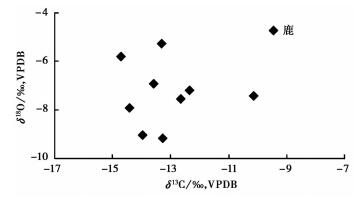
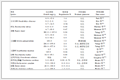
2 陆那洞遗址古环境重建 2.1 牙釉质的C、O稳定同位素分析 2.1.1 材料及方法陆那洞遗址同位素研究材料为9枚哺乳动物牙齿,均为鹿牙,且出土于与古人类牙齿同层位的第二文化层。实验过程:首先对样品进行清洗晾干,用牙钻在牙齿釉质部分钻取10~15mg的粉末,并使用玛瑙研磨盘磨至200目以下,保存在5ml的离心管内,加入50 %次氯酸钠溶液(NaClO)去除样品中的有机质。离心清洗后加入1 mol/L的冰醋酸溶液,以去除成岩作用产生的碳酸盐,蒸馏水离心清洗至中性后,冷冻干燥,最后送往实验室进行分析测试。本次实验在中国地质大学(武汉)国家生物与地质重点实验室进行,使用的仪器是MAT253稳定同位素质谱仪,C、O同位素的分析精度为0.2 ‰,C、O同位素的分析结果均以相对PDB的值δ13C和δ18O来表示,所得数据见图 2和表 1。
|
图 2 陆那洞遗址鹿牙化石δ13C和δ18O值散点图 Fig. 2 Scatter plot of δ 13 C and δ 18 O values of Cervus fossils from Luna Cave |
|
表 1 陆那洞遗址稳定同位素数据 Table 1 Sample information and isotopic data of Cervus fossils from Luna Cave |
陆那洞遗址鹿科动物的牙齿釉质δ13C集中在-10.4 ‰至-14.8 ‰之间,平均值为-13.2±1.27 ‰。较食物而言,食草类动物骨羟磷灰石的δ13C值约富集14 ‰ ~15 ‰ [46]。显然,这些动物均生活于以C3植物为主的植被中。此外,食草类动物的δ13C值处于-14 ‰,是判断环境是否为密闭或开放森林的临界值,即动物牙釉质δ13C值若处于-14 ‰以下则其偏好于栖息在闭合度较高的森林中[47]。据此,可以看出,陆那洞遗址所在区域的古环境应处于较为开放的森林环境。需要指出的是,相对偏差较大的鹿科动物的δ18O值平均值为-7.46±1.4 ‰,可能与其分属不同鹿科类型所引起的饮水环境密切相关。
2.2 孢粉分析 2.2.1 材料及方法陆那洞遗址孢粉样品采集剖面位于遗址探方东壁,探方东壁沉积物厚度为120cm,从顶层向底部连续采集土样,并确保地层剖面的延续性,共采集8个样品。样品送于中国地震局地震动力学国家重点实验室进行测试分析,由麦学舜老师完成分析鉴定等工作。
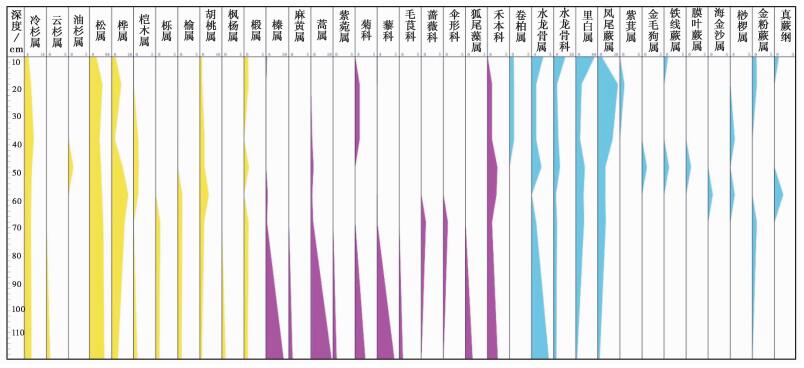
2.2.2 数据及结果分析从图 3中可见,陆那洞遗址孢粉组合特征显示:乔木植物花粉较多,占总数的49.9 %,其中以松属(Pinus)、桦属(Betula)及冷杉属(Abies)为主,依次分别占总数的31.7 %、11.0 %和3.0 %;灌木及草本植物较少,占总数的7.8 %,其中又以蒿属(Artemisia)为主;蕨类植物占总数的42.3 %,其中以里白属(Hicriopteris)及凤尾蕨属(Pteris)为主。从剖面孢粉分析结果来看,乔木植物所占比例较高,占到总数的近一半。乔木植物喜阳,一般乔木植物花粉越多,代表气候越炎热[48]。基于上述孢粉分析结果,可以看出,陆那洞遗址古人类当时所处的环境温和,并没有出现较为炎热或寒冷气候事件。
|
图 3 陆那洞沉积物主要孢粉类型百分含量图式 Fig. 3 Pollen percentage diagram of main palynomorphs from Luna Cave |
在进行粘土矿物样品采集之前,我们首先对剖面进行观察,选择完整的地层剖面,以确保地层剖面的延续性。采样时,首先去除地层表面覆盖层,以确保不受干扰,可以采到较为新鲜的样品。在陆那洞探方东壁堆积物厚度为120cm进行采样,并采取自上而下的取样方式,每10cm采集一个样品,每个样品采1kg左右的样品量。陆那洞所采集的11个样品在武汉上谱分析科技有限责任公司分析测试中心利用Agilent 7700e ICP-MS进行化学分析。
2.3.2 数据及结果分析地球化学元素循环是化学风化作用重要组成部分。在风化过程中,沉积物总的易迁移元素会相对亏损,而难迁移元素会相对富集。化学风化指数(CIA)(CIA=)能有效反映沉积物中易迁移元素和难迁移元素的比例,可以有效用来反应沉积物的化学风化程度。沉积物CIA值越大,表明风化作用越强,说明其形成于温暖湿润的气候条件;反之,表明该时段气候条件较为干冷[49]。
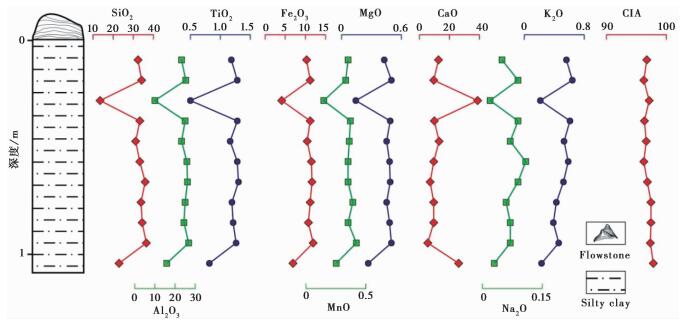
陆那洞遗址堆积物不同深度主量元素主要以SiO2、Al2O3、CaO和FeOtot为主,元素含量较为稳定。沉积物中SiO2含量在13.40 % ~36.41 %之间,平均值为30.95 %;Al2O3含量为9.93 % ~26.74 %,平均值为22.82 %;CaO的含量变化很大,从5.57 %到38.37 %,平均为13.65 %;FeOtot含量在4.18 % ~11.94 %之间,平均值为10.08 %。陆那洞沉积物中TiO2、MnO、MgO、Na2O和K2O含量仍较低且变化较小。相比南方红土,陆那洞沉积物具有相对较高的Na2O/Al2O3和更低的K2O/Al2O3比值,但仍远低于页岩和火成岩下限值[50]。陆那洞遗址沉积物不同深度的化学元素波动较小;SiO2、Al2O3、TiO2、FeOtot、K2O、MnO、MgO在0.3m深度处减小,而CaO含量则呈相反趋势;CIA值在96.24到97.87之间变化,平均值为96.93,整体沿剖面无明显变化(图 4和表 2)。根据粘土矿物数据分析,主量元素均变化较小,并且其CIA指数变化较小。暗示陆那洞古人类生活时期气候较为温暖湿润,没有出现大的环境变动,环境整体较为稳定。
|
图 4 陆那洞沉积物主量元素(%)及CIA指数 Fig. 4 Clay mineral composition(%) and CIA index of the sediments from Luna Cave |
|
|
表 2 陆那洞沉积物主量元素(%)和CIA数据表 Table 2 Clay mineral composition (%) and CIA index of the sediments from Luna Cave |
近年来对现代人在中国出现与演化研究的一个重要进展就是确认了较多早期现代人化石地点,如陆那洞[7]、福岩洞[3]、智人洞[4]、黄龙洞[6]等。对这些古人类遗址研究工作主要集中在地层学、年代学和形态学3个方面,特别是年代学的研究,提出了非常好的证据支持中国区域5~10万年间不缺乏现代人化石,挑战了国外关于非洲早期现代人6万年前进入中国的观点[3]。
从中国区域出土现代人化石材料来看,中国区域内存在5~10万年间的古人类[3~7, 15]。但是我们对古人类生活时期的古环境背景关注较少。这一时期,气候是否特别恶劣,不适合古人类生存?还是与非洲等地类似,处于较为温和的环境中,非常适宜于古人类的生存发展?对中国区域内早期现代人古环境背景的研究,将为认识中国区域内现代人类起源、迁徙和扩散提供良好的科学认识。
在本文中,利用多学科角度重建陆那洞早期现代人古环境背景。牙釉质稳定同位素分析研究数据显示,陆那洞遗址所在区域的环境植物以C3为主,古栖息环境处于森林环境,但碳同位素显示当时古环境还没有达到闭合森林状态,暗示当时气候较为温和;孢粉分析结果指示,陆那洞遗址古环境背景没有出现较为炎热或者冷的气候事件,整体气温比较稳定,环境温和;粘土矿物数据分析,主量元素和CIA指数均变化较小,暗示陆那洞古人类生活时期气候较为温暖湿润,没有出现大的环境变动,环境整体较为稳定。总体来看,以上3种不同类型的古气候指标对陆那遗址的重建结果基本一致。由此,我们认为陆那洞古人类生活时期,古环境背景比较温和,且没有出现大的冷暖波动,其生态环境非常适宜于古人类生存。
上述分析结果表明,晚更新世早期广西陆那洞及其周边现代人类的生存环境背景,古人类生活时期气候较为温和、环境稳定。因此,我们的结论支持中国华南区域在早期现代人生活时期的古环境背景非常适宜古人类居住。
4 结论(1) 本文通过多学科重建早期现代人古环境(牙釉质稳定同位素、孢粉、粘土矿物),重建更新世晚期广西田东陆那洞遗址古环境,牙釉质稳定同位素分析研究数据暗示古栖息环境处于森林环境,当时气候较为温和;孢粉分析结果指示陆那洞遗址古环境背景整体气温比较稳定,环境温和;粘土矿物数据分析暗示陆那洞古人类生活时期气候较为温暖湿润,没有出现大的环境变动,环境整体较为稳定。我们的数据支持陆那洞古人类生活时期,气候较为温和,并没有出现大的气候突变事件。
(2) 结合目前已发表国内关于早期现代人研究材料,我们认为,中国区域内早期现代人生活环境比较稳定及温暖,并没有出现大的气候冷事件。建立在这个基础上,我们认为,中国区域,特别是中国南方区域,在早期现代人生活阶段,气候环境非常适宜古人类生存。
(3) 陆那洞古人类遗址古环境背景重建,对于我们了解早期现代人生活环境,以及环境变化与人类演化有着非常重要的作用;并且进一步提示,中国南方晚更新世早期适宜的气候条件,或为现代人类的起源、迁徙和扩散,提供了良好的环境背景。
致谢: 衷心感谢匿名审稿专家和杨美芳编辑对论文的审阅并提出宝贵修改意见!感谢哈佛大学王传超博士对英文摘要等的修改!
| 1 |
Cann R L, Stoneking M, Wilson A C. Mitochondrial DNA and human evolution. Nature, 1987, 325(6099): 31-36. DOI:10.1038/325031a0 |
| 2 |
Wolpoff M, Hawaks J, Frayer D W, et al. Modern human ancestry at the peripheries:A test of the replacement theory. Science, 2001, 291(5502): 293-297. DOI:10.1126/science.291.5502.293 |
| 3 |
Liu Wu, Martinón-Torres M, Cai Yanjun, et al. The earliest unequivocally modern humans in Southern China. Nature, 2015, 526(7525): 696-699. |
| 4 |
Liu Wu, Jin Changzhu, Zhang Yingqi, et al. Human remains from Zhirendong, South China, and modern human emergence in East Asia. Proceedings of the National Academy of Sciences of the United States of America, 2010, 107(45): 19201-19206. DOI:10.1073/pnas.1014386107 |
| 5 |
Shang Hong, Tong Haowen, Zhang Shuangquan, et al. An early modern human from Tianyuan Cave, Zhoukoudian, China. Proceedings of the National Academy of Sciences of the United States of America, 2007, 104(16): 6575-6578. |
| 6 |
Liu Wu, Wu Xiujie, Pei Shuwen, et al. A preliminary report on Huanglong Cave:A Late Pleistocene human fossil site in Hubei Province, China. Quaternary Internation, 2010, 211: 29-41. DOI:10.1016/j.quaint.2009.06.017 |
| 7 |
Bae C J, Wang Wei, Zhao Jianxin, et al. Modern human teeth from Late Pleistocene Luna Cave(Guangxi, China). Quaternary Internation, 2014, 354: 169-183. |
| 8 |
陈铁梅, 原思训, 高世君. 铀子系法测定骨化石年龄的可靠性研究及华北地区主要旧石器地点的铀子系年代序列. 人类学学报, 1984, 3(3): 259-269. Chen Tiemei, Yuan Sixun, Gao Shijun. The study on uranium-series dating of fossil bones and an absolute age sequence for the main paleolithic sites of North China. Acta Anthropologica Sinica, 1984, 3(3): 259-269. |
| 9 |
陈铁梅, 袁振新. 山顶洞遗址的第二批加速器质谱14C年龄数据与讨论. 人类学学报, 1992, 11(2): 112-116. Chen Tiemei, Yuan Zhenxin. The second batch of accelerator radiocarbon dates for Upper Cave site of Zhoukoudian. Acta Anthropologica Sinica, 1992, 11(2): 112-116. |
| 10 |
原思训, 陈铁梅, 高世君. 华南若干旧石器时代地点的铀系年代. 人类学学报, 1986, 5(2): 179-190. Yuan Sixun, Chen Tiemei, Gao Shijun. Uranium series chronological sequence of some Palaeolithic site in South China. Acta Anthropologica Sinica, 1986, 5(2): 179-190. |
| 11 |
沈冠军, 王頠, 王谦, 等. 广西柳江土博咁前洞的铀系年代. 人类学学报, 2001, 20(3): 238-244. Shen Guanjun, Wang Wei, Wang Qian, et al. U-series dating of hominid site Ganqian Cave at Tubo, Liujiang, Guangxi in South China. Acta Anthropologica Sinica, 2001, 20(3): 238-244. |
| 12 |
王頠, 沈冠军, 周春林, 等. 柳江现代智人化石地点的地层及年代. 第四纪研究, 2004, 24(3): 272-277. Wang Wei, Shen Guanjun, Zhou Chunlin, et al. Stratigraphy and chronology of deposits in "Liujiang Hominid Cave", Gunagxi, China. Quaternary Sciences, 2004, 24(3): 272-277. |
| 13 |
刘武, 吴秀杰, 邢松, 等. 中国古人类化石. 北京: 科学出版社, 2014, 1-378. Liu Wu, Wu Xijie, Xing Song, et al. Human Fossils in China. Beijing: Science Press, 2014, 1-378. |
| 14 |
李意愿, 裴树文, 同号文, 等. 湖南道县后背山福岩洞2011年发掘简报. 人类学学报, 2013, 32(2): 133-143. Li Yiyuan, Pei Shuwen, Tong Haowen, et al. A preliminary report on the 2011 excavation at Houbeishan Fuyan Cave, Daoxian, Hunan Province. Acta Anthropologica Sinica, 2013, 32(2): 133-143. |
| 15 |
王頠, 黄超林, 谢绍文, 等. 广西平乐鸡母岩发现的晚更新世人类牙齿化石. 第四纪研究, 2011, 31(4): 699-704. Wang Wei, Huang Chaolin, Xie Shaowen, et al. Late Pleistocene hominin teeth from the Jimuyan Cave, Pingle County, Guangxi, South China. Quaternary Sciences, 2011, 31(4): 699-704. |
| 16 |
刘武. 早期现代人在中国的出现与演化. 人类学学报, 2013, 18(3): 233-246. Liu Wu. Emergency and evolution of early modern humans in China:Some thoughts derived form recent studies. Acta Anthropologica Sinica, 2013, 18(3): 233-246. |
| 17 |
吴汝康. 广西柳江发现的人类化石. 古脊椎动物与古人类, 1959, 1(3): 97-104. Wo Jukang. Human fossils found in Liujiang, Guangxi, China. Paleovertebrata et Paleoanthropologia, 1959, 1(3): 97-104. |
| 18 |
Hu Yaowu, Shang Hong, Tong Haowen, et al. Stable isotope dietary analysis of the Tianyuan 1 early modern human. Proceedings of the National Academy of Sciences of the United States of America, 2009, 106(27): 10971-10974. DOI:10.1073/pnas.0904826106 |
| 19 |
同号文, 尚虹, 张双权, 等. 周口店田园洞古人类遗址的发现. 科学通报, 2004, 49(9): 893-897. Tong Haowen, Shang Hong, Zhang Shuangquan, et al. Human fossils site found in Tianyuan cave, Zhoukoudian. Chinese Science Bulletin, 2004, 49(9): 893-897. |
| 20 |
吴新智. 现代人起源的多地区进化说在中国的证实. 第四纪研究, 2006, 26(5): 702-709. Wu Xinzhi. Evidence of multiregional human evolution hypothesis from China. Quaternary Sciences, 2006, 26(5): 702-709. |
| 21 |
刘武, 吴秀杰, 汪良. 柳江人头骨形态特征及柳江人演化的一些问题. 人类学学报, 2006, 25(3): 177-194. Liu Wu, Wu Xiujie, Wang Liang. Some problems for the Late Pleistocene human cranium found in Liujiang of South China based on morphological analysis. Acta Anthropologica Sinica, 2006, 25(3): 177-194. |
| 22 |
刘武, 吴秀杰, 李海军. 柳江人身体大小和形状-体重、身体比例及相对脑量的分析. 人类学学报, 2007, 26(4): 295-304. Liu Wu, Wu Xiujie, Li Haijun. Body size and shape in a human fossil from Liujiang, South China. Acta Anthropologica Sinica, 2007, 26(4): 295-304. |
| 23 |
吴秀杰, 金昌柱, 蔡演军, 等. 广西崇左智人洞早期现代人下颌骨和牙齿的病理现象及形态异常. 人类学学报, 2013, 32(3): 293-301. Wu Xiujie, Jin Changzhu, Cai Yanjun, et al. Dental caries and mandibular anomalies of earlier modern humans from the Zhirendong site, Chongzuo, Guangxi. Acta Anthropologica Sinica, 2013, 32(3): 293-301. |
| 24 |
吴秀杰, 刘武, 董为, 等. 柳江人头骨化石的CT扫描与脑形态特征. 科学通报, 2008, 53(13): 1570-1575. Wu Xiujie, Liu Wu, Dong Wei, et al. CT scan and brain morphology in a human fossil from Liujiang, South China. Chinese Science Bulletin, 2008, 53(13): 1570-1575. DOI:10.3321/j.issn:0023-074X.2008.13.013 |
| 25 |
刘武, 武仙竹, 吴秀杰, 等. 人类牙齿表面痕迹与古人类生存适应及行为特征——湖北郧西黄龙洞更新世晚期人类牙齿使用痕迹. 第四纪研究, 2008, 28(6): 014-1022. Liu Wu, Wu Xianzhu, Wu Xiujie, et al. Living adaptation and behaviors of Late Pleistiocene humans from Huanglong cave in Yunxi of Hubei Province reflected by tooth use marks. Quaternary Sciences, 2008, 28(6): 1014-1022. |
| 26 |
刘武, 武仙竹, 吴秀杰. 湖北郧西黄龙洞更新世晚期人类牙齿. 人类学学报, 2009, 28(2): 113-129. Liu Wu, Wu Xianzhu, Wu Xiujie. Late Pleistocene human teeth found in the Huanglong Cave, Yunxi of Hubei Province. Acta Anthropologica Sinica, 2009, 28(2): 113-129. |
| 27 |
金昌柱, 潘文石, 张颖奇, 等. 广西崇左江州木榄山智人洞古人类遗址及其地质时代. 科学通报, 2009, 53(19): 2848-2856. Jin Changzhu, Pan Wenshi, Zhang Yingqi, et al. The Homo sapiens Cave hominin site of Mulan Mountain, Jiangzhou district, Chongzuo, Guangxi with emphasis on its age. Chinese Science Bulletin, 2009, 53(19): 2848-2856. |
| 28 |
刘武, 武仙竹, 吴秀杰, 等. 湖北郧西黄龙洞更新世晚期人类牙齿磨耗与使用痕迹. 人类学学报, 2010, 29(1): 1-14. Liu Wu, Wu Xianzhu, Wu Xiujie, et al. Tooth wear and tooth use of Late Pleistocene humans form Huanglong Cave in Yunxi of Hubei Province. Acta Anthropologica Sinica, 2010, 29(1): 1-14. |
| 29 |
Wu Xiujie, Xing Song, Trinkaus E. An enlarged parietal foramen in the late archaic Xujiayao 11 neurocranium from Northern China. PLoS One, 2013, 8(3): 1-10. |
| 30 |
Wu Xiujie, Trinkaus E. Neurocranial trauma in the late archaic human remains from Xujiayao, Northern China. International Journal of Osteoarchaeology, 2015, 2(25): 245-252. |
| 31 |
Lacy S, Wu Xiujie, Jin Changzhu, et al. Dentoalveolar paleopathology of the early modern humans from Zhirendong, South China. International Journal of Paleopathology, 2012, 2: 10-18. DOI:10.1016/j.ijpp.2012.06.003 |
| 32 |
Darren C, Ji Xueping, Andy H, et al. Human remains from the Pleistocene-Holocene transition of Southwest China suggest a complex evolutionary history for East Asians. PLoS ONE, 2012, 7(3): 1915-1918. |
| 33 |
Fu Qiaomei, Meyerb M, Gao Xing, et al. DNA analysis of an early modern human from Tianyuan Cave, China. Proceedings of the National Academy of Sciences of the United States of America, 2013, 110(6): 2223-2227. DOI:10.1073/pnas.1221359110 |
| 34 |
邵庆丰, 韩非, Jean-JacquesBahain. 华南早更新世巨猿动物群的ESR/U-系年代. 第四纪研究, 2016, 36(5): 1224-1235. Shao Qingfeng, Han Fei, Jean-Jacques Bahain. Coupled ESR/U-series age estimates for Early Pleistocene Gigantopithecus faunas in Southern China. Quaternary Sciences, 2016, 36(5): 1224-1235. |
| 35 |
刘平, 邓成龙, 李仕虎, 等. 泥河湾盆地下沙沟动物群的磁性地层学定年及其对泥河湾动物群的年代制约. 第四纪研究, 2016, 36(5): 1176-1190. Liu Ping, Deng Chenglong, Li Shihu, et al. Magnetstratigraphic dating of the Xiashagou fauna and implication for sequencing the mammalian faunas in the Nihewan Basin, North China. Quaternary Sciences, 2016, 36(5): 1176-1190. |
| 36 |
卢小康, 陈善勤, 何文. 临夏盆地晚新近纪山西犀头骨新材料及其生存环境. 第四纪研究, 2015, 35(3): 539-549. Lu Xiaokang, Chen Shanqin, He Wen. New skulls of Shansirhinus ringstroemi from the Upper Neogene of the Linxia Basin, and their paleoenvironmental context. Quaternary Sciences, 2015, 35(3): 539-549. |
| 37 |
同号文, 陈曦, 王晓敏. 北京平原地区水牛化石新材料:时代与环境问题. 第四纪研究, 2015, 35(3): 561-572. Tong Haowen, Chen Xi, Wang Xiaomin. On the skull of Bubalus youngi of Late Pleistocene from the plain area of Beijing, China. Quaternary Sciences, 2015, 35(3): 561-572. |
| 38 |
董明星, 张艳红, 张建国, 等. 石家庄地区早全新世冷湿气候的牙齿微磨痕和同位素证据. 第四纪研究, 2014, 34(1): 8-15. Dong Mingxing, Zhang Yanhong, Zhang Jianguo, et al. Cold and/or wet Early Holocene in Shijiazhuang district:Evidences from tooth microwear and stable isotopes analyses. Quaternary Sciences, 2014, 34(1): 8-15. |
| 39 |
刘武, 吴秀杰. 现代人在中国的出现与演化:研究进展. 中国科学基金, 2016(4): 306-314. Liu Wu, Wu Xiujie. Research progresses of modern human origin and evolution in China. China Science Fund, 2016(4): 306-314. |
| 40 |
刘武. 更新世晚期人类演化及现代人群形成研究的一些问题. 自然科学进展, 2006, 17(7): 789-796. Liu Wu. Some questions of Human evolution and modern humans in the Late Pleistocene. Progress in Natural Science, 2006, 17(7): 789-796. |
| 41 |
刘武, 邢松, 吴秀杰. 中更新世晚期以来中国古人类化石形态特征的多样性. 中国科学:地球科学, 2016, 46(7): 906-917. Liu Wu, Xing Song, Wu Xiujie. Morphological diversities of the late-Middle and Late Pleistocene human fossils in China. Science China:Earth Sciences, 2016, 46(7): 906-917. |
| 42 |
刘武, 吴秀杰, 邢松. 现代人的出现与扩散——中国的化石证据. 人类学学报, 2016, 35(21): 161-171. Liu Wu, Wu Xiujie, Xing Song. Emergence and dispersal of modern humans:The fossil evidence from China. Acta Anthropologica Sinica, 2016, 35(21): 161-171. |
| 43 |
张聪聪, 李蕾, 王健, 等. 河北阳原侯家窑遗址区古河流与古人类生存环境研究. 第四纪研究, 2015, 35(3): 733-741. Zhang Congcong, Li Lei, Wang Jian, et al. Research on the relationship between the old river and living environment for ancient human at Houjiayao Site, Yangyuan County, Hebei Province. Quaternary Sciences, 2015, 35(3): 733-741. |
| 44 |
袁宝印, 郝青振, 徐钦琦, 等. 洛川黄土堆积粗颗粒变化记录与华北第四纪哺乳动物迁徙关系的初步探讨. 第四纪研究, 2015, 35(6): 1480-1488. Yuan Baoyin, Hao Qingzhen, Xu Qinqi, et al. A preliminary study on the relationship of climatic events recorded by coarse fractions in loess-paleosol sequence from Luochuan and southward migration of mammalian animals in North China. Quaternary Sciences, 2015, 35(6): 1480-1488. |
| 45 |
王绍武, 黄建斌. 中国华北与印度夏季降水遥相关的不确定性. 自然科学进展, 2006, 16(8): 980-985. Wang Shaowu, Huang Jianbin. Uncertainty of the summer precipitation of North China and India teleconnection. Progress in Natrual Science, 2006, 16(8): 980-985. |
| 46 |
Cerling T, Passey B H, Ayliffe L K, et al. Orphans' tales:Seasonal dietary changes in elephants from Tsavo National Park, Kenya. Palaeogeography, Palaeoclimatology, Palaeoecology, 2004, 206: 367-376. DOI:10.1016/j.palaeo.2004.01.013 |
| 47 |
Biasatti D, Wang Yang, Gao Feng, et al. Paleoecologies and paleoclimates of Late Cenozoic mammals from Southwest China:Evidence from stable carbon and oxygen isotopes. Journal of Asian Earth Science, 2012, 44: 48-61. DOI:10.1016/j.jseaes.2011.04.013 |
| 48 |
郑卓, 黄康有, 魏金辉, 等. 中国及其邻区现代孢粉数据:空间分布特征和定量古环境重建中的应用. 第四纪研究, 2013, 33(6): 1037-1053. Zheng Zuo, Huang Kangyou, Wei Jinhui, et al. Modern pollen data in China and adjacent areas:Sptatial distribution features and applications on quantitative paleoenvironment reconstruction. Quaternary Sciences, 2013, 33(6): 1037-1053. |
| 49 |
Mclennan S M. Weathering and global denudation. The Journal of Geology, 1993, 101(2): 295-303. DOI:10.1086/648222 |
| 50 |
Hong Hanlie, Wang Chaowen, Zeng Kefeng, et al. Geochemical constraints on provenance of the Mid-Pleistocene red earth sediments in subtropical China. Sedimentary Geology, 2013, 290(4): 97-108. |
② China University of Geosciences(Wuhan), Wuhan 430074;
③ Nanning Musemu, Nanning 530219)
Abstract
The origin and dispersal of early modern humans and the associated environment background changes have been important hot topics. In recent years, some fossils of early modern humans dated to the early Late Pleistocene have been found in South China, which provides important materials for understanding the origin and evolution of early modern humans in East Asia. However, we now still have little knowledge of the environment background of early modern humans. Luna Cave(23°36'48"N, 106°58'1"E) is located in the Karst mountains of the southeastern Bubing Basin in Guangxi Zhuang Autonomous Region, Southern China. The cave is about 30m above the valley floor and 162m above sea level. The deposits of about 0.5~2.0m in thickness are well preserved, including three different culture layers and were primarily of light brown clay containing a few limestone breccia. The Natural History Museum of Guangxi Zhuang Autonomous Region conducted the first excavation in 2004 and the second excavation in 2008. We discovered more than one hundred mammalian teeth and bones, including the two hominin teeth assigned to modern Homo sapiens that were dated between 70~120ka B.P. based on multiple MC-ICP-MS uranium-series dates of associated flowstones in clear stratigraphic context. In this paper, we used different analysis methods including enamel stable isotopes, sporopollen, and clay minerals to reconstruct the paleoenvironment of Luna Cave(70~120ka B.P.)in a multidisciplinary way. We selected nine well-preserved Cervus teeth for carbon and oxygen isotope analysis, as the Cervus teeth and human teeth were found in the same second culture layer. We used MAT 253 mass spectrometer in the State Key Laboratory of Biogeology and Environmental Geology at the China University of Geosciences(Wuhan). The results show that the δ13C values of the Luna Cave cervid enamel are from -10.4‰ to -14.8‰ with a mean value of -13.2±1.27‰, which clearly indicate the Luna Cave was in a forest environment dominated by C3 plants. The stable isotope analysis of the enamel from Luna Cave suggests that the Luna cave dominated by C3 plants was in a region belonging to the forest but not closed forest environment, indicating the climate was relatively mild. In total, we collected eight sporopollen samples continuously from the top to the bottom from the east wall of a 1.2m deep excavation unit in Luna Cave. The sporopollen analysis was carried out in the State Key Laboratory of Earthquake Dynamics at the Institute of Geology, China Earthquake Administration. The results suggest the Luna Cave was in mild paleoenvironment without extreme hot or cold weather events. We also collected the samples for clay mineral composition and CIA index of the sediments analysis from the east wall of a 1.2m deep excavation unit in Luna Cave. The exposed stratigraphic section was carefully cleaned before sampling. The 11 samples were taken at 10cm intervals from the top to the bottom of the excavation unit. The clay mineral composition and CIA index of the sediments of the samples were analyzed using Agilent 7700e ICP-MS in the Wuhan sample Solution Analytical Technology company. The clay mineral composition and CIA index of the sediments don't have big changes, consistently suggesting the Luna cave was in a mild and stable paleoenvironment during the time of human living. Using multidisciplinary methods to reconstruct paleoenvironment of early modern humans enables us to get a better understanding of the paleoenvironment background of early modern humans in East Asia. Our results suggest South China had suitable climatic conditions, which probably provided a good condition for the origin and evolution of early modern humans in East Asia.