 2017, Vol.37


② 广西民族博物馆, 南宁 530028;
③ 田东县博物馆, 田东 531500;
④ 田阳县博物馆, 田阳 533600)
百色盆地的旧石器最早发现于1973年[1],经过40多年的调查和发掘,百色盆地右江第Ⅳ级阶地上发现的旧石器遗址达113处,地面采集和发掘出土的石制品总共超过10000件[2]。2000年3月在《科学》杂志发表的论文认为,百色盆地的石器制造技术,在目的性加工、大型切割工具空间分布的不均一性、较高的剥片数量等与非洲同时期阿舍利技术(Acheulean)相似方面证明了东亚早期人类在石器加工技术、文化和认知能力上与西方并无优劣之分[3]。尽管百色盆地旧石器研究取得了巨大突破,但是国内外学者提出了一些质疑,主要包括两个方面:1) 标定百色手斧年代的玻璃陨石是否为原地保存[4~7];2) 百色手斧是否属于阿舍利加工技术[8~18]。对于以上两个方面问题的回答,无疑需要来自百色盆地其他更多遗址的材料来佐证。
2008年以来,在国家第三次文物普查期间,广西田阳县博物馆对百色盆地那赖旧石器遗址进行了细致的调查。在那赖遗址第Ⅳ级阶地的网纹红土中,发现了一件玻璃陨石和丰富的石制品(包括12件手斧)。本文将首先讨论该遗址玻璃陨石的原地埋藏问题;在详细描述和测量这批石制品的基础上,通过与世界上其他遗址的手斧在形态和加工技术方面进行进一步对比,讨论那赖遗址的手斧是否可以代表阿舍利技术在东亚的出现。
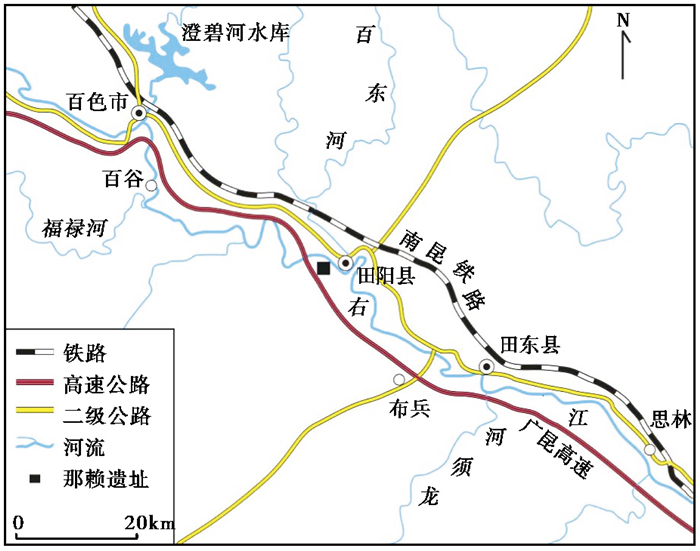
2 遗址地质背景及地层那赖旧石器遗址(23°43′40.1″N,106°52′01.9″E;海拔高度155.7m)位于田阳县城西侧约3km的那赖村,埋藏于百色盆地中部,右江右岸(南岸)第Ⅳ级阶地(图 1),是新近公布的“全国第七批重点文物保护单位”。遗址东西向长度约1000m,南北向宽度约为300m。为配合南宁至百色高速公路建设,2005年8~10月,广西柳州白莲洞洞穴科学博物馆、柳州市文物考古队、广西文物考古研究所和田阳县博物馆曾对那赖遗址进行过发掘,共出土遗物375件,包括2件手斧和2件玻璃陨石[19]。
|
图 1 那赖旧石器地理位置 Fig. 1 The location of the Nalai site |
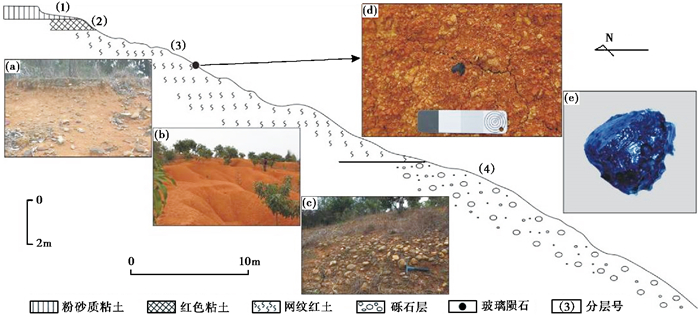
通过对那赖旧石器遗址的实地调查,发现该遗址的阶地堆积具典型的二元结构,自上而下可以分为4层(图 2):
|
图 2 那赖旧石器遗址地层剖面图 (a)地层顶部粉砂质粘土层和第二层红色粘土层(照片宽度代表2.85m);(b)网纹红土层(照片宽度代表17. 5m);(c)底部砾石层(锤子的长度为30cm);(d)网纹红土中发现的玻璃陨石(比例尺的长度为8cm);(e)在(d)中(网纹红土中)玻璃陨石的放大(玻璃陨石的宽度为1.23cm) Fig. 2 The stratigraphic profile of the Nalai site. (a)Silty clay layer at the top of the section and the second red clay layer(the width of the photograph is 2.85m); (b)Vermicular red soil layer(the width of the photograph is 17.5m); (c)The bottom gravel layer(the length of the hammer is 30cm); (d)Tektite found in the vermicular red soil layer(the scale bar is 8cm); (e)A larger version of the tektite in (d)(the width of the tektite is 1.23cm) |
(1) 浅褐色粉砂质粘土,有一定程度的胶结,较硬。本层厚度约为50cm。该层堆积中保存有大量的石制品,石制品个体较小,与下层网纹红土中保存的个体大的石制品差别很大。该层堆积在百色盆地右江第Ⅳ级阶地顶部广泛分布;
(2) 红色粘土,为网纹红土进一步风化形成。本层厚度约为50cm;
(3) 红色网纹红土,为百色盆地右江第Ⅳ级阶地的典型堆积物。该层劣地地形发育——地表沟壑密布,被切割得支离破碎,沟壑间分布着高度和形状不一致的丘地(图 2b)。在堆积物表面和冲沟中可见大量石制品,主要包括手斧、手镐等。距离剖面顶部(也是该遗址的顶部)约3m的位置发现一颗玻璃陨石。本层厚度约为6m;
(4) 砾石层。该层砾石磨圆好,分选较差。砾石没有定向排列,岩性以石英、石英岩和砂岩为主,3种类型所占比例接近。大于5cm的砾石约占整个砾石层的10 % ~30 % (体积百分比),少量砾石长度大于30cm。整个砾石层出露的厚度大于7.5m,未见底。
3 石制品分类及描述本次调查共采集石制品41件,主要有石锤、石核、石片和工具等,其中工具主要包括砍砸器、刮削器、手斧和手镐。石制品的岩性组成为石英岩(20件,49 %)、砂岩(15件,37 %)、火成岩(2件,5 %)、硅质岩(2件,5 %)、石英(1件,2 %)、角砾岩(1件,2 %)。下面对各类石制品进行分类描述。
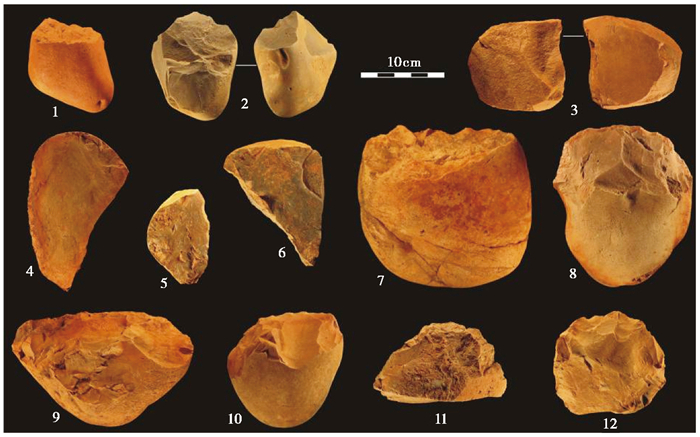
3.1 石锤本次调查采集到1件石锤(图 3-1)。长度为9.69cm,宽度为8.14cm,厚度为8.16cm,重量为2040g;很新鲜,没有磨蚀的痕迹,原料为黄褐色砂岩砾石;器身厚重,以一端为把手,另一端用以锤击。锤击面陡直,有较多细小的片疤在尾部折断形成阶梯状;锤击边缘有较多细小碎疤。锤击边缘钝厚。
|
图 3 那赖遗址地表采集的石锤、石核、石片、砍砸器和刮削器 1.石锤(那赖52);2~3.石核(2.那赖53,3.那赖56);4~6.石片(4.那赖51,5.那赖54,6.那赖55);7~10.砍砸器(7.那赖58,8.那赖03,9.那赖05,10.那赖02);11~12.刮削器(11.那赖07,12.那赖012) Fig. 3 Surface collected stone-hammer, cores, flakes, choppers and scrapers at the Nalai site. 1. Stone-hammer(Nalai 52); 2~3. Cores(2. Nalai 53, 3. Nalai 56); 4~6. Flakes(4. Nalai 51, 5. Nalai 54, 6. Nalai 55); 7~10. Choppers(7. Nalai 58, 8. Nalai 03, 9. Nalai 05, 10. Nalai 02); 11~12. Scrapers(11. Nalai 07, 12. Nalai 012) |
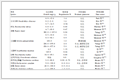
本次调查共采集5件石核(表 1)。岩性为砂岩的2件,石英岩的3件。表面都很新鲜,未受磨蚀。
|
表 1 那赖遗址地面采集的石核统计表 Table 1 Measurements of cores collected on surface at the Nalai site |
石核的长度在8.48~11.58cm之间,平均值12.13cm,标准偏差1.23,变异系数10.14;宽度在8.14~11.73cm之间,平均值9.70cm,标准偏差1.33,变异系数13.71;厚度在5.42~8.16cm之间,平均值6.95cm,标准偏差1.13,变异系数16.27;重量在1075~2040g之间,平均值1735.00g,标准偏差394.37,变异系数22.73。
那赖53(图 3-2):多台面石核。原料为青灰色细砂岩砾石。以砾石的上下两个面和一侧面为台面进行打片,其中上下两个台面为人工台面,侧面为自然台面;打击点清楚;打片次数多,石核利用率高;片疤大小不一。器身形状不规则。
那赖56(图 3-3):多台面石核。原料为褐色砂岩砾石。侧面有2个人工台面,之前应是人工台面预制后所用,打击点较清楚;打片次数多,石核利用率高;片疤有大有小,非常浅薄,长大于宽的片疤占多数。器身形状不规则。
那赖57:双台面石核。原料为灰褐色砂岩砾石。以砾石的一端和一侧为台面进行打片,其中一端为人工台面,侧面为自然台面;打击点不甚清楚;打片较少,片疤较大。器身形状不规则。
3.3 石片本次调查共采集3件石片(表 2)。岩性分别为石英岩(2件)和硅质岩(1件)。表面都很新鲜,未受磨蚀。
|
|
表 2 那赖遗址地面采集的石片统计表 Table 2 Measurements of flakes collected on surface at the Nalai site |
那赖51(图 3-4):石片。原料为石英岩,自然台面,打击点清楚,半锥体不显,放射线、同心波均清楚。石片背面左侧中下部为片疤,片疤较大,平浅,其余均为砾石面。石片右侧厚,左侧略薄,左侧边缘有较多使用时留下的细小碎疤。石片形状不规则。宽大,厚重。
那赖55(图 3-6):石片。原料为硅质岩,自然台面,打击点清楚,半锥体突出,放射线明显。石片背面仅在上端和下端保留少许砾石面,其余均为石片疤。刃缘较薄,石片形状不规则。无使用痕迹。
3.4 工具 3.4.1 砍砸器本次调查共采集7件砍砸器(表 3)。岩性为石英岩的3件,砂岩的1件,硅质岩的1件,火成岩的1件,石英的1件。全部由砾石加工而成。表面都很新鲜,未受磨蚀。
|
|
表 3 那赖遗址地面采集的砍砸器统计表 Table 3 Measurements of choppers collected on surface at the Nalai site |
砍砸器的长度在12.28~24.51mm之间,平均值15.88mm,标准偏差4.59,变异系数28.90;宽度在11.74~19.83mm之间,平均值14.75mm,标准偏差3.34,变异系数22.64;厚度在6.21~10.58mm之间,平均值7.19mm,标准偏差1.53,变异系数21.28;重量在1105~9560g之间,平均值2790g,标准偏差3038.89,变异系数108.89。
那赖05(图 3-9):砍砸器。由石英岩砾石加工而成。腹面较平,背面略凸。一端较宽,一端较窄。沿砾石较宽端由背面向腹面单面剥片,打出一弧刃,刃缘经过较多修整,加工面左侧均为小的片疤,片疤在尾部折断形成阶梯状;右侧加工面为一大的片疤。刃缘锋利,可见一些细小的崩疤,且多向两侧崩裂,应是使用痕迹。其余部分完全保留自然砾面,无人工痕迹。
那赖03(图 3-8):砍砸器。由石英岩砾石加工而成。腹面略凹,背面较平,一端较宽,另一端略窄。沿砾石较宽端由背面向腹面单面剥片,打出一弧刃。刃缘经过较多修整,加工面较平斜,片疤较大,平浅,部分片疤在尾部折断形成阶梯状。刃缘较锋利,有较多细小崩疤,且多向两侧崩裂,应是使用痕迹。把手保留自然砾面,较厚重。
那赖02(图 3-10):砍砸器。由石英岩砾石加工而成。背面较平,腹面略凸。沿砾石一侧由背面向腹面单面剥片,打出一道直刃。刃缘二次修整较好,刃缘加工面较陡,打击片疤多较小而浅平。刃缘较锋利,可见较多细小的崩疤,且多向两侧崩裂,应是使用痕迹。其余部分完全保留自然砾面,无人工痕迹。
那赖014:砍砸器。由砂岩砾石加工而成。腹面较平,背面略凸。在砾石一端由背面向腹面进行剥片,加工出一凸刃,加工面仅有4个片疤,片疤较大,平浅。刃缘较锋利,有较多细小崩疤,应是使用痕迹。该标本加工较简单,把手保留自然砾面,较厚重。
3.4.2 刮削器本次调查共采集2件刮削器(表 4)。岩性分别为火成岩和角砾岩。一件很新鲜,一件轻度磨蚀。
|
|
表 4 那赖遗址地面采集的刮削器统计表 Table 4 Measurements of scrapers collected on surface at the Nalai site |
那赖07(图 3-11):刮削器。由火成岩石片加工而成。背面为破裂面,较平整,腹面较凸。在石片一端和一侧由腹面向背面单向打片,加工出一直刃和弧刃,制作相对简单。部分片疤宽大而浅平,使用痕迹不明显。
那赖012(图 3-12):刮削器。由角砾岩石片加工而成。背面为破裂面,略平整,腹面凸起,均为砾石面。沿石片的两侧及远端由腹面向背面进行单向打击,三刃均为直刃,相交处均较圆钝;左侧及远端刃缘经精心修整,打击片疤较小;右侧刃缘平直,加工面片疤较平浅。刃缘使用痕迹不明显。
3.4.3 手斧本次调查共采集12件手斧(表 5)。其中用石片为毛坯加工的2件,用砾石加工的10件。岩性为砂岩的9件,石英岩的3件。其中表面新鲜未受磨蚀的10件,轻度磨蚀的1件,重度磨蚀的1件。
|
|
表 5 那赖遗址地面采集的手斧统计表 Table 5 Measurements of handaxes collected on surface at the Nalai site |
那赖00815:手斧。由砂岩大石片加工而成。腹面较凸,背面略平。腹面左侧刃缘内凹,呈锯齿状,加工面平浅;右侧交互打击形成一直刃,加工面平整,部分片疤在尾部折断形成阶梯状。背面左侧,加工面较平整,片疤平浅,刃缘与腹面左侧交互打击形成一直刃。尖部舌状,修整较好,背面留有修整尖部时的一平浅片疤。把手保留天然砾石面,较厚重。对称性好。
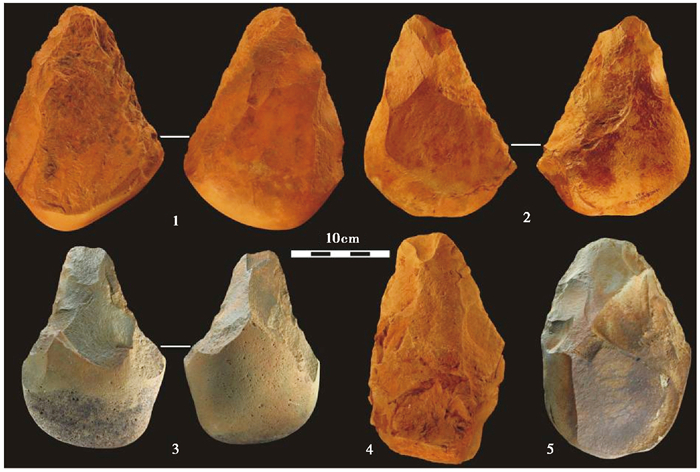
那赖00868(图 4-1):手斧。由石英岩砾石加工而成。背面较平,腹面略凸。腹面左侧刃缘加工至把手部分,交互打击,刃缘弧凸,修整较好,加工面片疤大小不一;右侧刃缘平直,加工面较平坦。腹面中部有一大堆片疤,是石器打制初期对腹面进行去薄。背面左侧加工仅在器身把手部,为3个片疤,从把手部一直到尖部,刃缘平直。左侧为2个较大的片疤,加工简单。尖部舌状,修整较好,背面端部有一片疤,明显是为去薄舌尖。把手部未经修整,较厚重,器身整体较对称。
|
图 4 那赖遗址地表采集的手斧和手稿 1~3.手斧(1.那赖00868,2.那赖00871,3.那赖00875);4~5.手稿(4.那赖00876,5.那赖00879) Fig. 4 Surface collected handaxes and picks at the Nalai site. 1~3. Handaxes(1. Nalai 00868, 2. Nalai 00871, 3. Nalai 00875); 4~5. Picks(4. Nalai 00876, 5. Nalai 00879) |
那赖00871(图 4-2):手斧。由砂岩砾石加工而成。背面较平,腹面略凸。腹面左侧仅在器身上部有一大的片疤;右侧加工至器身把手部,刃缘平直,加工面平整,仅有2个大的片疤,片疤平浅,右侧刃缘经过二次修整。左侧先对石器腹面进行去薄,片疤较大,基本占了整个腹面,继而进行二次修整。背面左侧刃缘平直,片疤大小不一,部分片疤在尾部折断形成阶梯状,右侧加工仅在器身上部,有2个较大的片疤。尖部舌状,较薄,修整较好,腹面尖部有一平浅的修整片疤,视为软锤技术。把手保留天然砾石面。器身较对称。
那赖00874:手斧。由砂岩砾石加工而成。背面较平,腹面略凸。腹面左侧刃缘加工至把手部分,交互打击,刃缘内凹,修整较好,加工面平浅;右侧加工至器身把部,刃缘平直,加工面较平坦,片疤大小不一。背面左侧加工仅在器身把手部,与腹面交互打击形成刃缘,刃缘平直;右侧加工仅在器身中部,刃缘较短,平直,片疤略深凹。尖部舌状,修整较好。把手处略有修整,器身整体较对称。
那赖00:手斧。由石英岩砾石加工而成。背面较平,腹面略凸。腹面左侧加工至器身中部,刃缘内凹,修整较好,加工面片疤仅有一个,较平浅;右侧加工仅在器身上部,交互打击形成一直刃。背面加工仅在器身左侧,加工面较平整,浅薄,仅有4个片疤。尖部舌状,略有修整。把手保留天然砾石面,较厚重。对称性好。
3.4.4 手镐本次调查共采集12件手镐(表 6)。全部由砾石加工而成。岩性为砂岩的3件,石英岩的9件。其中表面新鲜未受磨蚀的9件,轻度磨蚀的3件。
|
|
表 6 那赖遗址地面采集的手镐统计表 Table 6 Measurements of picks collected on surface at the Nalai site |
手镐的长度在14.88~21.41cm之间,平均值17.90cm,标准偏差2.21,变异系数12.35;宽度在10.27~15.38cm之间,平均值12.70cm,标准偏差1.61,变异系数12.68;厚度在5.21~10.87cm之间,平均值7.35cm,标准偏差1.50,变异系数20.42;重量在1220~2475g之间,平均值1665.83g,标准偏差391.02,变异系数23.47。
那赖00876(图 4-4):手镐。由石英岩砾石加工而成。两面均较凸,横截面近菱形。由两侧向前端加工成一尖,单向打击,两侧加工均至器身底部,左侧刃缘平齐,加工面片疤大小不一;右侧刃缘弧凸,片疤较大,平浅。两侧加工面在器身右侧相交形成一微凸的棱。尖部修整较好,略呈舌状。把手保留天然砾石面,较厚重。
那赖01:手镐。由石英岩砾石加工而成。腹面较平,背面凸起。由背面向腹面单向打击,沿两侧向前端加工出一尖。两侧均加工至器身末端,左侧刃缘内凹,加工面较平整,片疤较大,平浅;右侧刃缘弧凸,加工面略陡,片疤较小,部分片疤在尾部折断形成陡坎。两侧刃缘均经过修整,刃缘有较多细小的碎疤。尖部经过修整,留有一平浅的修整片疤,略呈舌尖。把手保留天然砾石面,较厚重。
那赖00879(图 4-5):手镐。由石英岩砾石加工而成。背面较凸,腹面较平。由背面向腹面单向打击,沿两侧向前端加工出一尖。两侧加工均至器身中部,左侧刃缘平直,修整较好,加工面片疤较大,较平浅;右侧刃缘略内凹,呈锯齿状,加工面片疤较小,部分片疤在尾部折断形成阶梯状。器身有一较大的片疤,基本贯穿整个腹面,为右侧打片,对器身进行去薄所致。尖部舌状,修整较好,有较多使用时留下的细小碎疤。把手略有加工。
那赖00869:手镐。由石英岩砾石加工而成。背面较凸,腹面略平。由背面向腹面单向打击,沿两侧向前端加工成一尖,两侧加工均至器身中部,左侧刃缘内凹,加工面片疤较大,平浅;右侧刃缘平齐,加工面片疤较小,部分片疤在尾部折断形成陡坎。两侧刃缘均经过细致修整,有较多细小的修整碎疤。两侧加工面在器身右侧相交形成一微凸的棱。尖部修整较好,略呈舌状。把手保留天然砾石面,较厚重。
那赖06:手镐。由石英岩砾石加工而成。背面较平,腹面凸起。由背面向腹面单向打击,沿两侧向前端加工出一尖。两侧加工近器身底部,左侧刃缘平直,刃缘略有修整,加工面片疤较大,部分片疤尾部略有折断;右侧刃缘弧凸,加工面较平缓,片疤较大。尖部舌状,修整较好,有较多细小碎疤。把手保留天然砾石面,较厚重。器物制作精美,较对称。
那赖08:手镐。由石英岩砾石加工而成。两面均较凸,由两侧向前端加工成一尖,单向打击,两侧加工均至器身底部,刃缘平齐,加工面陡直,两侧加工面在器身中部相交形成一较凸的棱。尖部未经修正,略呈舌状。把手保留天然砾石面。器物制作精美,较对称。
那赖00878:手镐。由石英岩砾石加工而成。由两侧向前端加工成一尖,两侧加工均在器身上部。右侧刃缘内凹,加工面较平,有一个较大的片疤;左侧刃缘内凹,略呈锯齿状,加工面不平整,片疤大小不一,尾部多有折断形成阶梯状。尖部经过修正,较薄,略呈舌状。把手厚重,保留天然砾石面。
4 讨论 4.1 原地埋藏的玻璃陨石近年来,通过对百色盆地大梅南半山遗址和枫树岛遗址的发掘,发现了与原地埋藏的玻璃陨石同处于一水平层位的手斧,从而证明玻璃陨石的年代可以用来标定手斧的年代[20, 21]。但是,一些研究者根据东南亚的玻璃陨石有被后期搬运的情况,推断百色盆地保存在右江第Ⅳ级阶地中的玻璃陨石同样也被后期搬运,而不是原地保存,所以玻璃陨石的年代不能代表与其同层保存的手斧的年代[4, 5]。我们对那赖旧石器遗址进行调查过程中,在右江第Ⅳ级阶地网纹红土地层中,同样发现了一件玻璃陨石(图 2d和2e)。玻璃陨石本身的特征及其与包含它的沉积物之间的关系表明,这件玻璃陨石是原地埋藏的,没有经过后期搬运。这件玻璃陨石的形态非常精美(图 2e):其表面保存了类似流动的形态和气泡,边缘还保存了精细的、棱角状的特征。如果这颗玻璃陨石经过流水作用搬运和磨蚀,这些特征不可能保存下来。保存这颗玻璃陨石的是百色盆地中典型的右江第Ⅳ级阶地网纹红土,一种网纹结构非常发育的砂质粘土,是古右江河漫滩相的细颗粒沉积物经过后期强烈风化形成。这种河漫滩相的细颗粒沉积物,在颗粒大小尺寸上,与玻璃陨石(1.37cm×1.23cm×0.99cm)差别很大,而且与玻璃陨石相同层位上,未见到任何有透镜体存在的证据,因此,这件玻璃陨石不可能与这些细颗粒沉积物一样为古右江搬运之后保存在洪泛平原上,而是从空中溅落之后被原地保存在地层中。玻璃陨石的年代可以用来代表与其同层的手斧的年代。因此,那赖遗址发现的玻璃陨石进一步证明,百色盆地右江第Ⅳ级阶地网纹红土中与手斧保存在一起的玻璃陨石,是原地保存的,没有经过后期流水作用搬运。并且,原地保存的玻璃陨石,普遍出现在百色盆地第Ⅳ级阶地网纹红土中[20, 21]。这些玻璃陨石的年代(40Ar-39Ar年龄803±3ka[3]),可以用来标定百色盆地手斧的年代。
4.2 那赖遗址手斧的形态和加工技术对比几何形态学分析是区分和比较不同时代、不同地区阿舍利石器工业的重要手段[7~12]。这里,我们详细地测量了那赖遗址手斧的长度、宽度、厚度,计算了加工精细程度(refinement ratio,厚度/宽度),并统计了手斧的片疤数量。在此基础上,与来自东亚的Imjin/Hantan盆地(IHRB)[9]、洛南盆地[14, 22]、丹江口库区[23]和百色盆地[2, 21]、西方旧大陆的欧洲[14, 22, 24]、中东[14]、南亚[14, 22]和非洲[14, 22, 24]的阿舍利工业手斧数据进行对比。
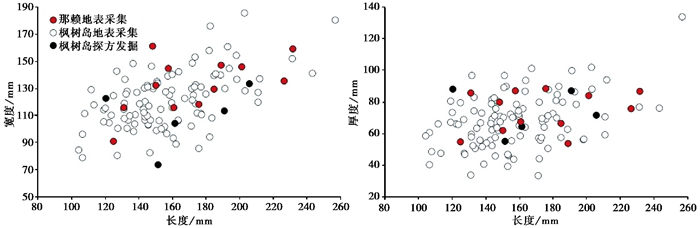
那赖遗址石器的类型组合,与百色盆地第Ⅳ级阶地其他遗址的相当[25~36]。并且,该遗址发现的12件手斧,在几何形态上与百色市右江区枫树岛遗址发现的手斧完全重叠(图 5),表明那赖遗址是百色盆地石器工业的组成部分。基于手斧的平均厚度和加工精细程度的差异,先前一些研究认为东亚的手斧与西方经典的阿舍利手斧之间存在明显的差别,东亚没有出现真正的阿舍利技术[9~11, 14]。但是,当我们将广西百色盆地那赖遗址和枫树岛遗址手斧的厚度数据[2, 21]与来自世界上更多遗址的阿舍利手斧的测量数据进行对比的时候不难发现:尽管平均值较大,那赖遗址手斧厚度值完全位于非洲的Kariandusi和Olduvai Bed Ⅱ、欧洲的High Lodge以及中东的Dawadmi 207-76地点的手斧厚度[14]的分布范围之内(表 7)。同样的,枫树岛遗址绝大多数手斧的厚度值[2, 21]也位于这些地点的手斧厚度的分布范围之内。由此可见,百色盆地的手斧在几何形态上与旧世界手斧之间的差异并没有先前研究认为的那么显著。并且,百色盆地手斧较高的厚度值很可能是由于这些手斧主要基于砾石加工,而不是像西方阿舍利手斧主要基于大石片加工导致的。相似的情况也出现在丹江口盆地第Ⅲ级阶地的手斧上,可能反映了当时人们对当地环境的适应[22, 23, 37, 38]。
|
图 5 那赖和枫树岛遗址手斧测量数据的对比 枫树岛遗址手斧测量数据来自文献[2, 21] Fig. 5 Dimension comparisons between the handaxes between the Nalai site and Fengshudao site. The handaxe metrical data of the Fengshudao site are from references[2, 21] |
|
|
表 7 那赖遗址手斧厚度数据(mm)对比表* Table 7 The comparison of handaxe thickness data(mm) from the Nalai site |
加工精细程度被认为是石器原料选择或者加工程度的一个重要指标[14, 39]。那赖遗址和枫树岛遗址手斧的加工精细程度数据与世界上其他阿舍利手斧测量数据的对比表明(表 8),那赖遗址手斧的加工精细程度平均值为0.57,与枫树岛遗址手斧的加工精细程度平均值0.585很接近[2, 21]。那赖遗址和枫树岛遗址手斧的加工精细程度值位于非洲和印度阿舍利手斧加工精细程度值的变化范围之类;同时,值得注意的是,这两个遗址手斧的加工精细程度值与亚洲东部韩国的Imjin/Hantan盆地、中国的洛南盆地和丹江口库区手斧的加工精细程度值差别较大,这个结果与先前的研究相一致[22, 23, 37, 38]。
|
|
表 8 那赖遗址手斧加工精细程度对比表(厚度/宽度)* Table 8 The comparison of handaxe refinement ratios from the Nalai site(thickness/width) |
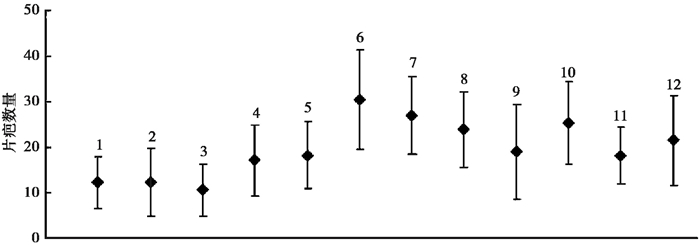
手斧的片疤数可以反映手斧被加工的程度[40]。来自埃塞俄比亚南部Konso组的证据表明,从早更新世早期到晚期,手斧的片疤数总体上随着年代减少而逐渐增加[41]。Hou等[3]发现百色盆地手斧的片疤数与Olorgesailie手斧的片疤数相当,首次证明百色手斧的加工技术与西方的并无差别。那赖遗址和枫树岛遗址手斧的片疤数与世界上其他遗址手斧的片疤数对比进一步表明(图 6),那赖遗址和枫树岛遗址手斧的片疤数整体上要比非洲早更新世的KGA6-A1 Locus C(约1.75Ma)、KGA 4-A2(约1.6Ma)、KGA 10-A11(约1.45Ma)和KGA7-A1,A2,A3(约1.4Ma)以及KGA12-A1(约1.25Ma)[41]的高,而与中更新世的Olorgesailie(0.4~0.7Ma)和Grotte des Ours(约0.4Ma)[24]的相当。
|
图 6 那赖遗址手斧片疤数量对比 1. KGA6-A1 Locus C(约1.75Ma);2. KGA 4-A2(约1.6Ma);3. KGA 10-A11(约1.45Ma);4. KGA 7-A1,A2,A3(约1.4Ma);5. KGA 12-A1(约1.25Ma);6. KGA 20-A1,A2(约0.85Ma);7.枫树岛遗址(约0.8Ma);8.那赖遗址(约0.8Ma);9. Ternifine(约0.7Ma);10. Olorgesailie (0.4~0.7Ma);11.丹江口库区Ⅲ级阶地(0.37~0.62Ma);12. Grotte des Ours(约0.4Ma)对比的数据为手斧片疤数量的平均值和标准偏差枫树岛遗址手斧片疤数据来自文献[2, 21],丹江口库区Ⅲ级阶地手斧片疤数据来自文献[23],其他遗址手斧片疤数据来自文献[24] Fig. 6 Comparison of flake scar counts of handaxes at the Nalai site with other Acheulean sites. 1. KGA 6-A1 Locus C(ca.1.75Ma); 2. KGA 4-A2(ca.1.6Ma); 3. KGA 10-A11(ca.1.45Ma); 4. KGA 7-A1, A2, A3(ca.1.4Ma); 5. KGA 12-A1(ca.1.25Ma); 6. KGA 20-A1, A2(ca.0.85Ma); 7. Fengshudao site(ca.0.8Ma); 8. Nalai site(ca.0.8Ma); 9. Ternifine(ca.0.7Ma); 10. Olorgesailie(0.4~0.7Ma); 11. Third terrace of the Danjiangkou Reservoir Region(0.37~0.62Ma); 12. Grotte des Ours(ca.0.4Ma). Data for comparison are the mean value and standard deviation of the flake scar counts of handaxes. The handaxe flake scar data of the Fengshudao site are from references[2, 21], third terrace of the Danjiangkou Reservoir Region are from reference[23], and the rest of the handaxe flake scar data are from reference[24] |
最新的证据表明,具有阿舍利技术的石器类型早在早更新世晚期(约0.9Ma)就已经出现在中国北方的三门峡盆地[42]。这个发现进一步扩展了南洛河流域阿舍利技术持续的时间[43~45]。通过几何形态学和加工技术对比证明,与百色盆地第Ⅳ级阶地的其他遗址一样,那赖遗址的手斧代表了早中更新世之交东亚的阿舍利技术。该遗址手斧几何形态学和加工技术的差异可能代表了阿舍利技术在不同地区的变化,反映了古人类对当地环境的适应,这与丹江口水库和洛南盆地的研究结果相一致[22, 23, 37, 38]。
5 结论本次调查在百色盆地中部那赖旧石器发现如此多的手斧,进一步丰富了百色盆地的阿舍利技术组合。在网纹红土中发现的玻璃陨石,明显表现出原地埋藏的特征。那赖旧石器遗址发现的旧石器和玻璃陨石,为确认玻璃陨石的形成时间可以用来代表百色盆地旧石器的年代提供了又一直接的证据。
那赖遗址的石制品主要以石锤、石核、石片和工具等为主,其中工具主要包括砍砸器、刮削器、手斧和手镐。那赖遗址的石器类型组合与百色盆地右江第Ⅳ级阶地的其他遗址相当,表明那赖遗址是百色盆地石器工业的组成部分。
那赖遗址发现的12件手斧的厚度值,完全位于非洲的Kariandusi和Olduvai Bed Ⅱ,欧洲的High Lodge,中东的Dawadmi 207-76地点的阿舍利手斧厚度的分布范围之内。同时,那赖遗址手斧加工精细程度的平均值,与枫树岛遗址手斧加工精细程度的平均值很接近,而且都位于非洲和印度阿舍利手斧加工精细程度值的变化范围之类。最后,那赖遗址手斧的片疤数整体上要比非洲早更新世阿舍利手斧的高,而与中更新世Olorgesailie(0.4~0.7Ma)和Grotte des Ours(约0.4Ma)遗址阿舍利手斧的相当。总之,通过与世界上其他阿舍利手斧对比表明,尽管存在一定的差异,那赖遗址的手斧在形态上和加工技术上与西方的手斧没有本质上的不同,可以代表早中更新世之交东亚的阿舍利技术面貌。
致谢: 衷心感谢三位匿名审稿专家和杨美芳编辑的审阅并提出宝贵修改意见!感谢中山大学陈琼老师帮助修改英文摘要!
| 1 |
李炎贤, 尤玉柱. 广西百色发现的旧石器. 古脊椎动物与古人类, 1975, 13(4): 225-228. Li Yanxian, You Yuzhu. Discovery of Palaeolithic artifacts in Bose, Guangxi. Vertebrata PalAsiatica,, 1975, 13(4): 225-228. |
| 2 |
王頠. 广西百色盆地枫树岛旧石器遗址. 北京: 科学出版社, 2014, 1-147. Wang Wei. The Fengshudao Site in Bose Basin, Guangxi, South China. Beijing: Science Press, 2014, 1-147. |
| 3 |
Hou Y M, Richard P, Yuan B Y, et al. Mid-Pleistocene Acheulean-like stone technology of the Bose Basin, South China. Science, 2000, 287(5458): 1622-1626. DOI:10.1126/science.287.5458.1622 |
| 4 |
Koeberl C, Glass B P, Keates S G. Tektites and the age paradox in Mid-Pleistocence China. Science, 2000, 289(5479): 507. DOI:10.1126/science.289.5479.507a |
| 5 |
Langbroek M. Do tektites really date the bifaces from the Bose(Baise)Basin, Guangxi, Southern China?. Journal of Human Evolution, 2015, 80(6): 175-178. |
| 6 |
郭士伦, 郝秀红, 陈宝流, 等. 用裂变径迹法测定广西百色旧石器遗址的年代. 人类学学报, 1996, 15(4): 347-350. Guo Shilun, Hao Xiuhong, Chen Baoliu, et al. Fission track dating of Paleolithic site at Bose in Guangxi, South China. Acta Anthropologica Sinica, 1996, 15(4): 347-350. |
| 7 |
黄慰文, 冷健, 员晓枫, 等. 对百色石器层位和时代的新认识. 人类学学报, 1990, 9(2): 105-112. Huang Weiwen, Leng Jian, Yuan Xiaofeng, et al. Advanced opinions on the stratigraphy and chronology of Baise Stone Industry. Acta Anthropologica Sinica, 1990, 9(2): 105-112. |
| 8 |
高星. 中国旧石器时代手斧的特点与意义. 人类学学报, 2012, 31(2): 97-112. Gao Xing. Characteristics and significance of Paleolithic handaxes from China. Acta Anthropologica Sinica, 2012, 31(2): 97-112. |
| 9 |
Norton C J, Bae K, Harris J W K, et al. Middle Pleistocene handaxes from the Korean Peninsula. Journal of Human Evolution, 2006, 51(5): 527-536. DOI:10.1016/j.jhevol.2006.07.004 |
| 10 |
Norton C J, Bae K. The Movius Line sensu lato(Norton et al., 2006) further assessed and defined.. Journal of Human Evolution, 2006, 55(6): 1148-1150. |
| 11 |
Lycett S J, Bae C J. The Movius Line controversy:The state of the debate. World Archaeology, 2010, 42(4): 521-544. DOI:10.1080/00438243.2010.517667 |
| 12 |
Lycett S J, Norton C J. A demographic model for Palaeolithic technological evolution:The case of East Asia and the Movius Line. Quaternary International, 2010, 211(1-2): 55-65. DOI:10.1016/j.quaint.2008.12.001 |
| 13 |
Zhang P, Huang W W, Wang W. Acheulean handaxes from Fengshudao, Bose sites of South China. Quaternary International, 2010, 223-224(5): 440-443. |
| 14 |
Petraglia M D, Shipton C. Large cutting tool variation West and East of the Movius Line. Journal of Human Evolution, 2008, 55(6): 962-966. DOI:10.1016/j.jhevol.2007.11.007 |
| 15 |
Shipton C, Petraglia M D. Inter-continental variation in Acheulean bifaces. In:Norton C J, Braun D R eds. Asian Paleoanthropology:From Africa to China and Beyond. Dordrecht:Springer Netherlands, 2010. 49~55 https://link.springer.com/chapter/10.1007/978-90-481-2719-1_8/fulltext.html
|
| 16 |
林圣龙. 对九件手斧标本的再研究和关于莫维斯理论之拙见. 人类学学报, 1994, 13(3): 189-208. Lin Shenglong. Restudy of nine hand-axe specimens and the applicability of Movius' theory. Acta Anthropologica Sinica, 1994, 13(3): 189-208. |
| 17 |
林圣龙. 中西方旧石器文化中的技术模式的比较. 人类学学报, 1996, 15(1): 1-20. Lin Shenglong. Discovery of Palaeolithic artifacts in Bose, Guangxi. Acta Anthropologica Sinica, 1996, 15(1): 1-20. |
| 18 |
林圣龙. 关于百色的手斧. 人类学学报, 1995, 14(2): 118-131. Lin Shenglong. Comparison of technological mode of Paleolithic culture between China and the West. Acta Anthropologica Sinica, 1995, 14(2): 118-131. |
| 19 |
柳州白莲洞博物馆, 柳州市文物考古队, 广西文物考古研究所等. 田阳那赖遗址B区发掘报告. 见: 广西文物考古研究所编. 广西考古文集(第四辑). 北京: 科学出版社, 2010. 175~212 Bailian Cave Museum of Liuzhou, Archaeological Team of Liuzhou, Guangxi Institute of Cultural Relics and Archaeology et al. A report on the excavation of B area of the Nalai Site. In:Guangxi Institute of Cultural Relics and Archaeology ed. Collected Works of Guangxi Archaeology(Volume Four). Beijing:Science Press, 2010. 175~212 |
| 20 |
Wang Wei, Mo Jinyou, Huang Zhitao. Recent discovery of handaxes associated with tektites in the Nanbanshan locality of the Damei site, Bose Basin, Guangxi, South China. Chinese Science Bulletin, 2006, 51(18): 2161-2165. |
| 21 |
Wang W, Bae C J, Huang S M, et al. Middle Pleistocene bifaces from Fengshudao(Bose Basin, Guangxi, China). Journal of Human Evolution, 2014, 69(1): 110-122. |
| 22 |
Kuman K, Li H, Li C R. Large cutting tools from the Danjiangkou Reservoir Region, Central China:Comparisons and contrasts with Western and South Asian Acheulean. Quaternary International, 2016, 400: 58-64. DOI:10.1016/j.quaint.2015.07.052 |
| 23 |
Li H, Li C R, Kuman K. Rethinking the "Acheulean" in East Asia:Evidence from recent investigations in the Danjiangkou Reservoir Region, Central China. Quaternary International, 2014, 347(1): 163-175. |
| 24 |
Li H, Li C R, Kuman K, et al. The Middle Pleistocene handaxe site of Shuangshu in the Danjiangkou Reservoir Region, Central China. Journal of Archaeological Science, 2014, 52: 391-409. DOI:10.1016/j.jas.2014.08.033 |
| 25 |
广西自然博物馆, 广西文物考古研究所. 百色南半山旧石器时代遗址发掘报告. 见: 广西文物考古研究所编. 广西考古文集(第四辑). 北京: 科学出版社, 2010. 63~82 Natural History Museum of Guangxi Zhuang Autonomous Region, Guangxi Institute of Cultural Relics and Archaeology. A report on the excavation of the Nanbanshan Paleolithic site in the Bose Basin. In:Guangxi Institute of Cultural Relics and Archaeology ed. Collected Works of Guangxi Archaeology(Volume Four). Beijing:Science Press, 2010. 63~82 |
| 26 |
侯亚梅, 高立红, 黄慰文, 等. 百色高岭坡旧石器遗址1993年发掘简报. 人类学学报, 2011, 30(1): 1-12. Hou Yamei, Gao Lihong, Huang Weiwen, et al. A report on the 1993 excavation of the Gaolingpo Paleolithic site in the Bose Basin. Acta Anthropologica Sinica, 2011, 30(1): 1-12. |
| 27 |
柳州市博物馆, 广西文物考古研究所, 田东县博物馆. 田东坡洪遗址A区发掘简报. 见: 广西文物考古研究所编. 广西考古文集(第四辑). 北京: 科学出版社, 2010. 36~62 Museum of Liuzhou, Guangxi Institute of Cultural Relics and Archaeology, Tiandong County Museum. A report on the excavation of A area of the Pohong site in Tiandong County. In:Guangxi Institute of Cultural Relics and Archaeology ed. Collected Works of Guangxi Archaeology(Volume Four). Beijing:Science Press, 2010. 36~62 |
| 28 |
谢光茂, 林强. 百色上宋遗址发掘简报. 人类学学报, 2008, 27(1): 13-22. Xie Guangmao, Lin Qiang. A preliminary report on the excavation of the Shangsong site. Acta Anthropologica Sinica, 2008, 27(1): 13-22. |
| 29 |
右江民族博物馆, 百色市文物管理所, 广西文物考古研究所. 百色六合遗址发掘简报. 见: 广西文物考古研究所编. 广西考古文集(第四辑). 北京: 科学出版社, 2010. 20~35 Youjiang Museum for Nationalities, Cultural Relics Management Department of Bose City, Guangxi Institute of Cultural Relics and Archaeology. A preliminary report on the excavation of the Liuhe site in the Bose Basin. In:Guangxi Institute of Cultural Relics and Archaeology ed. Collected Works of Guangxi Archaeology(Volume Four). Beijing:Science Press, 2010. 20~35 http://kns.cnki.net/KCMS/detail/detail.aspx?filename=rlxb201202004&dbname=CJFD&dbcode=CJFQ |
| 30 |
林强. 广西百色田东坡西岭旧石器时代遗址发掘简报. 人类学学报, 2002, 21(1): 59-64. Lin Qiang. A preliminary report on excavations at the Poxiling Paleolithic site in Tiandong County, Guangxi. Acta Anthropologica Sinica, 2002, 21(1): 59-64. |
| 31 |
高立红, 袁俊杰, 侯亚梅. 百色盆地高岭坡遗址的石制品. 人类学学报, 2014, 33(2): 13-22. Gao Lihong, Yuan Junjie, Hou Yamei. Paleolithic artifacts from the Gaolingpo site in the Bose Basin. Acta Anthropologica Sinica, 2014, 33(2): 13-22. |
| 32 |
裴树文, 陈福友, 张乐, 等. 百色六怀山旧石器遗址发掘简报. 人类学学报, 2007, 26(1): 1-15. Pei Shuwen, Chen Fuyou, Zhang Le, et al. Preliminary report on the excavation of the Liuhuaishan Paleolithic site at Baise, South China. Acta Anthropologica Sinica, 2007, 26(1): 1-15. |
| 33 |
谢光茂, 林强, 黄鑫. 百色田东百渡旧石器遗址发掘简报. 人类学学报, 2010, 29(4): 355-371. Xie Guangmao, Lin Qiang, Huang Xin. A preliminary report on the excavation of the Baidu site in the Bose Basin, South China. Acta Anthropologica Sinica, 2010, 29(4): 355-371. |
| 34 |
黄胜敏, 刘扬, 郭耀峥, 等. 广西百色百峰遗址发现的石制品. 人类学学报, 2011, 30(3): 307-312. Huang Shengmin, Liu Yang, Guo Yaozheng, et al. Palaeolithic artifacts from the Baifeng site at Baise, South China. Acta Anthropologica Sinica, 2011, 30(3): 307-312. |
| 35 |
李大伟, 黄中政, 罗志柏, 等. 田阳百峰遗址发现的含手斧石制品研究. 人类学学报, 2015, 34(3): 288-295. Li Dawei, Huang Zhongzheng, Luo Zhibo, et al. Early Mid-Pleistocene stone artifacts including handaxes discovered at the Baifeng site in Tianyang County, Bose Basin, Guangxi, South China. Acta Anthropologica Sinica, 2015, 34(3): 288-295. |
| 36 |
何乃汉, 邱中郎. 百色旧石器的研究. 人类学学报, 1987, 6(4): 289-297. He Naihan, Qiu Zhonglang. A study of stone tools from Baise, Guangxi. Acta Anthropologica Sinica,, 1987, 6(4): 289-297. |
| 37 |
Li H, Kuman K, Li C R. Re-examination of the morphological variability of East Asian handaxes from a comparative perspective. World Archaeology, 2014, 46(5): 705-733. DOI:10.1080/00438243.2014.953707 |
| 38 |
Li H, Kuman K, Li C R. What is currently (un)known about the Chinese Acheulean, with implications for hypotheses on the earlier dispersal of hominids. Comptes Rendus Palevol, 2016. DOI:10.1016/j.crpv.2015.09.008 |
| 39 |
Noll M P, Petraglia M D. Acheulean bifaces and early human behavioral patterns in East Africa and South India. In:Soressi M, Dibble H L eds. Multiple Approaches to the Study of Bifacial Technologies. Philadelphia:University of Pennsylvania Museum of Archaeology and Anthropology, 2003. 31~54 http://www.sciencedirect.com/science/article/pii/S0305440308001076
|
| 40 |
Sharon G. Acheulian large flake industries:Technology, chronology, and significance. In:Sharon G ed. British Archaeological Reports International Series 1701. Oxford:Archaeopress, 2007. 130~133 https://www.amazon.com/Acheulian-Large-Flake-Industries-International/dp/1407301438
|
| 41 |
Beyene Y, Katoh S, WoldeGabriel G, et al. The characteristics and chronology of the earliest Acheulean at Konso, Ethiopia. Proceedings of the National Academy of Sciences of the United States of America, 2013, 110(5): 1584-1591. DOI:10.1073/pnas.1221285110 |
| 42 |
Li X W, Ao H, Dekkers M J, et al. Early Pleistocene occurrence of Acheulian technology in North China. Quaternary Science Reviews, 2017, 156: 12-22. DOI:10.1016/j.quascirev.2016.11.025 |
| 43 |
鹿化煜, 张红艳, 王社江, 等. 东秦岭南洛河上游黄土地层年代的初步研究及其在旧石器考古中的意义. 第四纪研究, 2007, 27(4): 559-567. Lu Huayu, Zhang Hongyan, Wang Shejiang, et al. A preliminary survey on loess deposit in eastern Qinling Mountains(Central China)and its implication for estimating age of the Pleistocene lithic artifacts. Quaternary Sciences, 2007, 27(4): 559-567. |
| 44 |
王社江, 鹿化煜, 张红艳, 等. 东秦岭南洛河中游地区发现的旧石器和黄土堆积. 第四纪研究, 2008, 28(6): 988-999. Wang Shejiang, Lu Huayu, Zhang Hongyan, et al. A preliminary survey of Palaeolithic artifacts and loess deposit in the middle South Luohe River, eastern Qinling Mountains, Central China. Quaternary Sciences, 2008, 28(6): 988-999. |
| 45 |
鹿化煜, 张红艳, 孙雪峰, 等. 中国中部南洛河流域地貌、黄土堆积与更新世古人类生存环境. 第四纪研究, 2012, 32(2): 167-177. Lu Huayu, Zhang Hongyan, Sun Xuefeng, et al. Landform, loss deposit and paleoenvironmental changes in the south Luohe River(Central China)during the hominin occupations. Quaternary Sciences, 2012, 32(2): 167-177. |
② Anthropology Museum of Guangxi, Nanning 530028;
③ Tiandong County Museum, Tiandong 531500;
④ Tianyang County Museum, Tianyang 533600)
Abstract
The Nalai Paleolithic site(23°43'40.1"N, 106°52'01.9"E; 155.7m a.s.l.), situated at the Nalai Village in Tianyang County, Guangxi Zhuang Autonomous Region, is one of the most representative sites in the central Bose Basin. This site is located at the forth fluvial terrace of the Youjiang River, with 1000m in length from west to east, 300m in width from north to south. Its deposits are well preserved, with an outcrop of thick layered laterite and gravel bed, 6m and > 7. 5m in thickness, respectively. Further fieldworks have been carried out by Tianyang Couty Museum since 2008. 41 stone artifacts(including 12 handaxes)and one tektite were found in vermicular red soil layer of the forth fluvial terrace. Here, we report our observation and preliminary study on the in situ embedding of the tektite and the connection between this Paleolithic assemblage and Acheulean-equivalent technologies. The tektite in Nalai site displays delicate features with flow-like features, bubbles and delicate-sharp edges in the surface. The unabraded and sharp-edged surface of the tektite in Nalai site which is very similar to that of previously well-documented tektites from Damei and Fengshudao sites in the west Bose Basin indicate that it was embedded in situ without transportation or post-deposition. Based on well-established contexts of previously excavated sites at T4 in the Bose Basin, we infer that the lithic assemblage of Nalai are of similar age with the co-present tektites, which were dated to ca.0. 8Ma, roughly ranging from late Early Pleistocene to early Middle Pleistocene. The stone artifacts from the Nalai site mainly include heavy duty tools, such as handaxes, picks and choppers. Also, some light duty tools, such as scrapers, were found. The lithic raw materials of these stone artifacts are quartzite(49%), sandstone(37%), igneous rock(5%), silicalite(5%), quartz(2%)and breccia(2%). This Paleolithic assemblage is similar to those previously reported in other sites in the Bose Basin. Multiple morphological and technological parameters of the Nalai handaxes including weight, length, width, thickness, refinement ratio(thickness/width)and flake scar counts were summarized to differentiate the morphological and technological features between the Nalai handaxes and Acheulean assemblages from the Old Word(East and West Asia, Africa, Europe). The geometrical morphology of the Nalai handaxes are identical with that of the Fengshudao handaxes in west Bose Basin, suggesting that Nalai Paleolithic site was the component of the stone artifacts industry in Bose Basin. The thickness of the Nalai handaxes(74. 31mm in average)is within the variation range of Acheulean assemblages from the Europe(High Lodge), the Middle East(Dawadmi 207-76) and the Africa(Kariandusi and Olduvai Bed Ⅱ). The average refinement ratio of the Nalai handaxes(0. 57) is very close to that of the Fengshudao handaxes(0. 585), but slightly different from that of other East Asia handaxes, such as the Imjin/Hantan basin(0. 65) in Korea, Luonan basin(0. 61) and the Danjiangkou Reservoir Region(0. 51) in China. Notably, the refinement ratios of the Nalai handaxes are close to the Acheulean assemblages of Africa(Olduvai EF HR, Bed Ⅱ, Konso KGA 7-A1, A2, A3, Olorgesailie, M1, I3, Grotte des Ours, Amanzi Springs, Doornlaagte)and South Asia(Hunsgi Ⅴ, Mudnur Ⅷ). The Nalai handaxes have higher flake scar counts than the KGA 6-A1 Locus C(ca.1. 75Ma), KGA 4-A2(ca.1. 6Ma), KGA 10-A11(ca.1. 45Ma), KGA 7-A1, A2, A3(ca.1. 4Ma), KGA 12-A1(ca.1. 25Ma), indicating a more reduction level than that of the Early Pleistocene Acheulean handaxes in Africa. However, it is close to that of the Middle Pleistocene western Acheulean assemblage, such as Olorgesailie (0.4~0.7Ma) and Grotte des Ours(ca.0.4Ma). Based on above comparisons, the morphological and technological parameters of Nalai handaxes are completely within the variation ranges of the Acheulean Industrial Complex in the Old Word. There is no essential difference between the Bose toolmakers and known Acheulean communities, implying that Homo erectus in West and East had similar technology and behavioral competence, at least during the Early and Middle Pleistocene transition.