 2017, Vol.37


② 福建师范大学地理科学学院, 湿润亚热带山地生态国家重点实验室培育基地, 福州 350007)
西风环流是北大西洋气候区和东亚季风气候区之间的联系纽带[1],西风环流的位置和强度随着冰期-间冰期的旋回发生的剧烈变化,对东亚季风气候乃至全球气候都有着极其深刻的影响[2~7]。因此,研究西风环流是深入研究东亚季风和高低纬气候遥相关的重要补充和延续,也是全球气候变化机制研究的一项重要内容。伊犁盆地地处中亚内陆地区,常年深受西风环流影响,盆地河流阶地和山麓广泛分布的黄土是研究西风演变和区域古气候变迁的良好素材,因此近年来备受许多学者的青睐,并通过粒度、矿物学、地球化学以及岩石磁学等方法对伊犁黄土的物源、分布和年代等展开大量的工作,取得了丰硕的成果[8~29]。但是,由于粒度、磁化率等常用环境代用指标在新疆黄土中的指示意义还未得到一致的认识[15~24],因而依托伊犁黄土的环境演变重建还较为薄弱,亟待加强,这对西风环流研究也有深刻的意义。稀土元素(REE)由于其特殊的化学性质及其表生地球化学过程中比较稳定的特征,其特征参数,例如稀土的配分模式、δEu等,经常被用作物源示踪指标[30~42];同时,稀土矿物在物理和化学风化过程中的分解和溶解会影响稀土元素的分馏,因此稀土元素也可以较好地记录环境演变信息[43~49]。利用稀土元素重建环境在黄土、河流沉积及湖泊沉积中已经得到广泛应用[44~49],但是在中亚地区的应用还较少。因此,本文以伊犁盆地昭苏波马黄土-古土壤剖面为研究对象,对其开展系统的稀土元素地球化学研究,探讨末次冰期以来西风环流影响下的伊犁河谷的气候演变。
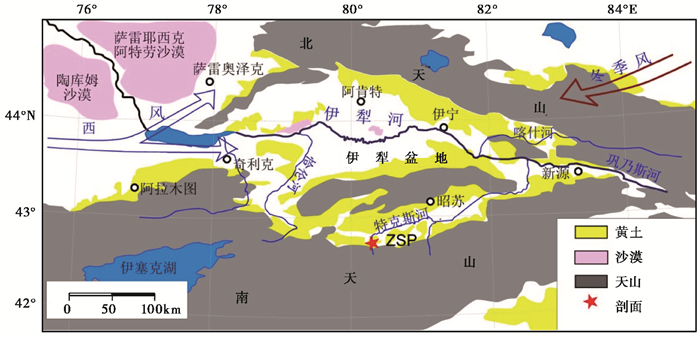
2 研究区与研究方法伊犁盆地位于我国新疆西部,是天山西段一个呈向西开口喇叭形的断陷盆地(图 1),西部毗邻中亚荒漠区。受西风环流和特殊地形的影响,来自北冰洋及地中海的水汽可以到达盆地形成降水,盆地年均温26~104 ℃,年降雨量约257~512 mm[9, 10, 29, 50]。盆地地带性土壤为灰钙土、黑钙土和栗钙土,植被自西向东随着海拔和水热条件的变化从荒漠草原、山地草原、山地森林草甸,向亚高山草甸、高山草甸更替。黄土主要分布在河流阶地,天山迎风坡,沉积厚度从几米到上百米不等,大部分为末次冰期以来的沉积[9~11]。
|
图 1 伊犁盆地地形图及采样点位置(修改自文献[11]) Fig. 1 Sampling site and the geographical environment of the Ili Basin, modified from reference[11] |
昭苏波马剖面(ZSP:80.25°E,42.69°N;海拔1875m),位于伊犁盆地南部特克斯河二级阶地上(图 1),厚685cm。根据野外地层特征,结合室内实验分析,可将ZSP剖面分为S0、L1L1、L1S1、L1L2和S1共5层,其中0~90cm (S0)为灰褐色灰钙土,疏松多孔,有植物根系;90~210cm (L1L1)为浅黄色黄土,具有较多直径约为0.1~0.5cm的钙结核;210~510cm (L1S1)为浅褐色弱发育古土壤,具较多的虫孔和团粒结构;510~640cm (L1L2)为浅黄色黄土,质地均匀;640~685cm (S1)为褐红色古土壤,含有蜗牛化石[29]。剖面的底部为河流砾石层,与黄土层呈不整合接触[11, 29]。光释光(OSL)和14C测年结果以及年代深度回归方程线性外推可知该剖面主要发育于末次冰期,底部年龄为80ka B.P.,同时选择2~10μm粒径应用粒度年代模型建立剖面的地层年代框架[11, 16, 29]。本次研究以5cm为间隔进行采样,共采集样品138个。
3 实验方法样品自然风干后,用玛瑙研钵研磨至200目,准确称取研磨样品0.0400g置于聚四氟乙烯罐中,加入电子级HNO3、HF、HClO4混合酸消解,使用美国ThermoFisher,X Series 2,ICP-MS测试,采用国家标准物质黄土(GBW07309)和新疆灰钙土(GBW07450)进行质量控制,标样测试值均在标准值范围内,测试过程中选用5μg/L的铟(In)和铹(Re)作为在线双内标元素同步测定,回收率为95 %~105 %,重复测试变异系数RSD < 5 %。所有实验在福建师范大学湿润亚热带山地生态国家重点实验室培育基地完成。
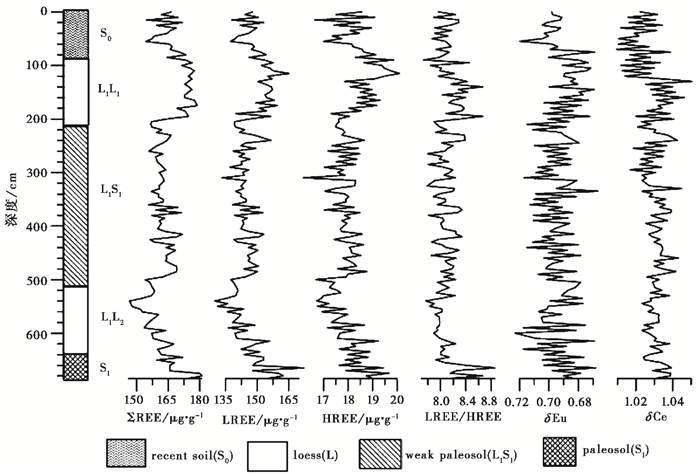
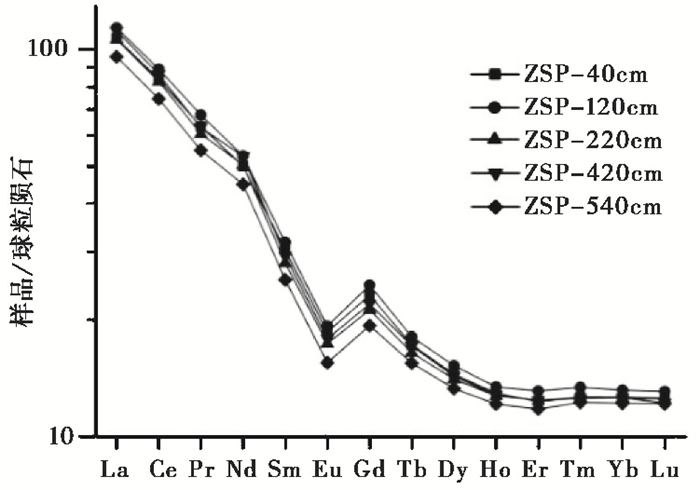
4 结果与讨论 4.1 稀土元素含量与分配模式实验结果表明(图 2),昭苏波马黄土剖面样品的稀土元素含量变化较大,稀土元素总量ΣREE (不包含Y)的变化范围为147~181μg/g,均值为164μg/g,略低于黄土高原黄土平均含量171μg/g[36],高于临近的塔克尔莫乎尔沙漠风沙沉积中的平均含量131μg/g[49]。其中,S0阶段的ΣREE变化范围为154~174μg/g,均值为165μg/g;L1L1的稀土总量急剧升高,变化范围为157~179μg/g,均值升高到173μg/g;到了L1S1又开始下降,变化范围降为154~172μg/g,均值为162μg/g;L1L2阶段ΣREE进一步下降(变化于147~168μg/g之间),均值降至全剖面最低(157μg/g);而后在接下来的S1阶段其含量又有了较大的回升,变化于160~181μg/g之间,均值上升到170μg/g。剖面各个沉积层样品球粒陨石标准化的稀土分配模式相似,呈现出缓右倾斜型的特征(图 3),轻稀土元素(LREE)富集,均值为147μg/g,重稀土元素(HREE)丰度低,均值仅为18.1μg/g。LREE/HREE值变化于7.73~8.86之间,均值为8.10,也表现出了明显的轻稀土富集特征,同时,LREE/HREE值在整个剖面中变化较小,偏差仅0.32。Eu明显亏损,δEu值(0.67~0.72)显著小于0.95,为中度负异常,Ce元素无显著异常,δCe介于1.01~1.05之间(图 2和3)。
|
图 2 ZSP剖面稀土元素及其特征值变化 Fig. 2 Changes of REE and its characteristics values in ZSP section |
|
图 3 ZSP剖面代表样品稀土分配模式 Fig. 3 REE distribution patterns of ZSP samples |
在REE各特征参数中,δCe值表示Ce异常的程度,δCe>1.05为正异常, < 0.95为负异常[40]。研究表明,Ce在氧化条件下可呈四价状态,与其他稀土元素发生分离,因而δCe可用于反映成土过程的氧化还原环境[51~54]。但是昭苏波马剖面的δCe值介于1.01~1.05之间,未见明显的异常,代表着ZSP剖面在沉积过程中整体风化成壤条件较差,并未发生明显的氧化还原作用。
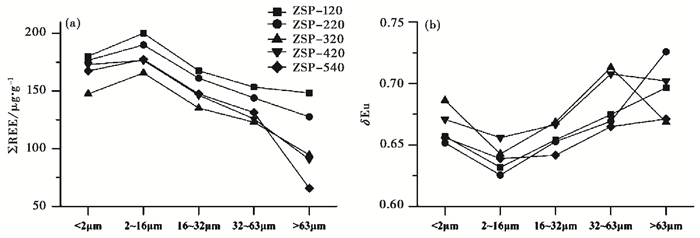
通常情况下,δEu值主要由物源区原岩类型决定,不同的原岩类型由于不同的成岩过程,δEu表现出不同的异常状况[40, 41]。Eu在自然界中不容易发生变价,但在强还原条件下,Eu3+也会被还原成Eu2+,从而与Sr2+一起淋溶损失,因而土壤中Eu的负异常值大小也可以反映土壤还原条件和淋溶程度的强弱[53]。但是这样的环境在地表过程中较少存在,特别是新疆地区,环境背景总体干旱,上述Ce异常的缺失也向我们表达了该区的气候环境不利于表生风化作用,而矿物研究也表明该区的重矿物以角闪石为主,伊犁黄土原始物质在堆积前未遇到强烈的风化,伊犁黄土形成于较干冷气候环境条件下[9, 29]。因而δEu值应仍然主要反映西风环流携带过来的原始粉尘的信息。一般而言,稀土元素总量(ΣREE)和分配模式的差异常被作为重要的示踪指标应用于各类沉积物的物源研究中[30~42]。近年来的许多研究成果也表明,在相同参考标准下,同一类沉积物稀土元素含量、组分变化及特征参数的差异也可以反映沉积环境的差异,元素富集与亏损的现象可以指示化学作用的强弱、干湿气候变化和降水量的变化[43~49]。由于粘土的吸附作用,一般而言稀土元素含量与粘粒含量具有较好的相关关系,但是由于伊犁地区粘粒含量可能主要代表了高空气流的强度变化[23, 29],因而该区稀土元素含量与粘粒含量的关系以及其对环境的指示意义还需要进一步的讨论。为了明确REE总量在伊犁地区黄土中所代表的指示意义,本文选取了昭苏波马剖面典型层位的代表样品(位于120cm、220cm、320cm、420cm和540cm处的样品),以63μm、32μm、16μm和2μm为界,进行分粒级分析。分析结果发现(图 4a),REE含量总体而言在细颗粒粒级中较高,随着粒度增大,特别是32μm之后,含量逐渐下降;而在细颗粒中,含量最高的粒级并非 < 2μm的粘粒粒组,而是2~16μm细粉砂粒组。
|
图 4 ZSP剖面不同粒级组分ΣREE、δEu分布特征 Fig. 4 Distribution of ΣREE and δEu in different grain size fractions in ZSP section |
伊犁黄土的研究表明,昭苏地区黄土主要是由区域的近源物质与西风携带的远源粉尘叠加而成,并且细颗粒物质并非主要由成壤作用所致,而是主要代表了高空西风环流的影响[9, 23, 29],因而伊犁黄土中的REE含量可能更多的受控于西风环流的远源输送。但是研究还发现,剖面中的ΣREE与细颗粒含量( < 2μm)仅存在较为微弱的相关关系,与粗颗粒含量(>32μm)变化不存在明显的相关关系(图 5),但与代表物源特征的Hf、Zr元素具有较为一致的变化特征(Pearson相关性:R2=0.436,P < 0.01;R2=0.463,P < 0.01),同时与Zr/Rb也呈现出良好的相关关系(R2=0.471,P < 0.01)。刘连文等[55]和Chen等[56]提出,Zr/Rb值在黄土-古土壤中的含量变化主要受控于风力分选,在一定程度上可以反映风力搬运的强度;但汪海斌等[57]也指出搬运过程虽然是控制Zr/Rb值的重要因素,但源区因素以及沉积后的风化作用也调节着Zr/Rb的值,特别是当CIA>65之后,Rb和Zr的淋失趋于显著[57, 58]。前面已提及,由于新疆地区环境背景总体干旱,不利于表生化学作用,CIA值变动于52~62之间[29],因而昭苏波马剖面Zr/Rb值受到化学风化的影响较弱。但在不同气候历史时期,由于北半球高纬度太阳辐射的变化,北极冰盖的扩大与退缩致使高空西风带的强弱与位置发生较大的改变[25, 59~62],这是否可能使得源区范围发生变化,导致昭苏波马剖面含Zr矿物发生较大的改变,从而影响Zr/Rb比值呢?对此,我们通过Zr/Hf值进行讨论。Zr和Hf属于高场强元素,它们的离子半径很小并且非常接近,价态较高(+4)且拥有中等程度的电负值,因此Zr和Hf具有非常相似的地球化学行为[63, 64],不同含Zr、Hf矿物的Zr/Hf值分布范围有着显著的差异[65]。但是从图 5可以看出,昭苏波马剖面的Zr/Hf值较为稳定(变化范围为35.9~40.1,平均值为37.7),不同时期西风带强度和位置的变化并未引起含Zr矿物的较大改变。因此,综上而看,昭苏波马剖面的Zr/Rb值主要还是反映了西风环流的风力搬运强度。而ΣREE与Zr、Hf元素以及Zr/Rb值等良好的相关关系可能暗示着REE含量的变化主要记录了西风环流强度和路径的改变而引起的水汽与物质的变化。因此,尽管昭苏波马剖面弱的成壤作用使得用稀土元素特征直接反映该地区的气候变化变得困难,但是ΣREE在剖面中的变化仍然良好地记录西风环流的变化状况以及这种变化所反映的气候环境演变。

|
图 5 ZSP剖面ΣREE、δEu、粒度参数、Zr/Rb、Zr、Hf和Zr/Hf变化 Fig. 5 Change of ΣREE, δEu, grain-size, Zr/Rb, Zr, Hf and Zr/Hf in ZSP section |
δEu研究也发现,δEu值随深度的变化与ΣREE具有一定的负相关关系(Pearson相关性:R2=0.381,P < 0.01),同时不同粒级组分的δEu值也呈现出与REE相反的趋势,总体随着粒级的增大而增大(图 2和图 4b),同样表明昭苏波马黄土剖面的Eu异常主要受控于西风带位置与强度变化下引起的物质与水汽的变化。
4.3 昭苏地区末次冰期以来的环境演变根据ZSP的REE变化特征,我们将昭苏地区80ka B.P.以来的环境演变划分为4个阶段(见图 5)。
(1) 80~57ka B.P. (685~530cm)
该阶段ΣREE值从剖面底部的最高值(181μg/g)开始逐步波动下降,到59ka B.P.附近达到了全剖面最低值(147μg/g),并且变化幅度大,虽然该段的ΣREE均值能达到161μg/g,但这主要得益于前期S1阶段(685~645cm)的ΣREE高值(均值为170μg/g);δEu则表现出逐渐增高和高频波动的趋势;同时 < 2μm的颗粒含量总体较低(7.31 %~12.79 %,平均9.95 %),>32μm粗颗粒含量高(12.87 %~28.26 %,平均18.92 %),并呈现出快速高幅度的波动特征,Zr/Rb值也处于较高的范畴(1.47~1.77,平均1.66)。这一时期正好处于深海氧同位素的MIS 5的后期和MIS 4阶段(71~57ka B.P.),西风环流随着轨道尺度(冰期-间冰期)、亚轨道尺度(冰段-间冰段)的气候冷暖交替,其位置和强度会相应发生变化[4, 62, 66]。这些指标的变化特征可能指示了伊犁地区在MIS 5后期西风环流较弱,气候较为温暖湿润,剖面中相应地发育了S1。这可能是由于在MIS 5时期,高纬度夏季太阳辐射较强,高的太阳辐射使得我国全境温暖,而中、低纬度的太阳高辐射造成海洋扩张以及海洋表面温度升高,蒸发加强,增强了西风环流的水汽含量导致该区降水量相对增加[67];但是随着MIS 4阶段高纬度夏季太阳辐射减弱[59],极地冰盖面积逐步扩张[60],西风环流增强。ZSP剖面>32μm的粗颗粒组分呈逐渐增多趋势并且波动频率和幅度均明显增大,细颗粒含量降低以及较大的Zr/Rb值均指示随着西风环流的增强,伊犁地区的近地面大气环流强度逐渐增强,尘暴活动增多增强,气候开始变冷并且极不稳定。REE含量的波动式下降同时表明伊犁地区该时段降水的波动式降低。这与之后的几个气候阶段表现出了不同的水热组合特征,其具体原因还有待进一步的深究,有可能是因为伊犁地区的降水主要来源于其西部的北冰洋、大西洋等地区[50, 68],水汽输送路径较远,并且中间补给源较少,加上此阶段的伊犁地区尘暴强度较大且发生频繁,干湿波动频繁,因此有效湿度总体呈波动降低趋势,剖面相应的地层中以黄土沉积为主,发育了L1L2。因而总体而言,伊犁地区该时段的气候表现出由温暖湿润逐渐转变为寒冷干旱的特征。
(2) 57~28ka B.P. (530~225cm)
57ka B.P.之后,REE含量和细颗粒含量都开始逐渐略有回升,ΣREE由154μg/g慢慢回升到172μg/g,虽然57ka B.P.到28ka B.P.之间的ΣREE平均值也仅恢复到162μg/g,但该段总体变化较为平稳; < 2μm的颗粒平均含量上升到10.94 %左右,并且数值稳定,波动较小,>32μm的粗颗粒组分在这一时段含量也是小并且稳定(11.95 %~23.88 %,平均15.82 %),Zr/Rb的平均值降到1.61(1.46~1.84)。这些指标可能综合指示了57~28ka B.P.期间伊犁地区气候温暖稳定,降水比之前略有增多。该时段正好处于深海氧同位素的MIS 3阶段,这时期高纬度夏季太阳辐射增强,北极冰盖逐渐退缩[59, 60],高空西风环流强度有所减弱,并且趋于稳定,因而风力搬运强度降低,挟持粒径减小[25, 61],伊犁地区黄土的细颗粒组分相对增多,并且近地面环流的减弱和稳定也使得砂粒组分含量明显下降和趋于稳定。同时,由于气温升高,北冰洋、大西洋等西风环流经过的地区沿途水汽蒸发增强[61],输送至伊犁地区的水汽反而比前期略有增多,因而导致伊犁地区夏季降水比之前稍有增多(但仍然要少于后来的L1L1时期),REE含量上升,温暖的气候加上一定的水汽也使得地层中相应地发育了L1S1,剖面碳酸盐矿物的研究也提示出这个时期降水的增加[25]。现代气候观测也证实,在全球变暖的背景下,西风带降水增加,新疆气候由暖干向暖湿转型[69]。鄂崇毅等[61]的研究也表明伊犁地区该阶段植被发育较好、有效湿度较高;施雅风和于革以及杨保等[67, 70]综合了西北地区的湖泊沉积、黄土-古土壤等资料也明确提出了40~30ka B.P.期间西风环流区的温暖湿润。
(3) 28~8ka B.P. (225~65cm)
28ka B.P.以后,REE含量进一步升高,28~8ka B.P.期间的ΣREE值变化于157~179μg/g之间,平均值达到171μg/g,为全剖面平均值最高的时段,并在24~8ka B.P.期间(相当于MIS 2阶段和全新世早期)保持稳定的高值,指示降水的进一步增加;加上细颗粒含量下降( < 2μm的颗粒含量均值降到10.26 %)、粗颗粒含量和Zr/Rb值的增高(>32μm粗颗粒组分的均值升高到19.39 %,Zr/Rb值平均1.79),联合表明了伊犁地区这一时段寒冷湿润的气候特征。同样是太阳辐射较弱,西风环流强,气候寒冷的时期,该时段的降水量似乎要比80~57ka B.P.后半段(对应于MIS 4时段)大得多,这可能是由于深海氧同位素的MIS 2阶段冰量范围比MIS 4阶段大,极地冷高压更强[59, 60],迫使高空西风环流逐渐南移至更低纬度地区,在携带着北大西洋水汽向东输送的过程中,沿途经过的地中海、黑海和里海等地区,给西风环流提供了更多的水汽补给,使到达伊犁地区的有效水汽增大。但是,由于该阶段温度低,这种相对“冷湿”的水热组合使得化学风化和生物风化作用都比较弱,加上低空的气流增强,冰期粉尘通量高,导致更多风暴的产生[23, 29],使得该区土壤成壤作用弱,胶结差,因此相对应的地层中未有明显的土壤发育,以黄土沉积为主(L1L1)。碳酸盐研究也表明该阶段方解石的平均含量处于整个剖面的最高值,反映了昭苏地区在此时期降水增加[25]。这种湿润的气候一直持续到全新世早期,而随着全新世的到来,气温慢慢地回升,地层中逐渐开始发育古土壤,细颗粒物质逐渐增加(图 5)。于革等[71]也提出了我国西部地区的湖泊在末次盛冰期时水位最高,而在13~6ka B.P.期间相对较高,到6ka B.P.之后显著变干。
(4) 8ka B.P.至今(65~0cm)
8ka B.P.至今,昭苏波马剖面的REE含量总体略有降低(ΣREE值范围为154~172μg/g,均值163μg/g),细颗粒含量总体在升高(平均11.60 %),可能指示了这一时段伊犁地区整体温暖,但是与之前相比较为干旱,碳酸盐研究也指示了这一时段比全新世早期降水减少[25]。同时由于西风环流的北移和减弱,风力也在变小(Zr/Rb平均值下降到1.57),该区气温有所回升。这种温暖的气候配合上适当的降水,使得化学风化和生物风化都有所加强,土壤开始有了微弱发育,因而在地层中发育了S0。干旱区湖泊沉积与盐湖的许多研究也阐释了全新世早期湿润、中晚期干旱的环境特征[72, 73]。
5 结论本文采用ICP-MS对新疆伊犁盆地的昭苏波马黄土-古土壤剖面开展了系统的稀土元素地球化学研究。研究结果发现,伊犁地区的ΣREE总体而言在细颗粒粒级中较高,随着粒度增大,含量逐渐下降。然而,剖面中的ΣREE随深度的变化与细颗粒含量仅存在较为微弱的相关关系,与粗颗粒含量不存在明显的相关关系,但与Hf、Zr以及Zr/Rb的Pearson相关系数R2分别达到0.436、0.463和0.471,相关关系较为良好。昭苏波马剖面的Zr/Rb值主要反映了西风环流风力搬运强度。而ΣREE与Zr/Rb、Zr、Hf的良好相关关系可能暗示着REE含量的变化主要记录了西风环流强度和路径的改变而引起的水汽与物质的变化,因而ΣREE在剖面中的变化良好地记录了西风环流的变化状况以及这种变化所导致的气候环境演变。
昭苏波马剖面稀土元素总量(ΣREE)的结果显示,伊犁地区约80ka B.P.以来的ΣREE的变化范围为147~181μg/g,均值为164μg/g。80~57ka B.P.期间,ΣREE值从80ka B.P.左右的全剖面最高值181μg/g开始逐步波动下降,直到147μg/g的全剖面最低值;57ka B.P.之后,ΣREE值逐渐回升,57~28ka B.P.期间的ΣREE值变化范围为154~172μg/g,并且变化平稳;28~8ka B.P.期间REE含量进一步升高,ΣREE变化范围为157~179μg/g,均值达到171μg/g,为全剖面平均含量最高的时段;8ka B.P.之后REE含量总体降低,均值降到163μg/g。根据ΣREE在剖面中的这种变化特征,结合粒度、Zr/Rb等指标,伊犁地区末次冰期以来的气候演化可以划分为4个阶段:80~57ka B.P.期间气候由温暖湿润逐渐变为寒冷干旱;57~28ka B.P.期间气候温暖稳定,降水比之前略有增多;28~8ka B.P.时期气候寒冷湿润;8ka B.P.至今气候整体温暖,但较为干旱。伊犁地区整个时期的气候变化大体上可与太阳辐射在亚轨道尺度上的变化呈现良好的相关。
致谢: 感谢中国科学院地球环境研究所宋友桂研究员在本文写作过程中给予的支持与帮助,以及其研究生在样品采集和整理方面提供的帮助;感谢杨美芳编辑对本文所提出的宝贵意见和提供的耐心帮助。
| 1 |
Porter S C, An Z S. Correlation between climate events in the North Atlantic and China during the Last Glaciation. Nature,1995, 375 (6529) : 305~308.
doi:10.1038/375305a0 ( 0) 0)
|
| 2 |
Anderson P M, Barnosky C W, Bartlein P J, et al. Climatic changes of the last 18, 000 years:Observations and model simulations. Science,1988, 241 (4869) : 1043~1052.
doi:10.1126/science.241.4869.1043 (0)
|
| 3 |
方小敏, 蒋平安, 杨胜利, 等. 昆仑山黄土与中国西部沙漠发育和高原隆升. 中国科学(D辑), 2001, 31 (3) : 177~184.
Fang Xiaomin, Jiang Ping'an, Yang Shengli, et al. The relationship among loess depositions in Kunlun Mountain and the development of China western desert and the uplift of Tibetan Plateau. Science in China (Series D),2001, 31 (3) : 177~184. ( 0)
|
| 4 |
方小敏, 史正涛, 杨胜利, 等. 天山黄土和古尔班通古特沙漠发育及北疆干旱化. 科学通报, 2002, 47 (7) : 540~545.
Fang Xiaomin, Shi Zhengtao, Yang Shengli, et al. Loess in the Tian Shan and its implications for the development of the Gurbantunggut Desert and drying of northern Xinjiang. Chinese Science Bulletin,2002, 47 (7) : 540~545. ( 0)
|
| 5 |
龚道溢, 王绍武. 北半球冬季纬向平均环流结构及对我国气候的影响. 地理科学, 2001, 21 (2) : 108~112.
Gong Daoyi, Wang Shaowu. Structure of the zonal-mean circulation over the northern hemisphere and its impact on climate of China in winter. Scientia Geographica Sinica,2001, 21 (2) : 108~112. ( 0)
|
| 6 |
屈文军, 张小曳, 王丹, 等. 西风带研究的重要意义. 海洋地质与第四纪地质, 2004, 24 (1) : 125~132.
Qu Wenjun, Zhang Xiaoye, Wang Dan, et al. The important significance of westerly wind study. Marine Geology & Quaternary Geology,2004, 24 (1) : 125~132. ( 0)
|
| 7 |
Machalett B, Frechen M, Hambach U, et al. The loess sequence from Remisowka (northern boundary of the Tien Shan Mountains, Kazakhstan)-Part Ⅰ:Luminescence dating. Quaternary international,2006, 152 (3) : 192~201.
(0)
|
| 8 |
叶玮, 董光荣. 新疆伊犁地区末次冰期气候的不稳定性. 科学通报, 2000, 45 (6) : 641~646.
Ye Wei, Dong Guangrong. Climate instability in the Yili region, Xinjiang during the Last Glaciation. Chinese Science Bulletin,2000, 45 (6) : 641~646. ( 0)
|
| 9 |
叶玮.
新疆西风区黄土沉积特征与古气候 . 北京: 海洋出版社, 2001 : 1 ~180.
Ye Wei. Sedimentary Characteristics of Loess and Paleoclimate in Westerly Region of Xinjiang. Beijing: China Ocean Press, 2001 : 1 ~180. ( 0)
|
| 10 |
Song Y G, Chen X L, Qian L B, et al. Distribution and composition of loess sediments in the Ili Basin, Central Asia. Quaternary International,2014, 334 (12) : 61~73.
(0)
|
| 11 |
Song Y G, Li C X, Zhao J D, et al. A combined luminescence and radiocarbon dating study of the Ili loess, Central Asia. Quaternary Geochronology,2012, 10 (4) : 2~7.
(0)
|
| 12 |
Song Y G, Lai Z P, Li Y, et al. Comparison between luminescence and radiocarbon dating of Late Quaternary loess from the Ili Basin in Central Asia. Quaternary Geochronology,2015, 30 : 405~410.
doi:10.1016/j.quageo.2015.01.012 (0)
|
| 13 |
E C Y, Lai Z P, Sun Y J, et al. A luminescence dating study of loess deposits from the Yili River basin in Western China. Quaternary Geochronology,2012, 10 (10) : 50~55.
(0)
|
| 14 |
Yang S L, Forman S L, Song Y G, et al. Evaluating OSL-SAR protocols for dating quartz grains from the loess in Ili Basin, Central Asia. Quaternary Geochronology,2014, 20 (2) : 78~88.
(0)
|
| 15 |
叶玮, 靳鹤龄, 赵兴有, 等. 新疆伊犁地区黄土的粒度特征与物质来源. 干旱区地理, 1998, 21 (4) : 1~8.
Ye Wei, Jin Heling, Zhao Xingyou, et al. Depositional features and material sources of loess in Yili region, Xinjiang. Arid Land Geography,1998, 21 (4) : 1~8. ( 0)
|
| 16 |
宋友桂, 史正涛, 方小敏, 等. 伊犁黄土的磁学性质及其与黄土高原对比. 中国科学(D辑), 2010, 40 (1) : 61~72.
Song Yougui, Shi Zhengtao, Fang Xiaomin, et al. Loess magnetic properties in the Ili Basin and their correlation with the Chinese Loess Plateau. Science in China (Series D),2010, 40 (1) : 61~72. ( 0)
|
| 17 |
Jia J, Xia D S, Wang B, et al. Magnetic investigation of Late Quaternary loess deposition, Ili area, China. Quaternary International,2012, 250 (2) : 84~92.
(0)
|
| 18 |
贾佳, 夏敦胜, 王博, 等. 黄土高原与伊犁黄土磁学特征对比及启示. 第四纪研究, 2012, 32 (4) : 749~760.
Jia Jia, Xia Dunsheng, Wang Bo, et al. The comparison between Loess Plateau and Ili loess magnetic properties and their implications. Quaternary Sciences,2012, 32 (4) : 749~760. ( 0)
|
| 19 |
夏敦胜, 陈发虎, 马剑英, 等. 新疆伊犁地区典型黄土磁学特征及其环境意义初探. 第四纪研究, 2010, 30 (5) : 902~910.
Xia Dunsheng, Chen Fahu, Ma Jianying, et al. Magnetic characteristics of loess in the Ili area and their environmental implication. Quaternary Sciences,2010, 30 (5) : 902~910. ( 0)
|
| 20 |
王涛, 刘秀铭, 吕镔, 等. 新疆尼勒克黄土岩石磁学特征及变化机制研究. 第四纪研究, 2014, 34 (3) : 491~503.
Wang Tao, Liu Xiuming, Lü Bin, et al. Study of rock magnetic properties and its variation mechanism of loess in Nileke, Xinjiang. Quaternary Sciences,2014, 34 (3) : 491~503. ( 0)
|
| 21 |
李冠华, 夏敦胜, 温仰磊, 等. 天山北麓典型黄土沉积序列的磁学特征及主控因子初探. 第四纪研究, 2013, 33 (5) : 900~910.
Li Guanhua, Xia Dunsheng, Wen Yanglei, et al. Rock mechanism of the loess/paleosol sequences in north of the Tianshan Mountains, Northwest China. Quaternary Sciences,2013, 33 (5) : 900~910. ( 0)
|
| 22 |
李志忠, 凌智永, 陈秀玲, 等. 新疆伊犁河谷晚全新世风沙沉积粒度旋回与气候变化. 地理科学, 2010, 30 (4) : 613~619.
Li Zhizhong, Ling Zhiyong, Chen Xiuling, et al. Late Holocene climate changes revealed by grain-size cycles in Takemukul Desert in Yili of Xinjiang,2010, 30 (4) : 613~619. ( 0)
|
| 23 |
李传想, 宋友桂, 千琳勃, 等. 中亚昭苏黄土剖面粒度记录的末次冰期以来气候变化历史. 沉积学报, 2011, 29 (6) : 1170~1179.
Li Chuanxiang, Song Yougui, Qian Linbo, et al. History of climate change recorded by grain size at the Zhaosu loess section in the Central Asia since the Last Glacial period. Acta Sedimentologica Sinica,2011, 29 (6) : 1170~1179. ( 0)
|
| 24 |
史正涛, 董铭. 天山黄土粒度特征及粉尘来源. 云南师范大学学报:自然科学版, 2007, 27 (3) : 55~57.
Shi Zhengtao, Dong Ming. Characteristics of loess grain size and source of dust in Tian Shan. Journal of Yunnan Normal University (Natural Science),2007, 27 (3) : 55~57. ( 0)
|
| 25 |
曾蒙秀, 宋友桂. 西风区昭苏黄土剖面中碳酸盐矿物组成及其古环境意义辨识. 第四纪研究, 2013, 33 (3) : 424~436.
Zeng Mengxiu, Song Yougui. Carbonate minerals from loess section in Zhaosu area, westerly area in China and their paleoenvironmental significance,2013, 33 (3) : 424~436. ( 0)
|
| 26 |
曾蒙秀, 宋友桂. 新疆伊犁昭苏黄土剖面中的矿物组成及其风化意义. 地质论评, 2013, 59 (3) : 575~586.
Zeng Mengxiu, Song Yougui. Mineral composition and their weathering significance of Zhaosu loess-paleosol sequence in the Ili Basin, Xinjiang. Geological Review,2013, 59 (3) : 575~586. ( 0)
|
| 27 |
李金婵, 陈秀玲, 贾丽敏, 等. 新疆伊犁河谷沙漠沉积不同粒径组分的地球化学元素分布特征. 地球环境学报, 2014, 5 (2) : 102~110.
Li Jinchan, Chen Xiuling, Jia Limin, et al. The distribution of geochemical elements in different grain-size fractions of desert sediments in Ili Valley of Xinjiang, China. Journal of Earth Environment,2014, 5 (2) : 102~110. ( 0)
|
| 28 |
李传想, 宋友桂. 新疆伊犁黄土化学风化特征及其控制因素. 高校地质学报, 2011, 17 (4) : 611~619.
Li Chuanxiang, Song Yougui. Chemical weathering characteristics and controlling factors of the Ili loess, Xinjiang. Geological Journal of China Universities,2011, 17 (4) : 611~619. ( 0)
|
| 29 |
李传想.新疆伊犁黄土沉积与末次冰期以来的环境变化.西安:中国科学院研究生院硕士论文, 2010. 1~58
Li Chuanxiang. The Loess Deposition in Ili Area of Xinjiang and Climate Change since the Last Glacial Period. Xi'an:The Master's Dissertation of Graduated School of Chinese Academy of Sciences, 2010. 1~58 ( 0)
|
| 30 |
Mclennan S M. Rare-earth elements in sedimentary-rocks-influence of provenance and sedimentary processes. Reviews in Mineralogy,1989, 21 (8) : 169~200.
(0)
|
| 31 |
Hao Q Z, Guo Z T, Qiao Y S, et al. Geochemical evidence for the provenance of Middle Pleistocene loess deposits in Southern China. Quaternary Science Reviews,2010, 29 (S23~24) : 3317~3326.
(0)
|
| 32 |
Elderfield H, Upstill-Goddard R, Sholkovitz E R. The rare earth elements in rivers, estuaries, and coastal seas and their significance to the composition of ocean waters. Geochimica et Cosmochimica Acta,1990, 54 (4) : 971~991.
doi:10.1016/0016-7037(90)90432-K (0)
|
| 33 |
杨守业, 韦刚健, 夏小平, 等. 长江口晚新生代沉积物的物源研究:REE和Nd同位素制约. 第四纪研究, 2007, 27 (3) : 339~346.
Yang Shouye, Wei Gangjian, Xia Xiaoping, et al. Provenance study of the Late Cenozoic sediments in the Changjiang Delta:REE and Nd isotopic constraints. Quaternary Sciences,2007, 27 (3) : 339~346. ( 0)
|
| 34 |
李楠, 郝青振, 张绪教, 等. 东秦岭黄土物源的常量元素和微量元素地球化学证据. 第四纪研究, 2016, 36 (2) : 332~346.
Li Nan, Hao Qingzhen, Zhang Xujiao, et al. Geochemical evidence for the provenance of loess deposits in the eastern Qinling Mountains, Central China. Quaternary Sciences,2016, 36 (2) : 332~346. ( 0)
|
| 35 |
戴慧敏, 鲍庆中, 杨作升, 等. 黄河沉积物中稀土元素(REE)组成的粒度效应. 第四纪研究, 2007, 27 (5) : 718~723.
Dai Huimin, Bao Qingzhong, Yang Zuosheng, et al. Granularity effects of rare earth elements (REE) of the Huang River sediments. Quaternary Sciences,2007, 27 (5) : 718~723. ( 0)
|
| 36 |
梁美艳, 郭正堂, 顾兆炎. 中新世风尘堆积的地球化学特征及其与上新世和第四纪风尘堆积的比较. 第四纪研究, 2006, 26 (4) : 657~664.
Liang Meiyan, Guo Zhengtang, Gu Zhaoyan. Geochemical characteristics of the Miocene eolian deposits and comparison with the Pliocene and Quaternary eolian deposits. Quaternary Sciences,2006, 26 (4) : 657~664. ( 0)
|
| 37 |
Ding Z L, Sun J M, Yang S L, et al. Geochemistry of the Pliocene red clay formation in the Chinese Loess Plateau and implications for its origin, source provenance and paleoclimate change. Geochimica et Cosmochimica Acta,2001, 65 (6) : 901~913.
doi:10.1016/S0016-7037(00)00571-8 (0)
|
| 38 |
Ferrat M, Weiss D J, Strekopytov S, et al. Improved provenance tracing of Asian dust sources using rare earth elements and selected trace elements for palaeomonsoon studies on the eastern Tibetan Plateau. Geochimica et Cosmochimica Acta,2011, 75 (21) : 6374~6399.
doi:10.1016/j.gca.2011.08.025 (0)
|
| 39 |
Yang S Y, Jung H S, Li C X. Two unique weathering regimes in the Changjiang and Huanghe drainage basins:Geochemical evidence from river sediments. Sedimentary Geology,2004, 164 (1~2) : 19~34.
(0)
|
| 40 |
王中刚, 于学元, 赵振华, 等.
稀土元素地球化学 . 北京: 科学出版社, 1989 : 133 ~342.
Wang Zhonggang, Yu Xueyuan, Zhao Zhenhua, et al. Gemochemistry of Rare Earth Elements. Beijing: Science Press, 1989 : 133 ~342. ( 0)
|
| 41 |
刘永生, 杨小平, 周哲, 等. 浑善达克沙地及其毗邻地区稀土元素与物源分析. 第四纪研究, 2003, 23 (4) : 456~456.
Liu Yongsheng, Yang Xiaoping, Zhou Zhe, et al. Rare earth element characteristics of Hunshandake sandy land and its adjacent areas and their implication for provenance. Quaternary Sciences,2003, 23 (4) : 456~456. ( 0)
|
| 42 |
马英军, 霍润科, 徐志方, 等. 化学风化作用中的稀土元素行为及其影响因素. 地球科学进展, 2004, 19 (1) : 87~94.
Ma Yingjun, Huo Runke, Xu Zhifang, et al. REE behavior and influence factors during chemical weathering. Advance in Earth Sciences,2004, 19 (1) : 87~94. ( 0)
|
| 43 |
杨競红, 王颖, 张振克, 等. 宝应钻孔沉积物的微量元素地球化学特征及沉积环境探讨. 第四纪研究, 2007, 27 (5) : 735~749.
Yang Jinghong, Wang Ying, Zhang Zhenke, et al. Geochemical characteristics of trace elements in Baoying borehole sediments and their implications for depositional environments. Quaternary Sciences,2007, 27 (5) : 735~749. ( 0)
|
| 44 |
谢周清, 孙立广, 刘晓东, 等. 近2000年来南极菲尔德斯半岛西湖沉积物中稀土元素1/δEu特征与气候演变. 沉积学报, 2002, 20 (2) : 303~306.
Xie Zhouqing, Sun Liguang, Liu Xiaodong, et al. The characteristic of 1/δEu in the sediments of West Lake with respect to climate change during the past 2000 years, Fildes Peninsula, Antarctica. Acta Sedimentologica Sinica,2002, 20 (2) : 303~306. ( 0)
|
| 45 |
曹军骥, 张小曳, 王丹, 等. 晚新生代风尘沉积的稀土元素地球化学特征及其古气候意义. 海洋地质与第四纪地质, 2001, 21 (1) : 97~101.
Cao Junji, Zhang Xiaoye, Wang Dan, et al. REE geochemistry of Late Cenozoic eolian sediments and the paleoclimate significance. Marine Geology & Quaternary Geology,2001, 21 (1) : 97~101. ( 0)
|
| 46 |
张虎才, 张文翔, 常凤琴, 等. 稀土元素在湖相沉积中的地球化学分异--以柴达木盆地贝壳堤剖面为例. 中国科学(D辑), 2009, 39 (8) : 1160~1168.
Zhang Hucai, Zhang Wenxiang, Chang Fengqin, et al. Geochemical fractionation of rare earth elements in lacustrine deposits from Qaidam Basin. Science in China (Series D),2009, 39 (8) : 1160~1168. ( 0)
|
| 47 |
史基安, 郭雪莲, 王琪, 等. 青海湖QH1孔晚全新世沉积物稀土元素地球化学与气候环境关系探讨. 湖泊科学, 2003, 15 (1) : 28~34.
Shi Ji'an, Guo Xuelian, Wang Qi, et al. Geochemistry of REE in QH1 sediments of Qinghai Lake since Late Holocene and its paleoclimatic significance. Journal of Lake Sciences,2003, 15 (1) : 28~34. doi:10.18307/2003.0104 ( 0)
|
| 48 |
刁桂仪, 文启忠. 渭南黄土剖面中的稀土元素. 海洋地质与第四纪地质, 2000, 20 (4) : 57~61.
Diao Guiyi, Wen Qizhong. Rare earth elements in the Weinan loess section. Marine Geology & Quaternary Geology,2000, 20 (4) : 57~61. ( 0)
|
| 49 |
陈秀玲, 李志忠, 贾丽敏, 等. 新疆伊犁河谷沙漠沉积的稀土元素特征及其环境意义. 第四纪研究, 2013, 33 (2) : 368~375.
Chen Xiuling, Li Zhizhong, Jia Limin, et al. Rare earth element characteristics of desert sediments in Ili Valley and their environmental implication. Quaternary Sciences,2013, 33 (2) : 368~375. ( 0)
|
| 50 |
Dai X G, Li W J, Ma Z G, et al. Water-vapor source shift of Xinjiang region during the recent twenty years. Progress in Natural Science,2007, 17 (5) : 569~575.
doi:10.1080/10020070708541037 (0)
|
| 51 |
冉勇, 刘铮. 我国主要土壤中稀土元素的含量分布, 1994, 12 (3) : 248~252.
Ran Yong, Liu Zheng. Concentration of rare earth element of soil in China. Journal of the Chinese Society of Rare Earths,1994, 12 (3) : 248~252. ( 0)
|
| 52 |
杨元根, 刘丛强, 袁可能, 等. 中国南方红壤中稀土元素分布的研究. 地球化学, 1999, 28 (1) : 70~79.
Yang Yuangen, Liu Congqiang, Yuan Keneng, et al. Distribution of rare earth elements in red soils in Southern China. Geochimica,1999, 28 (1) : 70~79. ( 0)
|
| 53 |
唐诵六, 孙景信, 屠树德, 等. 广州土壤中的稀土元素, 1980, 17 (4) : 299~307.
Tang Songliu, Sun Jingxin, Tu Shude, et al. Rare earth elements in some soils from Guangzhou. Acta Pedologica Sinica,1980, 17 (4) : 299~307. ( 0)
|
| 54 |
黄成敏, 王成善. 风化成土过程中稀土元素地球化学特征, 2002, 23 (5) : 46~49.
Huang Chengmin, Wang Chengshan. Geochemical features of rare earth elements in process of rock weathering and soil formation. Chinese Rare Earth,2002, 23 (5) : 46~49. ( 0)
|
| 55 |
刘连文, 陈骏, 陈旸, 等. 最近130ka以来黄土中Zr/Rb值变化及其对冬季风的指示意义. 科学通报, 2002, 47 (9) : 702~706.
Liu Lianwen, Chen Jun, Chen Yang, et al. Variation of Zr/Rb ratios on the Loess Plateau of Central China during the last 130000 years and its implications for winter monsoon. Chinese Science Bulletin,2002, 47 (9) : 702~706. ( 0)
|
| 56 |
Chen J, Chen Y, Liu L W, et al. Zr/Rb ratio in the Chinese loess sequences and its implication for changes in the East Asian winter monsoon strength. Geochimica et Cosmochimica Acta,2006, 70 : 1471~1482.
doi:10.1016/j.gca.2005.11.029 (0)
|
| 57 |
汪海斌, 刘连友, 冯兆东. 末次间冰期古土壤的Zr/Rb值时空分布特征及其影响因素, 2008, 53 (2) : 238~246.
Wang Haibin, Liu Lianyou, Feng Zhaodong. Spatiotemporal variations of Zr/Rb ratio in three last interglacial paleosol profiles across the Chinese Loess Plateau and its implications for climatic interpretation. Chinese Science Bulletin,2008, 53 (2) : 238~246. ( 0)
|
| 58 |
Nesbitt H W, Markovics G.
Weathering of granodioritic crust, long-term storage of elements in weathering profiles, and petrogenesis of siliciclastic sediments. 1997 : 1653 ~1670.
(0)
|
| 59 |
Berger A, Loutre M F. Insolation values for the climate of the last 10 million years. Quaternary Science Reviews,1991, 10 (4) : 297~317.
doi:10.1016/0277-3791(91)90033-Q (0)
|
| 60 |
Lisiecki L E, Raymo M E. A Pliocene-Pleistocene stack of 57 globally distributed benthic δ18O records. Paleoceanography,2005, 20 (1) : 1~16.
(0)
|
| 61 |
鄂崇毅, 杨太保, 赖忠平, 等. 中亚则克台黄土剖面记录的末次冰期以来的环境演变. 地球环境学报, 2014, 5 (2) : 163~172.
E Chongyi, Yang Taibao, Lai Zhongping, et al. The environment change records since the Last Glaciation at Zeketai loess section, Central Asia. Journal of Earth Environment,2014, 5 (2) : 163~172. ( 0)
|
| 62 |
Fang Xiaomin, Lü Lianqing, Yang Shengli, et al. Loess in Kunlun Mountains and its implications on desert development and Tibetan Plateau uplift in West China. Science in China (Series D),2002, 45 (4) : 289~299.
doi:10.1360/02yd9031 (0)
|
| 63 |
Jochum K P, Seufert H M, Spettel B, et al. The solar-system abundances of Nb, Ta and Y, and the relative abundances of refractory lithophile elements in differentiated planetary bodies. Geochimica et Cosmochimica Acta,1986, 50 (50) : 1173~1183.
(0)
|
| 64 |
Shannon R D. Revised effective ionic radii and systematic studies of interatomic distances in halides and chalcogenides. Acta Crystallographica,1976, 32 (5) : 751~767.
doi:10.1107/S0567739476001551 (0)
|
| 65 |
Bea F, Montero P, Ortega M. A LA-ICP-MS evaluation of Zr reservoirs in common crustal rocks:Implications for Zr and Hf geochemistry, and zircon-forming processes. Canadian Mineral,2006, 44 (3) : 693~714.
doi:10.2113/gscanmin.44.3.693 (0)
|
| 66 |
张小曳. 亚洲粉尘的源区分布、释放、输送、沉降与黄土堆积. 第四纪研究, 2001, 21 (1) : 29~40.
Zhang Xiaoye. Source distributions emission, transport, deposition of Asian dust and loess accumulation. Quaternary Sciences,2001, 21 (1) : 29~40. ( 0)
|
| 67 |
施雅风, 于革. 40~30ka B.P.中国暖湿气候和海侵的特征与成因探讨. 第四纪研究, 2003, 23 (1) : 1~11.
Shi Yafeng, Yu Ge. Warm-humid climate and transgressions during 40~30ka B.P. and their potential mechanisms. Quaternary Sciences,2003, 23 (1) : 1~11. ( 0)
|
| 68 |
史玉光, 孙照渤. 新疆水汽输送的气候特征及其变化, 2008, 27 (2) : 310~319.
Shi Yuguang, Sun Zhaobo. Climate characteristics of water vapor transportation and its variation over Xinjiang. Plateau Meteorology,2008, 27 (2) : 310~319. ( 0)
|
| 69 |
Shi Y F, Shen Y P, Kang E S, et al. Recent and future climate change in Northwest China. Climatic Change,2007, 80 (3~4) : 379~393.
(0)
|
| 70 |
杨保, 施雅风. 40~30ka B.P.中国西北地区暖湿气候的地质记录及成因探讨. 第四纪研究, 2003, 23 (1) : 60~68.
Yang Bao, Shi Yafeng. Warm-humid climate in Northwest China during the period of 40~30ka B.P.:Geological records and origin. Quaternary Sciences,2003, 23 (1) : 60~68. ( 0)
|
| 71 |
于革, 薛滨, 王苏民, 等. 末次盛冰期中国湖泊记录及其气候意义. 科学通报, 2000, 45 (3) : 250~255.
Yu Ge, Xue Bin, Wang Sumin, et al. Lake level records and the LGM climate in China. Chinese Science Bulletin,2000, 45 (3) : 250~255. doi:10.1007/BF02884684 ( 0)
|
| 72 |
姜文英, 吴海斌, 储国强, 等. 内蒙古巴彦查干湖白云石的成因及其环境意义. 第四纪研究, 2010, 30 (6) : 1116~1120.
Jiang Wenying, Wu Haibin, Chu Guoqiang, et al. Origin of dolomite in Lake Bayanchagan, Inner Mongolia and its palaeoclimatic implications. Quaternary Sciences,2010, 30 (6) : 1116~1120. ( 0)
|
| 73 |
郑绵平, 赵元艺, 刘俊英. 第四纪盐湖沉积与古气候. 第四纪研究, 1998 (4) : 297~307.
Zheng Mianping, Zhao Yuanyi, Liu Junying. Quaternary saline lake deposition and paleoclimate. Quaternary Sciences,1998 (4) : 297~307. ( 0)
|
② State Key Laboratory of Subtropical Mountain Ecology (Funded by Ministry of Science and Technology), College of Geographical Sciences, Fujian Normal University, Fuzhou 350007)
Abstract
The westerlies lie in a transitional zone between two major climate systems of the north high latitude Hemisphere and the East Asian monsoon. Therefore, detailed studies on the evolution of the westerlies are key to investigating the past atmospheric circulation patterns, and hence to getting better understanding on the climatic forcing mechanism. The Ili Basin in the Xinjiang Province of Northwestern China is located in the Central Asian hinterland. The westerlies prevail this area perennially. Therefore, its widespread loess deposits in the alluvial terraces and piedmonts play an important role in understanding the evolution of climate change and atmospheric circulation in the westerlies. Considerable attentions have been attracted to loess deposits in the Ili Basin, especially on their origins, distribution, geochronology, magnetism and geochemical characteristics. However, the paleoclimatic significances of climatic proxies such as magnetic susceptibility and grain size remain unclear. Therefore, the evolution of climate change reconstructed from the loess deposit in the Ili Basin remains ambiguous, suggesting more studies with more proper proxies. In this paper, a typical loess/paleosol sequence (Zhaosu Poma section) from the Ili Basin has been chosen, and REE analysis is conducted to explore the climate change in this area since the Late Pleistocene. The Zhaosu Poma section (ZSP:42.69°N, 80.25°E; elevation 1875m) is located in the second terrace of the Tekes River in the south Ili Basin. It is 6.85m thick and totally five pedostratigraphic units (S0, L1L1, L1S1, L1L2 and S1) can be identified. OSL dating show that the age of the bottom of this section is nearly 80ka B.P. The sub-samples for REE analysis were taken at 5cm intervals through the section and totally 138 samples were collected. Some typical samples were selected for size-differentiated REE analysis. The results show that ΣREE values of ZSP are higher in fine particle sizes, and decrease with the increasing of particle size. However, the ΣREE values show a weak correlation with the content of fine particles ( < 2 μm), but no correlation with the content of coarse particles (>32 μm). On the other hand, there is significant correlation between ΣREE and Zr/Rb values which can be used to reflect the strength of the westerlies. These may suggest that the REE contents mainly document the change of the moisture and source material carried by the westerlies. Therefore, climate change derived by the variation of the trajectory and intensity of the westerlies can be recorded well by the ΣREE values in loess deposits in this area. The ΣREE values in the ZSP section vary from 147 μg/g to 181 μg/g, with an average value of 164 μg/g since the Last Glaciations. The entire profile of ΣREE can be divided into four stages taking 57ka B.P., 28ka B.P. and 8ka B.P. as boundary. During 80~57ka B.P., the ΣREE values are high at the beginning, with the highest value of 181 μg/g at about 80ka B.P. It gradually decreases to the lowest value at about 57ka B.P. The ΣREE values increase abruptly just after 57ka B.P. and then keep relatively stable until 28ka B.P., with a range of 154~172 μg/g. During 28~8ka B.P., the ΣREE values increase further to its highest average value (171 μg/g) of the four stages of the section. After 8ka B.P., the ΣREE values decrease again and the average value drops to 163 μg/g. Based on the characteristics of ΣREE values, combined with the grain size parameters and Zr/Rb values etc, the evolution of paleoclimate in the Ili Basin and the westerlies since the Last Glaciation can be concluded as follows:From 80ka B.P. to 57ka B.P., the climate was warm and humid at first, but it became cold and dry gradually with strong fluctuation. It was warm and relatively humid during 57~28ka B.P. and became cold again from 28ka B.P. to 8ka B.P. with a large increase of moisture. After that the Ili Basin has experienced a warm period with less precipitation.