 2017, Vol.37

② 国土资源部新构造运动与地质灾害重点实验室, 北京 100081;
③ 中国地质大学(北京)地球科学与资源学院, 北京 100083)
中国黄土的形成与沙漠、戈壁、大陆冰川的分布密切相关,这些地区的大气环流将风化产生的大量粉尘搬运至周边甚至更远的地区堆积下来形成黄土,同时将源区和大气活动的信息保存其中,因而风尘物源一直是我国黄土研究中的基础工作之一[1]。前人对陇东黄土高原[2~5]、长江中下游[6, 7]、川西[8, 9]等地黄土的物源做过大量的研究工作,表明我国不同地区风尘物质的来源和搬运动力存在很大差异。
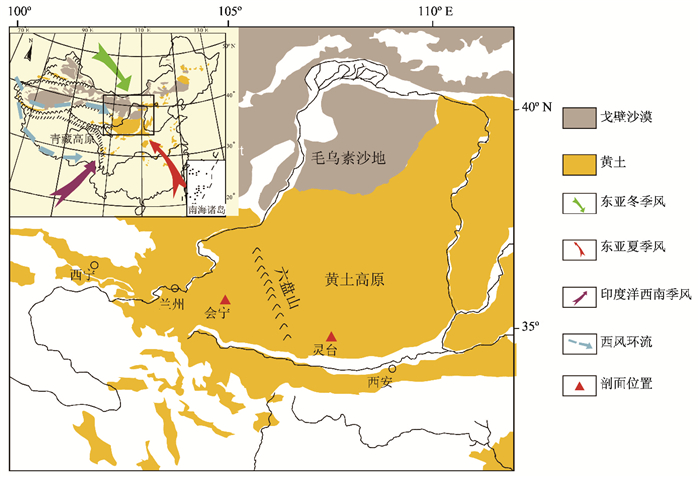
位于青藏高原东北缘的陇西黄土高原地处我国东亚季风、西南季风、西风环流及高原季风等多个大气环流的交汇部位,同时处在沙漠-黄土的边界带上(图 1),环境对气候变化的反应非常敏感。广泛分布于该区的风尘堆积是研究我国干旱、半干旱区古气候演化及高原隆升环境效应的理想材料[10~26]。与陇东黄土相比,对陇西黄土的研究目前还相对比较薄弱。多个剖面的磁性地层研究结果表明,陇西黄土主要是早更新世早期以来形成的[10~13],目前报道的最老黄土的底界年龄大约为2Ma B.P.[12]。古气候记录研究方面,前人主要利用该材料开展了短尺度、高分辨率的古气候环境变化过程与机制分析[14~26],而长时间尺度的气候环境变化研究相对较少。关于陇西黄土的物源,以前也开展过一些研究工作,但仍存在不同认识:一种观点认为,陇西黄土与陇东黄土一样,其风尘物质主要来源于西北内陆干旱荒漠区[27, 28];另一种观点则认为青藏高原冰川和冰缘作用产生的碎屑物质是该区黄土的主要物源[29, 30];还有的学者强调主要来自近源的第四纪松散沉积物[31]。最近,Peng等[32]通过对甘肃会宁黄土磁组构、石英颗粒表面形态的研究发现,北方干旱戈壁荒漠区、青藏高原等可能都是该区黄土的潜在物源区,并且风尘物源在地质历史时期曾发生过明显变化,由于受青藏高原隆升的影响,大约在300ka B.P.以后高原的冰川和冰缘物质对本区黄土物源的贡献明显增加,但这一认识还需要更多的证据支持。
|
图 1 中国黄土分布和剖面位置图 Fig. 1 Location map showing loess distribution in China and the sections mentioned in this study |
风尘堆积的地球化学组成与源岩成分密切相关,因而经常用来作为物源示踪的指标[6, 7, 33~42]。我们对甘肃会宁黄土的地球化学组成进行了系统测试分析,并通过与陇东同时代黄土的对比,研究其对青藏高原东北缘黄土物源的指示意义,同时对该区黄土的化学风化特征也进行了初步探讨。
1 材料和方法甘肃会宁位于青藏高原东北缘,属于陇西黄土高原的丘陵沟壑区,地势南高北低。南、中部多为黄土侵蚀形成的黄土梁、峁地貌,北部则为黄土塬和河流切割形成的河谷、河流阶地地貌。本区位于温带季风气候区的西北边缘,气候干冷,年平均气温7.9℃,年平均降水量330mm[32]。
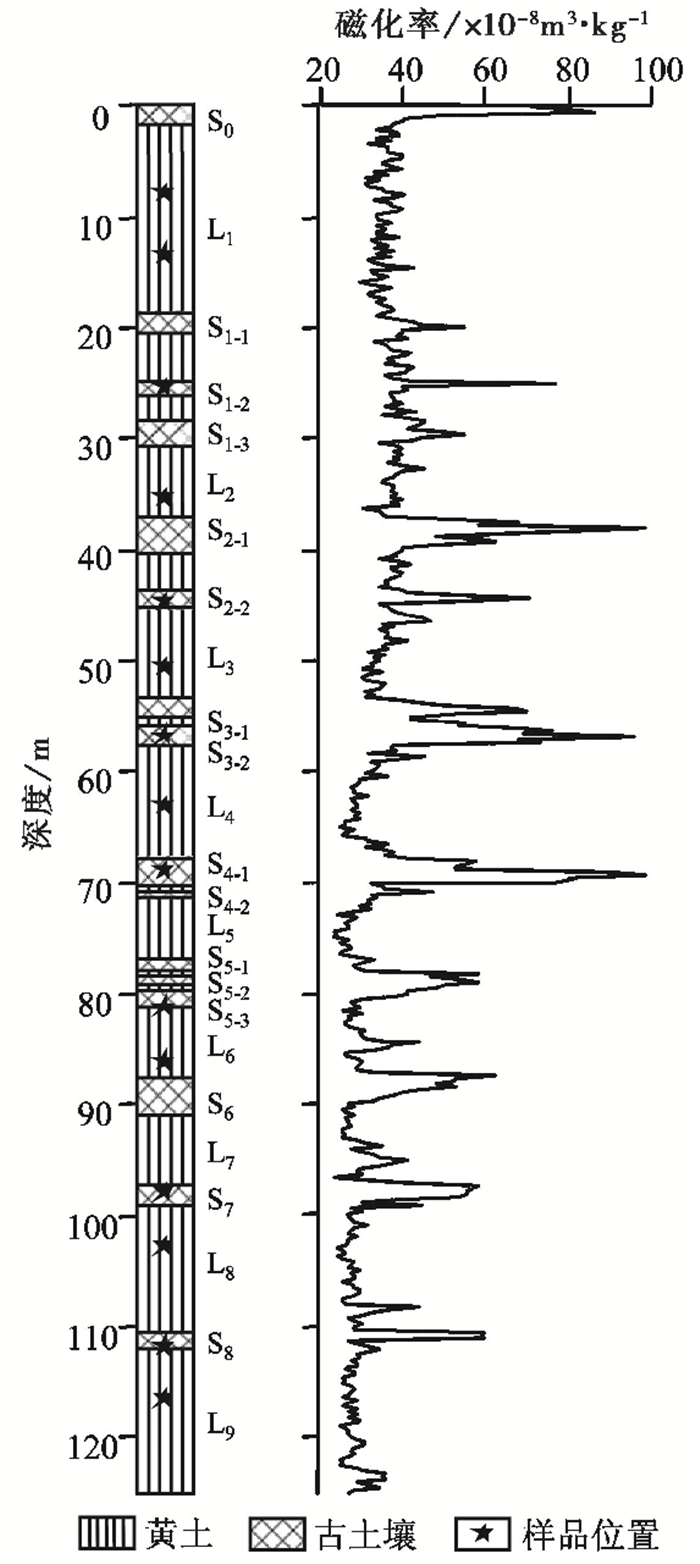
会宁黄土剖面(36°15′N,105°07′E)位于会宁县草滩乡[32],剖面总厚度224.25m,通过与邻近有磁性地层研究的断岘剖面(36°14′N,105°11′E)的磁化率对比,获得了该剖面L9以来(厚度约125m)的地层年代学框架[11, 32](图 2)。本次研究,我们选取L9以来不同层位的8个黄土和7个古土壤样品进行了常、微量元素含量测试。其中,黄土样品有2个来自L1,其余的分别来自L2、L3、L4、L6、L8和L9;7个古土壤样品分别来自S1、S2、S3、S4、S5、S7和S8。样品在剖面中的具体位置如图 2所示。本次研究我们主要验证300ka B.P.前后黄土物源变化在地球化学特征上的反映,因而S4以下层位测试分析的样品数量较少,其中L5、L7及S6没有选取样品。用于对比的同时代黄土、古土壤样品的常、微量数据来自陇东黄土高原的灵台剖面(34°59′N,107°45′E)[7](图 1)。
|
图 2 会宁黄土剖面地层及样品位置图 据Peng等[32]修改 Fig. 2 Stratigraphy and magnetic susceptibility of Huining section and sample positions, revised after Peng et al.[32] |
所有样品的常、微量元素测试在中国地质科学院国家地质实验测试中心完成。用于常、微量元素测试的样品在室温下用醋酸浸泡去除碳酸盐后获得酸不溶物,将酸不溶物用去离子水清洗后烘干,研磨至200目以下以备测试。常量元素采用X荧光光谱法(XRF)通过3080E光谱仪进行测定,大部分常量元素的测试误差小于3 %,P2O5和MnO因为含量太低,误差范围偶尔达到10 %。烧失量与碳酸盐、粘土矿物和有机质含量有关,通过计算在950℃下加热1小时前后的质量差得出。微量元素通过ICP-MS测得,测试误差小于10 %。
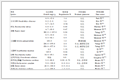
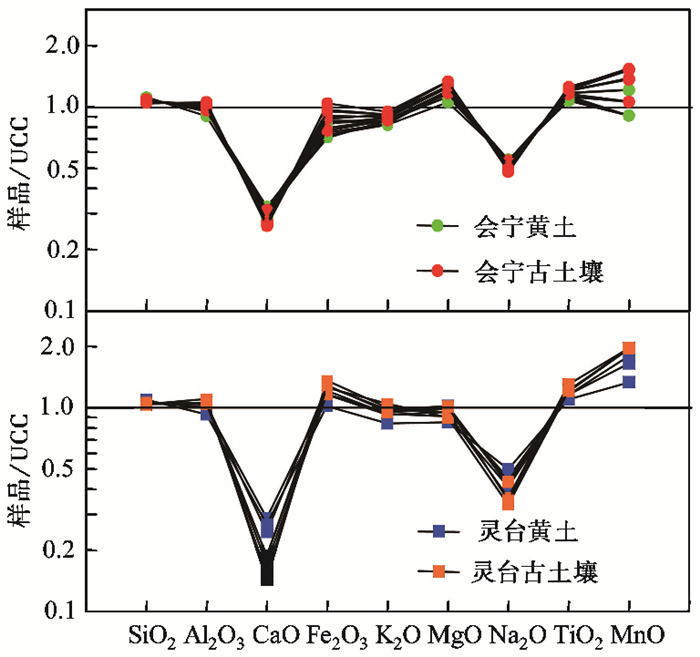
2 结果 2.1 常量元素会宁和灵台剖面黄土、古土壤样品的常量元素数据见表 1,对常量元素数据进行UCC (上部陆壳平均化学成分)标准化后绘制成图 3,UCC数据来源于Taylor和McLennan[43, 44]。会宁剖面的常量元素以SiO2(平均71.17 %)、Al2O3(平均15.06 %)、Fe2O3(平均3.82 %)为主,与灵台黄土、古土壤样品相似;与UCC值相比,会宁、灵台黄土样品都显示出明显偏低的CaO、Na2O和稍高的TiO2、MnO含量;与灵台黄土相比,会宁黄土具有较低的Fe2O3和较高的CaO、MgO、Na2O含量。
|
表 1 会宁和灵台[7]剖面样品常量元素数据表(单位%) Table 1 Major element concentrations (wt. %) of eolian deposits from sections of Huining and Lingtai[7] |
|
图 3 会宁和灵台[7]剖面黄土、古土壤样品常量元素的UCC[43, 44]标准化值 Fig. 3 UCC-normalized abundances of major elements for loess and paleosol samples from sections of Huining and Lingtai[7] |
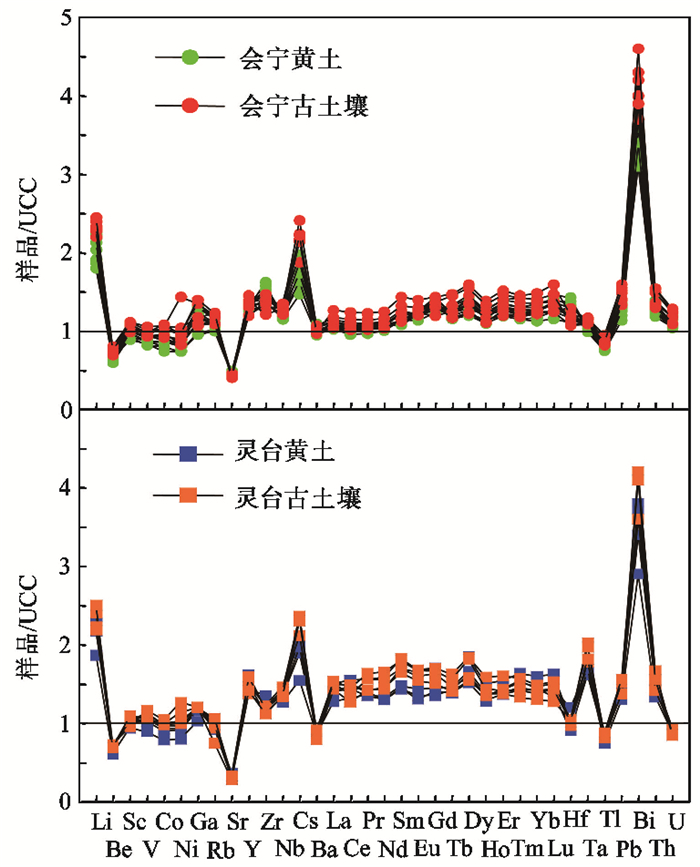
会宁和灵台剖面黄土、古土壤样品的微量元素数据见表 2,对两个剖面样品的微量元素数据进行UCC标准化后绘制成图 4,UCC数值来源于Taylor和McLennan[43, 44]。从图 4和表 2中可以看出,会宁与灵台黄土样品的微量元素具有相似的分布模式。但是,与灵台黄土相比,会宁黄土具有较低的Ta、Y和较高的Zr、Hf含量。
|
|
表 2 剖面样品的微量元素数据表(单位:ppm) Table 2 Trace element concentrations (ppm) of eolian deposits from sections of Huining and Lingtai[7] |
|
图 4 会宁和灵台[7]剖面黄土、古土壤样品微量元素的UCC[43, 44]标准化值 Fig. 4 UCC-normalized abundances of trace elements for loess and paleosol samples from sections of Huining and Lingtai[7] |
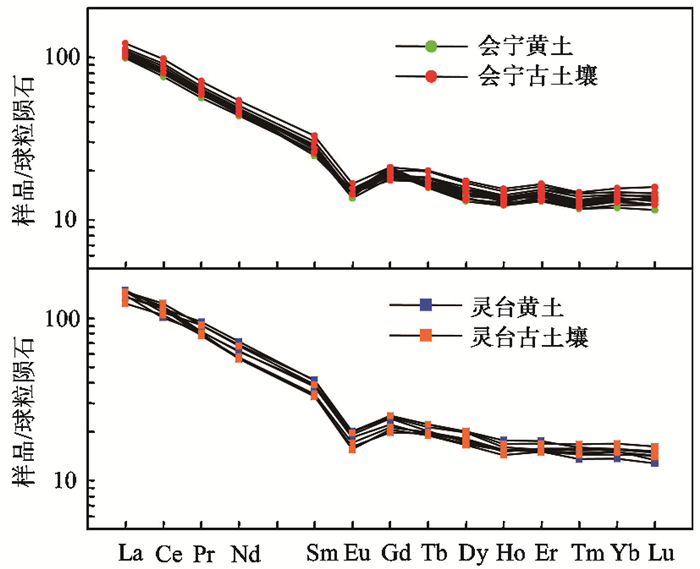
会宁和灵台黄土、古土壤样品的稀土元素数据见表 3,对会宁和灵台剖面样品的稀土元素数据进行球粒陨石标准化后绘制的分布模式图见图 5。从图 5中可以看出,会宁与灵台黄土、古土壤样品具有相似的分布模式:轻稀土相对富集,曲线较陡,重稀土相对亏损,曲线较平缓,并且都有明显的Eu负异常。
|
|
表 3 会宁和灵台[7]剖面样品的稀土元素数据表(单位:ppm) Table 3 Rare earth element concentrations (ppm) of eolian deposits from sections of Huining and Lingtai[7] |
|
图 5 会宁和灵台[7]剖面样品的球粒陨石标准化稀土元素分布模式图 Fig. 5 Chondrite-normalized REE patterns for eolian deposit samples from sections of Huining and Lingtai[7] |
以上研究结果表明,会宁、灵台剖面黄土样品的地球化学组成与UCC在整体上具有相似性,说明它们在沉积之前经过了多次搬运和沉积循环过程,是高度混合的产物。但是结果同样显示,会宁和灵台黄土的地球化学特征也在存在明显不同,反映了两者沉积后的化学风化及物源的差异。
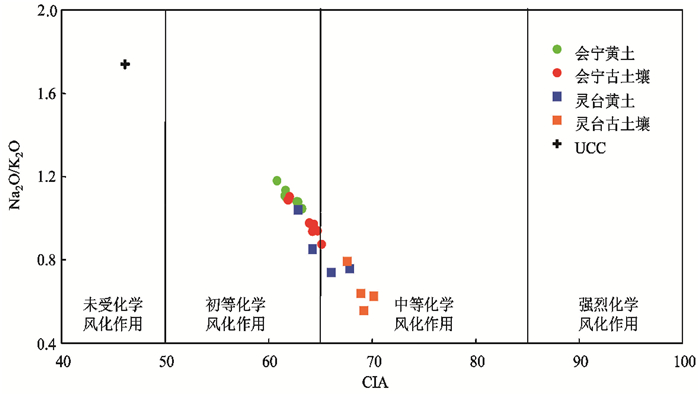
3.1 常量元素对化学风化强度的指示CIA是常用的反映化学风化强度的指标(CIA=(Al2O3/(Al2O3+CaO+Na2O+K2O))×100,CaO*只包括硅酸盐矿物中的Ca含量)[45]。根据CIA值进行化学风化阶段划分,CIA < 50为未受化学风化作用阶段,CIA=50~65为初等化学风化作用阶段,CIA=65~85为中等化学风化作用阶段,CIA>85为强烈化学风化作用阶段[46, 47]。本次研究的分析结果表明(图 6),灵台黄土样品[7]的CIA=63~68(均值为65)、古土壤样品的CIA=68~70(均值为69),处于中等化学风化阶段;会宁黄土样品的CIA=61~63(均值为62)、古土壤样品的CIA=62~65(均值63),处于初等化学风化阶段。Na2O/K2O可以反映斜长石的风化程度,Na2O/K2O值与样品的风化程度成反比[48~50]。图 6显示,灵台黄土、古土壤样品的风化程度大于会宁的黄土、古土壤样品,而同一剖面中古土壤的风化程度大于黄土的风化程度,与CIA值反映的现象一致。
|
图 6 UCC及会宁和灵台[7]剖面黄土、古土壤样品的Na2O/K2O-CIA图 Fig. 6 Na2O/K2O versus CIA diagram for UCC and loess and paleosol samples from sections of Huining and Lingtai[7] |
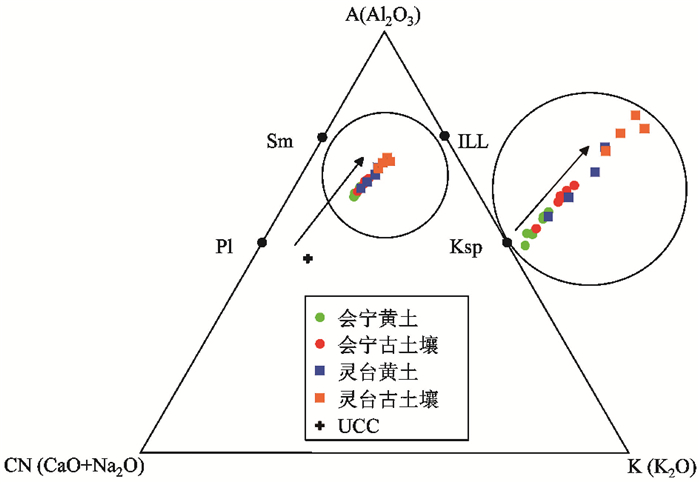
A-CN-K (Al2O3-CaO+Na2O-K2O)三角图能够反映黄土的风化趋势[45]。在A-CN-K三角图中(图 7),UCC、会宁黄土、灵台黄土组成一条近似平行于A-CN的线,向A-K边移动。从图 7中可以看出,会宁和灵台黄土、古土壤样品均发生了显著的Na、Ca流失,处在斜长石风化阶段,生成了高岭石、蒙脱石、伊利石等粘土矿物。
|
图 7 UCC及会宁和灵台[7]剖面黄土、古土壤样品的A-CN-K (Al2O3-CaO+Na2O-K2O)三角图 Fig. 7 A-CN-K triangular diagram for UCC and loess and paleosol samples from sections of Huining and Lingtai[7] |
磁组构和石英颗粒表面形态的分析结果表明,受青藏高原快速隆升的影响,大约300ka B.P.以后来自高原的冰川和冰缘物质对本区黄土物源的贡献明显增加[32]。为了验证这一事件在地球化学特征方面的反应,在分析过程中我们将会宁剖面S3以前和S3以后的黄土样品分别与灵台黄土的地球化学数据进行了对比。
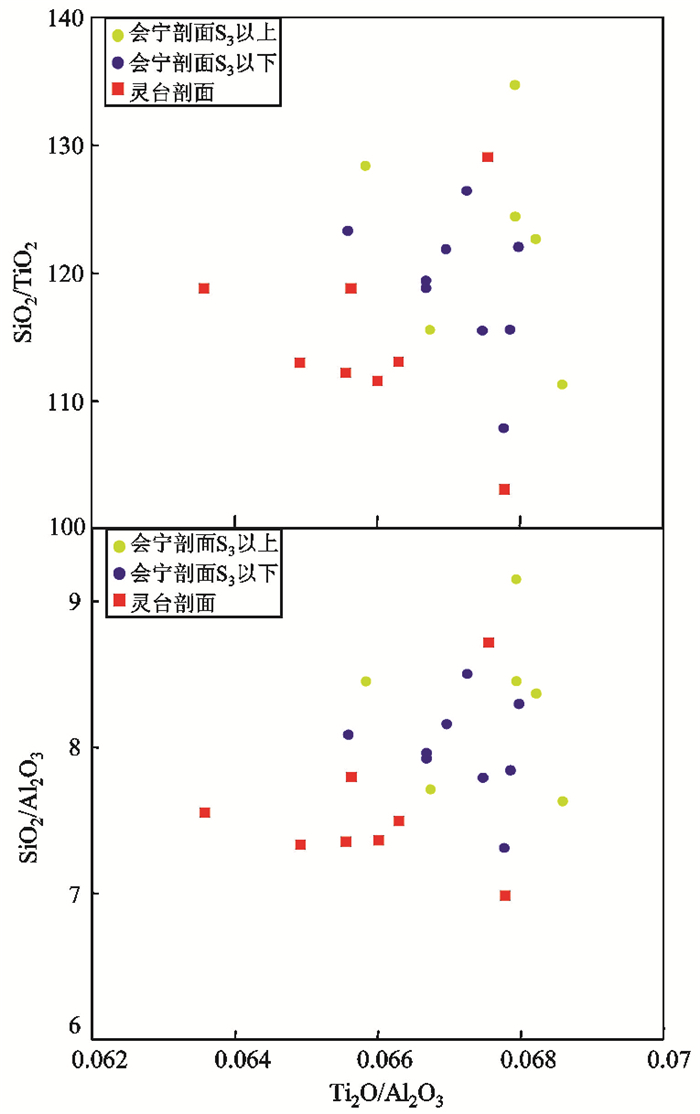
3.2.1 常量元素对物源的指示常量元素中,Si、Al、Ti元素在搬运沉积过程中几乎不发生迁移,能够较好地反映源区岩石的元素特征:Si元素主要存在于石英中,石英的性质稳定,导致Si元素不容易发生迁移;Al元素形成的化合物不易进入水中,因而不易迁移[51~54];Ti多存在于金红石等矿物中,抗风化能力强,也不易发生迁移。研究发现,SiO2/Al2O3与风尘粒度关系密切[6],但是TiO2/Al2O3在黄土的不同粒级中却有很好的一致性,几乎不受风化作用影响,因而可以作为风尘物源的重要指标[6, 55]。在TiO2/Al2O3-SiO2/Al2O3和TiO2/Al2O3-SiO2/TiO2图中(图 8),会宁和灵台黄土的投影区域有明显差异。与灵台黄土相比,会宁黄土具有总体偏高的SiO2/Al2O3、SiO2/TiO2和TiO2/Al2O3值。进一步分析发现,会宁剖面S3以前的样品更加接近灵台黄土的投影区域,而S3以后的样品则更加远离灵台黄土的投影区域,说明300ka B.P.前后青藏高原东北缘风尘物源可能发生过明显变化。
|
图 8 会宁和灵台[7]黄土样品的TiO2/Al2O3-SiO2/Al2O3和TiO2/Al2O3-SiO2/TiO2图 Fig. 8 TiO2/Al2O3 versus SiO2/Al2O3 and TiO2/Al2O3 versus SiO2/TiO2 diagrams for eolian deposit samples from sections of Huining and Lingtai[7] |
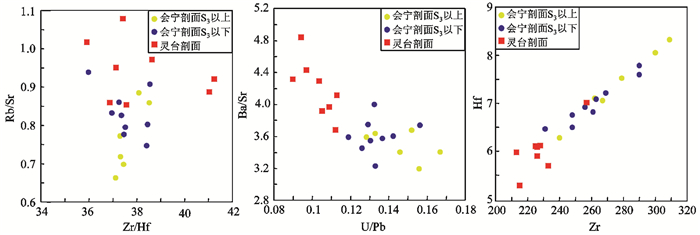
化学性质稳定的微量元素(如Ba、Rb、Zr、Hf等)及其比值(如Rb/Sr、Ba/Sr、U/Pb、Zr/Hf等)常用来指示黄土的物源[6, 7, 35, 36]。微量元素中,Ba、Rb和K具有相似的化学性质,经常通过置换K元素而进入钾长石中[56, 57]。从A-CN-K图可以看出(图 7),会宁和灵台黄土都处在斜长石风化的初始阶段,钾长石基本没有发生风化,因而钾长石中的Ba、Rb元素也得以保持了源区元素的特征。Zr和Hf主要存在于锆石中,抗风化能力强,基本不受风化作用影响[33, 58, 59]。在Zr/Hf-Rb/Sr、U/Pb-Ba/Sr和Zr-Hf图中(图 9),会宁和灵台黄土的投影区域有明显差异,与灵台黄土相比,会宁黄土具有总体较高的U/Pb、Zr、Hf值和较低的Rb/Sr、Ba/Sr值。同时,会宁剖面S3以前的样品更加接近灵台剖面样品的投影区域,而S3以后的样品则更加远离灵台黄土样品的投影区域。
|
图 9 会宁和灵台[7]剖面黄土样品的Zr/Hf-Rb/Sr、U/Pb-Ba/Sr和Zr-Hf图 Fig. 9 Zr/Hf-Rb/Sr, U/Pb-Ba/Sr and Zr-Hf diagrams for eolian deposit samples from sections of Huining and Lingtai[7] |
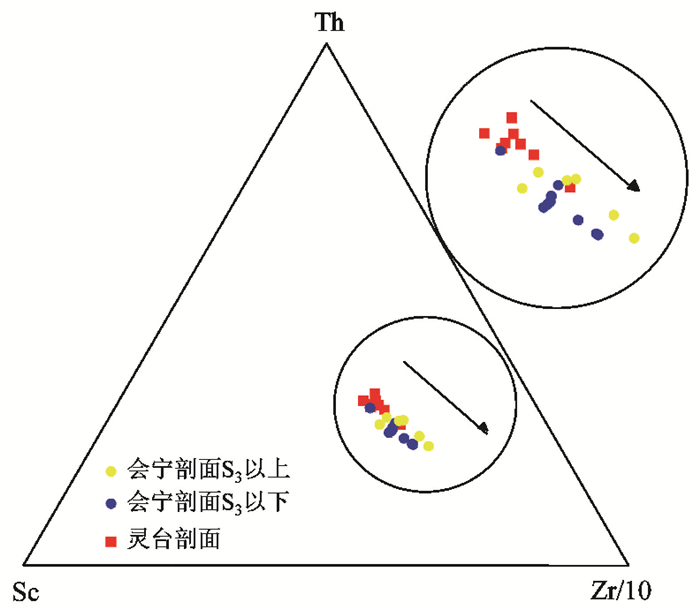
La-Th-Sc和Th-Sc-Zr/10三角图也可以反映不同地区沉积物之间的物源关系[60]。在会宁和灵台剖面样品的La-Th-Sc和Th-Sc-Zr/10三角图中(图 10),会宁和灵台黄土的投影区域也存在明显不同。其中,会宁剖面S3以后的样品更加远离灵台黄土样品,Zr元素含量明显增加(图 10),从微量元素的UCC标准化值也可以看出(图 4),会宁黄土Zr元素含量明显高于灵台黄土样品,与以青藏高原冰川及冰缘物质为主要物源的川西黄土相似[9]。
|
图 10 会宁和灵台[7]剖面黄土样品的La-Th-Sc和Th-Sc-Zr/10三角图 Fig. 10 La-Th-Sc and Th-Sc-Zr/10 triangular diagrams for eolian deposit samples from sections of Huining and Lingtai[7] |
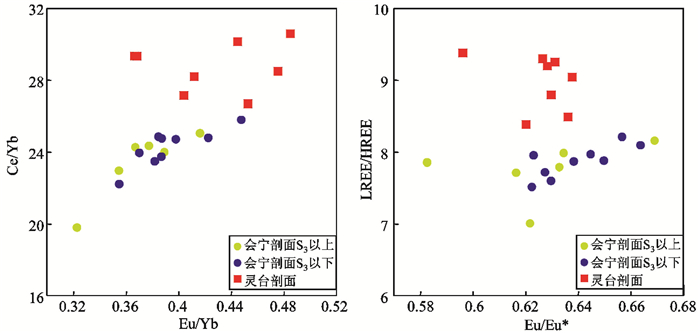
沉积物中的稀土元素特征主要与源岩相关,因而可以用来指示物质来源[43, 61, 62]。在会宁和灵台黄土样品的Ce/Yb-Eu/Yb和LREE/HREE-Eu/Eu*图中(图 11),会宁黄土具有较低的Ce/Yb、Eu/Yb和LREE/HREE值。
|
图 11 会宁和灵台[7]剖面样品的Ce/Yb-Eu/Yb和LREE/HREE-Eu/Eu*图 Fig. 11 Ce/Yb-Eu/Yb and LREE/HREE-Eu/Eu* diagrams for loess and paleosol samples from sections of Huining and Lingtai[7] |
综上所述,会宁与灵台黄土中能够反映物源的稳定元素含量及其比值存在着明显不同,反映了两者物源的差异。陇东黄土主要为来自西北戈壁荒漠区的粉尘物质[2~5]。与陇东黄土高原相比,陇西距离沙漠和青藏高原更近,并且地处东亚季风、西南季风、西风环流及高原季风等多个大气环流的交汇部位,决定了该区的黄土物源可能比陇东更为复杂,北方戈壁荒漠、青藏高原的冰川和冰缘沉积以及附近的第四纪松散沉积物都有可能成为本区风尘堆积的潜在物源,并且随着地质环境条件的改变,其物源可能会发生变化。Peng等[32]通过对本剖面磁组构数据的分析后发现,该区300ka B.P.以后的优势风向由原先的近南北向转变为近东西向;石英颗粒电镜扫描结果也显示,300ka B.P.以后来源于冰川及冰缘沉积物的成分明显增加,说明青藏高原对陇西黄土风尘物源的贡献明显增加[32]。本次研究中,会宁黄土中能够反映物源的稳定元素含量及其比值在大约300ka B.P.前后也发生了明显变化,进一步证明了这一观点。很多证据表明,青藏高原在300ka B.P.前后曾有过明显的构造隆升过程[63~67],因而高原在此时期的快速隆升导致的高原季风的加强可能是形成物源变化的根本原因[32]
4 结论通过对位于青藏高原东北缘的陇西会宁剖面黄土、古土壤样品常、微量元素的测试分析,并与陇东灵台黄土进行对比,得出以下初步认识:
(1) 会宁剖面黄土的常量元素以SiO2(平均71.17 %)、Al2O3(平均15.06 %)、Fe2O3(平均3.82 %)为主,和灵台剖面黄土样品的地球化学组成相似,与UCC平均化学成分也基本一致。同时,会宁和灵台黄土也具有相似的微量和稀土元素分布模式。上述地球化学特征说明,陇西黄土与陇东黄土一样都是复杂的源岩风化物质经过高度混合堆积而成。
(2) 常量元素分析结果表明,会宁和灵台黄土、古土壤样品均发生了显著的Na、Ca元素流失,处在斜长石风化阶段,生成了高岭石、蒙脱石、伊利石等粘土矿物。与陇东黄土相比,陇西黄土具有较高的CaO、MgO、Na2O值和较低的Fe2O3值,反映了该区黄土的化学风化强度相对较弱。CIA值分析结果也显示,灵台黄土样品的CIA=63~68(均值为65)、古土壤样品的CIA=68~70(均值为69),处于中等化学风化阶段;会宁黄土样品的CIA=61~63(均值为62)、古土壤样品的CIA=62~65(均值63),处于初等化学风化阶段。
(3) 陇西与陇东黄土中能够反映物源的稳定元素含量及其比值存在着明显不同,反映了两者物源的差异。与陇东黄土相比,陇西黄土具有相对较高的SiO2/Al2O3、SiO2/TiO2、TiO2/Al2O3、U/Pb、Zr、Hf值和较低的Ta、Y、Rb/Sr、Ba/Sr、Ce/Yb、Eu/Yb、LREE/HREE值,其特征与以青藏高原冰川和冰缘沉积为主要物源的川西黄土有相似之处。位于青藏高原东北缘的陇西黄土高原离戈壁荒漠和青藏高原较近,而且地处我国多个大气环流的交汇部位,其黄土物源更加复杂。地质历史时期,我国北方戈壁荒漠、青藏高原的冰川和冰缘沉积以及邻近的第四纪松散沉积物都可能成为其潜在的物源。
(4) 会宁剖面L9以来的黄土地球化学特征研究显示,能够反映物源的稳定元素含量及其比值在大约300ka B.P.前后发生了明显变化。结合以前磁组构、石英颗粒表面形态的分析,进一步证明青藏高原东北缘的风尘物源在该时期可能发生过明显变化,300ka B.P.以后青藏高原的冰川及冰缘沉积物对该区风尘物源的贡献明显增加,而青藏高原在此时期的快速隆升导致的高原季风加强可能是形成风尘物源变化的主要原因。
| 1 |
刘东生.
黄土与环境 . 北京: 科学出版社, 1985 : 481 .
Liu Tungsheng. Loess and Environment. Beijing: Science Press, 1985 : 481 . (  0) 0)
|
| 2 |
Sun J M. Provenance of loess material and formation of loess deposits on the Chinese Loess Plateau. Earth and Planetary Science Letters,2002, 203 (3~4) : 845~859.
(0)
|
| 3 |
Sun Y B, Chen H Y, Tada R, et al. ESR signal intensity and crystallinity of quartz from Gobi and sandy deserts in East Asia and implication for tracing Asian dust provenance. Geochemistry, Geophysics, Geosystems,2013, 14 (8) : 2615~2627.
doi:10.1002/ggge.20162 (0)
|
| 4 |
Chen J, Li G J, Yang J D, et al. Nd and Sr isotopic characteristics of Chinese deserts:Implications for the provenances of Asian dust. Geochimica et Cosmochimica Acta,2007, 71 (15) : 3904~3914.
doi:10.1016/j.gca.2007.04.033 (0)
|
| 5 |
Li G J, Chen J, Ji J F, et al. Natural and anthropogenic sources of East Asian dust. Geology,2009, 37 (8) : 727~730.
doi:10.1130/G30031A.1 (0)
|
| 6 |
Hao Q Z, Guo Z T, Qiao Y S, et al. Geochemical evidence for the provenance of Middle Pleistocene loess deposits in Southern China. Quaternary Science Reviews,2010, 29 (23~24) : 3317~3326.
(0)
|
| 7 |
Qiao Y S, Hao Q Z, Peng S S, et al. Geochemical characteristics of the eolian deposits in Southern China, and their implications for provenance and weathering intensity. Palaeogeography, Palaeoclimatology, Palaeoecology,2011, 308 (3~4) : 513~523.
(0)
|
| 8 |
Fang Xiaomin. The origin and provenance of Malan loess along the eastern margin of Qinghai-Xizang (Tibetan) Plateau and its adjacent area. Science in China (Series B),1995, 38 (7) : 876~887.
(0)
|
| 9 |
Qi Lin, Qiao Yansong. Geochemical characteristics of eolian deposits on the eastern margin of the Tibetan Plateau and implications for provenance. Acta Geologica Sinica,2014, 88 (3) : 801~811.
doi:10.1111/acgs.2014.88.issue-3 (0)
|
| 10 |
岳乐平, 雷祥义, 屈红军. 靖远黄土剖面磁性地层的初步研究. 第四纪研究, 1991 (4) : 349~352.
Yue Leping, Lei Xiangyi, Qu Hongjun. A magnetostratigraphic study on the Jingyuan loess section, Gansu, China. Quaternary Sciences,1991 (4) : 349~352. ( 0)
|
| 11 |
杨东, 方小敏, 董光荣, 等. 1.8Ma BP以来陇西断岘黄土剖面沉积特征及其反映的腾格里沙漠演化. 中国沙漠, 2006, 26 (1) : 6~13.
Yang Dong, Fang Xiaomin, Dong Guangrong, et al. Loess deposit characteristic in Duanxian section of Longxi basin and its reflected evolution of Tengger Desert at north of China since last 1.8Ma. Journal of Desert Research,2006, 26 (1) : 6~13. ( 0)
|
| 12 |
鹿化煜, 王先彦, 孙雪峰, 等. 钻探揭示的青藏高原东北部黄土地层与第四纪气候变化. 第四纪研究, 2007, 27 (2) : 230~241.
Lu Huayu, Wang Xianyan, Sun Xuefeng, et al. Loess stratigraphy and palaeoclimate changes during Quaternary in northeastern Tibetan Plateau revealed by loess core. Quaternary Sciences,2007, 27 (2) : 230~241. ( 0)
|
| 13 |
王荣华, 郭雪莲, 蒲宗文. 兰州九州台"上粉砂层"黄土L9的剩磁记录特征研究. 第四纪研究, 2016, 36 (5) : 1139~1153.
Wang Ronghua, Guo Xuelian, Pu Zongwen. The paleomagnetic record of the upper sandy loess L9 in Jiuzhoutai section, Lanzhou. Quaternary Sciences,2016, 36 (5) : 1139~1153. ( 0)
|
| 14 |
Chen F H, Bloemendal J, Wang J M, et al. High-resolution multi-proxy climate records from Chinese loess:Evidence for rapid climatic changes over the last 75 kyr. Palaeogeography, Palaeoclimatology, Palaeoecology,1997, 130 (1~4) : 323~335.
doi:10.1016/S0031-0182(96)00149-6 (0)
|
| 15 |
Chen F H, Qiang M R, Feng Z D, et al. Stable East Asian monsoon climate during the Last Interglacial (Eemian) indicated by paleosol S1 in the western part of the Chinese Loess Plateau. Global and Planetary Change,2003, 36 (3) : 171~179.
doi:10.1016/S0921-8181(02)00183-2 (0)
|
| 16 |
Ding Z L, Ren J Z, Yang S L, et al. Climate instability during the penultimate glaciation:Evidence from two high-resolution loess records, China. Journal of Geophysical Research,1999, 104 (B9) : 20123~20132.
doi:10.1029/1999JB900183 (0)
|
| 17 |
Fang X M, Li J J, Banerjee S K, et al. Millennial-scale climatic change during the last interglacial period:Super paramagnetic sediment proxy from paleosol S1, western Chinese Loess Plateau. Geophysical Research Letters,1999, 26 (16) : 2485~2488.
doi:10.1029/1999GL008335 (0)
|
| 18 |
Lu H Y, Wang X Y, Ma H Z, et al. The Plateau Monsoon variation during the past 130 kyr revealed by loess deposit at northeast Qinghai-Tibet (China). Global and Planetary Change,2004, 41 (3~4) : 207~214.
(0)
|
| 19 |
Lu H Y, Vandenberghe J, Miao X D, et al. Evidence for an abrupt climatic reversal during the Last Interglacial on the northeast Qinghai-Tibetan Plateau. Quaternary International,2006, 154~155 (5) : 136~140.
(0)
|
| 20 |
Lü Lianqing, Fang Xiaomin, Lu Huayu, et al. Millennial-scale climate change since the Last Glaciation recorded by grain sizes of loess deposits on the northeastern Tibetan Plateau. Chinese Science Bulletin,2004, 49 (11) : 1157~1164.
doi:10.1360/03wd0467 (0)
|
| 21 |
饶志国, 陈发虎, 曹洁, 等. 黄土高原西部地区末次冰期和全新世有机碳同位素变化与C3/C4植被类型转换研究. 第四纪研究, 2005, 25 (1) : 107~114.
Rao Zhiguo, Chen Fahu, Cao Jie, et al. Variation of soil organic carbon isotope and C3/C4 vegetation type transition in the western Loess Plateau during the Last Glacial and Holocene periods. Quaternary Sciences,2005, 25 (1) : 107~114. ( 0)
|
| 22 |
饶志国, 陈发虎, 汪海斌, 等. 九州台古土壤S1记录的末次间冰期东亚夏季风变化. 海洋地质与第四纪地质, 2006, 26 (2) : 103~111.
Rao Zhiguo, Chen Fahu, Wang Haibin, et al. Eastern Asian summer monsoon variation during MIS, 5e as recorded by paleosol S1 at Jiuzhoutai loess section. Marine Geology & Quaternary Geology,2006, 26 (2) : 103~111. ( 0)
|
| 23 |
Liu W G, Yang H, Sun Y B, et al. δ13C values of loess total carbonate:A sensitive proxy for Asian summer monsoon in arid northwestern margin of the Chinese Loess Plateau. Chemical Geology,2011, 284 (3~4) : 317~322.
(0)
|
| 24 |
Qiang M R, Chen F H, Wang Z T, et al. Aeolian deposits at the southeastern margin of the Tengger Desert (China):Implications for surface wind strength in the Asian dust source area over the past 20, 000 years. Palaeogeography, Palaeoclimatology, Palaeoecology,2010, 286 (1~2) : 66~80.
(0)
|
| 25 |
杨东, 焦金鱼, 田娜, 等. 陇西黄土沉积记录反映的末次间冰期以来青藏高原东北部季风的演化过程. 干旱区地理, 2008, 31 (1) : 23~30.
Yang Dong, Jiao Jinyu, Tian Na, et al. Process of monsoon variations of the northeastern Qinghai-Xizang Plateau from the loess record of Longxi basin since the last interglacial epoch. Arid Land Geography,2008, 31 (1) : 23~30. ( 0)
|
| 26 |
杨桂芳, 彭红霞, 黄长生, 等. 黄土高原西缘末次盛冰期以来古气候演化的有机碳同位素记录. 华中师范大学学报, 2005, 39 (1) : 126~130.
Yang Guifang, Peng Hongxia, Huang Changsheng, et al. Paleoclimatic evolution deduced from organic carbon isotope of western Loess Plateau sediments since Last Glacial Maximum. Journal of Central China Normal University,2005, 39 (1) : 126~130. ( 0)
|
| 27 |
Jahn B, Gallet S, Han J M. Geochemistry of the Xining, Xifeng and Jixian sections, Loess Plateau of China:Eolian dust provenance and paleosol evolution during the last 140ka. Chemical Geology,2001, 178 (1~4) : 71~94.
doi:10.1016/S0009-2541(00)00430-7 (0)
|
| 28 |
汪海斌, 陈发虎, 张家武. 黄土高原西部地区黄土粒度的环境指示意义. 中国沙漠, 2002, 22 (1) : 21~26.
Wang Haibin, Chen Fahu, Zhang Jiawu. Environmental significance of grain size of loess-paleosol sequence in western part of Chinese Loess Plateau. Journal of Desert Research,2002, 22 (1) : 21~26. ( 0)
|
| 29 |
李珍, 聂树人. 西宁黄土沉积及其物质来源. 地球科学, 1999, 24 (6) : 581~584.
Li Zhen, Nie Shuren. Xining loess deposition and its material sources. Earth Science,1999, 24 (6) : 581~584. ( 0)
|
| 30 |
赵锦慧, 鹿化煜, 梅凡民, 等. 西宁地区黄土堆积的粒径分组. 干旱区地理, 2008, 31 (1) : 31~37.
Zhao Jinhui, Lu Huayu, Mei Fanmin, et al. Simulation of grain size distribution of Xining loess accumulation. Arid Land Geography,2008, 31 (1) : 31~37. ( 0)
|
| 31 |
Guan Q Y, Pan B T, Gao H S, et al. Geochemical evidence of the Chinese loess provenance during the Late Pleistocene. Palaeogeography, Palaeoclimatolory, Palaeoecology,2008, 270 (1~2) : 53~58.
doi:10.1016/j.palaeo.2008.08.013 (0)
|
| 32 |
Peng S S, Ge J Y, Li C Z, et al. Pronounced changes in the atmospheric circulation and dust source area during Mid-Pleistocene as indicated by the Caotan loess-soil sequence North China. Quaternary International,2015, 372 : 97~107.
doi:10.1016/j.quaint.2014.09.075 (0)
|
| 33 |
Taylor S R, McLennan S M, McCulloch M T. Geochemistry of loess, continental crustal composition and crustal model ages. Geochimica et Cosmochimica Acta,1983, 47 (11) : 1897~1905.
doi:10.1016/0016-7037(83)90206-5 (0)
|
| 34 |
Gallet S, Jahn B, Lanoe B V V, et al. Loess geochemistry and its implications for particle origin and composition of the upper continental crust. Earth and Planetary Science Letters,1998, 156 (3~4) : 157~172.
(0)
|
| 35 |
Ferrat M, Weiss D J, Strekopytov S, et al. Improved provenance tracing of Asian dust sources using rare earth elements and selected trace elements for palaeomonsoon studies on the eastern Qinghai-Tibetan Plateau. Geochimica et Cosmochimica Acta,2011, 75 (21) : 6374~6399.
doi:10.1016/j.gca.2011.08.025 (0)
|
| 36 |
Sun J M. Provenance of loess material and formation of loess deposits on the Chinese Loess Plateau. Earth and Planetary Science Letters,2002, 203 (3~4) : 845~859.
(0)
|
| 37 |
杨杰东, 李高军, 戴澐, 等. 黄土高原黄土物源区的同位素证据. 地学前缘, 2009, 16 (6) : 195~206.
Yang Jiedong, Li Gaojun, Dai Yun, et al. Isotopic evidences for provenances of loess of the Chinese Loess Plateau. Earth Science Frontiers,2009, 16 (6) : 195~206. ( 0)
|
| 38 |
Rao Wenbo, Yang Jiedong, Chen Jun, et al. Sr-Nd isotope geochemistry of eolian dust of the arid-semiarid areas in China:Implications for loess provenance and monsoon evolution. Chinese Science Bulletin,2006, 51 (12) : 1401~1412.
(0)
|
| 39 |
汪海斌, 于英鹏, 刘现彬, 等. 黄土高原S1古土壤的地球化学特征及其对物源的指示. 第四纪研究, 2011, 31 (2) : 338~346.
Wang Haibin, Yu Yingpeng, Liu Xianbin, et al. Geochemical characteristics of last interglacial paleosols in the Chinese Loess Plateau and its implications to loess provenance. Quaternary Sciences,2011, 31 (2) : 338~346. ( 0)
|
| 40 |
张文翔, 史正涛, 张虎才, 等. 中国西风区伊犁盆地塔勒德黄土-古土壤元素地球化学特征及环境意义. 第四纪研究, 2011, 31 (5) : 812~821.
Zhang Wenxiang, Shi Zhengtao, Zhang Hucai, et al. Geochemical characteristics and environmental significance of the Talede loess-paleosol sequence in westerly area of China. Quaternary Sciences,2011, 31 (5) : 812~821. ( 0)
|
| 41 |
陈秀玲, 李志忠, 贾丽敏, 等. 新疆伊犁河谷沙漠沉积的稀土元素特征及其环境意义. 第四纪研究, 2013, 33 (2) : 368~375.
Chen Xiuling, Li Zhizhong, Jia Limin, et al. Rare earth element characteristics of desert sediments in Ili Valley and their environmental implication. Quaternary Sciences,2013, 33 (2) : 368~375. ( 0)
|
| 42 |
李楠, 郝青振, 张绪教, 等. 东秦岭黄土物源的常量元素和微量元素地球化学证据. 第四纪研究, 2016, 36 (2) : 332~346.
Li Nan, Hao Qingzhen, Zhang Xujiao, et al. Geochemicl evidence for the provenance of loess deposits in the eastern Qinling Mountains, Central China. Quaternary Sciences,2016, 36 (2) : 332~346. ( 0)
|
| 43 |
Taylor S R, McLennan S M. The Continental Crust:Its Composition and Evolution. Oxford:Blackwell Scientific Pub,1985 : 38~43.
(0)
|
| 44 |
McLennan S M. Relationships between the trace element composition of sedimentary rocks and upper continental crust. Geochemistry, Geophysics, Geosystems,2001, 2 (1) : 203~236.
(0)
|
| 45 |
Nesbitt H W, Young G M. Early Proterozoic climates and plate motions inferred from major element chemistry of lutites. Nature,1982, 299 (5885) : 715~717.
doi:10.1038/299715a0 (0)
|
| 46 |
Fedo C M, Nesbitt H W, Young G M. Unraveling the effects of potassium metasomatism in sedimentary rocks and paleosols, with implications for paleoweathering conditions and provenance. Geology,1995, 23 (10) : 921~924.
doi:10.1130/0091-7613(1995)023<0921:UTEOPM>2.3.CO;2 (0)
|
| 47 |
冯连君, 储雪蕾, 张启锐, 等. 化学蚀变指数(CIA)及其在新元古代碎屑岩中的应用. 地学前缘, 2003, 10 (4) : 539~544.
Feng Lianjun, Chu Xuelei, Zhang Qirui, et al. CIA (Chemical Index of Alteration) and its applications in the Neoproterozioc clastic rocks. Earth Science Frontiers,2003, 10 (4) : 539~544. ( 0)
|
| 48 |
Nesbitt H W, Markovices G, Price R C. Chemical processes affecting alkalis and alkaline earths during continental weathering. Geochem Cosmochim Acta,1980, 44 (11) : 1659~1666.
doi:10.1016/0016-7037(80)90218-5 (0)
|
| 49 |
Chen Jun, An Zhisheng, Liu Lianwen, et al. Variations in chemical compositions of the eolian dust in Chinese Loess Plateau over the past 2.5Ma and chemical weathering in the Asian inland. Science in China (Series D),2001, 44 (5) : 403~413.
doi:10.1007/BF02909779 (0)
|
| 50 |
Qiao Yongsong, Zhao Zhizhong, Wang Yan, et al. Variations of geochemical compositions and the paleoclimatic significance of a loess-soil sequence from Garzê County of western Sichuan Province, China. Chinese Science Bulletin,2009, 54 (24) : 4697~4703.
(0)
|
| 51 |
Broecker W S, Peng T.
Tracers in the Sea. New York: Eldigio Press, 1982 : 26 ~31.
(0)
|
| 52 |
Li Y H. A brief discussion on the mean oceanic residence time of elements. Geochimica et Cosmochimica Acta,1982, 46 (12) : 2671~2675.
doi:10.1016/0016-7037(82)90386-6 (0)
|
| 53 |
Li Y H.
A Compendium of Geochemistry--From Solar Nebula to the Human Brain. Princeton: Princeton University Press, 2000 : 14 ~17.
(0)
|
| 54 |
文启中.
中国黄土地球化学 . 北京: 科学出版社, 1989 : 71 ~133.
Wen Qizhong. Geochemistry of the Chinese Loess. Beijing: Science Press, 1989 : 71 ~133. ( 0)
|
| 55 |
顾兆炎, 丁仲礼, 熊尚发, 等. 灵台红粘土和黄土-古土壤序列的地球化学演化. 第四纪研究, 1999 (4) : 357~365.
Gu Zhaoyan, Ding Zhongli, Xiong Shangfa, et al. A seven million geochemical record from Chinese red-clay and loess-paleosol sequence:Weathering and erosion in Northwestern China. Quaternary Sciences,1999 (4) : 357~365. ( 0)
|
| 56 |
郭志刚, 杨作升, 范德江, 等. 东海中陆架泥质区及其周边底质中钙锶钡的地球化学特征. 青岛海洋大学学报, 1998, 28 (3) : 481~488.
Guo Zhigang, Yang Zuosheng, Fan Dejiang, et al. The geochemical characteristics of Ca, Sr, Ba in the surface sediments of the middle continental shelf mud area and its ambient areas in the East China Sea. Journal of Ocean University of Qingdao,1998, 28 (3) : 481~488. ( 0)
|
| 57 |
韩吟文, 马振东.
地球化学 . 北京: 地质出版社, 2003 : 135 ~140.
Han Yinwen, Ma Zhendong. Geochemistry. Beijing: Geological Publishing House, 2003 : 135 ~140. ( 0)
|
| 58 |
Hugh R R.
Using Geochemical Data:Evoluation, Presentation, Interpretation. New York: Longan Scientific and Technical Press, 1993 : 64 ~97.
(0)
|
| 59 |
Ali M O, Ayla A. Geochemistry and provenance of Maastrichtian clastic rocks in the Dikmendede Formation of Orhaniye in Kazan-Ankara-Turkey region. Acta Geologica Sinica,2011, 85 (5) : 1067~1083.
doi:10.1111/j.1755-6724.2011.00541.x (0)
|
| 60 |
Bhatia M R, Crook K A W. Trace element characteristics of greywackes and tectonic setting discrimination of sedimentary basins. Contributions to Mineralogy & Petrology,1986, 92 (2) : 181~193.
(0)
|
| 61 |
McLennan S M. Rare earth elements in sedimentary rocks:Influence of provenance and sedimentary processes. Reviews in Mineralogy and Geochemistry,1989, 21 (8) : 169~200.
(0)
|
| 62 |
Muhs D R, Budahn J R, Johnson D L, et al. Geochemical evidence for airborne dust additions to soils in Channel Islands National Park, California. The Geological Society of America Bulletin,2008, 120 (1~2) : 106~126.
(0)
|
| 63 |
许学汉, 裴静娴. 渡口-西昌区域第四系形成与新构造活动的热发光年龄及发展史研究. 地质科学, 1987 (4) : 374~383.
Xu Xuehan, Pei Jingxian. Study on thermoluminescence age and the geological history of formation of the Quaternary system and neotectonic activity in Dukou-Xichang area. Chinese Journal of Geology,1987 (4) : 374~383. ( 0)
|
| 64 |
刘勇, 赵志军, 李才林, 等. 川西高原杂谷脑河阶地的形成. 地理学报, 2006, 61 (3) : 249~254.
Liu Yong, Zhao Zhijun, Li Cailin, et al. Formation of the Zagunao River terraces in Western Sichuan Plateau, China. Acta Pedologica Sinica,2006, 61 (3) : 249~254. ( 0)
|
| 65 |
王国芝, 王成善, 刘登忠, 等. 滇西高原第四纪以来的隆升和剥蚀. 海洋地质与第四纪地质, 1999, 19 (4) : 67~74.
Wang Guozhi, Wang Chengshan, Liu Dengzhong, et al. Uplift and denudation of the western Yunnan Plateau in Quaternary. Marine Geology & Quaternary Geology,1999, 19 (4) : 67~74. ( 0)
|
| 66 |
邢成起, 丁国瑜, 卢演俦, 等. 黄河中游河流阶地的对比及阶地系列形成中构造作用的多层次性分析. 中国地震, 2001, 17 (2) : 187~201.
Xing Chengqi, Ding Guoyu, Lu Yanchou, et al. Comparison of river terraces in the middle reach valleys of the Yellow River and analysis on the multi-gradational features of tectonic action in the formation of terrace series. Earthquake Research in China,2001, 17 (2) : 187~201. ( 0)
|
| 67 |
郭正堂, 吴海滨, 魏建晶, 等. 用古土壤有机质碳同位素探讨青藏高原东南缘的隆升幅度. 第四纪研究, 2001, 21 (5) : 392~398.
Guo Zhengtang, Wu Haibin, Wei Jianjing, et al. Tentative estimate of the southeast margin uplift of Qinghai-Xizang Plateau using organic carbon isotope composition of paleosols. Quaternary Sciences,2001, 21 (5) : 392~398. ( 0)
|
 , Qiao Yansong①,②
 , Peng Shasha①, Li Chaozhu①, Qi Lin①,③, Han Chao①, Tan Yuanlong①, Cheng Yu①, Liu Zongxiu①
② Key Laboratory of Neotectonic Movement and Geohazard, Ministry of Land and Resources, Beijing 100081;
③ School of Earth Sciences and Resources, China University of Geosciences (Beijing), Beijing 100083)
Abstract
The Longxi basin of the Chinese Loess Plateau (CLP) is located in the northeastern margin of the Tibetan Plateau (TP), which is also in the desert-loess boundary zone of Northern China (NC). The climate in this region is controlled by the East Asian Monsoon, the Westerly Circulation, the TP monsoon and the India southwest monsoon, so the environmental response to climatic change is very sensitive in this area. The eolian deposits widely distributed in this region bear information about climate change for the arid or semi-arid zone of NC, and it is also an ideal material for studies on climatic response to uplift of the TP. In this study, geochemical compositions of an eolian sequence in the northeastern margin of the TP are studied and compared with loess and paleosol samples from the Longdong basin of the CLP. The main objectives are:(1) to characterize the elemental geochemistry of the eolian deposits in the northeastern margin of the TP and compare with the loess-paleosol sequence in the Longdong basin of the CLP; (2) to interpret the geological implications for dust sources; (3) to compare the chemical weathering characteristics of the eolian deposits in the Longxi and Longdong Basins. The studied section is from Huining (HN) County of Gansu Province. The present-day climate at HN County is temperate with mean annual precipitation of 330mm and mean annual temperature of 7.9℃, respectively. The HN section (36°15'N, 105°07'E) is 224.25m in thickness. In this study, only the upper part of this sequence (since L9 which is about 125m in depth) is studied, 15 samples were taken for major and trace elemental measurements, including 8 loess and 7 paleosol samples. 2 loess samples are from L1, and the other 6 loess samples are from L2, L3, L4, L6, L8, and L9; the 7 paleosol samples are from S1, S2, S3, S4, S5, S7, and S8. All the samples were measured at the National Research Center for Geoanalysis, Chinese Academy of Geological Sciences. The geochemical data of the Longdong basin loess are from Lingtai section (34°59'N, 107°45'E) in Lingtai County, Gansu Province. The results show that geochemical characteristics of the eolian deposits from the Longxi and Longdong basins are similar to the average UCC on the whole, indicating that the dust materials have experienced numerous upper crustal recycling processes. However, they also show obvious differences, reflecting different chemical weathering intensity and different eolian dust sources. The loess in the Longxi basin have higher CaO, MgO, Na2O and lower Fe2O3 concentrations in comparison with the Longdong loess samples, indicating lower weathering intensity of the Longxi loess. According to the CIA value, the Longxi loess was in the stage of incipient chemical weathering, while the Longdong loess was in the stage of intermediate chemical weathering intensity. For the relatively invariant elements, compared with the Longdong loess, the Longxi loess samples have higher Zr, Hf and lower Ta, Y value, higher SiO2/Al2O3, SiO2/TiO2, TiO2/Al2O3, U/Pb and lower Rb/Sr, Ba/Sr, Ce/Yb, Eu/Yb, LREE/HREE ratios, reflecting different eolian dust sources. Due to the influence of geographical location, the desert in NC, the glacial and periglacial sediments in the TP and the Quaternary sediments in the adjacent area is likely to become the potential sources of the Longxi loess. Further studies show obvious changes in geochemical characteristics of the HN loess since about 300ka B.P. Our geochemical data, combined with previous results of magnetic fabric and quartz grain surface morphology, further prove that the sources of the eolian deposits distributed in the northeastern margin of TP maybe obviously changed during this period. Eolian dust contribution of glacier and periglacial sediments from the TP significantly increased after 300ka B.P. This change may be related to the increased plateau monsoon caused by the rapid uplift of TP in this period.