 2017, Vol.37


② 中国科学院青海盐湖研究所, 青海省盐湖地质与环境重点实验室, 西宁 810008)
中国北方第四纪黄土(0~2.6Ma)[1~8]、晚中新世至上新世红粘土(约2.6~8Ma)[9~11]、新近纪黄土(3.5~22Ma)[12~14]为研究早中新世以来东亚季风演化乃至全球气候变化提供了近乎连续的陆相沉积记录。黄土高原第四纪黄土和新近纪黄土均由色调差异明显的黄土和古土壤互层而成,又称黄土-古土壤序列[8]。黄土层的色调偏黄,而古土壤层的色调偏红。为了表述方便,这里将黄土-古土壤序列简称为黄土。实质上,古土壤只是成壤作用较强的黄土。中国黄土具有典型的加积型土壤特征,即堆积和成壤过程同时进行。
西宁地区的风尘堆积包括新近纪黄土和第四纪黄土。由于西宁地区位于黄土高原边缘,毗邻青藏高原,靠近粉尘源区,也接近东亚夏季风的北界,所以这里的黄土沉积速率高,较灵敏地记录了源区和气候变化的信号,是我国西北地区环境演化研究的重点对象[15~17]。新近纪黄土分布在六盘山以西的黄土高原(又称西部黄土高原),从东部的天水地区[12]到西部的西宁地区[18]都有分布。西宁地区的河流阶地上保存了过去约7.4~13.5Ma前(古地磁定年)的新近纪风尘堆积[18, 19]。西宁泮子山钻孔的磁性地层年代结果显示其底部黄土的沉积年代约为2Ma[20],较完整地保存了第四纪时期的风尘堆积。
过去的研究表明:西宁地区的新近纪黄土与第四纪黄土的常量、微量和稀土元素地球化学组成结果大致相同[21];西宁地区的新近纪黄土可能部分来自青藏高原中、西部干旱区[22];Sr-Nd-Pb同位素地球化学结果显示西宁地区的风尘堆积与古老河流阶地的砂砾石层( < 75μm组分)存在显著差异[23]。
目前对西宁地区新近纪风尘堆积的物质来源研究还较少。西宁地区的新近纪风尘堆积从哪来?它与研究区的第四纪黄土在源区上是否存在相似性?对上述问题开展研究将有助于我国西北地区干旱区范围重建和粉尘搬运动力的研究。除了风尘堆积外,西宁地区的河流沉积和湖泊沉积也普遍发育[18, 24~26]。这些不同类型的沉积物为研究西宁地区新近纪风尘堆积的物质来源提供了良好的可供对比的材料。因此,本文对西宁地区的新近纪黄土、第四纪黄土、河流沉积和湖泊沉积的元素地球化学特征进行对比研究,主要目的是探讨西宁地区新近纪风尘堆积的元素地球化学组成特征及其对物源的指示意义。
2 材料与方法 2.1 材料为了采用元素地球化学手段研究西宁地区新近纪风尘堆积的物质来源,在研究区采集了第四纪黄土、新近纪黄土和河流沉积、湖泊沉积样品(图 1)。

|
图 1 研究区各类样品的空间分布示意图 Fig. 1 Distribution map of loess samples, fluvial and lacustrine samples in Xining area |
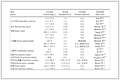
各类样品的岩性和经纬度见表 1,其他信息简述如下:
|
表 1 西宁地区各类样品的岩性和经纬度 Table 1 Lithology, latitude and longitude of different samples in Xining area |
(1) 第四纪黄土(24个):样品分布在西宁市周边、蔡家堡乡、殷家村和乐都县。在野外根据黄土堆积成壤和层序特征及前人在研究区的光释光年龄结果[27],可以大致判断它们形成于末次冰期以来。末次冰期堆积的黄土颜色偏黄且质地疏松,其上的全新世古土壤层颜色发黑且质地相对致密。
(2) 新近纪黄土(9个):西宁市以北蔡家堡乡的最高河流阶地上(阶地砾石层顶面高出现代湟水河河面590多米)堆积了新近纪黄土;磁性地层学结果显示这套沉积形成于距今约7.4~13.5Ma前[18]。新近纪黄土露头呈现出清晰的黄土-古土壤旋回变化特征。依据地层颜色特征,采集了新近纪黄土和古土壤样品。
(3) 河流沉积(8个):在西宁市西郊的湟水河采集了现代河流沉积物样品。西宁地区的湟水河发育多级阶地,在第一级(T1)、第二级(T2)河流阶地的砂砾石层中采集了样品;依据前人文献[18],在蔡家堡乡的第十级(T10)和第十一级(T11)河流阶地的砂砾石层采集了样品;样品号为XN4和XN40的样品采自典型的河流阶地砂砾石层,砾石磨圆度高,并定向排列。遗憾的是,由于城市建设和流水侵蚀对河流阶地的地貌特征造成破坏,这两个样品所在的阶地序次难以被准确识别。
(4) 湖泊沉积(13个):西宁地区广泛发育古湖相沉积。这些沉积物呈青灰色、灰绿色和红色,部分层位中含有石膏,结构致密,成岩程度高。出露的湖相地层呈水平状往两侧延伸,这套沉积之上发育第四纪黄土,二者呈不整合接触。所采集的样品来自西宁西郊、南郊和北郊。在西宁南郊所采样品的露头上出露了石膏层,湖相沉积与第四纪黄土为不整合接触关系。西宁南郊采样点位邻西宁经典的塔山和谢家剖面,北郊采样点位邻近水湾剖面。而西宁塔山河湖相沉积剖面的古地磁年代为16~35Ma[28];谢家和水湾剖面的底界年代约为40Ma,为始新世晚期[24]。因此,依据这些资料,宏观上推测采集的湖相沉积样品的年代为古近纪和新近纪。
2.2 实验方法为了减小粒度效应对元素相对含量的影响,对于松散的样品,直接过200目不锈钢网筛,获得粒径大约小于75μm的组分;对于固结在一块的样品,先将风干样品在玛瑙研钵中轻轻碾碎,再过200目不锈钢网筛,获得粒径大约小于75μm的组分。对于西宁地区新近纪黄土和湖相沉积样品,由于样品颗粒细,直接在玛瑙研钵中磨细即可。以往研究表明西宁地区新近纪黄土中粒径小于75μm的组分达99%以上[23]。因此,西宁地区新近纪黄土的全岩样品基本上都是小于75μm的组分;湖泊沉积物的样品也很细,颗粒粒径基本上小于75μm。
称取4g左右的样品放入聚氯乙烯环内,用压样机在25吨压力下保压60秒压制成圆片(直径为40mm)。压好的片在中国科学院青海盐湖研究所盐湖化学分析测试中心采用荷兰帕纳科公司生产的Axios X射线荧光光谱仪(型号PW4400)进行元素测定。测定过程中用实验室购买的国家土壤成分分析标准物质(包括土壤、沉积物)的标准样品(GSS-1至GSS-28)与重复样品(又称平行样品,见表 2的标星号“*”样品)进行质量监控,确保测试结果的准确度和精度。除MnO、Na2O和MgO外,其他常量元素的分析误差为±5%。
3 结果与讨论 3.1 各类沉积物的元素组成特征西宁地区各类沉积物样品的元素分析结果见表 2。表 2中的元素含量根据仪器测出来的元素总浓度重新计算而来,计算方法为用每一种元素的浓度除以该样品的总浓度(%),再乘以100(%)。元素Si、Al、Fe、Ca、Na、K、Mg、Ti、P、Mn以氧化物的形式表示;Fe元素用Fe2O3氧化物来表示。各类样品均以SiO2、Al2O3、Fe2O3和CaO为主,这4种氧化物的含量超过了86.7%;另外,新近纪风尘堆积的常量元素也以SiO2(平均61.61%)、Al2O3(平均16.33%)、Fe2O3(平均6.60%)和CaO(平均5.86%)为主。在Rb、Sr、Zr、Nb这4种微量元素中,各类样品的Zr和Sr的含量高,而Rb和Nb的含量低。
CaO和Na2O通常赋存在易风化的斜长石矿物中,在风化过程中属于不稳定元素。西宁新近纪黄土样品的CaO变化范围为1.35% ~10.77%,西宁第四纪黄土的Na2O变化范围为1.00% ~2.61%,西宁河流沉积的CaO变化范围为1.11% ~11.28%。CaO和Na2O在各类沉积物中含量上的较大变幅可能与风化(源区风化和沉积后期的风化)过程中元素自身的迁移和淀积有关。
各类沉积物样品的元素含量平均值见表 2。以平均值结果为基础,将西宁新近纪黄土分别与其他类型沉积物的常量元素含量进行对比,结果显示西宁新近纪黄土不但与西宁第四纪黄土大体相似(图 2a),而且与西宁地区的河流、湖泊沉积也大体相似(图 2b和2c)。也就是说,西宁地区各类沉积物在常量元素总体含量上大体一致。
|
|
表 2 西宁地区风尘堆积、河流沉积和湖泊沉积样品的元素组成 Table 2 Elemental compositions of eolian deposits, fluvial deposits and lacustrine sediments in Xining area |

|
图 2 西宁新近纪黄土与其他沉积物的常量元素组成的比较 Fig. 2 Comparison of major element compositions between Xining Neogene loess and Quaternary loess, fluvial deposits, lacustrine deposits |
黄土作为风力搬运的产物,源区粉砂粒级的碎屑组分通常是被搬运的主要对象[8, 31]。黄土是源区风化细碎屑物质经过风力分选作用高度混合的沉积物。中国、美国、欧洲和新西兰各地的黄土在元素组成特征上基本一致[32]。由于这种特性,地球化学研究上通常用黄土的化学成分来代表UCC(上地壳)的平均成分[32, 33]。
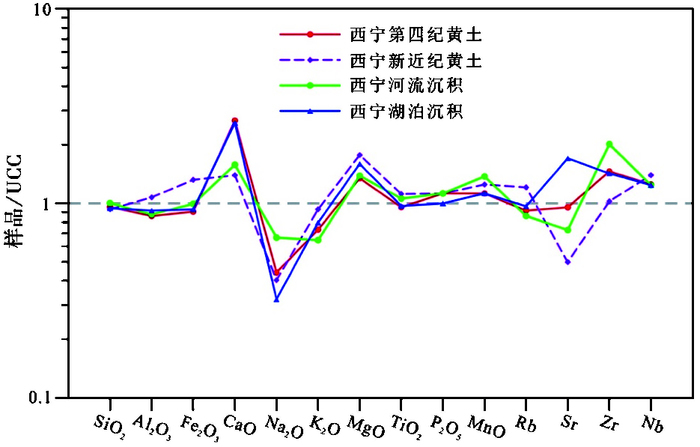
经UCC标准化后各类沉积物的常量元素组成结果(图 3)显示,西宁地区的新近纪、第四纪风尘堆积和河流沉积、湖泊沉积样品中的CaO、MgO、MnO、Zr、Nb含量较高,Na2O、K2O含量较低。分布于干旱、半干旱区的中国黄土富含碳酸盐(以碳酸钙为主),在元素组成上的表现就是具有较高的CaO含量[34]。西宁第四纪黄土的CaO含量为10.08% ~13.76%,新近纪黄土的CaO含量为1.35% ~10.77% (见表 2)。西宁地区的风尘堆积具有较高的CaO含量,与UCC[29, 30]具有较大的差别。
|
图 3 UCC标准化后各类沉积物的常量元素组成 Fig. 3 UCC-normalized abundances for the eolian deposits, fluvial and lacustrine sediments in Xining area |
与其他各类沉积物相比,西宁新近纪黄土具有较高的Al2O3、Fe2O3、K2O、MgO、TiO2、Rb、Nb,以及较低的CaO、Sr、Zr。过去的研究显示:与西峰第四纪黄土相比,天水秦安中新世黄土的Fe2O3、K2O、MgO含量较高,Na2O含量较低[35];与西宁第四纪黄土相比,西宁新近纪黄土的Fe2O3、K2O、MgO含量较高,Na2O含量较低,与秦安中新世黄土的特征[35]一致。
黄土高原粉尘沉积不同粒级组分中的元素含量结果表明,Al2O3、Fe2O3、K2O、MgO、TiO2在细颗粒中含量较高,Na2O在细颗粒中含量较低[36]。与西宁第四纪黄土相比,西宁新近纪黄土的中值粒径明显偏小,其粒度组成明显偏细[23]。因此,西宁新近纪黄土中较高的Al2O3、Fe2O3、K2O、MgO和TiO2,以及较低的Na2O含量,它们是与西宁新近纪黄土较细的粒度组成有关。
3.2 各类沉积物的Rb、Sr元素特征微量元素Rb、Sr及其比值常被用于黄土地球化学和古气候演化的研究[37~40]。黄土高原环县和西峰晚第四纪黄土及巴家咀红粘土剖面中的Rb/Sr比值与低频质量磁化率具有相似的变化特征,从而表明Rb/Sr比值可以指示东亚古夏季风的强度变化[9, 37]。
Rb、Sr作为分散元素,很少以单质的形式存在,主要以类质同象的形式分布在造岩矿物中[41]。Rb+的半径(0.148nm)和K+的半径(0.133nm)接近,Sr2+的半径(0.113nm)和Ca2+的半径(0.099nm)接近[42],且Rb和K为同主族元素,Sr和Ca为同主族元素。因此,在沉积物中Rb主要分散在含K的矿物中(如云母、钾长石),Sr主要分散在含Ca的矿物中(如斜长石、角闪石、碳酸盐矿物)[41]。研究表明:在同样的风化条件下,富Rb矿物比富Sr矿物稳定[43]。因此,在风化过程中Rb的活动性比Sr弱,从而造成Rb、Sr元素的分离[41];随着风化程度的增强,风化沉积物的Rb/Sr比值增加[44]。因此,Rb/Sr比值可以用来指示沉积物遭受的风化强度[39, 40, 45]。
西宁地区各类沉积物的Rb-Sr散点显示(图 4):1)西宁湖泊沉积的Rb、Sr最分散,含量变化最大;Rb含量的变化范围为16.05~152.66ppm,Sr的变化范围为141.32~3243.75ppm。即便是不考虑含盐沉积的样品(XN27和XN32),Rb含量的变幅为85.03~152.66ppm,Sr的变幅为141.32~1118.71ppm(图 4a)。2)西宁河流沉积的Rb含量相对较低,变幅为71.81~130.33ppm,而且与西宁地区的风尘堆积具有显著的差别(图 4b)。3)西宁新近纪黄土的Rb含量高,Sr含量低;而西宁第四纪黄土的Rb含量低,Sr含量高。西宁地区新近纪黄土和第四纪黄土的Rb、Sr含量散点图能够拟合成一条直线,R2可达0.72(图 4c)。

|
图 4 各类沉积物的Rb、Sr含量散点图(a~c)及Rb/Sr比值(d) Fig. 4 Plots of Rb and Sr contents(a~c) and Rb/Sr ratios (d) in different kinds of sediments in Xining area |
西宁新近纪、第四纪风尘堆积的Rb-Sr散点图可以拟合在一条直线上(图 4c),有可能指示了它们的母岩在物质成分方面存在共同特征;也有可能是分布于中国西北干旱、半干旱区的风尘堆积在沉降区沉积以后在大体相似的气候环境(如较少的降水、较冷的气候)下发生风化,引起了不同时期的风尘堆积的Rb、Sr在风化过程中产生了相似的元素分异。需要指出的是,相比西宁第四纪黄土,西宁新近纪黄土的Rb含量高,表明新近纪黄土堆积时期的降水更多,气候更温暖。西宁新近纪黄土的Rb/Sr比值(平均0.81)高于西宁第四纪黄土的Rb/Sr比值(平均0.31) (图 4d),进一步表明西宁新近纪黄土遭受的风化程度比第四纪黄土更强烈,为较强风化成壤作用下的产物。
3.3 元素比值特征及其对西宁风尘堆积物源的指示研究表明:风尘堆积的K2O、TiO2和Al2O3随粒级变小含量增加,倾向于在粘土粒级( < 2μm)中富集,它们在风化过程中不易迁移;K2O/Al2O3和TiO2/Al2O3比值除在 < 2μm的粘粒中较低外,在其他各粒级组分中基本不变,受粒级分选作用的影响较小,可以作为风尘堆积物源示踪的地球化学指标[36]。K2O/Al2O3和TiO2/Al2O3比值已被用来示踪长江流域下蜀黄土[46]、山东黄土[47]和东秦岭黄土[48]的物质来源。
在源区风化、侵蚀、搬运、沉积和沉积后期的风化过程中,沉积物中的Zr、Nb具有相对较低的移动性,保留了母岩的特征[49],从而具有物源指示意义。Zr/Nb比值已经被用于示踪中国南方下蜀黄土的物质来源[46]。
结合前人报道过的西宁地区晚第四纪黄土(L2~S0地层)全岩的元素组成数据[16],西宁风尘堆积的K2O/Al2O3比值变化范围为0.197~0.224,TiO2/Al2O3比值的变化范围为0.057~0.071,它们的变化幅度较小。然而,西宁地区河流沉积和湖泊沉积的K2O/Al2O3和TiO2/Al2O3比值变化较大(图 5a)。而且,在K2O/Al2O3-TiO2/Al2O3图解中,西宁风尘堆积与河流沉积没有交集(图 5a)。K2O/Al2O3-Zr/Nb图解(图 5b)具有与K2O/Al2O3-TiO2/Al2O3图解相似的特征。

|
图 5 各类样品的K2O/Al2O3-TiO2/Al2O3和K2O/Al2O3-Zr/Nb比值 Fig. 5 Plots of element ratios K2O/Al2O3 versus TiO2/Al2O3, and K2O/Al2O3 versus Zr/Nb of different samples in Xining area |
西宁地区的河流、湖泊沉积基本上为流域内水动力搬运而来的岩石碎屑物质,代表了区域内小范围的近源沉积。西宁河流、湖泊沉积物中较分散的K2O/Al2O3、TiO2/Al2O3和Zr/Nb比值很可能与区域内复杂的母岩物质只是经历短距离搬运尚未高度混合有关。然而,西宁地区新近纪风尘堆积和第四纪黄土的K2O/Al2O3、TiO2/Al2O3和Zr/Nb比值相对集中,表明母岩细碎屑物质经过长距离搬运并高度混合,从而使得化学成分趋于均质化,表现出典型风尘堆积的特征,进而指示二者源区具有相似性。
新近纪以来,随着全球变冷和青藏高原的隆升[50, 51],我国环境格局发生重大转变,由之前行星风系主控型环境演变为季风主控型环境[52, 53]。气候系统的巨大调整和青藏高原隆升导致亚洲季风系统的形成和内陆干旱化的发展[54, 55],也导致东亚粉尘从源区出发并建造出颇具规模的黄土高原。
大气环流格局对风尘堆积的物源研究具有十分重要的指示意义。末次间冰期和末次冰期的古风向重建研究结果显示:在黄土高原西部,搬运粉尘的风力主要为西北风和西风[56]。在冬季,西宁地区现代大气环流为盛行西风[2];在西风环流盛行时,柴达木盆地处于西宁地区的上风向。研究表明柴达木盆地很可能是西宁地区第四纪黄土的主要源区[57, 58]。但是,由于目前有关柴达木盆地沉积物的地球化学数据较缺乏,且对青藏高原东北部地区古风向重建的研究也不够,因此西宁地区风尘堆积的物源与柴达木盆地的关系还需要进一步研究。
4 结论通过对西宁地区的新近纪黄土、第四纪黄土、河流沉积和湖泊沉积的元素地球化学特征的研究,结果如下:
(1) 西宁地区新近纪风尘堆积的常量元素以SiO2(平均61.61%)、Al2O3(平均16.33%)、Fe2O3(平均6.60%)和CaO(平均5.86%)为主。在常量元素平均含量上,西宁地区新近纪黄土与第四纪黄土、河流沉积及湖泊沉积大体相似。与上地壳(UCC)平均成分相比,各沉积物的CaO、MgO、MnO、Zr、Nb含量较高,Na2O、K2O含量较低。与西宁第四纪黄土、河流和湖泊沉积物相比,西宁新近纪黄土具有较高的Al2O3、Fe2O3、K2O、MgO、TiO2、Rb、Nb,以及较低的CaO、Sr、Zr。这一特征可能与西宁新近纪黄土较细的粒度有关。
(2) 西宁地区新近纪风尘堆积和第四纪黄土的Rb-Sr含量散点图可以拟合成一条直线。这一特征表明西宁地区新近纪和第四纪风尘堆积的源岩在物质成分上可能具有相似性。与风尘堆积不同,西宁地区的河流、湖泊沉积的Rb-Sr含量散点图特别分散。西宁新近纪黄土的Rb/Sr比值(平均0.81)高于西宁第四纪黄土的Rb/Sr比值(平均0.31),指示了新近纪黄土为较强风化成壤作用下的产物。
(3) K2O/Al2O3(分子比)-TiO2/Al2O3(分子比)、K2O/Al2O3(分子比)-Zr/Nb图解显示西宁地区的新近纪风尘堆积与第四纪黄土一致,但是它们与西宁地区的河流、湖泊沉积显著不同。上述特征揭示西宁地区的新近纪黄土和第四纪黄土可能具有相似的源区。柴达木盆地位于西宁地区的上风向地带,且西风环流盛行。柴达木盆地可能是西宁地区新近纪风尘堆积的主要源区。这种特征表明西宁地区新近纪黄土和第四纪黄土序列可以作为古气候研究的重要地质记录载体,开展更长时间尺度下东亚季风演化研究。
致谢 感谢王德荣老师帮助测定了样品的元素含量;感谢审稿专家提出了建设性意见和编辑部杨美芳老师提出了许多有益的修改建议。
| 1 |
Burbank D W, Li J J. Age and palaeoclimatic significance of the loess of Lanzhou, North China. Nature, 1985, 316(6027): 429-431. DOI:10.1038/316429a0 |
| 2 |
Hao Q Z, Wang L, Oldfield F et al. Delayed build-up of Arctic ice sheets during 400, 000-year minima in insolation variability. Nature, 2012, 490(7420): 393-396. DOI:10.1038/nature11493 |
| 3 |
Heller F, Liu T S. Magnetostratigraphical dating of loess deposits in China. Nature, 1982, 300(5891): 431-433. DOI:10.1038/300431a0 |
| 4 |
Liu T S, Ding Z L. Chinese loess and the paleomonsoon. Annual Review of Earth and Planetary Sciences, 1998, 26: 111-145. DOI:10.1146/annurev.earth.26.1.111 |
| 5 |
Sun Y, Clemens S C, Morrill C et al. Influence of Atlantic meridional overturning circulation on the East Asian winter monsoon. Nature Geoscience, 2012, 5(1): 46-49. |
| 6 |
Yang S L, Ding Z L, Li Y Y et al. Warming-induced northwestward migration of the East Asian monsoon rain belt from the Last Glacial Maximum to the mid-Holocene. Proceedings of the National Academy of Sciences of the United States of America, 2015, 112(43): 13178-13183. DOI:10.1073/pnas.1504688112 |
| 7 |
Zhou L P, Oldfield F, Wintle A G et al. Partly pedogenic origin of magnetic variations in Chinese loess. Nature, 1990, 346(6286): 737-739. DOI:10.1038/346737a0 |
| 8 |
刘东生等. 黄土与环境. 北京: 科学出版社, 1985, 1-481. Liu Tungsheng et al. Loess and the Environment. Beijing: Science Press, 1985, 1-481. |
| 9 |
An Z S, Kutzbach J E, Prell W L et al. Evolution of Asian monsoons and phased uplift of the Himalaya-Tibetan Plateau since Late Miocene times. Nature, 2001, 411(6833): 62-66. DOI:10.1038/35075035 |
| 10 |
Ding Z L, Yang S L, Hou S S et al. Magnetostratigraphy and sedimentology of the Jingchuan red clay section and correlation of the Tertiary eolian red clay sediments of the Chinese Loess Plateau. Journal of Geophysical Research, 2001, 106(B4): 6399-6407. DOI:10.1029/2000JB900445 |
| 11 |
Guo Z T, Peng S Z, Hao Q Z et al. Origin of the Miocene-Pliocene Red-Earth formation at Xifeng in Northern China and implications for paleoenvironments. Palaeogeography, Palaeoclimatology, Palaeoecology, 2001, 170(1-2): 11-26. DOI:10.1016/S0031-0182(01)00235-8 |
| 12 |
Guo Z T, Ruddiman W F, Hao Q Z et al. Onset of Asian desertification by 22 Myr ago inferred from loess deposits in China. Nature, 2002, 416(6877): 159-163. DOI:10.1038/416159a |
| 13 |
Hao Q Z, Guo Z T. Magnetostratigraphy of a Late Miocene-Pliocene loess-soil sequence in the western Loess Plateau in China. Geophysical Research Letters, 2004, 31: L09209. DOI:10.1029/ ̄2003GL019392 |
| 14 |
李建星, 王建强, 岳乐平等. 阿尔金新近纪红粘土的古地磁年代及古气候记录. 第四纪研究, 2016, 36(5): 1103-1113. Li Jianxing, Wang Jianqiang, Yue Leping et al. Magnetostratigraphic chronology and paleoenvironmental records of Neogene red clay in Altun, Western China. Quaternary Sciences, 2016, 36(5): 1103-1113. |
| 15 |
Lu H, Wang X, Ma H et al. The plateau monsoon variation during the past 130 kyr revealed by loess deposit at northeast Qinghai-Tibet(China). Global and Planetary Change, 2004, 41(3-4): 207-214. DOI:10.1016/j.gloplacha.2004.01.006 |
| 16 |
Jahn B, Gallet S, Han J. Geochemistry of the Xining, Xifeng and Jixian sections, Loess Plateau of China:Eolian dust provenance and paleosol evolution during the last 140ka. Chemical Geology, 2001, 178(1-4): 71-94. DOI:10.1016/S0009-2541(00)00430-7 |
| 17 |
李高军, 车旭东, 肖国桥等. 西宁黄土碎屑锆石年龄特征及其对黄土高原黄土物源的指示意义. 第四纪研究, 2013, 33(2): 345-350. Li Gaojun, Che Xudong, Xiao Guoqiao et al. Zircon ages of Xining loess:Implication for the provenance of the loess on Chinese Loess Plateau. Quaternary Sciences, 2013, 33(2): 345-350. |
| 18 |
Lu H Y, Wang X Y, An Z S et al. Geomorphologic evidence of phased uplift of the northeastern Qinghai-Tibet Plateau since 14 million years ago. Science China:Earth Sciences, 2004, 47(9): 822-833. DOI:10.1360/03yd0315 |
| 19 |
Wang X, Lu H, Vandenberghe J et al. Late Miocene uplift of the NE Tibetan Plateau inferred from basin filling, planation and fluvial terraces in the Huang Shui catchment. Global and Planetary Change, 2012, 88-89: 10-19. DOI:10.1016/j.gloplacha.2012.02.009 |
| 20 |
鹿化煜, 王先彦, 孙雪峰等. 钻探揭示的青藏高原东北部黄土地层与第四纪气候变化. 第四纪研究, 2007, 37(2): 230-241. Lu Huayu, Wang Xianyan, Sun Xuefeng et al. Loess stratigraphy and palaeoclimate changes during Quaternary in northeastern Tibetan Plateau revealed by loess core. Quaternary Sciences, 2007, 37(2): 230-241. |
| 21 |
Wang X Y, Lu H Y, Ji J F et al. Origin of the Red Earth sequence on the northeastern Tibetan Plateau and its implications for regional aridity since the Middle Miocene. Science China:Earth Sciences, 2006, 49(5): 505-517. DOI:10.1007/s11430-006-0505-3 |
| 22 |
王先彦, 鹿化煜, 季峻峰等. 青藏高原东北部湟水流域新近纪风尘堆积源区分析. 沉积学报, 2006, 24(3): 365-369. Wang Xianyan, Lu Huayu, Ji Junfeng et al. Identification of dust sources of the Miocene-Pliocene Red Clay deposit in the northeastern Tibetan Plateau. Acta Sedimentologica Sinica, 2006, 24(3): 365-369. |
| 23 |
Zeng F M, Liang M Y, Peng S Z et al. Sr-Nd-Pb isotopic compositions of the Neogene eolian deposits in the Xining Basin and implication for dust source area. Journal of Earth Science, 2015, 26(5): 669-676. DOI:10.1007/s12583-015-0575-2 |
| 24 |
Dupont-Nivet G, Krijgsman W, Langereis C G et al. Tibetan Plateau aridification linked to global cooling at the Eocene-Oligocene transition. Nature, 2007, 445(7128): 635-638. DOI:10.1038/nature05516 |
| 25 |
胡彬, 张春霞, 郭正堂. 石膏岩中粘土矿物提取的一种新方法及在古气候重建中的应用. 第四纪研究, 2016, 36(4): 926-934. Hu Bin, Zhang Chunxia, Guo Zhengtang. A new method of clay mineral extraction from gypsum layer and its application in paleoclimate reconstruction. Quaternary Sciences, 2016, 36(4): 926-934. |
| 26 |
赵秀丽, 张春霞, 吴海斌等. 西宁盆地始新世/渐新世过渡期孢粉植物群特征及其意义. 第四纪研究, 2015, 35(6): 1489-1499. Zhao Xiuli, Zhang Chunxia, Wu Haibin et al. Significance of Eocene-Oligocene transition pollen record from Xining Basin, China. Quaternary Sciences, 2015, 35(6): 1489-1499. |
| 27 |
Wang X Y, Yi S W, Lu H Y et al. Aeolian process and climatic changes in loess records from the northeastern Tibetan Plateau:Response to global temperature forcing since 30ka. Paleoceanography, 2015, 30(6): 612-620. DOI:10.1002/2014PA002731 |
| 28 |
Xiao G Q, Guo Z T, Dupont-Nivet G et al. Evidence for northeastern Tibetan Plateau uplift between 25 and 20Ma in the sedimentary archive of the Xining Basin, Northwestern China. Earth and Planetary Science Letters, 2012, 317-318: 185-195. DOI:10.1016/j.epsl.2011.11.008 |
| 29 |
Taylor S R, McLennan S M. The Continental Crust:Its Composition and Evolution. Oxford:Blackwell Scientific Publications, 1985. 46
|
| 30 |
McLennan S M. Relationships between the trace element composition of sedimentary rocks and upper continental crust. Geochemistry, Geophysics, Geosystems, 2001, 2(4): paper number 2000GC000109. DOI:10.1029/2000GC000109 |
| 31 |
Pye K. The nature, origin and accumulation of loess. Quaternary Science Reviews, 1995, 14(7-8): 653-667. DOI:10.1016/0277-3791(95)00047-X |
| 32 |
Taylor S R, McLennan S M, McCulloch M T. Geochemistry of loess, continental crustal composition and crustal model ages. Geochimica et Cosmochimica Acta, 1983, 47(11): 1897-1905. DOI:10.1016/0016-7037(83)90206-5 |
| 33 |
Gallet S, Jahn B, van Vliet Lano B et al. Loess geochemistry and its implications for particle origin and composition of the upper continental crust. Earth and Planetary Science Letters, 1998, 156(3-4): 157-172. DOI:10.1016/S0012-821X(97)00218-5 |
| 34 |
Han J, Keppens E, Liu T et al. Stable isotope composition of the carbonate concretion in loess and climate change. Quaternary International, 1997, 37: 37-43. DOI:10.1016/1040-6182(96)00005-5 |
| 35 |
Liang M Y, Guo Z T, Kahmann A J et al. Geochemical characteristics of the Miocene eolian deposits in China:Their provenance and climate implications. Geochemistry, Geophysics, Geosystems, 2009, 10(4): Q04004. |
| 36 |
顾兆炎. 中国北方风成堆积的风化作用与环境变迁-U-Th、10Be及元素地球化学的研究. 北京: 中国科学院地质与地球物理研究所博士论文, 1999. 1~99 Gu Zhaoyan. Weathering Histories of Chinese Dust Deposits Based on Uranium and Thorium Series Nuclides, Cosmogenic 10Be, and Major Elements. Beijing:The Ph.D Thesis of Institute of Geology and Geophysics, Chinese Academy of Sciences, 1999. 1~99 |
| 37 |
Chen J, An Z S, Head J. Variation of Rb/Sr ratios in the loess-paleosol sequences of Central China during the last 130, 000 years and their implications for monsoon paleoclimatology. Quaternary Research, 1999, 51(3): 215-219. DOI:10.1006/qres.1999.2038 |
| 38 |
Liu C Q, Masuda A, Okada A et al. A geochemical study of loess and desert sand in Northern China:Implications for continental crust weathering and composition. Chemical Geology, 1993, 106(3-4): 359-374. DOI:10.1016/0009-2541(93)90037-J |
| 39 |
陈骏, 汪永进, 季峻峰等. 陕西洛川黄土剖面的Rb/Sr值及其气候地层学意义. 第四纪研究, 1999(4): 350-356. Chen Jun, Wang Yongjin, Ji Junfeng et al. Rb/Sr variations and its climatic stratigraphical significance of a loess-paleosol profile from Luochuan, Shaaxi Province. Quaternary Sciences, 1999(4): 350-356. |
| 40 |
庞奖励, 黄春长, 刘安娜等. 黄土高原南部全新世黄土-古土壤序列若干元素分布特征及意义. 第四纪研究, 2007, 27(3): 357-364. Pang Jiangli, Huang Chunchang, Liu Anna et al. Ba/Sr and Rb/Sr ratio of Holocene loess-paleosol sequences and its significance in south Loess Plateau, China. Quaternary Sciences, 2007, 27(3): 357-364. |
| 41 |
Chen J, Qiu G, Lu H Y et al. Variation of summer monsoon intensity on the Loess Plateau of Central China during the last 130000a——Evidence from Rb and Sr distribution. Chinese Science Bulletin, 1997, 42(6): 473-476. DOI:10.1007/BF02882595 |
| 42 |
Railsback L B. An Earth scientist's periodic table of the elements and their ions. Geology, 2003, 31(9): 737-740. DOI:10.1130/G19542.1 |
| 43 |
Goldich S S, Gast P W. Effects of weathering on the Rb-Sr and K-Ar ages of biotite from the Morton Gneiss, Minnesota. Earth and Planetary Science Letters, 1966, 1(6): 372-375. DOI:10.1016/0012-821X(66)90028-8 |
| 44 |
Dasch E J. Strontium isotopes in weathering profiles, deep-sea sediments, and sedimentary rocks. Geochimica et Cosmochimica Acta, 1969, 33(12): 1521-1552. DOI:10.1016/0016-7037(69)90153-7 |
| 45 |
吴帅虎, 庞奖励, 程和琴等. 汉江上游谷地辽瓦店剖面风化成壤特征以及成壤环境演变. 第四纪研究, 2015, 35(4): 1030-1040. Wu Shuaihu, Pang Jiangli, Cheng Heqin et al. Pedogenensis characteristics and pedogenic environmental change of Liaowadian profile in the upper Hanjiang River valley, China. Quaternary Sciences, 2015, 35(4): 1030-1040. |
| 46 |
Hao Q Z, Guo Z T, Qiao Y S et al. Geochemical evidence for the provenance of Middle Pleistocene loess deposits in Southern China. Quaternary Science Reviews, 2010, 29(23-24): 3317-3326. DOI:10.1016/j.quascirev.2010.08.004 |
| 47 |
Peng S, Hao Q, Wang L et al. Geochemical and grain-size evidence for the provenance of loess deposits in the central Shandong Mountains region, Northern China. Quaternary Research, 2016, 85(2): 290-298. DOI:10.1016/j.yqres.2016.01.005 |
| 48 |
李楠, 郝青振, 张绪教等. 东秦岭黄土物源的常量元素和微量元素地球化学证据. 第四纪研究, 2016, 36(2): 332-346. Li Nan, Hao Qingzhen, Zhang Xujiao et al. Geochemical evidence for the provenance of loess deposits in the eastern Qinling Mountains, Central China. Quaternary Sciences, 2016, 36(2): 332-346. |
| 49 |
Bhatia M R, Crook K A W. Trace element characteristics of graywackes and tectonic setting discrimination of sedimentary basins. Contributions to Mineralogy and Petrology, 1986, 92(2): 181-193. DOI:10.1007/BF00375292 |
| 50 |
Zachos J, Pagani M, Sloan L et al. Trends, rhythms, and aberrations in global climate 65Ma to present. Science, 2001, 292(5517): 686-693. DOI:10.1126/science.1059412 |
| 51 |
祝淑雅, 吴海斌, 李琴等. 晚新生代以来中国西北植被演化及反映的干旱化过程. 第四纪研究, 2016, 36(4): 820-831. Zhu Shuya, Wu Haibin, Li Qin et al. Aridification in Northwestern China since the Late Cenozoic evidenced by the vegetation change. Quaternary Sciences, 2016, 36(4): 820-831. |
| 52 |
Guo Z T, Sun B, Zhang Z S et al. A major reorganization of Asian climate by the Early Miocene. Climate of the Past, 2008, 4(3): 153-174. DOI:10.5194/cp-4-153-2008 |
| 53 |
Sun X J, Wang P X. How old is the Asian monsoon system?——Palaeobotanical records from China. Palaeogeography, Palaeoclimatology, Palaeoecology, 2005, 222(3-4): 181-222. DOI:10.1016/j.palaeo.2005.03.005 |
| 54 |
马小林, 田军. 15Ma以来海陆记录的轨道-构造尺度东亚季风的演化以及西北内陆的干旱化. 第四纪研究, 2015, 35(6): 1320-1330. Ma Xiaolin, Tian Jun. East Asian monsoon evolution and aridification of Northwest China viewed from land and sea on the tectonic-orbital time scale since 15Ma. Quaternary Sciences, 2015, 35(6): 1320-1330. |
| 55 |
苏宝煌, 姜大膀. 青藏高原隆升与亚洲内陆干旱化的海气耦合模式模拟研究. 第四纪研究, 2016, 36(4): 935-944. Su Baohuang, Jiang Dabang. The Tibetan Plateau uplift and Asian inland aridification simulated by a Coupled Atmosphere Ocean Model. Quaternary Sciences, 2016, 36(4): 935-944. |
| 56 |
Lu H, Sun D. Pathways of dust input to the Chinese Loess Plateau during the Last Glacial and interglacial periods. Catena, 2000, 40(3): 251-261. DOI:10.1016/S0341-8162(00)00090-4 |
| 57 |
Che X D, Li G J. Binary sources of loess on the Chinese Loess Plateau revealed by U-Pb ages of zircon. Quaternary Research, 2013, 80(3): 545-551. DOI:10.1016/j.yqres.2013.05.007 |
| 58 |
Pullen A, Kapp P, McCallister A T et al. Qaidam Basin and northern Tibetan Plateau as dust sources for the Chinese Loess Plateau and paleoclimatic implications. Geology, 2011, 39(11): 1031-1034. DOI:10.1130/G32296.1 |
② Key Laboratory of Salt Lake Geology and Environment of Qinghai Province, Qinghai Institute of Salt Lakes, Chinese Academy of Sciences, Xining 810008)
Abstract
Xining area is located on the northeastern Qinghai-Tibetan Plateau. The eolian deposits in Xining area are composed mainly of the Quaternary loess and Neogene loess, which are of importance for studying the environmental change and geomorphological evolution of the northeastern Qinghai-Tibetan Plateau. The Neogene eolian deposit accumulated on the high terraces of the Huangshui River (a main tributary of the Yellow River), and it lies between the fluvial sediments and Quaternary loess. Similar to the Quaternary loess and paleosol sequences, the Neogene eolian deposit in Xining displays clear loess and paleosol alternations. Previous paleomagnetic dating results and biochronology of micromammalian assemblages show that the depositional ages of the Neogene eolian deposit in Xining area are around 7.4Ma to 13.5Ma ago. The provenance of eolian deposit is closely linked to changes in source aridity and dust transport dynamics. However, the source area of the Neogene eolian deposit in Xining area is still unknown, hindering the research progress on arid zone reconstruction and paleomonsoon variation by investigating the Neogene eolian deposit. In the Xining area, 9 Neogene loess samples, 24 Quaternary loess samples, 8 fluvial sediments and 13 lacustrine sediments are collected. Fluvial sediments are sampled from terraces of the Huangshui River (e.g. the highest terrace T11 and the lowest terrace T1), and also from the modern floodplain of the Huangshui River. According to previous studies, the age of the lacustrine sediments should belong to Late Eocene to Early Miocene. Based on the X-ray fluorescence (XRF) analysis method, the element compositions of less than 75μm fractions in representative samples of Neogene and Quaternary eolian deposits, fluvial and lacustrine sediments in Xining area have been determined. The elemental comparison results for all studied samples show that:(1) The contents of major elements in Xining Neogene eolian deposit are not only generally similar to those in Late Quaternary loess, but also are broadly similar to those in fluvial and lacustrine sediments in the Xining area. Compared to the average content of the upper continental crust (UCC), the contents of CaO, MgO, MnO, Zr and Nb in the studied sediments are higher, Na2O and K2O contents are lower. (2) Compared to other studied sediments, Xining Neogene eolian deposit has higher Al2O3, Fe2O3, K2O, MgO, TiO2, Rb and Nb content, and lower CaO, Sr and Zr content. (3) The scatter plot of Rb and Sr contents of eolian deposits in Xining area can be fitted into a straight line, indicating that their source rocks may have common characteristics in composition. While the scatter plot of Rb and Sr contents in the fluvial and lacustrine sediments are very dispersed. The Rb/Sr ratios of Xining Neogene eolian deposit are higher than those of Xining Quaternary loess, indicating the Neogene eolian deposit is a production formed by relatively strong pedogenic weathering process, consistent with the previous conclusion by investigating the Qin'an Miocene loess deposit in Tianshui area, Gansu Province. (4) Plots of K2O/Al2O3 (molecular ratio)-TiO2/Al2O3 (molecular ratio), and K2O/Al2O3 (molecular ratio)-Zr/Nb show that the Neogene eolian deposits are similar to the Quaternary loess, but they are obviously different from the fluvial and lacustrine sediments in Xining area. The above characteristics show that the Neogene eolian deposit and Quaternary loess in Xining area are from remote areas by wind transportation, and they perhaps have similar source areas. Due to Qaidam Basin is located in the upwind area of the Xining area when dominated by the Westerly circulation, it may be the main source area of the eolian deposits in Xining area.