 2017, Vol.37


② 中国科学院地球环境研究所, 黄土与第四纪地质国家重点实验室, 西安 710061)
土地利用变化是一段时间内人类活动以及自然因素变化的直观反映[1~3],对区域水文和生物地球化学循环、生物多样性等方面都具有重要的影响,进而直接或者间接地影响着陆地生态系统的健康与稳定[4~8],已成为全球环境变化和地球关键带(Earth's Critical Zone)研究的核心内容之一[9, 10]。
渭河是黄河最大的支流,主要流经生态脆弱的黄土高原地区,渭河流域环境变化过程的研究不仅关系到该区域的生态环境建设和区域发展,还对黄土高原和黄河的综合治理产生重要影响[11]。近年来,在人类活动和全球环境变化的共同作用下,该区域土地利用特征发生了明显的变化。黎云云等[12]发现,渭河流域主要的土地利用类型(耕地、林地和草地)1985~2005年期间在空间位置上发生了较大转移;程磊等[13]也发现渭河流域在1980~2000年期间土地利用发生了较大改变,尤以草地、耕地和林地最为明显;吴琳娜等[14]在北洛河流域的研究则表明,北洛河流域土地利用变化主要表现为耕地向林地和建设用地的转化;张希彪[15]研究结果表明,与土地利用直接相关的政策因子、农业结构的调整以及建设用地的扩张是泾河流域中上游土地利用变化的主导因子;宋维念等[16]研究了渭河关中地区的土地利用变化情况,结果表明在1980~2000年期间土地利用的转移方向主要为草地、林地、水域和建设用地向耕地的转化,建设用地面积持续增大且增速越来越快。然而,以上这些研究主要集中于渭河流域或某一子流域的土地利用变化特征的研究,基于地形分区和河流汇演关系来分析流域土地利用变化时空异质性的研究则较为少见。
因此,本文选取渭河1980年、1995年和2010年3期土地利用数据,结合渭河流域地形分区特征和河流汇演关系,将其划分为渭河上游段、泾河段、北洛河段和渭河中下游段4个空间区域以及山地、丘陵和平原3个地形区域,定量分析了该流域不同空间区域和地形区域30年来的土地利用变化时空异质特征,初步探讨了不同空间和地形分区下流域内土地利用变化的主要驱动因素,以期为地球关键带研究及该流域土地资源的合理配置提供参考。
2 研究区概况渭河流域位于黄土高原的东南部,总面积为13.48×10⁴km2。河流源头位于甘肃省渭源县鸟鼠山,自西向东流经甘肃省、宁夏回族自治区和陕西省三省(区),于陕西潼关县注入黄河,全长818km,呈羽扇形分布(图 1a)。泾河和北洛河是渭河最大的两条支流,其中泾河面积为4.54×10⁴km2,北洛河面积为2.69×10⁴km2,分别占渭河流域总面积的约34 %和20 %。流域内地形地貌复杂,主要地形为丘陵沟壑、河谷平原及土石山地等。土地利用类型以耕地、草地和林地为主,这3种面积之和占流域总面积96 %以上。渭河全流域多年平均降水量为559mm,降水分布不均匀,呈由南到北递减和东多西少的规律,全区年平均气温约为8~14℃,其中极端日气温最高42.8℃,最低-28.1℃[17, 18]。

|
图 1 渭河流域(a)和基于地形的渭河流域空间区域划分及等降水线分布(b) Fig. 1 Location of the Wei River basin (a), precipitation isolines, four regions, and different terrains (b) |
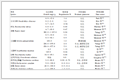
综合考虑到不同时期主导人类活动因素的差异,本文选取了渭河流域1980年、1995年和2010年共3期土地利用数据进行研究,其中,1980年代表人类活动相对较弱的本底阶段,1995年代表在家庭联产承包责任制和生产力发展共同作用的农村经济发展阶段,2010年则主要代表城镇经济发展和生态重建共同作用阶段。该数据来源于中国科学院资源环境科学数据中心(http://www.resdc.cn/),基于覆盖全国5年间隔的1:100000比例尺土地利用现状遥感监测数据,通过矢量数据栅格化生成1km的土地利用数据,精度达到90 %以上[19~21]。本文根据该土地利用数据原分类体系结合渭河流域实际情况,将流域内土地利用类型重分类为6种,分别为耕地、林地、草地、水域、建设用地和未利用土地。地形数据来源于中国科学院地理科学与资源研究所,根据中国科学院地理科学与资源研究所绘制编订的《中国1:1000000地貌图制图规范(试行)》[22]分为山地、丘陵和平原3种地形。根据渭河流域不同区域地形的差异(见表 1)和河流汇演关系,将渭河流域划分为渭河上游段、泾河段、北洛河段和渭河中下游段4个空间区域,其划分结果如图 1b所示。
|
表 1 渭河流域4个空间区域不同地形面积分布情况 Table 1 Distribution of different terrains in the four regions of the Wei River basin |
土地利用动态度是土地利用动态变化幅度的简称,用以计算一定时间范围内不同土地利用类型的时段变化率,可以用来反映区域研究时段内不同土地利用类型总的态势及其结构的变化[23]。计算公式为:

|
其中,LC表示i类土地利用类型从t1到t2阶段土地利用动态度,L(i,t1)和L(i,t2)分别表示t1阶段和t2阶段i类土地利用类型所占面积。
3.2.2 土地利用类型动态变化趋势土地利用类型动态趋势以转出率和转入率的形式来表现,转出率反映在一定时间内该土地利用类型转化为其他土地利用类型的比例,转入率则反映在一定时期内其他土地利用类型转化为该土地利用类型的比例[24]。计算公式分别为:

|
其中,n表示研究区内土地利用类型的种类数量,Louti表示从t1到t2阶段土地利用类型i的转出率,Lini表示从t1到t2阶段土地利用类型i的转入率;Oij表示从t1到t2阶段土地利用类型i转化为土地利用类型j的面积,Iij表示从t1到t2阶段土地利用类型j转化为土地利用类型i的面积;Lit1表示在t1时间段时土地利用类型i的面积,Lit2表示在t2时间段时土地利用类型i的面积。
3.2.3 土地利用转移矩阵土地利用转移矩阵是一种用来定量描述土地利用不同类型之间相互转化关系的方法,结果通常以表格的形式给出,具有明确的行列统计关系。其中不仅包括一定时期内土地利用类型的静态信息,还包括各种土地利用类型在时期初和时期末的动态转换信息,能够更好地显示土地利用类型的转移情况[25]。转移矩阵的数学表达式如下所示:

|
其中,S指的是某土地利用类型的面积或百分比,Sii指的是时间段内该土地利用类型保持不变的面积或百分比,Sij指的是时间段内由i种土地利用类型转化为j种土地利用类型的面积或百分比,n为土地利用类型的种类。
4 研究结果 4.1 渭河流域土地利用变化特征分析 4.1.1 土地利用面积构成及动态变化特征1980年、1995年和2010年3期土地利用面积构成如表 2和图 2a所示。可以看出在研究期内,渭河流域土地利用类型以耕地、林地和草地为主,3个时期三者面积之和占流域总面积比分别为96.85 %、96.71 %和96.34 %,水域、建设用地和未利用土地面积之和占流域总面积比均为3 %左右。
|
|
表 2 1980~2010年渭河流域的土地利用面积构成和动态度特征 Table 2 Area and percentage of land use types and dynamic degree in the Wei River basin in 1980, 1995, and 2010 |

|
图 2 1980~2010年渭河流域及其4个空间区域土地利用类型面积百分比 Fig. 2 Percentage of land use types in the Wei River basin from 1980 to 2010 |
表 3反映了渭河流域不同土地利用类型的动态变化情况。从表 2和表 3可以看出,在1980~2010年期间,耕地的转出率一直大于转入率,其面积呈现出持续减少的趋势,减少1257km2,尤以1995~2010年间变化比较明显;林地在1980~1995年间的转出面积大于转入面积,而在1995~2010年间则相反,30年间总体增长了552km2;草地面积与林地面积变化相似,在1985~2010年间呈现出微弱的增长趋势,增长了16km2;建设用地面积在研究期内呈现出持续增长的趋势。从其变化动态度来看,1995~2010年期间的变化程度平均高于1980~1995年期间的变化程度。
|
|
表 3 渭河流域不同土地利用类型的动态趋势 Table 3 The change index of different land use types in the Wei River basin |
表 4所示的是1980~2010年土地利用转移矩阵,可以看出:1980~1995年期间,耕地主要转化为草地,转化面积为16278km2,林地和建设用地次之;林地主要转化为草地和耕地,转化面积分别为4874km2和2706km2;草地主要转化为耕地和林地,转化面积分别为16057km2和4795km2。1995~2010年不同土地利用类型间的主要转移方向与1980~1995年间相同。总体来说,在1980~1995年和1995~2010年这两个阶段,土地利用转移方向主要为耕地、林地和草地这3种土地利用类型的相互转化,建设用地主要来源于耕地,未利用土地和水域主要转化为耕地和草地。
|
|
表 4 1980~2010年渭河流域土地利用类型转移矩阵(单位:km2) Table 4 Transition matrix of land use types in the Wei River basin from 1980 to 2010(unit: km2) |
研究在不同地形下的土地利用时空变化对了解流域土地利用特征的变化有至关重要的作用[26]。表 5所示的是渭河流域在1980~2010年期间不同地形分区的土地利用面积构成,可以看出:山地区土地利用类型以林地和草地为主,两者面积之和达到70 %以上,丘陵区与平原区均以耕地和草地为主,平原区耕地面积可达50 %以上。研究期内,3种地形区的林地和建设用地面积均呈增长趋势;耕地面积均减小,其中平原区耕地面积减小最为明显,从1980年的31207km2减小到2010年的30196km2,主要转化为林地、草地和建设用地,其中建设用地为主要转入类型;就草地面积来说,山地区和平原区因为耕地面积的转化,其草地面积均呈现出增长的趋势,而丘陵区由于草地面积转化为林地面积而呈现出草地面积减少的趋势。
|
|
表 5 1980~2010年期间渭河流域不同地形区的土地利用面积构成 Table 5 Area and percentage of land use types under different terrains in the Wei River basin in 1980, 1995, and 2010 |
表 6和图 3中所示分别是在1980~2010年期间渭河流域4个区域的土地利用面积构成和土地利用空间格局分布情况。结合表 6、图 2和图 3可以看出,研究期内,渭河上游段、泾河段、北洛河段及渭河中下游段土地利用类型均以耕地、草地和林地为主,从土地利用类型分布来看,4个区域的林地和草地主要分布在各区域的边缘地区,居民建设用地主要集中在河道附近。渭河上游段耕地面积高于草地和林地面积;泾河段耕地面积和草地面积基本持平,明显高于林地面积,耕地主要分布在建设用地周边以及泾河与渭河交界河岸的位置;北洛河段草地面积明显高于耕地和林地面积,耕地主要分布在建设用地周边以及北洛河和渭河交界地段;渭河中下游段耕地面积明显高于草地和林地面积,草地和林地面积基本持平,耕地呈包围建设用地沿河网分布的态势。
|
|
表 6 1980~2010年渭河流域4个区域的土地利用面积构成 Table 6 Area and percentage of land use types in the four regions of the Wei River basin in 1980, 1995, and 2010 |

|
图 3 1980年、1995年和2010年渭河流域土地利用空间格局分布 Fig. 3 Landuses in the Wei River basin in 1980, 1995 and 2010 |
图 4中表示的是渭河流域4个区域的土地利用相对变化量,结合表 6可以看出,1980~2010年期间,4个区域的耕地面积均呈现出减少的趋势,其中渭河中下游减少最为明显,减少498km2;渭河上游段和中下游段林地面积变化均为先增长后减少,泾河段和北洛河段则表现出先减少后增长的趋势。就草地面积变化而言,渭河中下游段变化的最为明显,呈先增长后减少趋势。在这4个区域中,未利用土地因其面积基数较小所以相对变化更为明显。

|
图 4 渭河流域4个区域土地利用相对变化量 (a)渭河上游段(the upper reaches of the Wei River);(b)泾河段(the Jing River subbasin);(c)北洛河段(the North Luo River subbasin);(d)渭河中下游段(the middle and lower reaches of the Wei River) Fig. 4 Landuse changes in the four regions of the Wei River basin |
图 5是渭河流域4个区域不同地形分布的土地利用类型面积统计结果。由表 1和图 5可以看出:渭河上游段地形地貌以丘陵为主,渭河中下游段以山地和平原为主,泾河段和北洛河段均以丘陵和平原为主。渭河上游段丘陵区耕地面积可达50 %以上,其面积在1980~2010年期间呈现出先增长后减少的趋势;泾河段丘陵区和平原区耕地和草地面积所占比重较大,两者之和均在80 %以上,但二者变化趋势略有不同,在研究期内,耕地面积持续减少,而草地面积先减少后增长;北洛河段山地区、丘陵区以及平原区耕地面积均呈现出减少的趋势,林地面积先减少后增长,且增长幅度远远大于减少幅度;渭河中下游段平原区耕地面积可达70 %左右,研究期内建设用地面积持续增长,且其增长的速度加快。

|
图 5 渭河流域4个区域不同地形下的土地利用面积百分比构成 (a)渭河上游段(the upper reaches of the Wei River);(b)泾河段(the Jing River subbasin);(c)北洛河段(the North Luo River subbasin);(d)渭河中下游段(the middle and lower reaches of the Wei River) Fig. 5 Thearea percentage of different land use types in different terrains in the four regions of the Wei River basin |
由表 7可以看出,渭河流域4个区域在1980~1995年和1995~2010年两个时期内的土地利用具有相似的转化趋势,转化幅度略有不同,且均为耕地、林地和草地3种类型之间的转化,主要表现为耕地转化为草地,林地转化为草地和耕地,草地转化为耕地和林地。此外,建设用地主要来源于耕地,其中尤以渭河中下游的建设用地面积增长最为明显,在1980~1995年和1995~2010年耕地转化为建设用地的面积分别为1114km2和1299km2。从转化程度上来看,1995~2010年期间的转化程度平均高于1980~1995年期间的转化程度。
|
|
表 7 1980~2010年渭河流域不同区域土地利用类型转移矩阵(单位:km2) Table 7 Transition matrix of land use types in the four regions from 1980 to 2010 of the Wei River basin(unit: km2) |
土地利用变化是自然、社会和生态系统的复合作用在地球关键带的直接表现,可以反映出一段时间内人类活动以及自然因素变化的强度[27]。影响土地利用变化的主要因素包括自然驱动力和人为驱动力。相对来说,其中,自然驱动力较为稳定,具有累积效应,而人为驱动力则比较活跃,对土地利用变化会产生直接的影响[28]。渭河流域属于大陆性气候,年降水量小于800mm,为干旱半干旱区,且降水分布极不均匀,由图 1b中其降水等值线的分布可以看出流域内降水呈现出由南到北递减和东多西少的规律,研究表明植被覆盖度与降水呈正相关[29]。在研究过程中我们发现,从土地利用分布上看,本区域内降水相对丰富的渭河中下游段具有更多的耕地分布,位于流域东部地区的北洛河段林草面积之和在1980~2010年期间均大于渭河上游段林草面积之和,流域内植被覆盖升高区也主要位于渭河中下游和北洛河段区域。一些极端气象现象也会引发土地利用的变化,渭河上游段在这一时期内出现的几次大的干旱使得山地区一些林木枯死[18],一定范围的林地主要转化为草地,从而使得草地面积增长而林地面积减少。
此外,人为驱动力在研究土地利用变化的时空异质性过程中也起到了非常重要的作用。
渭河上游段和泾河段主要位于甘肃省境内,北洛河段和渭河下游段主要位于陕西境内。1980~1995年期间,国家在农村推行生产承包责任制[13, 30],大部分草地和自然林地被开垦成农田,渭河上游段、泾河段以及北洛河段耕地面积均呈现出增长的趋势,而渭河中下游段主要位于陕西关中一带,其作为陕西经济的核心区,在这一时段内政府鼓励城市发展使得城市建设以及城市规模有了很大的进展,耕地大规模地转化为建设用地,建设用地面积不断地增长[31, 32],尤其以平原区变化明显;1995~2010年期间,随着农村经济体制改革,农产品市场需求趋于多元化,农民的生产生活由原来比较单一的耕地粮食生产开始向农、林、牧多元化转变[13],人口增长、城市化进程的不断加快以及1998年之后国家退耕还林还草政策的实施,均使得流域内耕地面积迅速减少,建设用地面积迅速增长,而林地和草地的变化趋势却有所不同。渭河中下游段由于经济发展和城市化进程的持续加快,建设用地面积持续增长[32],林地和草地面积减少,绝大部分转化为了耕地;退耕还林政策在北洛河的大力推进[14],使得北洛河段山地区、丘陵区以及平原区的林地面积在该阶段均得到了快速的增长,而林地面积的快速增长和20世纪90年代后期大量淤地坝的修建[33]都使得该区域草地面积大大降低,该区域和渭河中下游段草地面积的减少也直接导致了整个渭河流域草地面积的减少。总体来说,在1980~2010年期间,渭河流域土地利用特征总体呈现建设用地增长,耕地大面积转化为林地和草地的趋势。
土地利用具有自然和社会两重属性,其利用方式的改变对自然生态环境和人类活动也会产生一定的影响[34]。整体来看,渭河流域耕地面积减少而林草面积增长,对于不同地形分区而言,在1980~2010年期间,耕地逐渐实现了退耕,并且主要分布在平原区;生态环境更加脆弱的山地区和丘陵区林草面积呈上升趋势,植被覆盖度明显增长,有利于防止脆弱地区的水土流失加剧。由此可见,这30年来渭河流域土地利用格局日趋优化[26],有利于人地关系的和谐发展。
6 结论利用渭河流域1980年、1995年和2010年土地利用数据结合地形数据对渭河流域土地利用变化的时空异质特征进行了分析,主要取得出以下结论:
(1) 渭河流域及4个区域土地利用类型均以耕地、林地和草地为主,其土地利用转移也主要发生于这3种类型之间。整体来说,在研究期内,渭河流域的耕地面积呈减少趋势,草地和林地面积呈增长趋势,建设用地面积持续增长。其中,耕地面积的减少以渭河中下游段最为明显,减少498km2;草地面积在渭河上游段与北洛河段减少,而在中下游段和泾河段有所增长;林地面积在4个区域中均呈增长趋势。
(2) 不同地形分区影响着土地利用分布和转化特征。在研究期内,山地区土地利用类型以林地和草地为主,两者面积之和达到70 %以上,丘陵区和平原区则主要以耕地和草地为主,其中平原区耕地面积可达50 %以上。就转化特征而言,山地区以耕地向林地和草地的转化为主;丘陵区以草地和耕地向林地的转化为主;平原区则主要以耕地向林地、草地和建设用地三者的转化为主,其中建设用地为主要转入类型。
(3) 基于渭河流域1980年、1995年和2010年3期土地利用数据,分别探讨了1980~1995年和1995~2010年两个时期土地利用的时空动态变化特征及其驱动因素。这两个阶段因为驱动力因素的不同其土地利用变化呈现出不同的特征。1980~1995年期间,由于家庭联产承包责任制和生产力发展的共同作用,流域内大部分区域草地和自然林地被开垦成农田,耕地面积呈现出增长的趋势,林草面积有所降低;1995~2010年期间,随着人口增长、城市化进程的不断加快以及1998年之后国家退耕还林还草政策的实施,流域内耕地面积迅速减少,林草面积增加。从其变化动态度来看,1995~2010年期间的变化程度平均高于1980~1995年期间的变化程度。
以本文研究结果为基础,未来的研究拟进一步揭示土地利用时空变化的生态水文响应,以期为流域土地利用的调整和规划以及生态环境可持续发展提供科学指导和理论基础。
致谢 感谢匿名评审专家宝贵意见与建议!
| 1 |
李秀彬. 全球环境变化研究的核心领域--土地利用/土地覆被变化的国际研究动向. 地理学报, 1996, 51(6): 553-558. Li Xiubin. A review of the international researches on land use/land cover change. Acta Geographica Sinica, 1996, 51(6): 553-558. |
| 2 |
彭补拙, 高中贵. 长江三角洲地区土地利用变化及对策研究. 第四纪研究, 2004, 24(5): 506-511. Peng Buzhuo, Gao Zhonggui. The studies on the changes of land use and policy making on the deltaic area of the Changjiang River. Quaternary Sciences, 2004, 24(5): 506-511. |
| 3 |
刘纪远, 布和敖斯尔. 中国土地利用变化现代过程时空特征的研究:基于卫星遥感数据. 第四纪研究, 2000, 20(3): 229-239. Liu Jiyuan, Buheaosier. Study on spatial-temporal feature of modern land-use change in China:Using remote sensing techniques. Quaternary Sciences, 2000, 20(3): 229-239. |
| 4 |
Nosetto M D, Jobbágy E G, Brizuela A B et al. The hydrologic consequences of land cover change in Central Argentina. Agriculture Ecosystems & Environment, 2012, 154(3): 2-11. |
| 5 |
Barnes A D, Jochum M, Mumme S et al. Consequences of tropical land use for multitrophic biodiversity and ecosystem functioning. Nature Communications, 2014, 5(5351): 5351. |
| 6 |
Foley J A, Defries R, Asner G P et al. Global consequences of land use. Science, 2005, 309(5734): 570-574. DOI:10.1126/science.1111772 |
| 7 |
Kirschbaum M U, Saggar S, Tate K R et al. Quantifying the climate-change consequences of shifting land use between forest and agriculture. Science of the Total Environment, 2013, 465(6): 314. |
| 8 |
刘殿伟, 宋开山, 王丹丹等. 近50年来松嫩平原西部土地利用变化及驱动力分析. 地理科学, 2006, 26(3): 277-283. Liu Dianwei, Song Kaishan, Wang Dandan et al. Dynamic change of land-use patterns in west part of Songnen Plain. Scientia Geographica Sinica, 2006, 26(3): 277-283. |
| 9 |
王根绪, 马海燕, 王一博等. 黑河流域中游土地利用变化的环境影响. 冰川冻土, 2003, 25(4): 359-367. Wang Genxu, Ma Haiyan, Wang Yibo et al. Impacts of land use change on environment in the middle reaches of the Heihe River. Journal of Glaciology and Geocryology, 2003, 25(4): 359-367. |
| 10 |
宋开山, 刘殿伟, 王宗明等. 1954年以来三江平原土地利用变化及驱动力. 地理学报, 2008, 63(1): 93-104. Song Kaishan, Liu Dianwei, Wang Zongming et al. Land use change in Sanjiang Plain and its driving forces analysis since 1954. Acta Geographica Sinica, 2008, 63(1): 93-104. DOI:10.11821/xb200801010 |
| 11 |
王飞. 基于土地利用变化的渭河流域产流及生态系统服务价值研究. 杨凌: 西北农林科技大学硕士论文, 2013. 6~9 Wang Fei. The Study of Runoff and Value of Ecosystem Services Based on Landuse Change in Weihe River basin. Yangling:Thesis for Master's Degree Northwest A & F University. 2013. 6~9 http://cdmd.cnki.com.cn/Article/CDMD-10712-1013346071.htm |
| 12 |
黎云云, 畅建霞, 王义民等. 渭河流域径流对土地利用变化的时空响应. 农业工程学报, 2016, 32(15): 232-238. Li Yunyun, Chang Jianxia, Wang Yimin et al. Spatiotemporal responses of runoff to land use change in Wei River basin. Transactions of the Chinese Society of Agricultural Engineering, 2016, 32(15): 232-238. DOI:10.11975/j.issn.1002-6819.2016.15.032 |
| 13 |
程磊, 徐宗学, 罗睿等. 渭河流域1980~2000年LUCC时空变化特征及其驱动力分析. 水土保持研究, 2009, 16(5): 1-6. Cheng Lei, Xu Zongxue, Luo Rui et al. Spatial-temporal characteristics of LUCC and driving factor analysis for the Wei River basin from 1980 to 2000. Research of Soil and Water Conservation, 2009, 16(5): 1-6. |
| 14 |
吴琳娜, 杨胜天, 刘晓燕等. 1976年以来北洛河流域土地利用变化对人类活动程度的响应. 地理学报, 2014, 69(1): 54-63. Wu Linna, Yang Shengtian, Liu Xiaoyan et al. Response analysis of land use change to the degree of human activities in Beiluo River basin since 1976. Acta Geographica Sinica, 2014, 69(1): 54-63. DOI:10.11821/dlxb201401005 |
| 15 |
张希彪. 泾河中上游流域土地利用格局变化与驱动因子分析. 水土保持学报, 2005, 19(6): 137-140. Zhang Xibiao. Land-use/cover change process and driving force analysis in Jinghe River channels. Journal of Soil and Water Conservation, 2005, 19(6): 137-140. |
| 16 |
宋维念, 占车生, 李景玉等. 近30年来渭河关中地区土地利用时空格局的遥感分析. 中国土地科学, 2012, 26(2): 56-61. Song Weinian, Zhan Chesheng, Li Jingyu et al. Remote sensing analysis on the spatial-temporal characteristics of LUCC in the Guangzhong Plain region of the Wei River basin in the past 30 years. China Land Sciences, 2012, 26(2): 56-61. |
| 17 |
黎云云. 渭河流域气候和土地利用变化的水文响应研究. 西安: 西安理工大学硕士论文, 2015. 14~15 Li Yunyun. Study on the Hydrologic Response to Climate and Land Use Change in the Weihe River Basin. Xi'an:The Thesis for Master's Degree Xi'an University of Technology, 2015. 14~15 http://d.g.wanfangdata.com.cn/Thesis_D700249.aspx |
| 18 |
张钰. 渭河流域上游水土资源利用及其对水文过程的影响研究. 兰州: 中国科学院寒区旱区环境与工程研究所博士学位论文, 2005. 49~54 Zhang Yu. Study on the Utilization of Water Resources in the Upper Reaches of the Wei River Basin and Its Influence on Hydrological Processes. Lanzhou:Thesis for Ph.D's Degree of Cold and Arid Regions Environmental and Engineering Research Institute, Chinese Academy of Sciences, 2005. 49~54 http://d.wanfangdata.com.cn/Thesis/Y1630069 |
| 19 |
刘纪远, 匡文慧, 张增祥等. 20世纪80年代末以来中国土地利用变化的基本特征与空间格局. 地理学报, 2014, 69(1): 3-14. Liu Jiyuan, Kuang Wenhui, Zhang Zengxiang et al. Spatiotemporal characteristics, patterns and causes of land use changes in China since the late 1980s. Acta Geographica Sinica, 2014, 69(1): 3-14. DOI:10.11821/dlxb201401001 |
| 20 |
Liu Jiyuan, Liu Mingliang, Zhuang Dafang et al. Study on spatial pattern of land-use change in China during 1995~2000. Science in China (Series D), 2003, 46(4): 373-384. DOI:10.1360/02ye0285 |
| 21 |
刘纪远, 张增祥, 徐新良等. 21世纪初中国土地利用变化的空间格局与驱动力分析. 地理学报, 2009, 64(12): 1411-1420. Liu Jiyuan, Zhang Zengxiang, Xu Xinliang et al. Spatial patterns and driving forces of land use change in China in the early 21st century. Acta Geographica Sinica, 2009, 64(12): 1411-1420. DOI:10.3321/j.issn:0375-5444.2009.12.001 |
| 22 |
中国科学院地理研究所. 中国1:1000000地貌图制图规范(试行). 北京: 科学出版社, 1987, 1-44. Institute of Geography, Chinese Academy of Sciences. 1:1, 000, 000 Geomorphological Mapping Specification(trial). Beijing: Science Press, 1987, 1-44. |
| 23 |
朱会义, 李秀彬. 关于区域土地利用变化指数模型方法的讨论. 地理学报, 2003, 58(5): 643-650. Zhu Huiyi, Li Xiubin. Discussion on the index method of regional land use change. Acta Geographica Sinica, 2003, 58(5): 643-650. DOI:10.11821/xb200305001 |
| 24 |
彭建, 蔡运龙, 何钢等. 喀斯特生态脆弱区猫跳河流域土地利用/覆被变化研究. 山地学报, 2007, 25(5): 566-576. Peng Jian, Cai Yunlong, He Gang et al. Land use/cover change in ecologically fragile karst areas--A case study in Maotiaohe River basin, Guizhou China. Journal of Mountain Science, 2007, 25(5): 566-576. |
| 25 |
刘瑞, 朱道林. 基于转移矩阵的土地利用变化信息挖掘方法探讨. 资源科学, 2010, 32(8): 1544-1550. Liu Rui, Zhu Daolin. Methods for detecting land use changes based on the land use transition matrix. Resources Science, 2010, 32(8): 1544-1550. |
| 26 |
邱扬, 傅伯杰, 王军等. 黄土丘陵小流域土地利用的时空分布及其与地形因子的关系. 自然资源学报, 2003, 18(1): 20-29. Qiu Yang, Fu Bojie, Wang Jun et al. Spatio-temporal distribution of land use in relation to topography in a gully catchment of the Loess Plateau, China. Journal of Natural Resources, 2003, 18(1): 20-29. DOI:10.11849/zrzyxb.2003.01.005 |
| 27 |
尹永飞, 陈星, 张洁等. 中国过去300年土地利用变化及其气候效应. 第四纪研究, 2009, 29(6): 1162-1169. Yin Yongfei, Chen Xing, Zhang Jie et al. Land use change of the past 300 years in China and its climate effects. Quaternary Sciences, 2009, 29(6): 1162-1169. |
| 28 |
倪少祥. 土地利用_覆被变化研究的几个问题. 自然资源学报, 2005, 20(6): 932-937. Ni Shaoxiang. Some issues in the study on land use/cover change. Journal of Natural Resources, 2005, 20(6): 932-937. DOI:10.11849/zrzyxb.2005.06.018 |
| 29 |
孙睿, 刘昌明, 朱启疆. 黄河流域植被覆盖度动态变化与降水的关系. 地理学报, 2001, 56(6): 667-672. Sun Rui, Liu Changming, Zhu Qijiang. Relationship between the factional vegetation cover change and rainfall in the Yellow River basin. Acta Geographica Sinica, 2001, 56(6): 667-672. DOI:10.11821/xb200106005 |
| 30 |
甄霖, 谢高地, 杨丽等. 泾河流域土地利用变化驱动力及其政策的影响. 资源科学, 2005, 27(4): 33-37. Zhen Lin, Xie Gaodi, Yang Li et al. Land-use change dynamics, driving forces and policy implications in Jinghe watershed of Western China. Resources Science, 2005, 27(4): 33-37. |
| 31 |
杨勇, 任志远. 关中地区土地利用综合分区及对策研究. 地理研究, 2010, 29(1): 154-162. Yang Yong, Ren Zhiyuan. Land use regionalization and countermeasures in Guanzhong region. Geographical Research, 2010, 29(1): 154-162. |
| 32 |
郝慧梅, 郝永利, 任志远. 近20年关中地区土地利用/覆盖变化动态与格局. 中国农业科学, 2011, 44(21): 4525-4536. Hao Huimei, Hao Yongli, Ren Zhiyuan. Analysis on dynamic and pattern of land use/cover change in Guangzhong area. Scientia Agricultura Sinica, 2011, 44(21): 4525-4536. |
| 33 |
蒋观滔, 高鹏, 穆兴民等. 退耕还林(草)对北洛河上游水沙变化的影响. 水土保持研究, 2015, 22(6): 1-6. Jiang Guantao, Gao Peng, Mu Xingmin et al. Effect of conversion of farmland to forestland or grassland on the change in runoff and sediment in the upper reaches of Beiluo River. Research of Soil and Water Conservation, 2015, 22(6): 1-6. |
| 34 |
李晓文, 方创琳, 黄金川等. 西北干旱区城市土地利用变化及其区域生态环境效应--以甘肃河西地区为例. 第四纪研究, 2003, 23(3): 280-290. Li Xiaowen, Fang Chuanglin, Huang Jinchuan et al. The urban land use transformations and associated effects on eco-environment in Northwest China arid region:A case study in Hexi region, Gansu Province. Quaternary Sciences, 2003, 23(3): 280-290. |
② State Key Laboratory of Loess and Quaternary Geology, Institute of Earth Environment, Chinese Academy of Sciences, Xi'an 710061)
Abstract
Land use not only reflects the intensity of the human activities and the variability of the natural factors in a certain period but also influences the biodiversity and hydro-biogeochemical cycles in the terrestrial ecosystem. Thus, land use and its change has become one of the hottest topics in the global environment change and the Earth's Critical Zone. The Wei River is the largest tributary of the Yellow River, located in the southeastern part of the Chinese Loess Plateau, and plays an important role in water cycle, water supply, and the sustainable development of the Yellow River basin and the Loess Plateau. Although there are numerous publications on land use change analysis in the Wei River basin for whole basin or its subbasins, few studies reported the connectivity between the land use change and basin terrains. Therefore, the aim of this study is to consider the river reach and basin landform to conduct the historic land use change analysis in the Wei River basin. Land use data (1980-1995, and 2010)of the Wei River basin were obtained from Data Center for Resources and Environmental Sciences, Chinese Academy of Sciences (RESDC) (http://www.resdc.cn), and the topographic data was collected from Institute of Geographic Sciences and Natural Resources Research, Chinese Academy of Sciences. Firstly, based on different terrains and hydrological characteristics in the Wei River basin, we divided the Wei River basin into four regions, including the upper reaches of the Wei River, the Jing River subbasin, the North Luo River subbasin, and the middle and lower reaches of the Wei River. Then spatial-temporal heterogeneity of land use change was investigated through analyzing the land use dynamics degree and land use transition matrix based on the three time periods of land use data. Finally, we tried to analyze the driving forces of land use change in Wei River basin. The results showed that:(1)Farmland, grassland, and woodland were the main land use types in the four regions, and the main land use transition in the different time periods mainly occurred among these three land use types. Generally speaking, farmland exhibited a decreasing trend with a decreased area of 1257km2 in the whole basin during the period of 1980~2010. The woodland and developed land showed an increasing trend with an increase of 552km2 and 16km2, respectively. By investigating the driving forces of land use change in the Wei River basin at different regions and different periods, we found the climate, the terrains, and human activities all played important roles in the land use change processes. (2)The main terrain of the upper reaches of the Wei River is hill (accounted for 52.32% of total area); the middle and lower Reaches of the Wei River is characterized by mountain and plain; the Jing River subbasin and the North Luo River subbasin are mainly located in the plain and mountain areas. We found that the different terrains affected the distribution of land use types:the land use types in the mountain area is dominated by grassland and woodland and the sum of their area percentages was larger than 70%; hills and plains are mainly occupied by farmland and grassland. This study can be a useful guideline for the land use planning and adjustment to maintain the ecological sustainability of the Wei River basin.